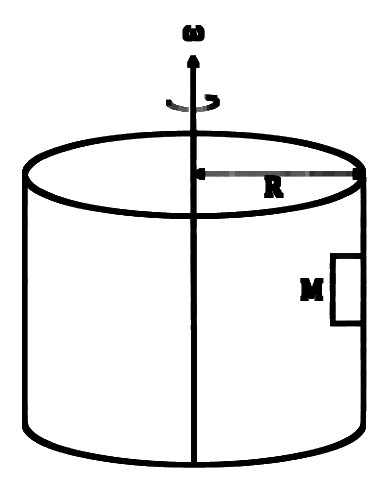
A 0.5 kg mass is in contact against the inner wall of a cylindrical drum of radius 4 m rotating about its vertical axis. The minimum rotational speed of the drum to enable the mass to remain stuck to the wall (without falling) is 5 rad/s. The coefficient of friction between the drum’s inner wall surface and mass is _________. (Take g=10 m/s2)
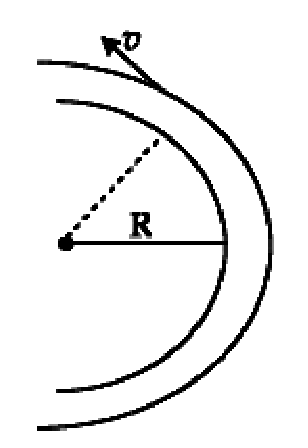
On a dry curved (banked) road, with banking angle of zero, the maximum safe speed for a moving vehicle is 'v'. After heavy rain, the maximum safe speed for the same road was reduced by 60%. The ratio of the coefficient of friction for the dry road to that of the wet road is
A large drum having radius R is spinning around its axis with angular velocity ω, as shown in figure. The minimum value of ω so that a body of mass M remains stuck to the inner wall of the drum, taking the coefficient of friction between the drum surface and mass M as μ, is:
A motor cyclist has to rotate in horizontal circles inside the cylindrical wall of inner radius ' R ' metre. If the coefficient of friction between the wall and the tyres is ' μs ', then the minimum speed required is ( g= acceleration due to gravity)
A coin is placed on a disc. The coefficient of friction between the coin and the disc is μ. If the distance of the coin from the center of the disc is r, the maximum angular velocity which can be given to the disc, so that the coin does not slip away, is:
On dry road, the maximum speed of a vehicle along a circular path is 'V'. When the road becomes wet, maximum speed becomes 2V. If coefficient of friction of dry road is 'μ' then that of wet road is
A car is moving on a horizontal curved road with radius 50 m. The approximate maximum speed of car will be, if the coefficient of friction between tyres and road is 0.34. [take g = 10 ms −2]
A coin placed on a rotating table just slips when it is placed at a distance of 1 cm from the center. If the angular velocity of the table is halved, it will just slip when placed at a distance of _________ from the centre:
A disc with a flat small bottom beaker placed on it at a distance R from its center is revolving about an axis passing through the center and perpendicular to its plane with an angular velocity ω. The coefficient of static friction between the bottom of the beaker and the surface of the disc is μ. The beaker will revolve with the disc if:
A curve in a level road has a radius 75 m. The maximum speed of a car turning this curved road can be 30 m/s without skidding. If radius of curved road is changed to 48 m and the coefficient of friction between the tyres and the road remains same, then maximum allowed speed would be ___________ m/s.
Numerical answer type. Work it out, then open the answer.
Statement I: A cyclist is moving on an unbanked road with a speed of 7 kmh−1 and takes a sharp circular turn along a path of radius of 2m without reducing the speed. The static friction coefficient is 0.2. The cyclist will not slip and pass the curve. (g = 9.8 m/s2)
Statement II: If the road is banked at an angle of 45∘, cyclist can cross the curve of 2m radius with the speed of 18.5 kmh−1 without slipping.
In the light of the above statements, choose the correct answer from the options given below.
A modern grand - prix racing car of mass m is travelling on a flat track in a circular arc of radius R with a speed v. If the coefficient of static friction between the tyres and the track is μs, then the magnitude of negative lift FL acting downwards on the car is: (Assume forces on the four tyres are identical and g = acceleration due to gravity)
A disc rotates about its axis of symmetry in a horizontal plane at a steady rate of 3.5 revolutions per second. A coin placed at a distance of 1.25 cm from the axis of rotation remains at rest on the disc. The coefficient of friction between the coin and the disc is: (g = 10 m/s2)
Concrete mixture is made by mixing cement, stone and sand in a rotating cylindrical drum. If the drum rotates too fast, the ingredients remain stuck to the wall of the drum and proper mixing of ingredients does not take place. The maximum rotational speed of the drum in revolutions per minute(rpm) to ensure proper mixing is close to:
(Take the radius of the drum to be 1.25 m and its axle to be horizontal):
The maximum velocity (in m s−1) with which a car driver must traverse a flat curve of radius 150 m and coefficient of friction 0.6 to avoid skidding is
A bicycle racing track is a level circular road of radius 10m. Three cyclists P, Q and R with identical cycles are cycling on the track with speeds 2m s−1, 3m s−1 and 5m s−1 respectively. If the coefficient of friction between the tyres and the road is 0.1, then which cyclist will slip? (Take g=10m s−2)
A coin is placed on a disc rotating with an angular velocity ω. The co-efficient of friction between the disc and the coin is μ. The maximum distance of the coin from the centre of the disc up to which it will rotate with the disc is
A car is moving in a circular horizontal track of radius 10m with a constant speed of 10m s−1. A bob is suspended from the roof of the car by a light wire of length 1.0m. The angle made by the wire with the vertical is (in rad)
A coin placed on a rotating turn table just slips if it is placed at a distance of 4cm from the centre. If the angular velocity of the turn table is doubled, it will just slip at a distance of
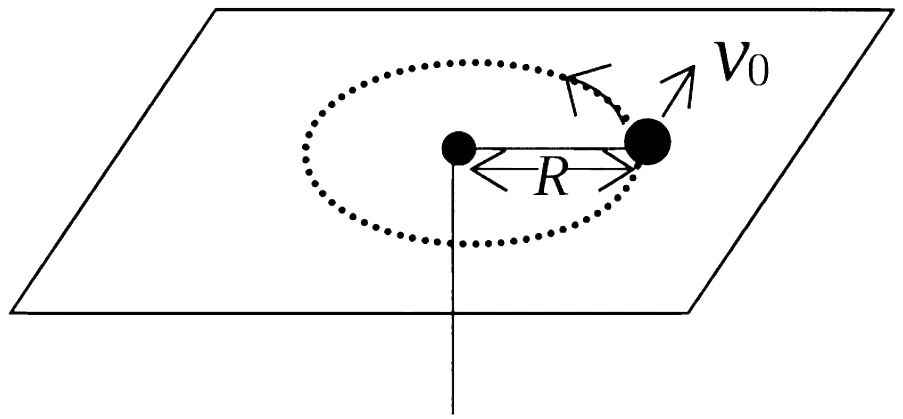
On imparting an initial velocity v0 a ball begins to move in horizontal circle of radius R on horizontal plane. If the coefficient of friction between the ball and plane is μ. Then the time required by ball to come to rest
A stone of mass 400g tied to one end of a string is rotated in a horizontal circle of radius 125m. If the string can withstand a maximum tension of 50π2N, then the minimum time period with which the stone can be rotated is
If a stone of mass 0.5kg tied to one end of a wire is whirled in a circular path of radius 2m with a speed 40rev/min in a horizontal plane, then the tension in the wire is nearly
A wire of length 2.5m is fixed at one end and a box of mass 4kg is tied at the other end. If the wire rotates in a horizontal circle about the fixed end with π2 rotations per second, then the tension in the wire is
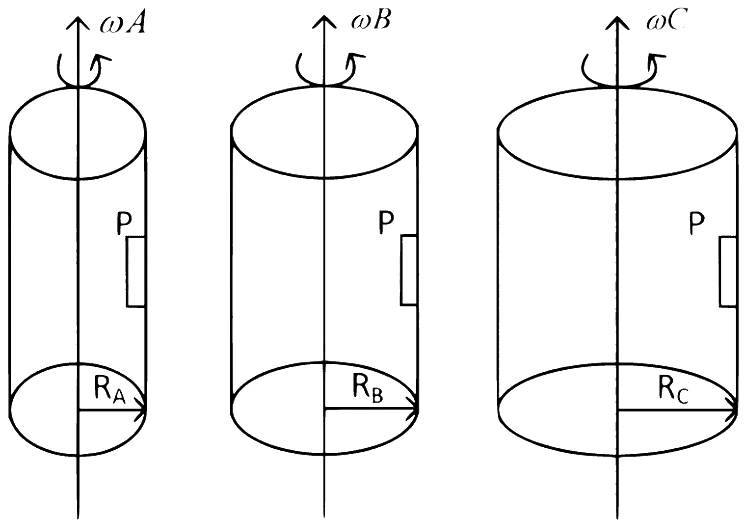
A block P is rotating in contact with the vertical wall of a rotor as shown in figures A,B,C. The relation between angular velocities ωA,ωB and ωC, so that block does not slide down. (RA<RB<RC radii)
A car is moving along a circular path having coefficient of friction 0.5 and radius of curvature 16.2m. Then, the maximum velocity of the car that can travel without falling outwards is (Acceleration due to gravity =10m s−2)
A body of mass 10kg is attached to a wire of 0.3m length. The breaking stress is 4.8×10⁷N m−2. The area of cross-section of the wire is 10−6m2. The maximum angular velocity with which it can be rotated in a horizontal circle is
A motor cyclist wants to drive in horizontal circles on the vertical inner surface of a large cylindrical wooden well of radius 8.0m, with minimum speed of 55m s−1. The minimum value of coefficient of friction between the tyres and the wall of the well must be (g=10m s−2)
A 20 ton truck is travelling along a curved path of radius 240m. If the centre of gravity of the truck above the ground is 2m and the distance between its wheels is 1.5m, the maximum speed of the truck with which it can travel without toppling over is (Acceleration due to gravity =10m s−2)
The coefficient of static friction between a small block and the surface of a horizontal turntable is 0.09. The block is placed at a distance of 0.1m from the centre of the turntable. At time t=0s the turntable starts rotating from rest with a constant angular acceleration of 0.5rad s−2. The time at which the block starts sliding is ts. Select the correct statement(s).
More than one option can be correct. Tap every correct option, then tap Check.