0 of 16 attemptedPick an answer to see the solution
Q1MHT CET 2026 · 14 MAY · SHIFT 2Medium
Gravitational Field · Field of sphere, shell & other bodies
The magnitude of gravitational field at distances r1 and r2 from the centre of a uniform sphere of radius R and mass M are I1 and I2 respectively. Given that r1>R and r2<R, the ratio I2I1 is
Gravitational Field · Field of sphere, shell & other bodies
The magnitude of gravitational field at distance r1 and r2 from the centre of a uniform sphere of radius R and mass M are E1 and E2 respectively. If r1>R and r2<R, then the ratio E1/E2 is
Gravitational Field · Field of sphere, shell & other bodies
A uniform sphere has radius ' R ' and mass ' M '. The magnitude of gravitational field at distances ' r1 ' and ' r2 ' from the centre of the sphere are ' E1 ' and ' E2 ' respectively. The ratio E1:E2 is (r1>R and r2<R)
Gravitational Field · Field of sphere, shell & other bodies
A uniform solid sphere of mass ' m ' and radius ' r ' is surrounded by a uniform thin spherical shell of radius ' 2r ' and mass ' m ' then the gravitational field
Gravitational Field · Field of sphere, shell & other bodies
The magnitude of gravitational field at distance ' r1 ' and ' r2 ' from the centre of a uniform sphere of radius ' R ' and mass ' M ' are ' F1 ' and ' F2 ' respectively. The ratio ' (F1/F2) ' will be (if r1>R and r2<R)
Gravitational Field · Field intensity & null point
A body of mass 60 g experiences a gravitational force of 3.0 N, when placed at a particular point. The magnitude of the gravitational field intensity at that point is
Gravitational Field · Field intensity & null point
The mass of earth is 81 times the mass of the moon and the distance between their centres is R. The distance from the centre of the earth, where gravitational force will be zero is
Gravitational Field · Field of sphere, shell & other bodies
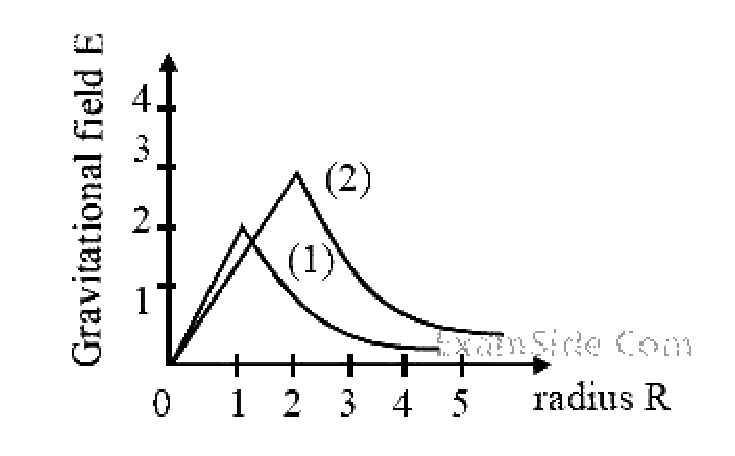
Consider two solid spheres of radii R1 = 1m, R2 = 2m and masses M1 and M2, respectively. The gravitational field due to sphere (1) and (2) are shown. The value of M2M1 is:
Gravitational Field · Field of sphere, shell & other bodies
A solid sphere of mass 'M' and radius 'a' is surrounded by a uniform concentric spherical shell of thickness 2a and mass 2M. The gravitational field at distance '3a' from the centre will be:
Gravitational Field · Field of sphere, shell & other bodies
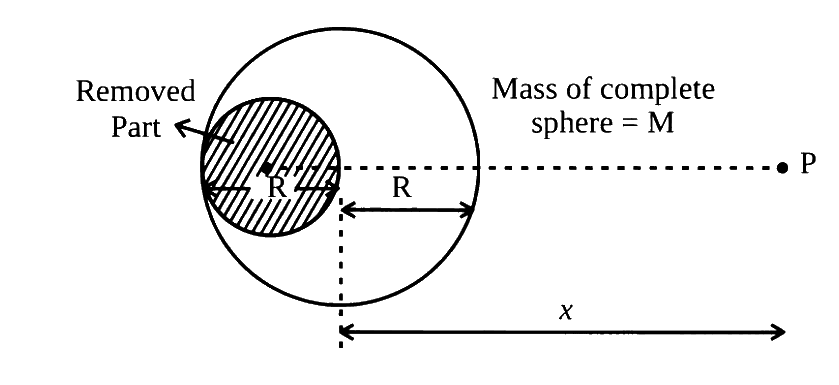
The gravitational field, due to the 'left over part' of a uniform sphere (from which a part as shown, has been 'removed out'), at a very far off point, P, located as shown, would be (nearly):
Gravitational Field · Field of sphere, shell & other bodies
Which one of the following plots represents the variation of gravitiational field on a particle with distance r due to a thin spherical shell of radius R? (r is measured from the centre of the spherical shell)
Gravitational Field · Field intensity & null point
This question contains Statement - 1 and Statement - 2. of the four choices given after the statements, choose the one that best describes the two statements.
Statement - 1:
For a mass M kept at the center of a cube of side ′a′, the flux of gravitational field passing through its sides 4πGM.
Statement - 2:
If the direction of a field due to a point source is radial and its dependence on the distance ′r′ from the source is given as r21, its flux through a closed surface depends only on the strength of the source enclosed by the surface and not on the size or shape of the surface.