
Kepler's Laws & Planetary Motion · Law of periods
In a solar system, the time-period of revolution of a planet tracing a circular orbit of radius is proportional to:
Show answer and solution
Answer: (c)
Loading the solution…
Home›Practice Hub›Chapters›Gravitation›Kepler's Laws & Planetary Motion
Gravitation PYQs · MHT CET · JEE Main · NEET
Kepler's Laws & Planetary Motion · Law of periods
In a solar system, the time-period of revolution of a planet tracing a circular orbit of radius is proportional to:
Answer: (c)
Kepler's Laws & Planetary Motion · Law of periods
A planet () is moving around the star of mass in the orbit of radius . Another planet () is moving around another star of mass in a orbit of radius . Ratio of time periods of revolution of and is ________.
Answer: (b)
Kepler's Laws & Planetary Motion · Law of orbits & law of areas
Given below are two statements: one is labelled as Assertion (A) and the other is labelled as Reason (R).
Assertion (A): The radius vector from the Sun to a planet sweeps out equal areas in equal intervals of time and thus areal velocity of planet is constant.
Reason (R): For a central force field the angular momentum is a constant.
In the light of the above statements, choose the most appropriate answer from the options given below:
Answer: (c)
Kepler's Laws & Planetary Motion · Law of periods
The radius of Martian orbit around the Sun is about 4 times the radius of the orbit of Mercury. The Martian year is 687 Earth days. Then which of the following is the length of 1 year on Mercury?
Answer: (c)
Kepler's Laws & Planetary Motion · Law of periods
The period of a planet around the sun is 8 times that of earth. The ratio of radius of planet's orbit to the radius of the earth's orbit is
Answer: (a)
Kepler's Laws & Planetary Motion · Law of periods
A planet takes 200 days to complete one revolution around the Sun. If the distance of the planet from Sun is reduced to one fourth of the original distance, how many days will it take to complete one revolution:
Answer: (d)
Kepler's Laws & Planetary Motion · Law of periods
Given below are two statements: one is labelled as Assertion (A) and the other is labelled as Reason (R).
Assertion (A): The angular speed of the moon in its orbit about the earth is more than the angular speed of the earth in its orbit about the sun.
Reason (R): The moon takes less time to move around the earth than the time taken by the earth to move around the sun.
In the light of the above statements, choose the most appropriate answer from the options given below:
Answer: (c)
Kepler's Laws & Planetary Motion · Law of orbits & law of areas
Choose the incorrect statement from the following:
Answer: (a)
Kepler's Laws & Planetary Motion · Law of orbits & law of areas
Every planet revolves around the sun in an elliptical orbit :-
A. The force acting on a planet is inversely proportional to square of distance from sun. B. Force acting on planet is inversely proportional to product of the masses of the planet and the sun.
C. The Centripetal force acting on the planet is directed away from the sun.
D. The square of time period of revolution of planet around sun is directly proportional to cube of semi-major axis of elliptical orbit.
Choose the correct answer from the options given below:
Answer: (c)
Kepler's Laws & Planetary Motion · Law of periods
If the distance of the earth from Sun is 1.5 10 km. Then the distance of an imaginary planet from Sun, if its period of revolution is 2.83 years is:
Answer: (d)
Kepler's Laws & Planetary Motion · Law of periods
Two planets A and B of equal mass are having their period of revolutions TA and TB such that TA = 2TB. These planets are revolving in the circular orbits of radii rA and rB respectively. Which out of the following would be the correct relationship of their orbits?
Answer: (c)
Kepler's Laws & Planetary Motion · Law of periods
The distance between Sun and Earth is R. The duration of year if the distance between Sun and Earth becomes 3R will be:
Answer: (d)
Kepler's Laws & Planetary Motion · Solar-system estimates
The distance of the Sun from earth is 1.5 1011 m and its angular diameter is (2000)″ when observed from the earth. The diameter of the Sun will be:
Answer: (c)
Kepler's Laws & Planetary Motion · Law of periods
The time period of X planet of our solar system is years. The distance of earth from the sun is . The distance of the X planet from the sun will be:
Answer: (c)
Kepler's Laws & Planetary Motion · Law of orbits & law of areas
The angular momentum of a planet of mass M moving around the sun in an elliptical orbit is . The magnitude of the areal velocity of the planet is:
Answer: (b)
Kepler's Laws & Planetary Motion · Law of orbits & law of areas
A planet revolving in elliptical orbit has:
A. a constant velocity of revolution.
B. has the least velocity when it is nearest to the sun.
C. its areal velocity is directly proportional to its velocity.
D. areal velocity is inversely proportional to its velocity.
E. to follow a trajectory such that the areal velocity is constant.
Choose the correct answer from the options given below:
Answer: (b)
Kepler's Laws & Planetary Motion · Law of periods
The period of revolution of planet around the sun is 8 times that of planet . How many times the distance of A from the sun is greater than that of B from the sun?
Answer: (c)
Kepler's Laws & Planetary Motion · Perigee & apogee: speeds & energies
The maximum and minimum distances of a comet from the Sun are 1.6 1012 m and 8.0 1010 m respectively. If the speed of the comet at the nearest point is 6 104 ms, the speed at the farthest point is:
Answer: (a)
Kepler's Laws & Planetary Motion · Perigee & apogee: speeds & energies
The minimum and maximum distances of a planet revolving around the sun are x1 and x2. If the minimum speed of the planet on its trajectory is v0 then its maximum speed will be:
Answer: (d)
Kepler's Laws & Planetary Motion · Perigee & apogee: speeds & energies
A satellite is in an elliptical orbit around a planet P. It is observed that the velocity of the satellite when it is farthest from the planet is 6 times less than that when it is closest to the planet. The ratio of distances between the satellite and the planet at closest and farthest points is:
Answer: (c)
Kepler's Laws & Planetary Motion · Solar-system estimates
The radius of the earth and the radius of orbit around the sun are 6371 km and respectively. The order of magnitude of the diameter of the orbit is greater than that of earth by
Answer: (c)
Kepler's Laws & Planetary Motion · Perigee & apogee: speeds & energies
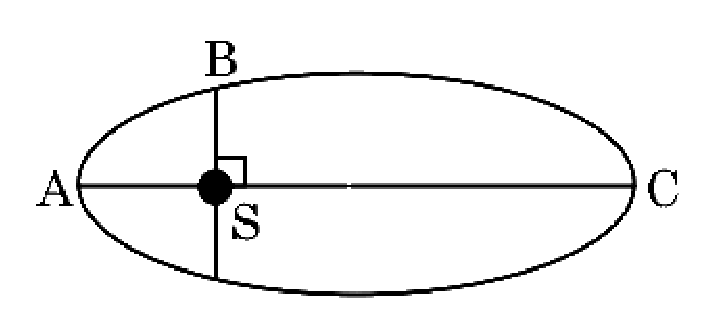
The kinetic energies of a planet in an elliptical orbit about the Sun, at positions A, B and C are KA, KB and KC, respectively. AC is the major axis and SB is perpendicular to AC at the position of the Sun S as shown in the figure. Then
Answer: (b)
Kepler's Laws & Planetary Motion · Law of orbits & law of areas
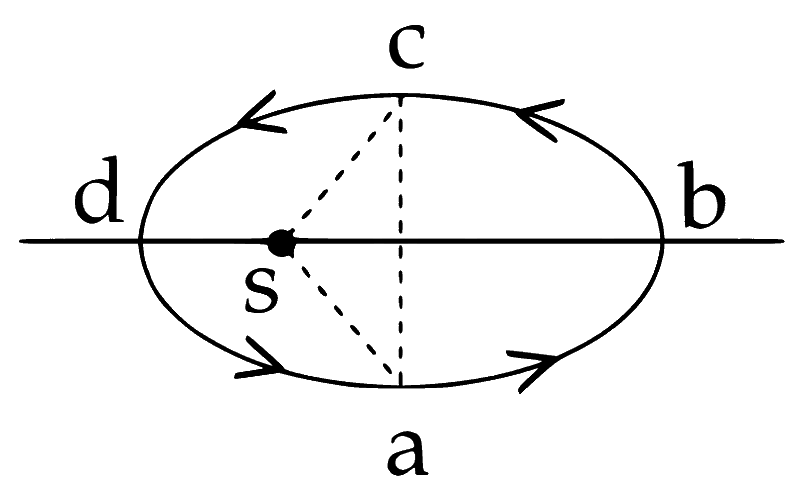
Figure shows elliptical path abcd of a planet around the sun S such that the area of triangle csa is the area of the ellipse. (See figure) With db as the semimajor axis, and ca as the semiminor axis. If t1 is the time taken for planet to go over path abc and t2 for path taken over cda then:
Answer: (c)
Kepler's Laws & Planetary Motion · Law of periods
Kepler's third law states that square of period of revoluation (T) of a planet around the sun, is proportional to third power of average distance r between sun and planet i.e. T2 = Kr3 here K is constant. If the masses of sun and planet are M and m respectively then as per Newton's law of gravitation force of attraction between them is F = , here G is gravitational constant. The relation between G and K is described as
Answer: (d)
Kepler's Laws & Planetary Motion · Perigee & apogee: speeds & energies
A satellite S is moving in an elliptical orbit around the earth. The mass of the satellite is very small compared to the mass of the earth. Then,
Answer: (b)
Kepler's Laws & Planetary Motion · Law of periods
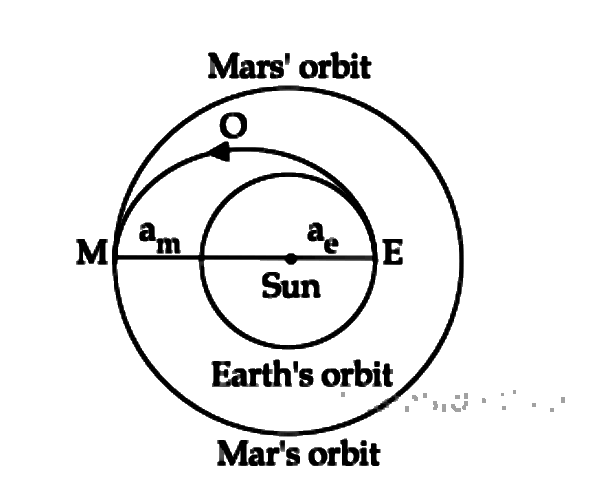
India's Mangalyan was sent to the Mars by launching it into a transfer orbit EOM around the sun. It leaves the earth at E and meets Mars at M. If the semi-major axis of earth's orbit is ae = 1.5 1011 m, that of Mars' orbit am = 2.28 1011 m, then Kepler's laws give the estimate of time for Mangalyan to reach Mars from Earth to be close to:
Answer: (c)
Kepler's Laws & Planetary Motion · Perigee & apogee: speeds & energies
A planet moving along an elliptical orbit is closest to the sun at a distance r1 and farthest away at a distance of r2. If 1 and 2 are the linear velocities at these points respectively, then the ratio is
Answer: (b)
Kepler's Laws & Planetary Motion · Law of orbits & law of areas
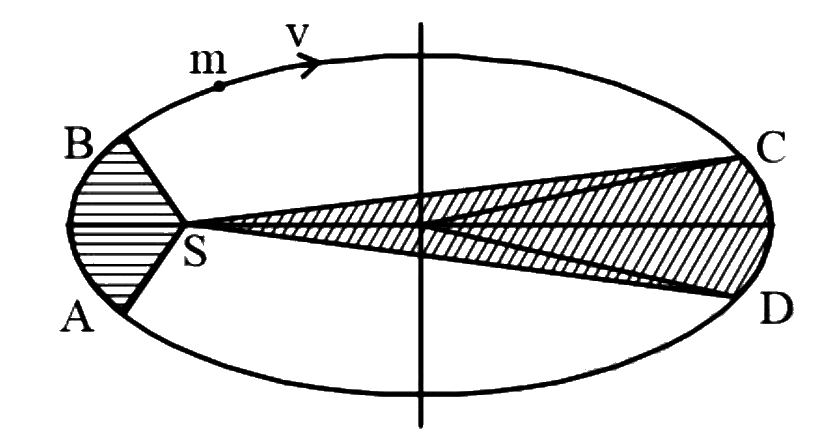
The figure shows elliptical orbit of a planet m about the sun S. The shaded area SCD is twice the shaded area SAB. If t1 is the time for the planet to move from C to D and t2 is the time to move from A to B then
Answer: (b)
Kepler's Laws & Planetary Motion · Law of periods
The period of revolution of planet around the sun is 8 times that of . The distance of from the sun is how many times greater than that of from the sun?
Answer: (a)
Kepler's Laws & Planetary Motion · Law of orbits & law of areas
The earth (mass ) revolves around the sun with an angular velocity of in a circular orbit of radius . The force exerted by the sun on the earth, in newton, is
Answer: (a)
Kepler's Laws & Planetary Motion · Law of periods
The distance of two planets from the sun are and respectively. The ratio of time periods of the planets is
Answer: (b)
Kepler's Laws & Planetary Motion · Perigee & apogee: speeds & energies
A planet is moving in an elliptical orbit around the sun. If , , and stand respectively for its kinetic energy, gravitational potential energy, total energy and magnitude of angular momentum about the centre of force, which of the following is correct?
Answer: (c)
Kepler's Laws & Planetary Motion · Law of periods
The distance of two planets from the sun are and respectively. The ratio of time periods of the planets is
Answer: (b)
Kepler's Laws & Planetary Motion · Perigee & apogee: speeds & energies
The largest and the shortest distance of the earth from the sun are and . Its distance from the sun when it is at perpendicular to the major-axis of the orbit drawn from the sun is
Answer: (c)
No questions match these filters.