A body of mass m is taken from earth surface to a height h equal to twice the radius of earth, the increase in potential energy will be (g = acceleration due to gravity on earth's surface) (R - radius of earth)
A body of mass m is taken from the surface of earth to a height equal to twice the radius of earth (Re). The increase in potential energy will be ______.
( g is acceleration due to gravity at the surface of earth)
Two particles of masses m and M are placed a distance d apart. The gravitational potential at the position where the gravitational field due to them is zero is V. Then
Three masses 200 kg,300 kg and 400 kg are placed at the vertices of an equilateral triangle with sides 20 m. They are rearranged on the vertices of a bigger triangle of side 25 m and with the same centre. The work done in this process ______ J. (Gravitational constant G=6.7×10⁻¹¹ N m2/kg2)
The magnitude of gravitational potential energy of a body at a distance ' R ' from the centre of the earth is ' E '. Its weight at a distance ' 1.5 R ' from the centre of the earth is
The gravitational potential at a point above the surface of earth is −5.12×10⁷ J/kg and the acceleration due to gravity at that point is 6.4 m/s2. Assume that the mean radius of earth to be 6400 km. The height of this point above the earth's surface is:
Two bodies of mass m and 9m are placed at a distance R. The gravitational potential on the line joining the bodies where the gravitational field equals zero, will be (G= gravitational constant):
If the gravitational field in the space is given as (−r2K). Taking the reference point to be at r=2 cm with gravitational potential V=10 J/kg. Find the gravitational potential at r=3 cm in SI unit (Given, that K=6 J cm/kg)
A body of mass 'm' is raised through a height above the earth's surface so that the increase in potential energy is 5mgR. The height to which the body is raised is ( R= radius of earth, g= acceleration due to gravity)
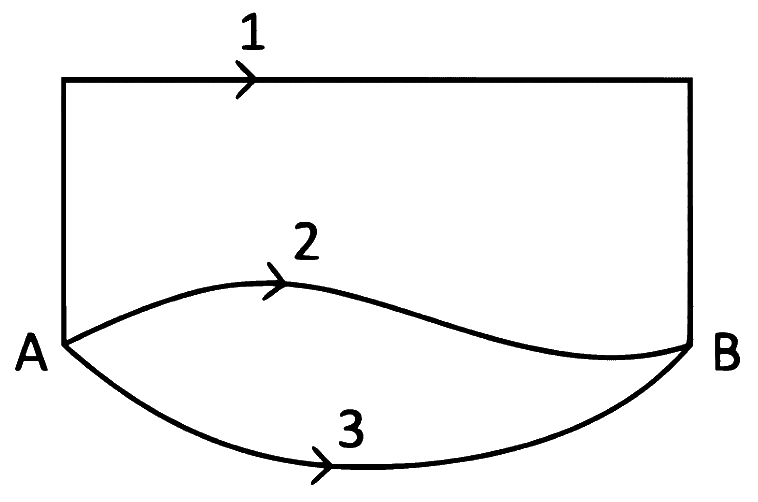
A gravitational field is present in a region and a mass is shifted from A to B through different paths as shown. If W1, W2 and W3 represent the work done by the gravitational force along the respective paths, then:
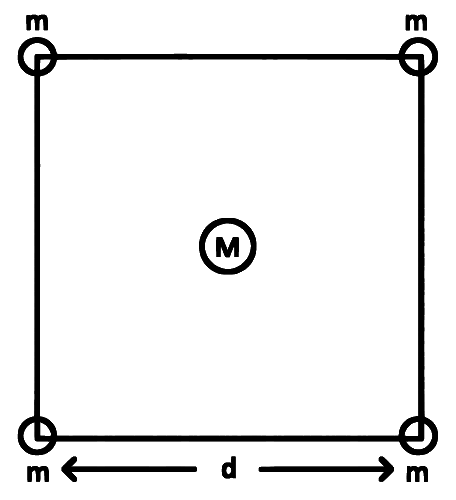
Four spheres each of mass m from a square of side d (as shown in figure). A fifth sphere of mass M is situated at the centre of square. The total gravitational potential energy of the system is:
An object of mass 1 kg is taken to a height from the surface of earth which is equal to three times the radius of earth. The gain in potential energy of the object will be [If, g=10 m s−2 and radius of earth =6400 km ]
Water falls from a 40 m high dam at the rate of 9 × 10⁴ kg per hour. Fifty percentage of gravitational potential energy can be converted into electrical energy. Using this hydroelectric energy number of 100 W lamps, that can be lit, is:
A mass of 50 kg is placed at the centre of a uniform spherical shell of mass 100 kg and radius 50 m. If the gravitational potential at a point, 25 m from the centre is V kg/m. The value of V is:
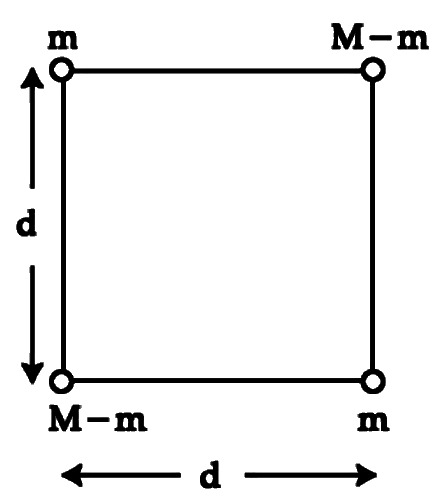
A body of mass (2M) splits into four masses (m, M − m, m, M − m}, which are rearranged to form a square as shown in the figure. The ratio of mM for which, the gravitational potential energy of the system becomes maximum is x: 1. The value of x is .............
Numerical answer type. Work it out, then open the answer.
If one wants to remove all the mass of the earth to infinity in order to break it up completely. The amount of energy that needs to be supplied will be 5xRGM2 where x is __________ (Round off to the Nearest Integer) (M is the mass of earth, R is the radius of earth, G is the gravitational constant)
Numerical answer type. Work it out, then open the answer.
On the x-axis and at a distance x from the origin, the gravitational field due a mass distribution is given by (x2+a2)3/2Ax in the x-direction. The magnitude of gravitational potential on the x-axis at a distance x, taking its value to be zero at infinity, is:
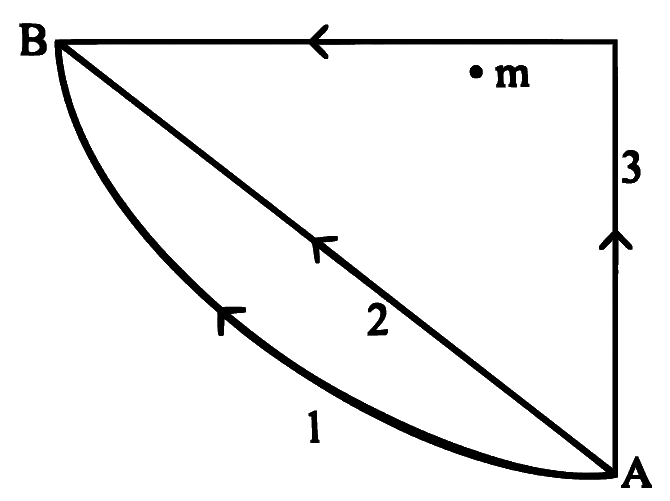
If W1,W2 and W3 represent the work done in moving a particle from A to B along three different paths 1,2 and 3 (as shown in fig) in the gravitational field of the point mass ' m '. Find the correct relation between ' W1 ', ' W2 ' and ' W3 '
Assuming that the gravitational potential energy of an object at infinity is zero, the change in potential energy (final − initial) of an object of mass m, when taken to a height h from the surface of earth (of radius R), is given by,
At what height from the surface of earth the gravitation potential and the value of g are −5.4 × 10⁷ J kg−1 and 6.0 m s−2 respectively? Take the radius of earth as 6400 km.
Which of the following most closely depicts the correct variation of the gravitation potential V(r) due to a large planet of radius R and uniform mass density? (figuresarenotdrawntoscale)
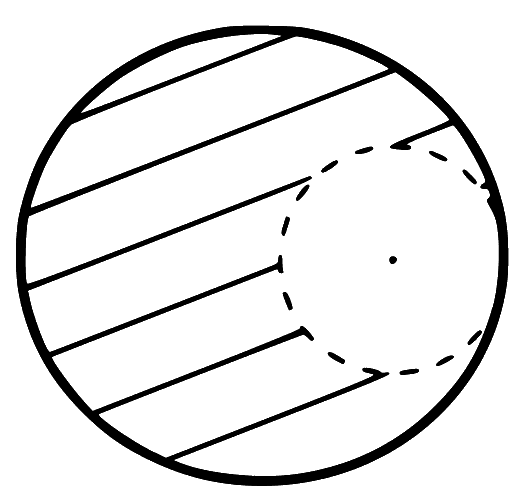
From a solid sphere of mass M and radius R, a spherical portion of radius R/2 is removed, as shown in the figure. Taking gravitational potential V=0 at r=∞, the potential at the center of the cavity thus formed is:
The gravitational field in a region is given byg=5 N/kgi^+12 N/kgj^. The change in the gravitational potential energy of a particle of mass 1 kg when it is taken from the origin to a point (7m, − 3m) is:
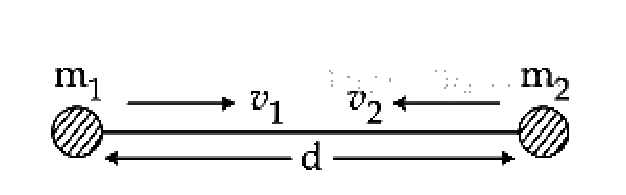
Two hypothetical planets of masses m1 and m2 are at rest when they are infinite distance apart. Because of the gravitational force they move towards each other along the line joining their centres. What is their speed when their separation is 'd'?
A body of mass 'm' is taken from the earth's surface to the height equal to twice the radius (R) of the earth. The change in potential energy of body will be
Infinite number of bodies, each of mass 2 kg are situated on x-axis at distance 1 m, 2 m, 4 m, 8 m,..., respectively, from the origin. The resulting gravitational potential due to this system at the origin will be
The gravitational field in a region is given by: E=(5 N/kg)i^+(12 N/kg)j^. If the potential at the origin is taken to be zero, then the ratio of the potential at the points (12 m, 0) and (0, 5 m) is:
A particle of mass M is situated at the centre of a spherical shell of same mass and radius a. The magnitude of the gravitational potential at a point situated at a/2 distance from the centre, will be:
Two bodies of masses m and 4m are placed at a distance r. The gravitational potential at a point on the line joining them where the gravitational field is zero is:
A particle of mass M is situated at the centre of a spherical shell of same mass and radius a. The magnitude of the gravitational potential at a point sutuated at a/2 distance from the centre, will be:
A particle of mass 10 g is kept on the surface of a uniform sphere of mass 100 kg and radius 10 cm. Find the work to be done against the gravitational force between them to take the particle far away from the sphere (you may take G=6.67×10⁻¹¹ N m2/kg2)
If g is the acceleration due to gravity on the earth's surface, the gain in the potential energy of an object of mass m raised from the surface of the earth to a height equal to the radius R of the earth is
A body of mass m is placed on earth's surface which is taken from earth surface to a height of h = 3R, then change in gravitational potential energy is