A box of mass 15 kg is kept on the floor of a stationary trolley. The coefficient of static friction between the box and the trolley is 0.12. Keeping the box in stationary state over the trolley, the maximum acceleration with which the trolley can be moved horizontally in ms−2 is: (g=10 m/s2)
A block of mass 1 kg is kept on ice surface. When velocity of 4 m/s is given to it, it stops by friction in 5 second. The coefficient of friction is (acceleration due to gravity, g=10 m/s2)
A heavy box of mass 50 kg is moving on a horizontal surface. If co-efficient of kinetic friction between the box and horizontal surface is 0.3 then force of kinetic friction is:
A wooden block, initially at rest on the ground, is pushed by a force which increases linearly with time t. Which of the following curve best describes acceleration of the block with time:
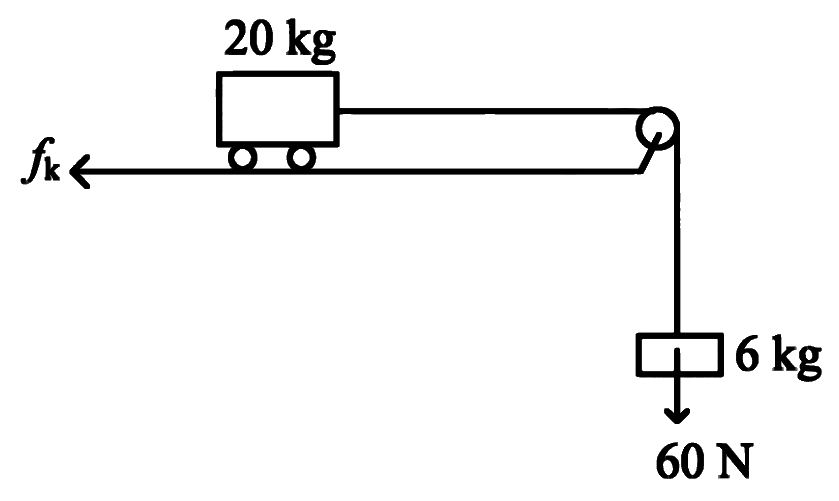
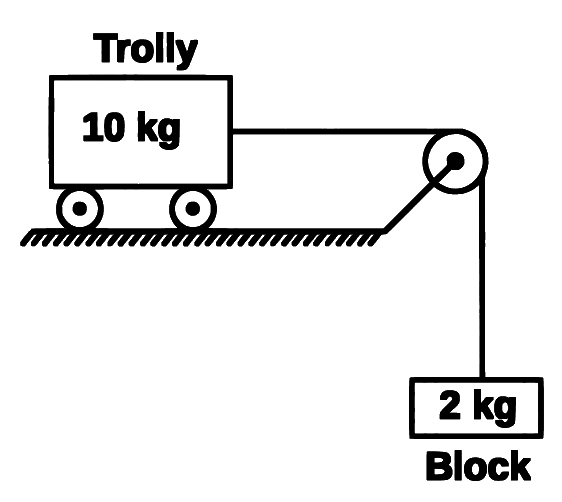
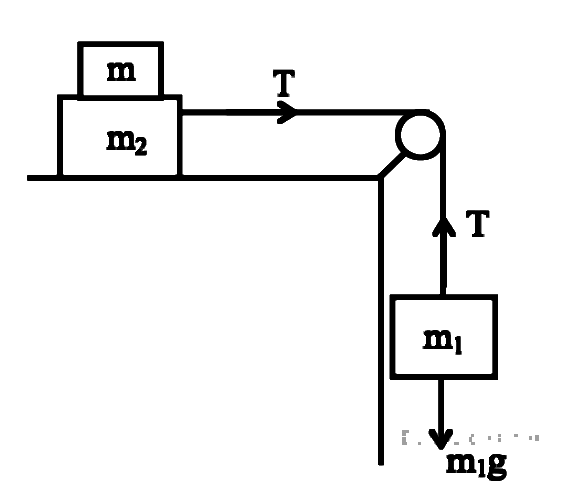
Consider a block and trolley system as shown in figure. If the coefficient of kinetic friction between the trolley and the surface is 0.04, the acceleration of the system in ms−2 is:
(Consider that the string is massless and unstretchable and the pulley is also massless and frictionless):
Calculate the maximum acceleration of a moving car so that a body lying on the floor of the car remains stationary. The coefficient of static friction between the body and the floor is 0.15 (g=10 m s−2).
A body of mass 10 kg is moving with an initial speed of 20 m/s. The body stops after 5 s due to friction between body and the floor. The value of the coefficient of friction is:
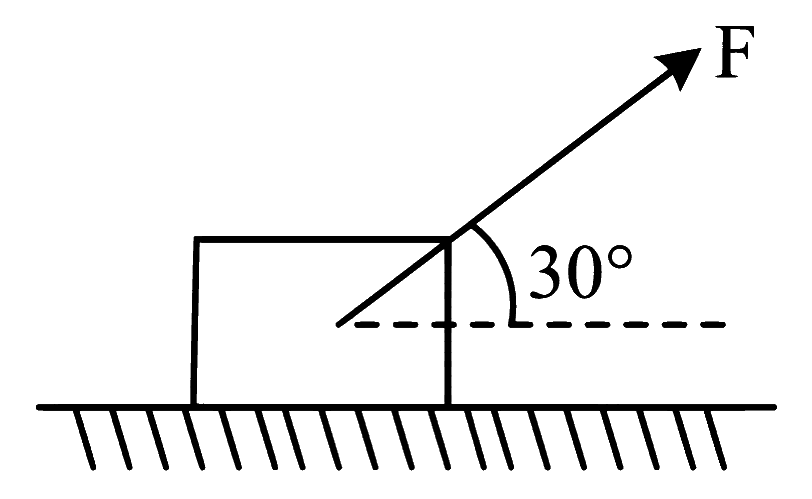
As shown in the figure a block of mass 10 kg lying on a horizontal surface is pulled by a force F acting at an angle 30∘, with horizontal. For μs=0.25, the block will just start to move for the value of F: [Given g=10 ms−2 ]
A block of mass 5 kg is placed at rest on a table of rough surface. Now, if a force of 30 N is applied in the direction parallel to surface of the table, the block slides through a distance of 50 m in an interval of time 10 s. Coefficient of kinetic friction is (given, g=10 ms−2):
A block of mass 10 kg starts sliding on a surface with an initial velocity of 9.8 ms−1. The coefficient of friction between the surface and block is 0.5. The distance covered by the block before coming to rest is:
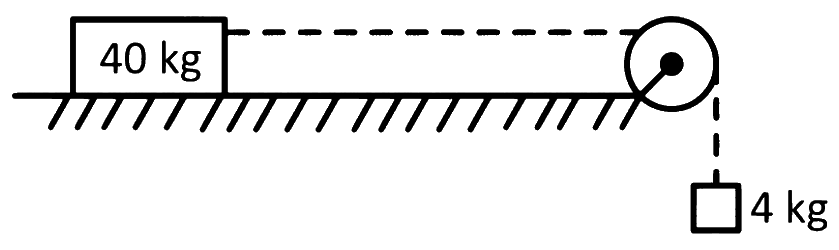
A block of mass 40 kg slides over a surface, when a mass of 4 kg is suspended through an inextensible massless string passing over frictionless pulley as shown below.
The coefficient of kinetic friction between the surface and block is 0.02. The acceleration of block is. (Given g = 10 ms−2.)
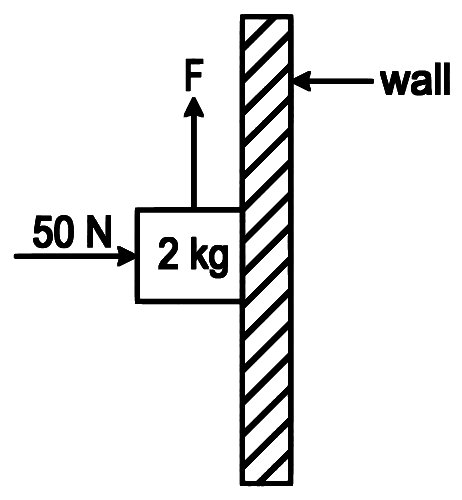
A 2 kg block is pushed against a vertical wall by applying a horizontal force of 50 N. The coefficient of static friction between the block and the wall is 0.5. A force F is also applied on the block vertically upward (as shown in figure). The maximum value of F applied, so that the block does not move upward, will be:
A bag is gently dropped on a conveyor belt moving at a speed of 2 m/s. The coefficient of friction between the conveyor belt and bag is 0.4. Initially, the bag slips on the belt before it stops due to friction. The distance travelled by the bag on the belt during slipping motion, is: [Take g=10 m/s2 ]
The coefficient of static friction between a wooden block of mass 0.5 kg and a vertical rough wall is 0.2. The magnitude of horizontal force that should be applied on the block to keep it adhere to the wall will be _________ N. [g = 10 ms−2]
Numerical answer type. Work it out, then open the answer.
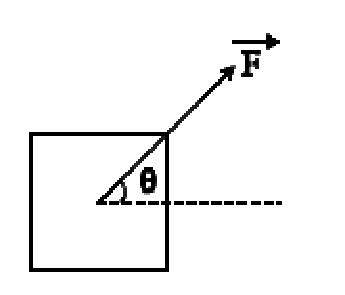
A block of mass m slides along a floor while a force of magnitude F is applied to it at an angle θ as shown in figure. The coefficient of kinetic friction is μk. Then, the block's acceleration 'a' is given by: (g is acceleration due to gravity)
A body of mass 1 kg rests on a horizontal floor with which it has a coefficient of static friction 31. It is desired to make the body move by applying the minimum possible force F N. The value of F will be ____________. (Round off to the Nearest Integer) [Take g = 10 ms−2 ]
Numerical answer type. Work it out, then open the answer.
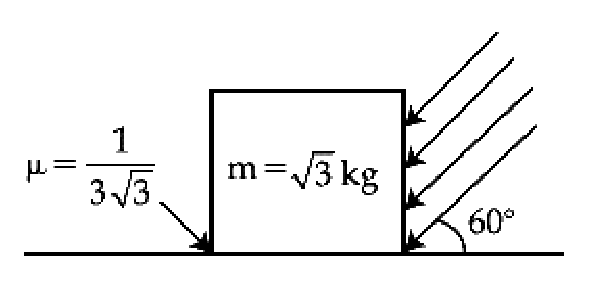
As shown in the figure, a block of mass 3 kg is kept on a horizontal rough surface of coefficient of friction 331. The critical force to be applied on the vertical surface as shown at an angle 60∘ with horizontal such that it does not move, will be 3x. The value of x will be _________. [g = 10 m/s2; sin60∘=23; cos60∘=21 ]
Numerical answer type. Work it out, then open the answer.
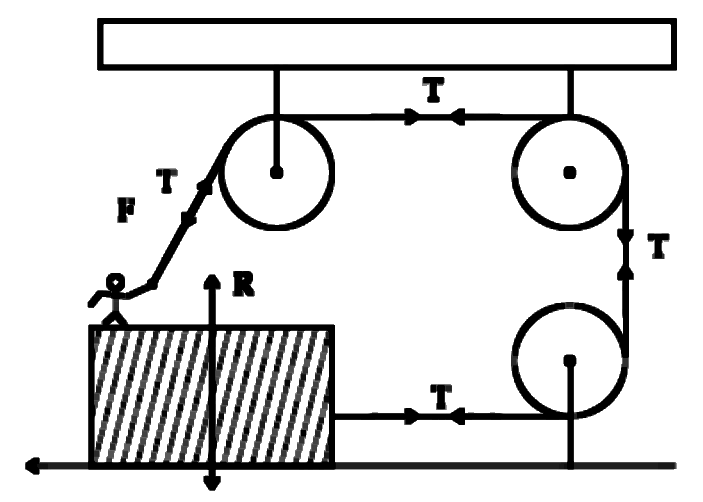
A boy of mass 4 kg is standing on a piece of wood having mass 5 kg. If the coefficient of friction between the wood and the floor is 0.5, the maximum force that the boy can exert on the rope so that the piece of wood does not move from its place is __________ N. (Round off to the Nearest Integer) [Take g = 10 ms-2 ]
Numerical answer type. Work it out, then open the answer.
A block of mass m is moving on rough horizontal surface with momentum p. The coefficient of friction between the block and surface is μ. The distance covered by block before it stops is [g= acceleration due to gravity]
Calculate the acceleration of the block and trolly system shown in the figure. The coefficient of kinetic friction between the trolly and the surface is 0.05. (g=10 m/s2, mass of the string is negligible and no other friction exists).
A body of mass m is kept on a rough horizontal surface (coefficient of friction = μ). A horizontal force is applied on the body, but it does not move. The resultant of normal reaction and the frictional force acting on the object is given by F, where F is,
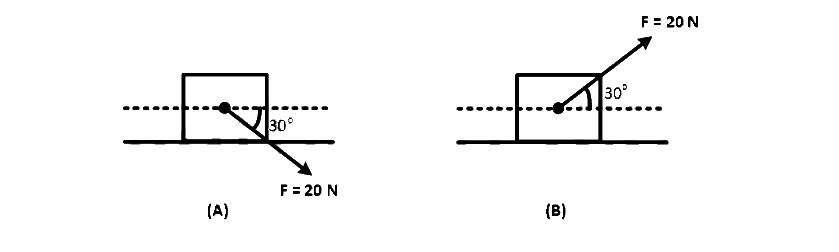
A block of mass 5 kg is (i) pushed in case (A) and (ii) pulled in case (B), by a force F = 20 N, making an angle of 30° with the horizontal, as shown in the figures. The coefficient of friction between the block and floor is μ = 0.2. The difference between the accelerations of the blocks, in case (B) and case (A) will be: (g = 10 ms–2)
Two masses m1 = 5 kg and m2 = 10 kg, connected by an inextensible string over a frictionless pulley, are moving as shown in the figure. The coefficient of friction of horizontal surface is 0.15. The minimum weight m that should be put on top of m2 to stop the motion is:
A block A of mass m1 rests on a horizontal table. A light string connected to it passes over a frictionless pully at the edge of table and from its other end another block B of mass m2 is suspended. The coefficient of kinetic friction between the block and the table is μk. When the block A is sliding on the table, the tension in the string is
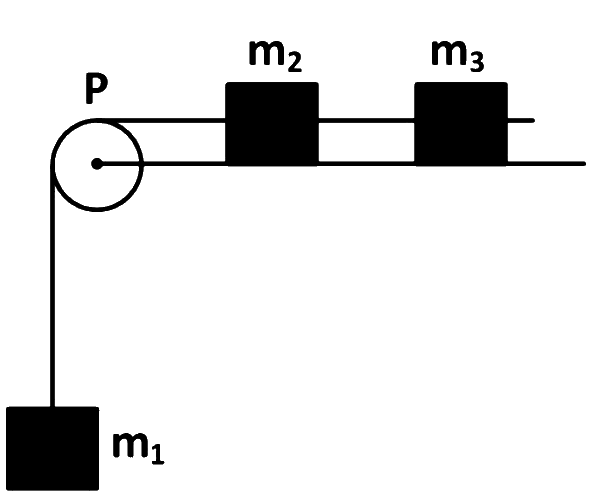
A system consists of three masses m1, m2 and m3 connected by a string passing over a pulley P. The mass m1 hangs freely and m2 and m3 are on a rough horizontal table (the coefficient of friction = μ). The pulley is frictionless and of negligible mass. The downward acceleration of mass m1 is (Assume m1 = m2 = m3 = m)
A heavy box is to be dragged along a rough horizontal floor. To do so, person A pushes it at an angle 30° from the horizontal and requires a minimum force FA, while person B pulls the box at an angle 60° from the horizontal and needs minimum force FB. If the coefficient of friction between the box and the floor is 53, the ratio FBFA is:
A block is placed on a rough horizontal plane. A time dependent horizontal force F=kt acts on the block, where k is a positive constant. The acceleration - time graph of the block is:
A conveyor belt is moving at a constant speed of 2 ms− 1. A box is gently dropped on it. The coefficient of friction between them is μ = 0.5. The distance that the box will move relativce to belt before coming to rest on it, taking g = 10 m s−2,, is
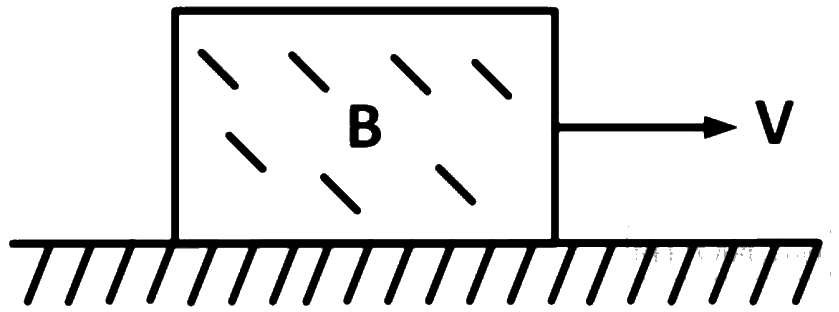
A block B is pushed momentarily along a horizontaly surface with an initial velocity V. If μ is the coefficient of sliding friction between B and the surface, block B will come to rest after a time
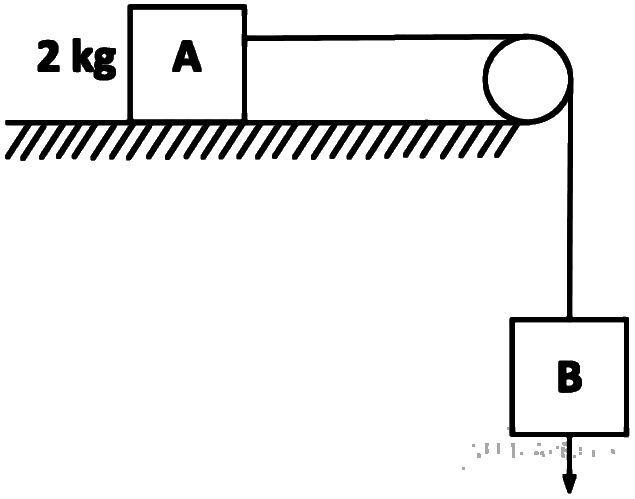
The coefficient of static friction, μs, between block A of mass 2 kg and the table as shown in the figure is 0.2. What would be the maximum mass value of block B so that the two blocks do not move? The string and the pulley are assumed to be smooth and massless. (g = 10 m/s2)
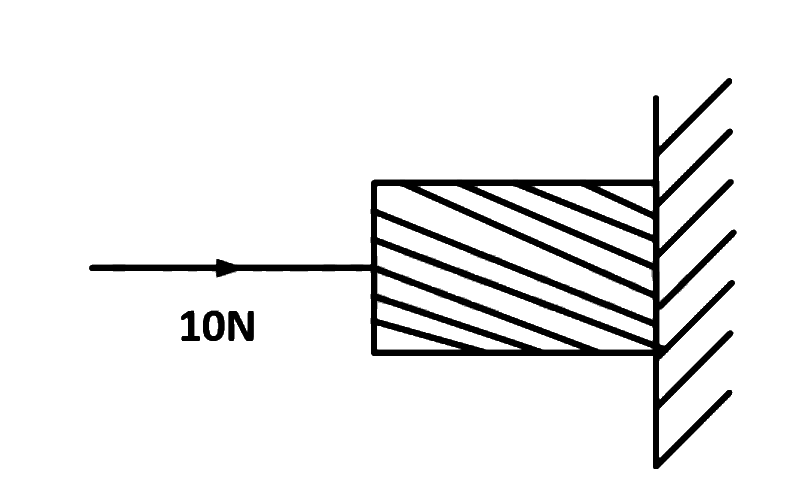
A horizontal force of 10 N is necessary to just hold a block stationary against a wall. The coefficient of friction between the block and the wall is 0.2. The weight of the block is
A block of mass 10 kg placed on rough horizontal surface having coefficient of friction μ = 0.5, if a horizontal force of 100 N acting on it then acceleration of the block will be
On the horizontal surface of a truck a block of mass 1 kg is placed (μ = 0.6) and truck is moving with acceleration 5 m/sec2 then the frictional force on the block will be
Consider a car moving along a straight horizontal road with a speed of 72 km/h. If the coefficient of static friction between the tyres and the road is 0.5, the shortest distance in which the car can be stopped is (taking g=10 m/s2)