0 of 33 attemptedPick an answer to see the solution
Q1JEE Main 2026 · 23 JAN · SHIFT 2Medium
Friction on an Incline · Sliding down & up a rough incline
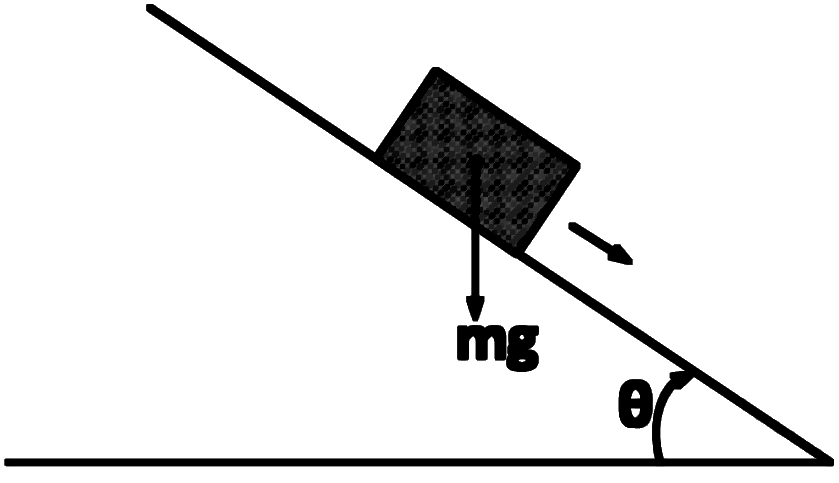
A block is sliding down on an inclined plane of slope θ and at an instant t=0 this block is given an upward momentum so that it starts moving up on the inclined surface with velocity u. The distance (S) travelled by the block before its velocity become zero, is ______.
Friction on an Incline · Force needed on a rough incline
A block of mass 5 kg is moving on an inclined plane which makes an angle of 30∘ with the horizontal. Friction coefficient between the block and inclined plane surface is 23. The force to be applied on the block so that the block will move down without acceleration is ______ N. (g=10 m/s2).
Friction on an Incline · Rough vs smooth: time of descent
The time taken by a block of mass m to slide down from the highest point to the lowest point on a rough inclined plane is 50% more compared to the time taken by the same block on identical inclined smooth plane. Both inclined planes are at 45∘ with the horizontal. The coefficient of kinetic friction between the rough inclined surface and block is ______
Friction on an Incline · Rough vs smooth: time of descent
A block takes t time to slide down a plane inclined at 45∘ to the horizontal. If the surface is made smooth (frictionless), the block takes time 2t to slide down the plane. The coefficient of friction between the block and the inclined plane is (100α). The value of α is ______.
Numerical answer type. Work it out, then open the answer.
Friction on an Incline · Rough vs smooth: time of descent
There are two inclined surfaces of equal length (L) and same angle of inclination 45∘ with the horizontal. One of them is rough and the other is perfectly smooth. A given body takes 2 times as much time to slide down on rough surface than on the smooth surface. The coefficient of kinetic friction (μk) between the object and the rough surface is close to
Friction on an Incline · Angle of repose & block at rest
A 2 kg brick begins to slide over a surface which is inclined at an angle of 45∘ with respect to horizontal axis. The co-efficient of static friction between their surfaces is:
Friction on an Incline · Angle of repose & block at rest
A block of mass m is placed on a surface having vertical cross-section given by y=x2/4. If coefficient of friction is 0.5, the maximum height above the ground at which block can be placed without slipping is:
Friction on an Incline · Force needed on a rough incline
A block of mass 5 kg is placed on a rough inclined surface as shown in the figure. If F1 is the force required to just move the block up the inclined plane and F2 is the force required to just prevent the block from sliding down, then the value of is: [Use g=10 m/s2]
Friction on an Incline · Rough vs smooth: time of descent
A given object takes n times the time to slide down 45∘ rough inclined plane as it takes the time to slide down an identical perfectly smooth 45∘ inclined plane. The coefficient of kinetic friction between the object and the surface of inclined plane is:
Friction on an Incline · Force needed on a rough incline
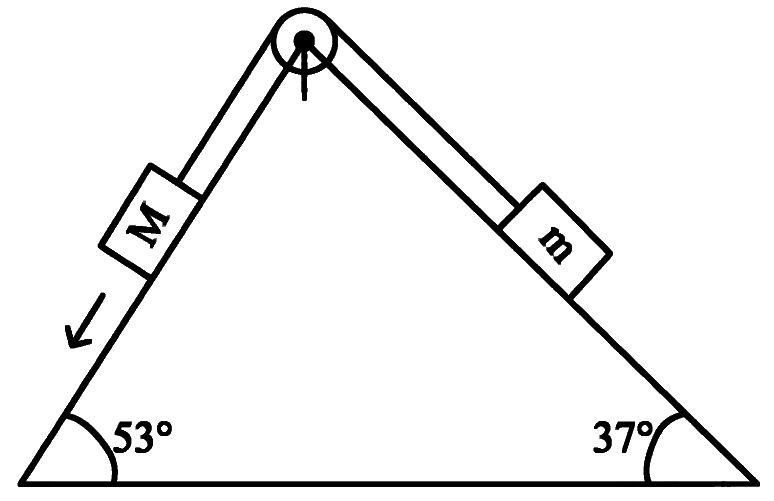
In the given arrangement of a doubly inclined plane two blocks of masses M and m are placed. The blocks are connected by a light string passing over an ideal pulley as shown. The coefficient of friction between the surface of the plane and the blocks is 0.25. The value of m, for which M=10 kg will move down with an acceleration of 2 m/s2, is: (take g=10 m/s2 and tan37∘=3/4)
Friction on an Incline · Angle of repose & block at rest
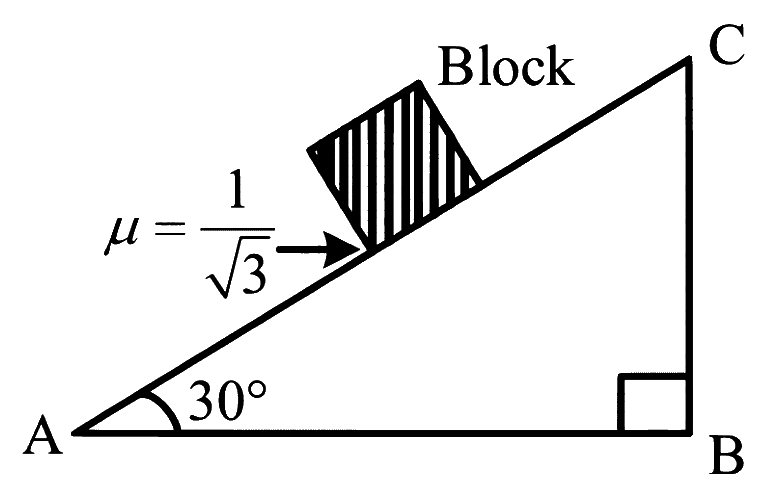
A block of mass 2 kg is placed on inclined rough surface AC (as shown in figure) of coefficient of friction μ. If g = 10 m s−2, the net force (in N) on the block will be:
Friction on an Incline · Force needed on a rough incline
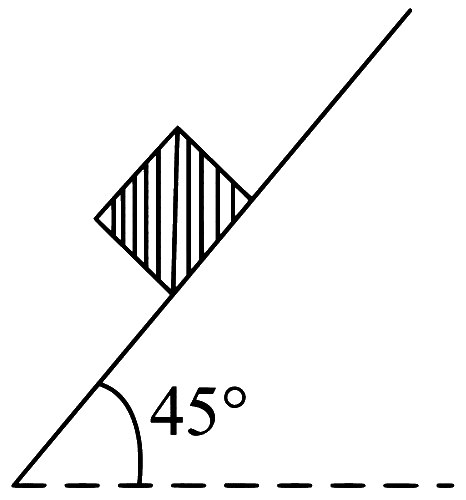
Consider a block kept on an inclined plane (incline at 45∘) as shown in the figure. If the force required to just push it up the incline is 2 times the force required to just prevent it from sliding down, the coefficient of friction between the block and inclined plane(μ) is equal to:
Friction on an Incline · Rough vs smooth: time of descent
The time taken by an object to slide down 45∘ rough inclined plane is n times as it takes to slide down a perfectly smooth 45∘ incline plane. The coefficient of kinetic friction between the object and the incline plane is:
Friction on an Incline · Angle of repose & block at rest
A block of mass M slides down on a rough inclined plane with constant velocity. The angle made by the incline plane with horizontal is θ. The magnitude of the contact force will be:
Friction on an Incline · Sliding down & up a rough incline
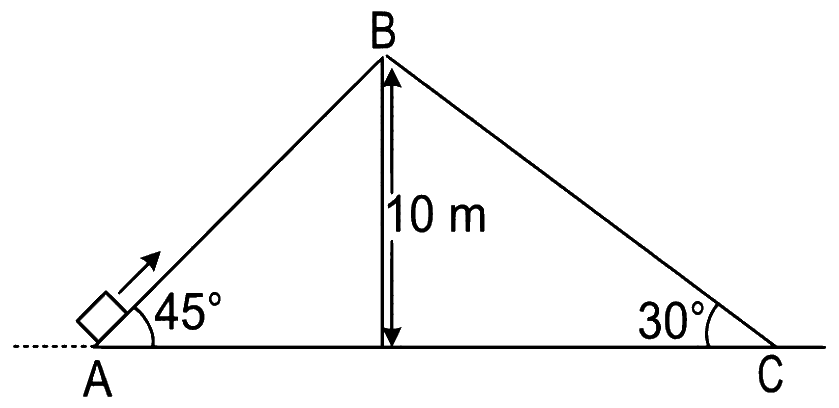
Two inclined planes are placed as shown in figure. A block is projected from the Point A of inclined plane AB along its surface with a velocity just sufficient to carry it to the top Point B at a height 10 m. After reaching the Point B the block slides down on inclined plane BC. Time it takes to reach to the point C from point A is t(2+1) s. The value of t is ___________.
(use g=10 m/s2)
Numerical answer type. Work it out, then open the answer.
Friction on an Incline · Angle of repose & block at rest
An inclined plane is bent in such a way that the vertical cross-section is given by y=4x2 where y is in vertical and x in horizontal direction. If the upper surface of this curved plane is rough with coefficient of friction μ = 0.5, the maximum height in cm at which a stationary block will not slip downward is _________ cm.
Numerical answer type. Work it out, then open the answer.
Friction on an Incline · Rough vs smooth: time of descent
When a body slides down from rest along a smooth inclined plane making an angle of 30∘ with the horizontal, it takes time T. When the same body slides down from the rest along a rough inclined plane making the same angle and through the same distance, it takes time αT, where α is a constant greater than 1. The co-efficient of friction between the body and the rough plane is x1(α2α2−1) where x = __________.
Numerical answer type. Work it out, then open the answer.
Friction on an Incline · Sliding down & up a rough incline
A body of mass 'm' is launched up on a rough inclined plane making an angle of 30∘ with the horizontal. The coefficient of friction between the body and plane is 5x if the time of ascent is half of the time of descent. The value of x is __________.
Numerical answer type. Work it out, then open the answer.
Friction on an Incline · Force needed on a rough incline
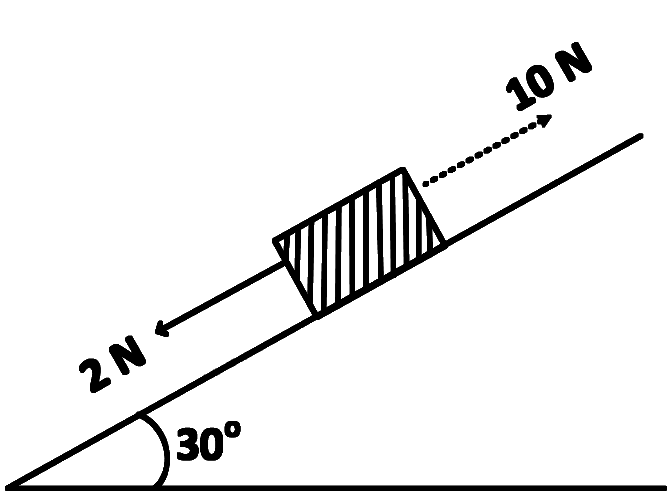
A block kept on a rough inclined plane, as shown in the figure, remains at rest upto a maximum force 2 N down the inclined plane. The maximum external force up the inclined plane that does not move the block is 10 N. The coefficient of static friction between the block and the plane is: [Take g = 10 m/s2]
Friction on an Incline · Force needed on a rough incline
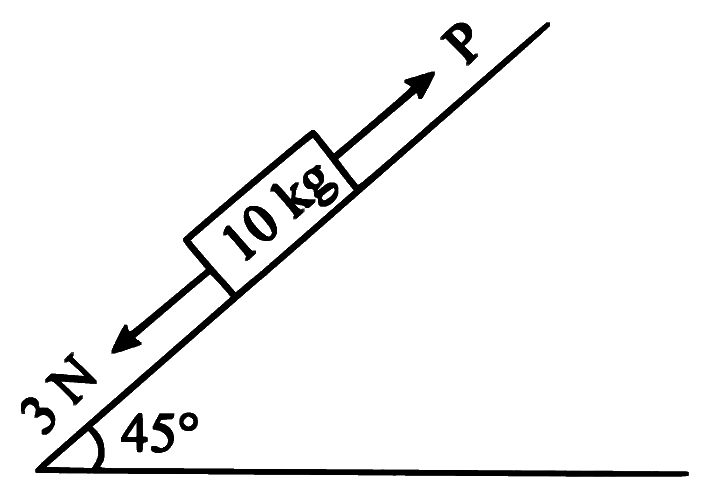
A block of mass 10 kg is kept on a rough inclined plane as shown in the figure. A force of 3 N is applied on the block. The coefficient of static friction between the plane and the block is 0.6. What should be the minimum value of force P, such that the block does not move downward? (take g = 10 ms−2)
Friction on an Incline · Sliding down & up a rough incline
A body of mass 2 kg slides down with an acceleration of 3 m/s2 on a rough inclined plane having a slope of 30∘. The external force required to take the same body up the plane with the same acceleration will be: (g = 10 m/s2)
Friction on an Incline · Rough vs smooth: time of descent
A given object takes n times more time to slide down a 45∘ rough inclined plane as it takes to slide down a perfectly smooth 45∘ incline. The coefficient of kinetic friction between the object and the incline is:
Friction on an Incline · Angle of repose & block at rest
A rocket is fired vertically from the earth with an acceleration of 2g, where g is the gravitational acceleration. On an inclined plane inside the rocket, making an angle θ with the horizontal, a point object of mass m is kept. The minimum coefficient of friction μmin between the mass and the inclined surface such that the mass does not move is:
Friction on an Incline · Angle of repose & block at rest
A plank with a box on it at one end is gradually raised about the other end. As the angle of inclination with the horizontal reaches 30°, the box starts to slip and slides 4.0 m down the plank in 4.0 s.
The coefficients of static and kinetic friction between the box and the plank will be, respectively
Friction on an Incline · Angle of repose & block at rest
A block of mass m is placed on a surface with a vertical cross section given by y=6x3. If the coefficient of friction is 0.5, the maximum height above the ground at which the block can be placed without slipping is:
Friction on an Incline · Sliding down & up a rough incline
The upper half of an inclined plane of inclination θ is perfectly smooth while lower half is rough. A block starting from rest at the top of the plane will again come to rest at the bottom, if the coefficient of friction between the block and lower half of the plane is given by
Friction on an Incline · Sliding down & up a rough incline
A body starts from rest on a long inclined plane of slope 45°. The coefficient of friction between the body and the plane varies as μ=0.3x, where x is distance travelled down the plane. The body will have maximum speed (for g=10 m/s2) when x =
Friction on an Incline · Rough vs smooth: time of descent
A smooth block is released at rest on a 45∘ incline and then slides a distance ′d′. The time taken to slide is ′n′ times as much to slide on rough incline than on a smooth incline. The coefficient of friction is
Friction on an Incline · Angle of repose & block at rest
A block rests on a rough inclined plane making an angle of 30∘ with the horizontal. The coefficient of static friction between the block and the plane is 0.8. If the frictional force on the block is 10 N, the mass of the block (in kg) is (take g=10 m/s2)
Friction on an Incline · Angle of repose & block at rest
A block has been placed on a inclined plane with the slope angle θ, block slides down the plane at constant speed. The coefficient of kinetic friction is equal to
Friction on an Incline · Rough vs smooth: time of descent
Starting from rest, a body slides down a 45∘ inclined plane in twice the time it takes to slide down the same distance in the absence of friction. The coefficient of friction between the body and the inclined plane is

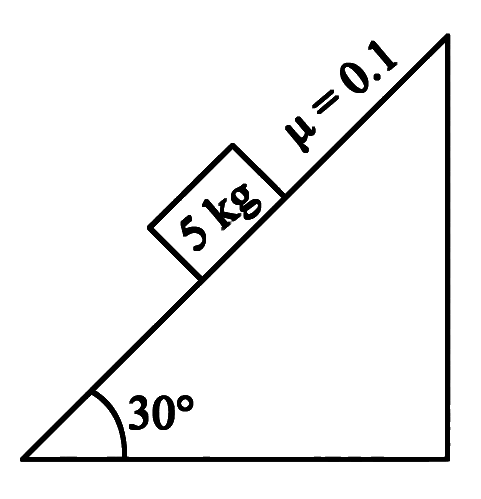
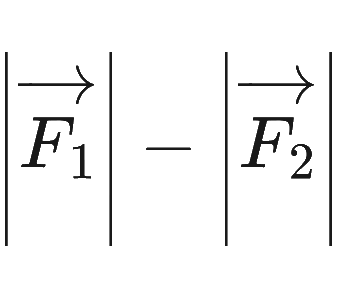 is: [Use