0 of 13 attemptedPick an answer to see the solution
Q1JEE Main 2026 · 24 JAN · SHIFT 1Medium
Two-Body Friction · Block on block
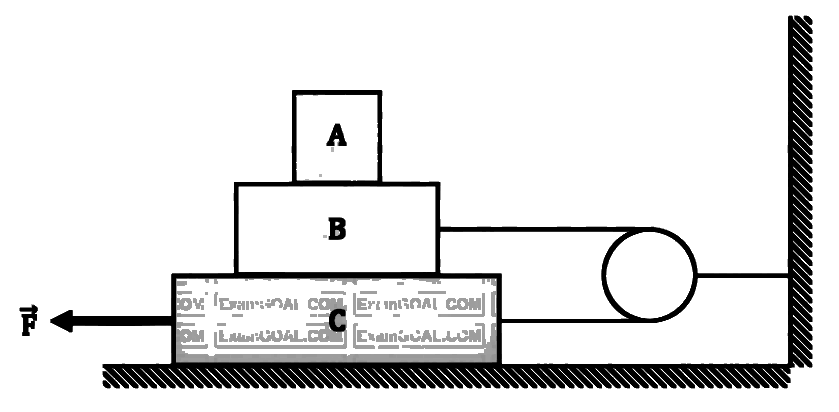
In the given figure the blocks A,B and C weigh 4 kg,6 kg and 8 kg respectively. The co-efficient of sliding friction between any two surfaces is 0.5. The force F required to slide the block C with constant speed is ______ N. (Use g=10 m/s2)
Numerical answer type. Work it out, then open the answer.
Two-Body Friction · Block on a cart or pressed to a wall
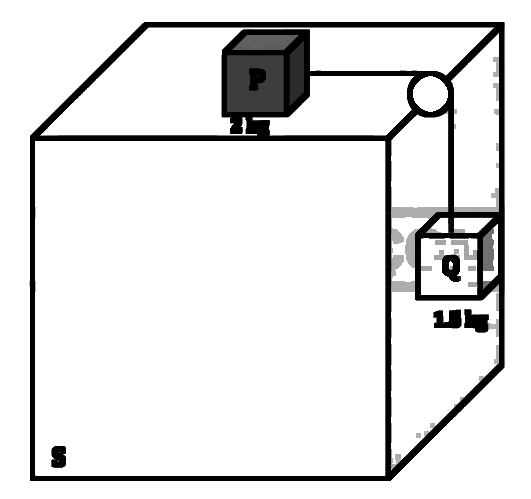
Two blocks ( P and Q) with respectively masses 2 kg and 1.5 kg are joined by a massless thread. These blocks are mounted on a frictionless pully which is fixed on the edge of a cube (S), as shown in the figure below. Block P is positioned on the top surface which has no friction and block Q is in contact with side-surface, having coefficient friction μ. The cube ( S) moves towards the right with acceleration of 2g, where g is gravitational acceleration. During this movement the block P and Q remain stationary. The value of μ is ______ (take g=10 m/s2)
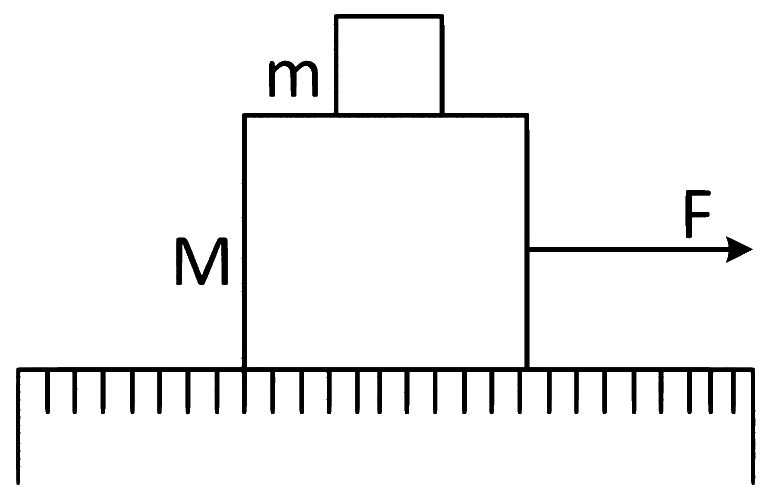
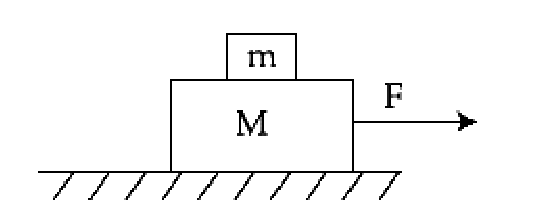
A system of two blocks of masses m = 2 kg and M = 8 kg is placed on a smooth table as shown in figure. The coefficient of static friction between two blocks is 0.5. The maximum horizontal force F that can be applied to the block of mass M so that the blocks move together will be:
A uniform chain of 6 m length is placed on a table such that a part of its length is hanging over the edge of the table. The system is at rest. The co-efficient of static friction between the chain and the surface of the table is 0.5, the maximum length of the chain hanging from the table is ___________ m.
Numerical answer type. Work it out, then open the answer.
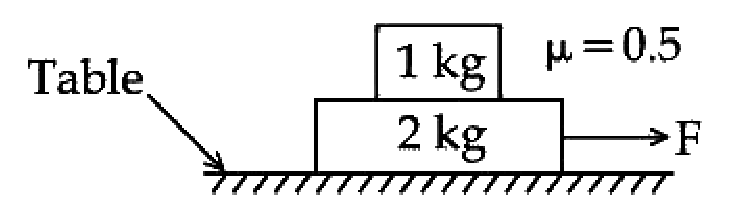
The coefficient of static friction between two blocks is 0.5 and the table is smooth. The maximum horizontal force that can be applied to move the blocks together is .................. N. (take g = 10 ms-2)
Numerical answer type. Work it out, then open the answer.
Two blocks (m = 0.5 kg and M = 4.5 kg) are arranged on a horizontal frictionless table as shown in figure. The coefficient of static friction between the two blocks is 73. Then the maximum horizontal force that can be applied on the larger block so that the blocks move together is ___________ N. (Round off to the Nearest Integer) [Take g as 9.8 ms−2]
Numerical answer type. Work it out, then open the answer.
An insect is at the bottom of a hemispherical ditch of radius 1 m. It crawls up the ditch but starts slipping after it is at height h from the bottom. If the coefficient of friction between the ground and the insect is 0.75, then h is:
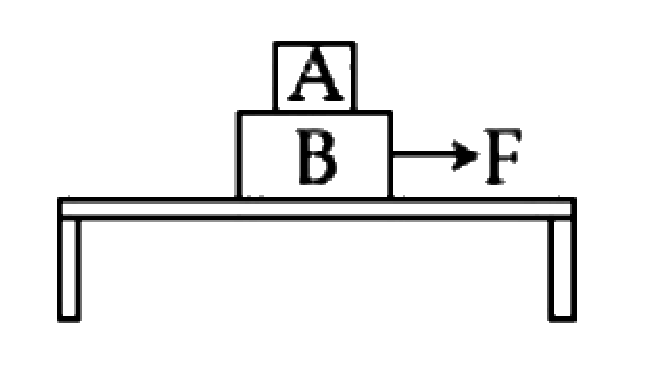
Two blocks A and B of masses mA = 1 kg and mB = 3 kg are kept on the table as shown in figure. The coefficient of friction between A and B is 0.2 and between B and the surface of the table is also 0.2. The maximum force F that can be applied on B horizontally, so that the block A does not slide over the block B is:
A block of mass 10 kg is in contact against the inner wall of a hollow cylindrical drum of radius 1 m. The coefficient of friction between the block and the inner wall of the cylinder is 0.1. The minimum angular velocity needed for the cylinder to keep the block stationary when the cylinder is vertical and rotating about its axis, will be: (g = 10 m/s2)
Two-Body Friction · Block on a cart or pressed to a wall
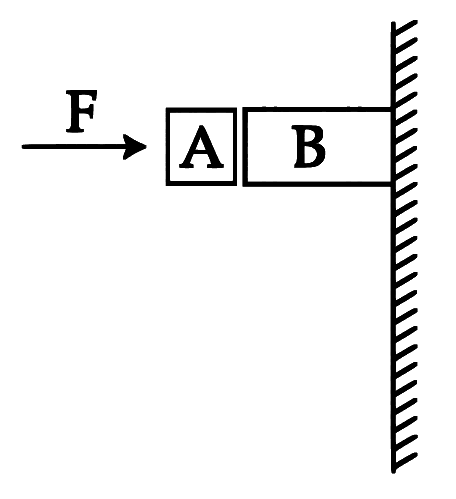
Given in the figure are two blocks A and B of weight 20 N and 100 N, respectively. These are being pressed against a wall by a force F as shown. If the coefficient of friction between the blocks is 0.1 and between block B and the wall is 0.15, the frictional force applied by the wall on block B is:
A block A of mass 4 kg is placed on another block B of mass 5 kg, and the block B rests on a smooth horizontal table. If the minimum force that can be applied on A so that both the blocks move together is 12 N, the maximum force that can be applied on B for the blocks to move together will be:
Two-Body Friction · Block on a cart or pressed to a wall
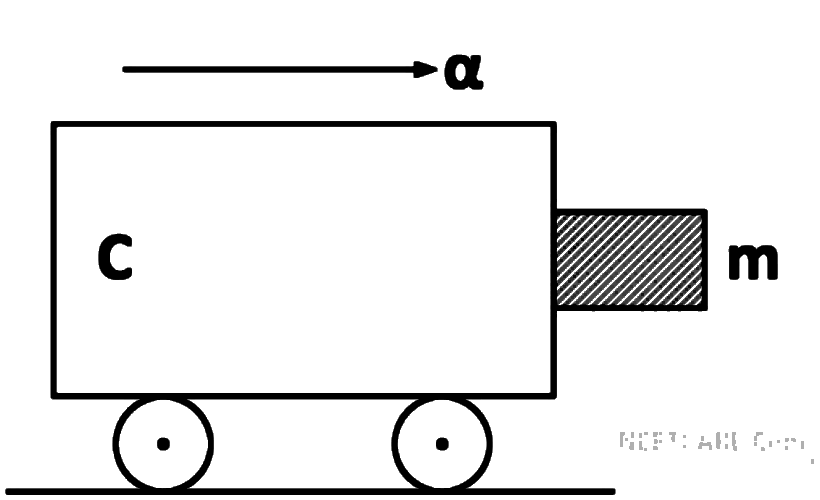
A block of mass m is in contact with the cart C as shown in the figure.
The coefficient of static friction between the block and the cart is μ. The acceleration α of the cart that will prevent the block from falling satisfies
A heavy uniform chain lies on horizontal table top. If the coefficient of friction between the chain and the table surface is 0.25, then the maximum fraction of the length of the chain that can hang over one edge of the table is