A lift of mass 1600 kg is supported by thick iron wire. If the maximum stress which the wire can withstand is 4×10⁸ N/m2 and its radius is 4 mm, then maximum acceleration the lift can take is m/s2.
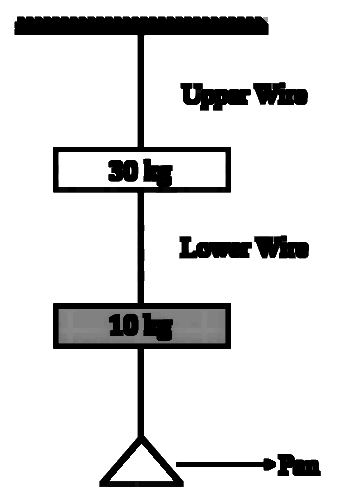
Two wires as shown in the figure below, made of steel and have breaking stress of 12×108 N/m2. Area of cross-section of upper wire is 0.008 cm2 and of lower wire is 0.004 cm2. The maximum mass that can be added to pan without breaking any wire is ______ kg.
A brass wire of length 2 m and radius 1 mm at 27∘C is held taut between two rigid supports. Initially it was cooled to a temperature of −43∘C creating a tension T in the wire. The temperature to which the wire has to be cooled in order to increase the tension in it to 1.4T, is ∘C.
A metallic bar of Young's modulus, 0.5×10¹¹ N m−2 and coefficient of linear thermal expansion 10−5∘C−1, length 1 m and area of cross-section 10−3 m2 is heated from 0∘C to 100∘C without expansion or bending. The compressive force developed in it is:
The density and breaking stress of a wire are 6×10⁴ kg/m3 and 1.2×10⁸ N/m2 respectively. The wire is suspended from a rigid support on a planet where acceleration due to gravity is 31rd of the value on the surface of earth. The maximum length of the wire without breaking is _______ m (take, g=10 m/s2 ).
Numerical answer type. Work it out, then open the answer.
A thin rod having a length of 1 m and area of cross-section 3×10⁻⁶ m2 is suspended vertically from one end. The rod is cooled from 210∘C to 160∘C. After cooling, a mass M is attached at the lower end of the rod such that the length of rod again becomes 1 m. Young's modulus and coefficient of linear expansion of the rod are 2×10¹¹ N m−2 and 2×10⁻⁵ K−1, respectively. The value of M is __________ kg.
(Take g=10 m s−2)
Numerical answer type. Work it out, then open the answer.
The area of cross section of the rope used to lift a load by a crane is 2.5×10⁻⁴ m2. The maximum lifting capacity of the crane is 10 metric tons. To increase the lifting capacity of the crane to 25 metric tons, the required area of cross section of the rope should be:
A metal wire of length 0.5 m and cross-sectional area 10−4 m2 has breaking stress 5×10⁸ Nm−2. A block of 10 kg is attached at one end of the string and is rotating in a horizontal circle. The maximum linear velocity of block will be _________ ms−1.
Numerical answer type. Work it out, then open the answer.
A steel rod with y = 2.0 × 10¹¹ Nm−2 and α = 10−5 ∘C−1 of length 4 m and area of cross-section 10 cm2 is heated from 0∘ C to 400∘C without being allowed to extend. The tension produced in the rod is x × 105 N where the value of x is ____________.
Numerical answer type. Work it out, then open the answer.
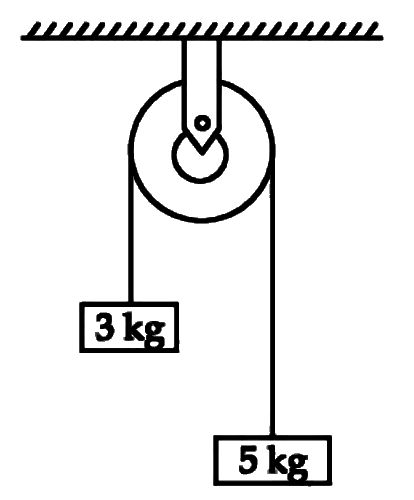
Two blocks of masses 3 kg and 5 kg are connected by a metal wire going over a smooth pulley. The breaking stress of the metal is π24×102 Nm-2. What is the minimum radius of the wire? (Take g = 10 ms-2)
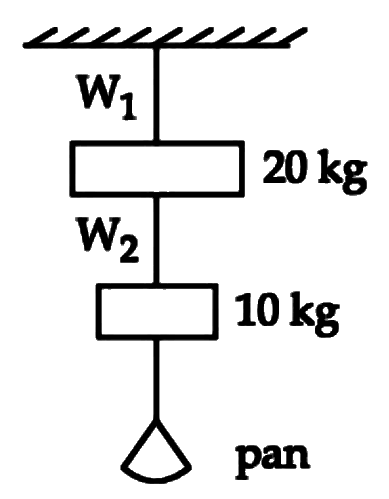
Wires W1 and W2 are made of same material having the breaking stress of 1.25 × 10⁹ N/m2. W1 and W2 have cross-sectional area of 8 × 10⁻⁷ m2 and 4 × 10⁻⁷ m2, respectively. Masses of 20 kg and 10 kg hang from them as shown in the figure. The maximum mass that can be placed in the pan without breaking the wires is ____________ kg. (Use g = 10 m/s2)
Numerical answer type. Work it out, then open the answer.
A body of mass m = 10 kg is attached to one end of a wire of length 0.3 m. The maximum angular speed (in rad s–1) with which it can be rotated about its other end in space station is: (Breaking stress of wire = 4.8 × 10⁷ Nm–2 and
area of cross-section of the wire = 10–2 cm2) is:
Numerical answer type. Work it out, then open the answer.
The elastic limit of brass is 379 MPa. What should be the minimum diameter of a brass rod if it is to support a 400 N load without exceeding its elastic limit?
A uniform cylindrical rod of length L and radius r, is made from a material whose Young’s modulus of Elasticity equals Y. When this rod is heated by temperature T and simultaneously subjected to a net longitudinal compressional force F, its length remains unchanged. The coefficient of volume expansion, of the material of the rod, is (nearly) equal to:
A lift is tied with thick iron ropes having mass ' M '. The maximum acceleration of the lift is ' a ' m/s2 and maximum safe stress is ' S ' N/m2. The minimum diameter of the rope is
The pressure that has to be applied to the ends of a steel wire of length 10 cm to keep its length constant when its temperature is raised by 100∘C is: (For steel Young's modulus is 2×10¹¹ Nm−2 and coefficient of thermal expansion is 1.1×10⁻⁵ K−1)
In steel, the Young's modulus and the strain at the breaking point are 2×10¹¹N/m2 and 0.15 respectively. The stress at the breaking point for steel is therefore
A wire can be broken by applying load of 200N. The force required to break another wire of the same length and same material, but double in diameter is
The elastic limit of brass is 3.5×10¹⁰N/m2. Find the maximum load that can be applied to a brass wire of 1mm diameter without exceeding the elastic limit.
A wire made of a certain material of length l and area of cross section a can withstand a maximum load =W without breaking. If another wire of the same material and cross-sectional area is used with double the original length, what will be the maximum load that the wire can withstand without breaking?
A metallic rod breaks when strain produced is 0.2%. The Young's modulus of the material of the rod is 7×10⁹N/m2. The area of cross-section to support a load of 104N is
A wire of length 0.5m and area of cross-section 4×10⁻⁶m2 at a temperature of 100∘C is suspended vertically by fixing its upper end to the ceiling. The wire is then cooled to 0∘C, but is prevented from contracting by attaching a mass at the lower end. If the mass of the wire is negligible, then the value of the mass attached to the wire is
[Young's modulus of material of the wire =1011N m−2, coefficient of linear expansion of the material of the wire =10−5K−1 and acceleration due to gravity =10m s−2]
A metal wire can withstand a maximum tension of 80N. If the wire is cut into four parts of equal length, then each part can withstand a maximum tension of
Two wires A and B of same length, same radius and same Young's modulus are heated to same range of temperatures. If the coefficient of linear expansion of A is 23 times that of B, then the ratio of the thermal stresses produced in the two wires A and B is
A solid rectangular sheet has two different coefficients of linear expansion α1 and α2 along its length and breadth respectively. The coefficient of surface expansion is (for α1t≪1, α2t≪1)
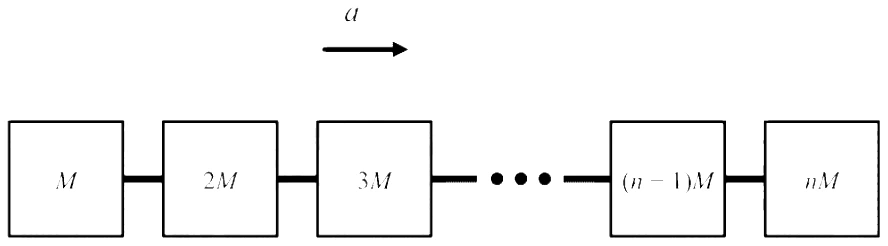
An accelerating train (acceleration a=1m s−2) of n blocks have a mass distribution as shown in the figure. The rightmost block of mass nM is the engine. The blocks are connected through a Aluminum cable of cross-section 10cm2. The maximum allowed strain in the connecting cables is 0.001. Taking M=1000kg and Young's modulus of Aluminum to be 7×10¹⁰Pa, the correct choice(s) is(are).
More than one option can be correct. Tap every correct option, then tap Check.
A metal rod of cross-sectional area 10−4m2 is hanging in a chamber kept at 20∘C with a weight attached to its free end. The coefficient of thermal expansion of the rod is 2.5×10⁻⁶K−1 and its Young's modulus is 4×10¹²N m−2. The weight attached to the rod is increased by 5000N but the temperature of the chamber is lowered so that the length of the wire is unchanged. Then, the temperature of the chamber is