
Energy in SHM · Total energy
The total energy of a particle executing SHM is . If the amplitude is doubled and the frequency is halved, the new total energy will be
Show answer and solution
Answer: (b)
Loading the solution…
Home›Practice Hub›Chapters›Oscillations›Energy in SHM
Oscillations PYQs · MHT CET · JEE Main · NEET
Energy in SHM · Total energy
The total energy of a particle executing SHM is . If the amplitude is doubled and the frequency is halved, the new total energy will be
Answer: (b)
Energy in SHM · Total energy
There is a body having mass and performing SHM with amplitude ''. There is a restoring force , where is the displacement. The total energy of the body depends upon which of the following?
Answer: (d)
Energy in SHM · KE and PE at a displacement
For a particle executing S.H.M., the potential energy is times the kinetic energy when its displacement from mean position is , where is the amplitude of S.H.M. The value of is
Answer: (d)
Energy in SHM · KE and PE at a displacement
For a particle performing linear S.H.M. of amplitude 'r', the potential energy is '' times its total energy. The displacement of particle is
Answer: (c)
Energy in SHM · KE and PE at a displacement
For a particle executing S.H.M., its potential energy is 8 times its kinetic energy at a certain displacement '' from the mean position. If '' is the amplitude of S.H.M., the value of '' is
Answer: (c)
Energy in SHM · KE and PE at a displacement
The maximum potential energy of a block executing S.H.M. is E and amplitude of oscillation is 'A'. The kinetic energy of the block at amplitude A/2 is
Answer: (a)
Energy in SHM · KE and PE at a displacement
For a particle P performing S.H.M., when displacement is 'x', potential energy and restoring force acting on it is denoted by 'E' and 'F' respectively. The relation between x, E and F is
Answer: (b)
Energy in SHM · KE and PE at a displacement
The amplitude of a particle executing SHM is cm. The displacement at which its kinetic energy will be more than the potential energy is (in cm)
Answer: (b)
Energy in SHM · Energy graphs and energy frequency
For a simple pendulum, having time period , the variation of kinetic energy (K.E.) with time is represented by:
Answer: (c)
Energy in SHM · Total energy
A linear harmonic oscillator of force constant N/m has amplitude m. Its
Answer: (a)
Energy in SHM · Total energy
A mass kg performs S.H.M. with a frequency Hz. At a certain displacement it has kinetic energy J and potential energy J. The amplitude of oscillation is
Answer: (a)
Energy in SHM · KE and PE at a displacement
Maximum kinetic energy of a particle of mass kg in S.H.M. is J and the time period is s. Maximum potential energy during the motion is J. Then
Answer: (c)
Energy in SHM · KE and PE at a displacement
A particle of mass '' is executing S.H.M. about the origin on x-axis with frequency , where K is a constant and a is the amplitude of S.H.M. If '' is the displacement of a particle at time '', the potential energy of a particle will be
Answer: (c)
Energy in SHM · KE and PE at a displacement
A block is fastened to a horizontal spring. The block is pulled to a distance cm from its equilibrium position (at ) on a frictionless surface from rest. The kinetic energy of the block at cm is J. The spring constant of the spring is nearly (in Nm)
Answer: (c)
Energy in SHM · KE and PE at a given time
A particle starts oscillating simple harmonically from its equilibrium position with time period T. The ratio of kinetic energy to potential energy of the particle at time is
Answer: (c)
Energy in SHM · KE and PE at a given time
A particle starts from mean position and performs S.H.M. with period second. At what time its kinetic energy is of total energy? ()
Answer: (a)
Energy in SHM · KE and PE at a given time
The displacement of a particle, executing simple harmonic motion with time period , is expressed as , where is the amplitude. The maximum value of potential energy of this oscillator is found at . The value of is ______.
Numerical answer type. Work it out, then open the answer.
Answer: 2
Energy in SHM · Energy graphs and energy frequency
The kinetic energy of a simple harmonic oscillator is oscillating with angular frequency of 176 rad/s. The frequency of this simple harmonic oscillator is ______ Hz. [ take ]
Answer: (b)
Energy in SHM · KE and PE at a displacement
A particle is executing S.H.M. of amplitude ' '. When the potential energy of the particle is half of its maximum value during the oscillation, its displacement from the equilibrium position is
Answer: (d)
Energy in SHM · KE and PE at a displacement
A particle is executing linear S.H.M. starting from mean position. The ratio of the kinetic energy to the potential energy of the particle at a point of half the amplitude is
Answer: (b)
Energy in SHM · Total energy
A point particle of mass 200 gram is executing S.H.M. of amplitude 0.2 m. When the particle passes through the mean position, its kinetic energy is . The equation of motion of this particle is (Initial phase of oscillation )
Answer: (d)
Energy in SHM · Total energy
An object of mass 0.2 kg executes simple harmonic oscillations along the x -axis with frequency of . At the position , the object has kinetic energy 1 J and potential energy 0.6 J. The amplitude of oscillation is
Answer: (c)
Energy in SHM · KE and PE at a displacement
For a particle performing S.H.M.; the total energy is ' ' times the kinetic energy, when the displacement of a particle from mean position is , where A is the amplitude of S.H.M. The value of ' ' is
Answer: (c)
Energy in SHM · KE and PE at a given time
A particle starts oscillating simple harmonically from its mean position with time period ' '. At time , the ratio of the potential energy to kinetic energy of the particle is
Answer: (d)
Energy in SHM · Energy graphs and energy frequency
A particle oscillates along the -axis according to the law, where . The kinetic energy of the particle as a function of is correctly represented by the graph
Answer: (d)
Energy in SHM · Total energy
In simple harmonic motion, the total mechanical energy of given system is . If mass of oscillating particle is doubled then the new energy of the system for same amplitude is:
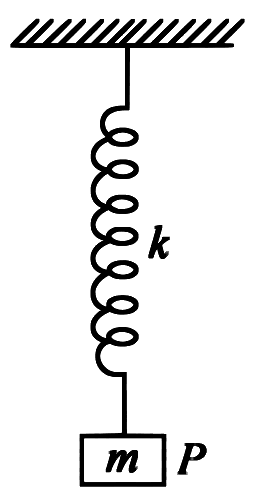
Answer: (d)
Energy in SHM · KE and PE at a displacement
A particle executing simple harmonic motion with amplitude A has the same potential and kinetic energies at the displacement
Answer: (c)
Energy in SHM · KE and PE at a displacement
When the displacement of a simple harmonic oscillator is one third of its amplitude, the ratio of total energy to the kinetic energy is , where _________.
Numerical answer type. Work it out, then open the answer.
Answer: 9
Energy in SHM · Total energy
The kinetic energy of a particle, executing simple harmonic motion is 16 J when it is in mean position. If amplitude of motion is 25 cm and the mass of the particle is 5.12 kg, the period of oscillation is
Answer: (a)
Energy in SHM · Total energy
An object of mass executes simple harmonic motion along axis with frequency of . At the position the object has kinetic energy and potential energy . The amplitude of oscillation is ________ .
Numerical answer type. Work it out, then open the answer.
Answer: 6
Energy in SHM · KE and PE at a displacement
In S.H.M. the displacement of a particle at an instant is , where and kinetic energy is 200 J. If force constant is , then x will be
Answer: (a)
Energy in SHM · KE and PE at a displacement
For a body performing simple harmonic motion, its potential energy is at displacement x and at displacement y from mean position. The potential energy at displacement is
Answer: (d)
Energy in SHM · KE and PE at a given time
Starting from mean position, a body oscillates simple harmonically with a period ' '. After what time will its kinetic energy be of the total energy?
Answer: (b)
Energy in SHM · KE and PE at a given time
A particle starts oscillating simple harmonically from its equilibrium position with time period ' T '. What is the ratio of potential energy to kinetic energy of the particle at time ?
Answer: (c)
Energy in SHM · KE and PE at a displacement
For a particle executing S.H.M., its potential energy is 8 times its kinetic energy at certain displacement '' from the mean position. If '' is the amplitude of S.H.M the value of '' is
Answer: (c)
Energy in SHM · KE and PE at a displacement
The amplitude of a particle executing S.H.M. is . The displacement at which its kinetic energy will be more than the potential energy is
Answer: (b)
Energy in SHM · KE and PE at a displacement
A particle is vibrating in S.H.M. with an amplitude of . At what displacement from the equilibrium position is its energy half potential and half kinetic?
Answer: (d)
Energy in SHM · KE and PE at a displacement
A particle executes SHM of amplitude A. The distance from the mean position when its kinetic energy becomes equal to its potential energy is:
Answer: (a)
Energy in SHM · KE and PE at a displacement
A particle is executing simple harmonic motion (SHM). The ratio of potential energy and kinetic energy of the particle when its displacement is half of its amplitude will be
Answer: (d)
Energy in SHM · KE and PE at a displacement
The maximum potential energy of a block executing simple harmonic motion is . A is amplitude of oscillation. At , the kinetic energy of the block is
Answer: (c)
Energy in SHM · KE and PE at a displacement
The amplitude of a particle executing SHM is . The displacement at which its kinetic energy will be more than the potential energy is: __________
Numerical answer type. Work it out, then open the answer.
Answer: 2
Energy in SHM · Energy graphs and energy frequency
Which graph represents the difference between total energy and potential energy of a particle executing SHM vs its distance from mean position?
Answer: (a)
Energy in SHM · Energy graphs and energy frequency
The variation of kinetic energy (KE) of a particle executing simple harmonic motion with the displacement starting from mean position to extreme position (A) is given by
Answer: (c)
Energy in SHM · KE and PE at a displacement
A body is executing a linear S.H.M. Its potential energies at the displacement '' and '' are '' and '' respectively. Its potential energy at displacement will be
Answer: (b)
Energy in SHM · KE and PE at a displacement
At a given point of time the value of displacement of a simple harmonic oscillator is given as . If amplitude is and kinetic energy at that time is , the value of force constant is . The value of is ____________.
Numerical answer type. Work it out, then open the answer.
Answer: 4
Energy in SHM · KE and PE at a given time
A particle starts from mean position and performs S.H.M. with period 4 second. At what time its kinetic energy is of total energy?
Answer: (d)
Energy in SHM · KE and PE at a given time
The general displacement of a simple harmonic oscillator is . Let T be its time period. The slope of its potential energy (U) - time (t) curve will be maximum when . The value of is ______________.
Numerical answer type. Work it out, then open the answer.
Answer: 8
Energy in SHM · KE and PE at a given time
A particle starts oscillating simple harmonically from its mean position with time period ''. At time , the ratio of the potential energy to kinetic energy of the particle is
Answer: (d)
Energy in SHM · Energy graphs and energy frequency
Match List-I with List-II
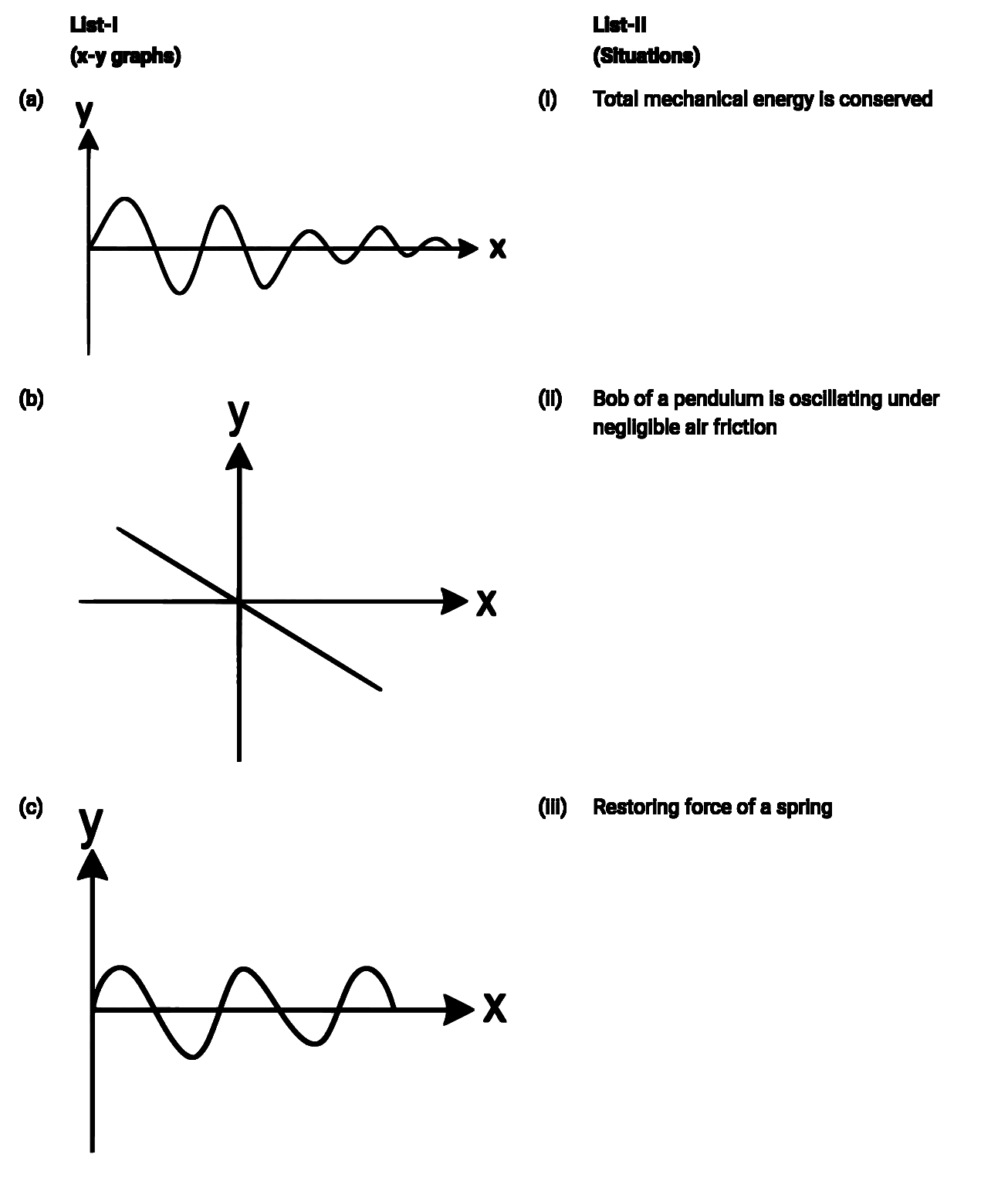
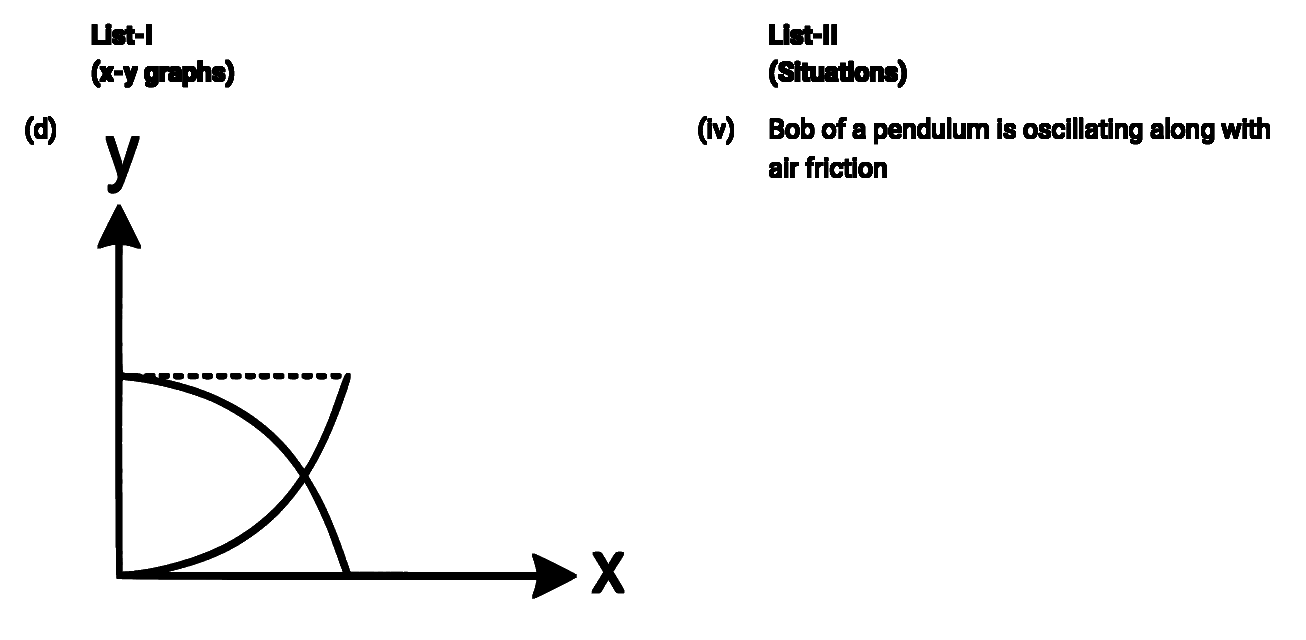
Choose the correct answer from the options given below
Answer: (c)
Energy in SHM · Total energy
A body of mass '' performs linear S.H.M. given by equation . The total energy of the particle at any instant is
Answer: (c)
Energy in SHM · Total energy
If the amplitude of linear S.H.M. is decreased then
Answer: (d)
Energy in SHM · Total energy
For a body executing S.H.M.:
(1) Potential energy is always equal to its K.E.
(2) Average potential and kinetic energy over any given time interval are always equal. (3) Sum of the kinetic and potential energy at any point of time is constant.
(4) Average K.E. in one time period is equal to average potential energy in one time period. Choose the most appropriate option from the options given below:
Answer: (a)
Energy in SHM · KE and PE at a displacement
A particle performing S.H.M. when displacement is '', the potential energy and restoring force acting on it are denoted by '' and '' respectively. The relation between and is
Answer: (c)
Energy in SHM · KE and PE at a displacement
A body is performing S.H.M. of amplitude 'A'. The displacement of the body from a point where kinetic energy is maximum to a point where potential energy is maximum, is
Answer: (b)
Energy in SHM · KE and PE at a displacement
A particle starts executing simple harmonic motion (SHM) of amplitude 'a' and total energy E. At any instant, its kinetic energy is then its displacement 'y' is given by:
Answer: (d)
Energy in SHM · KE and PE at a displacement
In a simple harmonic oscillation, what fraction of total mechanical energy is in the form of kinetic energy, when the particle is midway between mean and extreme position.
Answer: (b)
Energy in SHM · KE and PE at a displacement
For what value of displacement the kinetic energy and potential energy of a simple harmonic oscillation become equal?
Answer: (c)
Energy in SHM · Energy graphs and energy frequency
A body is executing simple harmonic motion with frequency 'n', the frequency of its potential energy is:
Answer: (c)
Energy in SHM · Energy graphs and energy frequency
The variation of displacement with time of a particle executing free simple harmonic motion is shown in the figure.
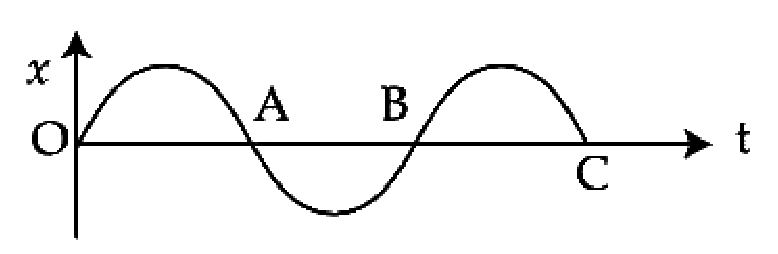
The potential energy U(x) versus time (t) plot of the particle is correctly shown in figure:
Answer: (d)
Energy in SHM · Total energy
A mass performs S.H.M. with a frequency . At a certain displacement it has kinetic energy and potential energy . The amplitude of oscillation is
Answer: (b)
Energy in SHM · KE and PE at a displacement
A body is executing S.H.M. under the action of force having maximum magntude . When its energy is half kinetic and half potential; the magnitude of the force acting on the particle is
Answer: (d)
Energy in SHM · KE and PE at a displacement
An object executes SHM along -axis with amplitude . At certain distance '' metre from mean position, it has kinetic energy and potential energy . the distance '' will be
Answer: (c)
Energy in SHM · KE and PE at a given time
An object of mass 0.5 kg is executing simple harmonic motion. It amplitude is 5 cm and time period (T) is 0.2 s. What will be the potential energy of the object at an instant starting from mean position. Assume that the initial phase of the oscillation is zero.
Answer: (a)
Energy in SHM · KE and PE at a given time
A particle of mass 1 kg is hanging from a spring of force constant 100 Nm. The mass is pulled slightly downward and released so that it executes free simple harmonic motion with time period T. The time when the kinetic energy and potential energy of the system will become equal, is . The value of x is _____________.
Numerical answer type. Work it out, then open the answer.
Answer: 8
Energy in SHM · KE and PE at a displacement
For a particle performing SHM when displacement is , the potential energy and restoring force acting on it is denoted by and , respectively. The relation between and is
Answer: (b)
Energy in SHM · Total energy
The total energy of a simple harmonic oscillaior is proportional to
Answer: (a)
Energy in SHM · Total energy
The quantity which does not vary periodically for a particle performing SHM is
Answer: (b)
Energy in SHM · KE and PE at a displacement
A particle is executing simple harmonic motion (SHM) of amplitude A, along the x-axis, about x = 0. When its potential Energy (PE) equals kinetic energy (KE), the position of the particle will be:
Answer: (c)
Energy in SHM · KE and PE at a given time
A particle undergoing simple harmonic motion has time dependent displacement given by x(t) = Asin . The ratio of kinetic to potential energy of this particle at t = 210 s will be:
Answer: (b)
Energy in SHM · Energy graphs and energy frequency
A particle is executing simple harmonic motion with a time period T. At time t = 0, it is at its position of equilibrium. The kinetic energy – time graph of the particle will look like:
Answer: (a)
Energy in SHM · Energy graphs and energy frequency
For a simple pendulum, a graph is plotted between its kinetic energy and potential energy against its displacement Which one of the following represents these correctly?
Answer: (d)
Energy in SHM · Total energy
The particle executing simple harmonic motion has a kinetic energy K0cos2t. The maximum values of the potential energy and the total energy are respectively
Answer: (c)
Energy in SHM · Total energy
A particle of mass executes simple harmonic motion with amplitude a and frequency The average kinetic energy during its motion from the position of equilibrium to the end is
Answer: (b)
Energy in SHM · KE and PE at a given time
Starting from the origin a body oscillates simple harmonically with a period of After what time will its kinetic energy be of the total energy?
Answer: (a)
Energy in SHM · Total energy
The total energy of particle, executing simple harmonic motion is
Answer: (a)
Energy in SHM · KE and PE at a displacement
The potential energy of a simple harmonic oscillator when the particle is half way to its end point is
Answer: (c)
Energy in SHM · KE and PE at a displacement
A body executes simple harmonic motion. The potential energy the kinetic energy and total energy are measured as a function of displacement Which of the following statements is true?
Answer: (a)
Energy in SHM · Energy graphs and energy frequency
A particle of mass m oscillates with simple harmonic motion between points x1 and x2, the equilibrium position being O. Its potential energy is plotted. It will be as given below in the graph
Answer: (a)
Energy in SHM · Total energy
In a simple harmonic oscillator, at the mean position
Answer: (c)
Energy in SHM · KE and PE at a displacement
Displacement between maximum potential energy position and maximum kinetic energy position for a particle executing simple harmonic motion is
Answer: (c)
Energy in SHM · Total energy
The total energy of particle performing SHM depend on
Answer: (b)
Energy in SHM · Total energy
A linear harmonic oscillator of force constant and amplitude has a total mechanical energy of . Its
Answer: (c)
Energy in SHM · KE and PE at a displacement
In a simple harmonic motion, when the displacement is one-half the amplitude, what fraction of the total energy is kinetic?
Answer: (b)
Energy in SHM · Energy graphs and energy frequency
A loaded vertical spring executes S.H.M. with a time period of . The difference between the kinetic energy and potential energy of this system varies with a period of
Answer: (a)
Energy in SHM · KE and PE at a displacement
A body executes simple harmonic motion with an amplitude . At what displacement from the mean position is the potential energy of the body is one fourth of its total energy?
Answer: (b)
No questions match these filters.