0 of 101 attemptedPick an answer to see the solution
Q1JEE Main 2026 · 8 APR · SHIFT 2Easy
Spring Systems · Spring constant and cut springs
The frequency of oscillation of a mass m suspended by a spring is v1. If the length of the spring is cut to half, the same mass oscillates with frequency v2. The value of v2/v1 is ______.
Spring Systems · Time period of a spring-mass system
A spring of force constant 180 N/m is loaded with a mass 0.20 kg. The amplitude of oscillations is 4 cm. When mass comes to equillibrium position, its velocity in m/s is
Spring Systems · Time period of a spring-mass system
A body of mass 64 g is made to oscillate turn by turn on two different springs A and B. Spring A and B has force constant 4 N/m and 16 N/m respectively. If T1 and T2 are the period of oscillations of springs A and B respectively, then (T1+T2)/(T1−T2) will be
Spring Systems · Time period of a spring-mass system
A spring force constant 180 N/m is loaded with a mass 0.2 kg. The amplitude of oscillations is 4 cm. When mass comes to equilibrium position, its velocity is
Spring Systems · Equal masses on different springs
Two particles A and B of equal masses are suspended from two massless springs of spring constants KA and KB respectively. The maximum velocities of the particles during oscillations are equal. The ratio of the amplitude of 'B' to that of 'A' is
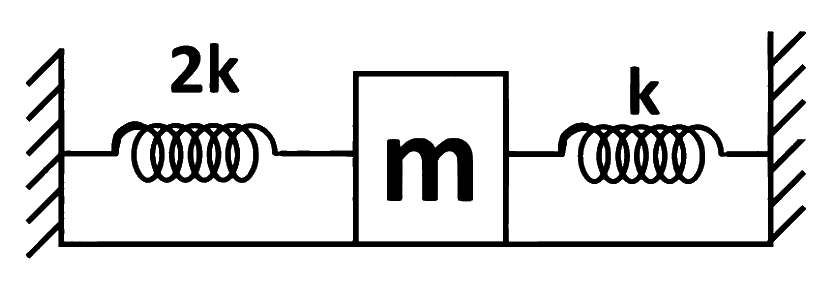
Two springs of force constants '2k' and 'k' are connected to a mass 'm' as shown. Mass is displaced slightly to one side and released. The frequency of oscillation of the two springs-mass system is
A spring has length l and force constant k. It is cut into 2 springs of length l1 and l2 such that l1=nl2 (n=an integer). The force constant of the spring of length l2 is (k∝l1)
Spring Systems · Time period of a spring-mass system
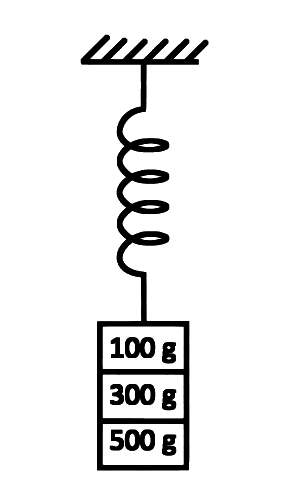
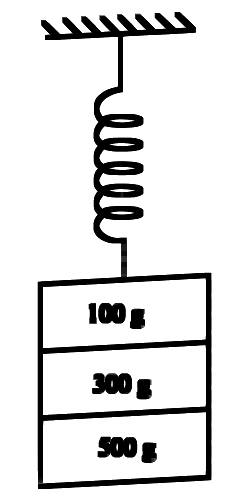
Three masses 100g, 300g and 500g are suspended at the end of a spring as shown in figure and are in equilibrium. When the 500 g mass is removed, the system oscillates with a period of 3 second. When the 300 g mass is also removed, it will oscillate with a period of
Spring Systems · Time period of a spring-mass system
A light spring is suspended with mass 'm1' at its lower end and its upper end is fixed to a rigid support. The mass is pulled down a short distance and then released. The period of oscillation is T second. When a mass ' ' is added to 'm1' and the system is made to oscillate the period is found to be 23 T. The ratio m2(m2m1) is
Spring Systems · Time period of a spring-mass system
A spring executes S.H.M. with mass 10 kg attached to it. The force constant of spring is 10 N/m. If at any instant its velocity is 40 cm/s, the displacement at that instant is
Spring Systems · Vertical spring and static extension
A mass is suspended from a vertical spring which is executing S.H.M. of frequency 10 Hz. The spring is unstretched at the highest point of oscillation. Maximum speed of the mass is (g=10 m/s2)
Spring Systems · Vertical spring and static extension
A spring produces extension ′x′ by applying a force ′F′ N. A body of mass ′m′ suspended from spring oscillates vertically with period ′T′. The mass of the suspended body is (Neglect mass of spring)
Spring Systems · Vertical spring and static extension
A spring stretches by 2 mm when it is loaded with a mass of 200 g. From equilibrium position the mass is further pulled down by 2 mm and released. The frequency associated with the system and maximum energy in the spring are ______ Hz and ______ J, respectively.
A body has time period T1 under the action of one force and T2 under the action of another force. The square of the time period when both the forces are acting in the same direction is
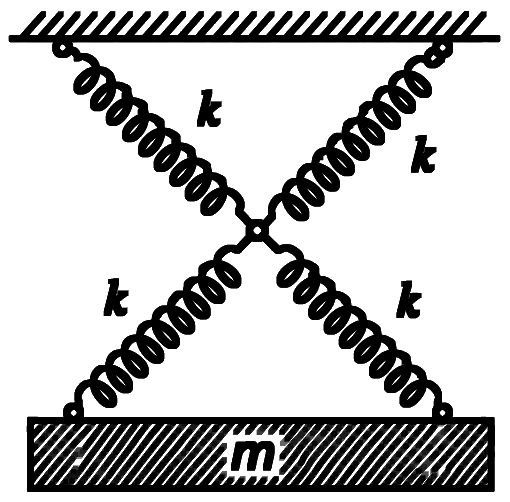
A simple harmonic oscillator having four identical springs (as shown in figure) has a time period T1. Another similar simple harmonic oscillator of the same mass m but the four identical springs with spring constants 2k has a time period T2, then T2T1 is
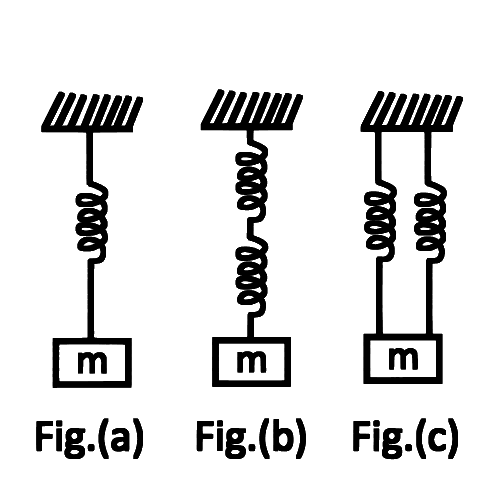
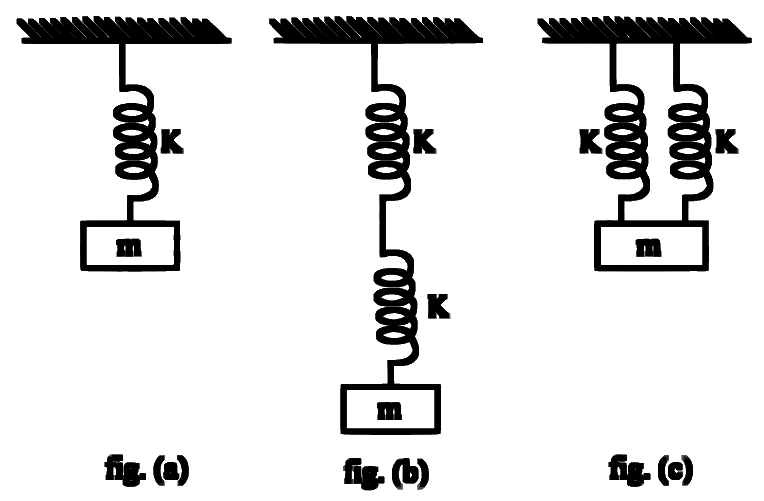
All the springs in fig (a), (b) and (c) are identical, each one having force constant K. Mass m is attached to each system. If Ta,Tb and Tc are the periodic time of oscillations of the three systems in fig (a), (b) and (c) respectively, then
Two massless springs of spring constants K1 and K2 are connected one after the other forming a single chain, suspended vertically and a certain mass is attached to the free end. If x1 and x2 are their respective extensions and 'F' is their stretching force, the total extension produced is
A horizontal spring executes S.H.M. with amplitude A1 when mass m is attached to it. When it passes through mean position another mass m is placed on it. Both masses move together with amplitude A2. The ratio A2A1 is
A mass m1 performs S.H.M. with amplitude A which is connected to horizontal spring. While mass m1 passing through mean position, another mass m2 (m2<m1) is placed on it so that both masses move together with amplitude A1. The ratio of A/A1 is
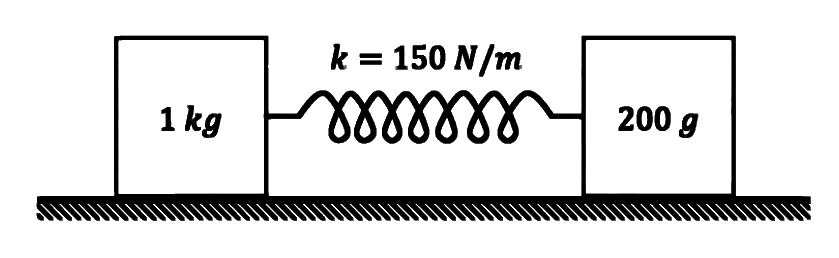
As shown in the figure, a spring is kept in a stretched position with some extension by holding the masses 1 kg and 0.2 kg with a separation more than spring natural length and are released. Assuming the horizontal surface to be frictionless, the angular frequency (in SI unit) of the system is:
Spring Systems · Equal masses on different springs
Two identical point masses P and Q, suspended from two separate massless springs of spring constants k1 and k2, respectively, oscillate vertically. If their maximum speeds are the same, the ratio ( AQ/AP) of the amplitude AQ of mass Q to the amplitude AP of mass P is
Spring Systems · Equal masses on different springs
Two bodies A and B of equal mass are suspended from two massless springs of spring constant k1 and k2, respectively. If the bodies oscillate vertically such that their amplitudes are equal, the ratio of the maximum velocity of A to the maximum velocity of B is
Spring Systems · Time period of a spring-mass system
A spring executes S.H.M. with mass 1 kg attached to it. The force constant of the spring is 4 N/m. If at any instant its velocity is 20 cm/s, the displacement at that instant is (Amplitude of S.H.M. is 0.4 m)
Spring Systems · Time period of a spring-mass system
A mass m is suspended from a spring of negligible mass. The spring is pulled a little and then released, so that mass executes S.H.M. of time period T. If the mass is increased by m0, the periodic time becomes 45T. The ratio Mm0
Spring Systems · Time period of a spring-mass system
A mass x gram is suspended from a light spring. It is pulled in downward direction and released so that mass performs S.H.M. of period T. If mass is increased by Y gram, the period becomes 34T. The ratio of Y/x is
Spring Systems · Time period of a spring-mass system
In an oscillating spring mass system, a spring is connected to a box filled with sand. As the box oscillates, sand leaks slowly out of the box vertically so that the average frequency ω(t) and average amplitude A(t) of the system change with time t. Which one of the following options schematically depicts these changes correctly?
Spring Systems · Time period of a spring-mass system
A block of mass 2 kg is attached to one end of a massless spring whose other end is fixed at a wall. The spring-mass system moves on a frictionless horizontal table. The spring's natural length is 2 m and spring constant is 200 N/m. The block is pushed such that the length of the spring becomes 1 m and then released. At distance x m (x < 2) from the wall, the speed of the block will be
Spring Systems · Vertical spring and static extension
A vertical spring oscillates with period 6 second with mass m is suspended from it. When the mass is at rest, the spring is stretched through a distance of (Take, acceleration due to gravity, g=π2=10 m/s2)
Spring Systems · Vertical spring and static extension
A mass suspended from a vertical spring performs S.H.M. of period 0.1 second. The spring is unstretched at the highest point of suspension. Maximum speed of the mass is (Gravitational acceleration g=10 m/s2)
All the springs in fig. (a), (b) and (c) are identical, each having force constant K each. Mass m is attached to each system. If Ta,Tb and Tc are the time periods of oscillations of the three systems in fig. (a), (b) and (c) respectively, then
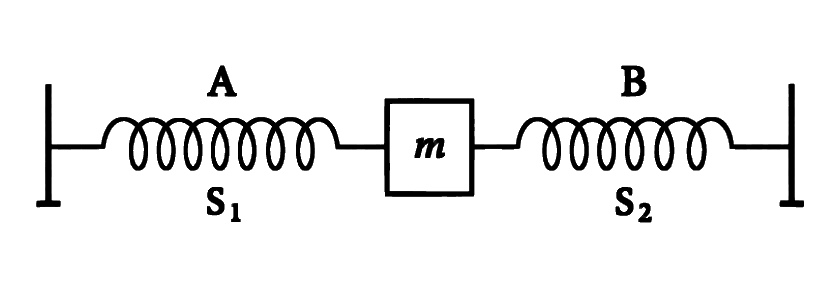
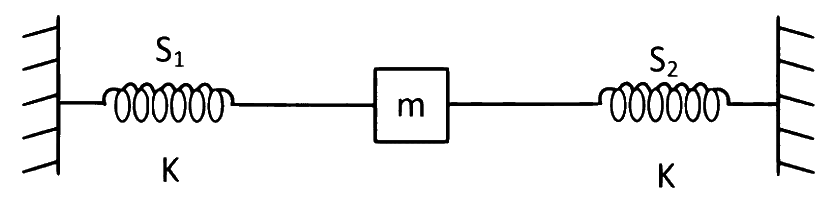
As shown in the figure, S1 and S2 are identical springs with spring constant K each. The oscillation frequency of the mass ' m ' is ' f '. If the spring S2 is removed, the oscillation frequency will become
A mass ' M ' attached to a horizontal spring executes S.H.M. of amplitude A1. When the mass M passes through its mean position, then a smaller mass ' m ' is placed over it and both of them move together with amplitude A2. The ratio (A2A1) is
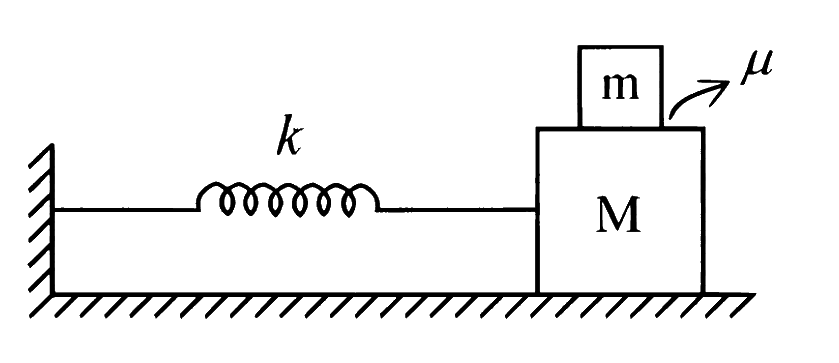
Two blocks of masses m and M,(M>m), are placed on a frictionless table as shown in figure. A massless spring with spring constant k is attached with the lower block. If the system is slightly displaced and released, then ( μ= coefficient of friction between the two blocks) A. The time period of small oscillation of the two blocks is T=2πk(m+M)
B. The acceleration of the blocks is a=−M+mkx ( x= displacement of the blocks from the mean position)
C. The magnitude of the frictional force on the upper block is M+mmμ∣x∣
D. The maximum amplitude of the upper block, if it does not slip, is kμ(M+m)g
E. Maximum frictional force can be μ(M+m)g.
Choose the correct answer from the options given below:
A spring has a certain mass suspended from it and its period of vertical oscillations is T1. The spring is now cut into two equal halves and the same mass is suspended from one of the halves. The period of vertical oscillations is now T2. The ratio of T2/T1 is
Spring Systems · Time period of a spring-mass system
A mass m is suspended from a spring of negligible mass and the system oscillates with a frequency f1. The frequency of oscillations if a mass 9m is suspended from the same spring is f2. The value of f2f1 is ________.
Numerical answer type. Work it out, then open the answer.
Spring Systems · Equal masses on different springs
Two bodies A and B of equal mass are suspended from two separate massless springs of spring constants K1 and K2 respectively. The two bodies oscillate vertically such that their maximum velocities are equal. The ratio of the amplitude of B to that of A is
Spring Systems · Time period of a spring-mass system
A mass ' m ' attached to a spring oscillates with a period of 3 second. If the mass is increased by 0.6 kg, the period increases by 3 second. The initial mass ' m ' is equal to
Spring Systems · Time period of a spring-mass system
Three masses 500 g,300 g and 100 g are suspended at the end of spring as shown in figure and are in equilibrium. When the 500 g mass is removed, the system oscillates with a period of 3 second. When the 300 g mass is also removed it will oscillate with a period of
Spring Systems · Vertical spring and static extension
Frequency of a particle performing S.H.M. is 10 Hz. The particle is suspended from a vertical spring. At the highest point of its oscillation the spring is unstretched. Maximum speed of the particle is (g=10 m/s2)
All the springs in fig. (a), (b) and (c) are identical, each having force constant K. Mass attached to each system is ' m '. If Ta,Tb and Tc are the time periods of oscillations of the three systems respectively, then
A spring has a certain mass suspended from it and its period for vertical oscillations is 'T1'. The spring is now cut in to two equal halves and the same mass is suspended from one of the halves. The period of vertical oscillations is now 'T2 '. The ratio T1/T2 is
Spring Systems · Time period of a spring-mass system
For a simple harmonic motion in a mass spring system shown, the surface is frictionless. When the mass of the block is 1 kg, the angular frequency is ω1. When the mass block is 2 kg the angular frequency is ω2. The ratio ω2/ω1 is
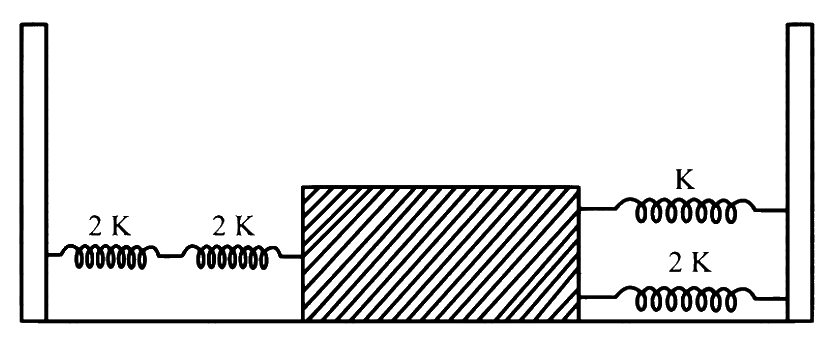
Four massless springs whose force constants are 2K,2K,K and 2K respectively are attached to a mass M kept on a frictionless plane as shown in figure. If mass M is displaced in horizontal direction then frequency of oscillating system is
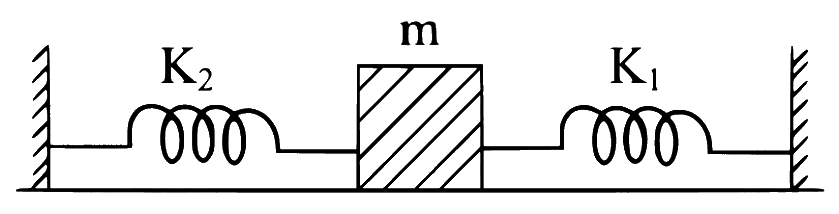
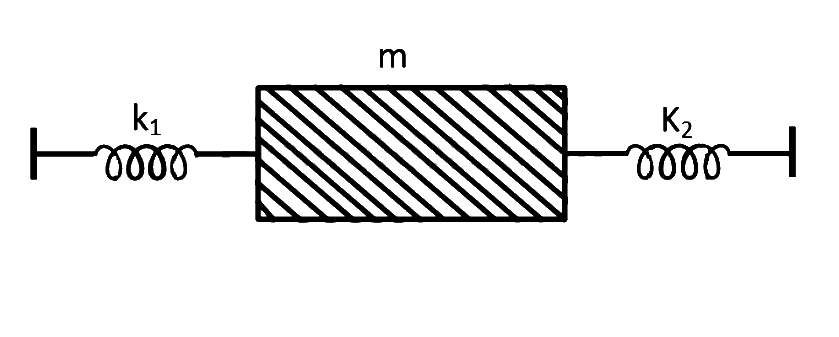
A mass m is attached to two springs as shown in figure. The spring constants of two springs are K1 and K2. For the frictionless surface, the time period of oscillation of mass m is:
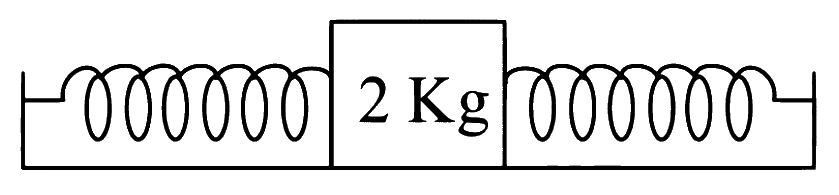
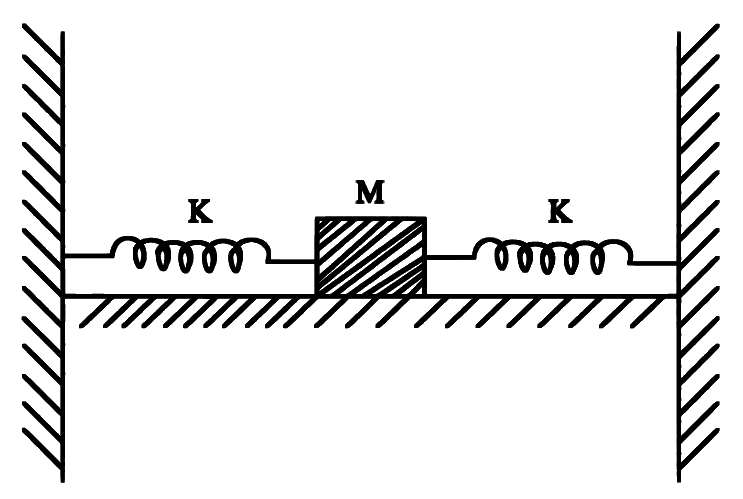
A block of mass 2 kg is attached with two identical springs of spring constant 20 N/m each. The block is placed on a frictionless surface and the ends of the springs are attached to rigid supports (see figure). When the mass is displaced from its equilibrium position, it executes a simple harmonic motion. The time period of oscillation is xπ in SI unit. The value of x is ____________.
Numerical answer type. Work it out, then open the answer.
Spring Systems · Time period of a spring-mass system
A light spring is suspended with mass m1 at its lower end and its upper end fixed to a rigid support. The mass is pulled down a short distance and then released. The period of oscillation is T second. When a mass m2 is added to m1 and the system is made to oscillate, the period is found to be 23T. The ratio m1:m2 is
Spring Systems · Time period of a spring-mass system
The upper end of the spring is fixed and a mass 'm' is attached to its lower end. When mass is slightly pulled down and released, it oscillates with time period 3 second. If mass 'm' is increased by 1 kg, the time period becomes 5 second. The value of 'm' is (mass of spring is negligible)
Spring Systems · Time period of a spring-mass system
A mass m attached to free end of a spring executes SHM with a period of 1s. If the mass is increased by 3 kg the period of the oscillation increases by one second, the value of mass m is ___________ kg.
Numerical answer type. Work it out, then open the answer.
Spring Systems · Vertical spring and static extension
A mass M is suspended from a light spring. An additional mass M1 added extends the spring further by a distance x. Now, the combined mass will oscillate on the spring with period T=
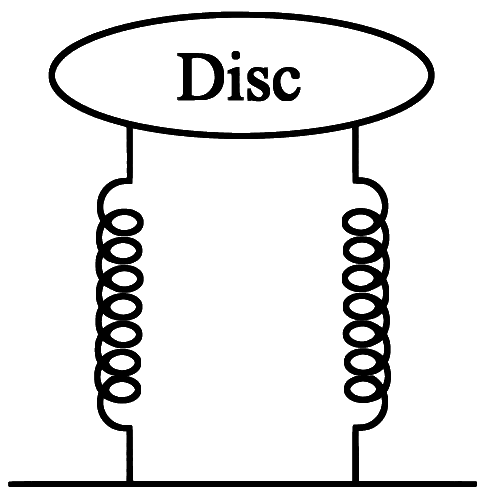
A uniform circular disc of mass 12 kg is held by two identical springs. When the disc is slightly pressed down and released, it executes S.H.M. of period 2 second. The force constant of each spring is (nearly) (Take π2=10)
Under the influence of force F1 the body oscillates with a period T1 and due to another force F2 body oscillates with period T2. If both forces acts simultaneously, then the resultant period is (consider displacement is same in all three cases)
In the figure given below, a block of mass M=490 g placed on a frictionless table is connected with two springs having same spring constant (K=2 N m−1). If the block is horizontally displaced through 'X' m then the number of complete oscillations it will make in 14π seconds will be _____________.
Numerical answer type. Work it out, then open the answer.
Spring Systems · Equal masses on different springs
Two massless springs with spring constants 2 k and 9 k, carry 50 g and 100 g masses at their free ends. These two masses oscillate vertically such that their maximum velocities are equal. Then, the ratio of their respective amplitudes will be:
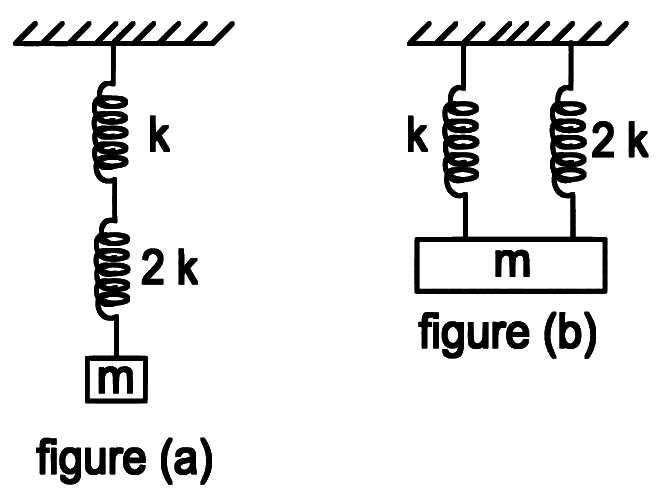
As per given figures, two springs of spring constants k and 2k are connected to mass m. If the period of oscillation in figure (a) is 3 s, then the period of oscillation in figure (b) will be x s. The value of x is ___________.
Numerical answer type. Work it out, then open the answer.
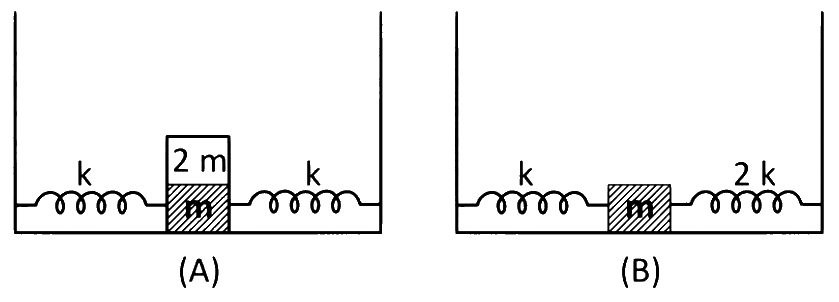
In figure (A), mass '2m' is fixed on mass 'm ' which is attached to two springs of spring constant k. In figure (B), mass 'm' is attached to two springs of spring constant 'k' and '2k. If mass 'm' in (A) and in (B) are displaced by distance 'x horizontally and then released, then time period T1 and T2 corresponding to (A) and (B) respectively follow the relation.
A mass 0.9 kg, attached to a horizontal spring, executes SHM with an amplitude A1. When this mass passes through its mean position, then a smaller mass of 124 g is placed over it and both masses move together with amplitude A2. If the ratio A2A1 is α−1α, then the value of α will be ___________.
Numerical answer type. Work it out, then open the answer.
Spring Systems · Equal masses on different springs
Two particles A and B of equal masses are suspended from two massless springs of spring constants K1 and K2 respectively. If the maximum velocities during oscillations are equal, the ratio of the amplitude of A and B is
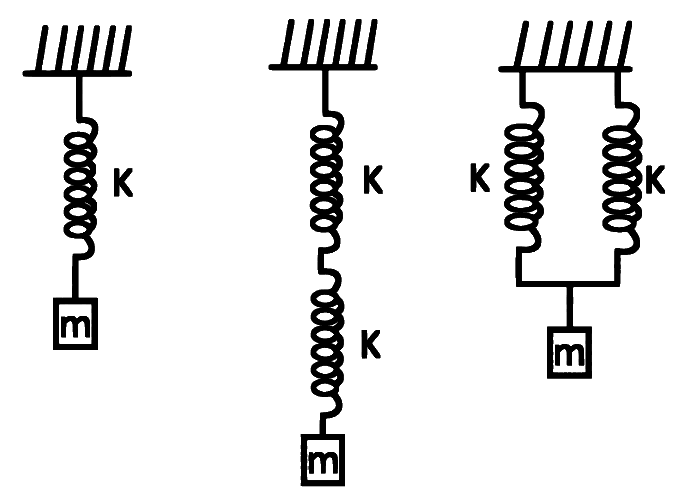
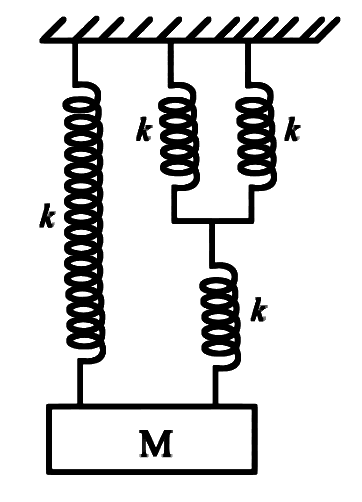
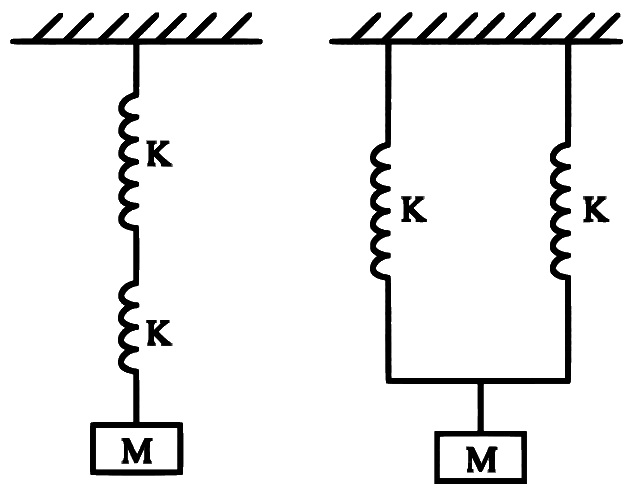
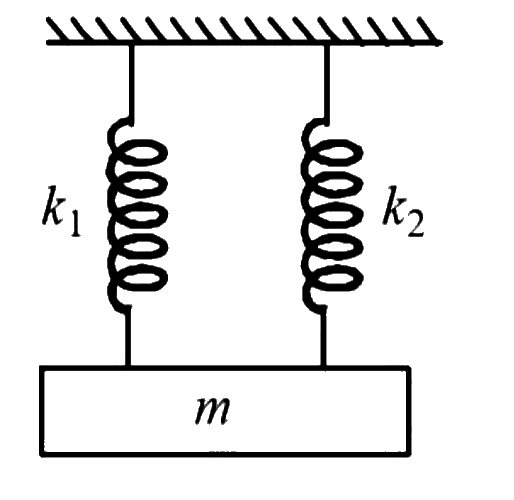
Two identical springs of constant 'K' are connected in series and parallel in shown in figure. A mass 'M' is suspended from them. The ratio of their frequencies is series to parallel combination will be
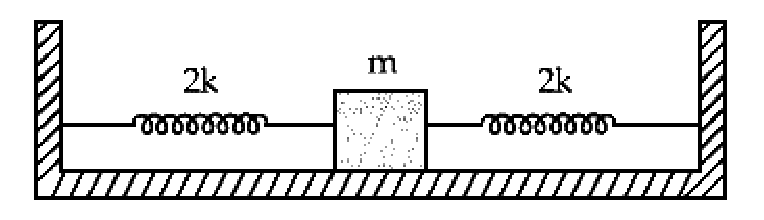
Two identical springs of spring constant '2k' are attached to a block of mass m and to fixed support (see figure). When the mass is displaced from equilibrium position on either side, it executes simple harmonic motion. The time period of oscillations of this system is:
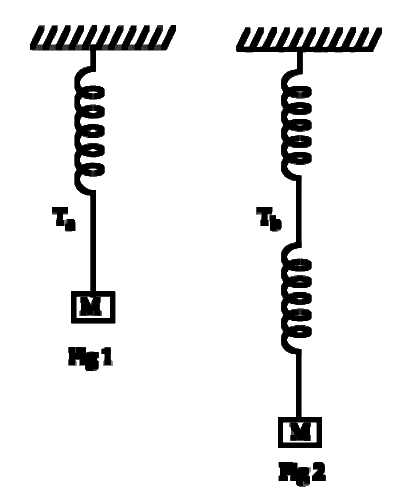
Consider two identical springs each of spring constant k and negligible mass compared to the mass M as shown. Fig. 1 shows one of them and Fig. 2 shows their series combination. The ratios of time period of oscillation of the two SHM is Tb/Ta = x, where value of x is ___________. (Round off to the Nearest Integer)
Numerical answer type. Work it out, then open the answer.
Spring Systems · Time period of a spring-mass system
A mass 'm1 ' is suspended from a spring of negligible mass. A spring is pulled slightly in downward direction and released, mass performs S.H.M. of period 'T1 '. If the mass is increased by 'm2', the time period becomes 'T2'. The ratio m1m2 is
Spring Systems · Time period of a spring-mass system
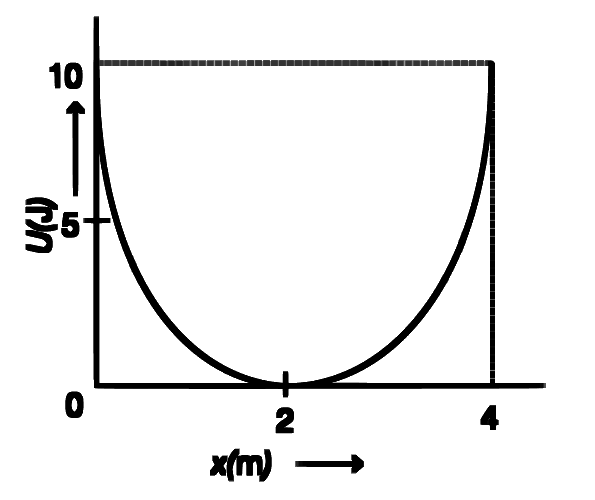
A mass of 5 kg is connected to a spring. The potential energy curve of the simple harmonic motion executed by the system is shown in the figure. A simple pendulum of length 4 m has the same period of oscillation as the spring system. What is the value of acceleration due to gravity on the planet where these experiments are performed?
Spring Systems · Time period of a spring-mass system
The motion of a mass on a spring, with spring constant K is as shown in figure.
The equation of motion is given by
x(t) = A sinωt + B cosωt with ω=mK
Suppose that at time t = 0, the position of mass is x(0) and velocity v(0), then its displacement can also be represented as x(t) = C cos(ωt −ϕ), where C and ϕ are:
Spring Systems · Vertical spring and static extension
A particle is suspended from a vertical spring which is executing S.H.M. of frequency 5 Hz. The spring is unstretched at the highest point of oscillation. Maximum speed of the particle is (g=10 m/s2)
A body executes SHM under the action of force 'F1' with time period 'T1 '. If the force is changed to 'F2', it executes SHM with period 'T2'. If both the forces 'F1 ' and 'F2' act simultaneously in the same direction on the body, its time period is
A particle connected to the end of a spring executes S.H.M. with period 'T1'. While the corresponding period for another spring is 'T2'. If the period of oscillation with two springs in series is 'T', then
A body performs S.H.M. under the action of force 'F1 ' with period 'T1' second. If the force is changed to 'F2' it performs S.H.M. with period 'T2 ' second. If both forces 'F1' and 'F2' act simultaneously in the same direction on the body, the period in second will be
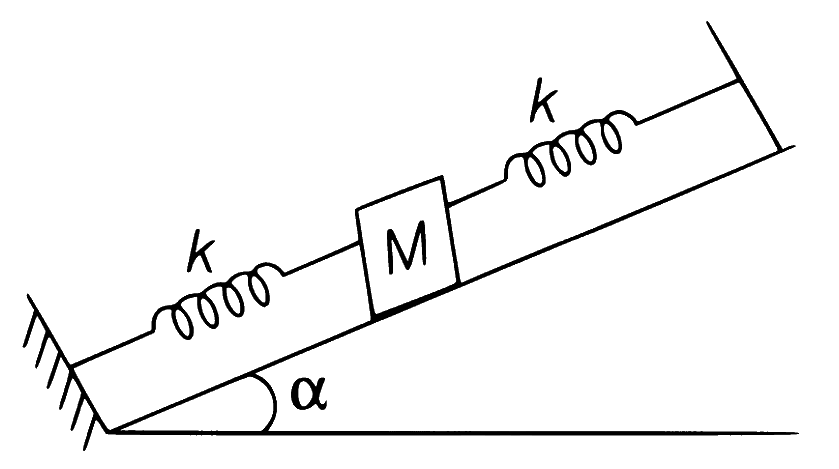
In the given figure, a body of mass M is held between two massless springs, on a smooth inclined plane. The free ends of the springs are attached to firm supports. If each spring has spring constant k, the frequency of oscillation of given body is:
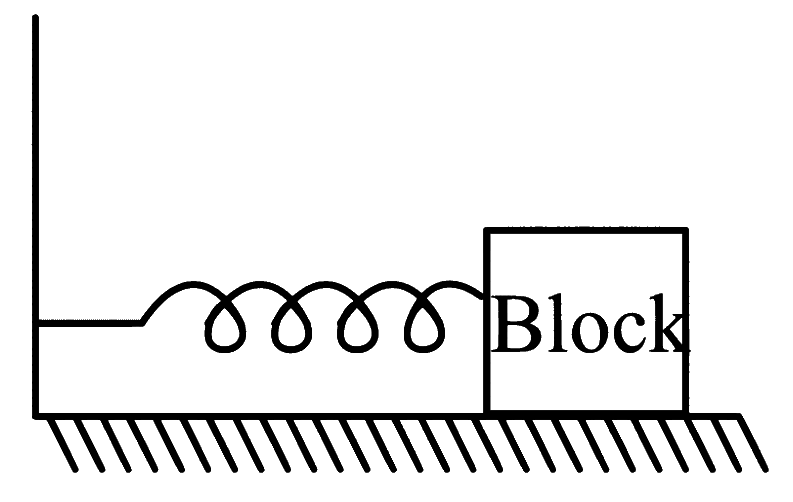
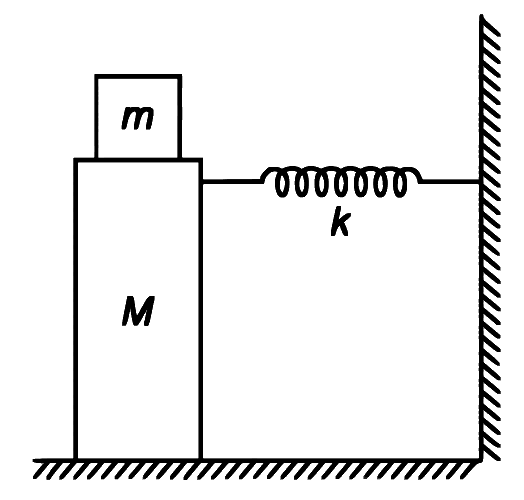
In the given figure, a mass M is attached to a horizontal spring which is fixed on one side to a rigid support. The spring constant of the spring is k. The mass oscillates on a frictionless surface with time period T and amplitude A. When the mass is in equilibrium position, as shown in the figure, another mass m is gently fixed upon it. The new amplitude of oscillations will be:
In the reported figure, two bodies A and B of masses 200 g and 800 g are attached with the system of springs. Springs are kept in a stretched position with some extension when the system is released. The horizontal surface is assumed to be frictionless. The angular frequency will be ____________ rad/s when k = 20 N/m.
Numerical answer type. Work it out, then open the answer.
Spring Systems · Time period of a spring-mass system
A body of mass 64 g is made to oscillate turn by turn on two different springs A and B. Spring A and B has force constant 4mN and 16mN respectively. If T1 and T2 are period of oscillations of springs A and B respectively, then T1−T2T1+T2 will be
Spring Systems · Vertical spring and static extension
A block of mass m attached to one end of the vertical spring produces extension x. If the block is pulled and released, the periodic time of oscillation is
Spring Systems · Equal masses on different springs
Two bodies A and B of equal mass are suspended from two separate massles springs of force constant k1 and k2, respectively. The bodies oscillate vertically such that their maximum velocities are equal. The ratio of the amplitudes of body A to that of body B is
A block of mass m attached to a massless spring is performing oscillatory motion of amplitude ‘A’ on a frictionless horizontal plane. If half of the mass of the block breaks off when it is passing through its equilibrium point, the amplitude of oscillation for the remaining system become fA. The value of f is:
A spring mass system (mass m, spring constant k and natural length l) rests in equilibrium on a horizontal disc. The free end of the spring is fixed at the centre of the disc. If the disc together with spring mass system, rotates about its axis with an angular velocity ω, (k ≫mω2) the relative change in the length of the spring is best given by the option:
Spring Systems · Time period of a spring-mass system
A silver atom in a solid oscillates in simple harmonic motion in some direction with a frequency of 1012/sec. What is the force constant of the bonds connecting one atom with the other? (Mole wt. of silver = 108 and Avogadro number = 6.02 × 10²³ gm mole–1)
An oscillator of mass M is at rest in its equilibrium position in a potential
V = 21 k(x − X)2. A particle of mass m comes from right with speed u and collides completely inelastically with M and sticks to it. This process repeats every time the oscillator crosses its equilibrium position. The amplitude of oscillations after 13 collisions is: (M = 10, m = 5, u = 1, k = 1)
A 1 kg block attached to a spring vibrates with a frequency of 1 Hz on a frictionless horizontal table. Two springs identical to the original spring are attached in parallel to an 8 kg block placed on the same table. So, the frequency of vibration of the 8 kg block is:
A spring of force constant k is cut into lengths of ratio 1: 2: 3. They are connected in series and the new force constant is K'. Then they are connected in parallel and force constant is k''. Then k': k'' is
Spring Systems · Time period of a spring-mass system
A body of mass m is attached to the lower end of a spring whose upper end is fixed. The spring has negligible mass. When the mass m is slightly pulled down and released, it oscillates with a time period of 3s. When the mass m is increased by 1 kg, the time period of oscillations becomes 5 s. The value of m in kg is
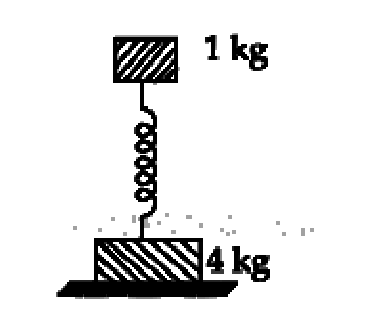
Two bodies of masses 1 kg and 4 kg are connected to a vertical spring, as shown in the figure. The smaller mass executes simple harmonic motion of angular frequency 25 rad /s, and amplitude 1.6 cm while the bigger mass remains stationary on the ground. The maximum force exerted by the system on the floor is (take g = 10 ms ______2).
A mass M, attached to a horizontal spring, executes S.H.M. with amplitude A1. When the mass M passes through its mean position then a smaller mass m is placed over it and both of them move together with amplitude A2. The ratio of (A2A1) is:
Spring Systems · Time period of a spring-mass system
The period of oscillation of a mass M suspended from a spring of negligible mass is T. If along with it another mass M is also suspended, the period of oscillation will now be
Two springs, of force constant k1 and k2 are connected to a mass m as shown. The frequency of oscillation of the mass is f. If both k1 and k2 are made four times their original values, the frequency of oscillation becomes
A particle at the end of a spring executes S.H.M. with a period t1. While the corresponding period for another spring is t2. If the period of oscillation with the two springs in series is T then
The time period of mass suspended from a spring is T. If the spring is cut into four equal parts and the same mass is suspended from one of the parts, then the new time period will be
Spring Systems · Time period of a spring-mass system
A mass M is suspended from a spring of negligible mass. The spring is pulled a little and then released so that the mass executes SHM of time period T. If the mass is increased by m. the time period becomes 35T. Then the ratio of Mm is
Spring Systems · Equal masses on different springs
Two particles A and B of equal masses are suspended from two massless springs of spring constant k1 and k2, respectively. If the maximum velocities, during oscillation, are equal, the ratio of amplitude of A and B is
A mass is suspended separately by two different springs in (successive order then time periods is t1 and t2 respectively, If it is connected by both spring as shown in figure then time period is t0, the correct relation is
Spring Systems · Time period of a spring-mass system
A mass m is vertically suspended from a spring of negligible mass; the system oscillates with a frequency n. What will be the frequency of the system, if a mass 4m is suspended from the same spring?
Spring Systems · Vertical spring and static extension
A body of mass 5 kg hangs from a spring and oscillates with a time period of 2π seconds. If the ball is removed, the length of the spring will decrease by
A mass m is suspended from the two coupled springs connected in series. The force constant for springs are k1 and k2. The time period of the suspended mass will be