Velocity & Acceleration in SHM · Velocity at a displacement
A particle executing simple harmonic motion starts from mean position with amplitude 'A' and periodic time 'T'. At what displacement is its speed one-fourth of the maximum speed?
Velocity & Acceleration in SHM · Velocity at a displacement
The velocity of a particle executing simple harmonic motion along x-axis is described as v2=50−x2, where x represents displacement. If the time period of motion is 7x s, the value of x is ______.
Numerical answer type. Work it out, then open the answer.
Velocity & Acceleration in SHM · Maximum velocity and acceleration
Two particles performing simple harmonic motions of maximum accelerations, 1 m/s2 and 100 m/s2, have the same amplitudes. The ratio of their angular frequencies is
Velocity & Acceleration in SHM · Maximum velocity and acceleration
A body of mass 0.4 kg performs simple harmonic motion. It experiences a restoring force of 0.4 N when its displacement from the mean position is 4 cm. The force constant and magnitude of acceleration respectively are
Velocity & Acceleration in SHM · Velocity at a displacement
A particle executes S.H.M. with time period 16 s. At time t=2 s, the particle crosses the mean position while at t=4 s, velocity is 4 m/s. The amplitude of motion (in m) is (sin45∘=21)
Velocity & Acceleration in SHM · Velocity at a displacement
A particle executes linear S.H.M. with amplitude 4 cm. The magnitude of velocity and acceleration is equal when it is at 3 cm from mean position. Time period is
Velocity & Acceleration in SHM · Graphs and phase relations
Consider a spring-mass simple harmonic oscillator in one dimension. The mass of the particle is m kg and the spring constant is k N m−1. At a given instant, the extension of the spring is x-meter and the speed of the particle is v m s−1. On the x−v plane, if the graph of v as a function of x is a circle, then the correct option is:
Velocity & Acceleration in SHM · Velocity at a displacement
A simple pendulum starts oscillating simple harmonically from its mean position ( x=0) with amplitude ' a ' and periodic time ' T '. The magnitude of velocity of pendulum at x=2a is
Velocity & Acceleration in SHM · Velocity at a displacement
A particle executes S.H.M. starting from the mean position. Its amplitude is ' a ' and its periodic time is ' T '. At a certain instant, its speed ' u ' is half that of maximum speed Vmax. The displacement of the particle at that instant is
Velocity & Acceleration in SHM · Graphs and phase relations
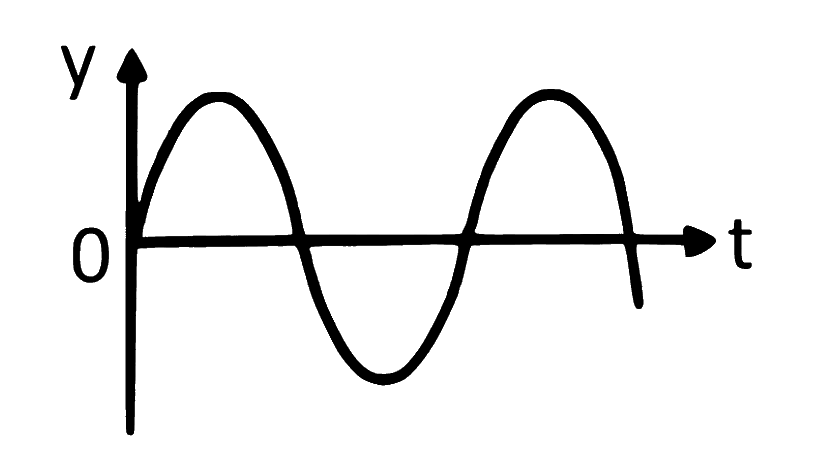
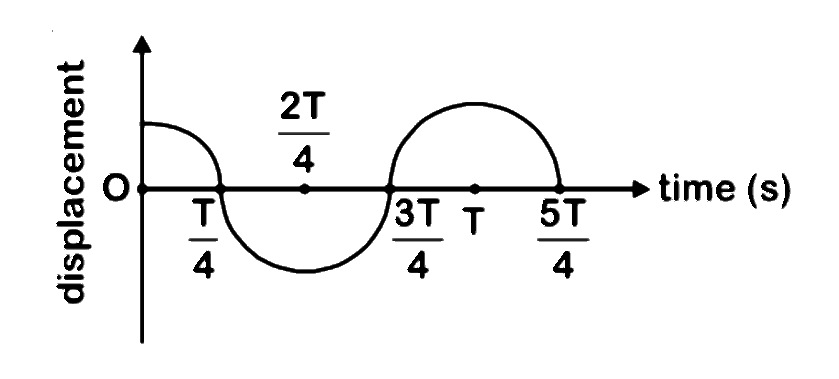
A particle is performing S.H.M. starting from extreme position. Graphical representation shows that between displacement and acceleration, there is a phase difference of
Velocity & Acceleration in SHM · Velocities at two positions
A particle executes a linear S.H.M. In two of its positions the velocities are V1,V2 and accelerations are a1 and a2 respectively (0<a1<a2). The distance between the positions is
Velocity & Acceleration in SHM · Velocity at a displacement
For a particle executing S.H.M. having amplitude A, the speed of the particle is (31)rd of its maximum speed when the displacement from the mean position is
Velocity & Acceleration in SHM · Velocity at a displacement
A particle is performing S.H.M. about its mean position with an amplitude ' a ' and periodic time ' T '. The speed of the particle when its displacement from mean position is 3a will be
Velocity & Acceleration in SHM · Velocity at a displacement
A particle is performing S.H.M. with an amplitude 4 cm. At the mean position the velocity of the particle is 12 cm/s. When the speed of the particle becomes 6 cm/s, the distance of the particle from mean position is
Velocity & Acceleration in SHM · Maximum velocity and acceleration
The maximum velocity and maximum acceleration of a particle performing a linear S.H.M. is ' α ' and ' β ' respectively. Then the path length of the particle is
Velocity & Acceleration in SHM · Velocity at a displacement
A particle performing S.H.M. starts from equilibrium position and its time period is 12 second. After 2 seconds its velocity is π m/s. Amplitude of the oscillation is
Velocity & Acceleration in SHM · Velocity at a displacement
The velocity of particle executing S.H.M. varies with displacement (x) as 4V2=50−x2. The time period of oscillation is 7x second. The value of ' x ' is (Take π=722)
Velocity & Acceleration in SHM · Velocity at a displacement
The displacement of a particle executing SHM is given by x=10sin(ωt+3π) m. The time period of motion is 3.14 s. The velocity of the particle at t=0 is _______ m/s.
Numerical answer type. Work it out, then open the answer.
Velocity & Acceleration in SHM · Velocity at a displacement
A particle performs simple harmonic motion with amplitude A. Its speed is increased to three times at an instant when its displacement is 32A. The new amplitude of motion is 3nA. The value of n is ___________.
Numerical answer type. Work it out, then open the answer.
Velocity & Acceleration in SHM · Velocity at a displacement
A particle executes simple harmonic motion with an amplitude of 4 cm. At the mean position, velocity of the particle is 10 cm/s. The distance of the particle from the mean position when its speed becomes 5 cm/s is α cm, where α= ________.
Numerical answer type. Work it out, then open the answer.
Velocity & Acceleration in SHM · Velocities at two positions
A particle performs linear S.H.M. When the displacement of the particle from mean position is 3 cm and 4 cm, corresponding velocities are 8 cm/s and 6 cm/s respectively. Its periodic time is
Velocity & Acceleration in SHM · Velocities at two positions
A particle is executing a linear simple harmonic motion. Let ' V1 ' and ' V2 ' are its speed at distance ' x1 ' and ' x2 ' from the equilibrium position. The amplitude of oscillation is
Velocity & Acceleration in SHM · Velocities at two positions
The position, velocity and acceleration of a particle executing simple harmonic motion are found to have magnitudes of 4 m,2 m s−1 and 16 m s−2 at a certain instant. The amplitude of the motion is x m where x is _________.
Numerical answer type. Work it out, then open the answer.
Velocity & Acceleration in SHM · Vertical SHM and loss of contact
A horizontal platform with a small object placed on it executes a linear S.H.M. in the vertical direction. The amplitude of oscillation is 40 cm. What should be the least period of these oscillations, so that the object is not detached from the platform? [Take g=10 m/s2]
Velocity & Acceleration in SHM · Velocities at two positions
A particle performs linear S.H.M. At a particular instant, velocity of the particle is ' u ' and acceleration is ' α ' while at another instant, velocity is ' v ' and acceleration is ' β ' (0<α<β). The distance between the two positions is
Velocity & Acceleration in SHM · Velocities at two positions
A particle performs linear S.H.M. At a particular instant, velocity of the particle is ' u ' and acceleration is ' a1 ' while at another instant velocity is ' v ' and acceleration is ' a2 ' (0<a1<a2). The distance between the two positions is
Velocity & Acceleration in SHM · Maximum velocity and acceleration
The maximum velocity of a particle performing S.H.M. is 'V'. If the periodic time is made (31)rd and the amplitude is doubled, then the new maximum velocity of the particle will be
Velocity & Acceleration in SHM · Velocity at a displacement
The velocity of a particle executing SHM varies with displacement (x) as 4v2=50−x2. The time period of oscillations is 7x s. The value of x is ___________. ( Take π=722)
Numerical answer type. Work it out, then open the answer.
Velocity & Acceleration in SHM · Maximum velocity and acceleration
A rectangular block of mass 5 kg attached to a horizontal spiral spring executes simple harmonic motion of amplitude 1 m and time period 3.14 s. The maximum force exerted by spring on block is _________ N
Numerical answer type. Work it out, then open the answer.
Velocity & Acceleration in SHM · Maximum velocity and acceleration
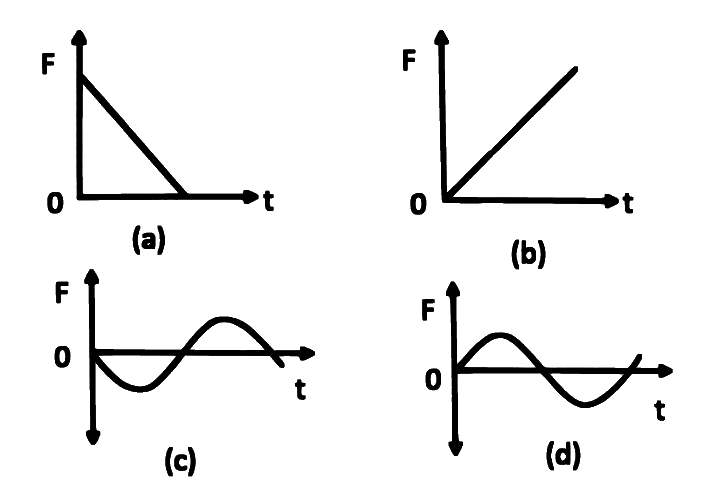
A particle of mass 250 g executes a simple harmonic motion under a periodic force F=(−25x) N. The particle attains a maximum speed of 4 m/s during its oscillation. The amplitude of the motion is ___________ cm.
Numerical answer type. Work it out, then open the answer.
Velocity & Acceleration in SHM · Vertical SHM and loss of contact
A block of mass 'M' rests on a piston executing S.H.M. of period one second. The amplitude of oscillations, so that the mass is separated from the piston, is (acceleration due to gravity, g=10 m s−2,π2=10)
Velocity & Acceleration in SHM · Maximum velocity and acceleration
A particle executing SHM has its velocity 20 cm s−1 at mean position and acceleration of 25 cm s−2 at one of its extreme position. The amplitude of the particle will be ____ cm.
Numerical answer type. Work it out, then open the answer.
Velocity & Acceleration in SHM · Velocity at a displacement
A body is performing simple harmonic with an amplitude of 10 cm. The velocity of the body was tripled by air jet when it is at 5 cm from its mean position. The new amplitude of vibration is x cm. The value of x is _____________.
Numerical answer type. Work it out, then open the answer.
Velocity & Acceleration in SHM · Velocity at a displacement
A particle executing S.H.M starts from the mean position. Its amplitude is 'A' and time period 'T'. At what displacement its speed is one-fourth of the maximum speed?
Velocity & Acceleration in SHM · Velocity at a displacement
A particle executes S.H.M. with amplitude 'a', and time period 'T'. The displacement of the particle when its speed is half of maximum speed is 2xa. The value of x is __________.
Numerical answer type. Work it out, then open the answer.
Velocity & Acceleration in SHM · Maximum velocity and acceleration
The displacement of a particle performing S.H.M. is given by x=5sin(3t+3), where x is in cm and t is in second. The maximum acceleration of the particle will be
Velocity & Acceleration in SHM · Velocity at a displacement
A particle executes S.H.M. of period 32π second along a straight line 4 cm long. The displacement of the particle at which the velocity is numerically equal to the acceleration is
Velocity & Acceleration in SHM · Maximum velocity and acceleration
A particle performing linear S.H.M. of amplitude 0.1 m has displacement 0.02 m and acceleration 0.5 m/s2. The maximum velocity of the particle in m/s is
Velocity & Acceleration in SHM · Velocities at two positions
A particle is making simple harmonic motion along the X-axis. If at a distances x1 and x2 from the mean position the velocities of the particle are v1 and v2 respectively. The time period of its oscillation is given as:
Velocity & Acceleration in SHM · Velocity at a displacement
A particle is performing a linear simple harmonic motion of amplitude ' A '. When it is midway between its mean and extreme position, the magnitudes of its velocity and acceleration are equal. What is the periodic time of the motion?
Velocity & Acceleration in SHM · Velocity at a displacement
A particle executes simple harmonic motion with an amplitude of 5 cm. When the particle is at 4 cm from the mean position, the magnitude of its velocity in SI units is equal to that of its acceleration. Then, its periodic time in seconds is -
Velocity & Acceleration in SHM · Graphs and phase relations
If ' x ', v ' and ' a ' denote the displacement, velocity and acceleration of a particle respectively executing SHM of periodic time T then which one of the following does not change with time?
Velocity & Acceleration in SHM · Maximum velocity and acceleration
A pendulum is hung from the roof of a sufficiently high building and is moving freely to and fro like a simple harmonic oscillator. The acceleration of the bob of the pendulum is 20 m s–2 at a distance of 5 m from the mean position. The time period of oscillation is
Velocity & Acceleration in SHM · Velocity at a displacement
A particle executes linear simple harmonic motion with an amplitude of 3 cm. When the particle is at 2 cm from the mean position, the magnitude of its velocity is equal to that of its acceleration. Then its time period in second is
Velocity & Acceleration in SHM · Maximum velocity and acceleration
The ratio of maximum acceleration to maximum velocity in a simple harmonic motion is 10 s−1. At, t = 0 the displacement is 5 m. What is the maximum acceleration? The initial phase is 4π.
Velocity & Acceleration in SHM · Velocity at a displacement
A particle performs simple harmonic motion with amplitude A. Its speed is trebled at the instant that it is at a distance 32A from equilibrium position. The new amplitude of the motion is:
Velocity & Acceleration in SHM · Vertical SHM and loss of contact
In an engine the piston undergoes vertical simple harmonic motion with amplitude 7 cm. A washer rests on top of the piston and moves with it. The motor speed is slowly increased. The frequency of the piston at which the washer no longer stays in contact with the piston, is close to:
Velocity & Acceleration in SHM · Velocities at two positions
A particle is executing SHM along a straight line. Its velocities at distances x1 and x2 from the mean position are V1 and V2 respectively. Its time period is
Velocity & Acceleration in SHM · Graphs and phase relations
A particle of mass m oscillates along x-axis according to equation x = asinωt. The nature of the graph between momentum and displacement of the particle is
Velocity & Acceleration in SHM · Vertical SHM and loss of contact
A mass m=1.0 kg is put on a flat pan attached to a vertical spring fixed on the ground. The mass of the spring and the pan is negligible. When pressed slightly and released, the mass executes simple harmonic motion. The spring constant is 500 N/m. What is the amplitude A of the motion, so that the mass m tends to get detached from the pan? (Take g=10 m/s2 ). The spring is stiff enough so that it does not get distorted during the motion.
Velocity & Acceleration in SHM · Graphs and phase relations
If x,v and a denote the displacement, the velocity and the acceleration of a particle executing simple harmonic motion of time period T, then, which of the following does not change with time?
Velocity & Acceleration in SHM · Vertical SHM and loss of contact
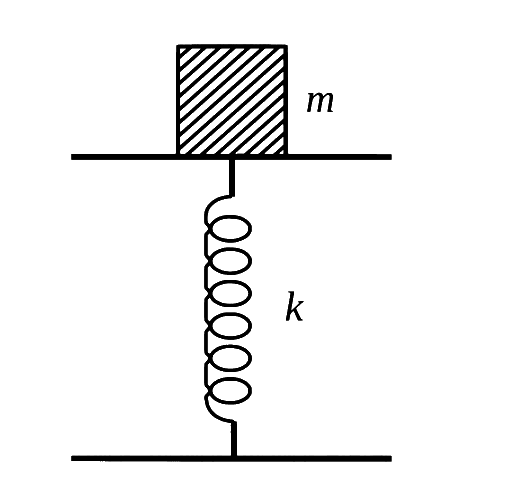
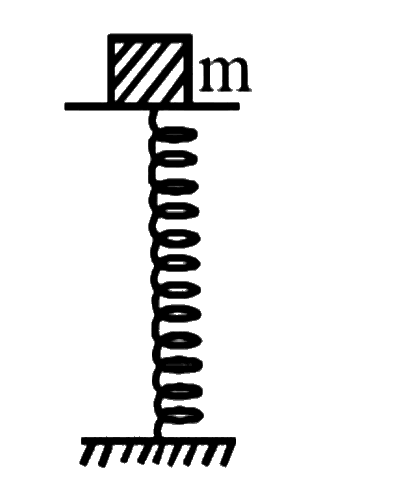
A mass of 2.0 kg is put on a flat pan attached to a vertical spring fixed on the ground as shown in the figure. The mass of the spring and the pan is negligible.
When pressed slightly and released the mass executes a simple harmonic motion. The spring constant is 200 N/m. What should be the minimum amplitude of the motion so that the mass gets detached from the pan (take g = 10 m/s2).
Velocity & Acceleration in SHM · Vertical SHM and loss of contact
A coin is placed on a horizontal platform which undergoes vertical simple harmonic motion of angular frequency ω. The amplitude of oscillation is gradually increased. The coin will leave contact with the platform for the first time
Velocity & Acceleration in SHM · Velocity at a displacement
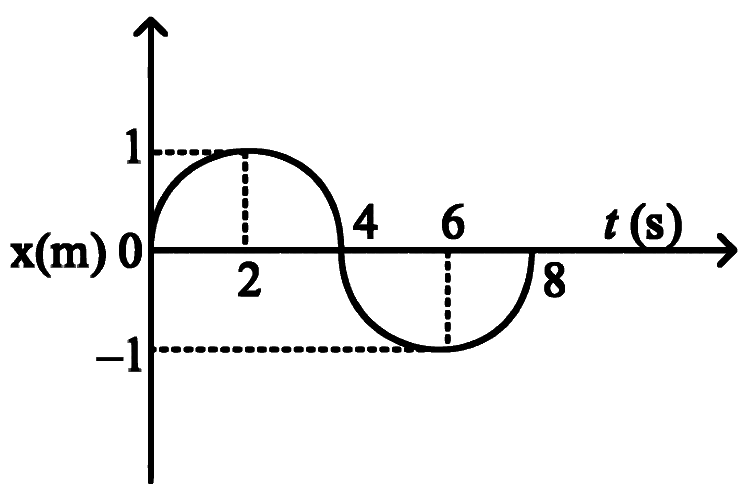
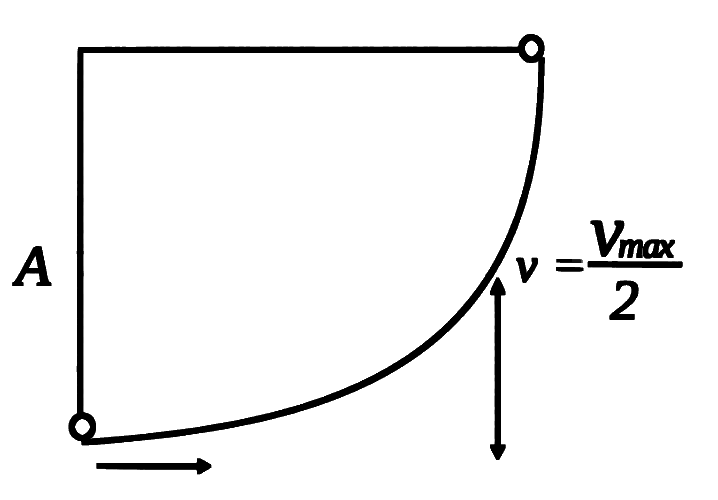
A particle starts with S.H.M. from the mean position as shown in the figure. Its amplitude is A and its time period is T. At one time, its speed is half that of the maximum speed. What is this displacement?
Velocity & Acceleration in SHM · Maximum velocity and acceleration
If a simple harmonic oscillator has got a displacement of 0.02 m and acceleration equal to 2.0 m/s2 at any time, the angular frequency of the oscillator is equal to
Velocity & Acceleration in SHM · Velocities at two positions
A body is executing simple harmonic motion. When the displacements from the mean position is 4 cm and 5 cm, the corresponding velocities of the body is 10 cm/sec and 8 cm/sec. Then the time period of the body is