Q1 MHT CET 2026 · 14 MAY · SHIFT 2 Easy ☆
Intrinsic & Extrinsic Semiconductors · Intrinsic semiconductors
In an intrinsic semiconductor, at any ordinary temperature, the correct relation between the number of electrons per unit volume (n e n_e n e n h n_h n h
(a) n e = n h n_e = n_h n e = n h (b) n e > n h n_e > n_h n e > n h (c) n e < n h n_e < n_h n e < n h (d) n e = n h = 0 n_e = n_h = 0 n e = n h = 0 Show answer and solution
Answer: (a)
Loading the solution…
Report a mistake Q2 MHT CET 2026 · 18 APR · SHIFT 2 Easy ☆
Intrinsic & Extrinsic Semiconductors · Intrinsic semiconductors
For intrinsic semiconductor, if n h n_h n h n e n_e n e
(a) n h < n e n_h < n_e n h < n e (b) n h > n e n_h > n_e n h > n e (c) n h = n e n_h = n_e n h = n e (d) n h ≠ n e n_h \neq n_e n h = n e Show answer and solution
Answer: (c)
Loading the solution…
Report a mistake Q3 MHT CET 2026 · 11 APR · SHIFT 1 Easy ☆
Intrinsic & Extrinsic Semiconductors · Intrinsic semiconductors
When the conductivity of a semiconductor is only due to breaking of covalent bonds, the semiconductor is called
(a) extrinsic. (b) intrinsic. (c) p-type. (d) n-type. Show answer and solution
Answer: (b)
Loading the solution…
Report a mistake Q4 MHT CET 2026 · 19 MAY · SHIFT 2 Easy ☆
Intrinsic & Extrinsic Semiconductors · n-type & p-type doping
In the energy band diagram of a p-type semiconductor, the "Acceptor Energy Level" is located
(a) exactly in the middle of the forbidden gap (b) inside the conduction band (c) just below the conduction band (d) just above the valence band Show answer and solution
Answer: (d)
Loading the solution…
Report a mistake Q5 MHT CET 2026 · 15 MAY · SHIFT 2 Easy ☆
Intrinsic & Extrinsic Semiconductors · n-type & p-type doping
At room temperature, a p-type semiconductor has
(a) large number of holes and few electrons (b) large number of free electrons and few holes (c) equal number of free electrons and holes (d) no electrons or holes Show answer and solution
Answer: (a)
Loading the solution…
Report a mistake Q6 MHT CET 2026 · 20 APR · SHIFT 1 Easy ☆
Intrinsic & Extrinsic Semiconductors · n-type & p-type doping
In the band structure of n-type semiconductor, the free electrons donated by impurity atoms occupy energy levels in
(a) the conduction band. (b) the valence band. (c) the band gap and are close to conduction band. (d) the band gap and are close to valence band. Show answer and solution
Answer: (c)
Loading the solution…
Report a mistake Q7 MHT CET 2026 · 19 APR · SHIFT 1 Easy ☆
Intrinsic & Extrinsic Semiconductors · n-type & p-type doping
In n-type semiconductor
A) pentavalent impurity are dopants and holes are majority carriers.
B) trivalent impurity are dopants and electrons are minority carriers.
C) pentavalent impurity are dopants and electrons are majority carriers.
D) trivalent impurity are dopants and holes are majority carriers.
Show answer and solution
Answer: (b)
Loading the solution…
Report a mistake Q8 MHT CET 2026 · 16 APR · SHIFT 1 Easy ☆
Intrinsic & Extrinsic Semiconductors · n-type & p-type doping
When a small amount of impurity atoms are added to a semiconductor then generally its resistivity
(a) increases (b) decreases (c) does not change (d) may increase or decrease depending upon the percentage of doping Show answer and solution
Answer: (b)
Loading the solution…
Report a mistake Q9 MHT CET 2026 · 12 MAY · SHIFT 2 Easy ☆
Intrinsic & Extrinsic Semiconductors · Mass action law
Pure silicon crystal at 300 300 300 2 × 1 0 16 2 \times 10^{16} 2 × 1 0 16 3 {}^{3} 3 4 × 1 0 22 4 \times 10^{22} 4 × 1 0 22 3 {}^{3} 3
(a) 5 × 1 0 9 / m 3 5 \times 10^{9}/\text{m}^{3} 5 × 1 0 9 / m 3 (b) 1 0 10 / m 3 10^{10}/\text{m}^{3} 1 0 10 / m 3 (c) 8 × 1 0 10 / m 3 8 \times 10^{10}/\text{m}^{3} 8 × 1 0 10 / m 3 (d) 1 0 9 / m 3 10^{9}/\text{m}^{3} 1 0 9 / m 3 Show answer and solution
Answer: (b)
Loading the solution…
Report a mistake Q10 MHT CET 2026 · 13 APR · SHIFT 2 Easy ☆
Intrinsic & Extrinsic Semiconductors · Mass action law
A pure silicon crystal at temperature 300 300 300 n i n_i n i 1 0 16 10^{16} 1 0 16 3 {}^{3} 3 1 0 21 10^{21} 1 0 21 n e n_e n e
(a) 1 0 19 10^{19} 1 0 19 3 {}^{3} 3 (b) 1 0 21 10^{21} 1 0 21 3 {}^{3} 3 (c) 1 0 5 10^{5} 1 0 5 3 {}^{3} 3 (d) 1 0 11 10^{11} 1 0 11 3 {}^{3} 3 Show answer and solution
Answer: (d)
Loading the solution…
Report a mistake Q11 MHT CET 2026 · 19 MAY · SHIFT 1 Medium ☆
Intrinsic & Extrinsic Semiconductors · n-type & p-type doping
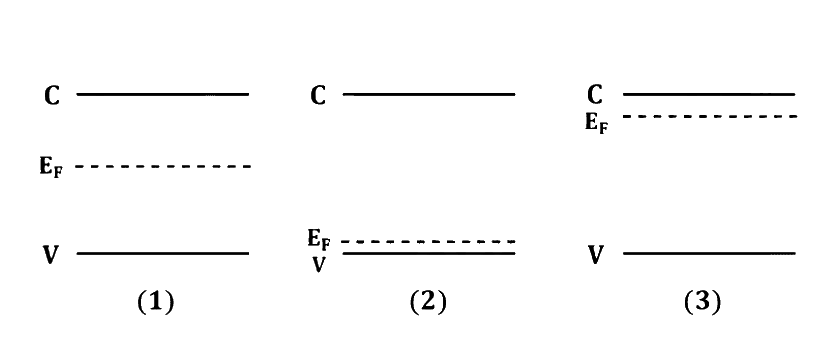
The band diagrams of three semiconductors p, n and intrinsic are given in the figures (1), (2) and (3). C and V are the conduction and valence bands and E F E_F E F
(a) intrinsic, n and p (b) p, intrinsic and n (c) intrinsic, p and n (d) n, intrinsic and p Show answer and solution
Answer: (b)
Loading the solution…
Report a mistake Q12 MHT CET 2025 · 23 APR · SHIFT 1 Easy ☆
Intrinsic & Extrinsic Semiconductors · n-type & p-type doping
Which of the following statements is TRUE for n-type semiconductor?
(a) Holes are majority carriers and trivalent atoms are dopants. (b) Electrons are majority carriers and trivalent atoms are dopants. (c) Holes are minority carriers and pentavalent atoms are dopants. (d) Electrons are minority carriers and pentavalent atoms are dopants. Show answer and solution
Answer: (c)
Loading the solution…
Report a mistake Q13 MHT CET 2025 · 22 APR · SHIFT 2 Easy ☆
Intrinsic & Extrinsic Semiconductors · n-type & p-type doping
In n-type semiconductor, free electrons donated by the impurity atoms occupy energy levels in
(a) the conduction band. (b) the valence band. (c) the band gap and are close to the conduction band. (d) the band gap and are close to the valence band. Show answer and solution
Answer: (c)
Loading the solution…
Report a mistake Q14 MHT CET 2025 · 22 APR · SHIFT 1 Easy ☆
Intrinsic & Extrinsic Semiconductors · Mass action law
In a pure silicon crystal electron-hole concentration is 1 0 16 10^{16} 1 0 16 m 3 \text{m}^{3} m 3 1 0 21 10^{21} 1 0 21 m 3 \text{m}^{3} m 3
(a) 1 0 5 10^{5} 1 0 5 (b) 1 0 11 10^{11} 1 0 11 (c) 1 0 19 10^{19} 1 0 19 (d) 1 0 21 10^{21} 1 0 21 Show answer and solution
Answer: (b)
Loading the solution…
Report a mistake Q15 MHT CET 2025 · 25 APR · SHIFT 2 Easy ☆
Intrinsic & Extrinsic Semiconductors · Effect of temperature
A piece of semiconductor is connected in series in an electric circuit. On increasing the temperature, the current in the circuit will
(a) decrease. (b) remain unchanged. (c) increase. (d) stop flowing. Show answer and solution
Answer: (c)
Loading the solution…
Report a mistake Q16 MHT CET 2025 · 23 APR · SHIFT 2 Easy ☆
Intrinsic & Extrinsic Semiconductors · Effect of temperature
By increasing the temperature, the specific resistance of a conductor and a semiconductor respectively
(a) increases, increases. (b) decreases, decreases. (c) increases, decreases. (d) decreases, increases. Show answer and solution
Answer: (c)
Loading the solution…
Report a mistake Q17 MHT CET 2025 · 21 APR · SHIFT 1 Easy ☆
Intrinsic & Extrinsic Semiconductors · Effect of temperature
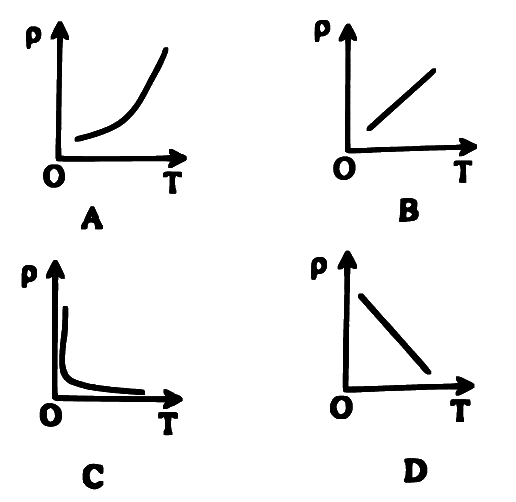
Which graph shows correctly the temperature (T). dependence of resistivity ( ρ ) (\rho) ( ρ )
Show answer and solution
Answer: (a)
Loading the solution…
Report a mistake Q18 JEE Main 2025 · 4 APR · SHIFT 2 Medium ☆
Intrinsic & Extrinsic Semiconductors · n-type & p-type doping
Consider a n-type semiconductor in which n e n_e n e n h n_h n h
(A) Holes are minority carriers
(B) The dopant is a pentavalent atom
(C) n e n h ≠ n i 2 n_e n_h \neq n_i^2 n e n h = n i 2
(where n i n_i n i n e n h ⩾ n i 2 n_e n_h \geqslant n_i^2 n e n h ⩾ n i 2
(E) The holes are not generated due to the donors
Choose the correct answer from the options given below:
(a) (A), (B), (E) only (b) (A), (C), (E) only (c) (A), (B), (C) only (d) (A), (C), (D) only Show answer and solution
Answer: (a)
Loading the solution…
Report a mistake Q19 MHT CET 2024 · 16 MAY · SHIFT 2 Easy ☆
Intrinsic & Extrinsic Semiconductors · n-type & p-type doping
When a small amount of impurity atoms are added to semiconductor, then generally its resistivity
(a) may increase or decrease depending upon the percentage of doping. (b) increases. (c) decreases. (d) does not change. Show answer and solution
Answer: (c)
Loading the solution…
Report a mistake Q20 MHT CET 2024 · 15 MAY · SHIFT 1 Easy ☆
Intrinsic & Extrinsic Semiconductors · n-type & p-type doping
In an extrinsic n-type semiconductor, the free electrons donated by the impurity atoms occupy energy levels in
(a) the conduction band. (b) the valance band. (c) the band gap and are close to conduction band. (d) the band gap and are close to valance band. Show answer and solution
Answer: (c)
Loading the solution…
Report a mistake Q21 MHT CET 2024 · 3 MAY · SHIFT 2 Easy ☆
Intrinsic & Extrinsic Semiconductors · n-type & p-type doping
Which one of the following statements is true? A p-type semiconductor is doped with
(a) trivalent impurity and electrons are majority carriers. (b) pentavalent impurity and electrons are minority carriers. (c) pentavalent impurity and holes are minority carriers. (d) trivalent impurity and holes are majority carriers. Show answer and solution
Answer: (d)
Loading the solution…
Report a mistake Q22 MHT CET 2024 · 11 MAY · SHIFT 1 Easy ☆
Intrinsic & Extrinsic Semiconductors · Mass action law
If ' n e n_e n e n h n_h n h
(a) n e ≫ n h n_e \gg n_h n e ≫ n h (b) n e ≪ n h n_e \ll n_h n e ≪ n h (c) n e ⩽ n h n_e \leqslant n_h n e ⩽ n h (d) n e = n h n_e = n_h n e = n h Show answer and solution
Answer: (a)
Loading the solution…
Report a mistake Q23 JEE Main 2024 · 6 APR · SHIFT 2 Medium ☆
Intrinsic & Extrinsic Semiconductors · n-type & p-type doping
The acceptor level of a p-type semiconductor is 6 eV 6\text{ eV} 6 eV h c = 1242 eV nm hc = 1242\text{ eV nm} h c = 1242 eV nm
(a) 407 nm (b) 103.5 nm (c) 414 nm (d) 207 nm Show answer and solution
Answer: (d)
Loading the solution…
Report a mistake Q24 JEE Main 2024 · 1 FEB · SHIFT 2 Difficult ☆
Intrinsic & Extrinsic Semiconductors · Effect of temperature
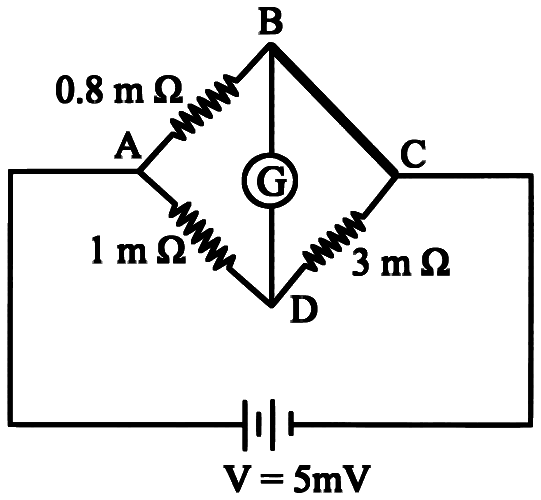
To measure the temperature coefficient of resistivity α \alpha α 2 5 ∘ C 25^\circ\text{C} 2 5 ∘ C 3 m Ω 3\text{ m}\Omega 3 m Ω BC \text{BC} BC 2 ∘ C/s 2^\circ\text{C/s} 2 ∘ C/s G \text{G} G 10 s 10\text{ s} 10 s α \alpha α
(a) − 1 × 1 0 − 2 ∘ C − 1 -1 \times 10^{-2}\ {}^\circ\text{C}^{-1} − 1 × 1 0 − 2 ∘ C − 1 (b) − 2 × 1 0 − 2 ∘ C − 1 -2 \times 10^{-2}\ {}^\circ\text{C}^{-1} − 2 × 1 0 − 2 ∘ C − 1 (c) − 2.5 × 1 0 − 2 ∘ C − 1 -2.5 \times 10^{-2}\ {}^\circ\text{C}^{-1} − 2.5 × 1 0 − 2 ∘ C − 1 (d) − 1.5 × 1 0 − 2 ∘ C − 1 -1.5 \times 10^{-2}\ {}^\circ\text{C}^{-1} − 1.5 × 1 0 − 2 ∘ C − 1 Show answer and solution
Answer: (a)
Loading the solution…
Report a mistake Q25 MHT CET 2023 · 14 MAY · SHIFT 2 Easy ☆
Intrinsic & Extrinsic Semiconductors · Intrinsic semiconductors
When the conductivity of a semiconductor is only due to the breaking of the covalent bonds, the semiconductor is called
(a) donor (b) intrinsic (c) acceptor (d) extrinsic Show answer and solution
Answer: (b)
Loading the solution…
Report a mistake Q26 MHT CET 2023 · 9 MAY · SHIFT 1 Easy ☆
Intrinsic & Extrinsic Semiconductors · Intrinsic semiconductors
For an intrinsic semiconductor ( n h (n_h ( n h n e n_e n e
(a) n h < n e n_h < n_e n h < n e (b) n h = n e n_h = n_e n h = n e (c) n h = n e 2 n_h = \frac{n_e}{2} n h = 2 n e (d) n h > n e n_h > n_e n h > n e Show answer and solution
Answer: (b)
Loading the solution…
Report a mistake Q27 MHT CET 2023 · 13 MAY · SHIFT 2 Easy ☆
Intrinsic & Extrinsic Semiconductors · n-type & p-type doping
Doping of a semiconductor (with small impurity atoms) generally changes the resistivity as follows.
(a) Decreases (b) Does not change (c) May increase or decrease depending on the dopant (d) Increase Show answer and solution
Answer: (a)
Loading the solution…
Report a mistake Q28 NEET 2023 Easy ☆
Intrinsic & Extrinsic Semiconductors · n-type & p-type doping
A p-type extrinsic semiconductor is obtained when Germanium is doped with:
(a) Antimony (b) Phosphorous (c) Arsenic (d) Boron Show answer and solution
Answer: (d)
Loading the solution…
Report a mistake Q29 JEE Main 2023 · 6 APR · SHIFT 1 Easy ☆
Intrinsic & Extrinsic Semiconductors · Effect of temperature
The resistivity ( ρ ) (\rho) ( ρ )
Show answer and solution
Answer: (d)
Loading the solution…
Report a mistake Q30 JEE Main 2023 · 31 JAN · SHIFT 1 Easy ☆
Intrinsic & Extrinsic Semiconductors · Effect of temperature
The effect of increase in temperature on the number of electrons in conduction band (n e n_e n e
(a) n e n_e n e (b) Both n e n_e n e (c) n e n_e n e (d) Both n e n_e n e Show answer and solution
Answer: (c)
Loading the solution…
Report a mistake Q31 JEE Main 2023 · 1 FEB · SHIFT 1 Medium ☆
Intrinsic & Extrinsic Semiconductors · n-type & p-type doping
Match List I with List II:
Choose the correct answer from the options given below:
List I List II A. Intrinsic semiconductor I. Fermi-level near the valence band B. n-type semiconductor II. Fermi-level in the middle of valence and conduction band. C. p-type semiconductor III. Fermi-level near the conduction band D. Metals IV. Fermi-level inside the conduction band
(a) A-III, B-I, C-II, D-IV (b) A-II, B-I, C-III, D-IV (c) A-I, B-II, C-III, D-IV (d) A-II, B-III, C-I, D-IV Show answer and solution
Answer: (d)
Loading the solution…
Report a mistake Q32 MHT CET 2023 · 10 MAY · SHIFT 2 Medium ☆
Intrinsic & Extrinsic Semiconductors · Mass action law
A pure Si \text{Si} Si 4 × 1 0 28 4 \times 10^{28} 4 × 1 0 28 m 3 \text{m}^{3} m 3
(a) 4 × 1 0 34 m − 3 4 \times 10^{34}\text{ m}^{-3} 4 × 1 0 34 m − 3 (b) 4 × 1 0 28 m − 3 4 \times 10^{28}\text{ m}^{-3} 4 × 1 0 28 m − 3 (c) 4 × 1 0 22 m − 3 4 \times 10^{22}\text{ m}^{-3} 4 × 1 0 22 m − 3 (d) 4 × 1 0 20 m − 3 4 \times 10^{20}\text{ m}^{-3} 4 × 1 0 20 m − 3 Show answer and solution
Answer: (c)
Loading the solution…
Report a mistake Q33 NEET 2022 · PHASE 1 Easy ☆
Intrinsic & Extrinsic Semiconductors · Effect of temperature
As the temperature increases, the electrical resistance
(a) Increases for both conductors and semiconductors (b) Decreases for both conductors and semiconductors (c) Increases for conductors but decreases for semiconductors (d) Decreases for conductors but increases for semiconductors Show answer and solution
Answer: (c)
Loading the solution…
Report a mistake Q34 JEE Main 2021 · 26 AUG · SHIFT 1 Easy ☆
Intrinsic & Extrinsic Semiconductors · n-type & p-type doping
Statement I: By doping silicon semiconductor with pentavalent material, the electrons density increases.
Statement II: The n-type semiconductor has net negative charge.
In the light of the above statements, choose the most appropriate answer from the options given below:
(a) Statement - I is true but Statement - II is false. (b) Statement - I is false but Statement - II is true. (c) Both Statement I and Statement II are true. (d) Both Statement I and Statement II are false. Show answer and solution
Answer: (a)
Loading the solution…
Report a mistake Q35 MHT CET 2021 · 21 SEP · SHIFT 1 Easy ☆
Intrinsic & Extrinsic Semiconductors · Mass action law
In a pure silicon, number of electrons and holes per unit volume are 1.6 × 1 0 16 m − 3 1.6 \times 10^{16}\text{ m}^{-3} 1.6 × 1 0 16 m − 3 4 × 1 0 22 m − 3 4 \times 10^{22}\text{ m}^{-3} 4 × 1 0 22 m − 3
(a) 6.4 × 1 0 − 9 m − 3 6.4 \times 10^{-9}\text{ m}^{-3} 6.4 × 1 0 − 9 m − 3 (b) 6.4 × 1 0 9 m − 3 6.4 \times 10^{9}\text{ m}^{-3} 6.4 × 1 0 9 m − 3 (c) 6.4 × 1 0 − 10 m − 3 6.4 \times 10^{-10}\text{ m}^{-3} 6.4 × 1 0 − 10 m − 3 (d) 6.4 × 1 0 10 m − 3 6.4 \times 10^{10}\text{ m}^{-3} 6.4 × 1 0 10 m − 3 Show answer and solution
Answer: (b)
Loading the solution…
Report a mistake Q36 JEE Main 2021 · 25 JUL · SHIFT 2 Easy ☆
Intrinsic & Extrinsic Semiconductors · Mass action law
In a semiconductor, the number density of intrinsic charge carries at 27∘ ^\circ ∘ × \times × × \times × × \times ×
Numerical answer type. Work it out, then open the answer.
Show answer and solution
Answer: 5
Loading the solution…
Report a mistake Q37 MHT CET 2021 · 23 SEP · SHIFT 2 Easy ☆
Intrinsic & Extrinsic Semiconductors · Effect of temperature
When the temperature of a semiconductor is increased, its resistance and electric conductivity respectively.
(a) increases and decreases (b) decreases and decreases (c) increases and increases (d) decreases and increases Show answer and solution
Answer: (d)
Loading the solution…
Report a mistake Q38 JEE Main 2021 · 25 FEB · SHIFT 2 Medium ☆
Intrinsic & Extrinsic Semiconductors · n-type & p-type doping
For extrinsic semiconductors; when doping level is increased;
(a) Fermi-level of both p-type and n-type semiconductors will go upward for T > TFK and downward for T < TFK, where TF is Fermi temperature. (b) Fermi-level of p-type semiconductor will go upward and Fermi-level of n-type semiconductors will go downward (c) Fermi-level of p and n-type semiconductors will not be affected. (d) Fermi-level of p-type semiconductors will go downward and Fermi-level of n-type semiconductor will go upward. Show answer and solution
Answer: (d)
Loading the solution…
Report a mistake Q39 NEET 2021 Medium ☆
Intrinsic & Extrinsic Semiconductors · Conductivity & mobility
The electron concentration in an n-type semiconductor is the same as hole concentration in a p-type semiconductor. An external field (electric) is applied across each of them. Compare the currents in them.
(a) No current will flow in p-type, current will only flow in n-type (b) Current in n-type = current in p-type (c) current in p-type > current in n-type (d) current in n-type > current in p-type Show answer and solution
Answer: (d)
Loading the solution…
Report a mistake Q40 MHT CET 2021 · 20 SEP · SHIFT 1 Medium ☆
Intrinsic & Extrinsic Semiconductors · Effect of temperature
Silicon and copper are cooled from 300 K to 100 K, the specific resistance (resistivity)
(a) increases in both copper and silicon (b) decreases in both copper and silicon (c) decreases in copper and increases in silicon (d) increases in copper and decreases in silicon Show answer and solution
Answer: (c)
Loading the solution…
Report a mistake Q41 MHT CET 2020 · 19 OCT · SHIFT 2 Easy ☆
Intrinsic & Extrinsic Semiconductors · Intrinsic semiconductors
In an intrinsic semiconductor, at an ordinary temperature, the correct relation between the number of electrons per unit volume n e n_e n e n h n_h n h
(a) n e = n h n_e = n_h n e = n h (b) n e > n h n_e > n_h n e > n h (c) n e < n h n_e < n_h n e < n h (d) n e = n h = 0 n_e = n_h = 0 n e = n h = 0 Show answer and solution
Answer: (a)
Loading the solution…
Report a mistake Q42 MHT CET 2020 · 16 OCT · SHIFT 1 Easy ☆
Intrinsic & Extrinsic Semiconductors · n-type & p-type doping
When a small amount of impurity atoms are added to a semiconductor, then generally its resistivity
(a) may increase or decrease depending upon the percentage of doping (b) increases (c) decreases (d) does not change Show answer and solution
Answer: (c)
Loading the solution…
Report a mistake Q43 NEET 2020 · PHASE 2 Easy ☆
Intrinsic & Extrinsic Semiconductors · n-type & p-type doping
An intrinsic semiconductor is converted into n n n
(a) Germanium (b) Phosphorous (c) Aluminium (d) Silver Show answer and solution
Answer: (b)
Loading the solution…
Report a mistake Q44 MHT CET 2020 · 16 OCT · SHIFT 2 Easy ☆
Intrinsic & Extrinsic Semiconductors · Effect of temperature
At absolute zero temperature, pure silicon behaves as
(a) non-metal (b) insulator (c) metal (d) extrinsic semiconductor Show answer and solution
Answer: (b)
Loading the solution…
Report a mistake Q45 NEET 2019 Easy ☆
Intrinsic & Extrinsic Semiconductors · n-type & p-type doping
For a p-type semiconductor, which of the following statements is true?
(a) Holes are the majority carriers and trivalent atoms are the dopants. (b) Holes are the majority carriers and pentavalent atoms are the dopants. (c) Electrons are the majority carriers and pentavalent atoms are the dopants (d) Electrons are the majority carriers and trivalent atoms are the dopants. Show answer and solution
Answer: (a)
Loading the solution…
Report a mistake Q46 JEE Main 2019 · 9 JAN · SHIFT 1 Medium ☆
Intrinsic & Extrinsic Semiconductors · Conductivity & mobility
Mobility of electrons in a semiconductor is defined as the ratio of their drift velocity to the applied electric field. If, for an n-type semiconductor, the density of electrons is 1019 m− 3 {}^{-3} − 3
(a) 2 Ω 2\ \Omega 2 Ω (b) 4 Ω \Omega Ω (c) 0.4 Ω \Omega Ω (d) 0.2 Ω \Omega Ω Show answer and solution
Answer: (c)
Loading the solution…
Report a mistake Q47 JEE Main 2017 · 8 APR · SHIFT 1 Medium ☆
Intrinsic & Extrinsic Semiconductors · Conductivity & mobility
What is the conductivity of a semiconductor sample having electron concentration of 5 × 1 0 18 m − 3 , 5 \times 10^{18}\text{ m}^{-3}, 5 × 1 0 18 m − 3 , 5 × 1 0 19 m − 3 , 5 \times 10^{19}\text{ m}^{-3}, 5 × 1 0 19 m − 3 , − 1 {}^{-1} − 1 − 1 {}^{-1} − 1 − 1 {}^{-1} − 1
(Take charge of electron as 1.6 × \times × − - −
(a) 1.68 (Ω \Omega Ω − 1 {}^{-1} − 1 (b) 1.83 (Ω \Omega Ω − 1 {}^{-1} − 1 (c) 0.59 (Ω \Omega Ω − 1 {}^{-1} − 1 (d) 1.20 (Ω \Omega Ω − 1 {}^{-1} − 1 Show answer and solution
Answer: (a)
Loading the solution…
Report a mistake Q48 JEE Main 2016 Difficult ☆
Intrinsic & Extrinsic Semiconductors · Effect of temperature
The temperature dependence of resistance of Cu \text{Cu} Cu Si \text{Si} Si 300 − 400 K , 300 - 400\text{ K}, 300 − 400 K ,
(a) Linear increases for Cu , \text{Cu}, Cu , Si . \text{Si}. Si . (b) Linear decrease for Cu , \text{Cu}, Cu , Si \text{Si} Si (c) Linear increase for Cu , \text{Cu}, Cu , Si . \text{Si}. Si . (d) Linear increase for Cu , \text{Cu}, Cu , Si \text{Si} Si Show answer and solution
Answer: (a)
Loading the solution…
Report a mistake Q49 NEET 2013 Easy ☆
Intrinsic & Extrinsic Semiconductors · n-type & p-type doping
In a n-type semiconductor, which of the following statements is true?
(a) Holes are minority carriers and pentavalent atoms are dopants. (b) Holes are majority carriers and trivalent atoms are dopants. (c) Electrons are majority carriers and trivalent atoms are dopants. (d) Electrons are minority carriers and pentavalent atoms are dopants. Show answer and solution
Answer: (a)
Loading the solution…
Report a mistake Q50 NEET 2011 · AIPMT · PRELIMS Easy ☆
Intrinsic & Extrinsic Semiconductors · n-type & p-type doping
If a small amount of antimony is added to germanium crystal
(a) it becomes a p-type semiconductor (b) the antimony becomes an acceptor atom (c) there will be more free electrons than holes in the semiconductor (d) its resistance is increased Show answer and solution
Answer: (c)
Loading the solution…
Report a mistake Q51 NEET 2011 · AIPMT · MAINS Easy ☆
Intrinsic & Extrinsic Semiconductors · Mass action law
Pure Si at 500 K has equal number of electron (ne) and hole (nh) concentrations of 1.5 × \times × − 3 {}^{-3} − 3 × \times × − 3 {}^{-3} − 3
(a) p-type having electron concentration ne = 5 × \times × − 3 {}^{-3} − 3 (b) n-type with electron concentration ne = 5 × \times × − 3 {}^{-3} − 3 (c) p-type with electron concentration ne = 2.5 × \times × − 3 {}^{-3} − 3 (d) n-type with electron concentration ne = 2.5 × \times × − 3 {}^{-3} − 3 Show answer and solution
Answer: (a)
Loading the solution…
Report a mistake Q52 NEET 2010 · AIPMT · PRELIMS Easy ☆
Intrinsic & Extrinsic Semiconductors · n-type & p-type doping
Which one of the following statement is false?
(a) Pure Si doped with trivalent impurities gives a p-type semiconductor. (b) Majority carries in a n-type semiconductor are holes. (c) Minority carries in a p-type semiconductor are electrons. (d) The resistance of intrinisic semiconductor decreases with increase of temperature. Show answer and solution
Answer: (b)
Loading the solution…
Report a mistake Q53 NEET 2007 · AIPMT Medium ☆
Intrinsic & Extrinsic Semiconductors · n-type & p-type doping
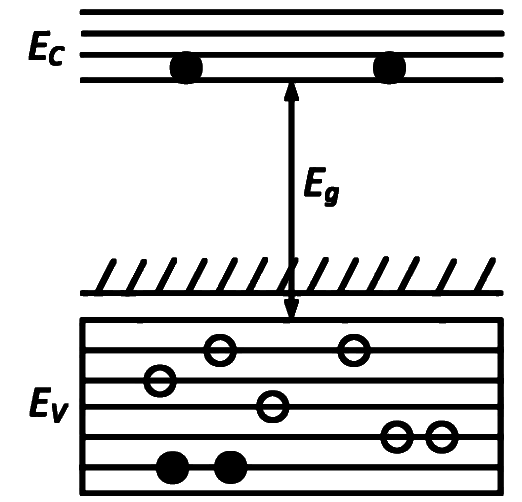
In the energy band diagram of a material shown below, the open circles and filled circles denote holes and electrons respectively. The material is
(a) an insulator (b) a metal (c) an n-type semiconductor (d) a p-type semiconductor. Show answer and solution
Answer: (d)
Loading the solution…
Report a mistake Q54 JEE Main 2006 · AIEEE Medium ☆
Intrinsic & Extrinsic Semiconductors · Conductivity & mobility
If the ratio of the concentration of electrons to that of holes in a semiconductor is 7 5 \frac{7}{5} 5 7 7 4 , \frac{7}{4}, 4 7 ,
(a) 5 8 \frac{5}{8} 8 5 (b) 4 5 \frac{4}{5} 5 4 (c) 5 4 \frac{5}{4} 4 5 (d) 4 7 \frac{4}{7} 7 4 Show answer and solution
Answer: (c)
Loading the solution…
Report a mistake Q55 JEE Main 2004 · AIEEE Easy ☆
Intrinsic & Extrinsic Semiconductors · Effect of temperature
A piece of copper and another of germanium are cooled from room temperature to 77 K , 77\text{ K}, 77 K ,
(a) copper increases and germanium decreases (b) each of them decreases (c) each of them increases (d) copper decreases and germanium increases Show answer and solution
Answer: (d)
Loading the solution…
Report a mistake Q56 JEE Main 2003 · AIEEE Easy ☆
Intrinsic & Extrinsic Semiconductors · Effect of temperature
A strip of copper and another of germanium are cooled from room temperature to 80 K . 80\text{ K}. 80 K .
(a) each of these decreases (b) copper strip increases and that of germanium decreases (c) copper strip decreases and that of germanium increases (d) each of these increases Show answer and solution
Answer: (c)
Loading the solution…
Report a mistake Q57 JEE Main 2003 · AIEEE Medium ☆
Intrinsic & Extrinsic Semiconductors · Effect of temperature
The difference in the variation of resistance with temperature in a metal and a semiconductor arises essentially due to the difference in the
(a) crystal structure (b) variation of the number of charge carriers with temperature (c) type of bonding (d) variation of scattering mechanism with temperature Show answer and solution
Answer: (b)
Loading the solution…
Report a mistake Q58 JEE Main 2002 · AIEEE Easy ☆
Intrinsic & Extrinsic Semiconductors · Effect of temperature
At absolute zero, Si acts as
(a) non-metal (b) metal (c) insulator (d) none of these Show answer and solution
Answer: (c)
Loading the solution…
Report a mistake Q59 JEE Main 2002 · AIEEE Easy ☆
Intrinsic & Extrinsic Semiconductors · Effect of temperature
By increasing the temperature, the specific resistance of a conductor and a semiconductor
(a) increases for both (b) decreases for both (c) increases, decreases (d) decreases, increases Show answer and solution
Answer: (c)
Loading the solution…
Report a mistake Q60 NEET 1999 · AIPMT Easy ☆
Intrinsic & Extrinsic Semiconductors · n-type & p-type doping
Which of the following when added as an impurity into silicon produces n n n
Show answer and solution
Answer: (a)
Loading the solution…
Report a mistake Q61 NEET 1999 · AIPMT Easy ☆
Intrinsic & Extrinsic Semiconductors · n-type & p-type doping
In a junction diode, the holes are due to
(a) protons (b) extra electrons (c) neutrons (d) missing electrons Show answer and solution
Answer: (d)
Loading the solution…
Report a mistake Q62 NEET 1999 · AIPMT Easy ☆
Intrinsic & Extrinsic Semiconductors · n-type & p-type doping
In p p p
(a) holes (b) electrons (c) protons (d) neutrons Show answer and solution
Answer: (a)
Loading the solution…
Report a mistake Q63 NEET 1997 · AIPMT Easy ☆
Intrinsic & Extrinsic Semiconductors · n-type & p-type doping
To obtain a p-type germanium semiconductor, it must be doped with
(a) indium (b) phosphorus (c) arsenic (d) antimony Show answer and solution
Answer: (a)
Loading the solution…
Report a mistake Q64 NEET 1996 · AIPMT Easy ☆
Intrinsic & Extrinsic Semiconductors · n-type & p-type doping
When arsenic is added as an impurity to silicon, the resulting material is
(a) n-type conductor (b) n-type semiconductor (c) p-type semiconductor (d) none of these Show answer and solution
Answer: (b)
Loading the solution…
Report a mistake Q65 NEET 1992 · AIPMT Easy ☆
Intrinsic & Extrinsic Semiconductors · Effect of temperature
A piece of copper and other of germanium are cooled from the room temperature to 80 K 80\text{ K} 80 K
(a) resistance of each will increase (b) resistance of copper will decrease (c) the resistance of copper will increase while that of germanium will decrease (d) the resistance of copper will decrease while that of germanium will increase Show answer and solution
Answer: (d)
Loading the solution…
Report a mistake Q66 NEET 1989 · AIPMT Medium ☆
Intrinsic & Extrinsic Semiconductors · Effect of temperature
When n type semiconductor is heated
(a) number of electrons increases while that of holes decreases (b) number of holes increases while that of electrons decreases (c) number of electrons and holes remain same (d) number of electrons and holes increases equally Show answer and solution
Answer: (d)
Loading the solution…
Report a mistake Q67 NEET 1988 · AIPMT Easy ☆
Intrinsic & Extrinsic Semiconductors · Effect of temperature
At absolute zero, Si acts as
(a) non metal (b) metal (c) insulator (d) none of these Show answer and solution
Answer: (c)
Loading the solution…
Report a mistake
No questions match these filters.