
Heat Engines, Refrigerators & Second Law
A Carnot engine has an efficiency of . The energy is supplied to the engine at the rate of kW. The output power of the engine is
Show answer and solution
Answer: (c)
Loading the solution…
Home›Practice Hub›Chapters›Thermodynamics›Heat Engines, Refrigerators & Second Law
Thermodynamics PYQs · MHT CET · JEE Main · NEET
Heat Engines, Refrigerators & Second Law
A Carnot engine has an efficiency of . The energy is supplied to the engine at the rate of kW. The output power of the engine is
Answer: (c)
Heat Engines, Refrigerators & Second Law
An ideal gas heat engine operate in Carnot cycle between and . It absorbs cal of heat at higher temperature. How much is the amount of heat converted in to work?
Answer: (b)
Heat Engines, Refrigerators & Second Law
The efficiency of Carnot engine which operates between the two temperatures K and K is
Answer: (d)
Heat Engines, Refrigerators & Second Law
A carnot engine having efficiency , operates between the source temperature and the sink temperature . Its efficiency increases to , when is decreased by 64 K. The temperatures and are repectively
Answer: (b)
Heat Engines, Refrigerators & Second Law
A Carnot engine, whose efficiency is 40% takes heat from a source maintained at temperature 600K. To have an efficiency 60%, the intake temperature for the same exhaust temperature should be
Answer: (b)
Heat Engines, Refrigerators & Second Law
A Carnot engine with efficiency 50% takes heat from a source at 600 K. To increase the efficiency by 20%, keeping temperature of the sink same, the new temperature of the source will be
Answer: (c)
Heat Engines, Refrigerators & Second Law
Carnot engine operating between temperatures and has efficiency . When is lowered by K, its efficiency becomes . Temperatures and are respectively
Answer: (a)
Heat Engines, Refrigerators & Second Law
The relation between efficiency of Carnot engine and coefficient of performance of refrigerator is
Answer: (a)
Heat Engines, Refrigerators & Second Law
A Carnot engine has efficiency . It becomes , when the temperature of is lowered by 57 K. The temperature of the source is
Answer: (c)
Heat Engines, Refrigerators & Second Law
An engine operating between temperatures and has efficiency . When is lowered by 45 K, its efficiency becomes . Temperatures and are respectively
Answer: (d)
Heat Engines, Refrigerators & Second Law
A Carnot engine is working between two temperatures 473 K and 273 K. In a new system two engines - engine works between 473 K to 373 K and engine works between 373 K to 273 K. If and are the efficiencies of the engines and , respectively, then
Answer: (d)
Heat Engines, Refrigerators & Second Law
Water of mass gram is slowly heated to increase the temperature from to . The change in entropy of the water, given specific heat of water is , is:
Answer: (d)
Heat Engines, Refrigerators & Second Law
The first operation involved in a Carnot cycle is
Answer: (a)
Heat Engines, Refrigerators & Second Law
The first operation involved in a carnot cycle is
Answer: (a)
Heat Engines, Refrigerators & Second Law
Heat engine operating between temperature and has efficiency . When is lowered by 62 K, its efficiency increases to . Then and respectively are
Answer: (a)
Heat Engines, Refrigerators & Second Law
A Carnot's cycle operating between and produces 1.5 kJ of mechanical work per cycle. The heat transferred to the engine by the reservoir is
Answer: (b)
Heat Engines, Refrigerators & Second Law
A carnot engine, whose efficiency is takes heat from a source maintained at temperature 600 K. It is desired to have an efficiency , then the intake temperature for the same exhaust (sink) temperature should be
Answer: (c)
Heat Engines, Refrigerators & Second Law
A diatomic ideal gas is used in Carnot engine as a working substance. If during the adiabatic expansion part of the cycle, the volume of the gas increases from V to 32 V, the efficiency of the engine is
Answer: (c)
Heat Engines, Refrigerators & Second Law
A carnot engine operates with source at and sink at . If the source supplies of heat energy, the work done by the engine is
Answer: (d)
Heat Engines, Refrigerators & Second Law
A Carnot engine has an efficiency of when its source is at a temperature . The temperature of the sink is :-
Answer: (d)
Heat Engines, Refrigerators & Second Law
Work done by a Carnot engine operating between temperatures and is . The amount of heat transferred to the engine by the reservoir is:
Answer: (a)
Heat Engines, Refrigerators & Second Law
A Carnot engine with efficiency 50% takes heat from a source at 600 K. In order to increase the efficiency to 70%, keeping the temperature of sink same, the new temperature of the source will be:
Answer: (b)
Heat Engines, Refrigerators & Second Law
A Carnot engine has the same efficiency between (i) and and (ii) and . The temperature in kelvin of the sink is
Answer: (b)
Heat Engines, Refrigerators & Second Law
A Carnot engine with efficiency takes heat from a source at . To increase the efficiency to , keeping the temperature of the sink same, the new temperature of the source will be
Answer: (b)
Heat Engines, Refrigerators & Second Law
An engine operating between the boiling and freezing points of water will have
A. efficiency more than 27%.
B. efficiency less than the efficiency of a Carnot engine operating between the same two temperatures.
C. efficiency equal to
D. efficiency less than
Choose the correct answer from the options given below:
Answer: (b)
Heat Engines, Refrigerators & Second Law
A Carnot engine operating between two reservoirs has efficiency . When the temperature of cold reservoir is raised by x, its efficiency decreases to . The value of x, if the temperature of hot reservoir is C, will be:
Answer: (b)
Heat Engines, Refrigerators & Second Law
Given below are two statements: one is labelled as Assertion and the other is labelled as Reason
Assertion A: Efficiency of a reversible heat engine will be highest at temperature of cold reservoir.
Reason R: The efficiency of Carnot's engine depends not only on the temperature of the cold reservoir but it depends on the temperature of the hot reservoir too and is given as In the light of the above statements, choose the correct answer from the options given below
Answer: (a)
Heat Engines, Refrigerators & Second Law
An ideal refrigerator has freezer at a temperature of . The coefficient of performance of the engine is 5. The temperature of the air (to which heat is rejected) is
Answer: (b)
Heat Engines, Refrigerators & Second Law
The efficiency of a heat engine is '' and the coefficient of performance of a refrigerator is ''. Then
Answer: (b)
Heat Engines, Refrigerators & Second Law
A Carnot engine is operating between the two reservoirs of temperature and respectively. If the engine performs work per cycle. Then, the heat absorbed from hot reservoir per cycle will be:
Answer: (c)
Heat Engines, Refrigerators & Second Law
The efficiency of a Carnot's engine, working between steam point and ice point, will be:
Answer: (a)
Heat Engines, Refrigerators & Second Law
A Carnot engine has efficiency of . If the temperature of sink is reduced by , its efficiency increases by . The temperature of the source will be:
Answer: (c)
Heat Engines, Refrigerators & Second Law
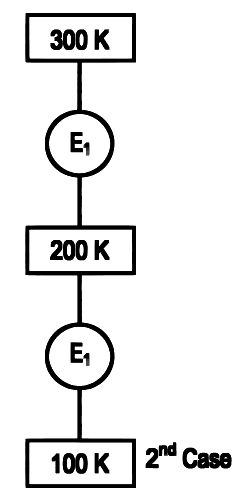
In st case, Carnot engine operates between temperatures and . In nd case, as shown in the figure, a combination of two engines is used. The efficiency of this combination (in nd case) will be:
Answer: (a)
Heat Engines, Refrigerators & Second Law
Let is the efficiency of an engine at and while is the efficiency at and . The ratio will be:
Answer: (b)
Heat Engines, Refrigerators & Second Law
A Carnot engine takes 5000 kcal of heat from a reservoir at 727C and gives heat to a sink at 127 C. The work done by the engine is
Answer: (c)
Heat Engines, Refrigerators & Second Law
A Carnot engine whose heat sink is at 27C, has an efficiency of 25%. By how many degrees should the temperature of the source be changed to increase the efficiency by 100% of the original efficiency?
Answer: (b)
Heat Engines, Refrigerators & Second Law
300 cal. of heat is given to a heat engine and it rejects 225 cal. If source temperature is 227C, then the temperature of sink will be ______________ C.
Numerical answer type. Work it out, then open the answer.
Answer: 102
Heat Engines, Refrigerators & Second Law
In a carnot engine, the temperature of reservoir is 527 C and that of sink is 200 K. If the work done by the engine when it transfers heat from reservoir to sink is 12000 kJ, the quantity of heat absorbed by the engine from reservoir is ______________ 106 J.
Numerical answer type. Work it out, then open the answer.
Answer: 16
Heat Engines, Refrigerators & Second Law
A heat engine operates with the cold reservoir at temperature 324 K. The minimum temperature of the hot reservoir, if the heat engine takes 300 J heat from the hot reservoir and delivers 180 J heat to the cold reservoir per cycle, is ____________ K.
Numerical answer type. Work it out, then open the answer.
Answer: 540
Heat Engines, Refrigerators & Second Law
A steam engine intakes 50 g of steam at 100C per minute and cools it down to 20 C. If latent heat of vaporization of steam is 540 cal g 1, then the heat rejected by the steam engine per minute is __________ 103 cal.
(Given: specific heat capacity of water: 1 cal g 1)
Numerical answer type. Work it out, then open the answer.
Answer: 31
Heat Engines, Refrigerators & Second Law
A Carnot's engine working between 400 K and 800 K has a work output of 1200 J per cycle. The amount of heat energy supplied to the engine from the source in each cycle is:
Answer: (a)
Heat Engines, Refrigerators & Second Law
For an ideal heat engine, the temperature of the source is 127 C. In order to have 60% efficiency the temperature of the sink should be ___________C. (Round off to the Nearest Integer)
Numerical answer type. Work it out, then open the answer.
Answer: -113
Heat Engines, Refrigerators & Second Law
An ideal gas in a cylinder is separated by a piston in such a way that the entropy of one part is S1 and that of the other part is S2. Given that S1 > S2. If the piston is removed then the total entropy of the system will be:
Answer: (d)
Heat Engines, Refrigerators & Second Law
A reversible engine has an efficiency of . If the temperature of the sink is reduced by 58C, its efficiency becomes double. Calculate the temperature of the sink:
Answer: (a)
Heat Engines, Refrigerators & Second Law
A heat engine has an efficiency of . When the temperature of sink is reduced by 62 C, its efficiency gets doubled. The temperature of the source is:
Answer: (d)
Heat Engines, Refrigerators & Second Law
A heat engine operates between a cold reservoir at temperature T2 = 400 K and a hot reservoir at temperature T1. It takes 300 J of heat from the hot reservoir and delivers 240 J of heat to the cold reservoir in a cycle. The minimum temperature of the hot reservoir has to be ______________ K.
Numerical answer type. Work it out, then open the answer.
Answer: 500
Heat Engines, Refrigerators & Second Law
A reversible heat engine converts one-fourth of the heat input into work. When the temperature of the sink is reduced by 52K, its efficiency is doubled. The temperature in Kelvin of the source will be __________.
Numerical answer type. Work it out, then open the answer.
Answer: 208
Heat Engines, Refrigerators & Second Law
A refrigerator consumes an average 35W power to operate between temperature C to 25 C. If there is no loss of energy then how much average heat per second does it transfer?
Answer: (a)
Heat Engines, Refrigerators & Second Law
Two Carnot engines A and B operate in series such that engine A absorbs heat at T1 and rejects heat to a sink at temperature T. Engine B absorbs half of the heat rejected by Engine A and rejects heat to the sink at T3. When workdone in both the cases is equal, to value of T is:
Answer: (d)
Heat Engines, Refrigerators & Second Law
The efficiency of a Carnot engine depends upon
Answer: (c)
Heat Engines, Refrigerators & Second Law
A Carnot engine operates between two reservoirs of temperatures 900 K and 300 K. The engine performs 1200 J of work per cycle. The heat energy (in J) delivered by the engine to the low temperature reservoir, in a cycle, is _______.
Numerical answer type. Work it out, then open the answer.
Answer: 600
Heat Engines, Refrigerators & Second Law
A heat engine is involved with exchange of heat of 1915 J, – 40J, + 125 J and –Q J, during one cycle achieving an efficiency of 50.0%. The value of Q is
Answer: (a)
Heat Engines, Refrigerators & Second Law
A carnot engine having an efficiency of is being used as a refrigerator. If the work done on the refrigerator is 10 J, the amount of heat absorbed from the reservoir at lower temperature is:
Answer: (a)
Heat Engines, Refrigerators & Second Law
Two ideal Carnot engines operate in cascade (all heat given up by one engine is used by the other engine to produce work) between temperature, T1 and T2. The temperature of the hot reservoir of the first engine is T1 and the temperature of the cold reservoir of the second engine is T2. T is temperature of the sink of first engine which is also the source for the second engine. How is T related to T1 and T2, if both engines perform equal amount of work?
Answer: (c)
Heat Engines, Refrigerators & Second Law
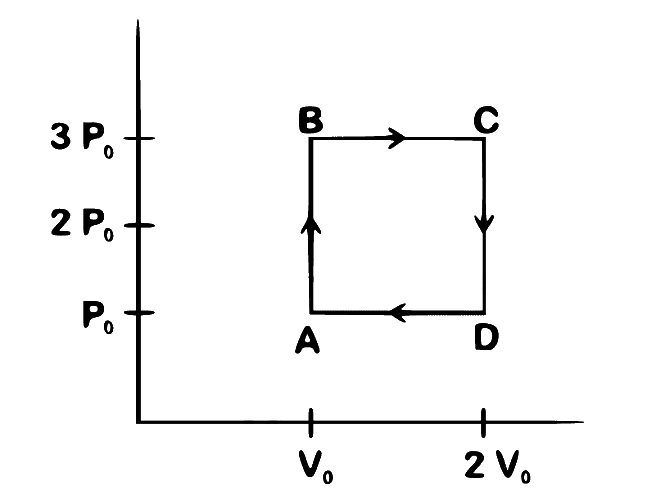
An engine operates by taking a monoatomic ideal gas through the cycle shown in the figure. The percentage efficiency of the engine is close to __________.
Numerical answer type. Work it out, then open the answer.
Answer: 19
Heat Engines, Refrigerators & Second Law
If minimum possible work is done by a refrigerator in converting 100 grams of water at 0oC to ice, how much heat (in calories) is released to the surroundings at temperature 27oC (Latent heat of ice = 80 Cal/gram) to the nearest integer?
Numerical answer type. Work it out, then open the answer.
Answer: 8791
Heat Engines, Refrigerators & Second Law
If is the coefficient of performance of a refrigerator and ' ' is heat released to the hot reservoir, then the heat extracted from the cold reservoir ' ' is
Answer: (c)
Heat Engines, Refrigerators & Second Law
A Carnot engine has an efficiency of . When the temperature of the sink is reduced by 62ºC, its efficiency is doubled. The temperatures of the source and the sink are, respectively
Answer: (a)
Heat Engines, Refrigerators & Second Law
Two Carnot engines A and B are operated in series. The first one, A, receives heat at T1 (= 600 K) and rejects to a reservoir at temperature T2. The second engine B receives heat rejected by the first engine and, in turn, rejects to a heat reservoir at T3 (=400 K). Calculate the temperature T2 if the work outputs of the two engines are equal:
Answer: (d)
Heat Engines, Refrigerators & Second Law
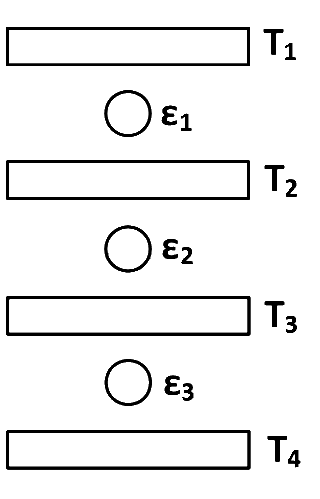
Three Carnot engines operate in series between a heat source at a temperature T1 and a heat sink at temperature T4 (see figure). There are two other reservoirs at temperature T2 and T3, as shown, with T1 > T2 > T3 > T4. The three engines are equally efficient if -
Answer: (d)
Heat Engines, Refrigerators & Second Law
The efficiency of an ideal heat engine working between the freezing point and boiling point of water, is
Answer: (a)
Heat Engines, Refrigerators & Second Law
Two Carnot engines A and B are operated in series. Engine A receives heat from a reservoir at 600 K and rejects heat to a reservoir at temperature T. Engine B receives heat rejected by engine A and in turn rejects it to a reservoir at 100 K. If the efficiencies of the two engines A and B are represented by and respectively, then what is the value of ?
Answer: (a)
Heat Engines, Refrigerators & Second Law
A Carnot's engine works as a refrigerator between K and K. It receives cal heat from the reservoir at the lower temperature. The amount of work done in each cycle to operate the refrigerator is:
Answer: (a)
Heat Engines, Refrigerators & Second Law
A carnot engine having an efficiency of as heat engine, is used as a refrigerator. If the work done on the system is 10 J, the amount of energy absorbed from the reservoir at lower temperature is
Answer: (a)
Heat Engines, Refrigerators & Second Law
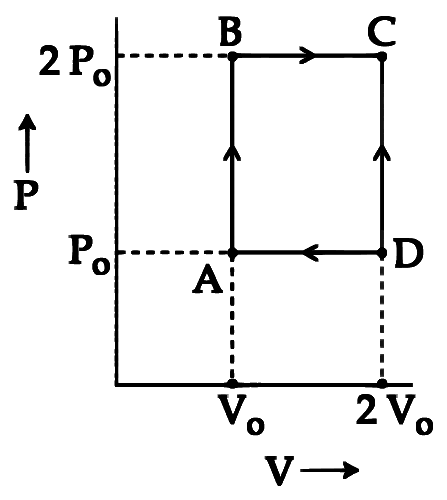
An engine operates by taking n moles of an ideal gas through the cycle ABCDA shown in figure. The thermal efficiency of the engine is: (Take Cv = 1.5 R, where R is gas constant)
Answer: (b)
Heat Engines, Refrigerators & Second Law
The temperature inside a refrigerator is t2 oC and the room temperature is t1 oC. The amount of heat delivered to the room for each joule of electrical energy consumed ideally will be
Answer: (b)
Heat Engines, Refrigerators & Second Law
A refrigerator works between 4oC and 30oC. It is required to remove 600 calories of heat every second in order to keep the temperature of the refrigerated space constant. The power required is (Take 1 cal = 4.2 Joules)
Answer: (a)
Heat Engines, Refrigerators & Second Law
A Carnot freezer takes heat from water at 0oC inside it and rejects it to the room at a temperature of 27oC. The latent heat of ice is 336×103 J kg−1. If 5 kg of water at 0oC is converted into ice at 0oC by the freezer, then the energy consumed by the freezer is close to:
Answer: (a)
Heat Engines, Refrigerators & Second Law
The coefficient of performance of a refrigerator is 5. If the temperature inside freezer is 20oC, the temperature of the surroundings to which it rejects heat is
Answer: (c)
Heat Engines, Refrigerators & Second Law
A Carnot engine, having an efficiency of as heat engine, is used as a refrigerator. If the work done on the system is 10 J, the amount of energy absorbed from the reservoir at lower temperature is
Answer: (a)
Heat Engines, Refrigerators & Second Law
A solid body of constant heat capacity is being heated by keeping it in contact with reservoirs in two ways:
Sequentially keeping in contact with reservoirs such that each reservoir
supplies same amount of heat.
Sequentially keeping in contact with reservoirs such that each reservoir
supplies same amount of heat.
In both the cases body is brought from initial temperature to final temperature . Entropy change of the body in the two cases respectively is:
Answer: (d)
Heat Engines, Refrigerators & Second Law
A Carnot engine absorbs 1000 J of heat energy from a reservoir at 127oC and rejects 600 J of heat energy during each cycle. The efficiency of engine and temperature of sink will be:
Answer: (b)
Heat Engines, Refrigerators & Second Law
Two Carnot engines A and B are operated in series. The engine A receives heat from the source at temperature T1 and rejects the heat to the sink at temperature T. The second engine B receives the heat at temperature T and rejects to its sink at temperature T2. For what values of T the efficiencies of the two engines are equal
Answer: (c)
Heat Engines, Refrigerators & Second Law
A Carnot engine, whose efficiency is , takes in heat from a source maintained at a temperature of It is desired to have an engine of efficiency Then, the intake temperature for the same exhaust (sink) temperature must be:
Answer: (c)
Heat Engines, Refrigerators & Second Law
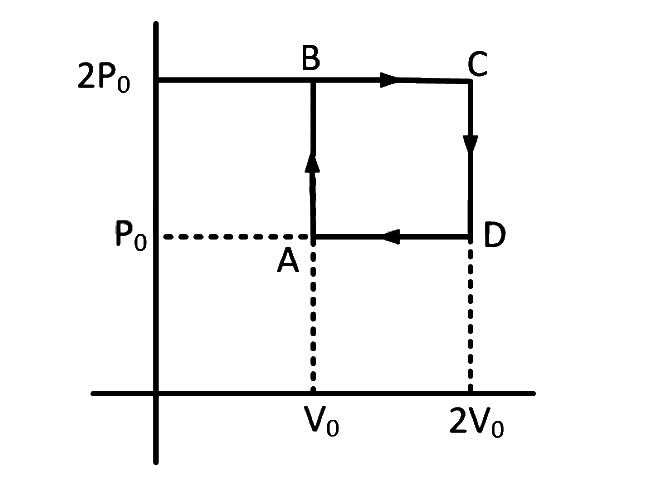
Helium gas goes through a cycle (consisting of two isochoric and isobaric lines) as shown in figure efficiency of this cycle is nearly: (Assume the gas to be close to ideal gas)
Answer: (a)
Heat Engines, Refrigerators & Second Law
When 1 kg of ice at 0oC melts to water at 0oC, the resulting change in its entropy, taking latent heat of ice to be 80 cal/oC, is
Answer: (d)
Heat Engines, Refrigerators & Second Law
A Carnot engine operating between temperatures and has efficiency . When is lowered by its efficiency increases to . Then and are, respectively:
Answer: (d)
Heat Engines, Refrigerators & Second Law
A diatomic ideal gas is used in a Carnot engine as the working substance. If during the adiabatic expansion part of the cycle the volume of the gas increases from to , the efficiency of the engine is
Answer: (b)
Heat Engines, Refrigerators & Second Law
An engine has an efficiency of 1/6. When the temperature of sink is reduced by 62oC, its efficiency is doubled. Temperatures of the source is
Answer: (c)
Heat Engines, Refrigerators & Second Law
A Carnot engine, having an efficiency of as heat engine, is used as a refrigerator. If the work done on the system is , the amount of energy absorbed from the reservoir at lower temperature is
Answer: (c)
Heat Engines, Refrigerators & Second Law
A Carnot engine whose sink is at 300 K has an efficiency of 40%. By how much should the temperature of source be increased so as to increase its efficiency by 50% of original efficiency?
Answer: (d)
Heat Engines, Refrigerators & Second Law
An ideal gas heat engine operates in Carnot cycle between 227oC and 127oC. It absorbs 6 104 cal of heat at higher temperature. Amount of heat converted to work is
Answer: (d)
Heat Engines, Refrigerators & Second Law
Which of the following processes is reversible?
Answer: (c)
Heat Engines, Refrigerators & Second Law
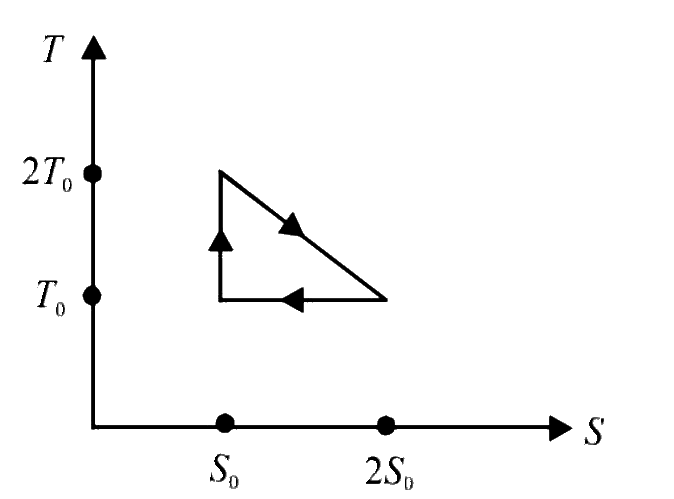
The temperature-entropy diagram of a reversible engine cycle is given in the figure. Its efficiency is
Answer: (d)
Heat Engines, Refrigerators & Second Law
Which of the following statements is correct for any thermodynamic system?
Answer: (b)
Heat Engines, Refrigerators & Second Law
An ideal gas heat engine operates in a Carnot cycle between 227oC and 127oC. It absorbs 6 kcal at the higher temperature. The amount of heat (in kcal) converted into work is equal to
Answer: (d)
Heat Engines, Refrigerators & Second Law
''Heat cannot by itself flow from a body at lower temperature to a body at higher temperature'' is a statement or consequence of:
Answer: (a)
Heat Engines, Refrigerators & Second Law
A carnot engine takes cal. of heat from a reservoir at and gives it to a sink at . The work done by the engine is
Answer: (b)
Heat Engines, Refrigerators & Second Law
Which statement is incorrect?
Answer: (a)
Heat Engines, Refrigerators & Second Law
Even Carnot engine cannot give efficiency because we cannot
Answer: (c)
Heat Engines, Refrigerators & Second Law
The efficiency of Carnot engine is 50% and temperature of sink is 500 K. If temperature of source is kept constant and its efficiency raised to 60%, then the required temperature of sink will be
Answer: (c)
Heat Engines, Refrigerators & Second Law
A scientist says that the efficiency of his heat engine which work at source temperature 127oC and sink temperature 27oC is 26%, then
Answer: (a)
Heat Engines, Refrigerators & Second Law
The (W/Q) of a Carnot engine is 1/6, now the temperature of sink is reduced by 62oC, then this ratio becomes twice, therefore the initial temperature of the sink and source are respectively
Answer: (b)
Heat Engines, Refrigerators & Second Law
The efficiency of a Carnot engine operating with reservoir temperature of and will be
Answer: (b)
Heat Engines, Refrigerators & Second Law
An ideal Carnot engine, whose efficiency is 40%, receives heat at 500 K. If its efficiency is 50%, then the intake temperature for the same exhaust temperature is
Answer: (c)
No questions match these filters.