
Polarisation · Brewster's law
Choose the correct statement from the following.
Brewster's angle for a transparent medium is
Show answer and solution
Answer: (a)
Loading the solution…
Home›Practice Hub›Chapters›Wave Optics›Polarisation
Wave Optics PYQs · MHT CET · JEE Main · NEET
Polarisation · Brewster's law
Choose the correct statement from the following.
Brewster's angle for a transparent medium is
Answer: (a)
Polarisation · Brewster's law
A ray of light is incident of the surface of a glass plate at an angle of incidence equal to Brewster's angle . If denotes the refractive index of glass w.r.t. air, then what will be the angle between reflected and refracted rays?
Answer: (b)
Polarisation · Three or more polaroids
Three polaroid sheets are co-axially placed such that pass axis of polaroids and make and with pass axis of sheet. If is the intensity of unpolarised light entering first sheet, the intensity of the emergent light through sheet is
Answer: (b)
Polarisation · Three or more polaroids
Unpolarized light with intensity passes through three polaroids such that the transmission axis of the last polaroid is crossed with the first. If the intensity of emerging light is . The angle between the first two polaroids and the angle for which the transmitted intensity is maximum are respectively given,
Answer: (a)
Polarisation · Three or more polaroids
An unpolarised light of intensity Wm passes through three polarizers successively such that the transmission axis of last polarizer is crossed with the first. The intensity of the emerging light is Wm. The angle between the transmission axis of the first two polarizers is
Answer: (a)
Polarisation · Three or more polaroids
Three identical polaroids and are placed one after another. The pass axis of and are inclined at angle of and with respect to axis of . The source has an intensity . The intensity of light finally coming out is
Answer: (b)
Polarisation · Three or more polaroids
Two polaroid A and B placed in such a way that the pass-axis of polaroid are perpendicular to each other. Now, another polaroid C is placed between A and B bisecting angle between them. If intensity of unpolarised light is then intensity of transmitted light after passing through polaroid B will be
Answer: (c)
Polarisation · Three or more polaroids
An unpolarized light of certain intensity passes through a combination of two polarizers whose transmission axes are at and , respectively, with respect to the horizontal axis. A third polarizer with its transmission axis at with the horizontal axis is placed between the two existing polarizers. The ratio of the output intensities with and without the third polarizer is ______.
Answer: (c)
Polarisation · Brewster's law
A ray of light is incident at polarising angle on air-glass interface. If and are the wavelengths of light in air and glass respectively then
Answer: (b)
Polarisation · Brewster's law
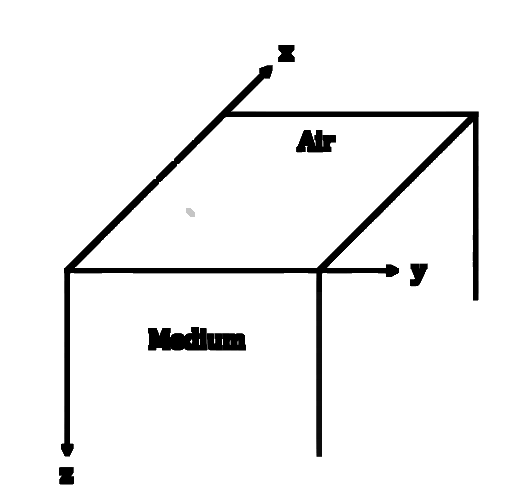
An unpolarized light is incident on the plane interface of air-dielectric medium shown in figure. If the incident angle is equal to Brewster angle, identify the expression representing reflected wave.
Answer: (a)
Polarisation · Brewster's law
When an unpolarized light falls at a particular angle on a glass plate (placed in air), it is observed that the reflected beam is linearly polarized. The angle of refracted beam with respect to the normal is ______.
, refractive indices of air and glass are 1.00 and 1.52, respectively.)
Answer: (d)
Polarisation · Other polarisation effects
Two plane polarised light waves combine at a certain point whose electric field components are and . The amplitude of the resultant wave is ()
Answer: (b)
Polarisation · Other polarisation effects
An unpolarized light of intensity passes through polarizer and then through a certain optically active and finally it goes to analyser. If the angle between analyser and polariser is and intensity of light emerged from analyser is , the angle of rotation of the light by the with respect to analyser is ______ degrees.
Numerical answer type. Work it out, then open the answer.
Answer: 30
Polarisation · Three or more polaroids
'n' polarizing sheets are arranged such that each makes an angle with the preceding sheet. An unpolarized light of intensity is incident into this arrangement. The output intensity is found to be . The value of will be
Answer: (b)
Polarisation · Malus's law: two polaroids
Two polaroids are oriented with their planes perpendicular to incident light and transmission axis making an angle with each other. What fraction of incident unpolarised light is transmitted?
Answer: (d)
Polarisation · Three or more polaroids
The intensity of transmitted light when a polaroid sheet, placed between two crossed polaroids at from the polarization axis of one of the polaroids, is ( is the intensity of polarised light after passing through the first polaroid):
Answer: (a)
Polarisation · Three or more polaroids
A beam of light of intensity falls on a system of three polaroids which are arranged in succession such that the pass (transmission) axis is turned through with respect to preceding one. The fraction of the incident light intensity that passes through the system is
Answer: (b)
Polarisation · Three or more polaroids
Two polaroids are placed in the path of unpolarised beam of intensity ' ' such that no light is emitted from the second polaroid. If a third polaroid whose polarisation axis makes an angle ' ' with the polarisation axis of first polaroid is placed between these polaroids then the intensity of light emerging from the last polaroid will be
Answer: (b)
Polarisation · Three or more polaroids
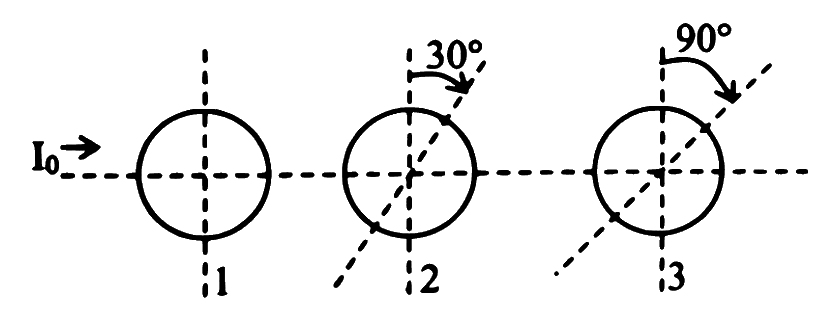
Three polarised sheets are co-axially placed. Pass axis of polaroids 2 and 3 make and with pass axis of polaroid sheet 1. If is the intensity of unpolarised light entering sheet 1, the intensity of the emergent light through sheet 3 is
Answer: (b)
Polarisation · Three or more polaroids
Four polaroids are placed such that the optic axis of each is inclined at an angle of the optic axis of the preceding one. If unpolarised light of intensity ' ' falls on the first polaroid, the intensity of light transmitted from the fourth polaroid is
Answer: (b)
Polarisation · Three or more polaroids
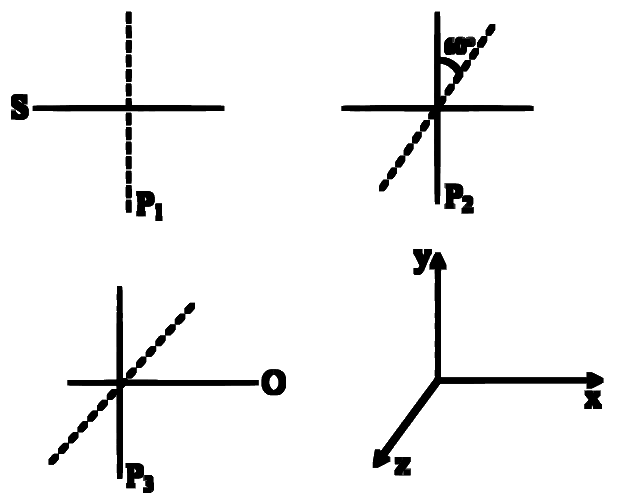
Three identical polaroids and are placed one after another. The pass axis of and are inclined at an angle of and with respect to axis of . The source has an intensity . The intensity of light at point ' O ' is
Answer: (a)
Polarisation · Three or more polaroids
Two polarisers and are placed in such a way that the intensity of the transmitted light will be zero. A third polariser is inserted in between and , at particular angle between and . The transmitted intensity of the light passing through all three polarisers is maximum. The angle between the polarisers and is:
Answer: (c)
Polarisation · Brewster's law
The polarising angle of transparent medium is ' '. Let the speed of light in the medium be ' v '. Then the relation between ' ' and ' ' is [ velocity of light in air]
Answer: (c)
Polarisation · Brewster's law
An unpolarized light beam travelling in air is incident on a medium of refractive index 1.73 at Brewster's angle. Then
Answer: (c)
Polarisation · Other polarisation effects
Two plane polarized light waves combine at a certain point whose electric field components are
Find the amplitude of the resultant wave.
Answer: (a)
Polarisation · Three or more polaroids
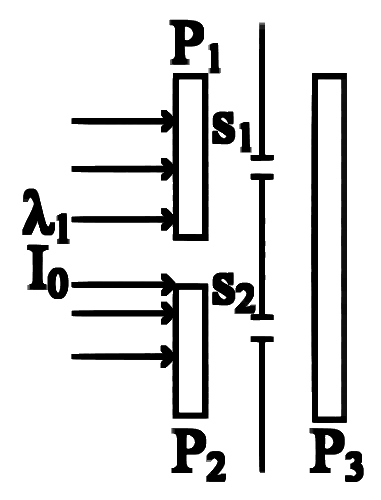
In a Young's double slit experiment, three polarizers are kept as shown in the figure. The transmission axes of and are orthogonal to each other. The polarizer covers both the slits with its transmission axis at to those of and . An unpolarized light of wavelength and intensity is incident on and . The intensity at a point after where the path difference between the light waves from and is , is
Answer: (c)
Polarisation · Malus's law: two polaroids
A beam of unpolarised light of intensity is passed through a polaroid and then through another polaroid which is oriented so that its principal plane makes an angle of relative to that of . The intensity of emergent light is:
Answer: (c)
Polarisation · Three or more polaroids
When a polaroid sheet is rotated between two crossed polaroids then the transmitted light intensity will be maximum for a rotation of:
Answer: (c)
Polarisation · Brewster's law
An unpolarised light beam strikes a glass surface at Brewster's angle. Then
Answer: (d)
Polarisation · Brewster's law
When unpolarized light is incident at an angle of on a transparent medium from air, the reflected ray is completely polarized. The angle of refraction in the medium is:
Answer: (c)
Polarisation · Three or more polaroids
Three identical polaroids and are placed one after another. The pass axis of and are inclined at an angle and with respect to axis of . The source has an intensity . The intensity of transmitted light through is
Answer: (c)
Polarisation · Three or more polaroids
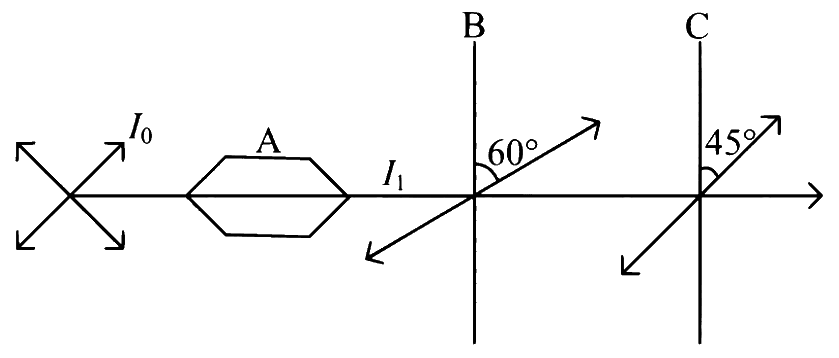
A beam of unpolarized light of intensity I0 is passed through a polaroid A, then through another polaroid B, oriented at and finally through another polaroid C, oriented at 45 relative to B as shown. The intensity of emergent light is:
Answer: (a)
Polarisation · Malus's law: two polaroids
A beam of unpolarized light passes through a tourmaline crystal A and then it passes through a second tourmaline crystal B oriented so that its principal plane is parallel to that of A. The intensity of emergent light is . Now B is rotated by about the ray. The emergent light will have intensity
Answer: (a)
Polarisation · Three or more polaroids
Two polaroids and are placed in such a way that the pass-axis of polaroids are perpendicular to each other. Now, another polaroid is placed between and bisecting angle between them. If intensity of unpolarized light is then intensity of transmitted light after passing through polaroid will be:
Answer: (b)
Polarisation · Three or more polaroids
Unpolarised light of intensity 32 Wm passes through the combination of three polaroids such that the pass axis of the last polaroid is perpendicular to that of the pass axis of first polaroid. If intensity of emerging light is 3 Wm , then the angle between pass axis of first two polaroids is ______________ .
Numerical answer type. Work it out, then open the answer.
Answer: 30
Polarisation · Three or more polaroids
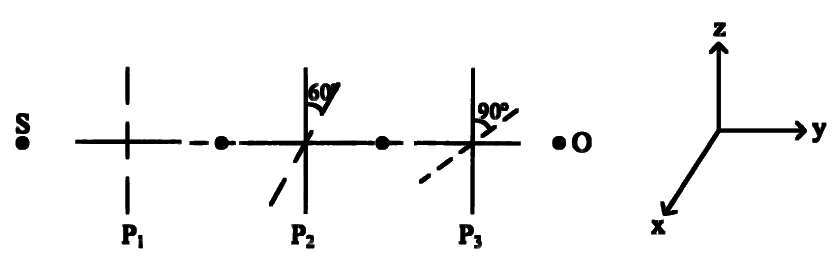
As shown in the figure, three identical polaroids P, P and P are placed one after another. The pass axis of P and P are inclined at angle of 60 and 90 with respect to axis of P. The source S has an intensity of 256 . The intensity of light at point O is ____________ .
Numerical answer type. Work it out, then open the answer.
Answer: 24
Polarisation · Brewster's law
A beam of light is incident on a glass plate at an angle of . The reflected ray is polarized. If angle of incidence is then angle of refraction is
Answer: (a)
Polarisation · Brewster's law
Given below are two statements:
Statement I: If the Brewster's angle for the light propagating from air to glass is , then the Brewster's angle for the light propagating from glass to air is
Statement II: The Brewster's angle for the light propagating from glass to air is where is the refractive index of glass.
In the light of the above statements, choose the correct answer from the options given below:
Answer: (d)
Polarisation · Brewster's law
Unpolarised light is incident on the boundary between two dielectric media, whose dielectric constants are 2.8 (medium ) and 6.8 (medium ), respectively. To satisfy the condition, so that the reflected and refracted rays are perpendicular to each other, the angle of incidence should be the value of is __________.
(Given for dielectric media, )
Numerical answer type. Work it out, then open the answer.
Answer: 7
Polarisation · Three or more polaroids
'' polarizing sheets are arranged such that each makes an angle with the preceding sheet. An unpolarized light of intensity I is incident into this arrangement. The output intensity is found to be . The value of will be:
Answer: (d)
Polarisation · Malus's law: two polaroids
After passing through a polariser a linearly polarised light of intensity I is incident on an analyser making an angle of 30 with that of the polariser. The intensity of light emitted from the analyser will be
Answer: (d)
Polarisation · Malus's law: two polaroids
Two poloroids and are placed parallel to each other with common axis.The light of intensity passes through a polaroid sheet and then passes through polaroid . If is now rotated by , then the intensity of the output light from will be:
Answer: (d)
Polarisation · Malus's law: two polaroids
An unpolarised light beam of intensity is passed through a polaroid P and then through another polaroid Q which is oriented in such a way that its passing axis makes an angle of relative to that of P. The intensity of the emergent light is
Answer: (c)
Polarisation · Brewster's law
A light whose electric field vectors are completely removed by using a good polaroid, allowed to incident on the surface of the prism at Brewster's angle. Choose the most suitable option for the phenomenon related to the prism.
Answer: (d)
Polarisation · Malus's law: two polaroids
A source of light is placed in front of a screen. Intensity of light on the screen is I. Two Polaroids P1 and P2 are so placed in between the source of light and screen that the intensity of light on screen is I/2. P2 should be rotated by an angle of (degrees) so that the intensity of light on the screen becomes .
Numerical answer type. Work it out, then open the answer.
Answer: 30
Polarisation · Malus's law: two polaroids
An unpolarised light beam is incident on the polarizer of a polarization experiment and the intensity of light beam emerging from the analyzer is measured as 100 Lumens. Now, if the analyzer is rotated around the horizontal axis (direction of light) by 30 in clockwise direction, the intensity of emerging light will be _________ Lumens.
Numerical answer type. Work it out, then open the answer.
Answer: 75
Polarisation · Malus's law: two polaroids
A polarizer - analyser set is adjusted such that the intensity of light coming out of the analyser is just 10% of the original intensity. Assuming that the polarizer - analyser set does not absorb any light, the angle by which the analyser need to be rotated further to reduce the output intensity to be zero, is:
Answer: (c)
Polarisation · Brewster's law
The Brewster's angle for the glass-air interface is . If a ray of light passing from air to glass strikes at an angle of incidence , then the angle of refraction is
Answer: (c)
Polarisation · Malus's law: two polaroids
A beam of plane polarised light of large
cross-sectional area and uniform intensity
of 3.3 Wm-2 falls normally on a
polariser (cross sectional area 3 10-4 m2) which
rotates about its axis with an angular speed
of 31.4 rad/s. The energy of light passing through
the polariser per revolution, is close to:
Answer: (b)
Polarisation · Three or more polaroids
A system of three polarizers P1, P2, P3 is set up such that the pass axis of P3 is crossed with respect to that of P1. The pass axis of P2 is inclined at 60° to the pass axis of P3. When a beam of unpolarized light of intensity I0 is incident on P1, the intensity of light transmitted by the three polarizers is I. The ratio ( ) equals (nearly):
Answer: (a)
Polarisation · Brewster's law
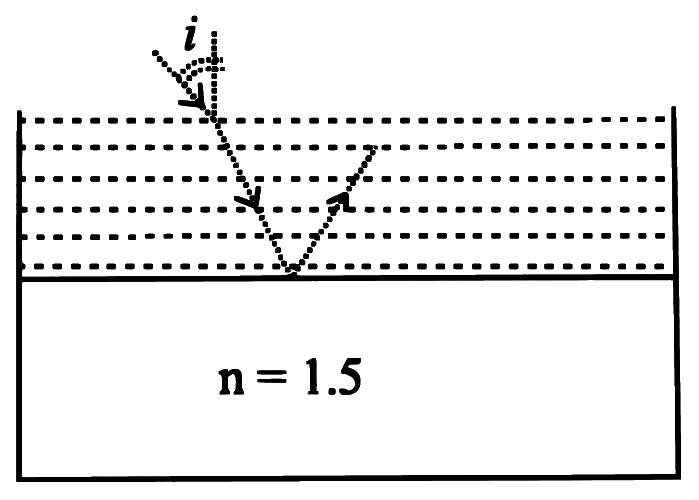
Consider a tank made of glass(refractive index 1.5) with a thick bottom. It is filled with a liquid of refractive index . A student finds that, irrespective of what the incident angle i (see figure) is for a beam of light entering the liquid, the light reflected from the liquid glass interface is never completely polarized. For this to happen, the minimum value of is:
Answer: (b)
Polarisation · Brewster's law
Unpolarised light is incident from air on a plane surface of a material of refractive index . At a particular angle of incidence i, it is found that the reflected and refracted rays are perpendicular to each other. Which of the following options is correct for this situation?
Answer: (b)
Polarisation · Malus's law: two polaroids
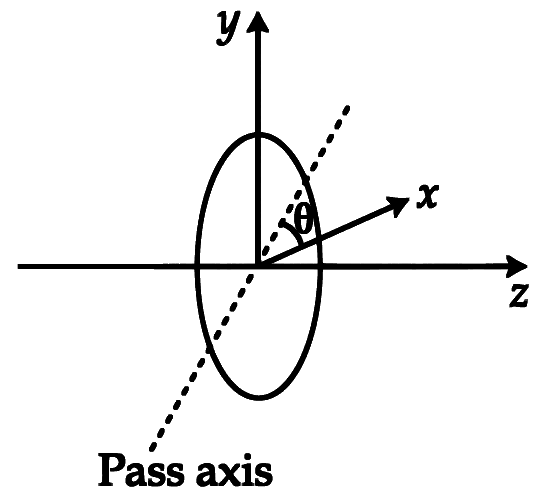
A plane polarized light is incident on a polariser with its pass axis making angle with x-axis, as shown in the figure. At four different values of = 8°, 38°, 188° and 218°, the observed intensities are same.
What is the angle between the direction of polarization and x-axis?
Answer: (c)
Polarisation · Three or more polaroids
Unpolarized light of intensity I is incident on a system of two polarizers, A followed by B. The intensity of emergent light is I/2. If a third polarizer C is placed between A and B, the intensity of emergent light is reduced to I/3. The angle between the polarizers A and C is . Then:
Answer: (b)
Polarisation · Three or more polaroids
Unpolarized light of intensity I passes through an ideal polarizer A. Another identical polarizer B is placed behind A. The intensity of light beyond B is found to be I/2. Now another identical polarizer C is placed between A and B. The intensity beyond B is now found to be I/8. The angle between polarizer A and C is:
Answer: (c)
Polarisation · Three or more polaroids
Two polaroids P1 and P2 are placed with their axis perpendicular to each other. Unpolarised light 0 is incident on P1. A third polaroid P3 is kept in between P1 and P2 such that its axis makes an angle 45° with that of P1. The intensity of transmitted light through P2 is
Answer: (b)
Polarisation · Brewster's law
Unpolarized light of intensity I0 is incident on surface of a block of glass at Brewster's angle. In that case, which one of the following statements is true?
Answer: (c)
Polarisation · Other polarisation effects
Two beams, and , of plane polarized light with mutually perpendicular planes of polarization are seen through a polaroid. From the position when the beam has maximum intensity (and beam has zero intensity), a rotation of polaroid through makes the two beams appear equally bright. If the initial intensities of the two beams are and respectively, then equals:
Answer: (d)
Polarisation · Brewster's law
A ray of light is incident from a denser to a rarer medium. The critical angle for total internal reflection is iC and the Brewster's angle of incidence is iB, such that siniC/siniB = = 1.28. The relative refractive index of the two media is:
Answer: (c)
Polarisation · Malus's law: two polaroids
A beam of unpolarised light of intensity is passed through a polaroid and then through another polaroid which is oriented so that its principal plane makes an angle of relative to that of . The intensity of the emergent light is
Answer: (c)
Polarisation · Brewster's law
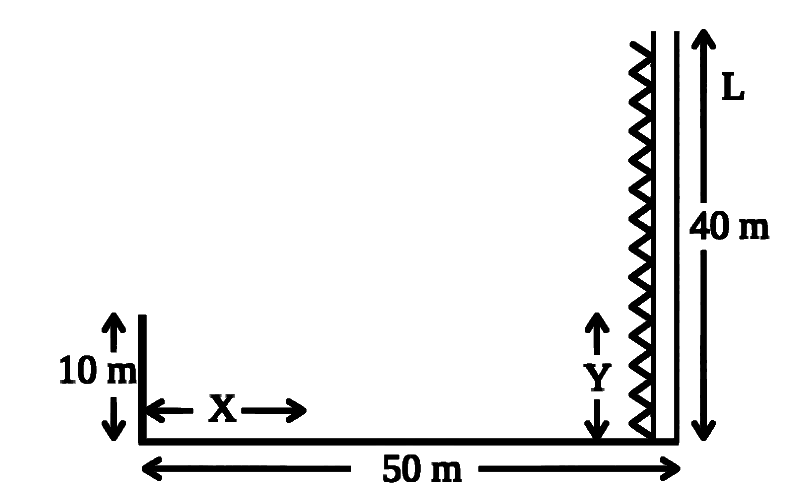
A person lives in a high-rise building on the bank of a river 50 m wide. Across the river is a well lit tower of height 40 m. When the person, who is at a height of 10 m, looks through a polarizer at an appropriate angle at light of the tower reflecting from the river surface, he notes that intensity of light coming from distance X from his building is the least and this corresponds to the light coming from light bulbs at height 'Y' on the tower. The values of X and Y are respectively close to (refractive index of water )
Answer: (b)
Polarisation · Malus's law: two polaroids
When an unpolarized light of intensity is incident on a polarizing sheet, the intensity of the light which does not get transmitted is
Answer: (b)
Polarisation · Brewster's law
The angle of incidence at which reflected light is totally polarized for reflection from air to glass (refractive index ) is:
Answer: (d)
Polarisation · Other polarisation effects
Which of the phenomenon is not common to sound and light waves?
Answer: (d)
No questions match these filters.