Work, Energy and Power PYQs · MHT CET · JEE Main · NEET
Conservation of Energy
Questions
44
MHT CET
9
JEE Main
30
NEET
5
Years
1997–2026
0 of 44 attemptedPick an answer to see the solution
Q1JEE Main 2026 · 23 JAN · SHIFT 1Medium
Conservation of Energy · Projectile: KE & PE at the top
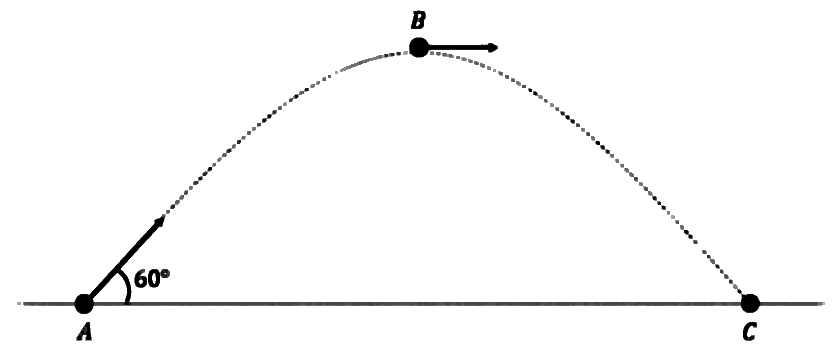
An object is projected with kinetic energy K from a point A at an angle 60∘ with the horizontal. The ratio of the difference in kinetic energies at points B and C to that at point A (see figure), in the absence of air friction is:
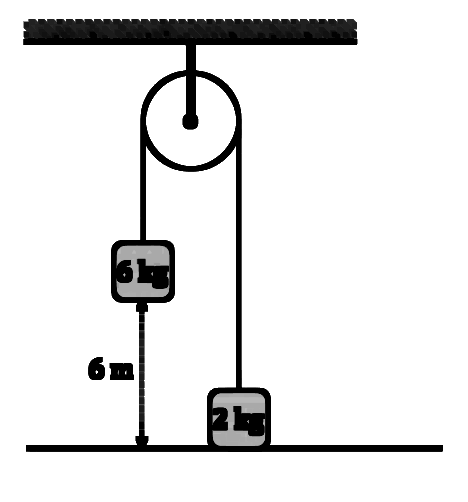
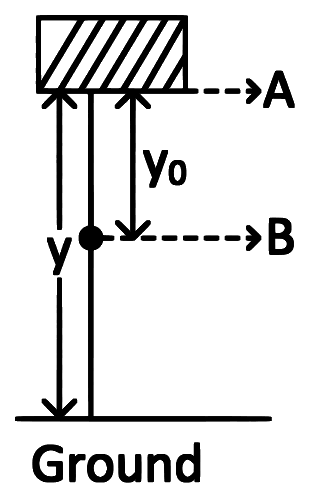
The velocity at which 6 kg mass (shown in figure) strikes the ground when it is released from a height of 6 m above the ground is m/s. Assume pulley is massless and string is light and inextensible. (Take g=10 m/s2)
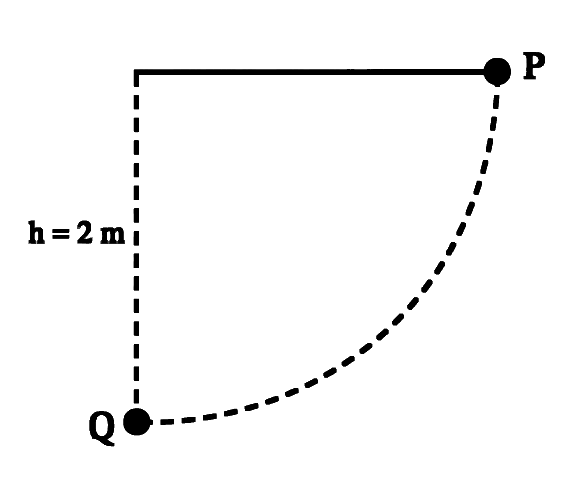
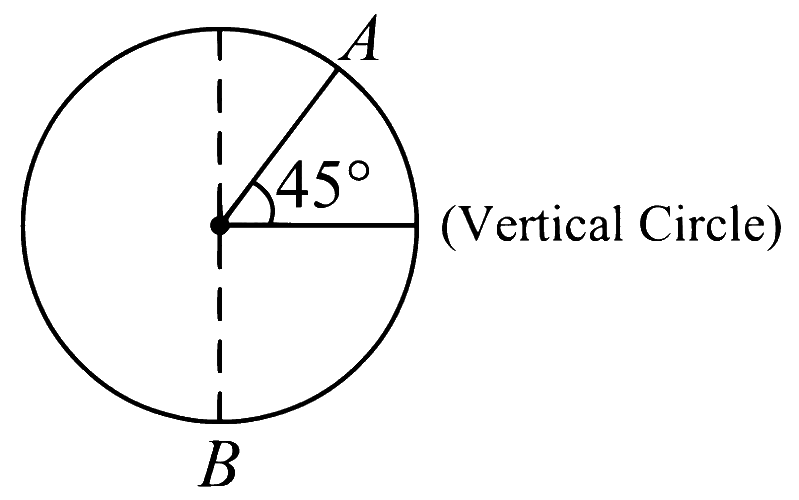
The bob of a simple pendulum of length 2m is kept at P. It is released and when it reaches Q, it losses 20% of its total energy due to air resistance. Its velocity at Q is [Take g=9.8 m/s2 ]
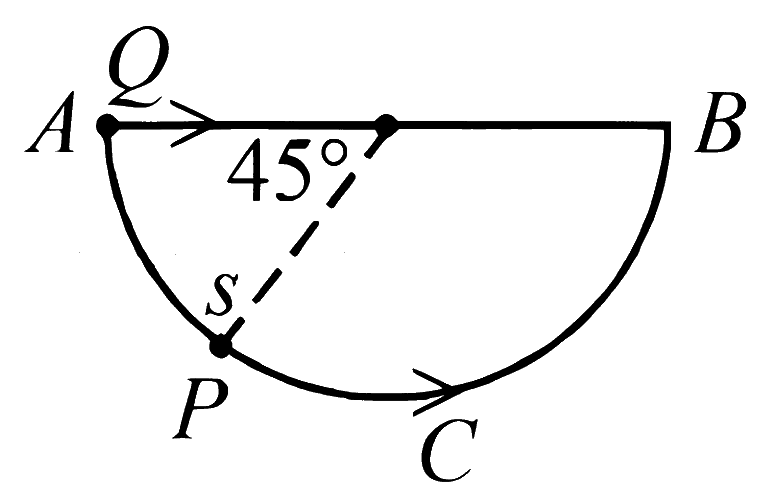
A bead P sliding on a frictionless semi-circular string (ACB) and it is at point S at t=0 and at this instant the horizontal component of its velocity is v. Another bead Q of the same mass as P is ejected from point A at t=0 along the horizontal string AB, with the speed v, friction between the beads and the respective strings may be neglected in both cases. Let tP and tQ be the respective times taken by beads P and Q to reach the point B, then the relation between tP and tQ is
Conservation of Energy · Projectile: KE & PE at the top
A ball having kinetic energy KE, is projected at an angle of 60∘ from the horizontal. What will be the kinetic energy of ball at the highest point of its flight?
Conservation of Energy · Free fall: K and U at a height
A particle is released from height S above the surface of the earth. At certain height its kinetic energy is three times its potential energy. The height from the surface of the earth and the speed of the particle at that instant are respectively.
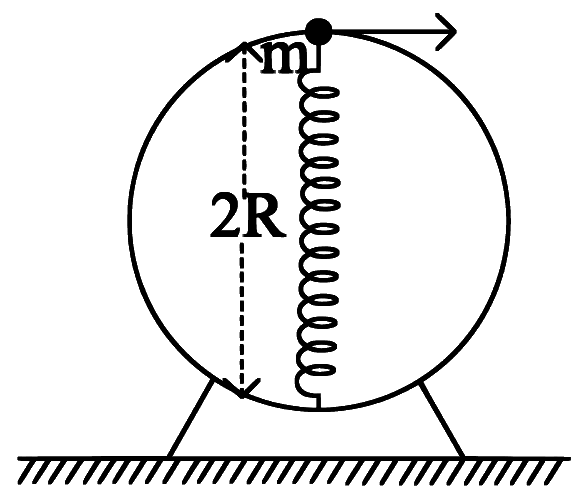
A bead of mass ' m ' slides without friction on the wall of a vertical circular hoop of radius ' R ' as shown in figure. The bead moves under the combined action of gravity and a massless spring (k) attached to the bottom of the hoop. The equilibrium length of the spring is ' R '. If the bead is released from top of the hoop with (negligible) zero initial speed, velocity of bead, when the length of spring becomes ' R ', would be (spring constant is ' k ', g is acceleration due to gravity)
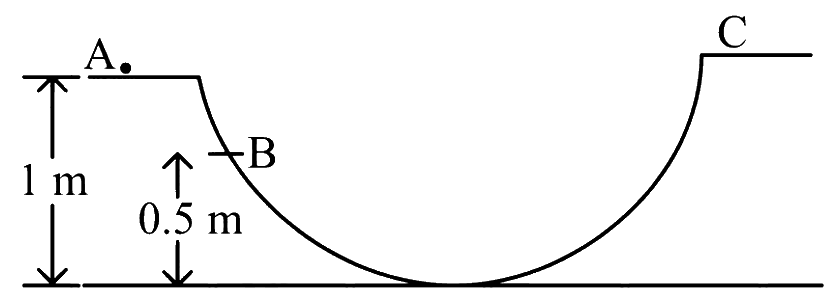
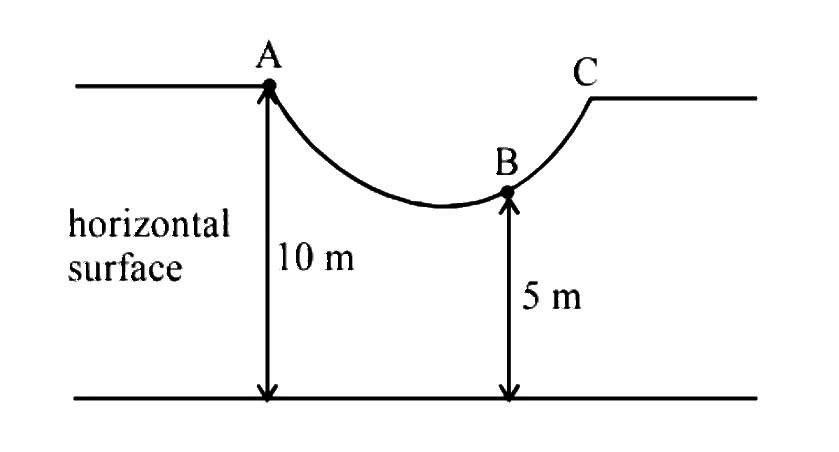
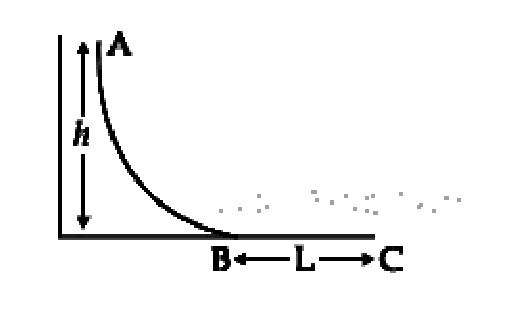
A particle is placed at the point A of a frictionless track ABC as shown in figure. It is gently pushed towards right. The speed of the particle when it reaches the point B is:
Conservation of Energy · Projectile: KE & PE at the top
A ball ' A ' is projected vertically upwards with certain initial speed. Another ball 'B' of same mass is projected at an angle of 30∘ with vertical with the same initial speed. At the highest point, the ratio of potential energy of ball A to that of ball B will be
A simple pendulum of length L has mass m and it oscillates freely with amplitude A. At extreme position, its potential energy is ( g= acceleration due to gravity)
A lead bullet moving with velocity ' V ' strikes a wall and stops. If 75% of its energy is converted into heat, then the increase in temperature is ( s= specific heat of lead, J= mechanical equivalent of heat)
A carpet of mass ' M ' made of a material is rolled along its length in the form of a cylinder of radius ' R ' and kept above the rough floor. If the carpet is unrolled without sliding to a radius ' R/2 '. The change in potential energy is ( g= acceleration due to gravity)
Conservation of Energy · Projectile: KE & PE at the top
A stone is projected at angle 30∘ to the horizontal. The ratio of kinetic energy of the stone at point of projection to its kinetic energy at the highest point of flight will be -
Conservation of Energy · Free fall: K and U at a height
A 0.4 kg mass takes 8s to reach ground when dropped from a certain height 'P' above surface of earth. The loss of potential energy in the last second of fall is __________ J.
(Take g = 10 m/s2)
Numerical answer type. Work it out, then open the answer.
Conservation of Energy · Projectile: KE & PE at the top
A stone is projected vertically upwards with speed 'v'. Another stone of same mass is projected at an angle of 60∘ with the vertical with the same speed 'v'. The ratio of their potential energies at the highest points of their journey is [sin30∘=cos60∘=0.5,cos30∘=sin60∘=23]
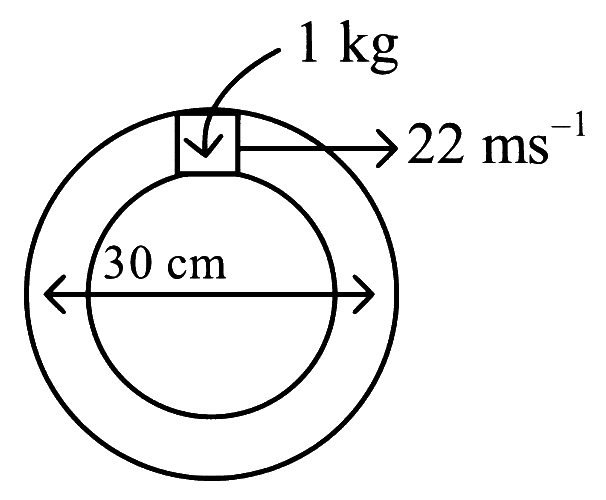
A closed circular tube of average radius 15 cm, whose inner walls are rough, is kept in vertical plane. A block of mass 1 kg just fits inside the tube. The speed of block is 22 m/s, when it is introduced at the top of tube. After completing five oscillations, the block stops at the bottom region of tube. The work done by the tube on the block is __________ J. (Given g = 10 m/s2).
Numerical answer type. Work it out, then open the answer.
Conservation of Energy · Projectile: KE & PE at the top
A ball is projected with kinetic energy E, at an angle of 60∘ to the horizontal. The kinetic energy of this ball at the highest point of its flight will become:
As shown in the figure, a particle of mass 10 kg is placed at a point A. When the particle is slightly displaced to its right, it starts moving and reaches the point B. The speed of the particle at B is x m/s. (Take g = 10 m/s2)
The value of 'x' to the nearest integer is __________.
Numerical answer type. Work it out, then open the answer.
Conservation of Energy · Free fall: K and U at a height
A particle is released from height S from the surface of the Earth. At a certain height its kinetic energy is three times its potential energy. The height from the surface of earth and the speed of the particle at that instant are respectively -
Conservation of Energy · Projectile: KE & PE at the top
A stone is projected vertically upwards with velocity 'V'. Another stone of same mass is projected at an angle of 60∘ with the vertical with the same speed (V). The ratio of their potential energies at the highest points of their journey, is
A pendulum bob has a speed of 3 m/s at its lowest position. The pendulum is 50 cm long. The speed of bob, when the length makes an angle of 60 ∘ to the vertical will be (g = 10 m/s2) ____________ m/s.
Numerical answer type. Work it out, then open the answer.
A uniform chain of length 3 meter and mass 3 kg overhangs a smooth table with 2 meter lying on the table. If k is the kinetic energy of the chain in joule as it completely slips off the table, then the value of k is .................. (Take g = 10 m/s2)
Numerical answer type. Work it out, then open the answer.
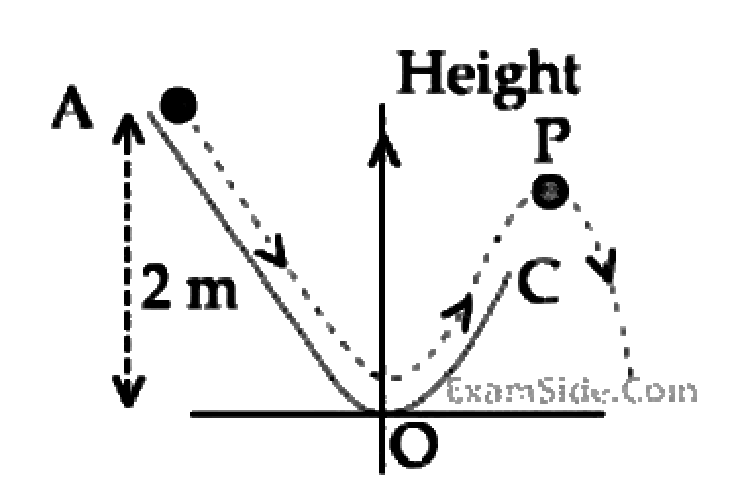
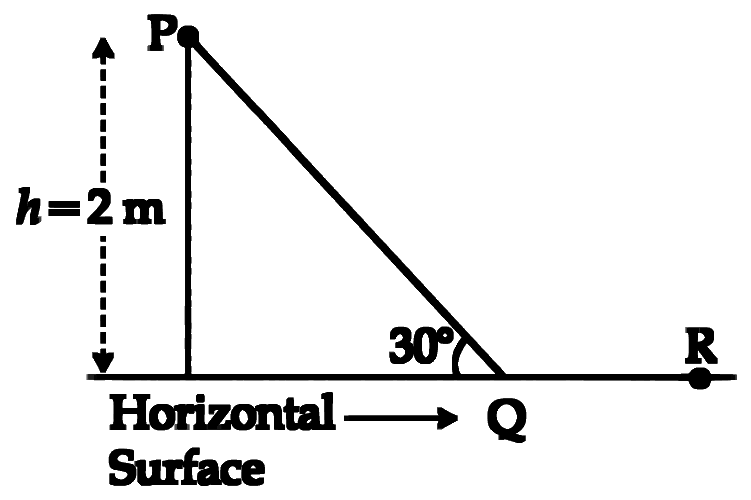
A particle (m = 1 kg) slides down a frictionless track (AOC) starting from rest at a point A (height 2 m). After reaching C, the particle continues to move freely in air as a projectile. When it reaches its highest point P (height 1 m), the kinetic energy of the particle (in J) is:
(Figure drawn is schematic and not to scale; take g = 10 ms-2)
Numerical answer type. Work it out, then open the answer.
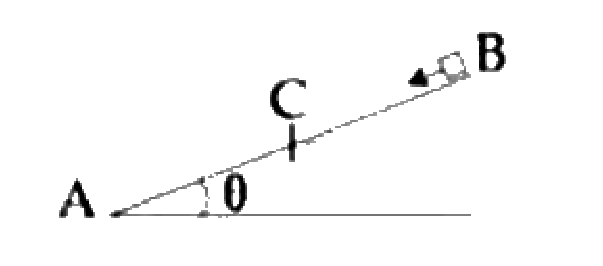
A small block starts slipping down from a point B on an inclined plane AB, which is making an angle θ with the horizontal section BC is smooth and the remaining section CA is rough with a coefficient of friction μ. It is found that the block comes to rest as it reaches the bottom (point A) of the inclined plane. If BC = 2AC, the coefficient of friction is given by μ = ktan θ. The value of k is _________.
Numerical answer type. Work it out, then open the answer.
A block starts moving up an inclined plane of inclination 30° with an initial velocity of v0. It comes back to its initial position with velocity 2v0. The value of the coefficient of kinetic friction between the block and the inclined plane is close to 1000I. The nearest integer to I is____.
Numerical answer type. Work it out, then open the answer.
A uniform cable of mass 'M' and length 'L' is placed on a horizontal surface such that its (1/n)th part is hanging below the edge of the surface. To lift the hanging part of the cable upto the surface, the work done should be:
A person trying to lose weight by burning fat lifts a mass of 10 kg upto a height of 1 m1000 times. Assume that the potential energy lost each time he lowers the mass is dissipated. How much fat will he use up considering the work done only when the weight is lifted up? Fat supplies 3.8×10⁷ J of energy per kg which is converted to mechanical energy with a 20% efficiency rate. Take g=9.8 ms−2:
A point particle of mass m, moves along the uniformly rough track PQR as shown in the figure. The coefficient of friction, between the particle and the rough track equals μ. The particle is released, from rest from the point P and it comes to rest at point R. The energies, lost by the ball, over the parts, PQ and QR, of the track, are equal to each other, and no energy is lost when particle changes direction from PQ to QR.
The value of the coefficient of friction μ and the distance x(=QR), are, respectively close to:
A small ball of mass m starts at a point A with speed vo and moves along a frictionless track AB as shown. The track BC has coefficient of friction μ. The ball comes to stop at C after travelling a distance L which is:
The average mass of rain drops is 3.0 × 10⁻⁵ kg and their average terminal velocity is 9 m/s. Calculate the energy transferred by rain to each square meter of the surface at a place which receives 100 cm of rain in a year.
A mass of M kg is suspended by a weightless string. The horizontal force that is required to displace it until the string makes an angle of 45∘ with the initial vertical direction is
A spherical ball of mass 20 kg is stationary at the top of a hill of height 100 m. It rolls down a smooth surface to the ground, then climbs up another hill of height 30 m and finally rolls down to a horizontal base at a height of 20 m above the ground. The velocity attained by the ball is
The upper half of an inclined plane with inclination ϕ is perfectly smooth while the lower half is rough. A body starting from rest at the top will again come to rest at the bottom if the coefficient of friction for the lower half is given by
Conservation of Energy · Free fall: K and U at a height
A ball of mass 2 kg and another of mass 4 kg are dropped together from a 60 feet tall building. After a fall of 30 feet each towards earth, their respective kinetic energies will be in the ratio of
A uniform chain of length 2 m is kept on a table such that a length of 60 cm hangs freely from the edge of the table. The total mass of the chain is 4 kg. What is the work done in pulling the entire chain on the table?
Conservation of Energy · Projectile: KE & PE at the top
A ball whose kinetic energy is E, is projected at an angle of 45∘ to the horizontal. The kinetic energy of the ball at the highest point of its flight will be