Work, Energy and Power PYQs · MHT CET · JEE Main · NEET
Work-Energy Theorem
Questions
32
MHT CET
1
JEE Main
24
NEET
7
Years
1989–2026
0 of 32 attemptedPick an answer to see the solution
Q1JEE Main 2026 · 6 APR · SHIFT 1Easy
Work-Energy Theorem · Work by air resistance
The rain drop of mass 1 g, starts with zero velocity from a height of 1 km. It hits the ground with a speed of 5 m/s. The work done by the unknown resistive force is ______ J.
Work-Energy Theorem · Work from v(x), x(t) or a v-t graph
A body of mass 2 kg is moving along x-direction such that its displacement as function of time is given by x(t)=αt2+βt+γ m, where α=1 m/s2,β=1 m/s and γ=1 m. The work done on the body during the time interval t=2 s to t=3 s, is ________ J.
The kinetic energies of two similar cars A and B are 100 J and 225 J respectively. On applying brakes, car A stops after 1000 m and car B stops after 1500 m. If FA and FB are the forces applied by the brakes on cars A and B respectively, then the ratio of FBFA is
Work-Energy Theorem · Work from v(x), x(t) or a v-t graph
A particle of mass m moves on a straight line with its velocity increasing with distance according to the equation v=αx, where α is a constant. The total work done by all the forces applied on the particle during its displacement from x=0 to x=d, will be:
A bullet is fired into a fixed target loses one third of its velocity after travelling 4 cm. It penetrates further D×10−3 m before coming to rest. The value of D is:
A lift of mass M=500 kg is descending with speed of 2 ms−1. Its supporting cable begins to slip thus allowing it to fall with a constant acceleration of 2 ms−2. The kinetic energy of the lift at the end of fall through to a distance of 6 m will be _____________ kJ.
Numerical answer type. Work it out, then open the answer.
A spherical body of mass 2 kg starting from rest acquires a kinetic energy of 10000 J at the end of 5th second. The force acted on the body is ________ N.
Numerical answer type. Work it out, then open the answer.
Statement I: A truck and a car moving with same kinetic energy are brought to rest by applying brakes which provide equal retarding forces. Both come to rest in equal distance. Statement II: A car moving towards east takes a turn and moves towards north, the speed remains unchanged. The acceleration of the car is zero.
In the light of given statements, choose the most appropriate answer from the options given below
Work-Energy Theorem · Work from v(x), x(t) or a v-t graph
A body of mass 0.5 kg travels on straight line path with velocity v=(3x2+4) m/s. The net workdone by the force during its displacement from x=0 to x=2 m is:
Work-Energy Theorem · Work from v(x), x(t) or a v-t graph
A particle of mass 500 gm is moving in a straight line with velocity v = b x5/2. The work done by the net force during its displacement from x = 0 to x = 4 m is: (Take b = 0.25 m−3/2 s−1).
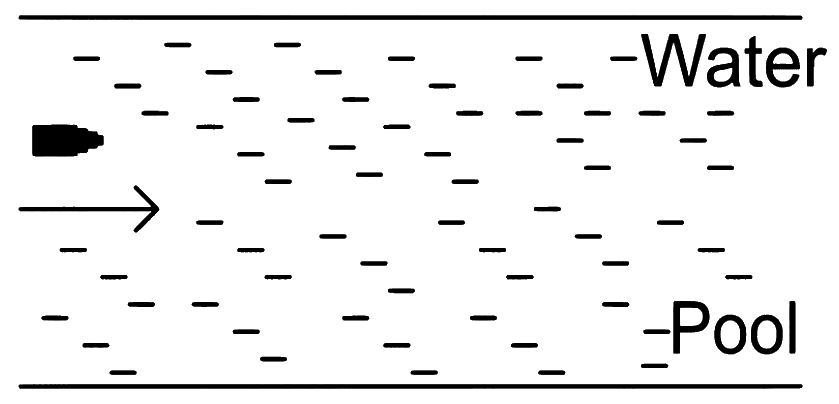
A bullet of mass 200 g having initial kinetic energy 90 J is shot inside a long swimming pool as shown in the figure. If its kinetic energy reduces to 40 J within 1 s, the minimum length of the pool, the bullet has to travel so that it completely comes to rest is
A cricket ball of mass 0.15 kg is thrown vertically up by a bowling machine so that it rises to a maximum height of 20 m after leaving the machine. If the part pushing the ball applies a constant force F on the ball and moves horizontally a distance of 0.2 m while launching the ball, the value of F (in N) is (g = 10 ms–2) ____.
Numerical answer type. Work it out, then open the answer.
A vehicle of mass m is moving with momentum p on a rough horizontal road. The coefficient of friction between the tyres and the horizontal road is μ. The stopping distance is (g= acceleration due to gravity)
A particle which is experiencing a force, given by F=3i^−12j^, undergoes a displacement of d=4i particle had a kinetic energy of 3 J at the beginning of the displacement, what is its kinetic energy at the end of the displacement?
Work-Energy Theorem · Work from v(x), x(t) or a v-t graph
A force acts on a 2 kg object so that its position is given as a function of time as x = 3t2 + 5. What is the work done by this force in first 5 seconds?
Work-Energy Theorem · Work from v(x), x(t) or a v-t graph
A body of mass m starts moving from rest along x-axis so that its velocity varies as v=as where a is a constant and s is the distance covered by the body. The total work done by all the forces acting on the body in the first t seconds after the start of the motion is:
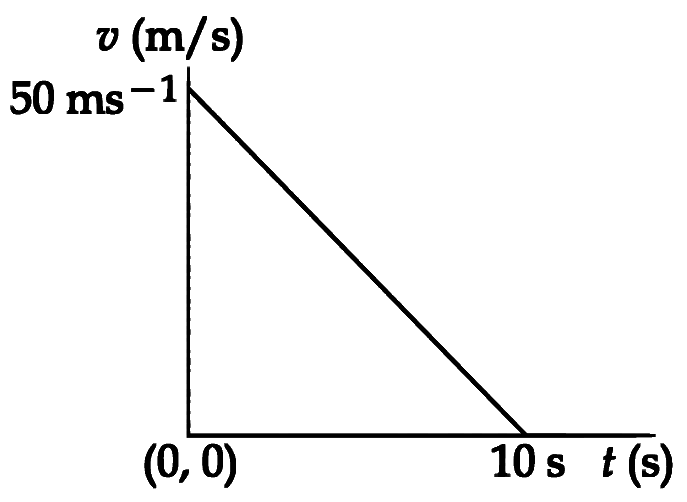
Consider a drop of rain water having mass 1 g falling from a height of 1 km. It hits the ground with a speed of 50 m s−1. Take 'g' constant with a value 10 m s−2. The work done by the (i) gravitational force and the (ii) resistive force of air is
Work-Energy Theorem · Work from v(x), x(t) or a v-t graph
A time dependent force F = 6t acts on a particle of mass 1 kg. If the particle starts from rest, the work done by the force during the first 1 sec. will be:
A body of mass 1 kg is thrown upwards with a velocity 20 m/s. It momentarily comes to rest after attaining a height of 18 m. How much energy is lost due to air friction? (g = 10 m/s2)
Work-Energy Theorem · Work from v(x), x(t) or a v-t graph
A body of mass 3 kg is under a constant force which causes a displacement s in metres in it, given by the relation s = 31 t2, where t is in seconds. Work done by the force in 2 seconds is
A ball of mass 0.2 kg is thrown vertically upwards by applying a force by hand. If the hand moves 0.2 m while applying the force and the ball goes upto 2 m height further, find the magnitude of the force. (consider g=10 m/s2 ).
A bullet fired into a fixed target loses half of its velocity after penetrating 3 cm How much further it will penetrate before coming to rest assuming that it faces constant resistance to motion?
Work-Energy Theorem · Work from v(x), x(t) or a v-t graph
A force acts on a 3.0 g particle in such a way that the position of the particle as a function of time is given by x=3t−4t2+t3, where x is in metre and t in second. The work done during the first 4 s is
A bullet of mass 10 g leaves a rifle at an initial velocity of 1000 m/s and strikes the earth at the same level with a velocity of 500 m/s. The work done in joule overcoming the resistance of air will be