
Physics Circle home Student Login

Home›Study material›Formula Book›Alternating Current

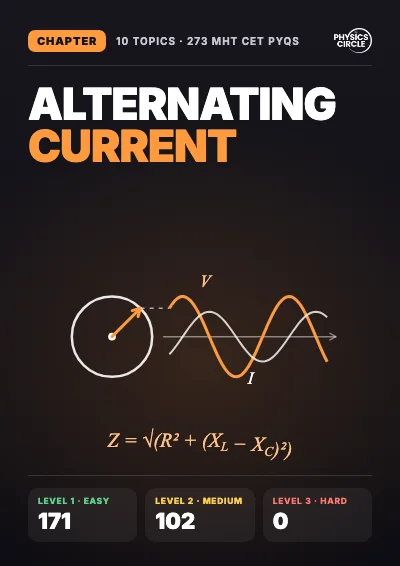
Alternating Current Formula Book

73 formulas in 10 topics, in the same order as the PYQ topics.

Only formulas used in the solutions of 273 MHT CET PYQs (Level 1, 2, 3)
01

AC Basics: Peak, RMS & Average Values

4 formulas · from 19 MHT CET PYQs

Practise these PYQs ›
02

Pure R, L and C Circuits

11 formulas · from 40 MHT CET PYQs

Practise these PYQs ›
  • Inductive reactanceXL=ωL=2πfL  ⇒  XL∝fX_L = \omega L = 2\pi fL \;\Rightarrow\; X_L \propto f
  • Capacitive reactanceXC=1ωC=12πfC  ⇒  XC∝1fX_C = \dfrac{1}{\omega C} = \dfrac{1}{2\pi fC} \;\Rightarrow\; X_C \propto \dfrac{1}{f}
  • Inductor in DC (f = 0)XL=0X_L = 0
  • Ratio of reactancesXCXL=1ω2LC∝1ω2\dfrac{X_C}{X_L} = \dfrac{1}{\omega^2 LC} \propto \dfrac{1}{\omega^2}
  • Current in a pure inductorIrms=VrmsXL=V2πfLI_{rms} = \dfrac{V_{rms}}{X_L} = \dfrac{V}{2\pi fL}
  • Current in a pure capacitorIrms=VrmsXC=Vrms ωCI_{rms} = \dfrac{V_{rms}}{X_C} = V_{rms}\,\omega C
  • Pure C: current leads voltage by pi/2I=E0ωCsin⁡(ωt+π2)I = E_0\omega C\sin\left(\omega t + \dfrac{\pi}{2}\right)
  • Pure L: current lags voltage by pi/2I=E0ωLsin⁡(ωt−π2)I = \dfrac{E_0}{\omega L}\sin\left(\omega t - \dfrac{\pi}{2}\right)
  • Charge and current on a capacitorq=CE0sin⁡ωt,I=dqdtq = CE_0\sin\omega t,\qquad I = \dfrac{dq}{dt}
  • Induced emf in an inductorE=LdIdtE = L\dfrac{dI}{dt}
  • Energy stored in an inductorU=12LI2U = \tfrac{1}{2}LI^2

🔒 For Vajra 2.0 Pro studentsTopic 1 is free. Log in with your Vajra 2.0 Pro number to see every formula.

03

RL and RC Series Circuits

6 formulas · from 36 MHT CET PYQs

Practise these PYQs ›
  • Impedance of RL circuitZ=R2+XL2Z = \sqrt{R^2 + X_L^2}
  • Impedance of RC circuitZ=R2+XC2Z = \sqrt{R^2 + X_C^2}
  • Current in RL circuitI=VR2+XL2I = \dfrac{V}{\sqrt{R^2 + X_L^2}}
  • Phase angle in RL circuittan⁡ϕ=XLR\tan\phi = \dfrac{X_L}{R}
  • Phase 45 degreestan⁡45∘=1⇒XL=R,Z=2R\tan 45^\circ = 1 \Rightarrow X_L = R,\qquad Z = \sqrt{2}R
  • Peak and rms currentI0=2 IrmsI_0 = \sqrt{2}\,I_{rms}

🔒 For Vajra 2.0 Pro studentsTopic 1 is free. Log in with your Vajra 2.0 Pro number to see every formula.

04

Series LCR Circuit

10 formulas · from 36 MHT CET PYQs

Practise these PYQs ›
  • Impedance of series LCRZ=R2+(XL−XC)2Z = \sqrt{R^2 + (X_L - X_C)^2}
  • Applied voltage in series LCRV=VR2+(VL−VC)2V = \sqrt{V_R^2 + (V_L - V_C)^2}
  • Phase angle in series LCRtan⁡ϕ=XL−XCR\tan\phi = \dfrac{X_L - X_C}{R}
  • Power factorcos⁡ϕ=RZ\cos\phi = \dfrac{R}{Z}
  • Phase 60 degreestan⁡60∘=3⇒X=3R\tan 60^\circ = \sqrt{3} \Rightarrow X = \sqrt{3}R
  • Phase 45 degreestan⁡45∘=1⇒∣XL−XC∣=R\tan 45^\circ = 1 \Rightarrow |X_L - X_C| = R
  • rms currentIrms=VrmsZI_{rms} = \dfrac{V_{rms}}{Z}
  • Voltage across L and C togetherVLC=∣VL−VC∣=I ∣XL−XC∣V_{LC} = |V_L - V_C| = I\,|X_L - X_C|
  • When X_L = X_CXL=XC⇒Z=R,cos⁡ϕ=1X_L = X_C \Rightarrow Z = R,\quad \cos\phi = 1
  • AdmittanceY=1ZY = \dfrac{1}{Z}

🔒 For Vajra 2.0 Pro studentsTopic 1 is free. Log in with your Vajra 2.0 Pro number to see every formula.

05

Resonance, Bandwidth & Q Factor

12 formulas · from 56 MHT CET PYQs

Practise these PYQs ›
  • Condition for resonanceXL=XC  ⇒  ωL=1ωCX_L = X_C \;\Rightarrow\; \omega L = \dfrac{1}{\omega C}
  • Impedance at resonance (minimum)Z=R,Z=R2+(XL−XC)2≥RZ = R,\qquad Z = \sqrt{R^2 + (X_L - X_C)^2} \ge R
  • Phase at resonancetan⁡ϕ=XL−XCR=0⇒ϕ=0\tan\phi = \dfrac{X_L - X_C}{R} = 0 \Rightarrow \phi = 0
  • Resonant angular frequencyω0=1LC\omega_0 = \dfrac{1}{\sqrt{LC}}
  • Resonant frequencyf0=12πLC  ⇒  f∝1LCf_0 = \dfrac{1}{2\pi\sqrt{LC}} \;\Rightarrow\; f \propto \dfrac{1}{\sqrt{LC}}
  • Capacitance needed for resonanceC=1ω2LC = \dfrac{1}{\omega^2 L}
  • Current at resonance (maximum)I=VRI = \dfrac{V}{R}
  • Current amplitude in series LCRI0=E0R2+(ωL−1ωC)2I_0 = \dfrac{E_0}{\sqrt{R^2 + \left(\omega L - \frac{1}{\omega C}\right)^2}}
  • Voltage across L at resonanceVL=IωL=IXCV_L = I\omega L = IX_C
  • Quality factorQ=ω0LR=1RLCQ = \dfrac{\omega_0 L}{R} = \dfrac{1}{R}\sqrt{\dfrac{L}{C}}
  • BandwidthΔω=RL\Delta\omega = \dfrac{R}{L}
  • Equivalent L and C before using f0f0=12πLeqCeqf_0 = \dfrac{1}{2\pi\sqrt{L_{eq}C_{eq}}}

🔒 For Vajra 2.0 Pro studentsTopic 1 is free. Log in with your Vajra 2.0 Pro number to see every formula.

06

Power, Power Factor & Wattless Current

9 formulas · from 35 MHT CET PYQs

Practise these PYQs ›
  • Average power in ACP=VrmsIrmscos⁡ϕ=V0I02cos⁡ϕP = V_{rms}I_{rms}\cos\phi = \dfrac{V_0I_0}{2}\cos\phi
  • Power factorcos⁡ϕ=RZ=true powerapparent power\cos\phi = \dfrac{R}{Z} = \dfrac{\text{true power}}{\text{apparent power}}
  • Average power from impedanceP=Irms2R=Erms2RZ2P = I_{rms}^2R = \dfrac{E_{rms}^2R}{Z^2}
  • rms from peak emfErms2=E022E_{rms}^2 = \dfrac{E_0^2}{2}
  • Power in RL circuitP=V2RR2+ω2L2P = \dfrac{V^2R}{R^2 + \omega^2L^2}
  • Impedance from power factorZ=Rcos⁡ϕ∝1cos⁡ϕZ = \dfrac{R}{\cos\phi} \propto \dfrac{1}{\cos\phi}
  • Power factor 1/sqrt2cos⁡ϕ=12⇒X=R,Z=2R\cos\phi = \dfrac{1}{\sqrt{2}} \Rightarrow X = R,\quad Z = \sqrt{2}R
  • Wattless current (phi = 90 degrees)P=VrmsIrmscos⁡90∘=0P = V_{rms}I_{rms}\cos 90^\circ = 0
  • Extra capacitor for resonance (power factor 1)C+C1=1ω2LC + C_1 = \dfrac{1}{\omega^2L}

🔒 For Vajra 2.0 Pro studentsTopic 1 is free. Log in with your Vajra 2.0 Pro number to see every formula.

07

Parallel AC Circuits

4 formulas · from 5 MHT CET PYQs

Practise these PYQs ›
  • Current in L and C (parallel)iL=1L∫e dt,iC=Cdedti_L = \dfrac{1}{L}\int e\,dt,\qquad i_C = C\dfrac{de}{dt}
  • Net current, L parallel to CI=∣IL−IC∣I = |I_L - I_C|
  • Impedance of L parallel to CZ=ωL∣1−ω2LC∣Z = \dfrac{\omega L}{|1 - \omega^2 LC|}
  • Parallel resonanceω2=1LC\omega^2 = \dfrac{1}{LC}

🔒 For Vajra 2.0 Pro studentsTopic 1 is free. Log in with your Vajra 2.0 Pro number to see every formula.

08

LC Oscillations

6 formulas · from 11 MHT CET PYQs

Practise these PYQs ›
  • Energy stored in a charged capacitorU=Q22CU = \dfrac{Q^2}{2C}
  • Energy exchange in LC circuit12CV2=12LImax2  ⇒  Imax=VCL\tfrac{1}{2}CV^2 = \tfrac{1}{2}LI_{max}^2 \;\Rightarrow\; I_{max} = V\sqrt{\dfrac{C}{L}}
  • Frequency of LC oscillationsf=12πLC  ⇒  f∝1Cf = \dfrac{1}{2\pi\sqrt{LC}} \;\Rightarrow\; f \propto \dfrac{1}{\sqrt{C}}
  • Time for capacitor to fully discharget=T4=π2LCt = \dfrac{T}{4} = \dfrac{\pi}{2}\sqrt{LC}
  • Energy equally sharedUE=UB=U2U_E = U_B = \dfrac{U}{2}
  • Dielectric in the capacitorC′=KCC' = KC

🔒 For Vajra 2.0 Pro studentsTopic 1 is free. Log in with your Vajra 2.0 Pro number to see every formula.

09

AC Generator & Transformer

6 formulas · from 29 MHT CET PYQs

Practise these PYQs ›
  • Transformer: turns ratioVsVp=NsNp\dfrac{V_s}{V_p} = \dfrac{N_s}{N_p}
  • Transformer: current ratioIsIp=NpNs\dfrac{I_s}{I_p} = \dfrac{N_p}{N_s}
  • Ideal transformer: power in = power outVpIp=VsIsV_pI_p = V_sI_s
  • Impedance ratio of transformerZpZs=(NpNs)2\dfrac{Z_p}{Z_s} = \left(\dfrac{N_p}{N_s}\right)^2
  • Mutual induction emfe=MdIdt,e0=MωI0e = M\dfrac{dI}{dt},\qquad e_0 = M\omega I_0
  • Average power to a resistorPavg=e022RP_{avg} = \dfrac{e_0^2}{2R}

🔒 For Vajra 2.0 Pro studentsTopic 1 is free. Log in with your Vajra 2.0 Pro number to see every formula.

10

Inductors & DC Transients (Mixed)

5 formulas · from 6 MHT CET PYQs

Practise these PYQs ›
  • Mutual induction emfe=MdIpdte = M\dfrac{dI_p}{dt}
  • Energy stored in an inductorU=12LI2U = \tfrac{1}{2}LI^2
  • Inductors in parallel1Leq=1L1+1L2\dfrac{1}{L_{eq}} = \dfrac{1}{L_1} + \dfrac{1}{L_2}
  • Inductors in seriesLeq=L1+L2L_{eq} = L_1 + L_2
  • Potential drop across R and LVA−VB=IR+LΔIΔtV_A - V_B = IR + L\dfrac{\Delta I}{\Delta t}

🔒 For Vajra 2.0 Pro studentsTopic 1 is free. Log in with your Vajra 2.0 Pro number to see every formula.