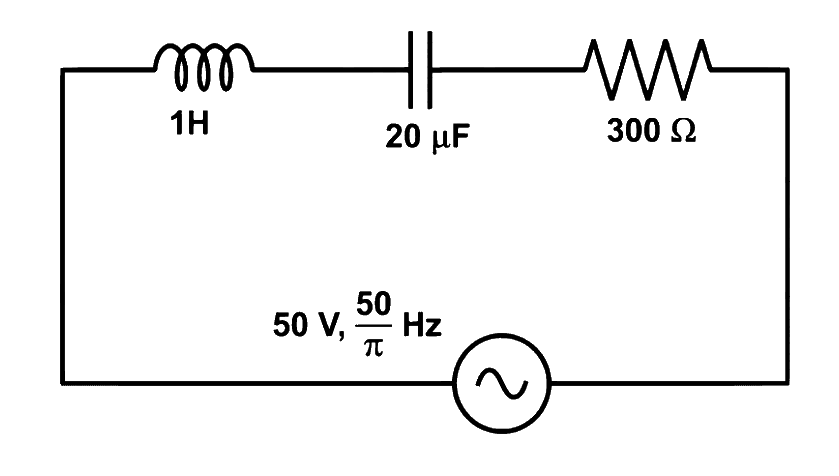
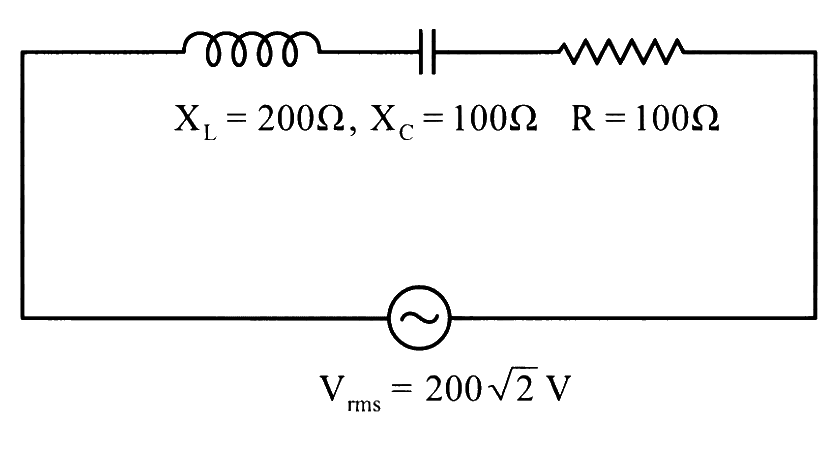
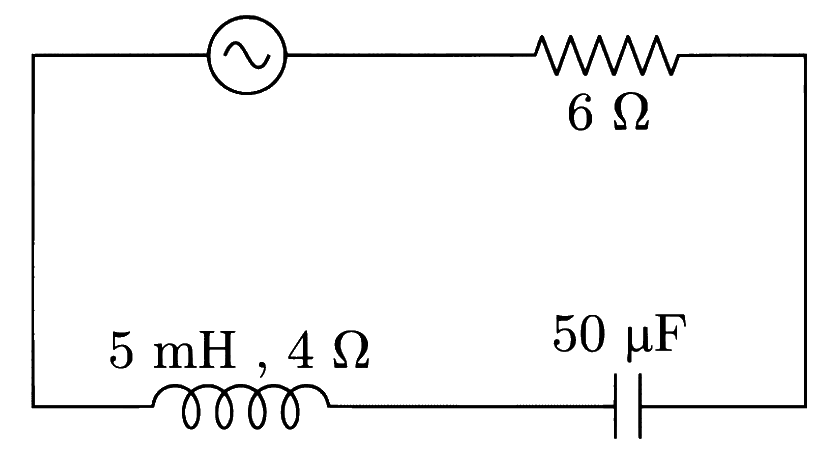
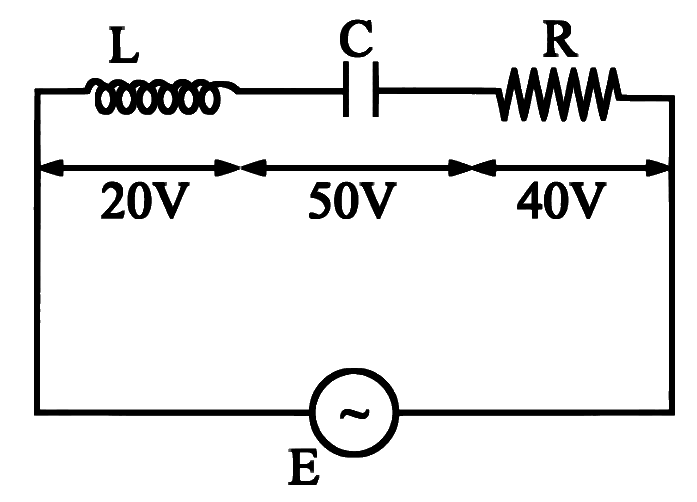
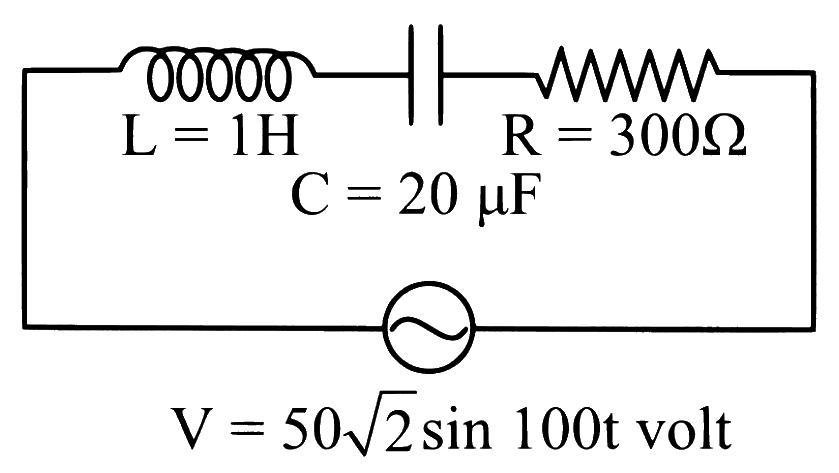
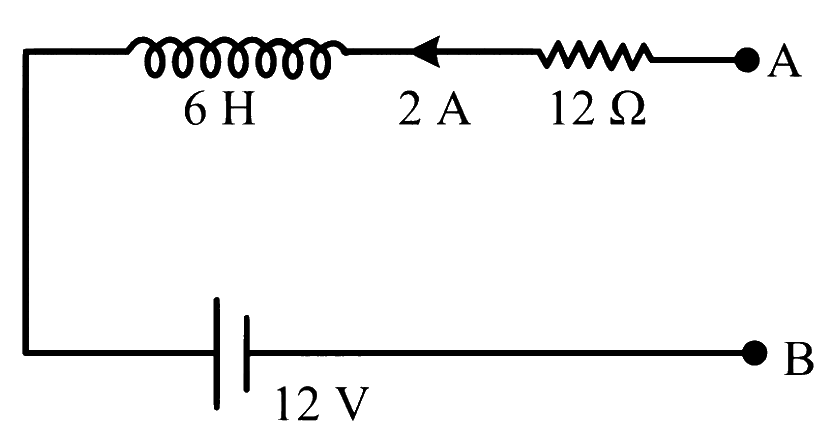
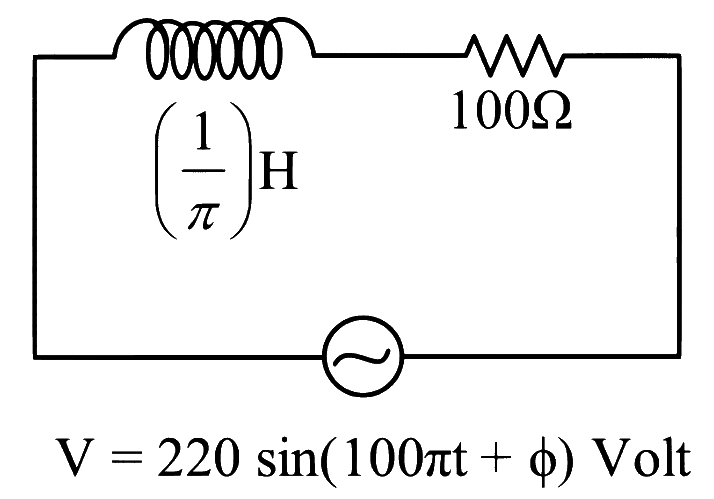
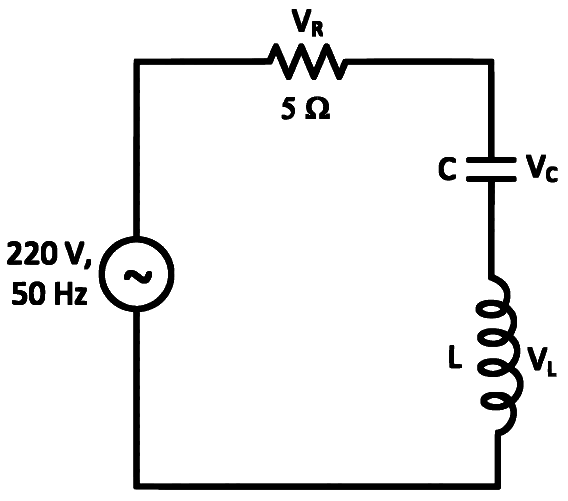
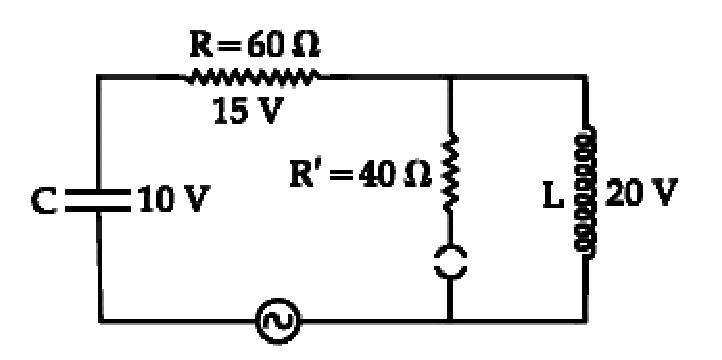
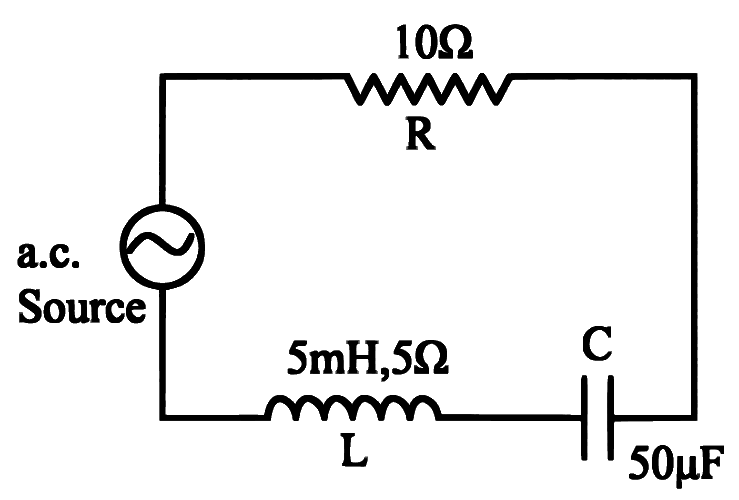
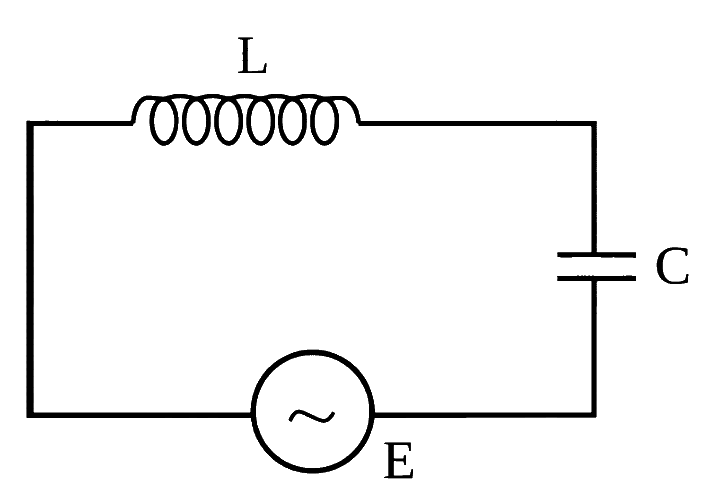
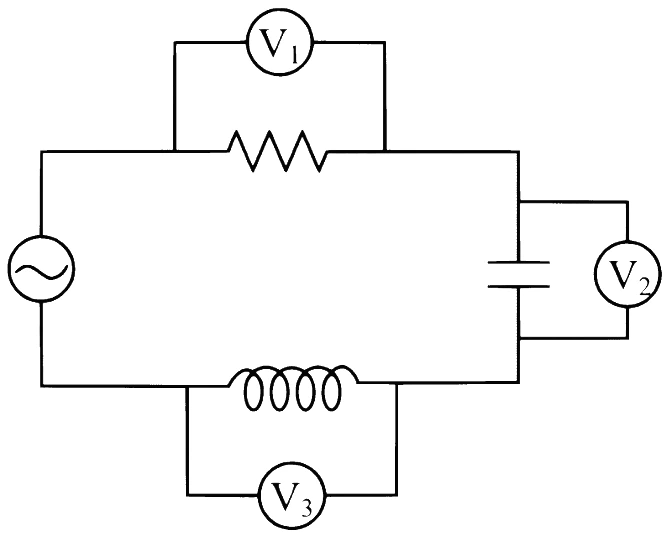
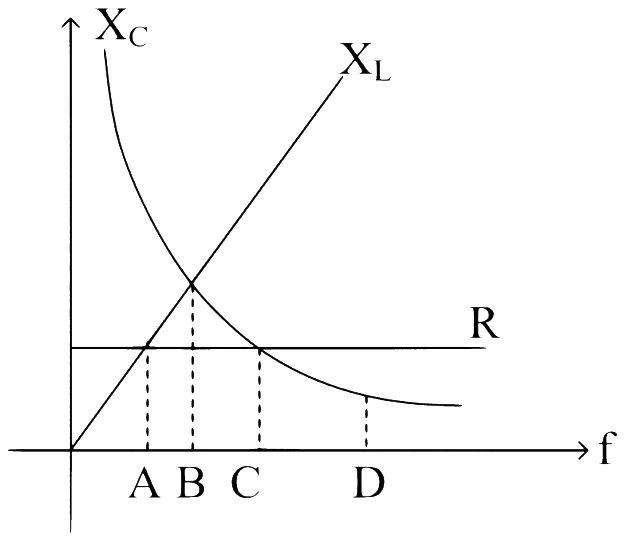
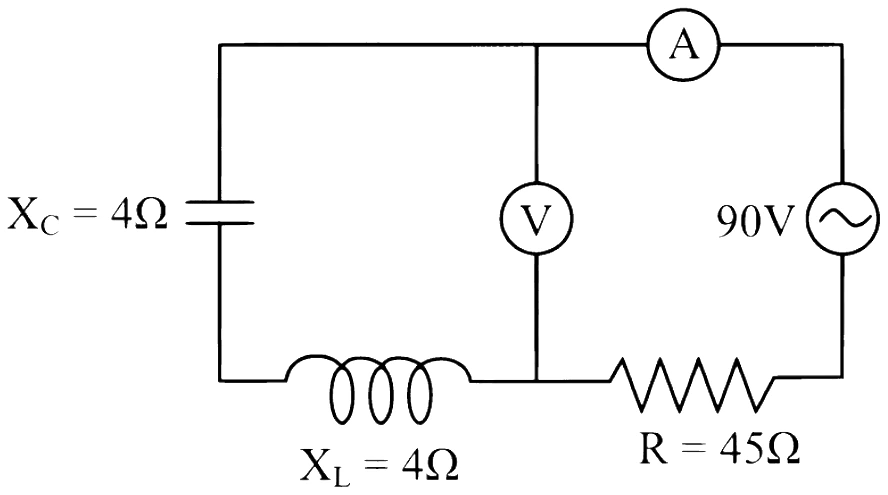
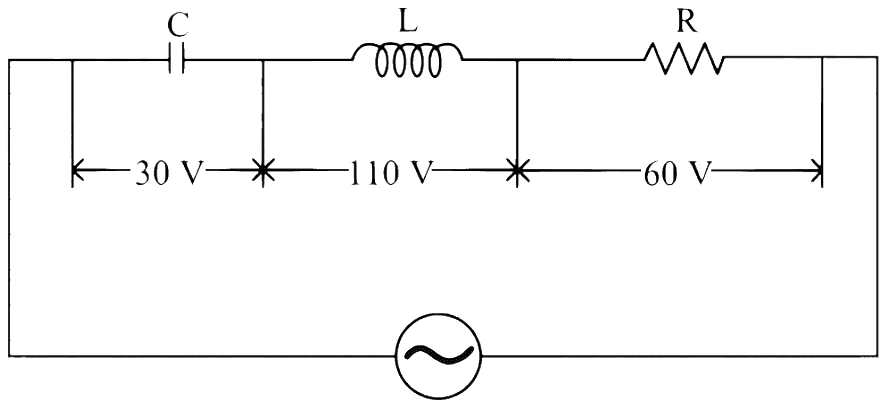
In an LCR series circuit, the potential difference across the terminals of the inductor, capacitor and resistor is 60 V, 30 V and 40 V respectively. Then supply voltage will be equal to
Series LCR circuit containing an a.c. source of 100V has a inductor and a capacitor of reactance 24Ω and 16Ω respectively. If a resistance of 6Ω is connected in series, then the potential difference across the series combination of inductor and capacitor only is
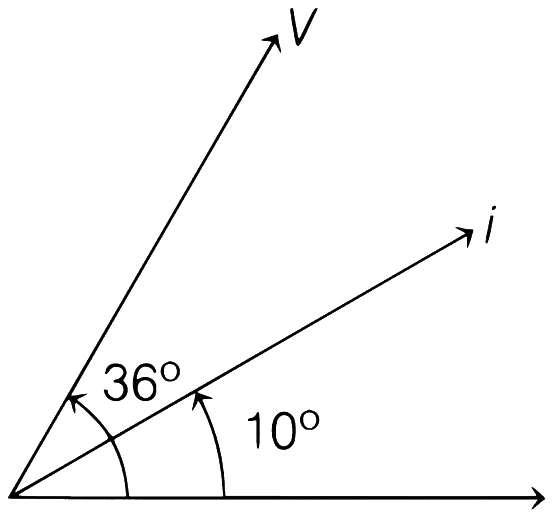
For a series LCR circuit inductive reactance XL is equal to resistance R and also equal to twice the capacitive reactance XC. The impedance of the circuit and the phase difference between voltage V and current i are respectively
In an LCR series circuit, a. c. voltage source is connected in series. When L is removed from the circuit, the phase difference between the voltage and the current is π/3. If instead C is removed, the phase difference is again π/3. The power factor of the circuit is (tan3π=3)
The resistor 'R' inductance 'L' and capacitance 'C' are connected in series with an a.c. source. When 'L' is removed from the circuit, the phase difference between voltage and current in the circuit is 3π. If instead, C is removed from the circuit, the phase difference is again 3π. The power factor of the circuit is
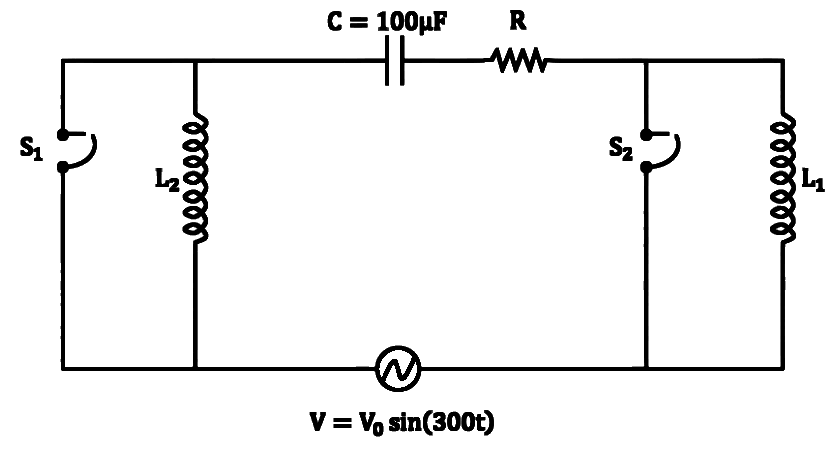
The figure given below shows an LCR series circuit with two switches S1 and S2. When switch S1 is closed keeping S2 open, the phase difference (φ) between the current and source voltage is 30° and phase difference is 60° when S2 is closed keeping S1 open. The value of (3L1 − L2) is ______ H.
To an ac power supply of 220 V at 50 Hz, a resistor of 20Ω, a capacitor of reactance 25Ω and an inductor of reactance 45Ω are connected in series. The corresponding current in the circuit and the phase angle between the current and the voltage is, respectively
An alternating e.m.f. having voltage V=V0sinωt is applied to a series L-C-R circuit. Given: ∣XL−XC∣=R. The r.m.s. value of potential difference across capacitor will be
A series LCR circuit is connected to an a.c. source of 230 V,50 Hz. The circuit contains resistance of 80Ω an inductor having inductive reactance 70Ω and a capacitor of capacitive reactance 130Ω. The power factor of the circuit is x. The value of x is
An inductor of (π100) mH, capacitor of capacitance (2π10−3) F and resistance of 10Ω are connected in series with an AC voltage source of 110 V,50 Hz supply. The tangent of the phase angle ' ϕ ' between voltage and current is
In LCR series circuit, when ' L ' is removed from the circuit, the phase difference between voltage and current in the circuit is 3π. If ' C ' is removed from the circuit instead of L then phase difference is again 3π. The power factor of the circuit is (tan60∘=3)
In an electrical circuit ' R ', ' L ', ' C ' and an a.c. voltage source are all connected in series. When ' L ' is removed from the circuit, the phase difference between the voltage and the current in the circuit is 3π. If instead ' C ' is removed from the circuit, the phase difference is again 3π. The power factor of the circuit is (tan3π=3)
In an LCR circuit, if ' V ' is the effective value of the applied voltage, VR is the voltage across ' R ', ' VL ' and ' VC ' is the effective voltage across ' L ' and ' C ' respectively then
A series LCR circuit is subjected to an ac signal of 200 V,50 Hz. If the voltage across the inductor (L=10 mH) is 31.4 V, then the current in this circuit is _______.
An inductance of π300 mH, a capacitance of π1 mF and a resistance of 20Ω are connected in series with an a.c. source of 240 V,50 Hz. The phase angle of the circuit is
With an alternating voltage source frequency ' f ', inductor ' L ', capacitor ' C ' and resistance ' R ' are connected in series. The voltage leads the current by 45∘. The value of ' L ' is (tan45∘=1)
The a.c. source is connected to series LCR circuit. If voltage across R is 40 V, that across L is 80 V and that across C is 40 V, then the e.m.f. 'e' of a.c. source is
With an alternating voltage source of frequency 'f', inductor 'L', capacitor 'C' and resistance 'R' are connected in series. The voltage leads the current by 45∘. The value of 'L' is (tan45∘=1)
A sinusoidal voltage V(t)=200sin2000t volt is applied to a series LCR circuit in which L=10 mH,C=25μF and R=100Ω. The impedance of the circuit is _______ Ω
Numerical answer type. Work it out, then open the answer.
A sinusoidal voltage V(t) = 210 sin 3000 t volt is applied to a series LCR circuit in which L = 10 mH, C = 25 μF and R = 100 Ω. The phase difference (Φ) between the applied voltage and resultant current will be:
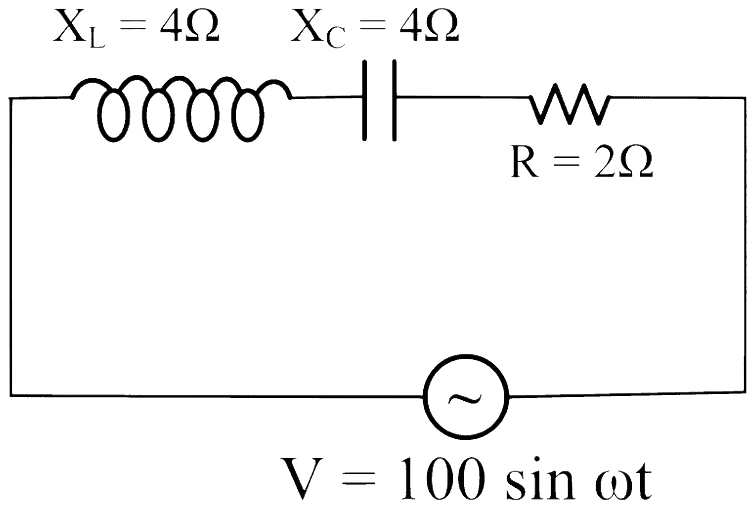
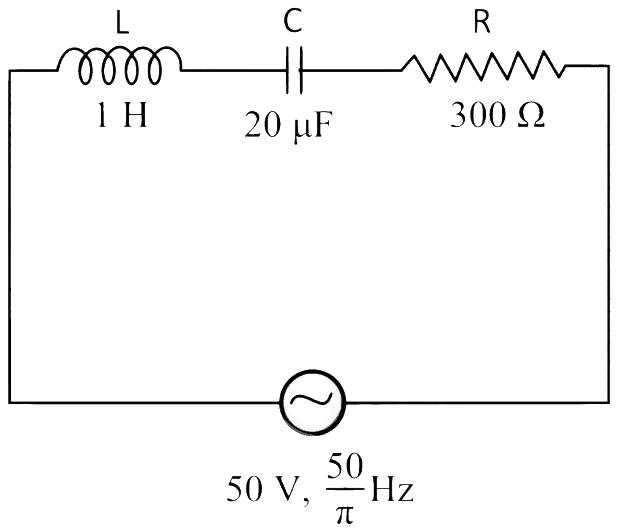
In the given circuit, the magnitude of VL and VC are twice that of VR. Given that f = 50 Hz, the inductance of the coil is Kπ1 mH. The value of K is ____________.
Numerical answer type. Work it out, then open the answer.
A circuit element X when connected to an a.c. supply of peak voltage 100 V gives a peak current of 5 A which is in phase with the voltage. A second element Y when connected to the same a.c. supply also gives the same value of peak current which lags behind the voltage by 2π. If X and Y are connected in series to the same supply, what will be the rms value of the current in ampere?
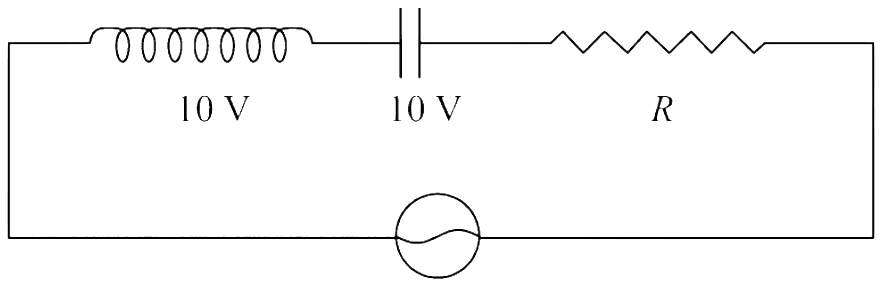
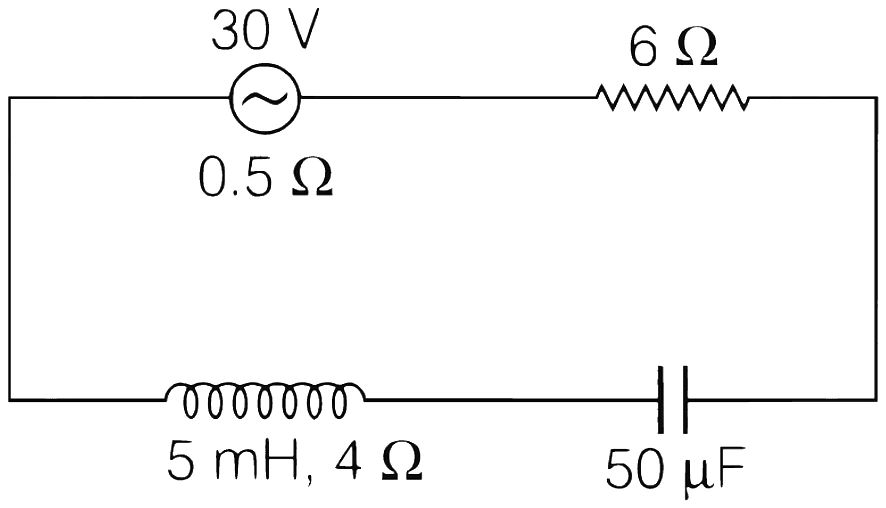
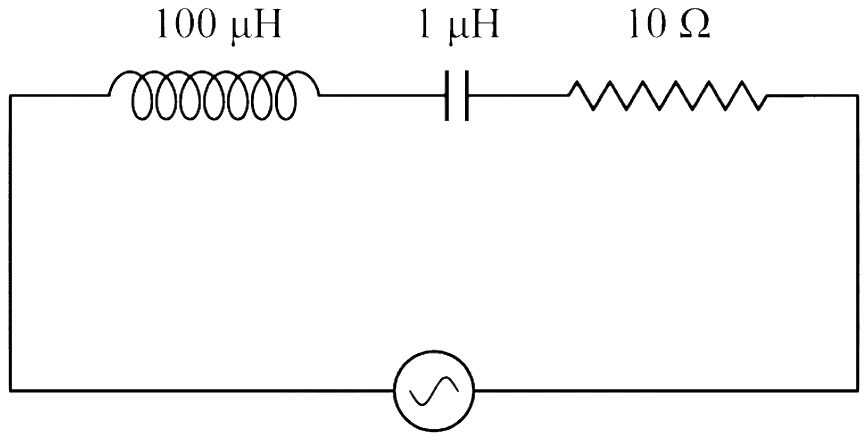
The angular frequency of alternating current in a L-C-R circuit is 100 rad/s. The components connected are shown in the figure. Find the value of inductance of the coil and capacity of condenser.
A series LCR circuit with resistance (R) 500 ohm is connected to an a.c. source of 250 V. When only the capacitance is removed, the current lags behind the voltage by 60∘. When only the inductance is removed, the current leads the voltage by 60∘. The impedance of the circuit is (tan3π=3)
For a series LCR circuit with R = 100 Ω, L = 0.5 mH and C = 0.1 pF connected across 220V-50 Hz AC supply, the phase angle between current and supplied voltage and the nature of the circuit is:
A series LCR circuit is connected to an ac voltage source. When L is removed from the circuit, the phase difference between current and voltage is 3π. If instead C is removed from the circuit, the phase difference is again 3π between current and voltage. The power factor of the circuit is:
A sinusoidal voltage of peak value 283 V and angular frequency 320/s is applied to a series LCR circuit. Given that R=5 Ω, L=25 mH and C=1000 μF. The total impedance, and phase difference between the voltage across the source and the current will respectively be:
When the rms voltages VL, VC and VR are measured respectively across the inductor L, the capacitor C and the resistor R in a series LCR circuit connected to an AC source, it is found that the ratio VL: VC: VR = 1: 2: 3. If the rms voltage of the AC source is 100 V, then VR is close to:
In an electrical circuit R, L, C and a.c. voltage source are all connected in series. When L is removed from the circuit, the phase difference between the voltage and the current in the circuit is 3π. If instead, C is removed from the circuit, the phase difference is again 3π. The power factor of the circuit is
In a circuit L, C and R are connected in series with an alternating voltage source of frquency f The current leads the voltage by 45°. The value of C is
In a circuit, a metal filament lamp is connected in series with a capacitor of capacitance CμF across a 200V, 50Hz supply. The power consumed by the lamp is 500W while the voltage drop across it is 100V. Assume that there is no inductive load in the circuit. Take rms values of the voltages. The magnitude of the phase-angle (in degrees) between the current and the supply voltage is φ. Assume, π3≈5.
The value of φ is ______.
Numerical answer type. Work it out, then open the answer.
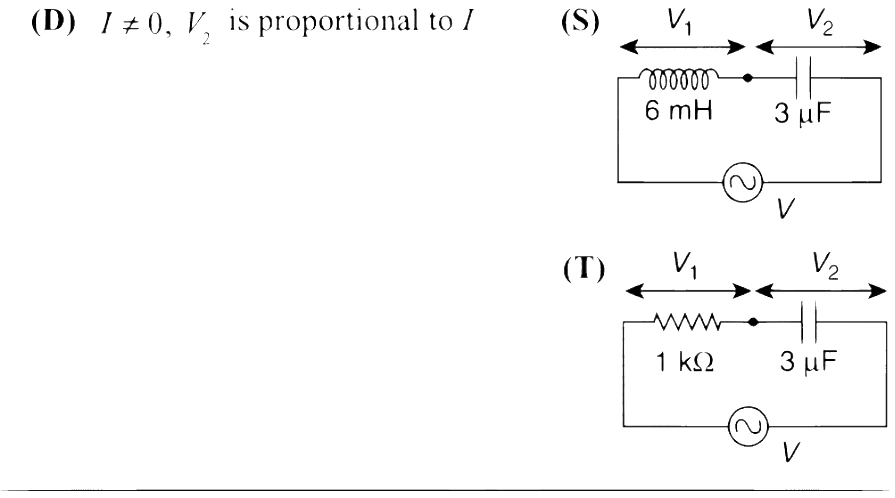
You are given many resistances, capacitors and inductors. These are connected to a variable DC voltage source (the first two circuits) or an AC voltage source of 50Hz frequency (the next three circuits) in different ways as shown in Column II. When a current I (steady state for DC or rms for AC) flows through the circuit, the corresponding voltage V1 and V2 (indicated in circuits) are related as shown in Column I. Match the two:
Column I
Column II
(A) I=0, V1 is proportional to I
(P) 6mH inductor (V1) and 3μF capacitor (V2) in series with variable DC source
(B) I=0, V2>V1
(Q) 6mH inductor (V1) and 2Ω resistor (V2) in series with variable DC source
(C) V1=0, V2=V
(R) 6mH inductor (V1) and 2Ω resistor (V2) in series with 50 Hz AC source
(D) I=0, V2 is proportional to I
(S) 6mH inductor (V1) and 3μF capacitor (V2) in series with 50 Hz AC source
(T) 1kΩ resistor (V1) and 3μF capacitor (V2) in series with 50 Hz AC source
In a circuit L, C and R are connected in series with an alternating voltage source of frequency f. The current leads the voltage by 45∘. The value of C is
Assertion: When capacitive reactance is smaller than the inductive reactance in L-C-R circuit, emf leads the current. Reason: The phase angle is the angle between the alternating emf and alternating current of the circuit.
In a circuit, L, C and R are connected in series with an alternating voltage source of frequency f. The current leads the voltage by 45∘. The value of C is
In an LCR series AC circuit, the voltage across the inductor and capacitor are each 300V, while the voltage across the resistor is 400V. The rms voltage of the AC source is
A pure resistive circuit element X, when connected to an AC supply of peak voltage 200V, gives a peak current of 5A. A second circuit element Y, when connected to the same AC supply also gives the same value of peak current but the current lags behind by 90∘. If the series combination of X and Y is connected to the same supply, what will be the rms value of current?
A resistance R and inductance L and a capacitor C all are connected in series with an AC supply. The resistance of R is 24ohm and for a given frequency, the inductive reactance of L is 36ohm and capacitive reactance of C is 24ohm. If the current in the circuit is 5amp, find the potential difference across R, L and C.
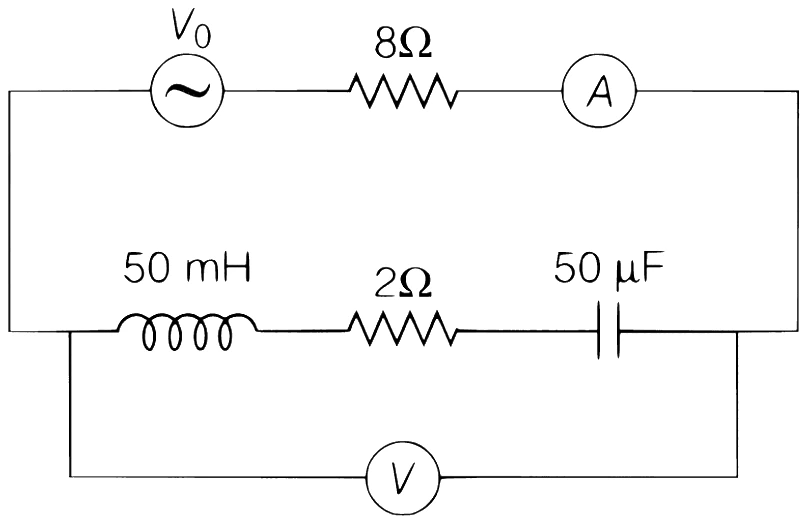
In the circuit shown in the figure, the AC source gives a voltage V=20cos(2000t). Neglecting source resistance, the voltmeter and ammeter reading will be
In an AC circuit, the potential across an inductance and resistance joined in series are respectively 16V and 20V. The total potential difference across the circuit is
A resistor R, an inductor L and capacitor C are connected in series to an oscillator of frequency n. If the resonant frequency is nr, then the current lags behind voltage, when
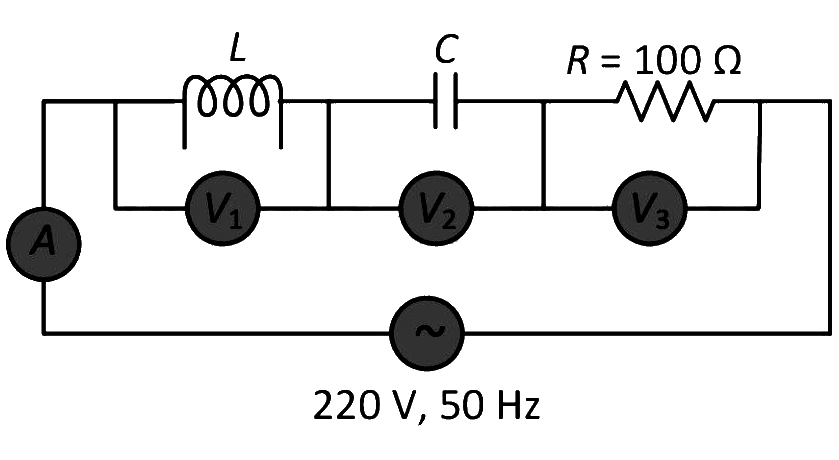
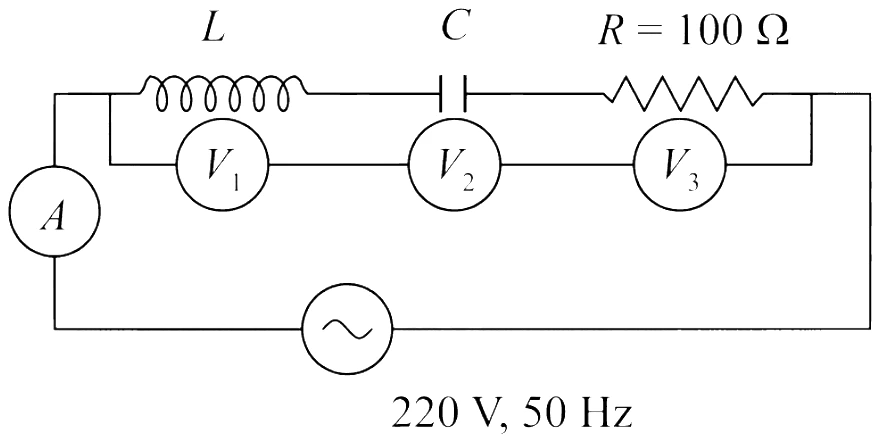
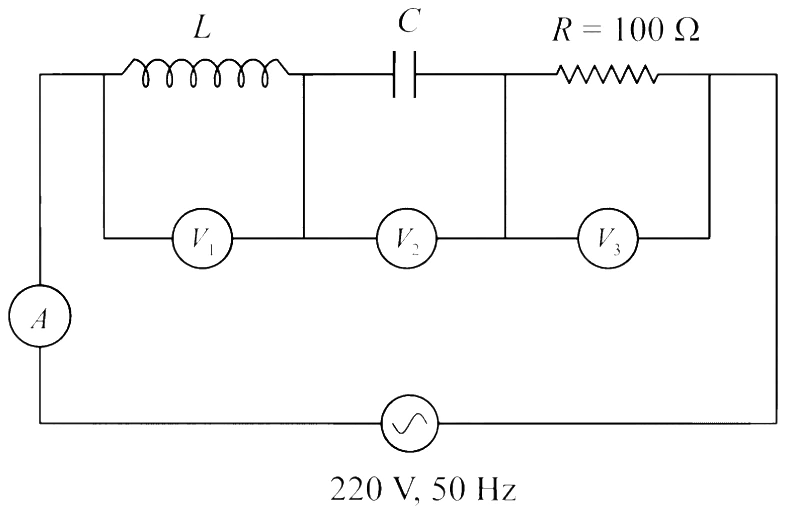
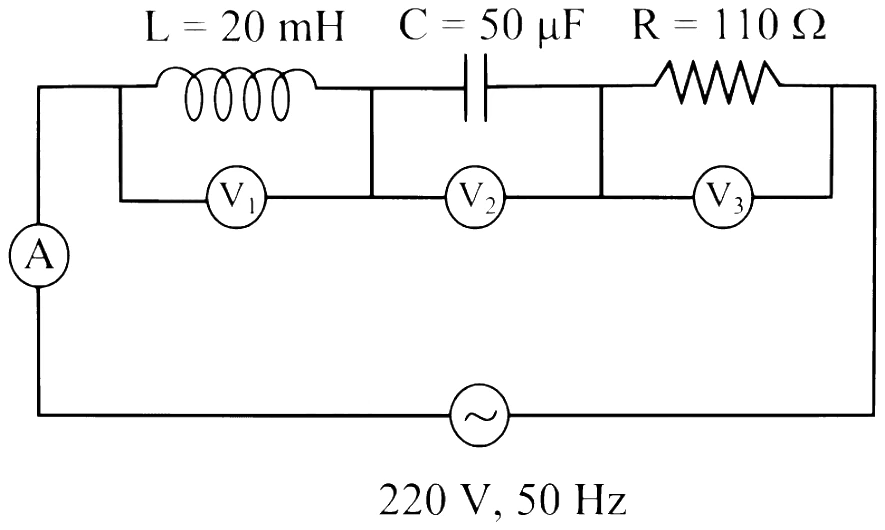
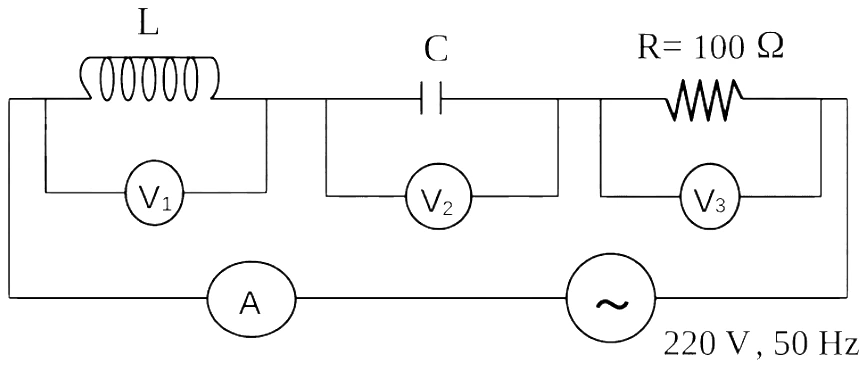
A series L-C-R circuit is connected to an AC source of 220V and 50Hz shown in figure. If the readings of the three voltmeters V1, V2 and V3 are 65V, 415V and 204V respectively, the value of inductance and capacitance will be
A series LCR circuit containing an AC source of 100V has an inductor and a capacitor of reactances 24Ω and 16Ω respectively. If a resistance of 6Ω is connected in series, then the potential difference across the series combination of inductor and capacitor only is
In a series LCR circuit the resistance, inductive reactance and capacitive reactance are in the ratio 3:8:4. If the potential difference across the resistor is 12V, then the emf of the ac source used in the circuit is
If a resistor of resistance 4Ω, a capacitor of capacitive reactance 6Ω and an inductor of inductive reactance 9Ω are connected in series with an AC source, then the impedance of the circuit is
In an LCR series circuit, if the potential differences across inductor, capacitor and resistor are 60V, 30V and 40V respectively, then the AC voltage applied to the circuit is
In a series LCR circuit, the voltages across the capacitor, resistor and inductor are in the ratio 2:3:6, if the voltage of the AC source in the circuit is 240V, then the voltage across the inductor is
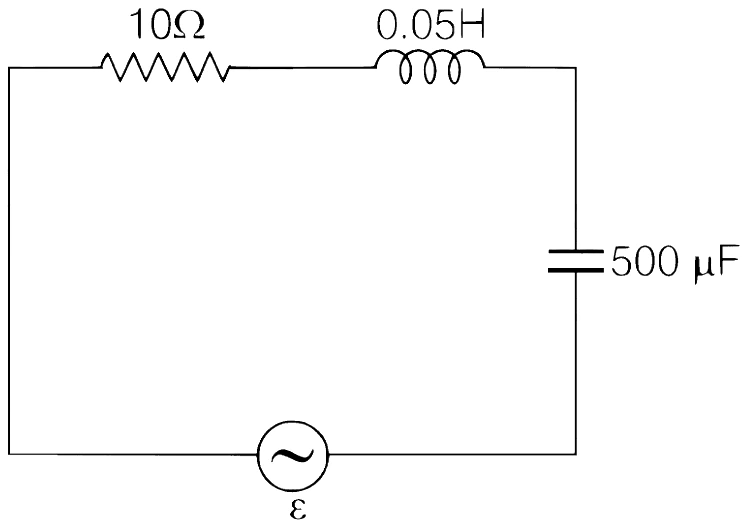
An R−L−C circuit consists of a 150Ω resistor, 20μF capacitor and a 500mH inductor connected in series with a 100V AC supply. The angular frequency of the supply voltage is 400rad s−1. The phase angle between current and the applied voltage is
A capacitor of capacitance 100μF and a coil of resistance 20Ω and inductance 12.5mH are connected in series with a 220V, π200Hz AC source. The maximum value of instantaneous current in the circuit is
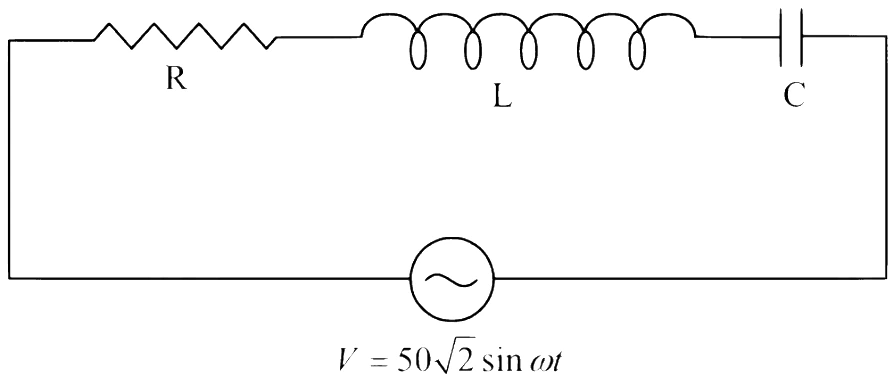
In a series LCR circuit, the rms voltage across the resistor and the capacitor are 30V and 90V respectively. If the applied voltage is 502sinωt, then the peak voltage across the inductor is
A 400Ω resistor, a 250mH inductor and a 2.5μF capacitor are connected in series with an AC source of peak voltage 5V and angular frequency 2kHz. What is the peak value of the electrostatic energy of the capacitor?
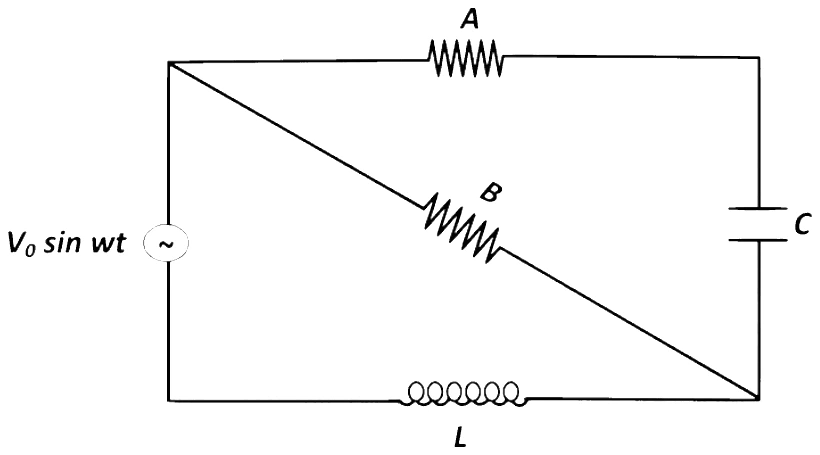
Consider the circuit diagram as shown in the figure. The source has a voltage V=V0sinωt. Both the resistors A and B have the same resistance. The capacitor and the inductor have capacitance C and inductance L, respectively. For some frequency ω, and certain initial charge in the capacitor, the current through the resistor A is in phase with the source. What is the value of ω?
The voltage across a resistor, an inductor, and a capacitor connected in series to an ac source are 20V, 15V and 30V respectively. The resultant voltage in the circuit is