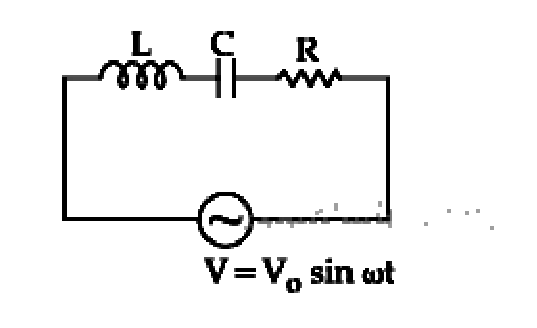
In a series LCR circuit alternating e.m.f. and current are given by the equations V=V0sin(ωt) and I=I0sin(ωt+3π) respectively. The average power dissipated in the circuit over one cycle of a.c. is (cos60∘=0.5)
In series LCR circuit, resistance is 18Ω and impedance 33Ω. An r.m.s. Voltage of 220 V is applied across the circuit. The true power consumed in a c. circuit is
A LCR series circuit driven with Erms=90 V at frequency fd=30 Hz has resistance R=80Ω, an inductance with inductive reactance XL=20.0Ω and capacitance with capacitive reactance XC=80.0Ω. The power factor of the circuit is ______.
An inductor of inductance L and a resistor of resistance R are joined in series and connected to an a.c. source of frequency ω. The power dissipated in the circuit is
An inductor of reactance 100Ω, a capacitor of reactance 50Ω, and a resistor of resistance 50Ω are connected in series with an AC source of 10 V, 50 Hz. Average power dissipated by the circuit is ____
For series LCR circuit, the current is observed to lead the applied voltage. An additional capacitor C1 when joined with capacitor C, makes the power factor of the circuit unity. The capacitor C1 must be connected in
An a.c. source is applied to a series LR circuit with XL=3R and power factor is X1. Now a capacitor with Xc=R is added in series to LR circuit and power factor is X2. The ratio X1 to X2 is
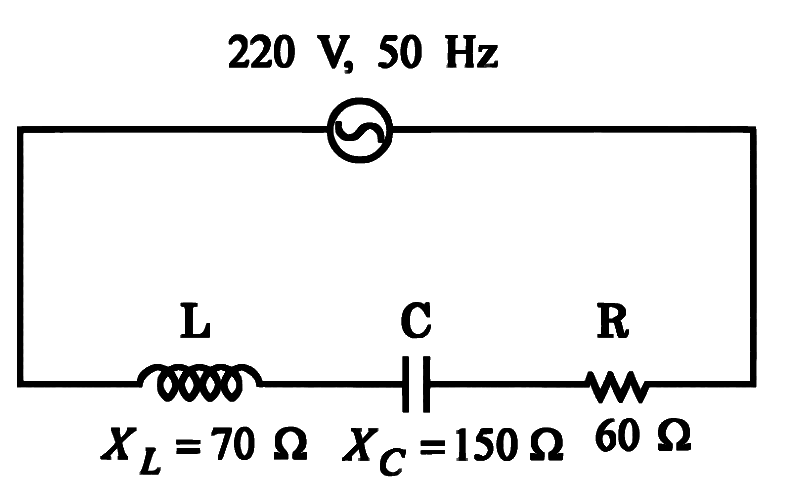
A series LCR circuit is connected to an a.c. source of 220 V, 50 Hz. The circuit contains a resistance R=80Ω, an inductor of inductive reactance 70Ω and capacitor of capacitive reactance 130Ω. The power factor of the circuit is 10x. The value of x is
In a series LR circuit with XL=R. Power factor is P1. If a capacitor of capacitance C with Xc=XL is added to the circuit the power factor becomes P2. The ratio of P1 to P2 will be:
An inductor of 10 mH, capacitor of 0.1μF and a resistor of 100Ω are connected in series across an a.c power supply 220 V,70 Hz. The power factor of the given circuit is 0.5. The difference in the inductive reactance and capacitance reactance is 3αΩ. The value of α is ______.
Numerical answer type. Work it out, then open the answer.
An arc lamp requires a direct current of 10 A at 90 V to function. If it is connected to 220 V (rms), 50 Hz a.c. supply, the series inductor needed for it to work is nearly
In LCR series circuit, R = 18 Ω and impedance 33Ω. An r.m.s. voltage of 220 V is applied across the circuit. The true power consumed in a.c. circuit is
Given below are two statements: one is labelled as Assertion (A) and the other is labelled as Reason (R).
Assertion (A): Choke coil is simply a coil having a large inductance but a small resistance. Choke coils are used with fluorescent mercury-tube fittings. If household electric power is directly connected to a mercury tube, the tube will be damaged.
Reason (R): By using the choke coil, the voltage across the tube is reduced by a factor (R/R2+ω2L2), where ω is frequency of the supply across resistor R and inductor L. If the choke coil were not used, the voltage across the resistor would be the same as the applied voltage. In the light of the above statements, choose the most appropriate answer from the options given below:
In an L−R circuit, the inductive reactance is equal to 3 times the resistance ' R ' of the circuit. An e.m.f. E=E0sin(ωt) is applied to the circuit. The power consumed in the circuit is
An inductor of reactance 100Ω, a capacitor of reactance 50Ω, and a resistor of resistance 50Ω are connected in series with an AC source of 10 V,50 Hz. Average power dissipated by the circuit is ___________ W.
Numerical answer type. Work it out, then open the answer.
An a.c. source is applied to a series LR circuit with XL=3R and power factor is X1. Now a capacitor with Xc=R is added in series to LR circuit and the power factor is X2. The ratio X1 to X2 is
In LCR series circuit, an alternating e.m.f. 'e' and current ' i ' are given by equations e=160sin(100t) Volt and i=250sin(100t+3π) mA. The average power dissipated in the circuit is
In an A.C. circuit, the potential difference ' V ' and current 'I' are given respectively by V=100sin(100t) V,I=100sin(100t+3π) mA The power dissipated in the circuit will be [Given →cos3π=21 ]
A series LCR circuit with L=π100 mH,C=π10−3 F and R=10Ω, is connected across an ac source of 220 V,50 Hz supply. The power factor of the circuit would be ________.
Numerical answer type. Work it out, then open the answer.
An e.m.f. E=E0cosωt is applied to the L−R circuit. The inductive reactance is equal to the resistance ' R ' of the circuit. The power consumed in the circuit is
A capacitor of reactance 43Ω and a resistor of resistance 4Ω are connected in series with an ac source of peak value 82 V. The power dissipation in the circuit is __________ W.
Numerical answer type. Work it out, then open the answer.
A series L.R circuit connected with an ac source E=(25sin1000t) V has a power factor of 21. If the source of emf is changed to E=(20sin2000t) V, the new power factor of the circuit will be:
Statement I: Maximum power is dissipated in a circuit containing an inductor, a capacitor and a resistor connected in series with an AC source, when resonance occurs
Statement II: Maximum power is dissipated in a circuit containing pure resistor due to zero phase difference between current and voltage.
In the light of the above statements, choose the correct answer from the options given below:
In a L-R circuit the inductive reactance is equal to the resistance R in the circuit. An emf E=E0cosωt is applied to the circuit. The power consumed in the circuit is
A series LCR circuit is connected to an AC source of 220 V, 50 Hz. The circuit contains a resistance R = 80Ω, an inductor of inductive reactance XL=70Ω, and a capacitor of capacitive reactance XC=130Ω. The power factor of circuit is 10x. The value of x is:
Numerical answer type. Work it out, then open the answer.
In a series LR circuit, XL=R, power factor is P1. If a capacitor of capacitance C with XC=XL is added to the circuit the power factor becomes P2. The ratio of P1 to P2 will be
In a series LR circuit with XL=R, power factor P1. If a capacitor of capacitance C with XC=XL is added to the circuit the power factor becomes P2. The ratio of P1 to P2 will be:
In a series LR circuit XL=R and power factor of the circuit is P1. When capacitor with capacitance C such that XL=XC is put in series, the power factor becomes P2. The ratio P2P1 is:
To light, a 50 W,100 V lamp is connected, in series with a capacitor of capacitance πx50μF, with 200 V,50 Hz AC source. The value of x will be ___________.
Numerical answer type. Work it out, then open the answer.
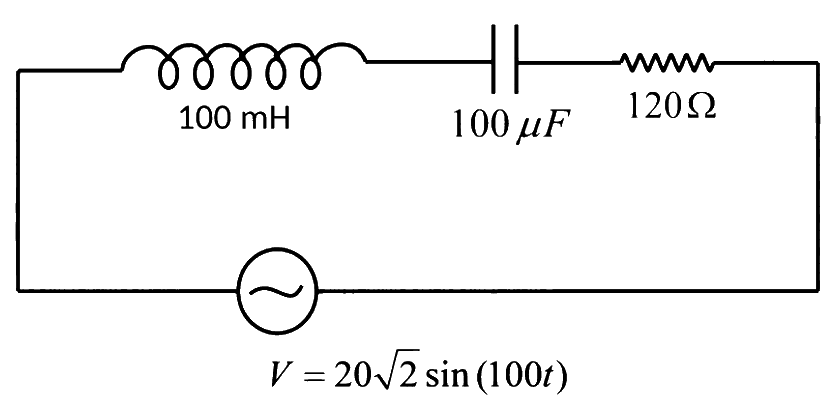
An AC source is connected to an inductance of 100 mH, a capacitance of 100 μF and a resistance of 120 Ω as shown in figure. The time in which the resistance having a thermal capacity 2 J/∘C will get heated by 16∘ C is _____________ s.
Numerical answer type. Work it out, then open the answer.
In a series LCR circuit, the inductive reactance (XL) is 10Ω and the capacitive reactance (XC) is 4Ω. The resistance (R) in the circuit is 6Ω. The power factor of the circuit is:
An ac circuit has an inductor and a resistor of resistance R in series, such that XL = 3R. Now, a capacitor is added in series such that XC = 2R. The ratio of new power factor with the old power factor of the circuit is 5:x. The value of x is ___________.
Numerical answer type. Work it out, then open the answer.
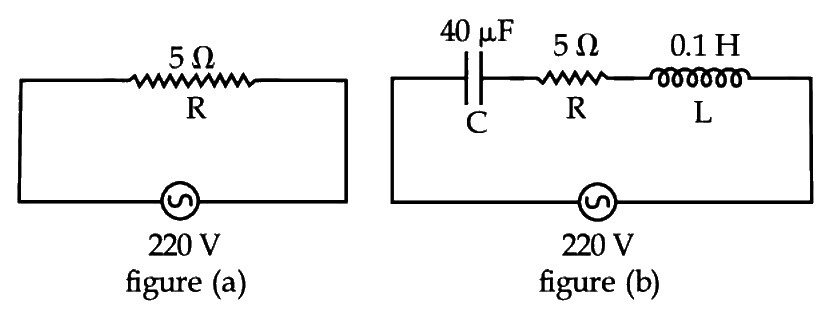
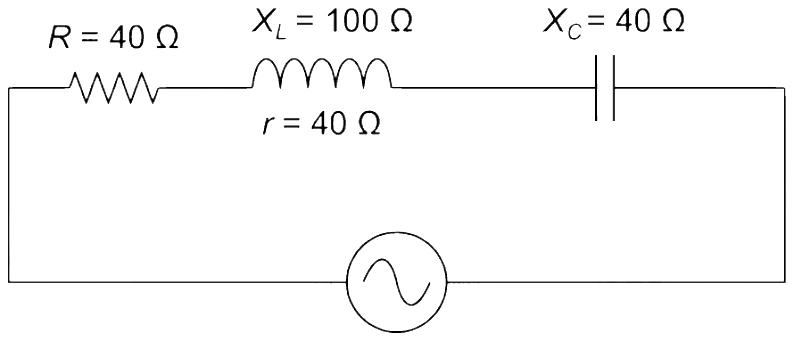
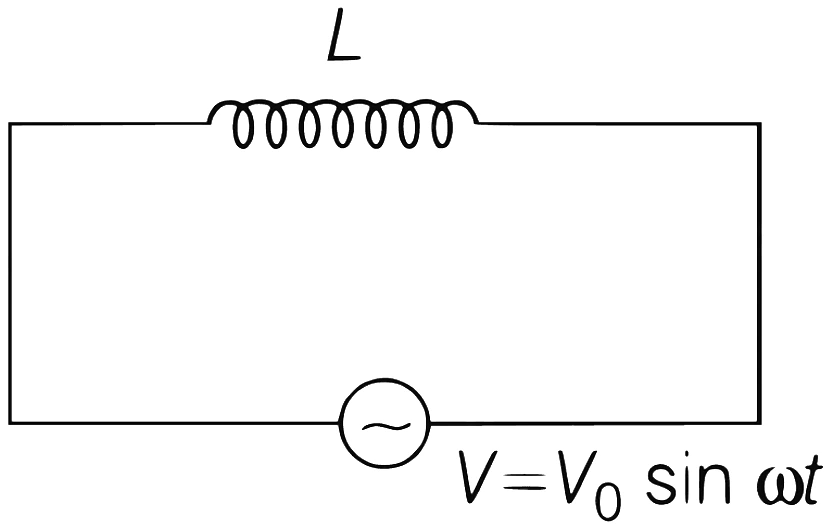
Two circuits are shown in the figure (a) & (b). At a frequency of ____________ rad/s the average power dissipated in one cycle will be same in both the circuits.
Numerical answer type. Work it out, then open the answer.
A series LCR circuit driven by 300 V at a frequency of 50 Hz contains a resistance R = 3 kΩ, an inductor of inductive reactance XL = 250 πΩ and an unknown capacitor. The value of capacitance to maximize the average power should be: (Take π2 = 10)
An LCR circuit contains resistance of 110Ω and a supply of 220 V at 300 rad/s angular frequency. If only capacitance is removed from the circuit, current lags behind the voltage by 45∘. If on the other hand, only inductor is removed the current leads by 45∘ with the applied voltage. The rms current flowing in the circuit will be:
A 750 Hz, 20 V (rms) source is connected to a resistance of 100 Ω, an inductance of 0.1803 H and a capacitance of 10 μF all in series. The time in which the resistance (heat capacity 2 J/oC) will get heated by 10oC. (assume no loss of heat to the surroudnings) is close to:
In a series LR circuit, power of 400W is dissipated from a source of 250 V, 50 Hz. The power factor of the circuit is 0.8. In order to bring the power factor to unity, a capacitor of value C is added in series to the L and R. Taking the value of C as (3πn)μF, then value of n is __________.
Numerical answer type. Work it out, then open the answer.
A series AC circuit containing an inductor (20 mH), a capacitor (120 μF) and a resistor (60 Ω) is driven by an AC source of 24V/50 Hz. The energy dissipated in the circuit in 60 s is:
An inductor 20 mH, a capacitor 100 μF and a resistor 50 Ω are connected in series across a source of emf, V = 10 sin 314 t. The power loss in the circuit is
The potential differences across the resistance, capacitance and inductance are 80 V, 40 V and 100 V respectively in an L-C-R circuit. The power factor of this circuit is
An inductor 20 mH, a capacitor 50 μF and a resistor 40 Ω are connected in series across a source of emf V = 10 sin 340t. The power loss in A.C. circuit is
An arc lamp requires a direct current of 10 A at 80 V to function. If it is connected to a 220 V (rms), 50 Hz AC supply, the series inductor needed for it to work is close to:
A resistance 'R' draws power 'P' when connected to an AC source. If an inductance is now placed in series with the resistance, such that the impedance of the circuit becomes 'Z'. the power drawn will be
For the LCR circuit, shown here, the current is observed to lead the applied voltage. An additional capacitor C', when joined with the capacitor C present in the circuit, makes the power factor of the circuit unity. The capacitor C', must have been connected in:
A series LR circuit is connected to an ac source of frequency ω and the inductive reactance is equal to 2R. A capacitance of capacitive reactance equal to R is added in series with L and R. The ratio of the new power factor to the old one is:
In a series LCR circuit R=200Ω and the voltage and the frequency of the main supply are 220 V and 50 Hz respectively. On taking out the capacitance from the circuit the current lags behind the voltage by 30∘. On taking out the inductor from the circuit the current leads the voltage by 30∘. The power dissipated in the LCR circuit is
In an a.c. circuit the voltage applied is E=E0sinωt. The resulting current in the circuit is I=I0sin(ωt−2π). The power consumption in the circuit is given by
A coil of inductive reactance 31 Ω has a resistance of 8 Ω. It is placed in series with a condenser of capacitative reactance 25 Ω. The combination is connected to an a.c. source of 110 V. The power factor of the circuit is
In an A.C. circuit, the current flowing is I=5sin(100t−π/2) ampere and the potential difference is V=200sin(100t) volts. The power consumption is equal to
In a circuit, a metal filament lamp is connected in series with a capacitor of capacitance CμF across a 200V, 50Hz supply. The power consumed by the lamp is 500W while the voltage drop across it is 100V. Assume that there is no inductive load in the circuit. Take rms values of the voltages. The magnitude of the phase-angle (in degrees) between the current and the supply voltage is φ. Assume, π3≈5.
The value of C is ______.
Numerical answer type. Work it out, then open the answer.
Assertion: If the frequency of the applied AC is doubled, then the power factor of a series R-L circuit decreases. Reason: Power factor of series R-L circuit is given by cosθ=R2+ω2L22R
An L−C−R series circuit with a resistance of 100Ω is connected to 200V (AC source) and angular frequency 300rad s−1. When only the capacitor is removed, then the current lags behind the voltage by 60∘. When only the inductor is removed the current leads the voltage by 60∘. The average power dissipated in original L−C−R circuit is
An electric bulb has a rated power of 50W at 100V. If it is used on an AC source 200V, 50Hz, a choke has to be used in series with it. This choke should have an inductance of
A lamp in which 10 amp current can flow at 15V, is connected with an alternating source of potential 220V. The frequency of source is 50Hz. The inductance of choke coil required to light the bulb is
In a given circuit, the instantaneous values of the alternating voltage and current are V=0.5sin(80πt+3π) volt and I=0.5sin(80πt) ampere respectively. Find the average power consumed in that circuit.
A series LCR circuit having R=44Ω, L=2H and C=25μF is connected to a variable frequency of 220V. What is the average power transferred to the circuit in one complete cycle if the frequency of supply equals the natural frequency of the circuit?
The instantaneous values of alternating current and voltages in a circuit are I=23sin(200πt) ampere and V=23sin(200πt+6π) volt. What is the average power consumed in the circuit in watt ?
In an electrical circuit R,L,C and AC voltage source are all connected in series. When L is removed from the circuit, the phase difference between the voltage and the current in the circuit is π/3. If instead C is removed from the circuit, the phase difference is again π/3. The power factor of the circuit is
An inductor of inductance L and resistor R are joined together in series and connected by a source of frequency ω. The power dissipated in the circuit is
A resistor of 450Ω and an inductor are connected in series to an AC source of frequency π75Hz. If the power factor of the circuit is 0.6, then the inductance connected in the circuit is
A 50Hz AC circuit has a 10mH inductor and a 2Ω resistor in series. The value of capacitance to be placed in series in the circuit to make the circuit power factor as unity is
An inductor and a resistor are connected in series to an AC source. If the power factor of the circuit is 0.5, the ratio of the resistance of the resistor and the reactance of the inductor is
A resistor of resistance R and an inductor of inductive reactance R are connected in series to an AC source. A capacitor of capacitive reactance 2R is then connected in series with L and R. The ratio of the power factors of L−R and L−C−R circuits is
When an inductor and a resistor are connected in series to an ac source, the power factor of the circuit is 132. If the same resistor and a capacitor are connected in series to the same ac source, then the power factor of the circuit is 21. If these inductor, capacitor and resistor are connected in series to the same ac source, then the ratio of the resistance and impedance of the LCR circuit is
A capacitor and a resistor are connected in series to an AC source. If the ratio of the capacitive reactance of the capacitor and the resistance of the resistor is 4:3, then the power factor of the circuit is
An inductor of inductive reactance R, a capacitor of capacitive reactance 2R and a resistor of resistance R are connected in series to an AC source. The power factor of the series L−C−R circuit is
An alternating emf given by the equation E=200sin(50πt) (where E is in volts and t is in seconds) is applied across a series combination of an inductor and a resistor having inductive reactance 40Ω and resistance 30Ω respectively. At time t=1s, the power dissipated by the resistor is close to (cos53∘=0.6)
A series L−C−R circuit is connected to an AC source of voltage 150sin(80πt) volt. If the resistance of the resistor in the circuit is 25Ω and the impedance in the circuit is 75Ω, the average power dissipated per cycle in the circuit is
A resistor of resistance R draws power P when connected to an AC source. If an inductance is now placed in series with R, such that the impedance of the circuit becomes Z, the power drawn will be
When an alternating voltage E=E0sinωt is applied to a circuit, a current I=I0sin(ωt+2π) flows through it. The average power dissipated in the circuit is