
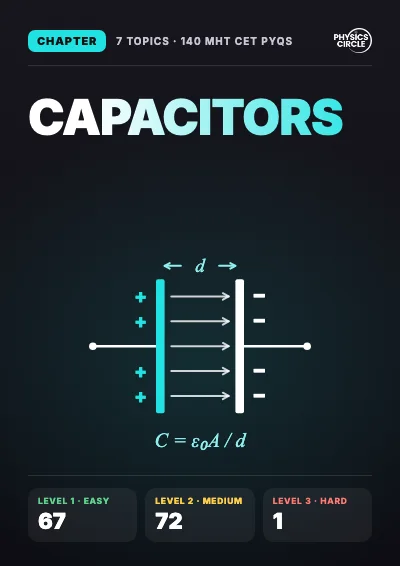
Capacitors Formula Book
42 formulas in 7 topics, in the same order as the PYQ topics.
Only formulas used in the solutions of 140 MHT CET PYQs (Level 1, 2, 3)Capacitance of a Conductor
4 formulas · from 8 MHT CET PYQs
- Capacitance
- Capacitance of an isolated sphere
- Sphere: volume-to-area ratio gives R
- Surface charge density of a sphere
Parallel Plate Capacitor
4 formulas · from 6 MHT CET PYQs
- Parallel plate capacitor
- Circular plates
- Field between the plates
- Plates with charges q1 and q2
🔒 For Vajra 2.0 Pro studentsTopic 1 is free. Log in with your Vajra 2.0 Pro number to see every formula.
Energy Stored & Force between Plates
9 formulas · from 20 MHT CET PYQs
- Energy stored in a capacitor
- Energy and charge (same C)
- Energy and voltage (same C)
- Energy in terms of field
- Field between the plates
- Force between the plates
- Work done by the battery
- Work done = change in stored energy
- Rate of change of stored energy
🔒 For Vajra 2.0 Pro studentsTopic 1 is free. Log in with your Vajra 2.0 Pro number to see every formula.
Dielectrics
10 formulas · from 46 MHT CET PYQs
- Capacitor fully filled with dielectric
- Slab of thickness t (partly filled)
- Metal slab of thickness t
- Dielectrics side by side in thickness (series)
- Two dielectrics each filling half the gap
- Dielectric filling half the plate area (parallel)
- Dielectric filling half the gap
- Battery removed, dielectric inserted (Q fixed)
- Capacitance depends on K and d
- Capacitors in series share voltage
🔒 For Vajra 2.0 Pro studentsTopic 1 is free. Log in with your Vajra 2.0 Pro number to see every formula.
Combination of Capacitors
9 formulas · from 46 MHT CET PYQs
- Capacitors in series
- Two capacitors in series
- Capacitors in parallel
- n identical capacitors
- Charge on series capacitors (same for each)
- Voltage across one capacitor in series
- Energy stored, same voltage
- Same energy stored in series and parallel
- Plates split into parts (area A/2 each)
🔒 For Vajra 2.0 Pro studentsTopic 1 is free. Log in with your Vajra 2.0 Pro number to see every formula.
Charge Sharing & Loss of Energy
4 formulas · from 9 MHT CET PYQs
- Common potential after joining
- Charged capacitor joined to an uncharged one
- Joined with opposite plates together
- Equivalent of two capacitors in series
🔒 For Vajra 2.0 Pro studentsTopic 1 is free. Log in with your Vajra 2.0 Pro number to see every formula.
Capacitors in DC Circuits & RC
2 formulas · from 5 MHT CET PYQs
- Displacement current
- Capacitor discharging through an inductor
🔒 For Vajra 2.0 Pro studentsTopic 1 is free. Log in with your Vajra 2.0 Pro number to see every formula.