A parallel plate air capacitor having area of each plate 'A' and the distance between the plates 'd' has uniform electric field E in the space between the plates. The energy stored in the capacitor is (ϵ0 = permittivity of free space.)
A capacitor of capacitance C has charge Q and energy stored in it is W. If the charge is increased to 3Q, the energy stored in the capacitor W' will be
The electrostatic force (F) between the metal plates of an isolated parallel plate capacitor (C) having a charge Q and area A is (d = distance between the plates)
A capacitor of capacity 5μF is charged by a battery of e.m.f. 10 V. At an instant, the potential difference across the capacitor is 4 V and the time rate of change of potential difference across the capacitor is 0.6 V/s. Then the time rate at which energy is stored in the capacitor at that instant is
A parallel plate air capacitor is connected to a battery. The plates are pulled apart at uniform speed v. If x is the separation between the plates at any instant, then the time rate of change of electrostatic energy of the capacitor is proportional to xα, where α is ______.
Consider a parallel plate capacitor of area A (of each plate) and separation ' d ' between the plates. If E is the electric field and ε0 is the permittivity of free space between the plates, then potential energy stored in the capacitor is
A parallel plate capacitor of capacitance 1 µF is charged to a potential difference of 20 V. The distance between plates is 1 µm. The energy density between plates of capacitor is:
A parallel plate capacitor having plate area ' A ' and separation ' d ' is charged to a potential difference ' V '. The charging battery is disconnected and the plates are pulled apart to four times the initial separation. The work required to increase the distance between the plates is ( ε0= permittivity of free space)
A parallel plate capacitor is charged and then isolated. If the separation between the plates is increased, which one of the following statement is NOT correct?
The amount of work done in increasing the voltage across the plates of a capacitor form 5 V to 10 V is ' W '. The work done in increasing it from 10 V to 15 V will be (nearly)
A parallel plate capacitor has plate area 'A' and separation between plates is 'd'. It is charged to a potential difference of V0 volt. The charging battery is then disconnected and plates are pulled apart three times the initial distance. The work done to increase the distance between the plates is (ε0= permittivity of free space)
A parallel plate air capacitor has a uniform electric field 'E' in the space between the plates. Area of each plate is A and the distance between the plates is 'd'. The energy stored in the capacitor is [ε0= permittivity of free space)
The force between the plates of a parallel plate capacitor of capacitance 'C' and distance of separation of the plates 'd' with a potential difference 'V' between the plates is
A parallel plate capacitor is charged and then disconnected from the charging battery. If the plates are now moved further apart by pulling them by means of insulating handles, then
If the potential difference across a capacitor is increased from 5 V to 15 V, then the ratio of final energy to initial energy stored in the capacitor is
A parallel plate capacitor has a uniform electric field E in the space between the plates. If the distance between the plates is 'd' and the area of each plate is 'A', the energy stored in the capacitor is: (ε0 = permittivity of free space)
A battery is used to charge a parallel plate capacitor till the potential difference between the plates becomes equal to the e.m.f. of the battery. The ratio of the energy stored int he capacitor to the work done by the battery will be
A parallel plate capacitor with area 200 cm2 and separation between the plates 1.5 cm, is connected across a battery of emf V. If the force of attraction between the plates is 25×10−6 N, the value of V is approximately: (ϵ0=8.85×10⁻¹²N⋅m2C2)
A parallel plate air capacitor has capacity C, distance of separation between plates is d and potential difference V is applied between the plates. Force of attraction between the plates of the parallel plate air capacitor is
A parallel plate capacitor has a uniform electric field E in the space between the plates. If the distance between the plates is d and area of each plate is A, the energy stored in the capacitor is
A parallel plate capacitor has a uniform electric field E in the space between the plates. If the distance between the plates is d and area of each plate is A, the energy stored in the capacitor is
The energy required to charge a parallel plate condenser of plate separation d and plate area of cross-section A such that the uniform electric field between the plates is E, is
A battery is used to charge a parallel plate capacitor till the potential difference between the plates becomes equal to the electromotive force of the battery. The ratio of the energy stored in the capacitor and the work done by the battery will be
A parallel plate air capacitor is charged to a potential difference of V volts. After disconnecting the charging battery the distance between the plates of the capacitor is increased using an insulting handle. As a result the potential difference between the plates
A fully charged capacitor has a capacitance ′C′. It is discharged through a small coil of resistance wire embedded in a thermally insulated block of specific heat capacity ′s′ and mass ′m′. If the temperature of the block is raised by ′ΔT′, the potential difference ′v′ across the capacitor is
A parallel plate capacitor has an electric field of 105V m−1 between the plates. If the charge on the capacitor plates is 1μC, the force on each capacitor plate is
Assertion : Circuit containing capacitors should be handled cautiously even when there is no current. Reason : The capacitors are very delicate and so quickly break down.
A 40μF capacitor in a defibrillator is charged to 3000V. The energy stored in the capacitor is sent through the patient during a pulse of duration 2ms. The power delivered to the patient is :
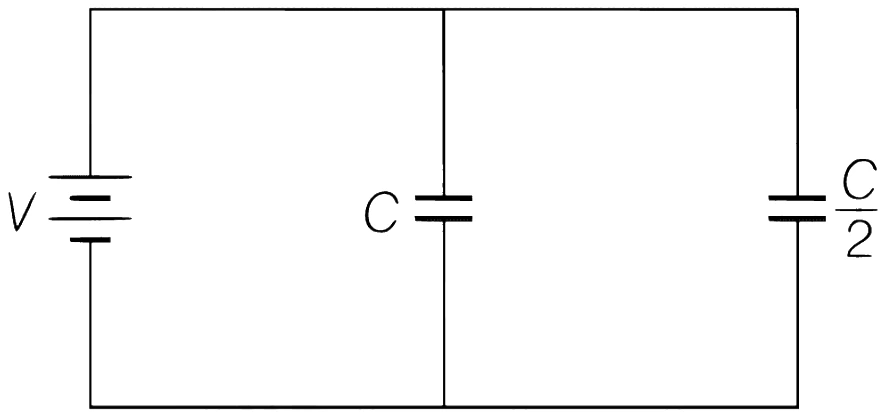
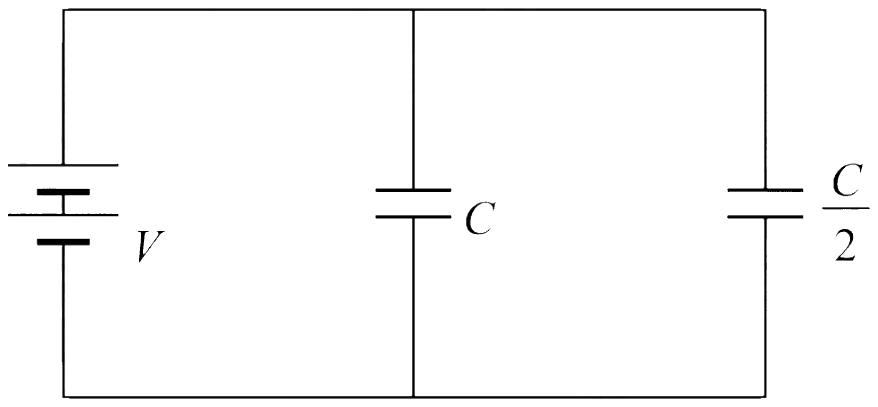
Two condensers, one of capacity C and the other of capacity 2C, are connected to a V-volt battery, as shown. The work done in charging fully both the condensers is
A condenser of capacitance C is fully charged by a 200V supply. It is then discharged through a small coil of resistance wire embedded in a thermally insulated block of specific heat 250J kg−1K−1 and of mass 100g. If the temperature of the block rises by 0.4K, then the value of C is
A cylindrical capacitor has charge Q and length L. If both the charge and length of the capacitor are doubled, by keeping other parameters fixed, the energy stored in the capacitor
A parallel plate capacitor has a uniform electric field 'E' in the space between the plates. If the distance between the plates is 'd' and area of each plate is 'A', the energy stored in the capacitor is
A parallel plate capacitor of capacitance 12μF is charged to a potential of 180V. If the distance between the plates of the capacitor is π3mm, then the energy density of the electric field between the plates of the capacitor is
A parallel plate capacitor having capacity C0 is charged to V0. With battery disconnected, if the separation between the plates is doubled then the energy stored in it is E1. Instead if the separation between the plates is doubled, with battery in connection, the energy stored in it is E2. Then the value of E2/E1 is
The insulated plates of a charged parallel plate capacitor (with small separation between the plates) are approaching each other due to electrostatic attraction. Assuming no other force to be operative and no radiation taking place, which of the following graphs approximately shows the variation with time (t) of the potential difference (V) between the plates?
A variable capacitor is connected to a 200V battery. If its capacitance is changed from 2μF to XμF, the decrease in energy of the capacitor is 2×10⁻²J. The value of X is