
Charge Sharing & Loss of Energy
A capacitor of F is charged up to V is connected in parallel with another capacitor of F which is charged up to V. Then, the common potential will be
Show answer and solution
Answer: (a)
Loading the solution…
Home›Practice Hub›Chapters›Capacitors›Charge Sharing & Loss of Energy
Capacitors PYQs · MHT CET · JEE Main · NEET
 Capacitors · Lecture 1 · Capacitance & Spherical Conductor1:08:22All 11 Capacitors videos →
Charge Sharing & Loss of Energy
A capacitor of F is charged up to V is connected in parallel with another capacitor of F which is charged up to V. Then, the common potential will be
Answer: (a)
Charge Sharing & Loss of Energy
A condenser of capacity is charged to potential and then disconnected. Uncharged capacitor of capacity is connected in parallel with . The resultant potential is
Answer: (b)
Charge Sharing & Loss of Energy
A capacitor with capacitance is fully charged with a potential difference of 6.0 V and disconnected from the battery. The charged capacitor is connected across another capacitor with capacitance . The charge on capacitor when equilibrium is established will be (assume capacitor does not have any charge initially), the value of is ______.
Numerical answer type. Work it out, then open the answer.
Answer: 4
Charge Sharing & Loss of Energy
Consider two uncharged capacitors of equal capacitance 200 pF. One of them is charged by a 100 V supply and disconnected. Now this capacitor is connected to the uncharged capacitor. The amount of electrostatic energy lost in the process is:
Answer: (a)
Charge Sharing & Loss of Energy
A sphere of capacitance 100 pF is charged to a potential of 100 V. Another identical uncharged metal sphere is brought in contact with the charged sphere, then the change in the total energy stored on these spheres, when they touch is . The value of is ______. (combined capacitance of spheres is 200 pF)
Answer: (b)
Charge Sharing & Loss of Energy
A parallel plate capacitor of capacitance 'C' is connected to a battery and charged to a potential 'V'. Another capacitor of capacitance '' is charged to a potential ''. The charging battery is then disconnected and both the capacitors are connected in parallel to each other such that positive terminal of one is connected to negative terminal of the other. The final energy of the configuration is
Answer: (c)
Charge Sharing & Loss of Energy
Two capacitors of and are connected in parallel. If the potential difference across is 20 V and across is 40 V, then the common potential of the parallel combination will be (same polarities of the capacitor connected together)
Answer: (d)
Charge Sharing & Loss of Energy
Using a battery, a 100 pF capacitor is charged to 60 V and then the battery is removed. After that, a second uncharged capacitor is connected to the first capacitor in parallel. If the final voltage across the second capacitor is 20 V, its capacitance is: (in pF)
Answer: (d)
Charge Sharing & Loss of Energy
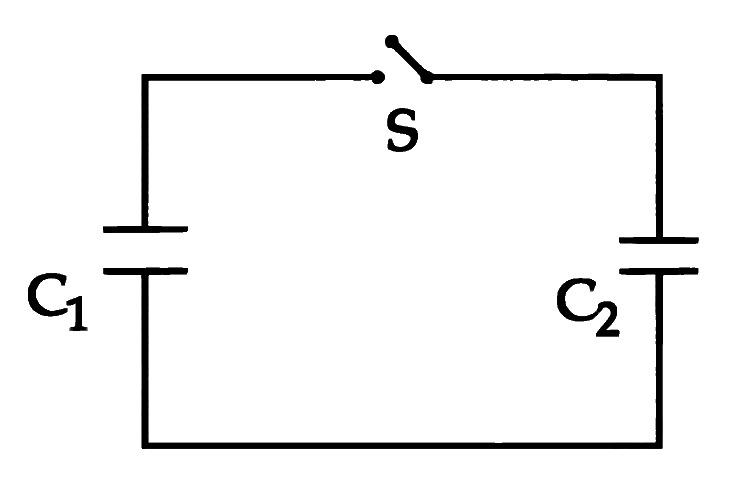
A capacitor, is charged to a potential difference of using a 5V battery. The battery is removed and another capacitor, is inserted in place of the battery. When the switch 'S' is closed, the charge flows between the capacitors for some time until equilibrium condition is reached. What are the charges ( and ) on the capacitors and when equilibrium condition is reached.
Answer: (a)
Charge Sharing & Loss of Energy
A capacitor of capacitance and potential has energy . It is connected to another capacitor of capacitance and potential . Then the loss of energy is , where is _______.
Numerical answer type. Work it out, then open the answer.
Answer: 2
Charge Sharing & Loss of Energy
Two identical capacitors have the same capacitance ' '. One of them is charged to potential and other to . The negative ends of capacitors are connected together. When positive ends are also connected, the decrease in energy of the combined system is
Answer: (d)
Charge Sharing & Loss of Energy
A parallel plate capacitor of capacitance ' ' is connected to a battery and charged to a potential difference ' '. Another capacitor of capacitance 3 C is similarly charged to a potential difference 3 V. The charging battery is then disconnected and capacitors are connected in parallel to each other in such a way that positive terminal of one is connected to the negative terminal of the other. The final energy of the configuration is
Answer: (b)
Charge Sharing & Loss of Energy
Two identical capacitors have same capacitance . One of them is charged to the potential and other to the potential . The negative ends of both are connected together. When the positive ends are also joined together, the decrease in energy of the combined system is:
Answer: (a)
Charge Sharing & Loss of Energy
A parallel plate capacitor of capacitance is charged to a potential , The energy stored in the capacitor is . The capacitor is now connected to another uncharged identical capacitor in parallel combination. The energy stored in the combination is . The ratio is:
Answer: (a)
Charge Sharing & Loss of Energy
A capacitor is charged by supply. It is then disconnected from the supply and is connected to another uncharged capacitor. Electrostatic energy lost in the process is ____________
Numerical answer type. Work it out, then open the answer.
Answer: 6
Charge Sharing & Loss of Energy
Two identical capacitors have the same capacitance ''. One of them is charged to a potential and the other to . The negative ends of the capacitors are connected together. When the positive ends are also connected, the decrease in energy of the combined system is
Answer: (c)
Charge Sharing & Loss of Energy
A capacitor of capacitance is charged by a battery. The capacitor is disconnected from the battery and connected to another uncharged identical capacitor such that one plate of uncharged capacitor connected to positive plate and another plate of uncharged capacitor connected to negative plate of the charged capacitor. The loss of energy in this process is measured as . The value of is _____________.
Numerical answer type. Work it out, then open the answer.
Answer: 225
Charge Sharing & Loss of Energy
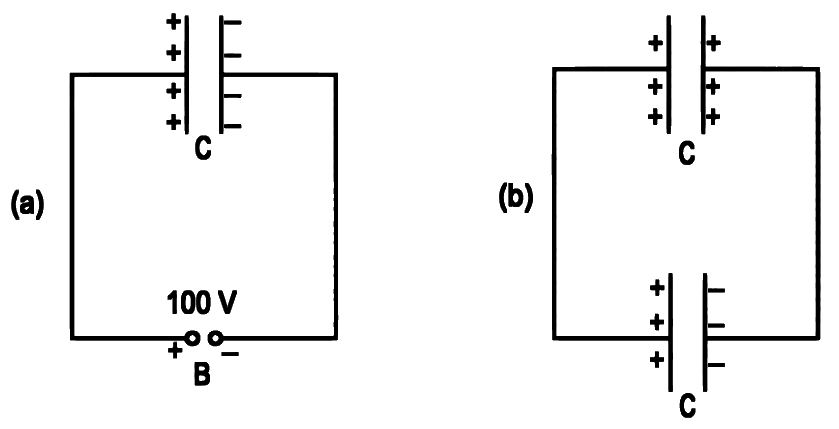
A capacitor of capacitance C = 900 pF is charged fully by 100 V battery B as shown in figure (a). Then it is disconnected from the battery and connected to another uncharged capacitor of capacitance C = 900 pF as shown in figure (b). The electrostatic energy stored by the system (b) is
Answer: (c)
Charge Sharing & Loss of Energy
A capacitor of capacitance 50 pF is charged by 100 V source. It is then connected to another uncharged identical capacitor. Electrostatic energy loss in the process is ___________ nJ.
Numerical answer type. Work it out, then open the answer.
Answer: 125
Charge Sharing & Loss of Energy
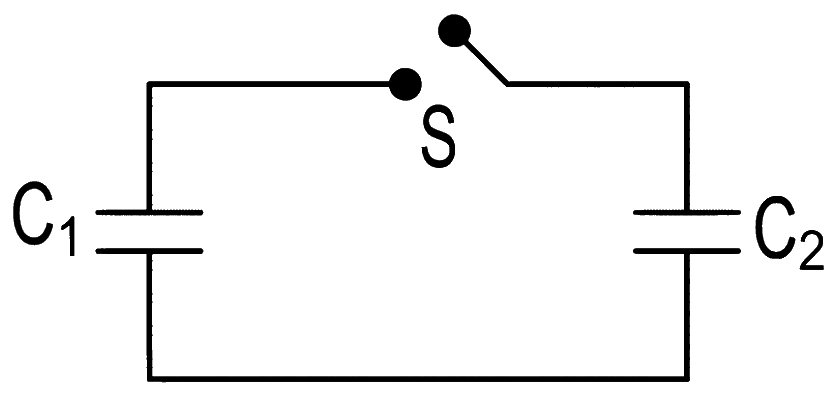
Two capacitors having capacitance C1 and C2 respectively are connected as shown in figure. Initially, capacitor C1 is charged to a potential difference V volt by a battery. The battery is then removed and the charged capacitor C1 is now connected to uncharged capacitor C2 by closing the switch S. The amount of charge on the capacitor C2, after equilibrium, is:
Answer: (a)
Charge Sharing & Loss of Energy
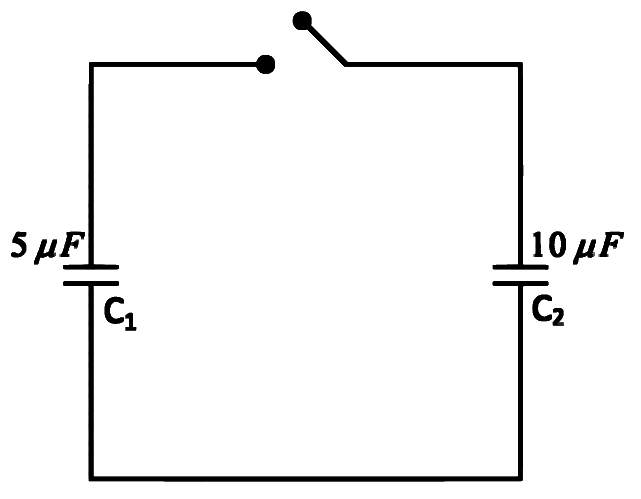
A capacitor C1 of capacitance 5 F is charged to a potential of 30 V using a battery. The battery is then removed and the charged capacitor is connected to an uncharged capacitor C2 of capacitance 10 F as shown in figure. When the switch is closed charge flows between the capacitors. At equilibrium, the charge on the capacitor C2 is __________ C.
Numerical answer type. Work it out, then open the answer.
Answer: 100
Charge Sharing & Loss of Energy
A condenser of capacity '' is charged to potential ' ' and then disconnected. Uncharged capacitor of capacity '' is connected in parallel with ''. The resultant potential '' is
Answer: (d)
Charge Sharing & Loss of Energy
A 2F capacitor C1 is first charged to a potential difference of 10V using a battery. Then the battery is removed and the capacitor is connected to an uncharged capacitor C2 of 8 F. The charge in C2 on equilibrium condition is ____________ C. (Round off to the Nearest Integer)
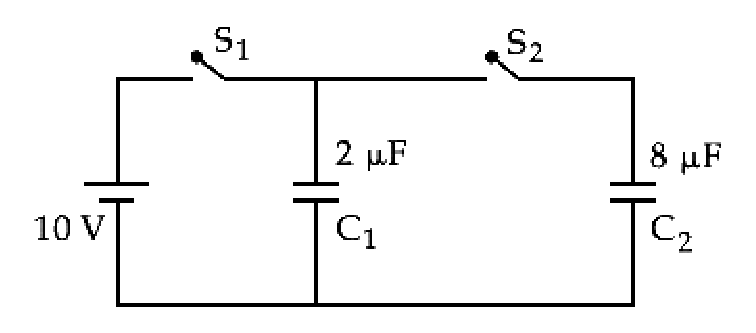
Numerical answer type. Work it out, then open the answer.
Answer: 16
Charge Sharing & Loss of Energy
Two identical capacitors have the same capacitance ''. One of them is charged to potential '' and the other to . The negative ends of the capacitors are connected together. When positive ends are also connected, the decrease in energy of the combined system is
Answer: (a)
Charge Sharing & Loss of Energy
A 10 F capacitor is fully charged to a potential difference of 50 V. After removing the source voltage it is connected to an uncharged capacitor in parallel. Now the potential difference across them becomes 20 V. The capacitance of the second capacitor is:
Answer: (b)
Charge Sharing & Loss of Energy
A capacitor C is fully charged with voltage V0. After disconnecting the voltage source, it is connected in parallel with another uncharged capacitor of capacitance . The energy loss in the process after the charge is distributed between the two capacitors is:
Answer: (d)
Charge Sharing & Loss of Energy
A 60 pF capacitor is fully charged by a 20 V supply. It is then disconnected from the supply and is conneced to another uncharged 60 pF capacitor in parallel. The electrostatic energy that is lost in this process by the time the charge is redistributed between them is (in nJ) _____
Numerical answer type. Work it out, then open the answer.
Answer: 6
Charge Sharing & Loss of Energy
A 5 F capacitor is charged fully by a 220 V supply. It is then disconnected from the supply and is connected in series to another uncharged 2.5 F capacitor. If the energy change during the charge redistribution is then value of X to the nearest integer is _____.
Numerical answer type. Work it out, then open the answer.
Answer: 4
Charge Sharing & Loss of Energy
Two capacitors of capacitances C and 2C are charged to potential differences V and 2V, respectively. These are then connected in parallel in such a manner that the positive terminal of one is connected to the negative terminal of the other. The final energy of this configuration is:
Answer: (b)
Charge Sharing & Loss of Energy
Two identical capacitors and of equal capacitance are connected as shown in the circuit. Terminals a and b of the key k are connected to charge capacitor using battery of emf V volt. Now disconnecting a and b the terminals b and c are connected. Due to this, what will be the percentage loss of energy?
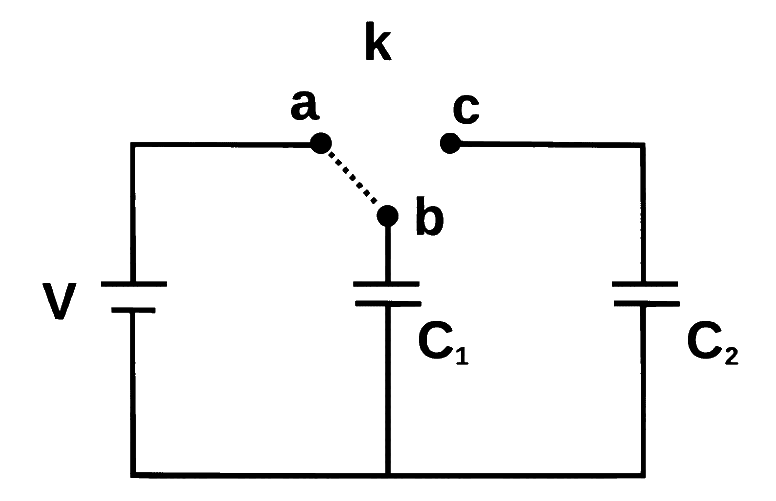
Answer: (d)
Charge Sharing & Loss of Energy
In the figure shown, after the switch 'S' is turned from position 'A' to position 'B', the energy dissipated in the circuit in terms of capacitance 'C' and total charge 'Q' is:
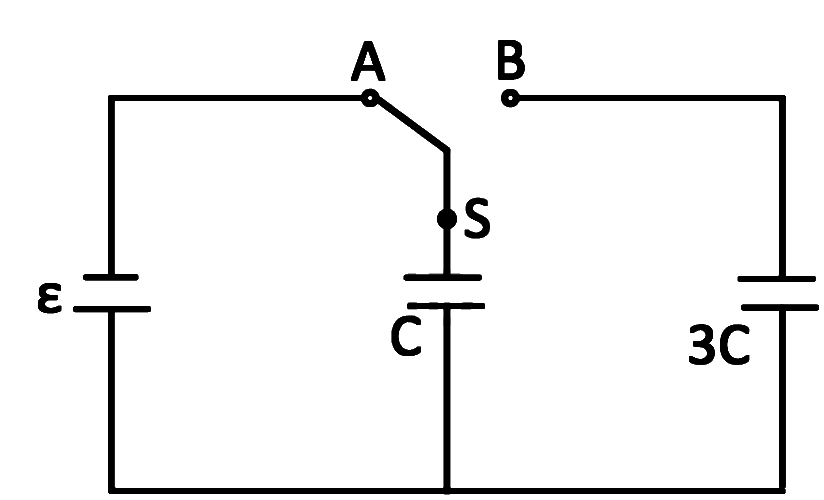
Answer: (d)
Charge Sharing & Loss of Energy
A capacitor C1 = 1.0 F is charged up to a voltage V = 60 V by connecting it to battery B through switch (1). Now C1 is disconnected from battery and connected to a circuit consisting of two uncharged capacitors and C3 = 6.0 F through switch (2), as shown in the figure. The sum of final charges on C2 and C3 is:
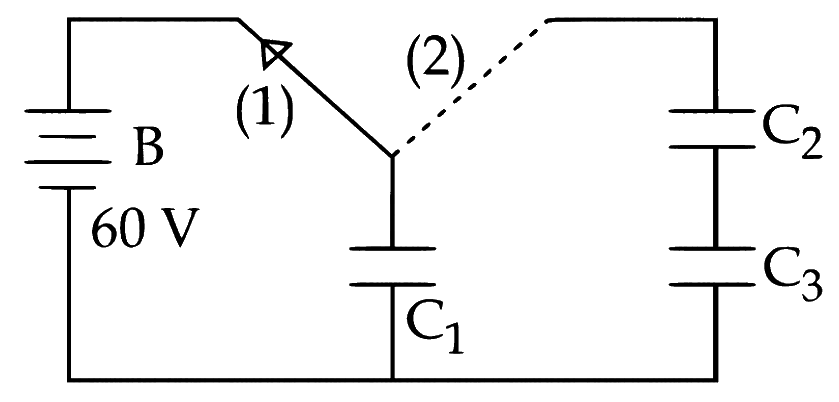
Answer: (a)
Charge Sharing & Loss of Energy
A capacitor is charged by a battery. The battery is removed and another identical uncharged capacitor is connected in parallel. The total electrostatic energy of resulting system
Answer: (a)
Charge Sharing & Loss of Energy
A capacitor of 2 F is charged as shown in the diagram. When the switch S is turned to position 2, the percentage of its stored energy dissipated is
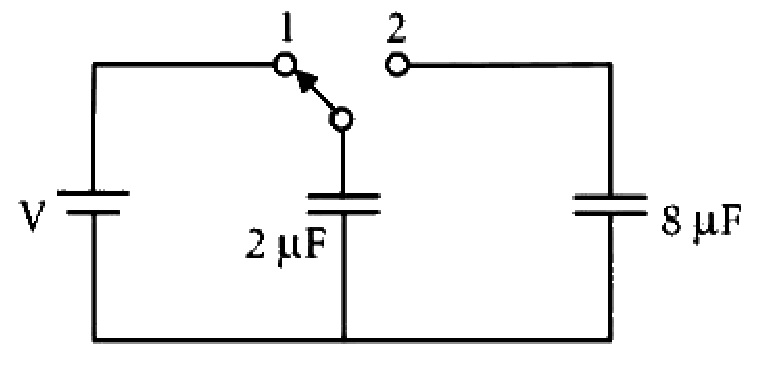
Answer: (b)
Charge Sharing & Loss of Energy
Two capacitors and are charged to and respectively. It is found that connecting them together the potential on each one can be made zero. Then
Answer: (b)
Charge Sharing & Loss of Energy
A capacitor of capacity C1 charged upto V volt and then connected to an uncharged capacitor of capacity C2. The final potential difference across each will be
Answer: (a)
Charge Sharing & Loss of Energy
A capacitor is charged with a battery and energy stored is U. After disconnecting battery another capacitor of same capacity is connected in parallel to the first capacitor. Then energy stored in each capacitor is
Answer: (b)
Charge Sharing & Loss of Energy
If two conducting spheres are separately charged and then brought in contact :
Answer: (b)
Step-by-step solution coming soon.
Charge Sharing & Loss of Energy
A capacitor is charged as shown in the figure. The percentage of its stored energy dissipated after the switch is turned to position is
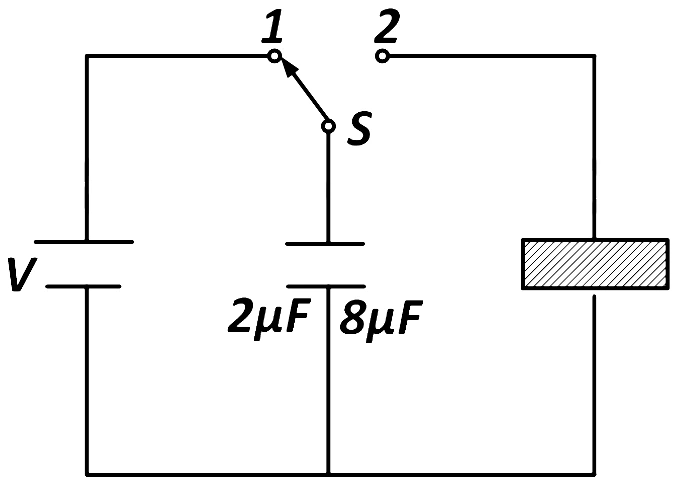
Answer: (d)
Step-by-step solution coming soon.
Charge Sharing & Loss of Energy
A parallel plate capacitor of capacitance is connected to a battery and is charged to a potential difference . Another capacitor of capacitance is connected to another battery and is charged to potential difference . The charging batteries are now disconnected and the capacitors are connected in parallel to each other in such a way that the positive terminal of one is connected to the negative terminal of the other. The final energy of the configuration is
Answer: (c)
Step-by-step solution coming soon.
Charge Sharing & Loss of Energy
Assertion : When charges are shared between any two bodies no charge is really lost, some loss of energy does occur.
Reason : Some energy disappears in the form of heat, sparking etc.
Answer: (a)
Step-by-step solution coming soon.
Charge Sharing & Loss of Energy
Two capacitors of capacities and are charged upto the potential and , then condition for not flowing the charge between on connected them in parallel is
Answer: (c)
Step-by-step solution coming soon.
Charge Sharing & Loss of Energy
A capacitor is charged as shown. When switch is shifted to position , the percentage of energy lost is
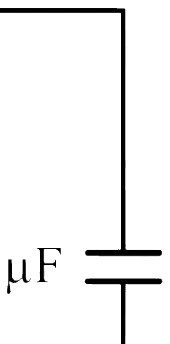
Answer: (d)
Step-by-step solution coming soon.
Charge Sharing & Loss of Energy
A parallel plate capacitor of capacitance is charged to and then connected to another uncharged capacitor. If the potential falls to , the capacitance of the second capacitor is
Answer: (b)
Step-by-step solution coming soon.
Charge Sharing & Loss of Energy
The energy stored in the capacitor as shown in Fig. (a) is . If the battery is replaced by another capacitor of as shown in Fig. (b), then the total energy of system is
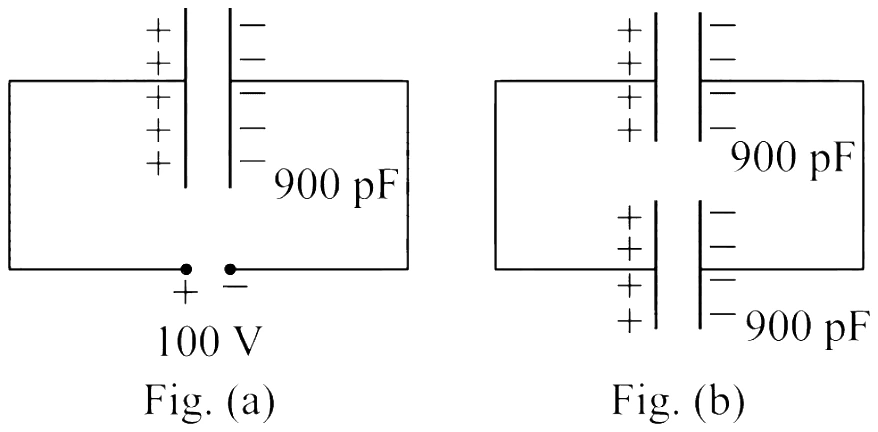
Answer: (b)
Step-by-step solution coming soon.
Charge Sharing & Loss of Energy
A capacitor of capacitance is fully charged by connecting it to a source of . It is then disconnected from the supply and connected to an uncharged capacitor of capacitance . The electrostatic energy lost in this sharing is:
Answer: (b)
Step-by-step solution coming soon.
Charge Sharing & Loss of Energy
A capacitor of capacitance is charged to a potential of and then connected in parallel to an uncharged capacitor of capacitance . The final potential difference across each capacitor will be:
Answer: (c)
Step-by-step solution coming soon.
Charge Sharing & Loss of Energy
Two capacitors and are charged to and respectively. It is found that upon connecting them together in parallel, the potential on each one of them is zero. Therefore
Answer: (d)
Step-by-step solution coming soon.
Charge Sharing & Loss of Energy
A parallel plate capacitor is filled by a dielectric whose relative permittivity varies with the applied voltage () as . A similar capacitor with no dielectric is charged to . It is then connected to the uncharged capacitor with the dielectric. Find the final voltage on the capacitors.
Answer: (a)
Step-by-step solution coming soon.
Charge Sharing & Loss of Energy
A capacitor of capacity is charged up to a potential and then connected in parallel to an uncharged capacitor of capacity . The final potential difference across each capacitor will be
Answer: (b)
Step-by-step solution coming soon.
Charge Sharing & Loss of Energy
Two capacitors and are charged to and , respectively. When they are connected in parallel, it is found that potential on each one of them is zero. Therefore,
Answer: (b)
Step-by-step solution coming soon.
Charge Sharing & Loss of Energy
A capacitor of capacitance charged by an amount is connected in parallel with an uncharged capacitor of capacitance . The final charges on the capacitors are
Answer: (c)
Step-by-step solution coming soon.
Charge Sharing & Loss of Energy
Two capacitors of and are connected in series and a potential difference of is applied across the combination. They are then disconnected and reconnected in parallel. The potential difference across the combination is
Answer: (d)
Step-by-step solution coming soon.
Charge Sharing & Loss of Energy
A capacitor of charged up to is connected in parallel with another capacitor of charged up to . The common potential is
Answer: (d)
Step-by-step solution coming soon.
Charge Sharing & Loss of Energy
A capacitor of capacitance is charged with the help of a battery. After disconnecting the battery, if this capacitor is connected in parallel with another uncharged capacitor of capacitance , then the potential difference across the plates of capacitor is
Answer: (c)
Step-by-step solution coming soon.
Charge Sharing & Loss of Energy
One of the two identical capacitors having the same capacitance , is charged to a potential and the other is charged to a potential . If they are connected with their like plates together, then the decrease in the electrostatic potential energy of the combined system is
Answer: (c)
Step-by-step solution coming soon.
Charge Sharing & Loss of Energy
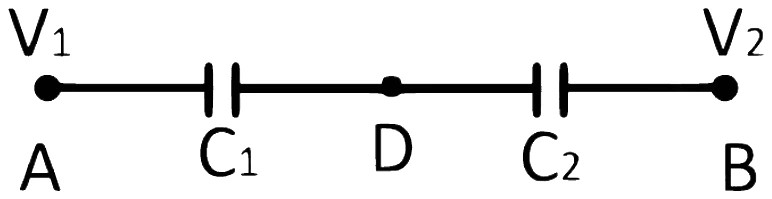
Two condensers and in a circuit are joined as shown in the figure. The potential of point is and that of point is . The potential at point will be
Answer: (c)
Step-by-step solution coming soon.
Charge Sharing & Loss of Energy
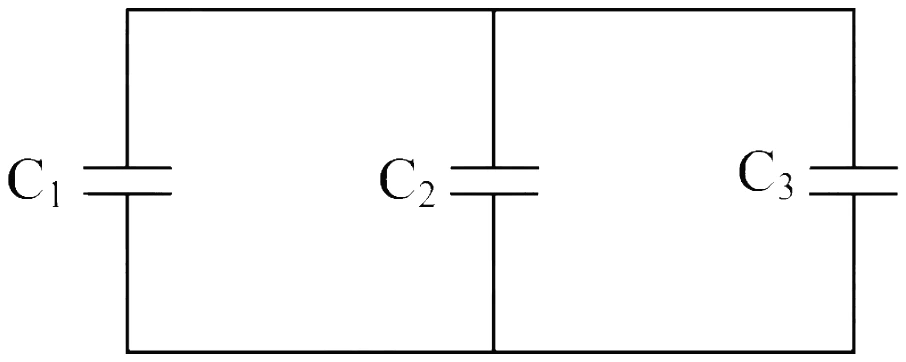
A capacitor of capacitance is charged using a battery. is then removed from the battery and connected to capacitors and of and , respectively as shown in the figure. The charge on after equilibrium has reached is
Answer: (a)
Step-by-step solution coming soon.
Charge Sharing & Loss of Energy
A parallel plate capacitor of capacitance is charged by a supply. The capacitor is then disconnected from the supply and is connected to another uncharged parallel plate capacitor of capacitance . The loss of electrostatic energy in this process is
Answer: (a)
Step-by-step solution coming soon.
Charge Sharing & Loss of Energy
A capacitor is charged by a battery. It is disconnected from the battery and is connected to another uncharged capacitor of capacitance . During this process, the electrostatic energy lost by the first capacitor is
Answer: (d)
Step-by-step solution coming soon.
Charge Sharing & Loss of Energy
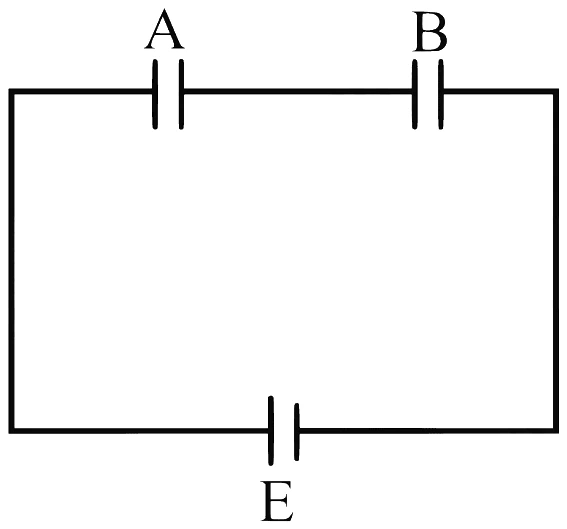
The circuit shows two capacitors and of capacitances and respectively, connected in series with a cell of emf . When they are fully charged, the cell is removed and the capacitors are connected with their plates of opposite polarities touching each other. Then
(i) Charge on is
(ii) Charge on is zero
(iii) Loss of energy in this process is
The correct statement/s is/are
Answer: (b)
Step-by-step solution coming soon.
Charge Sharing & Loss of Energy
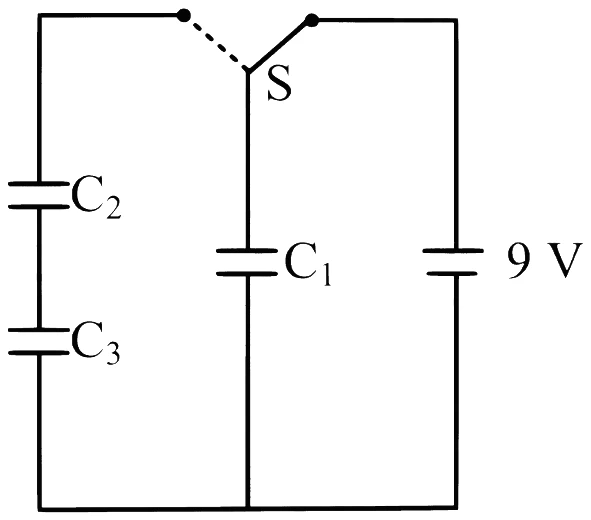
The following figure shows a battery and uncharged capacitors of capacitances . The switch is thrown to the right side until capacitor is fully charged, then the switch is thrown to the left. The final charge on capacitor is
Answer: (c)
Step-by-step solution coming soon.
Charge Sharing & Loss of Energy
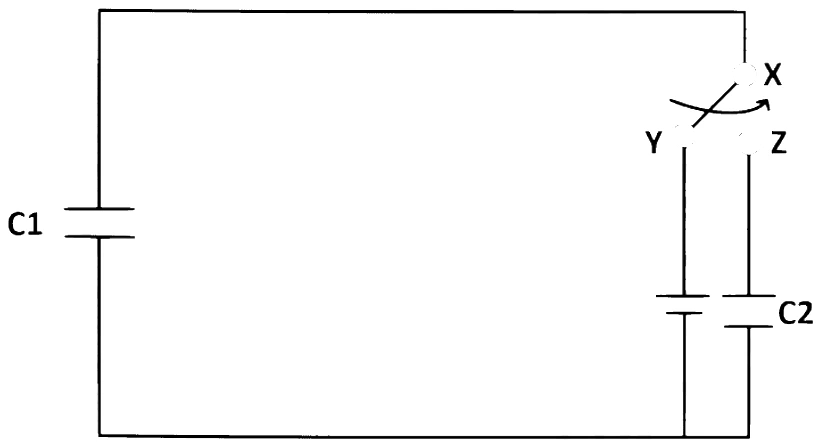
Consider the shown circuit. The capacitors and have capacitances and , respectively. The switch can connect point to either or . Initially is connected until the capacitor is fully charged by the battery. Then the switch connects and , and the final charges on and are and , respectively. What is the value of the ratio ?
Answer: (d)
Step-by-step solution coming soon.
No questions match these filters.