Alternating Current PYQs · MHT CET · JEE Main · NEET
Series LCR Circuit
Questions
64
MHT CET
36
JEE Main
19
NEET
9
Years
2004–2026
0 of 64 attemptedPick an answer to see the solution
Q1MHT CET 2026 · 18 APR · SHIFT 2Easy
Series LCR Circuit · Voltages and the phasor sum
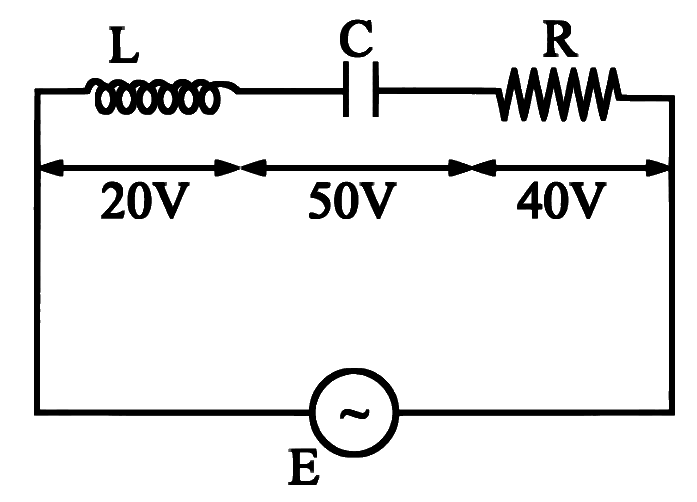
In an LCR series circuit, the potential difference across the terminals of the inductor, capacitor and resistor is 60 V, 30 V and 40 V respectively. Then supply voltage will be equal to
Series LCR circuit containing an a.c. source of 100V has a inductor and a capacitor of reactance 24Ω and 16Ω respectively. If a resistance of 6Ω is connected in series, then the potential difference across the series combination of inductor and capacitor only is
For a series LCR circuit inductive reactance XL is equal to resistance R and also equal to twice the capacitive reactance XC. The impedance of the circuit and the phase difference between voltage V and current i are respectively
Series LCR Circuit · Phase angle: leading or lagging
In an LCR series circuit, a. c. voltage source is connected in series. When L is removed from the circuit, the phase difference between the voltage and the current is π/3. If instead C is removed, the phase difference is again π/3. The power factor of the circuit is (tan3π=3)
Series LCR Circuit · Phase angle: leading or lagging
The resistor 'R' inductance 'L' and capacitance 'C' are connected in series with an a.c. source. When 'L' is removed from the circuit, the phase difference between voltage and current in the circuit is 3π. If instead, C is removed from the circuit, the phase difference is again 3π. The power factor of the circuit is
Series LCR Circuit · Phase angle: leading or lagging
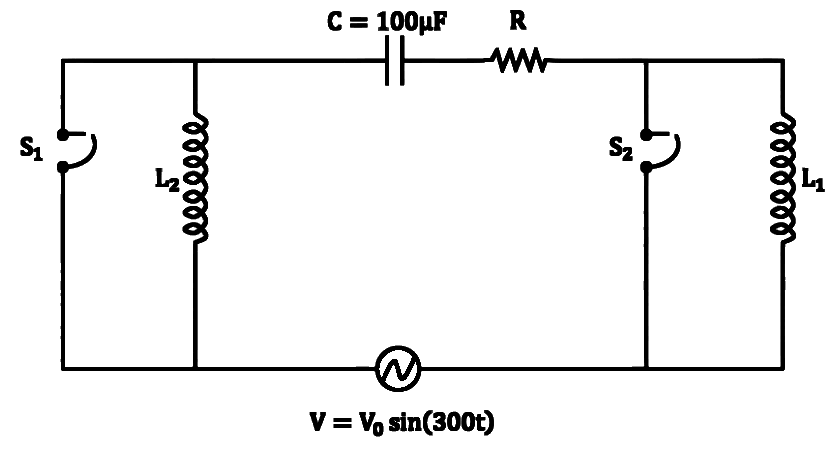
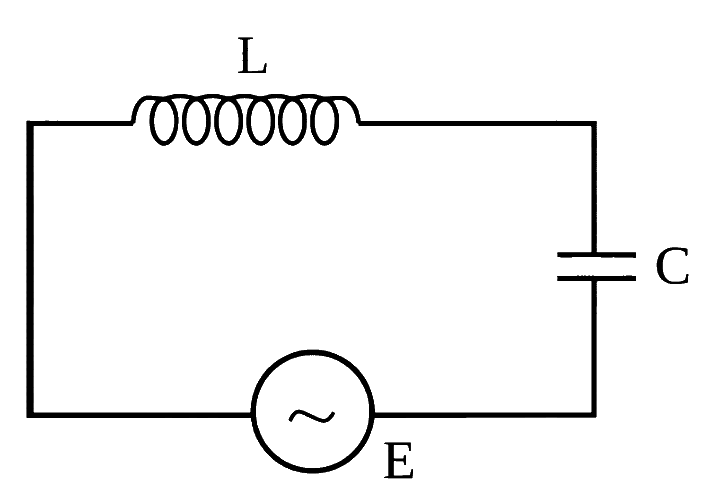
The figure given below shows an LCR series circuit with two switches S1 and S2. When switch S1 is closed keeping S2 open, the phase difference (φ) between the current and source voltage is 30° and phase difference is 60° when S2 is closed keeping S1 open. The value of (3L1 − L2) is ______ H.
To an ac power supply of 220 V at 50 Hz, a resistor of 20Ω, a capacitor of reactance 25Ω and an inductor of reactance 45Ω are connected in series. The corresponding current in the circuit and the phase angle between the current and the voltage is, respectively
An alternating e.m.f. having voltage V=V0sinωt is applied to a series L-C-R circuit. Given: ∣XL−XC∣=R. The r.m.s. value of potential difference across capacitor will be
A series LCR circuit is connected to an a.c. source of 230 V,50 Hz. The circuit contains resistance of 80Ω an inductor having inductive reactance 70Ω and a capacitor of capacitive reactance 130Ω. The power factor of the circuit is x. The value of x is
Series LCR Circuit · Phase angle: leading or lagging
An inductor of (π100) mH, capacitor of capacitance (2π10−3) F and resistance of 10Ω are connected in series with an AC voltage source of 110 V,50 Hz supply. The tangent of the phase angle ' ϕ ' between voltage and current is
Series LCR Circuit · Phase angle: leading or lagging
In LCR series circuit, when ' L ' is removed from the circuit, the phase difference between voltage and current in the circuit is 3π. If ' C ' is removed from the circuit instead of L then phase difference is again 3π. The power factor of the circuit is (tan60∘=3)
Series LCR Circuit · Phase angle: leading or lagging
In an electrical circuit ' R ', ' L ', ' C ' and an a.c. voltage source are all connected in series. When ' L ' is removed from the circuit, the phase difference between the voltage and the current in the circuit is 3π. If instead ' C ' is removed from the circuit, the phase difference is again 3π. The power factor of the circuit is (tan3π=3)
In an LCR circuit, if ' V ' is the effective value of the applied voltage, VR is the voltage across ' R ', ' VL ' and ' VC ' is the effective voltage across ' L ' and ' C ' respectively then
A series LCR circuit is subjected to an ac signal of 200 V,50 Hz. If the voltage across the inductor (L=10 mH) is 31.4 V, then the current in this circuit is _______.
Series LCR Circuit · Phase angle: leading or lagging
An inductance of π300 mH, a capacitance of π1 mF and a resistance of 20Ω are connected in series with an a.c. source of 240 V,50 Hz. The phase angle of the circuit is
Series LCR Circuit · Phase angle: leading or lagging
With an alternating voltage source frequency ' f ', inductor ' L ', capacitor ' C ' and resistance ' R ' are connected in series. The voltage leads the current by 45∘. The value of ' L ' is (tan45∘=1)
The a.c. source is connected to series LCR circuit. If voltage across R is 40 V, that across L is 80 V and that across C is 40 V, then the e.m.f. 'e' of a.c. source is
Series LCR Circuit · Phase angle: leading or lagging
With an alternating voltage source of frequency 'f', inductor 'L', capacitor 'C' and resistance 'R' are connected in series. The voltage leads the current by 45∘. The value of 'L' is (tan45∘=1)
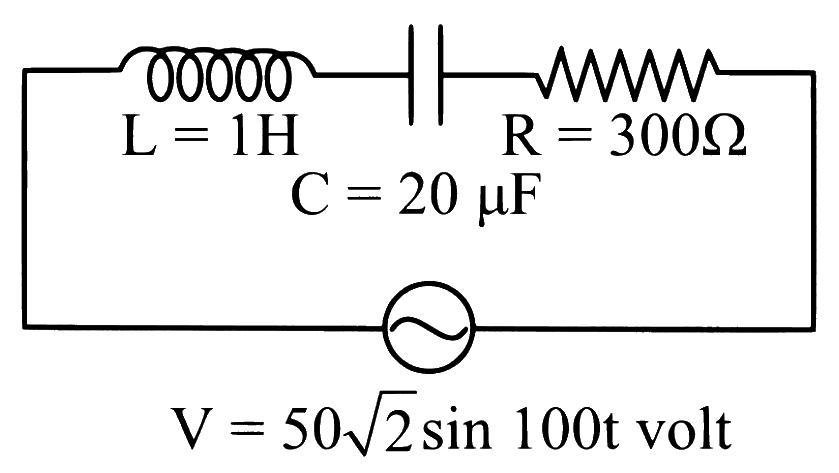
A sinusoidal voltage V(t)=200sin2000t volt is applied to a series LCR circuit in which L=10 mH,C=25μF and R=100Ω. The impedance of the circuit is _______ Ω
Numerical answer type. Work it out, then open the answer.
Series LCR Circuit · Phase angle: leading or lagging
A sinusoidal voltage V(t) = 210 sin 3000 t volt is applied to a series LCR circuit in which L = 10 mH, C = 25 μF and R = 100 Ω. The phase difference (Φ) between the applied voltage and resultant current will be:
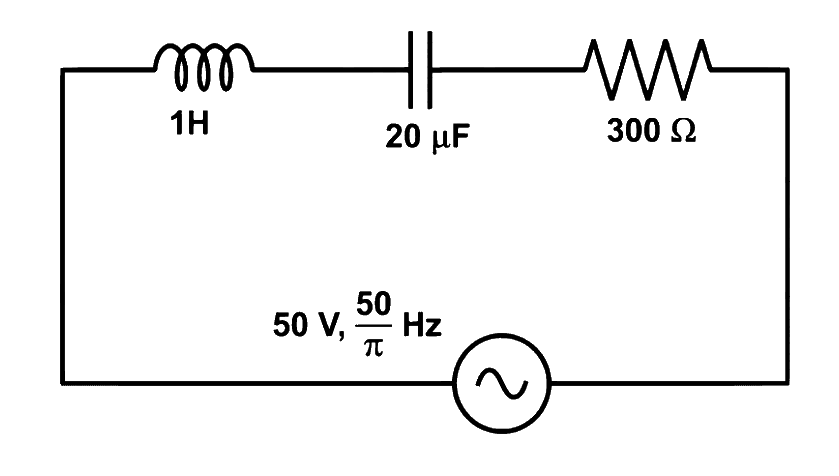
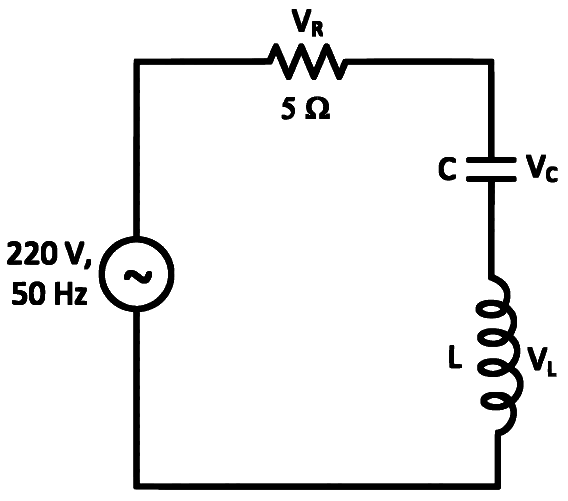
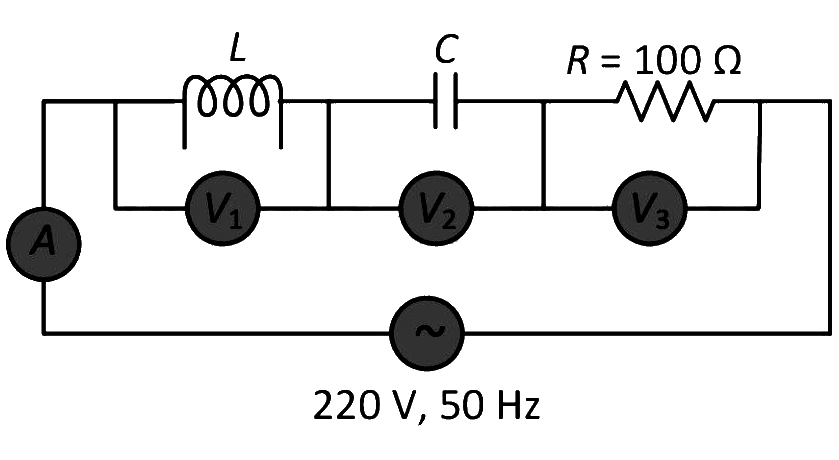
In the given circuit, the magnitude of VL and VC are twice that of VR. Given that f = 50 Hz, the inductance of the coil is Kπ1 mH. The value of K is ____________.
Numerical answer type. Work it out, then open the answer.
A circuit element X when connected to an a.c. supply of peak voltage 100 V gives a peak current of 5 A which is in phase with the voltage. A second element Y when connected to the same a.c. supply also gives the same value of peak current which lags behind the voltage by 2π. If X and Y are connected in series to the same supply, what will be the rms value of the current in ampere?
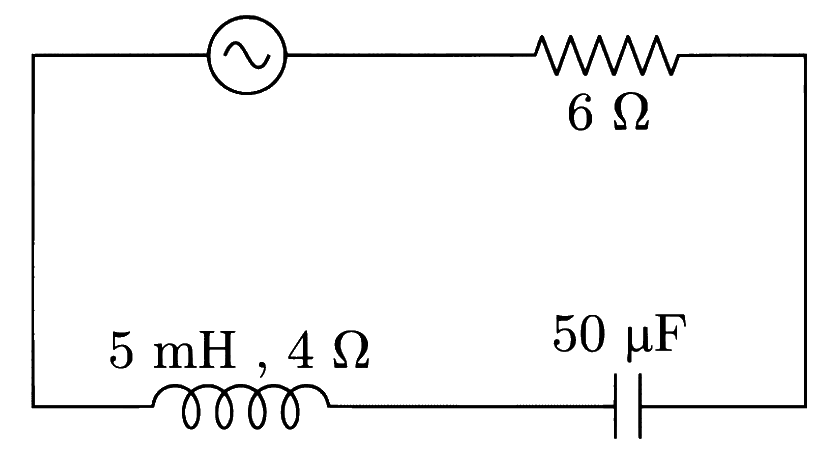
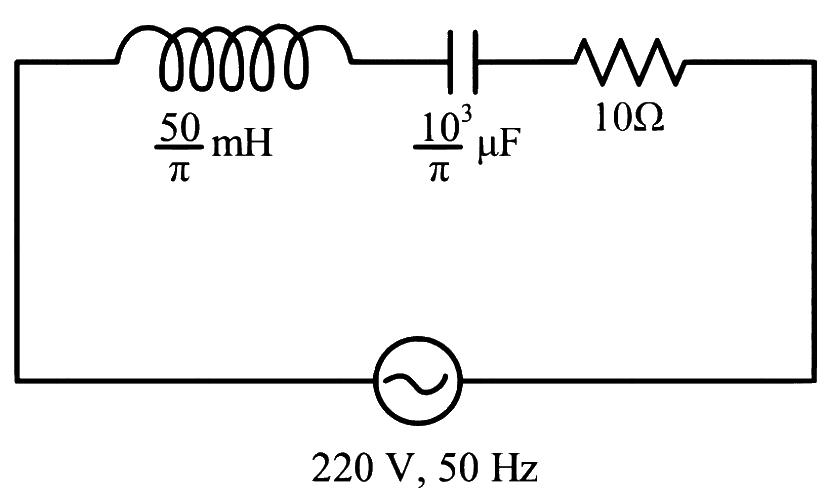
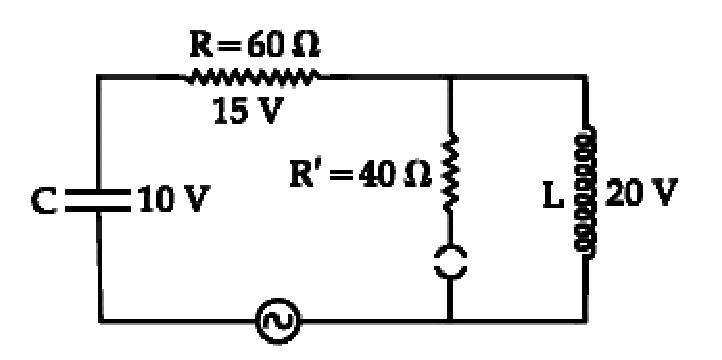
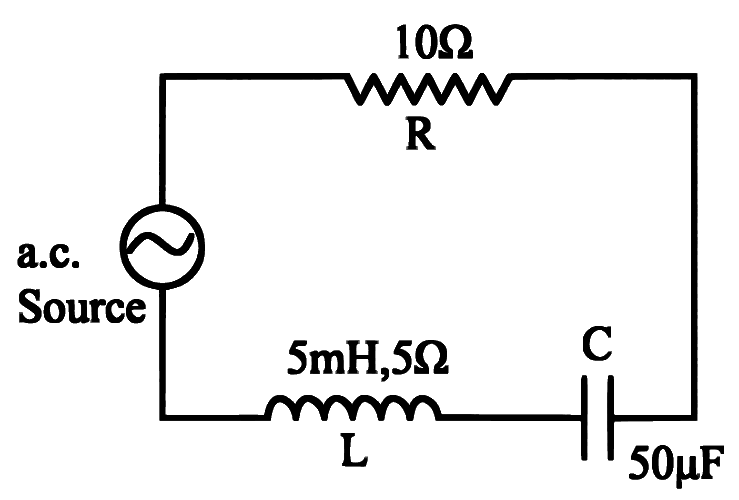
The angular frequency of alternating current in a L-C-R circuit is 100 rad/s. The components connected are shown in the figure. Find the value of inductance of the coil and capacity of condenser.
Series LCR Circuit · Phase angle: leading or lagging
A series LCR circuit with resistance (R) 500 ohm is connected to an a.c. source of 250 V. When only the capacitance is removed, the current lags behind the voltage by 60∘. When only the inductance is removed, the current leads the voltage by 60∘. The impedance of the circuit is (tan3π=3)
Series LCR Circuit · Phase angle: leading or lagging
For a series LCR circuit with R = 100 Ω, L = 0.5 mH and C = 0.1 pF connected across 220V-50 Hz AC supply, the phase angle between current and supplied voltage and the nature of the circuit is:
Series LCR Circuit · Phase angle: leading or lagging
A series LCR circuit is connected to an ac voltage source. When L is removed from the circuit, the phase difference between current and voltage is 3π. If instead C is removed from the circuit, the phase difference is again 3π between current and voltage. The power factor of the circuit is:
A sinusoidal voltage of peak value 283 V and angular frequency 320/s is applied to a series LCR circuit. Given that R=5 Ω, L=25 mH and C=1000 μF. The total impedance, and phase difference between the voltage across the source and the current will respectively be:
When the rms voltages VL, VC and VR are measured respectively across the inductor L, the capacitor C and the resistor R in a series LCR circuit connected to an AC source, it is found that the ratio VL: VC: VR = 1: 2: 3. If the rms voltage of the AC source is 100 V, then VR is close to:
Series LCR Circuit · Phase angle: leading or lagging
In an electrical circuit R, L, C and a.c. voltage source are all connected in series. When L is removed from the circuit, the phase difference between the voltage and the current in the circuit is 3π. If instead, C is removed from the circuit, the phase difference is again 3π. The power factor of the circuit is
Series LCR Circuit · Phase angle: leading or lagging
In a circuit L, C and R are connected in series with an alternating voltage source of frquency f The current leads the voltage by 45°. The value of C is