

Motion of Charges in an Electric Field
An electric charge of magnitude '' and mass '' is moving in an electric field 'E'. The acceleration imparted to the charge is
Show answer and solution
Answer: (b)
Loading the solution…
Home›Practice Hub›Chapters›Electrostatics›Motion of Charges in an Electric Field
Electrostatics PYQs · MHT CET · JEE Main · NEET
Motion of Charges in an Electric Field
An electric charge of magnitude '' and mass '' is moving in an electric field 'E'. The acceleration imparted to the charge is
Answer: (b)
Motion of Charges in an Electric Field
A simple pendulum has a bob with mass and charge . The pendulum string has negligible mass. When a uniform and horizontal electric field is applied, the tension in the string changes. The final tension in the string, when pendulum attains an equilibrium position is ______.
Answer: (b)
Motion of Charges in an Electric Field
Two metal plates (A, B) are kept horizontally with separation of cm, with plate A on the top. An atomizer jet sprays oil (density 1.5 g/cm3) droplets of radius 1 mm horizontally. All oil droplets carry a charge 5 nC. The potentials VA and VB are required on plates A and B respectively in order to ensure the droplets do not descend. The values of VA and VB are ______.
(Neglect the air resistance to the droplets and take g = 10 m/s2)
Answer: (a)
Motion of Charges in an Electric Field
A charged particle of mass ' ' and charge ' ' is at rest. It is acce:lerated in a uniform electric field of intensity ' ': for time ' '. The kinetic energy of the particles after time is
Answer: (b)
Motion of Charges in an Electric Field
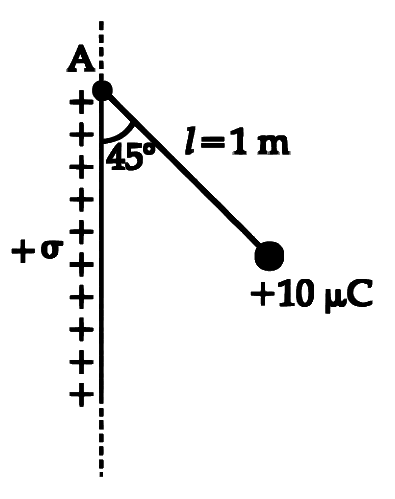
A small bob of mass 100 mg and charge is connected to an insulating string of length 1 m. It is brought near to an infinitely long non-conducting sheet of charge density ' ' as shown in figure. If string subtends an angle of with the sheet at equilibrium the charge density of sheet will be. (Given, and acceleration due to gravity, )
Answer: (a)
Motion of Charges in an Electric Field
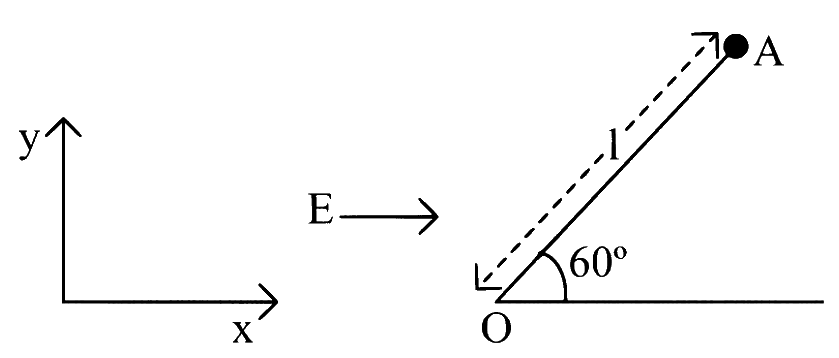
A particle of mass ' ' and charge ' ' is fastened to one end ' ' of a massless string having equilibrium length , whose other end is fixed at point ' '. The whole system is placed on a frictionless horizontal plane and is initially at rest. If uniform electric field is switched on along the direction as shown in figure, then the speed of the particle when it crosses the -axis is
Answer: (c)
Motion of Charges in an Electric Field
A particle ' ' has charge ' ' and a particle ' ' has charge ' '. Each has same mass ' '. When they are allowed to fall from rest through the same potential, the ratio of their speeds will become (particle A to particle B)
Answer: (b)
Motion of Charges in an Electric Field
An electron of mass ' ' and charge ' ' is accelerated from rest in a uniform electric field of intensity ' '. The velocity acquired by it as it travels a distance ' ' is ' '. The ratio in terms of and is
Answer: (a)
Motion of Charges in an Electric Field
A small particle carrying a negative charge of is suspended in equilibrium between two horizontal metal plates 8 cm apart having a potential difference of 980 V across them. The mass of the particle is
Answer: (a)
Motion of Charges in an Electric Field
An infinitely long positively charged straight thread has a linear charge density . An electron revolves along a circular path having axis along the length of the wire. The graph that correctly represents the variation of the kinetic energy of electron as a function of radius of circular path from the wire is:
Answer: (d)
Motion of Charges in an Electric Field
A particle of charge '' and mass '' moves in a circle of radius '' around an infinitely long line charge of linear charge density ''. Then time period will be given as:
(Consider as Coulomb's constant)
Answer: (d)
Motion of Charges in an Electric Field
An electron is moving under the influence of the electric field of a uniformly charged infinite plane sheet having surface charge density . The electron at is at a distance of from and has a speed of . The maximum value of if the electron strikes at is , the value of is ___________.
Numerical answer type. Work it out, then open the answer.
Answer: 8
Motion of Charges in an Electric Field
Suppose a uniformly charged wall provides a uniform electric field of normally. A charged particle of mass being suspended through a silk thread of length and remain stayed at a distance of from the wall.
Then the charge on the particle will be where ___________. [use ]
Numerical answer type. Work it out, then open the answer.
Answer: 3
Motion of Charges in an Electric Field
An electron of mass '' and charge '' is accelerated from rest in a uniform electric field of strength ''. The velocity acquired by the electron, when it travels a distance '', is
Answer: (b)
Motion of Charges in an Electric Field
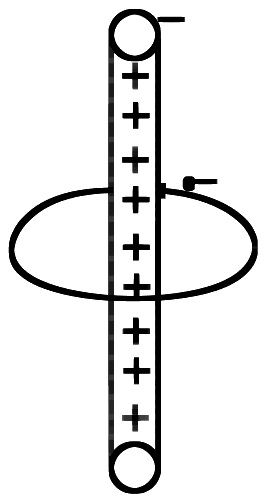
An electron revolves around an infinite cylindrical wire having uniform linear charge density in circular path under the influence of attractive electrostatic field as shown in the figure. The velocity of electron with which it is revolving is ___________ . Given mass of electron
Numerical answer type. Work it out, then open the answer.
Answer: 8
Motion of Charges in an Electric Field
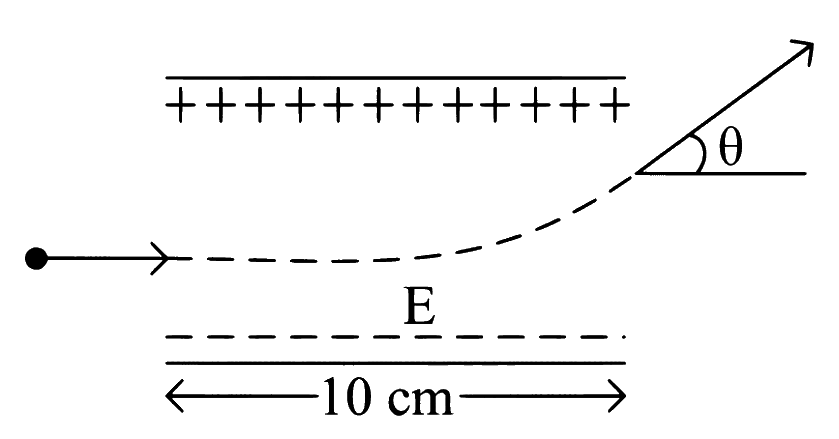
A uniform electric field of 10 N/C is created between two parallel charged plates (as shown in figure). An electron enters the field symmetrically between the plates with a kinetic energy 0.5 eV. The length of each plate is 10 cm. The angle () of deviation of the path of electron as it comes out of the field is ___________ (in degree).
Numerical answer type. Work it out, then open the answer.
Answer: 45
Motion of Charges in an Electric Field
A stream of positively charged particles having and velocity is deflected by an electric field kV/m. The electric field exists in a region of 10 cm along direction. Due to the electric field, the deflection of the charged particles in the direction is _________ mm.
Numerical answer type. Work it out, then open the answer.
Answer: 2
Motion of Charges in an Electric Field
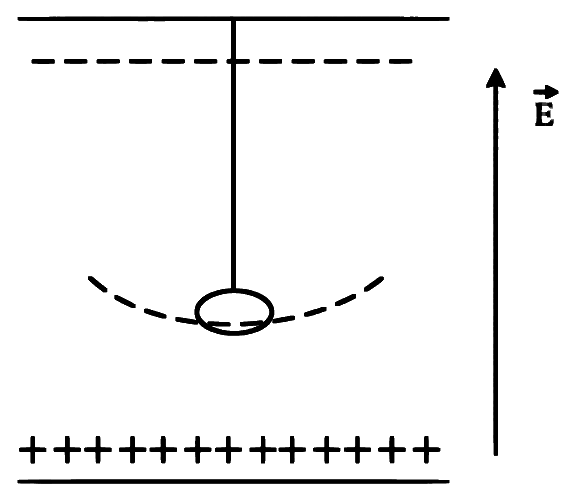
The bob of a simple pendulum of length '' has a mass '' and charge ''. The pendulum is suspended between the plates of a charged parallel plate capacitor. The direction of electric field is shown in figure. The period of oscillations of the simple pendulum is (acceleration due to gravity )
Answer: (c)
Motion of Charges in an Electric Field
A vertical electric field of magnitude 4.9 105 N/C just prevents a water droplet of a mass 0.1 g from falling. The value of charge on the droplet will be:
(Given: g = 9.8 m/s2)
Answer: (b)
Motion of Charges in an Electric Field
A positive charge particle of 100 mg is thrown in opposite direction to a uniform electric field of strength 1 105 NC. If the charge on the particle is 40 C and the initial velocity is 200 ms, how much distance it will travel before coming to the rest momentarily:
Answer: (d)
Motion of Charges in an Electric Field
A long cylindrical volume contains a uniformly distributed charge of density . The radius of cylindrical volume is R. A charge particle (q) revolves around the cylinder in a circular path. The kinetic energy of the particle is:
Answer: (a)
Motion of Charges in an Electric Field
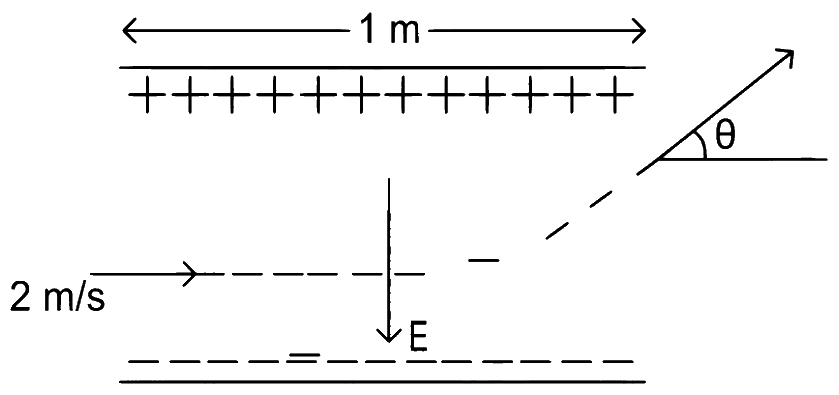
A uniform electric field is created between two parallel plates of length as shown in figure, (where mass of electron and e = charge of electron). An electron enters the field symmetrically between the plates with a speed of . The angle of the deviation of the path of the electron as it comes out of the field will be _________.
Answer: (b)
Motion of Charges in an Electric Field
Two identical positive charges each are fixed at a distance of '2a' apart from each other. Another point charge with mass 'm' is placed at midpoint between two fixed charges. For a small displacement along the line joining the fixed charges, the charge executes . The time period of oscillation of charge will be:
Answer: (a)
Motion of Charges in an Electric Field
An electron of mass '' and charge '' is accelerated from rest in a uniform electric field of strength ''. The velocity acquired by the electron when it travels a distance '' is
Answer: (c)
Motion of Charges in an Electric Field
Two particles and having same mass have charge and respectively. When they are allowed to fall from rest through same electric potential difference, the ratio of their speeds '' to '' will become
Answer: (a)
Motion of Charges in an Electric Field
A charge of magnitude '2e' and mass '4m' is moving in an electric field . The acceleration imparted to the above charge is
Answer: (b)
Motion of Charges in an Electric Field
An oil drop of radius 2 mm with a density 3g cm is held stationary under a constant electric field 3.55 105 V m in the Millikan's oil drop experiment. What is the number of excess electrons that the oil drop will possess? (consider g = 9.81 m/s2)
Answer: (b)
Motion of Charges in an Electric Field
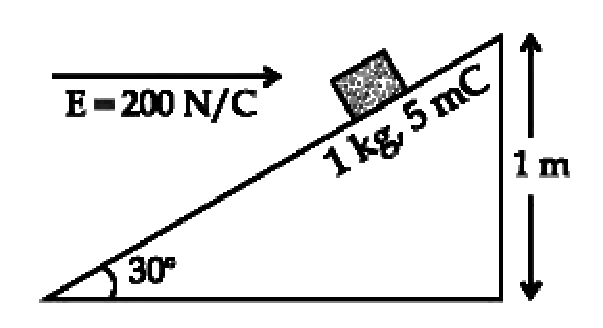
An inclined plane making an angle of 30 with the horizontal is placed in a uniform horizontal electric field as shown in the figure. A body of mass 1 kg and charge 5 mC is allowed to slide down from rest at a height of 1 m. If the coefficient of friction is 0.2, find the time taken by the body to reach the bottom.
[g = 9.8 m/s2; ; ]
Answer: (c)
Motion of Charges in an Electric Field
Two electrons each are fixed at a distance '2d'. A third charge proton placed at the midpoint is displaced slightly by a distance x (x << d) perpendicular to the line joining the two fixed charges. Proton will execute simple harmonic motion having angular frequency: (m = mass of charged particle)
Answer: (b)
Motion of Charges in an Electric Field
A particle of mass 1 mg and charge q is lying at the mid-point of two stationary particles kept at a distance '2 m' when each is carrying same charge 'q'. If the free charged particle is displaced from its equilibrium position through distance 'x' (x << 1 m), the particle executes SHM. Its angular frequency of oscillation will be ____________ 105 rad/s if q2 = 10 C2.
Numerical answer type. Work it out, then open the answer.
Answer: 6000
Motion of Charges in an Electric Field
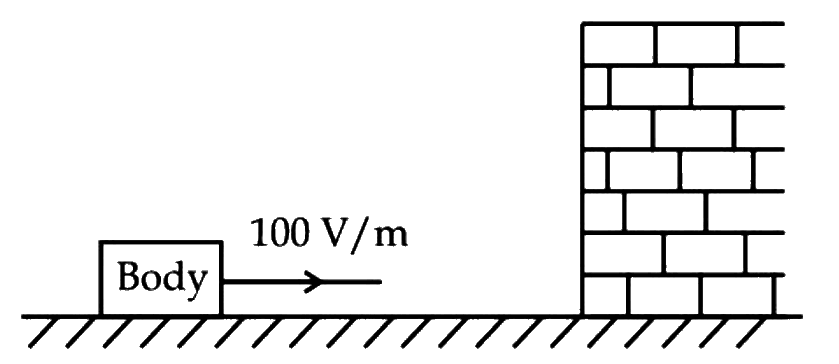
A body having specific charge 8 C/g is resting on a frictionless plane at a distance 10 cm from the wall (as shown in the figure). It starts moving towards the wall when a uniform electric field of 100 V/m is applied horizontally towards the wall. If the collision of the body with the wall is perfectly elastic, then the time period of the motion will be _______________ s.
Numerical answer type. Work it out, then open the answer.
Answer: 1
Motion of Charges in an Electric Field
A particle of mass m and charge q is released from rest in a uniform electric field. If there is no other force on the particle, the dependence of its speed v on the distance x travelled by it is correctly given by (graphs are schematic and not drawn to scale)
Answer: (b)
Motion of Charges in an Electric Field
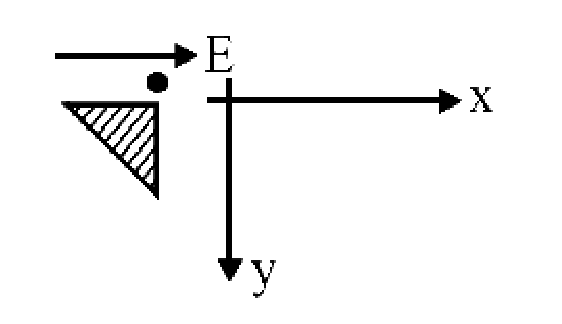
A small point mass carrying some positive charge on it, is released from the edge of a table. There is a uniform electric field in this region in the horizontal direction. Which of the following options then correctly describe the trajectory of the mass?
(Curves are drawn schematically and are not to scale).
Answer: (a)
Motion of Charges in an Electric Field
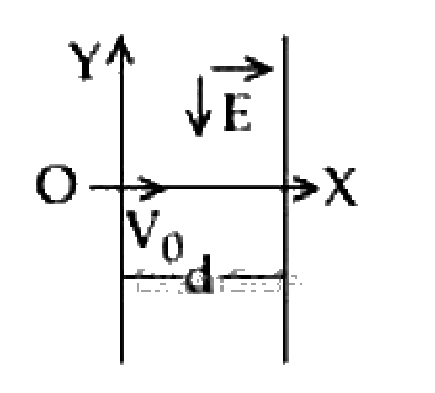
A charged particle (mass m and charge q)
moves along X-axis with velocity V0. When it
passes through the origin it enters a region having uniform electric field
which extends upto x = d.
Equation of path of electron in the region x > d is
Answer: (b)
Motion of Charges in an Electric Field
A particle of charge q and mass m is subjected to an electric field
E = E0 (1 – x2) in the x-direction, where and E0 are constants. Initially the particle was at rest at x = 0. Other than the initial position the kinetic energy of the particle becomes zero when the distance of the particle from the origin is:
Answer: (c)
Motion of Charges in an Electric Field
The bob of a simple pendulum has mass 2g and a charge of 5.0 μC. It is at rest in a uniform horizontal electric field of intensity 2000 V/m. At equilibrium, the angle that the pendulum makes with the vertical is: (take g = 10 m/s2)
Answer: (c)
Motion of Charges in an Electric Field
An electron falls from rest through a vertical distance h in a uniform and vertically upward directed electric field E. The direction of electric field is now reversed, keeping its magnitude the same. A proton is allowed to fall from rest in it through the same vertical distance h. The time of fall of the electron, in comparison to the time of fall of the proton is
Answer: (a)
Motion of Charges in an Electric Field
A body of mass and charge is connected to spring of spring constant It is oscillating along -direction about its equilibrium position, taken to be at with an amplitude . An electric field is applied along the -direction. Which of the following statements is correct?
Answer: (b)
Motion of Charges in an Electric Field
A uniform electric field exists between the plates of a charged condenser. A charged particle enters the space between the plates and perpendicular to . The path of the particle between the plates is a:
Answer: (c)
Motion of Charges in an Electric Field
A liquid drop having 6 excess electrons is kept stationary under a uniform electric field of 25.5 kVm . The density of liquid is kg m . The radius of the drop is (neglect buoyancy).
Answer: (b)
Motion of Charges in an Electric Field
Two charges, each equals to are kept at and on the -axis. A particle of mass and charge is placed at the origin. If charge is given a small displacement along the -axis, the net force acting on the particle is proportional to
Answer: (a)
Motion of Charges in an Electric Field
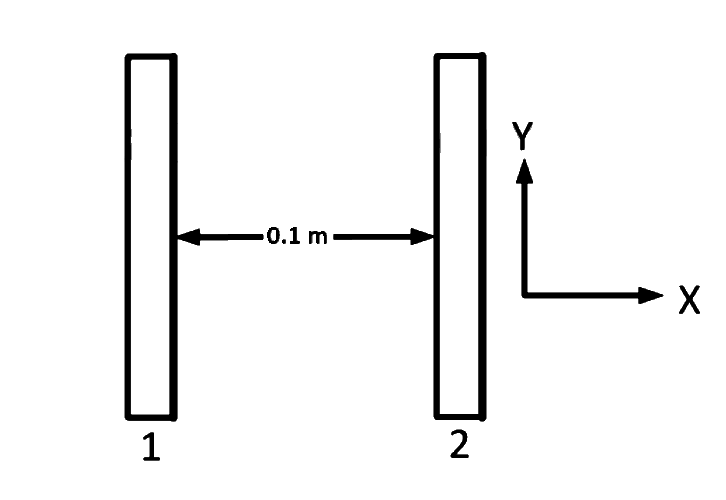
Two insulating plates are both uniformly charged in such a way that the potential difference between them is (i.e., plate is at a higher potential). The plates are separated by and can be treated as infinitely large. An electron is released from rest on the inner surface of plate What is its speed when it hits plate ?
Answer: (a)
Motion of Charges in an Electric Field
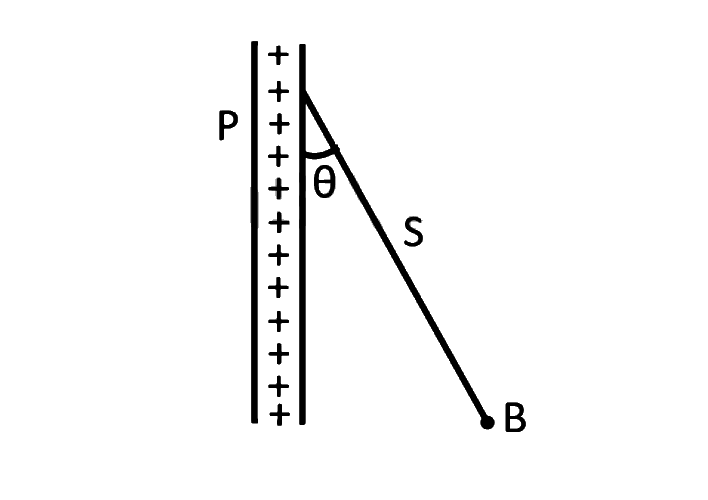
A charged ball hangs from a silk thread which makes angle with a large charged conducting sheet as shown in the figure. The surface charge density of the sheet is proportional to
Answer: (c)
Motion of Charges in an Electric Field
A charged oil drop is suspended in a uniform field of so that it neither falls nor rises. The charge on the drop will be (Take the mass of the charge and )
Answer: (c)
Motion of Charges in an Electric Field
A particle of mass and charge is placed at rest in a uniform electric field and then released. The kinetic energy attained by the particle after moving a distance is
Answer: (c)
Motion of Charges in an Electric Field
Two beads, each with charge and mass , are on a horizontal, frictionless, non-conducting, circular hoop of radius . One of the beads is glued to the hoop at some point, while the other one performs small oscillations about its equilibrium position along the hoop. The square of the angular frequency of the small oscillations is given by
[ is the permittivity of free space.]
Answer: (b)
Step-by-step solution coming soon.
Motion of Charges in an Electric Field
A disk of radius with uniform positive charge density is placed on the plane with its center at the origin. The Coulomb potential along the -axis is
.
A particle of positive charge is placed initially at rest at a point on the axis with and . In addition to the Coulomb force, the particle experiences a vertical force with . Let .
Which of the following statement(s) is(are) correct?
More than one option can be correct. Tap every correct option, then tap Check.
Answer: (a), (c), (d)
Step-by-step solution coming soon.
Motion of Charges in an Electric Field
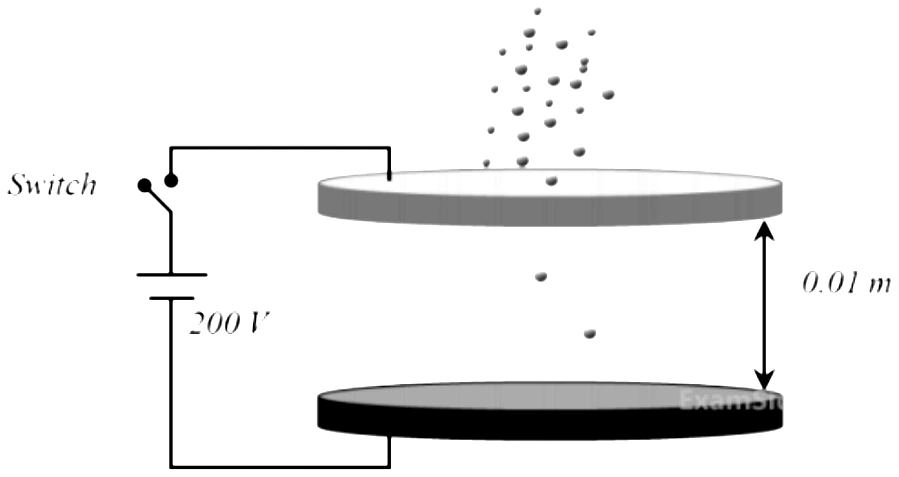
Two large circular discs separated by a distance of are connected to a battery via a switch as shown in the figure. Charged oil drops of density are released through a tiny hole at the center of the top disc. Once some oil drops achieve terminal velocity, the switch is closed to apply a voltage of across the discs. As a result, an oil drop of radius stops moving vertically and floats between the discs. The number of electrons present in this oil drop is ________. (neglect the buoyancy force, take acceleration due to gravity and charge on an electron )
Numerical answer type. Work it out, then open the answer.
Answer: 6
Step-by-step solution coming soon.
Motion of Charges in an Electric Field
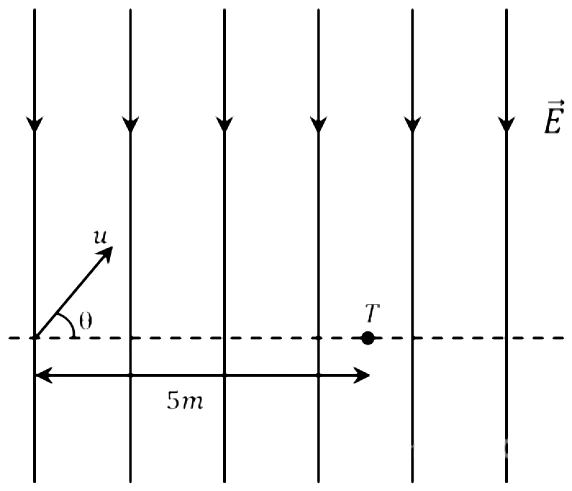
A uniform electric field, is applied in a region. A charged particle of mass carrying positive charge is projected in this region with an initial speed of . This particle is aimed to hit a target , which is away from its entry point into the field as shown schematically in the figure. Take . Then
More than one option can be correct. Tap every correct option, then tap Check.
Answer: (b), (c)
Step-by-step solution coming soon.
Motion of Charges in an Electric Field
A particle, of mass and charge , is initially at rest. At time , the particle comes under the influence of an electric field , where and . Consider the effect of only the electrical force on the particle. Then the maximum speed, in , attained by the particle at subsequent times is ________.
Numerical answer type. Work it out, then open the answer.
Answer: 2
Step-by-step solution coming soon.
Motion of Charges in an Electric Field
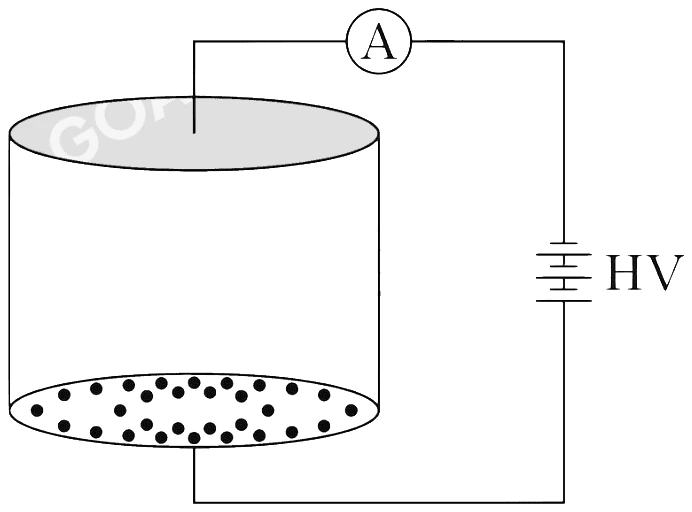
Consider an evacuated cylindrical chamber of height having rigid conducting plates at the ends and an insulating curved surface as shown in the figure. A number of spherical balls made of a light weight and soft material and coated with a conducting material are placed on the bottom plate. The balls have a radius . Now, a high voltage source (HV) is connected across the conducting plates such that the bottom plate is at and the top plate at . Due to their conducting surface, the balls will get charge, will become equipotential with the plate and are repelled by it. The balls will eventually collide with the top plate, where the coefficient of restitution can be taken to be zero due to the soft nature of the material of the balls. The electric field in the chamber can be considered to be that of a parallel plate capacitor. Assume that there are no collisions between the balls and the interaction between them is negligible. (Ignore gravity)
Which one of the following statements is correct?
Answer: (d)
Step-by-step solution coming soon.
Motion of Charges in an Electric Field
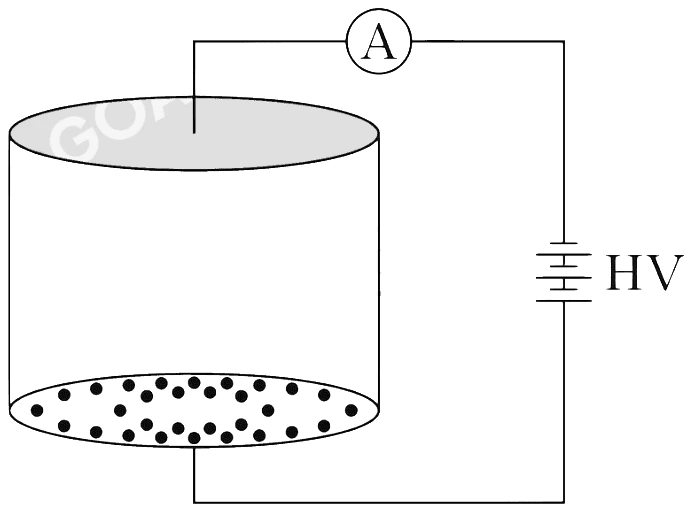
Consider an evacuated cylindrical chamber of height having rigid conducting plates at the ends and an insulating curved surface as shown in the figure. A number of spherical balls made of a light weight and soft material and coated with a conducting material are placed on the bottom plate. The balls have a radius . Now, a high voltage source (HV) connected across the conducting plates such that the bottom plate is at and the top plate at . Due to their conducting surface, the balls will get charge, will become equipotential with the plate and are repelled by it. The balls will eventually collide with the top plate, where the coefficient of restitution can be taken to be zero due to the soft nature of the material of the balls. The electric field in the chamber can be considered to be that of a parallel plate capacitor. Assume that there are no collisions between the balls and the interaction between them is negligible. (Ignore gravity)
The average current in the steady state registered by the ammeter in the circuit will be
Answer: (a)
Step-by-step solution coming soon.
Motion of Charges in an Electric Field
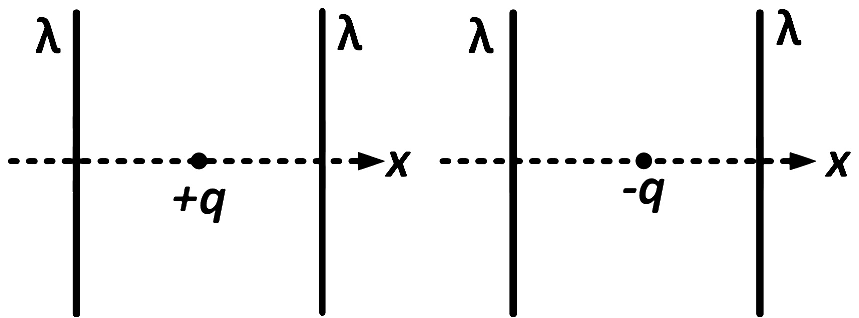
The figures below depict two situations in which two infinitely long static line charges of constant positive line charge density are kept parallel to each other. In their resulting electric field, point charges and are kept in equilibrium between them. The point charges are confined to move in the direction only. If they are given a small displacement about their equilibrium positions, then the correct statement(s) is (are)
More than one option can be correct. Tap every correct option, then tap Check.
Answer: (c)
Step-by-step solution coming soon.
Motion of Charges in an Electric Field
Two large vertical and parallel metal plates having a separation of are connected to a voltage source of potential difference . A proton is released at rest midway between the two plates. It is found to move at to the vertical JUST after release. Then is nearly
Answer: (c)
Step-by-step solution coming soon.
Motion of Charges in an Electric Field
A tiny spherical oil drop carrying a net charge is balanced in still air with a vertical uniform electric field of strength . When the field is switched off, the drop is observed to fall with terminal velocity . Given , viscosity of the air and the density of oil , the magnitude of is
Answer: (d)
Step-by-step solution coming soon.
Motion of Charges in an Electric Field
Positive charge is distributed uniformly over a circular ring of radius . A point particle having a mass and a negative charge is placed on its axis at a distance from the centre. Assuming , find the time period of oscillation of the particle, if it is released from there [neglect gravity].
Answer: (a)
Step-by-step solution coming soon.
Motion of Charges in an Electric Field
An electron of mass , initially at rest, moves through a certain distance in a uniform electric field in time . A proton of mass also initially at rest, takes time to move through an equal distance in this uniform electric field. Neglecting the effect of gravity, the ratio is nearly equal to
Answer: (b)
Step-by-step solution coming soon.
Motion of Charges in an Electric Field
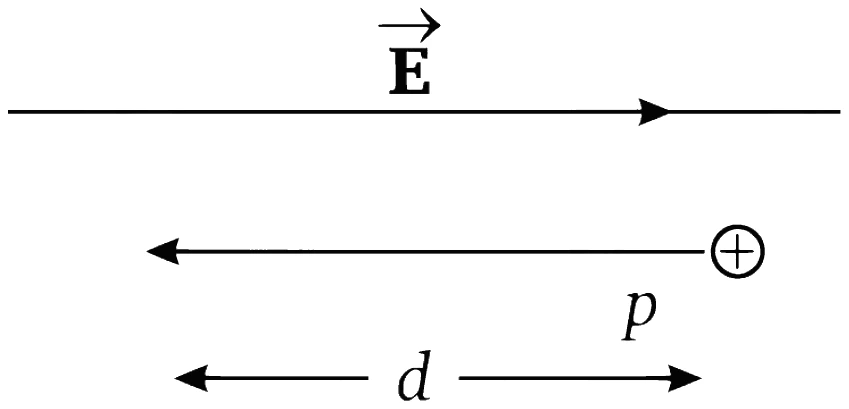
In the figure, a proton moves a distance in a uniform electric field as shown in the figure. Does the electric field do a positive or negative work on the proton? Does the electric potential energy of the proton increase or decrease?
Answer: (a)
Step-by-step solution coming soon.
Motion of Charges in an Electric Field
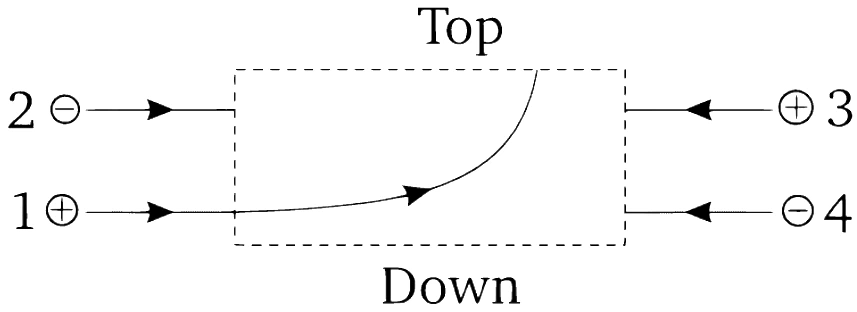
The figure shows the path of a positively charged particle 1 through a rectangular region of uniform electric field as shown in the figure. What is the direction of electric field and the direction of deflection of particles 2, 3 and 4 ?
Answer: (a)
Step-by-step solution coming soon.
Motion of Charges in an Electric Field
A particle having charge and mass is projected with velocity in uniform electric field . Change in momentum during any time interval is given by :
Answer: (b)
Step-by-step solution coming soon.
Motion of Charges in an Electric Field
The mass of a proton is times that of an electron. A electron and a proton are injected into a uniform electric field at right angle to the direction of the field with the same initial K.E.
Answer: (d)
Step-by-step solution coming soon.
Motion of Charges in an Electric Field
Two equal negative charges are fixed at the points and on the -axis. A positive charge is released from rest at the point on the -axis. The charge will
Answer: (d)
Step-by-step solution coming soon.
Motion of Charges in an Electric Field
The kinetic energy of an electron, which is accelerated in the potential difference of , is
Answer: (a)
Step-by-step solution coming soon.
Motion of Charges in an Electric Field
A charged oil drop is suspended in uniform field of so that it neither falls nor rises. The charge on the drop will be (Take the mass of the charge and )
Answer: (a)
Step-by-step solution coming soon.
Motion of Charges in an Electric Field
Two similar charges having mass and are placed in an electric field. The ratio of their kinetic energy is :
Answer: (c)
Step-by-step solution coming soon.
Motion of Charges in an Electric Field
Two equal -ve charges are fixed at the point and on the -axis. A positive charge is released from rest at the point on the -axis. The charge will :
Answer: (d)
Step-by-step solution coming soon.
Motion of Charges in an Electric Field
A charged particle is suspended in equilibrium in a uniform vertical electric field of intensity . If mass of the particle is , the charge on it and excess number of electrons on the particle respectively are ()
Answer: (a)
Step-by-step solution coming soon.
Motion of Charges in an Electric Field
An oil drop of radius is held stationary under a constant electric field of due to some excess electrons present on it. If the density of oil drop is , then number of excess electrons on the oil drop approximately are [Take, ]
Answer: (c)
Step-by-step solution coming soon.
Motion of Charges in an Electric Field
A dust particle of mass is suspended in air under the influence of an electric field of directed vertically upwards. How many electrons were removed from the neutral dust particle? [Take, ]
Answer: (c)
Step-by-step solution coming soon.
Motion of Charges in an Electric Field
A uniform electric field of is maintained in the positive direction. A point charge of at rest is released from the origin. The kinetic energy attained by the charge when it is from the origin is:
Answer: (b)
Step-by-step solution coming soon.
Motion of Charges in an Electric Field
A pith ball of mass gram and charge is suspended using a massless silk thread near a large charged conducting metal sheet of area and surface charge density . If the silk thread makes an angle with the metal sheet, then:
Answer: (a)
Step-by-step solution coming soon.
Motion of Charges in an Electric Field
A particle of mass and charge is released from rest in a uniform electric field of intensity . If the value of kinetic energy attained by the particle after moving through a distance of is , then the value of is:
Answer: (a)
Step-by-step solution coming soon.
Motion of Charges in an Electric Field
A bob of a simple pendulum has a mass of and a charge of . If it is at rest in a uniform horizontal electric field of intensity , the angle that the pendulum makes with the vertical at equilibrium is:
Answer: (a)
Step-by-step solution coming soon.
Motion of Charges in an Electric Field
Three identical conducting balls and , each of mass , are thrown upward at an angle to the horizontal with an initial speed in a region of space that has a uniform electric field downward along with the gravitational field . is positively charged, is uncharged and is negatively charged. Rank the ranges of these three balls in increasing order.
Answer: (a)
Step-by-step solution coming soon.
Motion of Charges in an Electric Field
An electron starting from rest and moving with the velocity through a potential difference is shown by the graphs below. Identify the correct graph.
Answer: (c)
Step-by-step solution coming soon.
Motion of Charges in an Electric Field
A tiny ball of mass and charge is suspended from the fixed support using an insulating string of length . The horizontal uniform electric field is switched on. The angle made by the string with vertical when the ball is in equilibrium is . The magnitude of uniform electric field is
Answer: (a)
Step-by-step solution coming soon.
Motion of Charges in an Electric Field
Figure shows three arrangements of electric field lines. In each arrangement, a proton is released from rest at point and then accelerated through point by the electric field. Points and have equal separations in the three arrangements. If , and are linear momentum of the proton at point in the three arrangements respectively, then
Answer: (a)
Step-by-step solution coming soon.
Motion of Charges in an Electric Field
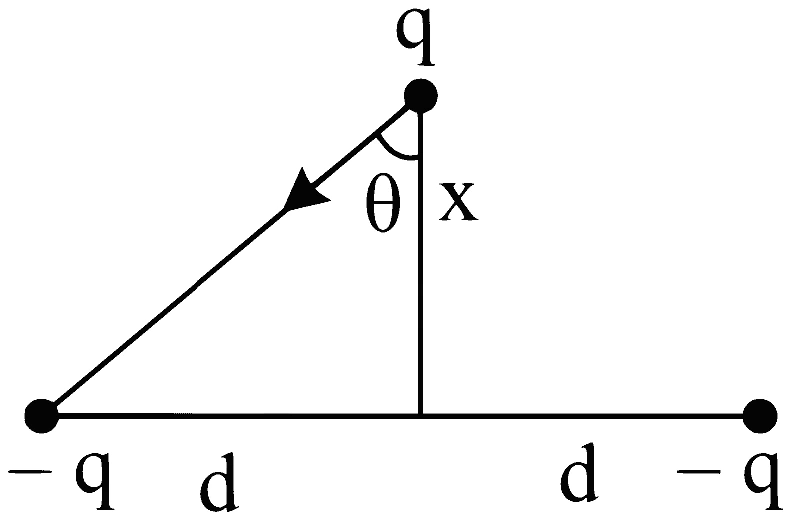
Two charges each are fixed, separated by distance . A third charge of mass placed at the mid-point is displaced slightly by () perpendicular to the line joining the two fixed charges as shown in the figure. The time period of oscillation of will be
Answer: (d)
Step-by-step solution coming soon.
Motion of Charges in an Electric Field
An electron and a proton having mass and respectively, initially at rest, move through the same distance in a uniform electric field . If the time taken by them to cover that distance is and respectively, then is equal to:
Answer: (b)
Step-by-step solution coming soon.
Motion of Charges in an Electric Field
A spherical metal ball of density and radius is immersed in a liquid of density . When an electric field is applied in the upward direction the metal ball remains just suspended in the liquid. Then the expression for the charge on the metal ball is:
Answer: (b)
Step-by-step solution coming soon.
Motion of Charges in an Electric Field
An electron falls through a distance in a uniform field of from rest. The time taken to cover this distance, in second, is ____ (, )
Answer: (a)
Step-by-step solution coming soon.
Motion of Charges in an Electric Field
A charged particle of mass and charge is released from rest in a uniform electric field . Neglecting the effect of gravity, the kinetic energy of the charged particle after seconds is
Answer: (c)
Step-by-step solution coming soon.
Motion of Charges in an Electric Field
A tiny spherical oil drop carrying a net charge is balanced in still air, with a vertical uniform electric field of strength . When the field is switched OFF, the drop is observed to fall with terminal velocity . Here , viscosity of air is and density of oil is . The magnitude of is
Answer: (a)
Step-by-step solution coming soon.
Motion of Charges in an Electric Field
A object, located in a region of uniform electric field carries a charge . The object released from rest at , has a kinetic energy of at . Then, is
Answer: (c)
Step-by-step solution coming soon.
Motion of Charges in an Electric Field
A copper rod of length is rotated about end with a constant angular velocity . The electric field at a distance from the axis of rotation is
Answer: (a)
Step-by-step solution coming soon.
Motion of Charges in an Electric Field
A particle of mass and charge is placed at rest in uniform electric field and then released. The kinetic energy attained by the particle after moving a distance is
Answer: (c)
Step-by-step solution coming soon.
Motion of Charges in an Electric Field
A mass of carrying a charge of is accelerated through a potential of . The velocity acquired by it is
Answer: (b)
Step-by-step solution coming soon.
Motion of Charges in an Electric Field
A particle of charge and mass starts moving from the origin under the action of electric field, with a velocity . The time taken to increase its velocity to is
Answer: (b)
Step-by-step solution coming soon.
Motion of Charges in an Electric Field
A particle of mass and charge is released from rest in a uniform electric field of . The kinetic energy of the particle after moving a distance of is
Answer: (b)
Step-by-step solution coming soon.
Motion of Charges in an Electric Field
The velocity acquired by an electron at rest when subjected to a uniform electric field of potential difference is
(Mass of electron and charge of electron )
Answer: (d)
Step-by-step solution coming soon.
Motion of Charges in an Electric Field
A particle of mass and charge is subjected to a uniform electric field of . If the particle is initially at rest, the velocity of the particle after a time of is
Answer: (d)
Step-by-step solution coming soon.
Motion of Charges in an Electric Field
The magnitude of an electric field which can just suspend a deuteron of mass freely in air is
Answer: (a)
Step-by-step solution coming soon.
Motion of Charges in an Electric Field
A particle of mass and charge is accelerated from rest through a potential difference of . The speed acquired by the particle is
Answer: (a)
Step-by-step solution coming soon.
Motion of Charges in an Electric Field
A solid sphere of radius carries a positive charge distributed uniformly throughout its volume. A very thin hole is drilled through its centre. A particle of mass and charge performs simple harmonic motion about the centre of the sphere in this hole. The frequency of oscillation is
Answer: (a)
Step-by-step solution coming soon.
Motion of Charges in an Electric Field
An electron is moving in a stable circular orbit of radius around a thin infinitely long positively charged straight wire. If orbital velocity of the electron around the wire is , then linear charge density of the wire is nearly
Answer: (c)
Step-by-step solution coming soon.
Motion of Charges in an Electric Field
If a particle of mass and charge at rest is subjected to a uniform electric field of potential difference , then the velocity acquired by the particle is
Answer: (d)
Step-by-step solution coming soon.
Motion of Charges in an Electric Field
An alpha particle and a proton are accelerated from rest in a uniform electric field. The ratio of the times taken by proton and alpha particle to attain equal displacements is
Answer: (c)
Step-by-step solution coming soon.
Motion of Charges in an Electric Field
An electron and a positron enter a uniform electric field perpendicular to it with equal speeds at the same time. The distance of separation between them in the direction of the field after a time is ( is specific charge of electron)
Answer: (b)
Step-by-step solution coming soon.
Motion of Charges in an Electric Field
A proton and an -particle are both accelerated from rest in a uniform electric field. The ratio of work done by the electric field on the proton and the -particle in a given time is
Answer: (a)
Step-by-step solution coming soon.
Motion of Charges in an Electric Field
A particle of mass and charge travelling with a velocity along the -axis enters a uniform electric field directed along the -axis. What will be the trajectory of the particle?
Answer: (c)
Step-by-step solution coming soon.
Motion of Charges in an Electric Field
A large metal plate has a surface charge density of . An electron having initial kinetic energy of is moving towards the centre of the plate. If the electron stops just before reaching the plate, then the initial distance between the electron and the plate is [take ]
Answer: (a)
Step-by-step solution coming soon.
Motion of Charges in an Electric Field
A simple pendulum of length has a bob of mass , with a charge . On it a vertical sheet of charge, with surface charge density , passes through the point of suspension. At equilibrium, if the string makes an angle with the vertical, then
Answer: (a)
Step-by-step solution coming soon.
Motion of Charges in an Electric Field
Consider a particle of mass and charge at rest. Now the particle is subjected to an electric field in the -direction, where and . The maximum speed attained by the particle is
Answer: (b)
Step-by-step solution coming soon.
Motion of Charges in an Electric Field
Two charges, each equal to are kept at and . A charge is placed at the origin. If is given a small displacement along direction, the force acting on is proportional to
Answer: (b)
Step-by-step solution coming soon.
Motion of Charges in an Electric Field
A pair of parallel metal plates are kept with a separation . One plate is at a potential and the other is at ground potential. A narrow beam of electrons enters the space between the plates with a velocity and in a direction parallel to the plates. What will be the angle of the beam with the plates after it travels an axial distance ?
Answer: (b)
Step-by-step solution coming soon.
Motion of Charges in an Electric Field
A negative charge is placed at the midpoint between two fixed equal positive charges, separated by a distance . If the negative charge is given a small displacement () perpendicular to the line joining the positive charges, how the force developed on it will approximately depend on ?
Answer: (a)
Step-by-step solution coming soon.
Motion of Charges in an Electric Field
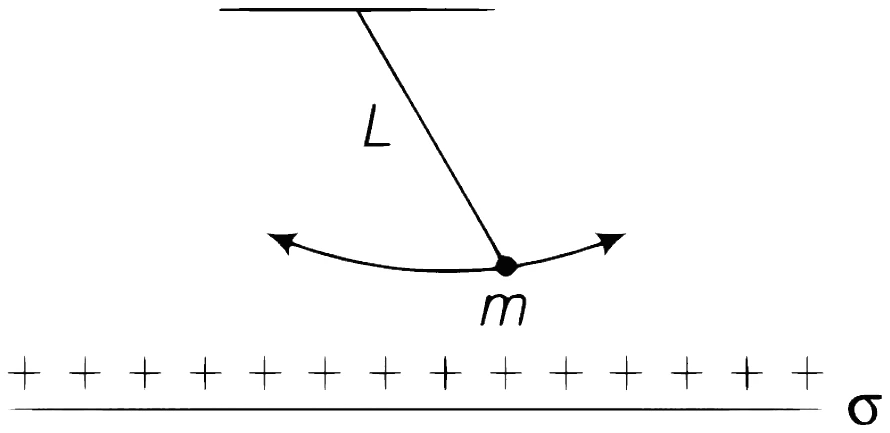
The bob of a pendulum of mass , suspended by an inextensible string of length as shown in the figure carries a small charge . An infinite horizontal plane conductor with uniform surface charge density is placed below it. What will be the time period of the pendulum for small amplitude oscillations?
Answer: (d)
Step-by-step solution coming soon.
Motion of Charges in an Electric Field
A particle with charge coulomb, tied at the end of an inextensible string of length metre, revolves in a vertical plane. At the centre of the circular trajectory, there is a fixed charge of magnitude coulomb. The mass of the moving charge is such that . If at the highest position of the particle, the tension of the string just vanishes, the horizontal velocity at the lowest point has to be
Answer: (b)
Step-by-step solution coming soon.
Motion of Charges in an Electric Field
A particle with charge and mass , moving along the -axis with a uniform speed , enters a region where a uniform electric field is acting along the -axis. The particle starts to move in a parabola. Its focal length (neglecting any effect of gravity) is
Answer: (d)
Step-by-step solution coming soon.
Motion of Charges in an Electric Field
A unit negative charge with mass resides at the mid-point of the straight line of length adjoining two fixed charges of magnitude each. If it is given a very small displacement () in a direction perpendicular to the straight line, it will
Answer: (b)
Step-by-step solution coming soon.
Motion of Charges in an Electric Field
A charged particle of mass and charge is revolving in a circle of radius . Another charged particle of charge and mass is situated at the centre of the circle. If the velocity and time period of the revolving particle be and respectively, then
More than one option can be correct. Tap every correct option, then tap Check.
Answer: (d)
Step-by-step solution coming soon.
Motion of Charges in an Electric Field
A particle of mass and electric charge starts from rest under the influence of a uniform external electric field to travel a distance in time . If the particle had mass , it would take time to travel the same distance. What is the ratio ?
Answer: (a)
Step-by-step solution coming soon.
Motion of Charges in an Electric Field
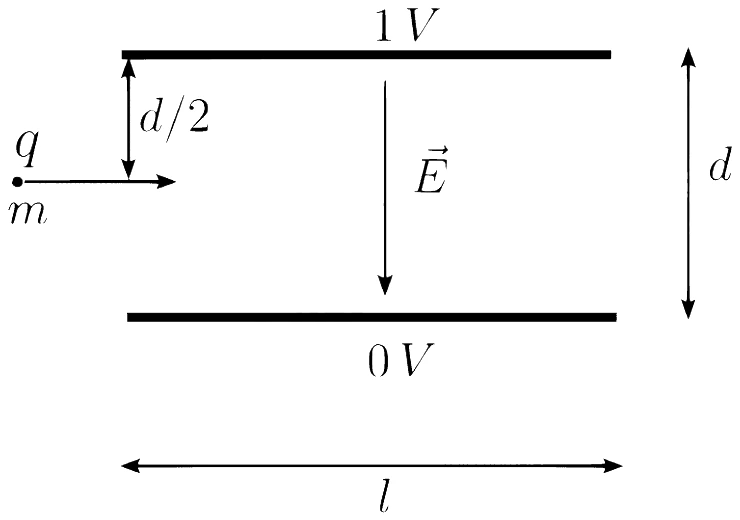
A particle of charge and mass with kinetic energy enters an electric field set up by two parallel plates of length as illustrated in the figure. The potential difference between the two plates is and their separation is . What is the minimum value of (in eV) for which the particle will not hit either of the plates? [ is the charge of the electron.]
Answer: (a)
Step-by-step solution coming soon.
Motion of Charges in an Electric Field
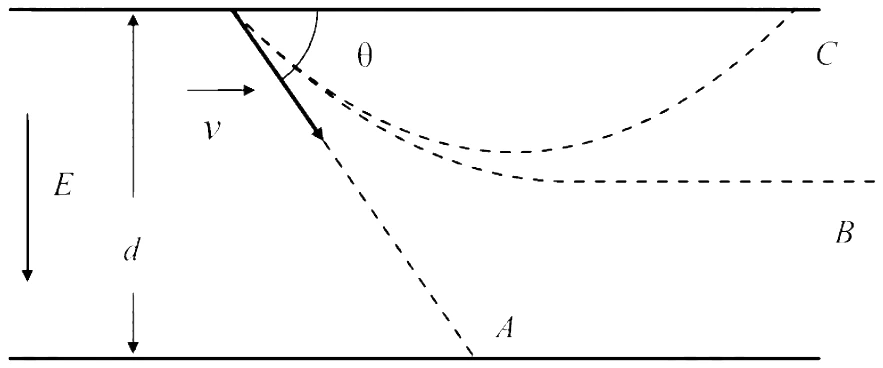
An electron of mass and charge is projected with a speed making an angle with respect to the top electrode of a parallel plate capacitor as shown in the figure. Considering only the effect of the downward constant electric field on the electron's motion, which of the following statements is correct?
Answer: (b)
Step-by-step solution coming soon.
Motion of Charges in an Electric Field
In an oil drop experiment, negatively charged droplets of equal mass are studied as they fall through vacuum. An electric field of magnitude , pointing downwards, is present. It is observed that a droplet of charge remains suspended while another with charge falls through from rest in . The is closest to,
Answer: (a)
Step-by-step solution coming soon.
Motion of Charges in an Electric Field
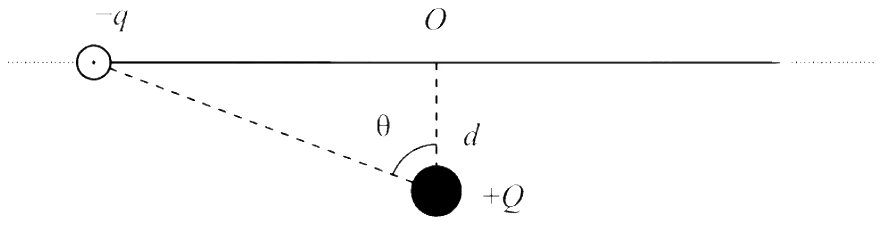
A bead of mass and charge is constrained to move along a line. A charge of is kept at distance away from the line as shown in the figure. The charged bead is released from rest at a point far away from . Select the correct option(s).
More than one option can be correct. Tap every correct option, then tap Check.
Answer: (b), (d)
Step-by-step solution coming soon.
Motion of Charges in an Electric Field
An atom is modelled by a stationary central positive point charge surrounded by a spherical electron cloud (radius , total charge of ) of uniform charge density. The electron cloud is displaced slightly from its equilibrium position and released. Assuming that the cloud maintains its shape, select the correct statement(s) from the following options.
More than one option can be correct. Tap every correct option, then tap Check.
Answer: (a), (b)
Step-by-step solution coming soon.
Motion of Charges in an Electric Field
Assertion (A): A negative charge in an electric field moves along the direction of the electric field.
Reason (R): On a negative charge a force acts in the direction of the electric field.
Answer: (d)
Step-by-step solution coming soon.
No questions match these filters.