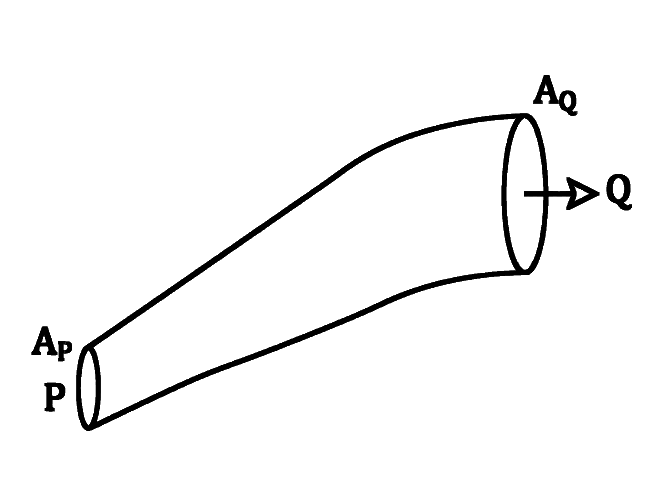
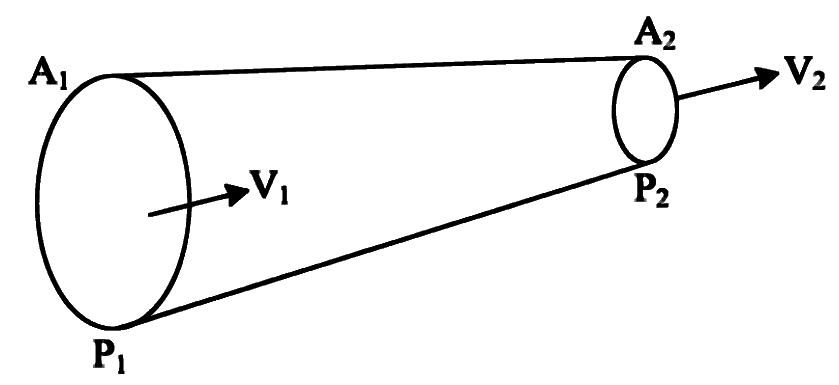
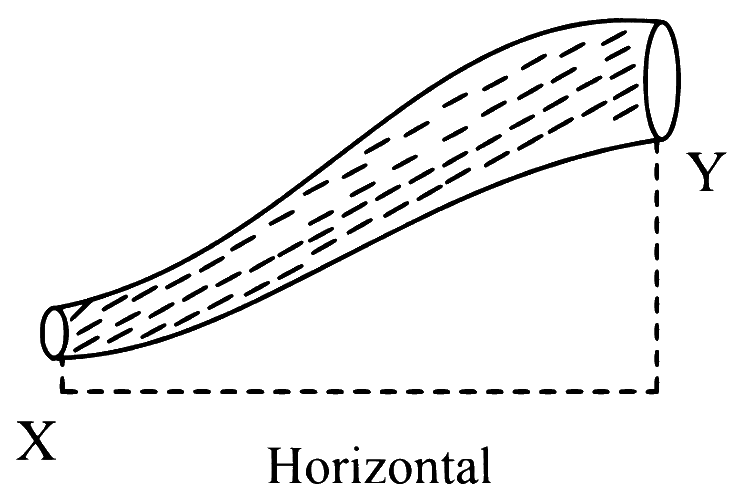
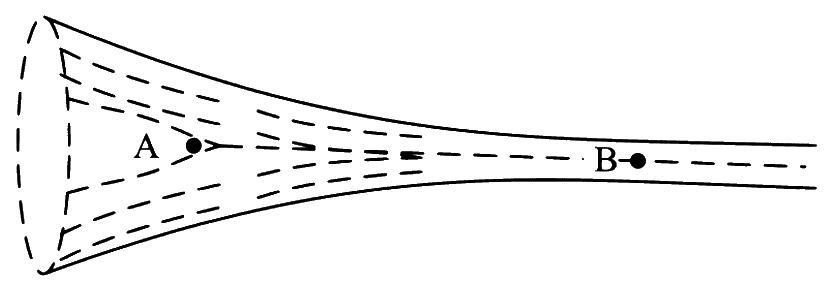
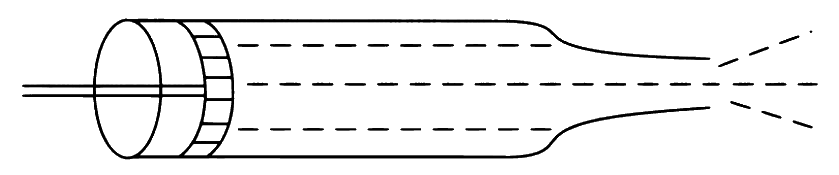
An incompressible fluid (ideal fluid) is flowing through non uniform cross-sectional tube PQ as shown in the figure from end P to end Q. If KP and KQ are the kinetic energy per unit volume of the fluid at end P and end Q respectively, then
A horizontal pipe carries water in a streamline flow. At point along the pipe, where the cross- sectional area is A1, the velocity of water is V1 and the pressure is P1. What is the pressure of water at another point where the cross-sectional area is A2?
A closed pipe containing liquid showed a pressure P1 by gauge. When the valve was opened, pressure was reduced to P2. The speed of water flowing out of the pipe is (ρ=density of water)
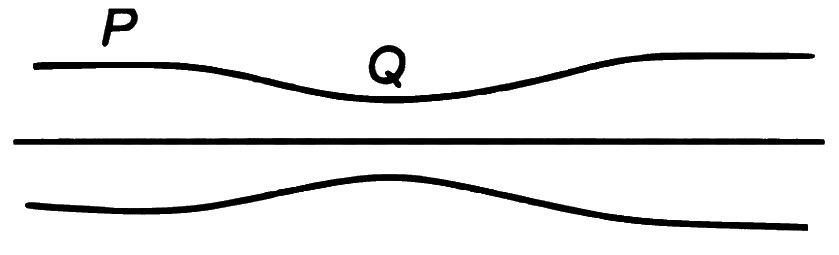
Water flows in a streamline motion through a horizontal pipe of circular cross-section as shown in the figure. The pressure difference of water between P and Q is 15 Nm−2. The area of cross-section at P and Q are 40 cm2 and 20 cm2, respectively. The rate of flow of water through the pipe, in cm3 s−1, is:
A liquid of density 600 kg/m3 flowing steadily in a tube of varying cross-section. The cross-section at a point A is 1.0 cm2 and that at B is 20 mm2. Both the points A and B are in same horizontal plane, the speed of the liquid at A is 10 cm/s. The difference in pressures at A and B points is ______ Pa.
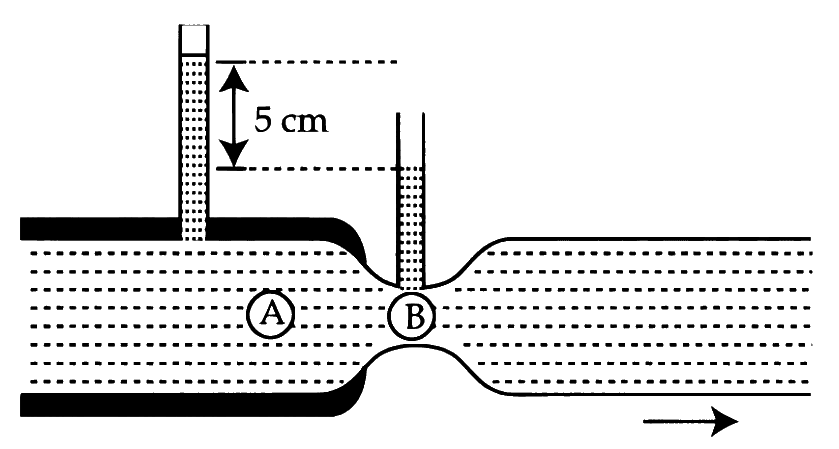
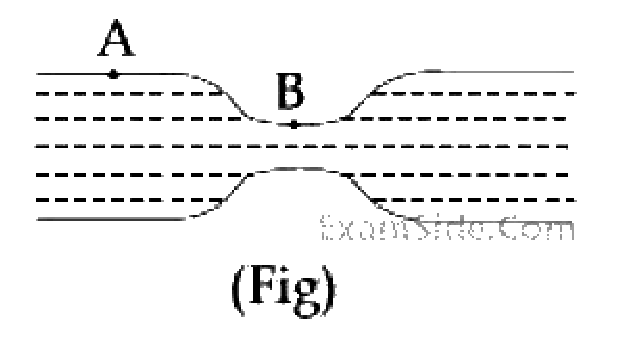
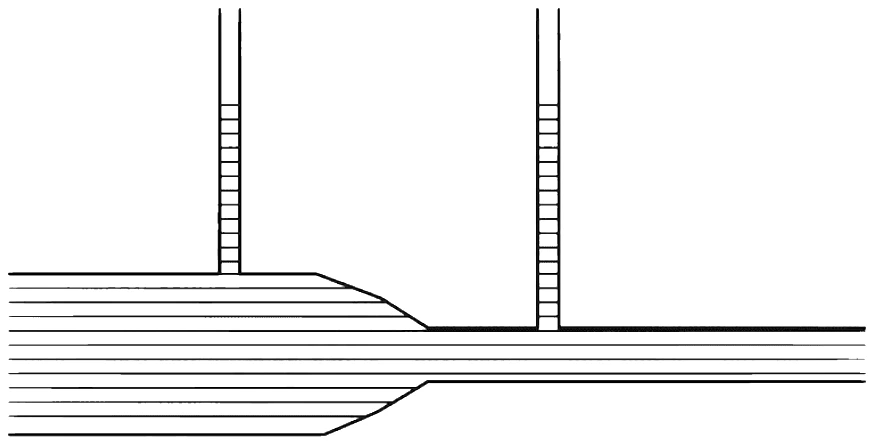
Water flows through a horizontal tube as shown in the figure. The difference in height between the water columns in vertical tubes is 5 cm and the area of cross-sections at A and B are 6 cm2 and 3 cm2 respectively. The rate of flow will be cm3/s. (take g=10 m/s2)
A horizontal pipeline carries water in a streamline flow. At a point along the pipe, where the cross- sectional area is 10 cm2, the velocity of water is 1 m/s and pressure is 2000 Pa. The pressure of water at another point where the cross-sectional area 5 cm2 is
Water flows in a horizontal pipe whose one end is closed with a valve. The reading of the pressure gauge attached to the pipe is P1. The reading of the pressure gauge falls to P2 when the valve is opened. The speed of water flowing in the pipe is proportional to
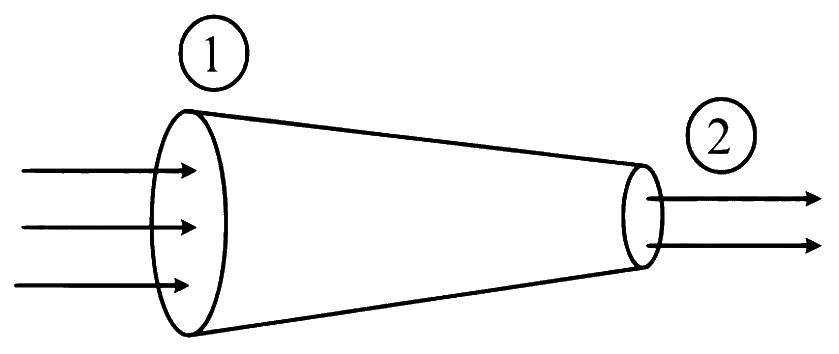
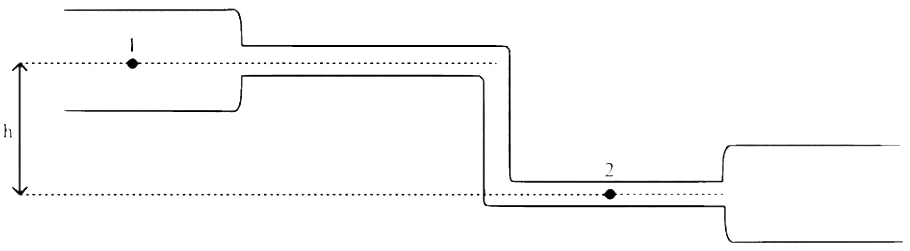
A tube of length L is shown in the figure. The radius of cross section at the point (1) is 2 cm and at the point (2) is 1 cm, respectively. If the velocity of water entering at point (1) is 2 m/s, then velocity of water leaving the point (2) will be
A closed pipe containing a liquid showed a pressure P1 by gauge. When the valve was opened, pressure was reduced to P2. The speed of water flowing out of the pipe is (ρ= density of water)
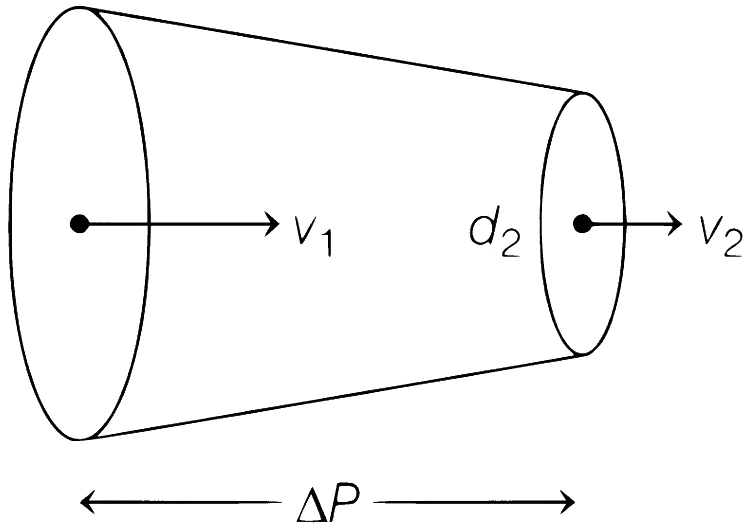
Water is flowing in a conical tube as shown in figure. Velocity of water at area ' A2 ' is 60 cm/s. The value of ' A1 ' and ' A2 ' is 10 cm2 and 5 cm2 respectively. The pressure difference at both the cross- section is
A streamline flow of a liquid of density ' ρ ' is passing through a horizontal pipe of crosssectional area A1 and A2 at two ends. If the pressure of liquid is ' P ' at a point where flow speed is ' v ', then pressure at another point where the flow of speed becomes 3 v is
An ideal fluid is flowing in a non-uniform cross-sectional tube XY (as shown in the figure) from end X to end Y. If K1 and K2 are the kinetic energy per unit volume of the fluid at X and Y respectively, then the correct option is:
Glycerine of density 1.25×10³ kg/m3 is flowing in conical shaped horizontal pipe. Crosssectional area of the pipe at its both ends is 10 cm2 and 5 cm2 respectively. Pressure difference at both the ends is 3 N/m2. Rate of flow of liquid in the pipe is
The figure shows a liquid of given density flowing steadily in horizontal tube of varying cross - section. Cross sectional areas at A is 1.5 cm2, and B is 25 mm2, if the speed of liquid at B is 60 cm/s then (PA−PB) is:
(Given PA and PB are liquid pressures at A and B points.
Glycerin of density 1.25×10³ kg m−3 is flowing through the conical section of pipe. The area of cross-section of the pipe at its ends are 10 cm2 and 5 cm2 and pressure drop across its length is 3 Nm−2. The rate of flow of glycerin through the pipe is x×10−5 m3 s−1. The value of x is ___________.
Numerical answer type. Work it out, then open the answer.
Figure below shows a liquid being pushed out of the tube by a piston having area of cross section 2.0 cm2. The area of cross section at the outlet is 10 mm2. If the piston is pushed at a speed of 4 cm s−1, the speed of outgoing fluid is __________ cms−1
Numerical answer type. Work it out, then open the answer.
A liquid of density 750 kgm−3 flows smoothly through a horizontal pipe that tapers in cross- sectional area from A1 = 1.2 × 10⁻² m2 to A2 = 2A1. The pressure difference between the wide and narrow sections of the pipe is 4500 Pa. The rate of flow of liquid is ___________ × 10−3 m3s−1.
Numerical answer type. Work it out, then open the answer.
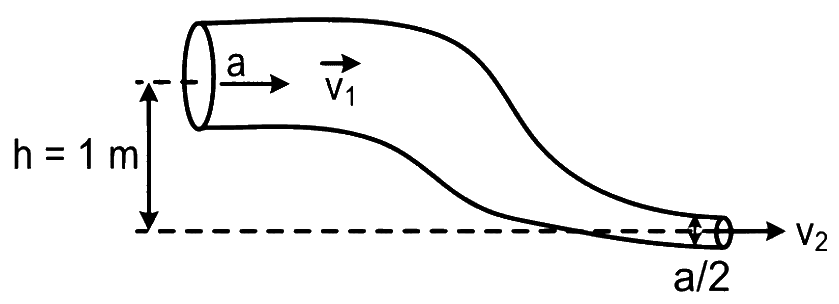
An ideal fluid of density 800 kgm−3, flows smoothly through a bent pipe (as shown in figure) that tapers in cross-sectional area from a to 2a. The pressure difference between the wide and narrow sections of pipe is 4100 Pa. At wider section, the velocity of fluid is 6x ms−1 for x = ___________. (Given g = 10 ms−2)
Numerical answer type. Work it out, then open the answer.
A tube of length 50 cm is filled completely with an incompressible liquid of mass 250 g and closed at both ends. The tube is then rotated in horizontal plane about one of its ends with a uniform angular velocity xF rad s−1. If F be the force exerted by the liquid at the other end then the value of x will be __________.
Numerical answer type. Work it out, then open the answer.
A fluid is flowing through a horizontal pipe of varying cross-section, with
speed v ms–1 at a point where the pressure is P pascal. At another point where pressure is 2P Pascal its speed is V ms–1. If the density of the fluid is ρ kg m–3 and the flow is streamline, then V is equal to:
A train with cross-sectional area St is moving with speed vt inside a long tunnel of cross-sectional area S0 (S0=4St). Assume that almost all the air (density ρ) in front of the train flows back between its sides and the walls of the tunnel. Also, the air flow with respect to the train is steady and laminar. Take the ambient pressure and that inside the train to be p0. If the pressure in the region between the sides of the train and the tunnel walls is p, then p0−p=2N7ρvt2. The value of N is ______.
Numerical answer type. Work it out, then open the answer.
Water flows steadily through a horizontal pipe of non-uniform cross-section. If the pressure of water is p at a point where the velocity of flow is v and area is A, the pressure at another point where the area becomes 2A is (Given, density of water is ρ)
Water from a tap of cross-sectional area 1cm2 falls vertically downwards at 2m/s. The cross-sectional area of the stream, 20cm below the tap is (assume that pressure is constant throughout and the flow is streamlined; g=10m s−2)
A horizontal pipe carries water in a streamlined flow. At a point along the pipe, where the cross-sectional area is 10cm2, the velocity of water is 1m s−1 and the pressure is 2000Pa. What is the pressure of water at another point where the cross-sectional area is 5cm2? [Density of water =1000kg m−3]
Water is flowing in streamline manner in a horizontal pipe. If the pressure at a point where cross-sectional area is 10cm2 and velocity 1m s−1 is 2000Pa, then the pressure of water at another point where the cross-sectional area 5cm2 is
A steady flow of a liquid of density ρ is shown in figure. At point 1, the area of cross-section is 2A and the speed of flow of liquid is 2m s−1. At point 2, the area of cross-section is A. Between the points 1 and 2, the pressure difference is 100N m−2 and the height difference is 10cm. The value of ρ is (Acceleration due to gravity =10m s−2)
Water is flowing through a horizontal pipe AB of non-uniform cross section. Water is entering the pipe at the end A having cross-sectional area of 4cm2 at a pressure of 105N m−2 with a velocity of 20m s−1 and water is leaving the pipe at the end B having cross-sectional area 8cm2. The pressure at the end B of the pipe is
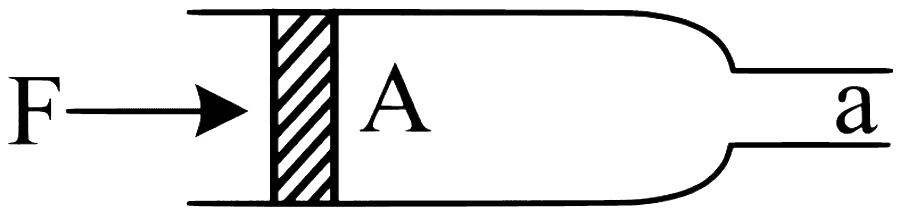
As shown in the figure, a pump is designed as horizontal cylinder with a piston having area A and an outlet orifice having an area a. The piston moves with a constant velocity under the action of force F. If the density of the liquid is ρ, then the speed of the liquid emerging from the orifice is, (assume A≫a)
In the tube shown below, the wider part has cross-sectional area A, and the narrower part has cross-sectional area A/3. When water inside the tube is at rest, the vertical manometers show the same height of water, as shown.
When water is made to flow steadily through the tube, the difference in heights of water in the two manometers is 40cm. Neglecting viscosity effects, the speed of water flow in the narrower part of the tube is (taking g=10m s−2)