In a hydraulic press, the piston in the small cylinder has a diameter of d1 cm, while the larger piston has a diameter of d2 cm. If a force F1 is applied to the small piston, then the force F2 on the large piston is given by
In a hydraulic press, the small cylinder has a diameter of d1 cm, while the large cylinder has a diameter of d2 cm. If a force F1 is applied to a piston of small cylinder, then the force on the piston of large cylinder F2 is
A piston of cross-sectional area 2.5×10⁻² m2 is used in a hydraulic lift to exert a force of 250 N on water. The cross-sectional area of the other piston which supports a car of mass 3000 kg is (g=9.8 m/s2)
A sample of a liquid is kept at 1 atm. It is compressed to 5 atm which leads to a change of volume of 0.8 cm3. If the bulk modulus of the liquid is 2 GPa, the initial volume of the liquid was _______ litre. (Take 1 atm = 105 Pa)
Numerical answer type. Work it out, then open the answer.
The increase in pressure required to decrease the volume of a water sample by 0.2% is P×105 N m−2. Bulk modulus of water is 2.15×10⁹ N m−2. The value of P is _________.
Numerical answer type. Work it out, then open the answer.
In a hydraulic lift, the surface area of the input piston is 6 cm2 and that of the output piston is 1500 cm2. If 100 N force is applied to the input piston to raise the output piston by 20 cm, then the work done is _______ kJ.
Numerical answer type. Work it out, then open the answer.
The fractional compression (VΔV) of water at the depth of 2.5 km below the sea level is __________ %. Given, the Bulk modulus of water = 2×10⁹ N m−2, density of water = 103 kg m−3, acceleration due to gravity g=10 m s−2.
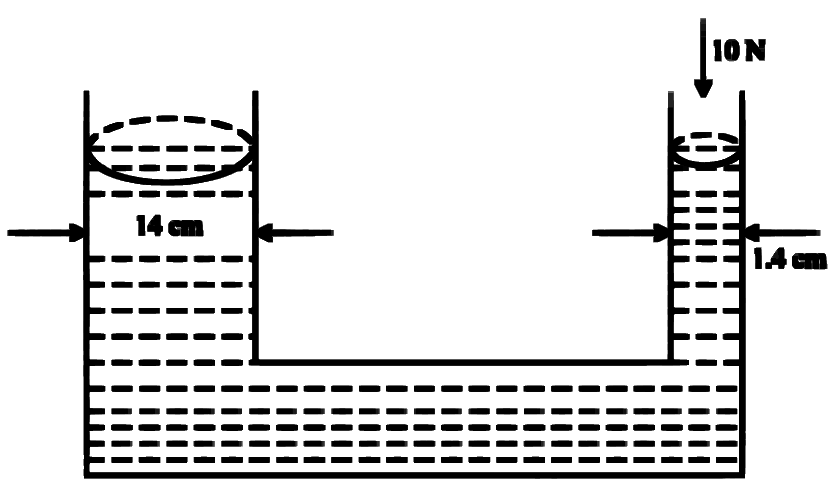
A hydraulic press containing water has two arms with diameters as mentioned in the figure. A force of 10 N is applied on the surface of water in the thinner arm. The force required to be applied on the surface of water in the thicker arm to maintain equilibrium of water is _________ N.
Numerical answer type. Work it out, then open the answer.
If average depth of an ocean is 4000 m and the bulk modulus of water is 2×10⁹ N m−2, then fractional compression VΔV of water at the bottom of ocean is α×10−2. The value of α is _______ (Given, g=10 m s−2,ρ=1000 kg m−3)
Numerical answer type. Work it out, then open the answer.
A certain pressure 'P' is applied to 1 litre of water and 2 litre of a liquid separately. Water gets compressed to 0.01% whereas the liquid gets compressed to 0.03%. The ratio of Bulk modulus of water to that of the liquid is x3. The value of x is ____________.
Numerical answer type. Work it out, then open the answer.
A hydraulic automobile lift is designed to lift vehicles of mass 5000 kg. The area of cross section of the cylinder carrying the load is 250 cm2. The maximum pressure the smaller piston would have to bear is [ Assume g=10 m/s2]
Given below are two statements: one is labelled as Assertion A and the other is labelled as Reason R
Assertion A: When you squeeze one end of a tube to get toothpaste out from the other end, Pascal's principle is observed.
Reason R: A change in the pressure applied to an enclosed incompressible fluid is transmitted undiminished to every portion of the fluid and to the walls of its container.
In the light of the above statements, choose the most appropriate answer from the options given below
A hydraulic press can lift 100 kg when a mass 'm' is placed on the smaller piston. It can lift ___________ kg when the diameter of the larger piston is increased by 4 times and that of the smaller piston is decreased by 4 times keeping the same mass 'm' on the smaller piston.
Numerical answer type. Work it out, then open the answer.
An object is located at 2 km beneath the surface of the water. If the fractional compression VΔV is 1.36%, the ratio of hydraulic stress to the corresponding hydraulic strain will be ____________. [Given: density of water is 1000 kgm−3 and g = 9.8 ms−2]
The normal density of a material is ρ and its bulk modulus of elasticity is K. The magnitude of increase in density of material, when a pressure P is applied uniformly on all sides, will be:
When a rubber ball is taken to a depth of __________m in deep sea, its volume decreases by 0.5%. (The bulk modulus of rubber = 9.8 × 10⁸ Nm−2, Density of sea water = 103 kgm−3, g = 9.8 m/s2)
Numerical answer type. Work it out, then open the answer.
A solid sphere of radius r made of a soft material of bulk modulus K is surrounded by a liquid in a cylindrical container. A massless piston of area a floats on the surface of the liquid, covering entire cross section of cylindrical container. When a mass m is placed on the surface of the piston to compress the liquid, the fractional decrement in the radius of the sphere, (rdr) is:
The approximate depth of an ocean is 2700 m. The compressiblity of water is 45.4 × 10⁻¹¹ Pa−1 and density of water is 103 kg/m3. What fractional compression of water will be obtained at the bottom of the ocean?
The Bulk moduli of Ethanol, Mercury and water are given as 0.9, 25 and 2.2 respectively in units of 109 Nm−2. For a given value of pressure, the fractional compression in volume is VΔV. Which of the following statements about VΔV for these three liquids is correct?
A ball is made of a material of density ρ where ρoil<ρ<ρwater with ρoil and ρwater representing the densities of oil and water, respectively. The oil and water are immiscible. If the above ball is in equilibrium in a mixture of this oil and water, which of the following pictures represents its equilibrium position?
A spherical shell of outer radius R and inner radius R/2 contains a solid sphere of radius R/2 (see figure). The density of the material of the solid sphere is ρ and that of the shell is ρ/2. What is the average mass density of the larger sphere thus formed?
An object is made of two equal parts by volume; one part has density ρ0, and the other part has density 2ρ0. What is the average density of the object?
Two substances of densities ρ1 and ρ2 are mixed in equal volume and their relative density is 4. When they are mixed in equal masses, relative density is 3. The values of ρ1 and ρ2 respectively are
A container is first filled with water and then the entire water is replaced by mercury. Mercury has a density of 13.6×10³kg m−3. If X is the weight of the water and Y is the weight of the mercury, then
Specific gravity of silver is 11 and specific gravity of iron is 8. Which one among the following is the approximate relative density of silver with respect to iron?
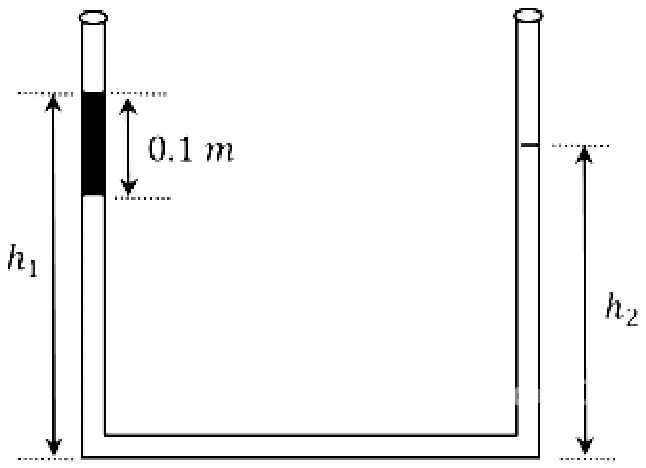
An open-ended U-tube of uniform cross-sectional area contains water (density 103kg m−3). Initially the water level stands at 0.29m from the bottom in each arm. Kerosene oil (a water-immiscible liquid) of density 800kg m−3 is added to the left arm until its length is 0.1m, as shown in the schematic figure below. The ratio (h2h1) of the heights of the liquid in the two arms is:
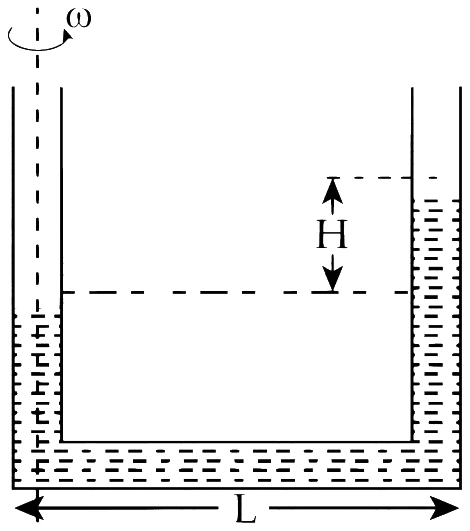
A U-tube is rotated about one of its limbs with an angular velocity ω. Find the difference in height H of the liquid (density ρ) level, where the diameter of the tube is d≪L.
The neck and bottom of a bottle are 3cm and 15cm in radius respectively. If the cork is pressed with a force 12N in the neck of the bottle, then force exerted on the bottom of the bottle is
A car of mass 500kg is lifted by a hydraulic jack that consist of two pistons. If the diameter of large and small pistons are 2m and 20cm, respectively. Then force required (in N) to lift the car by smaller piston is (take, g=10m s−2)
In a car lift, compressed air exerts a force F1 on a small piston having a radius of 5.0cm. This pressure is transmitted to a second piston of radius 15.0cm. If the mass of the car to be lifted is 1350kg, the force on the small piston is
In a hydraulic lift, if the radius of the smaller piston is 5cm and the radius of the larger piston is 50cm, then the weight that the larger piston can support when a force of 250N is applied to the smaller piston is
In a hydraulic lift, compressed air exerts a force F on a small piston of radius 3cm. Due to this pressure the second piston of radius 5cm lifts a load of 1875kg. The value of F is (Acceleration due to gravity =10m s−2)
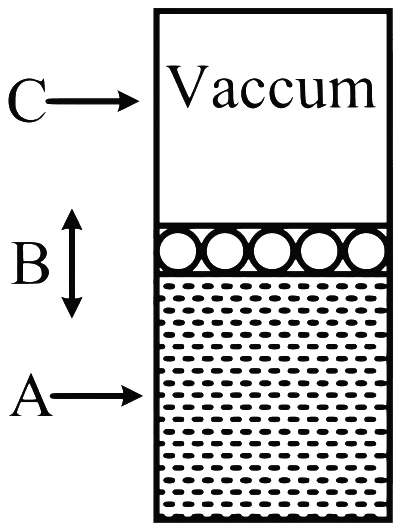
In the figure, the chamber A contains a gas, movable chamber B is placed on the top of the gas and it contains n metal balls. The weight of chamber B is supported by the gas. Chamber C has vacuum. Let the gas be in equilibrium at pressure p. Let p′ be the pressure, if one of the balls is taken away. Find (p−p′)/p.
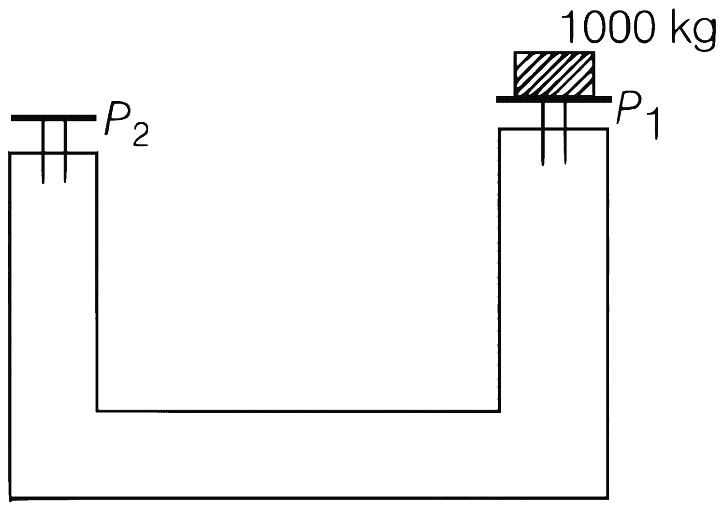
A hydraulic lift as shown in the figure is used to lift a mass of 1000kg, which is placed on a piston (P1) of area 1m2. If the cross-section area of the piston (P2) at the other end is 0.01m2, then how much mass needs to be put on it to lift the 1000kg ?
Ice on land mass melting into ocean, due to global warming, is estimated to be around 1.3×10¹⁵kg per year. The density of sea water is 1025kg m−3. Assuming that the melting rate of ice remains constant and the effective surface area covered by the oceans is 3.6×10¹⁴m2, the estimated average rise in sea level (in m) in the next 75 years will be closest to