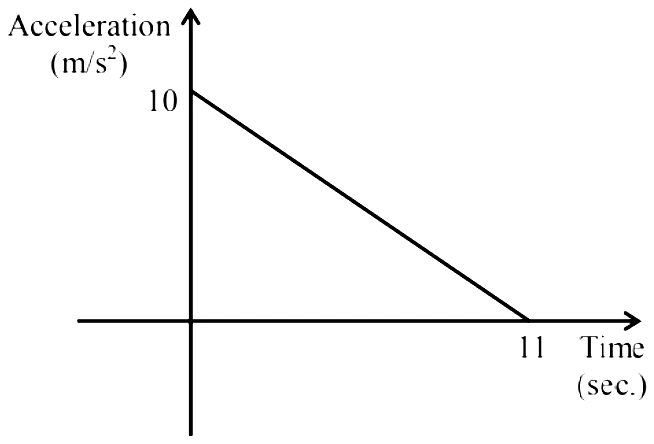
Q1 JEE Main 2026 · 28 JAN · SHIFT 2 Medium ☆
Velocity, Acceleration & Variable Motion
A particle starts moving from time t = 0 t = 0 t = 0 x ( t ) = 4 t 3 − 3 t x(t) = 4t^3 - 3t x ( t ) = 4 t 3 − 3 t
B. The particle is 1 unit away from origin at its turning point
C. Acceleration of the particle is non-negative
D. The particle is 0.5 units away from origin at its turning point
E. Particle never turns back as acceleration is non-negative
Choose the correct answer from the options given below:
(a) A, C, D Only (b) A, B, C Only (c) C, E Only (d) A, C Only Show answer and solution
Answer: (b)
Loading the solution…
Report a mistake Open question page Q2 MHT CET 2025 · 22 APR · SHIFT 2 Medium ☆
Velocity, Acceleration & Variable Motion
At any time ' t t t x = a t 2 x = at^2 x = a t 2 y = b t 2 y = bt^2 y = b t 2
(a) 2 t a 2 + b 2 2t\sqrt{a^2 + b^2} 2 t a 2 + b 2 (b) 2 t a 2 − b 2 2t\sqrt{a^2 - b^2} 2 t a 2 − b 2 (c) 2 t ( a + b ) 2t(a + b) 2 t ( a + b ) (d) 2 t a 2 + b 2 \frac{2t}{\sqrt{a^2 + b^2}} a 2 + b 2 2 t Show answer and solution
Answer: (a)
Loading the solution…
Report a mistake Open question page Q3 JEE Main 2025 · 3 APR · SHIFT 2 Medium ☆
Velocity, Acceleration & Variable Motion
A particle moves along the x x x x x x
x = c 0 ( t 2 − 2 ) + c ( t − 2 ) 2 x = c_0\left(t^2 - 2\right) + c(t - 2)^2 x = c 0 ( t 2 − 2 ) + c ( t − 2 ) 2
where c 0 c_0 c 0
Then, which of the following statements is correct?
(a) the acceleration of the particle is 2 ( c + c 0 ) 2(c + c_0) 2 ( c + c 0 ) (b) the acceleration of the particle is 2 c 0 2c_0 2 c 0 (c) the acceleration of the particle is 2 c (d) the initial velocity of the particle is 4 c 4c 4 c Show answer and solution
Answer: (a)
Loading the solution…
Report a mistake Open question page Q4 NEET 2025 Medium ☆
Velocity, Acceleration & Variable Motion
In some appropriate units, time ( t ) (t) ( t ) ( x ) (x) ( x ) t = x 2 + x t = x^2 + x t = x 2 + x
(a) + 2 ( x + 1 ) 3 +\frac{2}{(x + 1)^3} + ( x + 1 ) 3 2 (b) + 2 2 x + 1 +\frac{2}{2x + 1} + 2 x + 1 2 (c) − 2 ( x + 2 ) 3 -\frac{2}{(x + 2)^3} − ( x + 2 ) 3 2 (d) − 2 ( 2 x + 1 ) 3 -\frac{2}{(2x + 1)^3} − ( 2 x + 1 ) 3 2 Show answer and solution
Answer: (d)
Loading the solution…
Report a mistake Open question page Q5 JEE Main 2025 · 29 JAN · SHIFT 2 Difficult ☆
Velocity, Acceleration & Variable Motion
Two cars P and Q are moving on a road in the same direction. Acceleration of car P increases linearly with time whereas car Q moves with a constant acceleration. Both cars cross each other at time t = 0, for the first time. The maximum possible number of crossing(s) (including the crossing at t = 0) is ________.
Numerical answer type. Work it out, then open the answer.
Show answer and solution
Answer: 3
Loading the solution…
Report a mistake Open question page Q6 MHT CET 2024 · 11 MAY · SHIFT 2 Easy ☆
Velocity, Acceleration & Variable Motion
Two cars start from a point at the same time in a straight line and their positions are represented by x 1 ( t ) = a t + b t 2 x_1(t) = at + bt^2 x 1 ( t ) = a t + b t 2 x 2 ( t ) = F t − t 2 x_2(t) = Ft - t^2 x 2 ( t ) = Ft − t 2
(a) a + F 2 ( b − 1 ) \frac{a + F}{2(b - 1)} 2 ( b − 1 ) a + F (b) a − F 1 + b \frac{a - F}{1 + b} 1 + b a − F (c) a + F 2 ( 1 + b ) \frac{a + F}{2(1 + b)} 2 ( 1 + b ) a + F (d) F − a 2 ( 1 + b ) \frac{F - a}{2(1 + b)} 2 ( 1 + b ) F − a Show answer and solution
Answer: (d)
Loading the solution…
Report a mistake Open question page Q7 NEET 2024 Easy ☆
Velocity, Acceleration & Variable Motion
A particle is moving along x x x ( t ) (t) ( t ) x = α t 4 + β t 2 + γ t + δ x = \alpha t^4 + \beta t^2 + \gamma t + \delta x = α t 4 + β t 2 + γ t + δ
(a) 2 α : δ 2\alpha : \delta 2 α : δ (b) γ : 2 δ \gamma : 2\delta γ : 2 δ (c) 4 α : β 4\alpha : \beta 4 α : β (d) γ : 2 β \gamma : 2\beta γ : 2 β Show answer and solution
Answer: (d)
Loading the solution…
Report a mistake Open question page Q8 JEE Main 2024 · 29 JAN · SHIFT 2 Easy ☆
Velocity, Acceleration & Variable Motion
A particle is moving in a straight line. The variation of position 'x x x t t t x = ( t 3 − 6 t 2 + 20 t + 15 ) m x = \left(t^3 - 6t^2 + 20t + 15\right)\text{ m} x = ( t 3 − 6 t 2 + 20 t + 15 ) m
(a) 6 m/s (b) 10 m/s (c) 8 m/s (d) 4 m/s Show answer and solution
Answer: (c)
Loading the solution…
Report a mistake Open question page Q9 JEE Main 2024 · 1 FEB · SHIFT 1 Easy ☆
Velocity, Acceleration & Variable Motion
A particle is moving in one dimension (along x x x 16 m 16\text{ m} 16 m ( x ) (x) ( x ) ( t ) (t) ( t ) x = − 3 t 3 + 18 t 2 + 16 t x = -3t^3 + 18t^2 + 16t x = − 3 t 3 + 18 t 2 + 16 t x x x m \text{m} m t t t s \text{s} s
The velocity of the particle when its acceleration becomes zero is _________ m/s \text{m/s} m/s
Numerical answer type. Work it out, then open the answer.
Show answer and solution
Answer: 52
Loading the solution…
Report a mistake Open question page Q10 MHT CET 2024 · 16 MAY · SHIFT 1 Medium ☆
Velocity, Acceleration & Variable Motion
The co-ordinates of a moving particle at any time ' t t t x = α t 3 x = \alpha t^3 x = α t 3 y = β t 3 y = \beta t^3 y = β t 3 α \alpha α β \beta β t t t
(a) t α 2 + β 2 t\sqrt{\alpha^2 + \beta^2} t α 2 + β 2 (b) 3 t α 2 + β 2 3t\sqrt{\alpha^2 + \beta^2} 3 t α 2 + β 2 (c) t 2 α 2 + β 2 t^2\sqrt{\alpha^2 + \beta^2} t 2 α 2 + β 2 (d) 3 t 2 α 2 + β 2 3t^2\sqrt{\alpha^2 + \beta^2} 3 t 2 α 2 + β 2 Show answer and solution
Answer: (d)
Loading the solution…
Report a mistake Open question page Q11 JEE Main 2024 · 31 JAN · SHIFT 1 Medium ☆
Velocity, Acceleration & Variable Motion
The relation between time 't t t x x x t = α x 2 + β x t = \alpha x^2 + \beta x t = α x 2 + β x α \alpha α β \beta β ( a ) (a) ( a ) ( v ) (v) ( v )
(a) a = − 5 α v 5 a = -5\alpha v^5 a = − 5 α v 5 (b) a = − 3 α v 2 a = -3\alpha v^2 a = − 3 α v 2 (c) a = − 2 α v 3 a = -2\alpha v^3 a = − 2 α v 3 (d) a = − 4 α v 4 a = -4\alpha v^4 a = − 4 α v 4 Show answer and solution
Answer: (c)
Loading the solution…
Report a mistake Open question page Q12 JEE Main 2024 · 6 APR · SHIFT 2 Medium ☆
Velocity, Acceleration & Variable Motion
A particle moves in a straight line so that its displacement x x x t t t x 2 = 1 + t 2 x^2 = 1 + t^2 x 2 = 1 + t 2 t t t x − n x^{-n} x − n n = n = n =
Numerical answer type. Work it out, then open the answer.
Show answer and solution
Answer: 3
Loading the solution…
Report a mistake Open question page Q13 JEE Main 2024 · 1 FEB · SHIFT 2 Medium ☆
Velocity, Acceleration & Variable Motion
A particle initially at rest starts moving from reference point x = 0 x = 0 x = 0 x x x v v v v = 4 x m/s v = 4\sqrt{x}\text{ m/s} v = 4 x m/s ms − 2 \text{ms}^{-2} ms − 2
Numerical answer type. Work it out, then open the answer.
Show answer and solution
Answer: 8
Loading the solution…
Report a mistake Open question page Q14 MHT CET 2023 · 13 MAY · SHIFT 1 Easy ☆
Velocity, Acceleration & Variable Motion
Which one of the following statements is Wrong?
(a) A body can have zero velocity and still be accelerated. (b) A body can have a constant velocity and still have a varying speed. (c) A body can have a constant speed and still have a varying velocity. (d) The direction of the velocity of a body can change when its acceleration is constant. Show answer and solution
Answer: (b)
Loading the solution…
Report a mistake Open question page Q15 MHT CET 2023 · 14 MAY · SHIFT 2 Easy ☆
Velocity, Acceleration & Variable Motion
The position 'x x x x = a t 2 − b t 3 x = at^2 - bt^3 x = a t 2 − b t 3 a a a b b b
(a) 2 a 3 b \frac{2a}{3b} 3 b 2 a (b) a b \frac{a}{b} b a (c) a 3 b \frac{a}{3b} 3 b a (d) zero Show answer and solution
Answer: (c)
Loading the solution…
Report a mistake Open question page Q16 MHT CET 2023 · 11 MAY · SHIFT 2 Easy ☆
Velocity, Acceleration & Variable Motion
Two cars A and B start from a point at the same time in a straight line and their positions are represented by R A ( t ) = R_A(t) = R A ( t ) = + b t 2 +bt^2 + b t 2 R B ( t ) = x t − t 2 R_B(t) = xt - t^2 R B ( t ) = x t − t 2
(a) x − a 2 ( b + 1 ) \frac{x - a}{2(b + 1)} 2 ( b + 1 ) x − a (b) x + a 2 ( b − 1 ) \frac{x + a}{2(b - 1)} 2 ( b − 1 ) x + a (c) x − a ( b + 1 ) \frac{x - a}{(b + 1)} ( b + 1 ) x − a (d) x + a ( b − 1 ) \frac{x + a}{(b - 1)} ( b − 1 ) x + a Show answer and solution
Answer: (a)
Loading the solution…
Report a mistake Open question page Q17 NEET 2023 Easy ☆
Velocity, Acceleration & Variable Motion
The position of a particle is given by
r ⃗ ( t ) = 4 t i ^ + 2 t 2 j ^ + 5 k ^ \vec{r}(t) = 4t\hat{i} + 2t^2\hat{j} + 5\hat{k} r ( t ) = 4 t i ^ + 2 t 2 j ^ + 5 k ^
where t t t r r r v ( t ) v(t) v ( t ) t = 1 s t = 1\text{ s} t = 1 s x x x
(a) 4 2 ms − 1 , 4 5 ∘ 4\sqrt{2}\text{ ms}^{-1}, 45^\circ 4 2 ms − 1 , 4 5 ∘ (b) 4 2 ms − 1 , 6 0 ∘ 4\sqrt{2}\text{ ms}^{-1}, 60^\circ 4 2 ms − 1 , 6 0 ∘ (c) 3 2 ms − 1 , 3 0 ∘ 3\sqrt{2}\text{ ms}^{-1}, 30^\circ 3 2 ms − 1 , 3 0 ∘ (d) 3 2 ms − 1 , 4 5 ∘ 3\sqrt{2}\text{ ms}^{-1}, 45^\circ 3 2 ms − 1 , 4 5 ∘ Show answer and solution
Answer: (a)
Loading the solution…
Report a mistake Open question page Q18 JEE Main 2023 · 15 APR · SHIFT 1 Easy ☆
Velocity, Acceleration & Variable Motion
The position of a particle related to time is given by x = ( 5 t 2 − 4 t + 5 ) m x = \left(5t^2 - 4t + 5\right)\text{ m} x = ( 5 t 2 − 4 t + 5 ) m t = 2 s t = 2\text{ s} t = 2 s
(a) 14 ms − 1 14\text{ ms}^{-1} 14 ms − 1 (b) 16 ms − 1 16\text{ ms}^{-1} 16 ms − 1 (c) 10 ms − 1 10\text{ ms}^{-1} 10 ms − 1 (d) 06 ms − 1 06\text{ ms}^{-1} 06 ms − 1 Show answer and solution
Answer: (b)
Loading the solution…
Report a mistake Open question page Q19 JEE Main 2023 · 13 APR · SHIFT 2 Easy ☆
Velocity, Acceleration & Variable Motion
The distance travelled by an object in time t t t s = ( 2.5 ) t 2 s = (2.5)t^2 s = ( 2.5 ) t 2 t = 5 s t = 5\text{ s} t = 5 s
(a) 5 ms − 1 5\text{ ms}^{-1} 5 ms − 1 (b) 12.5 ms − 1 12.5\text{ ms}^{-1} 12.5 ms − 1 (c) 62.5 ms − 1 62.5\text{ ms}^{-1} 62.5 ms − 1 (d) 25 ms − 1 25\text{ ms}^{-1} 25 ms − 1 Show answer and solution
Answer: (d)
Loading the solution…
Report a mistake Open question page Q20 JEE Main 2023 · 25 JAN · SHIFT 2 Easy ☆
Velocity, Acceleration & Variable Motion
The distance travelled by a particle is related to time t as x = 4 t 2 x = 4t^2 x = 4 t 2
(a) 25 ms − 1 25\text{ ms}^{-1} 25 ms − 1 (b) 20 ms − 1 20\text{ ms}^{-1} 20 ms − 1 (c) 8 ms − 1 8\text{ ms}^{-1} 8 ms − 1 (d) 40 ms − 1 40\text{ ms}^{-1} 40 ms − 1 Show answer and solution
Answer: (d)
Loading the solution…
Report a mistake Open question page Q21 JEE Main 2022 · 25 JUN · SHIFT 2 Easy ☆
Velocity, Acceleration & Variable Motion
Two buses P and Q start from a point at the same time and move in a straight line and their positions are represented by X P ( t ) = α t + β t 2 X_P(t) = \alpha t + \beta t^2 X P ( t ) = α t + β t 2 X Q ( t ) = f t − t 2 X_Q(t) = ft - t^2 X Q ( t ) = f t − t 2
(a) α − f 1 + β \frac{\alpha - f}{1 + \beta} 1 + β α − f (b) α + f 2 ( β − 1 ) \frac{\alpha + f}{2(\beta - 1)} 2 ( β − 1 ) α + f (c) α + f 2 ( 1 + β ) \frac{\alpha + f}{2(1 + \beta)} 2 ( 1 + β ) α + f (d) f − α 2 ( 1 + β ) \frac{f - \alpha}{2(1 + \beta)} 2 ( 1 + β ) f − α Show answer and solution
Answer: (d)
Loading the solution…
Report a mistake Open question page Q22 JEE Main 2022 · 25 JUL · SHIFT 2 Easy ☆
Velocity, Acceleration & Variable Motion
A particle is moving in a straight line such that its velocity is increasing at 5 ms− 1 {}^{-1} − 1 − 2 {}^{-2} − 2 − 1 {}^{-1} − 1
Numerical answer type. Work it out, then open the answer.
Show answer and solution
Answer: 100
Loading the solution…
Report a mistake Open question page Q23 JEE Main 2022 · 29 JUL · SHIFT 1 Medium ☆
Velocity, Acceleration & Variable Motion
If t = x + 4 t = \sqrt{x} + 4 t = x + 4 ( d x d t ) t = 4 \left(\frac{dx}{dt}\right)_{t=4} ( d t d x ) t = 4
Show answer and solution
Answer: (b)
Loading the solution…
Report a mistake Open question page Q24 JEE Main 2021 · 25 JUL · SHIFT 2 Easy ☆
Velocity, Acceleration & Variable Motion
The instantaneous velocity of a particle moving in a straight line is given as V = α t + β t 2 V = \alpha t + \beta t^2 V = α t + β t 2 α \alpha α β \beta β
(a) 3α \alpha α β \beta β (b) 3 2 α + 7 3 β \frac{3}{2}\alpha + \frac{7}{3}\beta 2 3 α + 3 7 β (c) α 2 + β 3 \frac{\alpha}{2} + \frac{\beta}{3} 2 α + 3 β (d) 3 2 α + 7 2 β \frac{3}{2}\alpha + \frac{7}{2}\beta 2 3 α + 2 7 β Show answer and solution
Answer: (b)
Loading the solution…
Report a mistake Open question page Q25 JEE Main 2021 · 17 MAR · SHIFT 2 Easy ☆
Velocity, Acceleration & Variable Motion
The velocity of a particle is v = v0 + gt + Ft2. Its position is x = 0 at t = 0; then its displacement after time (t = 1) is:
(a) v0 + g + f (b) v0 + g 2 + F 3 \frac{g}{2} + \frac{F}{3} 2 g + 3 F (c) v0 + 2g + 3F (d) v0 + g 2 \frac{g}{2} 2 g Show answer and solution
Answer: (b)
Loading the solution…
Report a mistake Open question page Q26 JEE Main 2021 · 25 JUL · SHIFT 2 Medium ☆
Velocity, Acceleration & Variable Motion
The relation between time t and distance x for a moving body is given as t = mx2 + nx, where m and n are constants. The retardation of the motion is: (When v stands for velocity)
(a) 2 mv3 (b) 2 mnv3 (c) 2nv3 (d) 2n2v3 Show answer and solution
Answer: (a)
Loading the solution…
Report a mistake Open question page Q27 JEE Main 2021 · 27 AUG · SHIFT 1 Medium ☆
Velocity, Acceleration & Variable Motion
If the velocity of a body related to displacement x is given by v = 5000 + 24 x v = \sqrt{5000 + 24x} v = 5000 + 24 x
Numerical answer type. Work it out, then open the answer.
Show answer and solution
Answer: 12
Loading the solution…
Report a mistake Open question page Q28 JEE Main 2020 · 9 JAN · SHIFT 1 Difficult ☆
Velocity, Acceleration & Variable Motion
The distance x covered by a particle in one dimensional motion varies with time t as x2 = at2 + 2bt + c. If the acceleration of the particle depends on x as x–n, where n is an integer, the value of n is __________
Numerical answer type. Work it out, then open the answer.
Show answer and solution
Answer: 3
Loading the solution…
Report a mistake Open question page Q29 JEE Main 2019 · 9 APR · SHIFT 2 Easy ☆
Velocity, Acceleration & Variable Motion
The position of a particle as a function of time t, is given by
x(t) = at + bt2 – ct3
where a, b and c are constants. When the particle attains zero acceleration, then its velocity will be:
(a) a + b 2 c a + \frac{b^2}{c} a + c b 2 (b) a + b 2 4 c a + \frac{b^2}{4c} a + 4 c b 2 (c) a + b 2 3 c a + \frac{b^2}{3c} a + 3 c b 2 (d) a + b 2 2 c a + \frac{b^2}{2c} a + 2 c b 2 Show answer and solution
Answer: (c)
Loading the solution…
Report a mistake Open question page Q30 JEE Main 2019 · 9 APR · SHIFT 2 Easy ☆
Velocity, Acceleration & Variable Motion
The position vector of a particle changes with time according to the relation
r ⃗ ( t ) = 15 t 2 i ^ + ( 4 − 20 t 2 ) j ^ \vec{r}(t) = 15t^2\hat{i} + (4 - 20t^2)\hat{j} r ( t ) = 15 t 2 i ^ + ( 4 − 20 t 2 ) j ^
What is the magnitude of the acceleration at t = 1?
Show answer and solution
Answer: (a)
Loading the solution…
Report a mistake Open question page Q31 JEE Main 2019 · 12 APR · SHIFT 2 Medium ☆
Velocity, Acceleration & Variable Motion
A particle is moving with speed v = bx \sqrt{x} x τ \tau τ
(a) b 2 τ 2 \frac{b^2\tau}{\sqrt{2}} 2 b 2 τ (b) b 2 τ b^2\tau b 2 τ (c) b 2 τ 2 \frac{b^2\tau}{2} 2 b 2 τ (d) b 2 τ 4 \frac{b^2\tau}{4} 4 b 2 τ Show answer and solution
Answer: (c)
Loading the solution…
Report a mistake Open question page Q32 NEET 2016 · PHASE 2 Easy ☆
Velocity, Acceleration & Variable Motion
Two cars P and Q start from a point at the same time in a straight line and their positions are represented by
xP(t) = (at + bt2) and xQ(t) = (ft − - −
At what time do the cars have the same velocity?
(a) a − f 1 + b \frac{a - f}{1 + b} 1 + b a − f (b) a + f 2 ( b − 1 ) \frac{a + f}{2(b - 1)} 2 ( b − 1 ) a + f (c) a + f 2 ( 1 + b ) \frac{a + f}{2(1 + b)} 2 ( 1 + b ) a + f (d) f − a 2 ( 1 + b ) \frac{f - a}{2(1 + b)} 2 ( 1 + b ) f − a Show answer and solution
Answer: (d)
Loading the solution…
Report a mistake Open question page Q33 NEET 2016 · PHASE 1 Easy ☆
Velocity, Acceleration & Variable Motion
If the velocity of a particle is v = At + Bt2, where A and B are constants, then the distance travelled by it between 1 s and 2 s is
(a) 3 2 A + 7 3 B \frac{3}{2}A + \frac{7}{3}B 2 3 A + 3 7 B (b) A 2 + B 3 \frac{A}{2} + \frac{B}{3} 2 A + 3 B (c) 3 2 A + 4 B \frac{3}{2}A + 4B 2 3 A + 4 B (d) 3 A + 7 B 3A + 7B 3 A + 7 B Show answer and solution
Answer: (a)
Loading the solution…
Report a mistake Open question page Q34 NEET 2015 · AIPMT · CANCELLED PAPER Medium ☆
Velocity, Acceleration & Variable Motion
A particle of unit mass undergoes one-dimensional motion such that its velocity varies according to v ( x ) = β x − 2 n v(x) = \beta x^{-2n} v ( x ) = β x − 2 n β \beta β
(a) − 2 β 2 x − 2 n + 1 -2\beta^2 x^{-2n+1} − 2 β 2 x − 2 n + 1 (b) − 2 n β 2 e − 4 n + 1 -2n\beta^2 e^{-4n+1} − 2 n β 2 e − 4 n + 1 (c) − 2 n β 2 x − 2 n − 1 -2n\beta^2 x^{-2n-1} − 2 n β 2 x − 2 n − 1 (d) − 2 n β 2 x − 4 n − 1 -2n\beta^2 x^{-4n-1} − 2 n β 2 x − 4 n − 1 Show answer and solution
Answer: (d)
Loading the solution…
Report a mistake Open question page Q35 NEET 2013 Medium ☆
Velocity, Acceleration & Variable Motion
The displacement 'x' (in meter) of a particle of mass 'm' (in kg) moving in one dimension under the action of a force, is related to time 't' (in sec) by t = x + 3 \sqrt{x} + 3 x + 3
(a) 4 m (b) 0 m (zero) (c) 6 m (d) 2 m Show answer and solution
Answer: (b)
Loading the solution…
Report a mistake Open question page Q36 NEET 2012 · AIPMT · PRELIMS Easy ☆
Velocity, Acceleration & Variable Motion
The motion of a particle along a straight line is described by equation x = 8 + 12t − - −
(a) 24 m s− 2 {}^{-2} − 2 (b) zero (c) 6 m s− 2 {}^{-2} − 2 (d) 12 m s− 2 {}^{-2} − 2 Show answer and solution
Answer: (d)
Loading the solution…
Report a mistake Open question page Q37 JEE Main 2011 · AIEEE Medium ☆
Velocity, Acceleration & Variable Motion
An object, moving with a speed of 6.25 m/s, is decelerated at a rate given by:
d v d t = − 2.5 v \frac{dv}{dt} = -2.5\sqrt{v} d t d v = − 2.5 v
Show answer and solution
Answer: (a)
Loading the solution…
Report a mistake Open question page Q38 NEET 2010 · AIPMT · PRELIMS Medium ☆
Velocity, Acceleration & Variable Motion
A particle moves a distance x in time t according to equation x = (t + 5)− 1 {}^{-1} − 1
(a) (velocity)3/2 (b) (distance)2 (c) (distance)− 2 {}^{-2} − 2 (d) (velocity)2/3 Show answer and solution
Answer: (a)
Loading the solution…
Report a mistake Open question page Q39 JEE Main 2007 · AIEEE Easy ☆
Velocity, Acceleration & Variable Motion
The velocity of a particle is v = v0 + gt + ft2. If its position is x = 0 at t = 0, then its displacement after unit time (t = 1) is
(a) v0 + g/2 + f (b) v0 + 2g + 3f (c) v0 + g/2 + f/3 (d) v0 + g + f Show answer and solution
Answer: (c)
Loading the solution…
Report a mistake Open question page Q40 NEET 2007 · AIPMT Medium ☆
Velocity, Acceleration & Variable Motion
The position x of a particle with respect to time t along x-axis is given by x = 9t2 − - −
(a) 54 m (b) 81 m (c) 24 m (d) 32 m Show answer and solution
Answer: (a)
Loading the solution…
Report a mistake Open question page Q41 NEET 2007 · AIPMT Medium ☆
Velocity, Acceleration & Variable Motion
A particle moving along x-axis has acceleration f, at time t, given by f = f0 ( 1 − t T ) , \left(1 - \frac{t}{T}\right), ( 1 − T t ) ,
(a) 1 2 \frac{1}{2} 2 1 (b) f0T2 (c) − 1 2 -\frac{1}{2} − 2 1 (d) f0T Show answer and solution
Answer: (c)
Loading the solution…
Report a mistake Open question page Q42 NEET 2006 · AIPMT Medium ☆
Velocity, Acceleration & Variable Motion
A particle moves along a straight line OX. At a time t (in seconds) the distance x (in metres) of the particle from O is given by x = 40 + 12t − - −
(a) 16 m (b) 24 m (c) 40 m (d) 56 m Show answer and solution
Answer: (a)
Loading the solution…
Report a mistake Open question page Q43 JEE Main 2006 · AIEEE Medium ☆
Velocity, Acceleration & Variable Motion
A particle located at x = 0 at time t = 0, starts moving along the positive x-direction with a velocity 'v' that varies as v = α x v = \alpha\sqrt{x} v = α x
Show answer and solution
Answer: (a)
Loading the solution…
Report a mistake Open question page Q44 NEET 2005 · AIPMT Medium ☆
Velocity, Acceleration & Variable Motion
The displacement x of a particle varies with time t as x = ae− α -\alpha − α β \beta β α \alpha α β \beta β
(a) be independent of β \beta β (b) drop to zero when α = β \alpha = \beta α = β (c) go on decreasing with time (d) go on increasing with time. Show answer and solution
Answer: (d)
Loading the solution…
Report a mistake Open question page Q45 JEE Main 2005 · AIEEE Medium ☆
Velocity, Acceleration & Variable Motion
The relation between time t and distance x is t = ax2 + bx where a and b are constants. The acceleration is
(a) 2bv3 (b) -2abv2 (c) 2av2 (d) -2av3 Show answer and solution
Answer: (d)
Loading the solution…
Report a mistake Open question page Q46 JEE Main 2003 · AIEEE Easy ☆
Velocity, Acceleration & Variable Motion
The co-ordinates of a moving particle at any time 't' are given by x = α \alpha α
(a) 3 t α 2 + β 2 3t\sqrt{\alpha^2 + \beta^2} 3 t α 2 + β 2 (b) 3 t 2 α 2 + β 2 3t^2\sqrt{\alpha^2 + \beta^2} 3 t 2 α 2 + β 2 (c) t 2 α 2 + β 2 t^2\sqrt{\alpha^2 + \beta^2} t 2 α 2 + β 2 (d) α 2 + β 2 \sqrt{\alpha^2 + \beta^2} α 2 + β 2 Show answer and solution
Answer: (b)
Loading the solution…
Report a mistake Open question page Q47 NEET 2000 · AIPMT Easy ☆
Velocity, Acceleration & Variable Motion
Motion of a particle is given by equation s = (3t3 + 7t2 + 14t + 8) m. The value of acceleration of the particle at t = 1 sec is
(a) 10 m/s2 (b) 32 m/s2 (c) 23 m/s2 (d) 16 m/s2 Show answer and solution
Answer: (b)
Loading the solution…
Report a mistake Open question page Q48 NEET 1997 · AIPMT Easy ☆
Velocity, Acceleration & Variable Motion
The position x x x t t t x = a t 2 − b t 3 x = at^2 - bt^3 x = a t 2 − b t 3 t t t
(a) a 3 b \frac{a}{3b} 3 b a (b) zero (c) 2 a 3 b \frac{2a}{3b} 3 b 2 a (d) a b \frac{a}{b} b a Show answer and solution
Answer: (a)
Loading the solution…
Report a mistake Open question page Q49 NEET 1995 · AIPMT Medium ☆
Velocity, Acceleration & Variable Motion
The acceleration of a particle is increasing linearly with time t t t b t bt b t v 0 v_0 v 0 t t t
(a) v 0 t + 1 3 b t 2 v_0 t + \frac{1}{3}bt^2 v 0 t + 3 1 b t 2 (b) v 0 t + 1 2 b t 2 v_0 t + \frac{1}{2}bt^2 v 0 t + 2 1 b t 2 (c) v 0 t + 1 6 b t 3 v_0 t + \frac{1}{6}bt^3 v 0 t + 6 1 b t 3 (d) v 0 t + 1 3 b t 3 v_0 t + \frac{1}{3}bt^3 v 0 t + 3 1 b t 3 Show answer and solution
Answer: (c)
Loading the solution…
Report a mistake Open question page Q50 NEET 1994 · AIPMT Easy ☆
Velocity, Acceleration & Variable Motion
A particle moves along a straight line such that its displacement at any time t t t s = ( t 3 − 6 t 2 + 3 t + 4 ) s = (t^3 - 6t^2 + 3t + 4) s = ( t 3 − 6 t 2 + 3 t + 4 )
(a) 3 m/s 3\text{ m/s} 3 m/s (b) 42 m/s 42\text{ m/s} 42 m/s (c) − 9 m/s -9\text{ m/s} − 9 m/s (d) − 15 m/s -15\text{ m/s} − 15 m/s Show answer and solution
Answer: (c)
Loading the solution…
Report a mistake Open question page Q51 NDA 2025 Easy ☆
Velocity, Acceleration & Variable Motion
At uniform speed the acceleration is
(a) Maximum (b) Minimum (c) Zero (d) Constant Show answer
Answer: (c)
Step-by-step solution coming soon.
Report a mistake Q52 NDA 2018 Easy ☆
Velocity, Acceleration & Variable Motion
If an object moves with constant velocity then which one of the following statements is not correct?
(a) Its motion is along a straight line (b) Its speed changes with time (c) Its acceleration is zero (d) Its displacement increases linearly with time Show answer
Answer: (b)
Step-by-step solution coming soon.
Report a mistake Q53 NDA 2015 Easy ☆
Velocity, Acceleration & Variable Motion
Which one of the following statements is not correct?
(a) If the velocity and acceleration have opposite sign, the object is slowing down (b) If the velocity is zero at an instant, the acceleration should also be zero at that instant (c) If the velocity is zero for a time interval; the acceleration is zero at any instant within the time interval (d) If the position and velocity have opposite sign, the object is moving towards the origin Show answer
Answer: (b)
Step-by-step solution coming soon.
Report a mistake Q54 JEE Advanced 2017 Medium ☆
Velocity, Acceleration & Variable Motion
Consider an expanding sphere of instantaneous radius R R R ρ \rho ρ ( 1 ρ d ρ d t ) \left(\dfrac{1}{\rho}\dfrac{d\rho}{dt}\right) ( ρ 1 d t d ρ ) v v v
(a) R R R (b) R 3 R^3 R 3 (c) 1 R \dfrac{1}{R} R 1 (d) R 2 / 3 R^{2/3} R 2/3 Show answer
Answer: (a)
Step-by-step solution coming soon.
Report a mistake Q55 JEE Advanced 2004 Easy ☆
Velocity, Acceleration & Variable Motion
A body starts from rest at time t = 0 t=0 t = 0
(a) 110 m s − 1 110\,\text{m s}^{-1} 110 m s − 1 (b) 55 m s − 1 55\,\text{m s}^{-1} 55 m s − 1 (c) 650 m s − 1 650\,\text{m s}^{-1} 650 m s − 1 (d) 550 m s − 1 550\,\text{m s}^{-1} 550 m s − 1 Show answer
Answer: (b)
Step-by-step solution coming soon.
Report a mistake Q56 JEE Advanced 1993 Difficult ☆
Velocity, Acceleration & Variable Motion
A particle of mass m m m x x x t = 0 t=0 t = 0 x = 0 x=0 x = 0 t = 1 t=1 t = 1 x = 1 x=1 x = 1 0 < t < 1 0<t<1 0 < t < 1 α \alpha α
More than one option can be correct. Tap every correct option, then tap Check.
(a) α \alpha α t t t 0 ≤ t ≤ 1 0\le t\le1 0 ≤ t ≤ 1 (b) ∣ α ∣ |\alpha| ∣ α ∣ 2 2 2 (c) ∣ α ∣ |\alpha| ∣ α ∣ ≥ 4 \ge4 ≥ 4 (d) α \alpha α Show answer
Answer: (a), (c)
Step-by-step solution coming soon.
Report a mistake Q57 AIIMS 2018 Easy ☆
Velocity, Acceleration & Variable Motion
Assertion: A body is momentarily at rest at the instant, if it reverses the direction.
(a) Both Assertion and Reason are correct, Reason is the correct explanation of Assertion (b) Both Assertion and Reason are correct but Reason is not the correct explanation of Assertion (c) Assertion is correct and Reason is incorrect (d) Assertion is incorrect and Reason is correct Show answer
Answer: (c)
Step-by-step solution coming soon.
Report a mistake Q58 AIIMS 2013 Easy ☆
Velocity, Acceleration & Variable Motion
Assertion: A body can have acceleration even if its velocity is zero at that instant of time.
(a) If both the assertion and reason are true and reason explains the assertion. (b) If both the assertion and reason are true but reason does not explain the assertion. (c) If assertion is true but reason is false. (d) If assertion is false but reason is true. Show answer
Answer: (a)
Step-by-step solution coming soon.
Report a mistake Q59 AIIMS 2012 Easy ☆
Velocity, Acceleration & Variable Motion
A particle moves along the x x x x x x t t t x = b 0 + b 1 t + b 2 t 2 x = b_0 + b_1t + b_2t^2 x = b 0 + b 1 t + b 2 t 2
(a) b 0 b_0 b 0 (b) b 1 b_1 b 1 (c) b 2 b_2 b 2 (d) 2 b 2 2b_2 2 b 2 Show answer
Answer: (d)
Step-by-step solution coming soon.
Report a mistake Q60 AIIMS 2009 Easy ☆
Velocity, Acceleration & Variable Motion
The displacement of a particle, starting from rest (at t = 0 t=0 t = 0 s = 6 t 2 − t 3 s = 6t^2 - t^3 s = 6 t 2 − t 3
Show answer
Answer: (b)
Step-by-step solution coming soon.
Report a mistake Q61 JIPMER 2019 Easy ☆
Velocity, Acceleration & Variable Motion
Speeds of a particle at the 3 rd 3^{\text{rd}} 3 rd 8 th 8^{\text{th}} 8 th 20 m s − 1 20\,\text{m s}^{-1} 20 m s − 1 3 rd 3^{\text{rd}} 3 rd 8 th 8^{\text{th}} 8 th
(a) 3 m s − 2 3\,\text{m s}^{-2} 3 m s − 2 (b) 4 m s − 2 4\,\text{m s}^{-2} 4 m s − 2 (c) 5 m s − 2 5\,\text{m s}^{-2} 5 m s − 2 (d) 6 m s − 2 6\,\text{m s}^{-2} 6 m s − 2 Show answer
Answer: (b)
Step-by-step solution coming soon.
Report a mistake Q62 JIPMER 2018 Easy ☆
Velocity, Acceleration & Variable Motion
Velocity is given by v = 4 t ( 1 − 2 t ) v = 4t(1 - 2t) v = 4 t ( 1 − 2 t )
(a) 0.25 s 0.25\,\text{s} 0.25 s (b) 1 s 1\,\text{s} 1 s (c) 0.45 s 0.45\,\text{s} 0.45 s (d) 4 s 4\,\text{s} 4 s Show answer
Answer: (a)
Step-by-step solution coming soon.
Report a mistake Q63 JIPMER 2016 Medium ☆
Velocity, Acceleration & Variable Motion
The displacement x x x t t t x = a e − α t + b e β t x = ae^{-\alpha t} + be^{\beta t} x = a e − α t + b e βt a a a b b b α \alpha α β \beta β
(a) decrease with time (b) be independent of α \alpha α β \beta β (c) drop to zero when α = β \alpha = \beta α = β (d) increase with time Show answer
Answer: (d)
Step-by-step solution coming soon.
Report a mistake Q64 JIPMER 2015 Medium ☆
Velocity, Acceleration & Variable Motion
The distance x x x μ m \mu\text{m} μ m A A A t = 0 t = 0 t = 0 B B B x = t 2 ( 2 − t 3 ) x = t^2\left(2 - \dfrac{t}{3}\right) x = t 2 ( 2 − 3 t ) A A A B B B μ m \mu\text{m} μ m
(a) 10.7 10.7 10.7 (b) 20.7 20.7 20.7 (c) 40.7 40.7 40.7 (d) 50.7 50.7 50.7 Show answer
Answer: (a)
Step-by-step solution coming soon.
Report a mistake Q65 JIPMER 2008 Easy ☆
Velocity, Acceleration & Variable Motion
The displacement of a particle is given by x = a 0 + a 1 t 2 − a 2 t 2 3 x = a_0 + \dfrac{a_1t}{2} - \dfrac{a_2t^2}{3} x = a 0 + 2 a 1 t − 3 a 2 t 2
(a) 2 a 2 3 \dfrac{2a_2}{3} 3 2 a 2 (b) − 2 a 2 3 -\dfrac{2a_2}{3} − 3 2 a 2 (c) a 2 a_2 a 2 (d) Zero Show answer
Answer: (b)
Step-by-step solution coming soon.
Report a mistake Q66 JIPMER 2008 Medium ☆
Velocity, Acceleration & Variable Motion
A particle moves along a straight line O X OX OX t t t x x x O O O x = 40 + 12 t − t 3 x = 40 + 12t - t^3 x = 40 + 12 t − t 3
(a) 24 m 24\,\text{m} 24 m (b) 40 m 40\,\text{m} 40 m (c) 56 m 56\,\text{m} 56 m (d) 16 m 16\,\text{m} 16 m Show answer
Answer: (d)
Step-by-step solution coming soon.
Report a mistake Q67 JIPMER 2007 Medium ☆
Velocity, Acceleration & Variable Motion
The displacement x x x t t t x = a e − α t + b e β t x = ae^{-\alpha t} + be^{\beta t} x = a e − α t + b e βt a , b , α a, b, \alpha a , b , α β \beta β
(a) go on decreasing with time (b) be independent of α \alpha α β \beta β (c) drop to zero when α = β \alpha = \beta α = β (d) go on increasing with time Show answer
Answer: (d)
Step-by-step solution coming soon.
Report a mistake Q68 BITSAT 2020 Easy ☆
Velocity, Acceleration & Variable Motion
The acceleration of a particle in m s − 2 \text{m s}^{-2} m s − 2 a = ( 3 t 2 − 2 t + 1 ) a = (3t^2 - 2t + 1) a = ( 3 t 2 − 2 t + 1 ) t t t v = 1 m s − 1 v = 1\,\text{m s}^{-1} v = 1 m s − 1 t = 1 s t = 1\,\text{s} t = 1 s 4 s 4\,\text{s} 4 s
(a) 40 m s − 1 40\,\text{m s}^{-1} 40 m s − 1 (b) 52 m s − 1 52\,\text{m s}^{-1} 52 m s − 1 (c) 48 m s − 1 48\,\text{m s}^{-1} 48 m s − 1 (d) 84 m s − 1 84\,\text{m s}^{-1} 84 m s − 1 Show answer
Answer: (b)
Step-by-step solution coming soon.
Report a mistake Q69 COMEDK 2025 Easy ☆
Velocity, Acceleration & Variable Motion
A particle starts from rest and moves along the x x x v = 100 + 4 x m s − 1 v = \sqrt{100 + 4x}\,\text{m s}^{-1} v = 100 + 4 x m s − 1
(a) 25 m s − 2 25\,\text{m s}^{-2} 25 m s − 2 (b) 5 m s − 2 5\,\text{m s}^{-2} 5 m s − 2 (c) 4 m s − 2 4\,\text{m s}^{-2} 4 m s − 2 (d) 2 m s − 2 2\,\text{m s}^{-2} 2 m s − 2 Show answer
Answer: (d)
Step-by-step solution coming soon.
Report a mistake Q70 COMEDK 2021 Medium ☆
Velocity, Acceleration & Variable Motion
The displacement x x x t t t x = a e − p t + b e q t x = ae^{-pt} + be^{qt} x = a e − pt + b e qt a a a b b b p p p q q q
(a) go on increasing forever (b) be independent of p p p q q q (c) drop to zero when p = q p = q p = q (d) go on decreasing with time Show answer
Answer: (a)
Step-by-step solution coming soon.
Report a mistake Q71 KCET 2026 Medium ☆
Velocity, Acceleration & Variable Motion
The velocity of a particle moving along x x x V = x 2 − 5 x + 4 V = x^2 - 5x + 4 V = x 2 − 5 x + 4 x x x x x x
(a) 2 m/s 2 2\,\text{m/s}^2 2 m/s 2 (b) 3 m/s 2 3\,\text{m/s}^2 3 m/s 2 (c) Zero (d) 1 m/s 2 1\,\text{m/s}^2 1 m/s 2 Show answer
Answer: (c)
Step-by-step solution coming soon.
Report a mistake Q72 KCET 2022 Medium ☆
Velocity, Acceleration & Variable Motion
The displacement x x x m \text{m} m m m m kg \text{kg} kg t t t t = x + 3 t = \sqrt{x} + 3 t = x + 3
(a) zero (b) 6 m 6\,\text{m} 6 m (c) 2 m 2\,\text{m} 2 m (d) 4 m 4\,\text{m} 4 m Show answer
Answer: (a)
Step-by-step solution coming soon.
Report a mistake Q73 AP EAPCET 2026 Easy ☆
Velocity, Acceleration & Variable Motion
Acceleration varies as a = 6 t a = 6t a = 6 t t = 2 s t = 2\,\text{s} t = 2 s
(a) 6 m s − 1 6\,\text{m s}^{-1} 6 m s − 1 (b) 12 m s − 1 12\,\text{m s}^{-1} 12 m s − 1 (c) 18 m s − 1 18\,\text{m s}^{-1} 18 m s − 1 (d) 24 m s − 1 24\,\text{m s}^{-1} 24 m s − 1 Show answer
Answer: (b)
Step-by-step solution coming soon.
Report a mistake Q74 AP EAPCET 2026 Medium ☆
Velocity, Acceleration & Variable Motion
If a = − k v a = -kv a = − k v v v v v / 2 v/2 v /2
(a) ln 2 k \dfrac{\ln 2}{k} k ln 2 (b) 1 2 k \dfrac{1}{2k} 2 k 1 (c) ln 2 2 k \dfrac{\ln 2}{2k} 2 k ln 2 (d) 2 k \dfrac{2}{k} k 2 Show answer
Answer: (a)
Step-by-step solution coming soon.
Report a mistake Q75 AP EAPCET 2026 Medium ☆
Velocity, Acceleration & Variable Motion
If t = P x 2 + Q x t = Px^2 + Qx t = P x 2 + Q x t t t x x x P P P Q Q Q
(a) 2 P x + Q \dfrac{2P}{x+Q} x + Q 2 P (b) − 2 P ( 2 P x + Q ) 3 \dfrac{-2P}{(2Px+Q)^3} ( 2 P x + Q ) 3 − 2 P (c) ( 2 P x + Q ) 3 (2Px+Q)^3 ( 2 P x + Q ) 3 (d) − 2 P ( 2 P x + Q ) 3 -2P(2Px+Q)^3 − 2 P ( 2 P x + Q ) 3 Show answer
Answer: (b)
Step-by-step solution coming soon.
Report a mistake Q76 AP EAPCET 2025 Medium ☆
Velocity, Acceleration & Variable Motion
If the displacement (s s s t t t s = t 3 − 6 t 2 + 18 t + 9 s = t^3 - 6t^2 + 18t + 9 s = t 3 − 6 t 2 + 18 t + 9
(a) 29 m s − 1 29\,\text{m s}^{-1} 29 m s − 1 (b) 5 m s − 1 5\,\text{m s}^{-1} 5 m s − 1 (c) 6 m s − 1 6\,\text{m s}^{-1} 6 m s − 1 (d) 12 m s − 1 12\,\text{m s}^{-1} 12 m s − 1 Show answer
Answer: (c)
Step-by-step solution coming soon.
Report a mistake Q77 AP EAPCET 2024 Easy ☆
Velocity, Acceleration & Variable Motion
The velocity of a particle is given by the equation v ( x ) = 3 x 2 − 4 x v(x) = 3x^2 - 4x v ( x ) = 3 x 2 − 4 x x x x
(a) ( 6 x − 4 ) (6x-4) ( 6 x − 4 ) (b) 6 ( 3 x 2 − 4 x ) 6(3x^2-4x) 6 ( 3 x 2 − 4 x ) (c) ( 3 x 2 − 4 x ) ( 6 x − 4 ) (3x^2-4x)(6x-4) ( 3 x 2 − 4 x ) ( 6 x − 4 ) (d) ( 6 x − 4 ) 2 (6x-4)^2 ( 6 x − 4 ) 2 Show answer
Answer: (c)
Step-by-step solution coming soon.
Report a mistake Q78 AP EAPCET 2024 Medium ☆
Velocity, Acceleration & Variable Motion
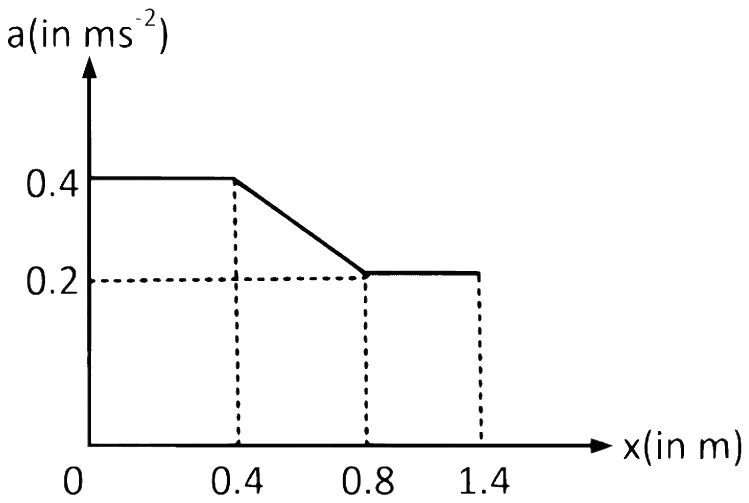
The acceleration of a particle which moves along the positive X X X 0.8 m s − 1 0.8\,\text{m s}^{-1} 0.8 m s − 1 x = 0 x=0 x = 0 x = 1.4 m x = 1.4\,\text{m} x = 1.4 m in m s − 1 \text{in m s}^{-1} in m s − 1
(a) 1.6 1.6 1.6 (b) 1.2 1.2 1.2 (c) 1.4 1.4 1.4 (d) 0.8 0.8 0.8 Show answer
Answer: (b)
Step-by-step solution coming soon.
Report a mistake Q79 AP EAPCET 2024 Medium ☆
Velocity, Acceleration & Variable Motion
The relation between time t t t x x x t = α x 2 + β x t = \alpha x^2 + \beta x t = α x 2 + β x α \alpha α β \beta β v v v
(a) 2 α v 3 β 2 2\alpha v^3\beta^2 2 α v 3 β 2 (b) 2 α β v 3 2\alpha\beta v^3 2 α β v 3 (c) − 2 β v 3 -2\beta v^3 − 2 β v 3 (d) 2 α v 3 2\alpha v^3 2 α v 3 Show answer
Answer: (d)
Step-by-step solution coming soon.
Report a mistake Q80 AP EAPCET 2023 Easy ☆
Velocity, Acceleration & Variable Motion
If the velocity of a particle moving along a straight line with uniform acceleration, is given by v = ( 196 − 16 X ) m s − 1 v = \left(\sqrt{196-16X}\right)\text{m s}^{-1} v = ( 196 − 16 X ) m s − 1 X X X
(a) 8 m s − 2 8\,\text{m s}^{-2} 8 m s − 2 (b) 14 m s − 2 14\,\text{m s}^{-2} 14 m s − 2 (c) − 8 m s − 2 -8\,\text{m s}^{-2} − 8 m s − 2 (d) − 16 m s − 2 -16\,\text{m s}^{-2} − 16 m s − 2 Show answer
Answer: (c)
Step-by-step solution coming soon.
Report a mistake Q81 AP EAPCET 2022 Medium ☆
Velocity, Acceleration & Variable Motion
y = ( P t 2 − Q t 3 ) m y = (Pt^2 - Qt^3)\,\text{m} y = ( P t 2 − Q t 3 ) m
(a) 27 P 3 4 Q 2 \dfrac{27P^3}{4Q^2} 4 Q 2 27 P 3 (b) 4 Q 2 27 P 3 \dfrac{4Q^2}{27P^3} 27 P 3 4 Q 2 (c) 4 P 3 27 Q 2 \dfrac{4P^3}{27Q^2} 27 Q 2 4 P 3 (d) 27 Q 2 4 P 3 \dfrac{27Q^2}{4P^3} 4 P 3 27 Q 2 Show answer
Answer: (c)
Step-by-step solution coming soon.
Report a mistake Q82 AP EAPCET 2021 Easy ☆
Velocity, Acceleration & Variable Motion
The displacement of a particle starting from rest at t = 0 t = 0 t = 0 s = 9 t 2 − 2 t 3 s = 9t^2 - 2t^3 s = 9 t 2 − 2 t 3
(a) 8 s 8\,\text{s} 8 s (b) 6 s 6\,\text{s} 6 s (c) 4 s 4\,\text{s} 4 s (d) 3 s 3\,\text{s} 3 s Show answer
Answer: (d)
Step-by-step solution coming soon.
Report a mistake Q83 TS EAMCET 2025 Medium ☆
Velocity, Acceleration & Variable Motion
The relation between the displacement 'x x x t t t t = 2 x 2 + 3 x t = 2x^2 + 3x t = 2 x 2 + 3 x 25 cm 25\,\text{cm} 25 cm x = 0 x = 0 x = 0
(a) + 1 16 m s − 2 +\dfrac{1}{16}\,\text{m s}^{-2} + 16 1 m s − 2 (b) − 1 16 m s − 2 -\dfrac{1}{16}\,\text{m s}^{-2} − 16 1 m s − 2 (c) + 1 8 m s − 2 +\dfrac{1}{8}\,\text{m s}^{-2} + 8 1 m s − 2 (d) − 1 8 m s − 2 -\dfrac{1}{8}\,\text{m s}^{-2} − 8 1 m s − 2 Show answer
Answer: (b)
Step-by-step solution coming soon.
Report a mistake Q84 TS EAMCET 2024 Easy ☆
Velocity, Acceleration & Variable Motion
The position x x x x = t 3 − 12 t + 3 x = t^3 - 12t + 3 x = t 3 − 12 t + 3 t t t 15 m s − 1 15\,\text{m s}^{-1} 15 m s − 1
(a) 15 m s − 2 15\,\text{m s}^{-2} 15 m s − 2 (b) 24 m s − 2 24\,\text{m s}^{-2} 24 m s − 2 (c) 18 m s − 2 18\,\text{m s}^{-2} 18 m s − 2 (d) 12 m s − 2 12\,\text{m s}^{-2} 12 m s − 2 Show answer
Answer: (c)
Step-by-step solution coming soon.
Report a mistake Q85 TS EAMCET 2023 Medium ☆
Velocity, Acceleration & Variable Motion
A bird flies with a velocity ( t − 2 ) m s − 1 (t-2)\,\text{m s}^{-1} ( t − 2 ) m s − 1 t t t 4 4 4
(a) 2 m 2\,\text{m} 2 m (b) 4 m 4\,\text{m} 4 m (c) 6 m 6\,\text{m} 6 m (d) 8 m 8\,\text{m} 8 m Show answer
Answer: (b)
Step-by-step solution coming soon.
Report a mistake Q86 TS EAMCET 2023 Medium ☆
Velocity, Acceleration & Variable Motion
The relation between time t t t x x x t = a x 2 + b x t = ax^2 + bx t = a x 2 + b x a a a b b b v v v
(a) − 2 a b v 2 -2abv^2 − 2 ab v 2 (b) 2 b v 3 2bv^3 2 b v 3 (c) − 2 a v 3 -2av^3 − 2 a v 3 (d) 2 a v 2 2av^2 2 a v 2 Show answer
Answer: (c)
Step-by-step solution coming soon.
Report a mistake Q87 TS EAMCET 2020 Medium ☆
Velocity, Acceleration & Variable Motion
A particle moving along X X X f f f t t t f = f 0 ( 1 − t T ) f = f_0\left(1 - \dfrac{t}{T}\right) f = f 0 ( 1 − T t ) f 0 f_0 f 0 T T T t = 0 t=0 t = 0 t = 0 t=0 t = 0 f = 0 f=0 f = 0
(a) 1 2 f 0 T 2 \dfrac{1}{2}f_0T^2 2 1 f 0 T 2 (b) f 0 T 2 f_0T^2 f 0 T 2 (c) 1 2 f 0 T \dfrac{1}{2}f_0T 2 1 f 0 T (d) f 0 T f_0T f 0 T Show answer
Answer: (c)
Step-by-step solution coming soon.
Report a mistake Q88 TS EAMCET 2020 Medium ☆
Velocity, Acceleration & Variable Motion
A particle is moving along the Y Y Y ( t ) (t) ( t ) y ( t ) = 10 t e − 2 t y(t) = 10te^{-2t} y ( t ) = 10 t e − 2 t y y y t t t
(a) 5 m 5\,\text{m} 5 m (b) 5 e m 5e\,\text{m} 5 e m (c) 5 e m \dfrac{5}{e}\,\text{m} e 5 m (d) 10 m 10\,\text{m} 10 m Show answer
Answer: (c)
Step-by-step solution coming soon.
Report a mistake Q89 WB JEE 2008 Easy ☆
Velocity, Acceleration & Variable Motion
The distance travelled by an object along a straight line in time t t t s = 3 − 4 t + 5 t 2 s = 3 - 4t + 5t^2 s = 3 − 4 t + 5 t 2
(a) 3 3 3 (b) − 3 -3 − 3 (c) 4 4 4 (d) − 4 -4 − 4 Show answer
Answer: (d)
Step-by-step solution coming soon.
Report a mistake Q90 IAT 2022 Difficult ☆
Velocity, Acceleration & Variable Motion
A particle experiences an acceleration a ⃗ = α v ⃗ \vec{a} = \alpha\vec{v} a = α v v ⃗ \vec{v} v α \alpha α t 2 − t 1 t_2 - t_1 t 2 − t 1 t 3 − t 1 t_3 - t_1 t 3 − t 1 S 12 S_{12} S 12 S 13 S_{13} S 13
(a) S 13 S 12 = log [ α ( t 3 − t 1 ) ] log [ α ( t 2 − t 1 ) ] \dfrac{S_{13}}{S_{12}} = \dfrac{\log[\alpha(t_3 - t_1)]}{\log[\alpha(t_2 - t_1)]} S 12 S 13 = log [ α ( t 2 − t 1 )] log [ α ( t 3 − t 1 )] (b) S 13 S 12 = exp [ α ( t 3 − t 1 ) ] exp [ α ( t 2 − t 1 ) ] \dfrac{S_{13}}{S_{12}} = \dfrac{\exp[\alpha(t_3 - t_1)]}{\exp[\alpha(t_2 - t_1)]} S 12 S 13 = exp [ α ( t 2 − t 1 )] exp [ α ( t 3 − t 1 )] (c) S 13 S 12 = exp [ α ( t 3 − t 1 ) ] − 1 exp [ α ( t 2 − t 1 ) ] − 1 \dfrac{S_{13}}{S_{12}} = \dfrac{\exp[\alpha(t_3 - t_1)] - 1}{\exp[\alpha(t_2 - t_1)] - 1} S 12 S 13 = exp [ α ( t 2 − t 1 )] − 1 exp [ α ( t 3 − t 1 )] − 1 (d) S 13 S 12 = log [ α ( t 3 − t 1 ) ] − 1 log [ α ( t 2 − t 1 ) ] − 1 \dfrac{S_{13}}{S_{12}} = \dfrac{\log[\alpha(t_3 - t_1)] - 1}{\log[\alpha(t_2 - t_1)] - 1} S 12 S 13 = log [ α ( t 2 − t 1 )] − 1 log [ α ( t 3 − t 1 )] − 1 Show answer
Answer: (c)
Step-by-step solution coming soon.
Report a mistake
No questions match these filters.