Q1 JEE Main 2026 · 2 APR · SHIFT 2 Easy ☆
Mass Defect & Binding Energy
The binding energy per nucleon of 83 209 B i {}_{83}^{209}Bi 83 209 B i
[Take m ( 83 209 B i ) = 208.980388 m({}_{83}^{209}Bi) = 208.980388 m ( 83 209 B i ) = 208.980388 m p = 1.007825 m_p = 1.007825 m p = 1.007825 m n = 1.008665 m_n = 1.008665 m n = 1.008665 1 1 1 = 931 = 931 = 931 / c 2 /c^{2} / c 2
(a) 7.48 (b) 7.84 (c) 8.79 (d) 6.94 Show answer and solution
Answer: (b)
Loading the solution…
Report a mistake Open question page Q2 JEE Main 2026 · 24 JAN · SHIFT 1 Easy ☆
Mass Defect & Binding Energy
Given below are two statements:
Statement I: For all elements, greater the mass of the nucleus, greater is the binding energy per nucleon.
Statement II: For all elements, nuclei with less binding energy per nucleon transforms to nuclei with greater binding energy per nucleon.
In the light of the above statements, choose the correct answer from the options given below
(a) Statement I is false but Statement II is true (b) Both Statement I and Statement II are true (c) Both Statement I and Statement II are false (d) Statement I is true but Statement II is false Show answer and solution
Answer: (a)
Loading the solution…
Report a mistake Open question page Q3 JEE Main 2026 · 5 APR · SHIFT 2 Medium ☆
Mass Defect & Binding Energy
Assuming the experimental mass of 6 12 C {}_{6}^{12}C 6 12 C 12 u 12u 12 u 6 12 C {}_{6}^{12}C 6 12 C _ _ _ _ _ MeV/c 2 \_\_\_\_\_\ \text{MeV/c}^{2} _____ MeV/c 2 = 1.00727 u = 1.00727\text{u} = 1.00727 u = 1.00866 u , 1 u = 931.5 MeV/c 2 = 1.00866\text{u}, 1\text{u} = 931.5\text{MeV/c}^{2} = 1.00866 u , 1 u = 931.5 MeV/c 2
(a) 127.5 (b) 89.03 (c) 272.0 (d) 92.0 Show answer and solution
Answer: (b)
Loading the solution…
Report a mistake Open question page Q4 JEE Main 2026 · 24 JAN · SHIFT 2 Medium ☆
Mass Defect & Binding Energy
The binding energy for the following nuclear reactions are expressed in MeV.
2 He 3 + 0 n 1 → 2 He 4 + 20 MeV {}_{2}\text{He}^{3} + {}_{0}\text{n}^{1} \rightarrow {}_{2}\text{He}^{4} + 20\text{MeV} 2 He 3 + 0 n 1 → 2 He 4 + 20 MeV
2 He 4 + 0 n 1 → 2 He 5 − 0.9 MeV {}_{2}\text{He}^{4} + {}_{0}\text{n}^{1} \rightarrow {}_{2}\text{He}^{5} - 0.9\text{MeV} 2 He 4 + 0 n 1 → 2 He 5 − 0.9 MeV
If X 3 , X 4 , X 5 \mathrm{X_3, X_4, X_5} X 3 , X 4 , X 5 2 He 3 , 2 He 4 {}_{2}\text{He}^{3}, {}_{2}\text{He}^{4} 2 He 3 , 2 He 4 2 He 5 {}_{2}\text{He}^{5} 2 He 5
(a) X 4 > X 5 > X 3 X_4 > X_5 > X_3 X 4 > X 5 > X 3 (b) X 4 < X 5 < X 3 X_4 < X_5 < X_3 X 4 < X 5 < X 3 (c) X 4 > X 5 < X 3 X_4 > X_5 < X_3 X 4 > X 5 < X 3 (d) X 4 = X 5 = X 3 X_4 = X_5 = X_3 X 4 = X 5 = X 3 Show answer and solution
Answer: (a)
Loading the solution…
Report a mistake Open question page Q5 JEE Main 2025 · 23 JAN · SHIFT 2 Easy ☆
Mass Defect & Binding Energy
Given below are two statements. One is labelled as Assertion (A) and the other is labelled as Reason (R).
Assertion (A): The binding energy per nucleon is found to be practically independent of the atomic number A, for nuclei with mass numbers between 30 and 170.
Reason (R): Nuclear force is long range. In the light of the above statements, choose the correct answer from the options given below:
(a) (A) is true but (R) is false (b) Both (A) and (R) are true and (R) is the correct explanation of (A) (c) (A) is false but (R) is true (d) Both (A) and (R) are true but (R) is NOT the correct explanation of (A) Show answer and solution
Answer: (a)
Loading the solution…
Report a mistake Open question page Q6 JEE Main 2024 · 9 APR · SHIFT 1 Easy ☆
Mass Defect & Binding Energy
The energy equivalent of 1 g 1\text{ g} 1 g
(a) 5.6 × 1 0 26 MeV 5.6 \times 10^{26}\text{ MeV} 5.6 × 1 0 26 MeV (b) 5.6 × 1 0 12 MeV 5.6 \times 10^{12}\text{ MeV} 5.6 × 1 0 12 MeV (c) 5.6 eV 5.6\text{ eV} 5.6 eV (d) 11.2 × 1 0 24 MeV 11.2 \times 10^{24}\text{ MeV} 11.2 × 1 0 24 MeV Show answer and solution
Answer: (a)
Loading the solution…
Report a mistake Open question page Q7 JEE Main 2024 · 8 APR · SHIFT 1 Easy ☆
Mass Defect & Binding Energy
Binding energy of a certain nucleus is 18 × 1 0 8 J 18 \times 10^{8}\text{ J} 18 × 1 0 8 J
(a) 20 μ \mu μ (b) 2 μ \mu μ (c) 10 μ \mu μ (d) 0.2 μ \mu μ Show answer and solution
Answer: (a)
Loading the solution…
Report a mistake Open question page Q8 JEE Main 2024 · 31 JAN · SHIFT 1 Easy ☆
Mass Defect & Binding Energy
The mass defect in a particular reaction is 0.4 g 0.4\text{ g} 0.4 g n × 1 0 7 kWh n \times 10^{7}\text{ kWh} n × 1 0 7 kWh n = n = n = = 3 × 1 0 8 m/s ) = 3 \times 10^{8}\text{ m/s}) = 3 × 1 0 8 m/s )
Numerical answer type. Work it out, then open the answer.
Show answer and solution
Answer: 1
Loading the solution…
Report a mistake Open question page Q9 MHT CET 2024 · 16 MAY · SHIFT 1 Easy ☆
Mass Defect & Binding Energy
If M O \mathrm{M_O} M O 8 O 17 {}_{8}\text{O}^{17} 8 O 17 M p \mathrm{M_p} M p M N \mathrm{M_N} M N
(a) M o C 2 \mathrm{M_o C^2} M o C 2 (b) ( M o − 8 M P ) C 2 (\mathrm{M_o} - 8\mathrm{M_P})\mathrm{C}^2 ( M o − 8 M P ) C 2 (c) ( M o − 17 M N ) C 2 (\mathrm{M_o} - 17\mathrm{M_N})\mathrm{C}^2 ( M o − 17 M N ) C 2 (d) ( M o − 8 M P − 9 M N ) C 2 (\mathrm{M_o} - 8\mathrm{M_P} - 9\mathrm{M_N})\mathrm{C}^2 ( M o − 8 M P − 9 M N ) C 2 Show answer and solution
Answer: (d)
Loading the solution…
Report a mistake Open question page Q10 JEE Main 2024 · 8 APR · SHIFT 2 Easy ☆
Mass Defect & Binding Energy
If M 0 M_0 M 0 5 12 B , M p {}_{5}^{12}B, M_p 5 12 B , M p M n M_n M n
(a) ( 5 M p + 7 M n − M 0 ) C 2 (5M_p + 7M_n - M_0)C^{2} ( 5 M p + 7 M n − M 0 ) C 2 (b) ( M 0 − 5 M p − 7 M n ) C 2 (M_0 - 5M_p - 7M_n)C^{2} ( M 0 − 5 M p − 7 M n ) C 2 (c) ( M 0 − 5 M p ) C 2 (M_0 - 5M_p)C^{2} ( M 0 − 5 M p ) C 2 (d) ( M 0 − 12 M n ) C 2 (M_0 - 12M_n)C^{2} ( M 0 − 12 M n ) C 2 Show answer and solution
Answer: (a)
Loading the solution…
Report a mistake Open question page Q11 JEE Main 2024 · 27 JAN · SHIFT 2 Medium ☆
Mass Defect & Binding Energy
The atomic mass of 6 C 12 {}_{6}\text{C}^{12} 6 C 12 12.000000 u 12.000000\text{ u} 12.000000 u 6 C 13 {}_{6}\text{C}^{13} 6 C 13 13.003354 u 13.003354\text{ u} 13.003354 u 6 C 13 {}_{6}\text{C}^{13} 6 C 13 1.008665 u 1.008665\text{ u} 1.008665 u
(a) 62.5 MeV (b) 6.25 MeV (c) 4.95 MeV (d) 49.5 MeV Show answer and solution
Answer: (c)
Loading the solution…
Report a mistake Open question page Q12 JEE Main 2023 · 1 FEB · SHIFT 1 Easy ☆
Mass Defect & Binding Energy
The mass of proton, neutron and helium nucleus are respectively 1.0073 u , 1.0087 u 1.0073\,u, 1.0087\,u 1.0073 u , 1.0087 u 4.0015 u 4.0015\,u 4.0015 u
(a) 28.4 MeV 28.4\text{ MeV} 28.4 MeV (b) 56.8 MeV 56.8\text{ MeV} 56.8 MeV (c) 7.1 MeV 7.1\text{ MeV} 7.1 MeV (d) 14.2 MeV 14.2\text{ MeV} 14.2 MeV Show answer and solution
Answer: (a)
Loading the solution…
Report a mistake Open question page Q13 JEE Main 2023 · 13 APR · SHIFT 2 Easy Old syllabus ☆
Mass Defect & Binding Energy
Given below are two statements: one is labelled as Assertion A \mathbf{A} A R \mathbf{R} R
Assertion A: The binding energy per nucleon is practically independent of the atomic number for nuclei of mass number in the range 30 to 170.
Reason R: Nuclear force is short ranged.
In the light of the above statements, choose the correct answer from the options given below
(a) A \mathrm{A} A R \mathbf{R} R (b) A \mathrm{A} A R \mathbf{R} R (c) Both A \mathbf{A} A R \mathbf{R} R R \mathbf{R} R A \mathbf{A} A (d) Both A \mathbf{A} A R \mathbf{R} R R \mathbf{R} R A \mathbf{A} A Show answer and solution
Answer: (c)
Loading the solution…
Report a mistake Open question page Q14 JEE Main 2023 · 1 FEB · SHIFT 2 Medium ☆
Mass Defect & Binding Energy
Nucleus A having Z = 17 Z = 17 Z = 17 1.2 MeV 1.2\text{ MeV} 1.2 MeV
Another nucleus B \text{B} B Z = 12 Z = 12 Z = 12 1.8 MeV 1.8\text{ MeV} 1.8 MeV B \text{B} B A \text{A} A MeV \text{MeV} MeV
Numerical answer type. Work it out, then open the answer.
Show answer and solution
Answer: 6
Loading the solution…
Report a mistake Open question page Q15 JEE Main 2023 · 8 APR · SHIFT 1 Difficult ☆
Mass Defect & Binding Energy
For a nucleus Z A X {}_{\text{Z}}^{\text{A}}\text{X} Z A X A \text{A} A Z \text{Z} Z
A. The surface energy per nucleon ( b s ) = − a 1 A 2 / 3 (b_{\text{s}}) = -a_1 A^{2/3} ( b s ) = − a 1 A 2/3
B. The Coulomb contribution to the binding energy b c = − a 2 Z ( Z − 1 ) A 4 / 3 \text{b}_{\text{c}} = -a_2 \frac{Z(Z-1)}{A^{4/3}} b c = − a 2 A 4/3 Z ( Z − 1 )
C. The volume energy b v = a 3 A \text{b}_{\text{v}} = a_3 A b v = a 3 A
D. Decrease in the binding energy is proportional to surface area.
E. While estimating the surface energy, it is assumed that each nucleon interacts with 12 nucleons. ( a 1 , a 2 a_1, a_2 a 1 , a 2 a 3 a_3 a 3
Choose the most appropriate answer from the options given below:
(a) C, D only (b) B, C, E only (c) B, C only (d) A, B, C, D only Show answer and solution
Answer: (a)
Loading the solution…
Report a mistake Open question page Q16 JEE Main 2021 · 25 JUL · SHIFT 2 Medium ☆
Mass Defect & Binding Energy
From the given data, the amount of energy required to break the nucleus of aluminium 13 27 {}_{13}^{27} 13 27 × \times × − - −
Mass of neutron = 1.00866 u
Mass of proton = 1.00726 u
Mass of Aluminium nucleus = 27.18846 u
(Assume 1 u corresponds to x J of energy)
(Round off to the nearest integer)
Numerical answer type. Work it out, then open the answer.
Show answer and solution
Answer: 27
Loading the solution…
Report a mistake Open question page Q17 NEET 2020 · PHASE 1 Easy ☆
Mass Defect & Binding Energy
The energy equivalent of 0.5 g of a substance is:
(a) 4.5 × 1 0 13 J 4.5 \times 10^{13}\text{ J} 4.5 × 1 0 13 J (b) 1.5 × 1 0 13 J 1.5 \times 10^{13}\text{ J} 1.5 × 1 0 13 J (c) 0.5 × 1 0 13 J 0.5 \times 10^{13}\text{ J} 0.5 × 1 0 13 J (d) 4.5 × 1 0 16 J 4.5 \times 10^{16}\text{ J} 4.5 × 1 0 16 J Show answer and solution
Answer: (a)
Loading the solution…
Report a mistake Open question page Q18 JEE Main 2020 · 4 SEP · SHIFT 2 Easy ☆
Mass Defect & Binding Energy
Find the Binding energy per nucleon for 50 120 S n {}_{50}^{120}Sn 50 120 S n
(a) 9.0 MeV (b) 8.5 MeV (c) 8.0 MeV (d) 7.5 MeV Show answer and solution
Answer: (b)
Loading the solution…
Report a mistake Open question page Q19 JEE Main 2017 · 9 APR · SHIFT 1 Easy ☆
Mass Defect & Binding Energy
Imagine that a reactor converts all given mass into energy and that it operates at a power level of 109 watt. The mass of the fuel consumed per hour in the reactor will be: (velocity of light, c is 3×10⁸ m/s)
(a) 0.96 gm (b) 0.8 gm (c) 4 × \times × − - − (d) 6.6 × \times × − - − Show answer and solution
Answer: (c)
Loading the solution…
Report a mistake Open question page Q20 NEET 2013 Easy ☆
Mass Defect & Binding Energy
How does the Binding Energy per nucleon vary with the increase in the number of nucleons?
(a) Decrease continuously with mass number. (b) First decreases and then increases with increase in mass number. (c) First increases and then decreases with increase in mass number. (d) increases continuously with mass number. Show answer and solution
Answer: (c)
Loading the solution…
Report a mistake Open question page Q21 NEET 2010 · AIPMT · PRELIMS Easy ☆
Mass Defect & Binding Energy
The mass of a 3 7 L i {}_{3}^{7}Li 3 7 L i 3 7 L i {}_{3}^{7}Li 3 7 L i
(a) 46 MeV (b) 5.6 MeV (c) 3.9 MeV (d) 23 MeV Show answer and solution
Answer: (b)
Loading the solution…
Report a mistake Open question page Q22 JEE Main 2009 · AIEEE Difficult ☆
Mass Defect & Binding Energy
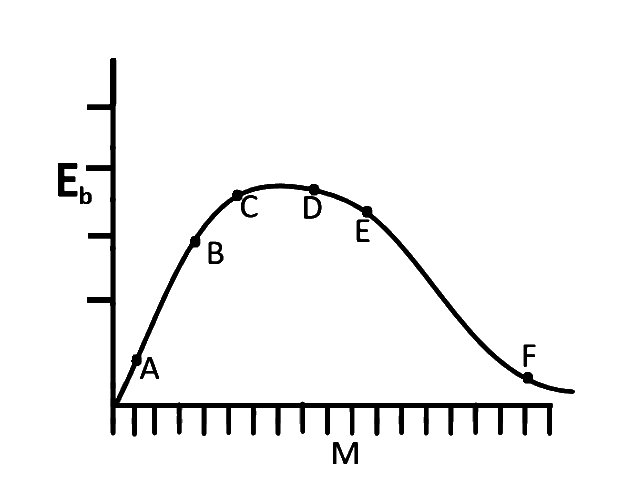
The above is a plot of binding energy per nucleon E b , E_b, E b , M ; A , B , C , D , E , F M; A, B, C, D, E, F M ; A , B , C , D , E , F
( i ) A + B → C + ε ( i i ) C → A + B + ε (i)\ \ A + B \rightarrow C + \varepsilon \quad (ii)\ \ C \rightarrow A + B + \varepsilon ( i ) A + B → C + ε ( ii ) C → A + B + ε
( i i i ) D + E → F + ε ( i v ) F → D + E + ε , (iii)\ \ D + E \rightarrow F + \varepsilon \quad (iv)\ \ F \rightarrow D + E + \varepsilon, ( iii ) D + E → F + ε ( i v ) F → D + E + ε ,
where ε \varepsilon ε ε \varepsilon ε
(a) ( i ) (i) ( i ) ( i i i ) (iii) ( iii ) (b) ( i i ) (ii) ( ii ) ( i v ) (iv) ( i v ) (c) ( i i ) (ii) ( ii ) ( i i i ) (iii) ( iii ) (d) ( i ) (i) ( i ) ( i v ) (iv) ( i v ) Show answer and solution
Answer: (d)
Loading the solution…
Report a mistake Open question page Q23 NEET 2008 · AIPMT Easy ☆
Mass Defect & Binding Energy
If M(A; Z), Mp and Mn denote the masses of the nucleus Z A X , {}_{Z}^{A}X, Z A X ,
(a) M(A, Z) = ZMp + (A − - − − - − (b) M(A, Z) = ZMp + (A − - − (c) M(A, Z) = ZMp + (A − - − − - − (d) M(A, Z) = ZMp + (A − - − Show answer and solution
Answer: (c)
Loading the solution…
Report a mistake Open question page Q24 JEE Main 2008 · AIEEE Easy ☆
Mass Defect & Binding Energy
This question contains Statement- 1 and Statement- 2. Of the four choices given after the statements, choose the one that best describes the two statements:
Statement- 1:
Energy is released when heavy nuclei undergo fission or light nuclei undergo fusion. Statement- 2:
For heavy nuclei, binding energy per nucleon increases with increasing Z Z Z Z . Z. Z .
(a) Statement - 1 1 1 2 2 2 (b) Statement - 1 1 1 2 2 2 2 2 2 1 1 1 (c) Statement - 1 1 1 2 2 2 2 2 2 1 1 1 (d) Statement - 1 1 1 2 2 2 Show answer and solution
Answer: (d)
Loading the solution…
Report a mistake Open question page Q25 NEET 2007 · AIPMT Easy ☆
Mass Defect & Binding Energy
A nucleus Z A X {}_{Z}^{A}X Z A X
(a) B.E. = [ZMp + (A − - − − - − (b) B.E. = [ZMp + AMp − - − (c) B.E. = M(A, Z) − - − − - − − - − (d) B.E. = [M(A, Z) − - − − - − − - − Show answer and solution
Answer: (a)
Loading the solution…
Report a mistake Open question page Q26 JEE Main 2007 · AIEEE Easy ☆
Mass Defect & Binding Energy
If M O M_O M O 8 O 17 , M p {}_{8}O^{17}, M_p 8 O 17 , M p M N M_N M N
(a) ( M O − 17 M N ) C 2 (M_O - 17M_N)C^{2} ( M O − 17 M N ) C 2 (b) ( M O − 8 M P ) C 2 (M_O - 8M_P)C^{2} ( M O − 8 M P ) C 2 (c) ( M O − 8 M P − 9 M N ) C 2 (M_O - 8M_P - 9M_N)C^{2} ( M O − 8 M P − 9 M N ) C 2 (d) M O c 2 M_O c^{2} M O c 2 Show answer and solution
Answer: (c)
Loading the solution…
Report a mistake Open question page Q27 NEET 2004 · AIPMT Easy ☆
Mass Defect & Binding Energy
If M(A; Z), Mp and Mn denote the masses of the nucleus Z A X , {}_{Z}^{A}X, Z A X ,
(a) M(A, Z) = ZMp + (A − - − − - − (b) M(A, Z) = ZMp + (A − - − (c) M(A, Z) = ZMp + (A − - − − - − (d) M(A, Z) = ZMp + (A − - − Show answer and solution
Answer: (c)
Loading the solution…
Report a mistake Open question page Q28 NEET 2003 · AIPMT Medium ☆
Mass Defect & Binding Energy
The mass of proton is 1.0073 u and that of neutron is 1.0087 u (u = atomic mass unit). The binding energy of 2 4 {}_{2}^{4} 2 4
(Given helium nucleus mass ≈ \approx ≈
(a) 0.0305 J (b) 0.0305 erg (c) 28.4 MeV (d) 0.061 u Show answer and solution
Answer: (c)
Loading the solution…
Report a mistake Open question page Q29 JEE Main 2002 · AIEEE Easy ☆
Mass Defect & Binding Energy
If mass-energy equivalence is taken into account, when water is cooled to form ice, the mass of water should
(a) increase (b) remain unchanged (c) decrease (d) first increase then decrease Show answer and solution
Answer: (c)
Loading the solution…
Report a mistake Open question page Q30 NEET 2001 · AIPMT Easy ☆
Mass Defect & Binding Energy
Mn and Mp represent the mass of neutron and proton respectively. An element having mass M has N neutrons and Z protons, then the correct relation will be
(a) M < {N ⋅ \cdot ⋅ ⋅ \cdot ⋅ (b) M > {N ⋅ \cdot ⋅ ⋅ \cdot ⋅ (c) M = {N ⋅ \cdot ⋅ ⋅ \cdot ⋅ (d) M = N {Mn + Mp} Show answer and solution
Answer: (a)
Loading the solution…
Report a mistake Open question page Q31 NEET 1993 · AIPMT Easy ☆
Mass Defect & Binding Energy
The binding energy per nucleon is maximum in case of
(a) 2 4 He {}_{2}^{4}\text{He} 2 4 He (b) 26 56 Fe {}_{26}^{56}\text{Fe} 26 56 Fe (c) 56 141 Ba {}_{56}^{141}\text{Ba} 56 141 Ba (d) 92 235 U {}_{92}^{235}\text{U} 92 235 U Show answer and solution
Answer: (b)
Loading the solution…
Report a mistake Open question page Q32 NEET 1992 · AIPMT Easy ☆
Mass Defect & Binding Energy
The energy equivalent of one atomic mass unit is
(a) 1.6 × 1 0 − 19 J 1.6 \times 10^{-19}\text{ J} 1.6 × 1 0 − 19 J (b) 6.02 × 1 0 23 J 6.02 \times 10^{23}\text{ J} 6.02 × 1 0 23 J (c) 931 MeV (d) 9.31 MeV Show answer and solution
Answer: (c)
Loading the solution…
Report a mistake Open question page Q33 NEET 1992 · AIPMT Easy ☆
Mass Defect & Binding Energy
The mass of α \alpha α
(a) less than the sum of masses of two protons and two neutrons (b) equal to mass of four protons (c) equal to mass of four neutrons (d) equal to sum of masses of two protons and two neutrons Show answer and solution
Answer: (a)
Loading the solution…
Report a mistake Open question page Q34 NEET 1989 · AIPMT Easy ☆
Mass Defect & Binding Energy
The average binding energy of a nucleon inside an atomic nucleus is about
(a) 8 MeV (b) 8 eV (c) 8 J (d) 8 erg Show answer and solution
Answer: (a)
Loading the solution…
Report a mistake Open question page Q35 JEE Advanced 2022 Difficult ☆
Mass Defect & Binding Energy
The binding energy of nucleons in a nucleus can be affected by the pairwise Coulomb repulsion. Assume that all nucleons are uniformly distributed inside the nucleus. Let the binding energy of a proton be E b p E_b^p E b p E b n E_b^n E b n
Which of the following statement(s) is(are) correct?
More than one option can be correct. Tap every correct option, then tap Check.
(a) E b p − E b n E_b^p - E_b^n E b p − E b n Z ( Z − 1 ) Z(Z-1) Z ( Z − 1 ) Z Z Z (b) E b p − E b n E_b^p - E_b^n E b p − E b n A − 1 / 3 A^{-1/3} A − 1/3 A A A (c) E b p − E b n E_b^p - E_b^n E b p − E b n (d) E b p E_b^p E b p Show answer
Answer: (a), (b), (d)
Step-by-step solution coming soon.
Report a mistake Q36 JEE Advanced 2016 Difficult ☆
Mass Defect & Binding Energy
The electrostatic energy of Z Z Z R R R E = 3 5 Z ( Z − 1 ) e 2 4 π ε 0 R E = \dfrac{3}{5}\dfrac{Z(Z-1)e^2}{4\pi\varepsilon_0 R} E = 5 3 4 π ε 0 R Z ( Z − 1 ) e 2
The measured masses of the neutron, 1 1 H {}^{1}_{1}\text{H} 1 1 H 7 15 N {}^{15}_{7}\text{N} 7 15 N 8 15 O {}^{15}_{8}\text{O} 8 15 O 1.008665 u 1.008665\,\text{u} 1.008665 u 1.007825 u 1.007825\,\text{u} 1.007825 u 15.000109 u 15.000109\,\text{u} 15.000109 u 15.003065 u 15.003065\,\text{u} 15.003065 u 7 15 N {}^{15}_{7}\text{N} 7 15 N 8 15 O {}^{15}_{8}\text{O} 8 15 O 1 u = 931.5 MeV / c 2 1\,\text{u} = 931.5\,\text{MeV}/c^2 1 u = 931.5 MeV / c 2 c c c e 2 / ( 4 π ε 0 ) = 1.44 MeV fm e^2/(4\pi\varepsilon_0) = 1.44\,\text{MeV fm} e 2 / ( 4 π ε 0 ) = 1.44 MeV fm 7 15 N {}^{15}_{7}\text{N} 7 15 N 8 15 O {}^{15}_{8}\text{O} 8 15 O 1 fm = 1 0 − 15 m 1\,\text{fm} = 10^{-15}\,\text{m} 1 fm = 1 0 − 15 m
(a) 2.85 fm 2.85\,\text{fm} 2.85 fm (b) 3.03 fm 3.03\,\text{fm} 3.03 fm (c) 3.42 fm 3.42\,\text{fm} 3.42 fm (d) 3.80 fm 3.80\,\text{fm} 3.80 fm Show answer
Answer: (c)
Step-by-step solution coming soon.
Report a mistake Q37 JEE Advanced 2008 Medium ☆
Mass Defect & Binding Energy
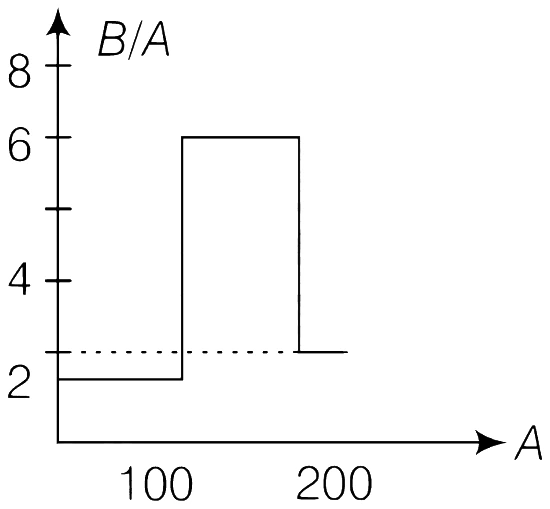
Assume that the nuclear binding energy per nucleon (B / A B/A B / A A A A
More than one option can be correct. Tap every correct option, then tap Check.
(a) Fusion of two nuclei with mass number lying in the range of 1 < A < 50 1 < A < 50 1 < A < 50 (b) Fusion of two nuclei with mass numbers lying in the range of 51 < A < 100 51 < A < 100 51 < A < 100 (c) Fission of a nucleus lying in the mass range of 100 < A < 200 100 < A < 200 100 < A < 200 (d) Fission of a nucleus lying in the mass range of 200 < A < 260 200 < A < 260 200 < A < 260 Show answer
Answer: (b), (d)
Step-by-step solution coming soon.
Report a mistake Q38 AIIMS 2016 Medium ☆
Mass Defect & Binding Energy
Assume that the nuclear binding energy per nucleon (B / A B/A B / A A A A
(a) Fusion of two nuclei with mass number lying in the range of 51 < A < 100 51 < A < 100 51 < A < 100 (b) Fusion of a nucleus lying in the mass range of 200 < A < 260 200 < A < 260 200 < A < 260 (c) Both (a) and (b) (d) None of the above Show answer
Answer: (c)
Step-by-step solution coming soon.
Report a mistake Q39 AIIMS 2009 Medium ☆
Mass Defect & Binding Energy
A neutron breaks into a proton, an electron (β \beta β ν ˉ \bar{\nu} ν ˉ 0 n 1 → 1 H 1 + − 1 β 0 + ν ˉ {}_0n^1 \to {}_1\text{H}^1 + {}_{-1}\beta^0 + \bar{\nu} 0 n 1 → 1 H 1 + − 1 β 0 + ν ˉ MeV \text{MeV} MeV
(a) 731 MeV 731\,\text{MeV} 731 MeV (b) 7.31 MeV 7.31\,\text{MeV} 7.31 MeV (c) 0.731 MeV 0.731\,\text{MeV} 0.731 MeV (d) 1.17 MeV 1.17\,\text{MeV} 1.17 MeV Show answer
Answer: (c)
Step-by-step solution coming soon.
Report a mistake Q40 AIIMS 2006 Easy ☆
Mass Defect & Binding Energy
Assertion: The binding energy per nucleon, for nuclei with atomic mass number A > 100 A > 100 A > 100 A A A Reason: The nuclear forces are weak for heavier nuclei.
(a) If both Assertion and Reason are true and the Reason is the correct explanation of the Assertion (b) If both Assertion and Reason are true but the Reason is not the correct explanation of the Assertion (c) If Assertion is true but Reason is false (d) If both Assertion and Reason are false Show answer
Answer: (c)
Step-by-step solution coming soon.
Report a mistake Q41 AIIMS 2004 Easy ☆
Mass Defect & Binding Energy
The dependence of binding energy per nucleon, B N B_N B N A A A
(a) Graph (A) (b) Graph (B) (c) Graph (C) (d) Graph (D) Show answer
Answer: (a)
Step-by-step solution coming soon.
Report a mistake Q42 AIIMS 2004 Easy ☆
Mass Defect & Binding Energy
When an electron-positron pair annihilates, the energy released is about :
(a) 0.8 × 1 0 − 13 J 0.8 \times 10^{-13}\,\text{J} 0.8 × 1 0 − 13 J (b) 1.6 × 1 0 − 13 J 1.6 \times 10^{-13}\,\text{J} 1.6 × 1 0 − 13 J (c) 3.2 × 1 0 − 13 J 3.2 \times 10^{-13}\,\text{J} 3.2 × 1 0 − 13 J (d) 4.8 × 1 0 − 13 J 4.8 \times 10^{-13}\,\text{J} 4.8 × 1 0 − 13 J Show answer
Answer: (b)
Step-by-step solution coming soon.
Report a mistake Q43 JIPMER 2017 Easy ☆
Mass Defect & Binding Energy
A nucleus Z A X ^A_ZX Z A X m ( A , Z ) m(A, Z) m ( A , Z ) m p m_p m p m n m_n m n B E BE BE
(a) B E = [ m ( A , Z ) − Z m p − ( A − Z ) m n ] c 2 BE = [m(A,Z) - Zm_p - (A-Z)m_n]c^2 BE = [ m ( A , Z ) − Z m p − ( A − Z ) m n ] c 2 (b) B E = [ Z m p + ( A − Z ) m n − m ( A , Z ) ] c 2 BE = [Zm_p + (A-Z)m_n - m(A,Z)]c^2 BE = [ Z m p + ( A − Z ) m n − m ( A , Z )] c 2 (c) B E = [ Z m 0 + A m n − m ( A , Z ) ] c 2 BE = [Zm_0 + Am_n - m(A,Z)]c^2 BE = [ Z m 0 + A m n − m ( A , Z )] c 2 (d) B E = m ( A , Z ) − Z m p − ( A − Z ) m N BE = m(A,Z) - Zm_p - (A-Z)m_N BE = m ( A , Z ) − Z m p − ( A − Z ) m N Show answer
Answer: (b)
Step-by-step solution coming soon.
Report a mistake Q44 JIPMER 2016 Easy ☆
Mass Defect & Binding Energy
If a proton and anti-proton come close to each other and annihilate, how much energy will be released?
(a) 1.5 × 1 0 − 10 J 1.5 \times 10^{-10}\,\text{J} 1.5 × 1 0 − 10 J (b) 3 × 1 0 − 10 J 3 \times 10^{-10}\,\text{J} 3 × 1 0 − 10 J (c) 4.5 × 1 0 − 10 J 4.5 \times 10^{-10}\,\text{J} 4.5 × 1 0 − 10 J (d) 2 × 1 0 − 10 J 2 \times 10^{-10}\,\text{J} 2 × 1 0 − 10 J Show answer
Answer: (b)
Step-by-step solution coming soon.
Report a mistake Q45 JIPMER 2015 Easy ☆
Mass Defect & Binding Energy
If M O M_O M O 8 O 17 _8\text{O}^{17} 8 O 17 M p M_p M p M n M_n M n
(a) M O c 2 M_Oc^2 M O c 2 (b) ( M O − 17 M n ) c 2 (M_O - 17M_n)c^2 ( M O − 17 M n ) c 2 (c) ( M O − 8 M p ) c 2 (M_O - 8M_p)c^2 ( M O − 8 M p ) c 2 (d) ( 8 M p + 9 M n − M O ) c 2 (8M_p + 9M_n - M_O)c^2 ( 8 M p + 9 M n − M O ) c 2 Show answer
Answer: (d)
Step-by-step solution coming soon.
Report a mistake Q46 JIPMER 2013 Easy ☆
Mass Defect & Binding Energy
The binding energy per nucleon is maximum in the case
(a) 92 235 U ^{235}_{92}\text{U} 92 235 U (b) 56 141 Ba ^{141}_{56}\text{Ba} 56 141 Ba (c) 26 56 Fe ^{56}_{26}\text{Fe} 26 56 Fe (d) 4 2 He ^{2}_{4}\text{He} 4 2 He Show answer
Answer: (c)
Step-by-step solution coming soon.
Report a mistake Q47 JIPMER 2009 Easy ☆
Mass Defect & Binding Energy
If M O M_O M O 8 O 17 _8\text{O}^{17} 8 O 17 M p M_p M p M n M_n M n
(a) ( M O − 8 M p ) c 2 (M_O - 8M_p)c^2 ( M O − 8 M p ) c 2 (b) ( 8 M p + 9 M n − M O ) c 2 (8M_p + 9M_n - M_O)c^2 ( 8 M p + 9 M n − M O ) c 2 (c) M O c 2 M_Oc^2 M O c 2 (d) ( M O − 17 M n ) c 2 (M_O - 17M_n)c^2 ( M O − 17 M n ) c 2 Show answer
Answer: (b)
Step-by-step solution coming soon.
Report a mistake Q48 JIPMER 2005 Medium ☆
Mass Defect & Binding Energy
A body of specific heat 0.2 kcal / kg ∘ C 0.2\,\text{kcal}/\text{kg}^\circ\text{C} 0.2 kcal / kg ∘ C 10 0 ∘ C 100^\circ\text{C} 10 0 ∘ C
(a) 9 % 9\% 9% (b) 9.3 × 1 0 − 11 % 9.3 \times 10^{-11}\% 9.3 × 1 0 − 11 % (c) 10 % 10\% 10% (d) None of these Show answer
Answer: (b)
Step-by-step solution coming soon.
Report a mistake Q49 JIPMER 2004 Easy ☆
Mass Defect & Binding Energy
The energy in MeV \text{MeV} MeV 1 kg 1\,\text{kg} 1 kg c = 3 × 1 0 8 m/s c = 3 \times 10^8\,\text{m/s} c = 3 × 1 0 8 m/s
(a) 7.625 × 10 MeV 7.625 \times 10\,\text{MeV} 7.625 × 10 MeV (b) 10.5 × 1 0 29 MeV 10.5 \times 10^{29}\,\text{MeV} 10.5 × 1 0 29 MeV (c) 2.8 × 1 0 − 28 MeV 2.8 \times 10^{-28}\,\text{MeV} 2.8 × 1 0 − 28 MeV (d) 5.625 × 1 0 29 MeV 5.625 \times 10^{29}\,\text{MeV} 5.625 × 1 0 29 MeV Show answer
Answer: (d)
Step-by-step solution coming soon.
Report a mistake Q50 BITSAT 2025 Easy ☆
Mass Defect & Binding Energy
The mass of proton is 1.0073 u 1.0073\,\text{u} 1.0073 u 1.0087 u 1.0087\,\text{u} 1.0087 u u \text{u} u 2 He 4 {}_{2}\text{He}^{4} 2 He 4 4.0015 u 4.0015\,\text{u} 4.0015 u 2 He 4 {}_{2}\text{He}^{4} 2 He 4
(a) 28.4 MeV 28.4\,\text{MeV} 28.4 MeV (b) 0.061 u 0.061\,\text{u} 0.061 u (c) 0.0305 J 0.0305\,\text{J} 0.0305 J (d) 0.0305 erg 0.0305\,\text{erg} 0.0305 erg Show answer
Answer: (a)
Step-by-step solution coming soon.
Report a mistake Q51 VITEEE 2012 Easy ☆
Mass Defect & Binding Energy
Calculate the energy released when three α \alpha α 12 C {}^{12}\text{C} 12 C 2 4 He {}_{2}^{4}\text{He} 2 4 He 4.002603 u 4.002603\,\text{u} 4.002603 u
(a) 0.007809 u 0.007809\,\text{u} 0.007809 u (b) 0.002603 u 0.002603\,\text{u} 0.002603 u (c) 4.002603 u 4.002603\,\text{u} 4.002603 u (d) 0.5 u 0.5\,\text{u} 0.5 u Show answer
Answer: (a)
Step-by-step solution coming soon.
Report a mistake Q52 VITEEE 2006 Easy ☆
Mass Defect & Binding Energy
The difference between the rest mass of the nucleus and the sum of the masses of the nucleons composing a nucleus is known as
(a) packing fraction (b) mass defect (c) binding energy (d) isotopic mass Show answer
Answer: (b)
Step-by-step solution coming soon.
Report a mistake Q53 VITEEE 2006 Easy ☆
Mass Defect & Binding Energy
How much energy is produced, if 2 kg 2\,\text{kg} 2 kg [ c = 3 × 1 0 8 m s − 1 ] [c = 3 \times 10^{8}\,\text{m s}^{-1}] [ c = 3 × 1 0 8 m s − 1 ]
(a) 9 × 1 0 16 J 9 \times 10^{16}\,\text{J} 9 × 1 0 16 J (b) 11 × 1 0 16 J 11 \times 10^{16}\,\text{J} 11 × 1 0 16 J (c) 15 × 1 0 16 J 15 \times 10^{16}\,\text{J} 15 × 1 0 16 J (d) 18 × 1 0 16 J 18 \times 10^{16}\,\text{J} 18 × 1 0 16 J Show answer
Answer: (d)
Step-by-step solution coming soon.
Report a mistake Q54 VITEEE 2006 Medium ☆
Mass Defect & Binding Energy
The velocity v v v
(a) v = c v = c v = c (b) v = 3 4 c v = \sqrt{\dfrac{3}{4}}\,c v = 4 3 c (c) v = 3 2 c v = \sqrt{\dfrac{3}{2}}\,c v = 2 3 c (d) v = 2 c v = 2c v = 2 c Show answer
Answer: (b)
Step-by-step solution coming soon.
Report a mistake Q55 COMEDK 2026 Medium ☆
Mass Defect & Binding Energy
The atomic mass of an element 10 20 X {}^{20}_{10}X 10 20 X 19.98170 amu 19.98170\,\text{amu} 19.98170 amu = 1.00867 amu = 1.00867\,\text{amu} = 1.00867 amu = 1.00783 amu = 1.00783\,\text{amu} = 1.00783 amu 1 amu = 931 MeV 1\,\text{amu} = 931\,\text{MeV} 1 amu = 931 MeV
(a) 17.66 MeV/nucleon 17.66\,\text{MeV/nucleon} 17.66 MeV/nucleon (b) 8.533 MeV/nucleon 8.533\,\text{MeV/nucleon} 8.533 MeV/nucleon (c) 85.33 MeV/nucleon 85.33\,\text{MeV/nucleon} 85.33 MeV/nucleon (d) 170.66 MeV/nucleon 170.66\,\text{MeV/nucleon} 170.66 MeV/nucleon Show answer
Answer: (b)
Step-by-step solution coming soon.
Report a mistake Q56 COMEDK 2025 Easy ☆
Mass Defect & Binding Energy
To get 300 MW 300\,\text{MW} 300 MW
(a) 6 × 1 0 − 2 kg 6\times10^{-2}\,\text{kg} 6 × 1 0 − 2 kg (b) 3 × 1 0 − 6 kg 3\times10^{-6}\,\text{kg} 3 × 1 0 − 6 kg (c) 6 × 1 0 − 3 kg 6\times10^{-3}\,\text{kg} 6 × 1 0 − 3 kg (d) 6 × 1 0 − 6 kg 6\times10^{-6}\,\text{kg} 6 × 1 0 − 6 kg Show answer
Answer: (d)
Step-by-step solution coming soon.
Report a mistake Q57 COMEDK 2025 Easy ☆
Mass Defect & Binding Energy
The nucleus of oxygen atom contains 8 protons and 8 neutrons. What is the mass defect in amu? [Given mass of proton = 1.00727 amu = 1.00727\,\text{amu} = 1.00727 amu = 1.00866 amu = 1.00866\,\text{amu} = 1.00866 amu = 15.99053 amu = 15.99053\,\text{amu} = 15.99053 amu
(a) 0.12691 amu 0.12691\,\text{amu} 0.12691 amu (b) 0.13692 amu 0.13692\,\text{amu} 0.13692 amu (c) 0.13691 amu 0.13691\,\text{amu} 0.13691 amu (d) 0.12961 amu 0.12961\,\text{amu} 0.12961 amu Show answer
Answer: (c)
Step-by-step solution coming soon.
Report a mistake Q58 COMEDK 2024 Easy ☆
Mass Defect & Binding Energy
Find the binding energy of the tritium nucleus: [Given: mass of 1 H 3 = 3.01605 u _1\text{H}^3 = 3.01605\,\text{u} 1 H 3 = 3.01605 u m p = 1.00782 u m_p = 1.00782\,\text{u} m p = 1.00782 u m n = 1.00866 u m_n = 1.00866\,\text{u} m n = 1.00866 u
(a) 8.5 MeV 8.5\,\text{MeV} 8.5 MeV (b) 8.5 J 8.5\,\text{J} 8.5 J (c) 0.00909 MeV 0.00909\,\text{MeV} 0.00909 MeV (d) 0.00909 eV 0.00909\,\text{eV} 0.00909 eV Show answer
Answer: (a)
Step-by-step solution coming soon.
Report a mistake Q59 COMEDK 2024 Medium ☆
Mass Defect & Binding Energy
The binding energy per nucleon for C 12 \text{C}^{12} C 12 7.68 MeV 7.68\,\text{MeV} 7.68 MeV C 13 \text{C}^{13} C 13 7.47 MeV 7.47\,\text{MeV} 7.47 MeV C 13 \text{C}^{13} C 13
(a) 7.92 × 1 0 − 13 MeV 7.92 \times 10^{-13}\,\text{MeV} 7.92 × 1 0 − 13 MeV (b) 4.95 × 1 0 − 13 eV 4.95 \times 10^{-13}\,\text{eV} 4.95 × 1 0 − 13 eV (c) 7.92 × 1 0 − 13 J 7.92 \times 10^{-13}\,\text{J} 7.92 × 1 0 − 13 J (d) 7.92 × 1 0 − 19 J 7.92 \times 10^{-19}\,\text{J} 7.92 × 1 0 − 19 J Show answer
Answer: (c)
Step-by-step solution coming soon.
Report a mistake Q60 COMEDK 2021 Easy ☆
Mass Defect & Binding Energy
When the speed of light becomes 2 3 \dfrac{2}{3} 3 2
(a) decrease by a factor 2 3 \dfrac{2}{3} 3 2 (b) decrease by a factor 4 9 \dfrac{4}{9} 9 4 (c) decrease by a factor 5 9 \dfrac{5}{9} 9 5 (d) decrease by a factor 5 9 \dfrac{\sqrt{5}}{9} 9 5 Show answer
Answer: (c)
Step-by-step solution coming soon.
Report a mistake Q61 KCET 2022 Medium ☆
Mass Defect & Binding Energy
Binding energy of a nitrogen nucleus [ 7 14 N ] \left[{}^{14}_{7}\text{N}\right] [ 7 14 N ] m [ 7 14 N ] = 14.00307 u m\left[{}^{14}_{7}\text{N}\right] = 14.00307\,\text{u} m [ 7 14 N ] = 14.00307 u
(a) 85 MeV 85\,\text{MeV} 85 MeV (b) 206.5 MeV 206.5\,\text{MeV} 206.5 MeV (c) 78 MeV 78\,\text{MeV} 78 MeV (d) 104.7 MeV 104.7\,\text{MeV} 104.7 MeV Show answer
Answer: (d)
Step-by-step solution coming soon.
Report a mistake Q62 KCET 2018 Easy ☆
Mass Defect & Binding Energy
The energy equivalent to a substance of mass 1 g 1\,\text{g} 1 g
(a) 18 × 1 0 13 J 18 \times 10^{13}\,\text{J} 18 × 1 0 13 J (b) 9 × 1 0 13 J 9 \times 10^{13}\,\text{J} 9 × 1 0 13 J (c) 18 × 1 0 6 J 18 \times 10^{6}\,\text{J} 18 × 1 0 6 J (d) 9 × 1 0 6 J 9 \times 10^{6}\,\text{J} 9 × 1 0 6 J Show answer
Answer: (b)
Step-by-step solution coming soon.
Report a mistake Q63 KCET 2017 Easy ☆
Mass Defect & Binding Energy
The mass defect of 2 4 He ^{4}_{2}\text{He} 2 4 He 0.03 u 0.03\,\text{u} 0.03 u
(a) 6.9825 6.9825 6.9825 (b) 27.93 27.93 27.93 (c) 2.793 2.793 2.793 (d) 69.825 69.825 69.825 Show answer
Answer: (a)
Step-by-step solution coming soon.
Report a mistake Q64 AP EAPCET 2026 Medium ☆
Mass Defect & Binding Energy
Binding energy per nucleon of deuteron and helium nuclei are 1.1 MeV 1.1\,\text{MeV} 1.1 MeV 7 MeV 7\,\text{MeV} 7 MeV
(a) 23.6 MeV 23.6\,\text{MeV} 23.6 MeV (b) 32.4 MeV 32.4\,\text{MeV} 32.4 MeV (c) 28.6 MeV 28.6\,\text{MeV} 28.6 MeV (d) 13.6 MeV 13.6\,\text{MeV} 13.6 MeV Show answer
Answer: (a)
Step-by-step solution coming soon.
Report a mistake Q65 AP EAPCET 2025 Medium ☆
Mass Defect & Binding Energy
If the binding energy per nucleon of deuteron ( 1 H 2 ) \left({}_1\text{H}^2\right) ( 1 H 2 ) 1.15 MeV 1.15\,\text{MeV} 1.15 MeV α \alpha α 7.1 MeV 7.1\,\text{MeV} 7.1 MeV
1 H 2 + 1 H 2 → 2 He 4 + Q {}_1\text{H}^2 + {}_1\text{H}^2 \to {}_2\text{He}^4 + Q 1 H 2 + 1 H 2 → 2 He 4 + Q
(a) 23.8 MeV 23.8\,\text{MeV} 23.8 MeV (b) 26.1 MeV 26.1\,\text{MeV} 26.1 MeV (c) 5.95 MeV 5.95\,\text{MeV} 5.95 MeV (d) 28.9 MeV 28.9\,\text{MeV} 28.9 MeV Show answer
Answer: (c)
Step-by-step solution coming soon.
Report a mistake Q66 AP EAPCET 2023 Easy ☆
Mass Defect & Binding Energy
The nucleus having highest binding energy per nucleon is
(a) 8 16 O {}_{8}^{16}\text{O} 8 16 O (b) 26 56 Fe {}_{26}^{56}\text{Fe} 26 56 Fe (c) 84 208 Pb {}_{84}^{208}\text{Pb} 84 208 Pb (d) 2 4 He {}_{2}^{4}\text{He} 2 4 He Show answer
Answer: (b)
Step-by-step solution coming soon.
Report a mistake Q67 AP EAPCET 2021 Easy ☆
Mass Defect & Binding Energy
Which of the following statements is correct?
(a) The rest mass of the stable nucleus is less than the sum of the rest masses of its separated nucleons. (b) The rest mass of the stable nucleus is greater than the sum of the rest masses of its separated nucleons. (c) In nuclear fission, energy is released by fusion of two nuclei of medium mass (approximately 100 amu 100\,\text{amu} 100 amu (d) In nuclear fission, energy is released by fragmentation of a very low atomic mass nucleus. Show answer
Answer: (a)
Step-by-step solution coming soon.
Report a mistake Q68 TS EAMCET 2026 Easy ☆
Mass Defect & Binding Energy
If a graph is drawn between the binding energy per nucleon and the mass number of nucleus, then the mass number of the nucleus for which the binding energy per nucleon has a maximum value is
(a) 56 56 56 (b) 35 35 35 (c) 106 106 106 (d) 115 115 115 Show answer
Answer: (a)
Step-by-step solution coming soon.
Report a mistake Q69 TS EAMCET 2026 Easy ☆
Mass Defect & Binding Energy
If the masses of proton and neutron are m p m_p m p m n m_n m n 2 He 4 {}_2\text{He}^4 2 He 4 8 O 16 {}_8\text{O}^{16} 8 O 16 M 1 M_1 M 1 M 2 M_2 M 2
(a) M 2 = 8 ( m p + m n ) M_2 = 8\,(m_p + m_n) M 2 = 8 ( m p + m n ) (b) M 2 < 8 ( m p + m n ) M_2 < 8\,(m_p + m_n) M 2 < 8 ( m p + m n ) (c) M 1 = 2 ( m p + m n ) M_1 = 2\,(m_p + m_n) M 1 = 2 ( m p + m n ) (d) M 1 > 2 ( m p + m n ) M_1 > 2\,(m_p + m_n) M 1 > 2 ( m p + m n ) Show answer
Answer: (b)
Step-by-step solution coming soon.
Report a mistake Q70 TS EAMCET 2023 Easy ☆
Mass Defect & Binding Energy
The energy equivalent to a mass of 1 kg 1\,\text{kg} 1 kg
(a) 9 × 1 0 13 J 9\times 10^{13}\,\text{J} 9 × 1 0 13 J (b) 9 × 1 0 9 J 9\times 10^{9}\,\text{J} 9 × 1 0 9 J (c) 9 × 1 0 16 J 9\times 10^{16}\,\text{J} 9 × 1 0 16 J (d) 9 × 1 0 6 J 9\times 10^{6}\,\text{J} 9 × 1 0 6 J Show answer
Answer: (c)
Step-by-step solution coming soon.
Report a mistake Q71 TS EAMCET 2020 Easy ☆
Mass Defect & Binding Energy
The binding energy (BE) per nucleon for an element is 7.14 MeV 7.14\,\text{MeV} 7.14 MeV 28.6 MeV 28.6\,\text{MeV} 28.6 MeV
(a) 4 4 4 (b) 8 8 8 (c) 16 16 16 (d) 32 32 32 Show answer
Answer: (a)
Step-by-step solution coming soon.
Report a mistake Q72 WB JEE 2025 Medium ☆
Mass Defect & Binding Energy
Let the binding energy per nucleon of nucleus is denoted by E b n E_{bn} E bn r r r A A A B B B 64 64 64 125 125 125
More than one option can be correct. Tap every correct option, then tap Check.
(a) r A < r B r_A < r_B r A < r B (b) r A > r B r_A > r_B r A > r B (c) E b n A > E b n B E_{bnA} > E_{bnB} E bn A > E bn B (d) E b n A < E b n B E_{bnA} < E_{bnB} E bn A < E bn B Show answer
Answer: (a), (c)
Step-by-step solution coming soon.
Report a mistake Q73 WB JEE 2024 Medium ☆
Mass Defect & Binding Energy
Which of the following statement(s) is/are true in respect of nuclear binding energy ?
(a) Statements (i), (ii) and (iii) are true (b) Statements (ii), (iii) and (iv) are true (c) Statements (ii) and (iii) are true (d) All the four statements are true Show answer
Answer: (b)
Step-by-step solution coming soon.
Report a mistake Q74 WB JEE 2008 Easy ☆
Mass Defect & Binding Energy
Which of the following statements is correct?
(a) The rest mass of a stable nucleus is less than the sum of the rest masses of its separated nucleons. (b) The rest mass of a stable nucleus is greater than the sum of the rest masses of its separated nucleons. (c) In nuclear fission, energy is released by fusion is two nuclei of medium mass (approximately 100 100 100 (d) In nuclear fission, energy is released by fragmentation of a very low nucleus. Show answer
Answer: (a)
Step-by-step solution coming soon.
Report a mistake Q75 IAT 2024 Medium ☆
Mass Defect & Binding Energy
Atomic masses of two oxygen isotopes 8 16 O ^{16}_{8}\text{O} 8 16 O 8 18 O ^{18}_{8}\text{O} 8 18 O 15.99491 u 15.99491\,\text{u} 15.99491 u 17.99916 u 17.99916\,\text{u} 17.99916 u u u u 1.00727 u 1.00727\,\text{u} 1.00727 u 1.00866 u 1.00866\,\text{u} 1.00866 u c c c 8 18 O ^{18}_{8}\text{O} 8 18 O 8 16 O ^{16}_{8}\text{O} 8 16 O u c 2 uc^2 u c 2
(a) 0.01307 0.01307 0.01307 (b) 2.00425 2.00425 2.00425 (c) 0.99559 0.99559 0.99559 (d) 3.01291 3.01291 3.01291 Show answer
Answer: (a)
Step-by-step solution coming soon.
Report a mistake Q76 NEST 2013 Medium ☆
Mass Defect & Binding Energy
The binding energy per nucleon of 10 X {}^{10}\text{X} 10 X 8 MeV 8\,\text{MeV} 8 MeV 11 X {}^{11}\text{X} 11 X 7.5 MeV 7.5\,\text{MeV} 7.5 MeV 11 X {}^{11}\text{X} 11 X
(a) 7.5 MeV 7.5\,\text{MeV} 7.5 MeV (b) 2.5 MeV 2.5\,\text{MeV} 2.5 MeV (c) 8 MeV 8\,\text{MeV} 8 MeV (d) 0.5 MeV 0.5\,\text{MeV} 0.5 MeV Show answer
Answer: (b)
Step-by-step solution coming soon.
Report a mistake Q77 CBSE Class 12 2025 Easy ☆
Mass Defect & Binding Energy
Which of the following figures correctly represents the shape of curve of binding energy per nucleon as a function of mass number?
(a) Graph (A) (b) Graph (B) (c) Graph (C) (d) Graph (D) Show answer
Answer: (a)
Step-by-step solution coming soon.
Report a mistake Q78 CBSE Class 12 2023 Easy ☆
Mass Defect & Binding Energy
The curve of binding energy per nucleon as a function of atomic mass number has a sharp peak for helium nucleus. This implies that helium nucleus is
(a) radioactive (b) unstable (c) easily fissionable (d) more stable nucleus than its neighbours Show answer
Answer: (d)
Step-by-step solution coming soon.
Report a mistake
No questions match these filters.