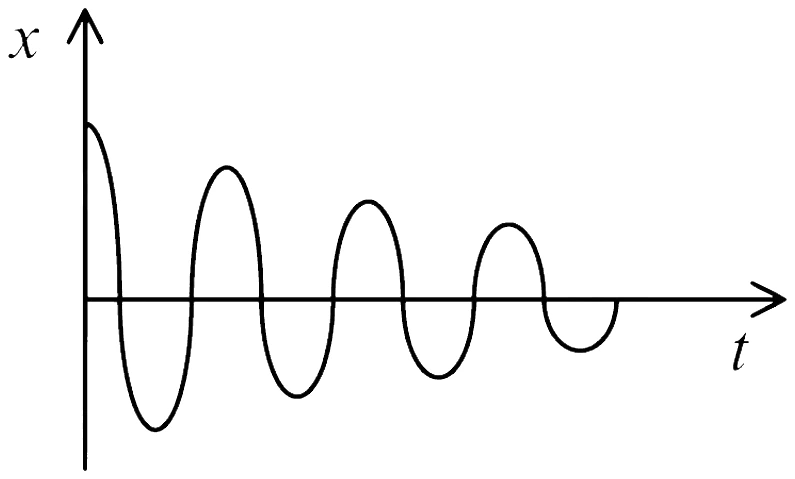
The amplitude of a damped oscillator becomes (31)rd of original amplitude in 2 seconds. If its amplitude after 6 second become (n1) times the original amplitude, the value of n is ( n is non zero integer)
A particle is subjected to two simple harmonic motions as: x1=7sin5t cm and x2=27sin(5t+3π) cm where x is displacement and t is time in seconds. The maximum acceleration of the particle is x×10−2 m s−2. The value of x is:
Q6JEE Main 2021 · 17 MAR · SHIFT 2MediumOld syllabus
Damped, Forced Oscillations & Superposition
A block of mass 1 kg attached to a spring is made to oscillate with an initial amplitude of 12 cm. After 2 minutes the amplitude decreases to 6 cm. Determine the value of the damping constant for this motion. (take ln 2 = 0.693)
Q7JEE Main 2021 · 16 MAR · SHIFT 2MediumOld syllabus
Damped, Forced Oscillations & Superposition
Amplitude of a mass-spring system, which is executing simple harmonic motion decreases with time. If mass = 500g, Decay constant = 20 g/s then how much time is required for the amplitude of the system to drop to half of its initial value? (ln 2 = 0.693)
Q11JEE Main 2019 · 8 APR · SHIFT 2MediumOld syllabus
Damped, Forced Oscillations & Superposition
A damped harmonic oscillator has a frequency of 5 oscillations per second. The amplitude drops to half its value for every 10 oscillations. The time it will take to drop to 1/1000 of the original amplitude is close to :-
Q13JEE Main 2017 · 9 APR · SHIFT 1MediumOld syllabus
Damped, Forced Oscillations & Superposition
A block of mass 0.1 kg is connected to an elastic spring of spring constant 640 Nm−1 and oscillates in a damping medium of damping constant 10−2 kg s−1. The system dissipates its energy gradually. The time taken for its mechanical energy of vibration to drop to half of its initial value, is closest to:
Q15JEE Main 2015 · 10 APR · SHIFT 1MediumOld syllabus
Damped, Forced Oscillations & Superposition
A simple harmonic oscillator of angular frequency 2 rad s−1 is acted upon by an external force F = sint N. If the oscillator is at rest in its equilibrium position at t = 0, its position at later times is proportional to:
Q17JEE Main 2015 · 11 APR · SHIFT 1DifficultOld syllabus
Damped, Forced Oscillations & Superposition
A pendulum with time period of 1s is losing energy due to damping. At certain time its energy is 45 J. If after completing 15 oscillations, its energy has become 15 J, its damping constant (in s−1) is:
A particle which is simultaneously subjected to two perpendicular simple harmonic motions represented by; x = a1 cos ωt and y = a2 cos 2ωt traces a curve given by:
Q19JEE Main 2014 · 11 APR · SHIFT 1DifficultOld syllabus
Damped, Forced Oscillations & Superposition
The angular frequency of the damped oscillator is given by,
ω=(mk−4m2r2) where k is the spring constant, m is the mass of the oscillator and r is the damping constant. If the ratio mkr2 is 8%, the change in time period compared to the undamped oscillator is approximately as follows:
Q20JEE Main 2014 · 9 APR · SHIFT 1DifficultOld syllabus
Damped, Forced Oscillations & Superposition
The amplitude of a simple pendulum, oscillating in air with a small spherical bob, decreases from 10 cm to 8 cm in 40 seconds. Assuming that Stokes law is valid, and ratio of the coefficient of viscosity of air to that of carbon dioxide is 1.3, the time in which amplitude of this pendulum will reduce from 10 cm to 5 cm in carbon dioxide will be close to (ln 5 = 1.609, ln 2 = 0.693).
Bob of a simple pendulum of length l is made of iron. The pendulum is oscillating over a horizontal coil carrying direct current. If the time period of the pendulum is T then:
The amplitude of a damped oscillator decreases to 0.9 times its original magnitude in 5 s. In another 10 s it will decrease to α times its original magnitude, where α equals
If a simple pendulum has significant amplitude (up to a factor of 1/e of original) only in the period between t=0 s to t=τ s, then τ may be called the average life of the pendulum When the spherical bob of the pendulum suffers a retardation (due to viscous drag) proportional to its velocity with b as the constant of proportionality, the average life time of the pendulum is (assuming damping is small) in seconds:
In forced oscillation of a particle the amplitude is maximum for a frequency ω1 of the force while the energy is maximum for a frequency ω2 of the force; then
A particle of mass m is attached to a spring (of spring constant k) and has a natural angular frequency ω0. An external force F(t) proportional to cosωt(ω=ω0) is applied to the oscillator. The time displacement of the oscillator will be proportional to
When an oscillator completes 100 oscillations its amplitude is reduced to 31 of initial value. What will be its amplitude, when it completes 200 oscillations?
A particle, with restoring force proportional to displacement and resisting force proportional to velocity is subjected to a force Fsinωt. If the amplitude of the particle is maximum for ω=ω1 and the energy of the particle is maximum for ω=ω2, then
(where ω0→ natural angular frequency of oscillations of particle)
The composition of two simple harmonic motions of equal periods at right angle to each other and with a phase difference of π results in the displacement of the particle along
A particle, with restoring force proportional to displacement and resisting force proportional to velocity is subjected to a force Fsinωt. If the amplitude of the particle is maximum for ω=ω1 and the energy of the particle is maximum for ω=ω2, then
A point mass is subjected to two simultaneous sinusoidal displacements in x-direction, x1(t)=Asinωt and x2(t)=Asin(ωt+32π). Adding a third sinusoidal displacement x3(t)=Bsin(ωt+ϕ) brings the mass to a complete rest. The values of B and ϕ are
Phase space diagrams are useful tools in analyzing all kinds of dynamical problems. They are especially useful in studying the changes in motion as initial position and momentum are changed. Here we consider some simple dynamical systems in one-dimension. For such systems, phase space is a plane in which position is plotted along horizontal axis and momentum is plotted along vertical axis. The phase space diagram is x(t) vs. p(t) curve in this plane. The arrow on the curve indicates the time flow. For example, the phase space diagram for a particle moving with constant velocity is a straight line as shown in the figure. We use the sign convention in which position or momentum upwards (or to right) is positive and downwards (or to left) is negative.
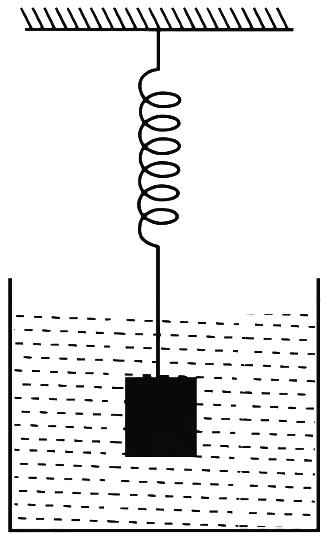
Consider the spring-mass system, with the mass submerged in water, as shown in the figure. The phase space diagram for one cycle of this system is
Assertion : Soldiers are asked to break steps while crossing the bridge. Reason : The frequency of marching may be equal to the natural frequency of bridge and may lead to resonance which can break the bridge.
A particle is subjected to two simple harmonic motions along X-axis while other is along a line making angle 45∘ with the X-axis. The two motions are given by x=x0sinωt and s=s0sinωt. The amplitude of resultant motion is
A particle is executing two different simple harmonic motions, mutually perpendicular, of different amplitudes and having phase difference of 2π. The path of the particle will be
A block of mass m is connected to a light spring of force constant k. The system is placed inside a damping medium of damping constant b. The instantaneous values of displacement, acceleration and energy of the block are x, a and E respectively. The initial amplitude of oscillation is A and ω′ is the angular frequency of oscillations. The incorrect expression related to the damped oscillations is
A particle executes two simple harmonic motions along mutually perpendicular axes, given by x=Asin(ω1t),y=Bcos(ω2t) where A=B and ω1=ω2. Which of the following best describes the resultant motion of the particle?
The mechanical energy of a damped harmonic oscillator at a time t=0 is 80J. If its mechanical energy becomes 40J after completing 15 oscillations, then the extra oscillations the oscillator has to complete so that its mechanical energy becomes 10J is
The amplitude of a damped harmonic oscillator becomes 50% of its initial value in a time of 12s. If the amplitude of the oscillator at a time of 36s is x% of its initial amplitude, then the value of x is
In a time of 2s, the amplitude of a damped oscillator becomes e1 times its initial amplitude A. In the next two seconds, the amplitude of the oscillator is
The displacement of a damped oscillator is x(t)=exp(−0.2t)cos(3.2t+ϕ), where t is time in second. The time required for the amplitude of the oscillator to become e1.21 times its initial amplitude is
The time taken for the amplitude of vibrations of a damped oscillator to drop to 25% of its initial value is t. The time taken for its mechanical energy to drop to 50% of its initial mechanical energy is
The amplitudes of a damped harmonic oscillator after 2 and 4 seconds are A1 and A2 respectively. If the initial amplitude of the oscillator is A0, then
The amplitude of a damped harmonic oscillator becomes 221 times its initial amplitude in a time of 6s. Additional time taken for the amplitude to become 421 times its initial amplitude is
If the amplitudes of a damped harmonic oscillator at times t=0, t1 and t2 are A0, A1 and A2 respectively, then the amplitude of the oscillator at a time of (t1+t2) is
If the amplitude of a damped harmonic oscillator becomes half of its initial amplitude in a time of 10s, then the time taken for the mechanical energy of the oscillator to become half of its initial mechanical energy is
In a time t amplitude of vibrations of a damped oscillator becomes half of its initial value, then the mechanical energy of the oscillator decreases by
The amplitude of a damped oscillator varies with time as A(t)=A0exp(−bt/2m), where b=70g/s and m=200g. How long does it take for the mechanical energy to drop to one-fourth of its initial value?