Physics Circle home Student Login

Home›Practice Hub›Chapters›Thermodynamics›Heat, Work & First Law of Thermodynamics

Thermodynamics PYQs · MHT CET · JEE Main · NEET

Heat, Work & First Law of Thermodynamics

Read the theory for this topic →

Questions
103
MHT CET
4
JEE Main
13
NEET
7
Other exams
79
▶ Video lectures on this topicThermodynamics · Lecture 1 · Zeroth Law & First Law1:06:40All 7 Thermodynamics videos →
0 of 103 attempted

Q1NEET 2026Easy

Heat, Work & First Law of Thermodynamics

An electric heater supplies heat to a system at a rate of 100 W. If the system performs work at a rate of 75 J/s75\text{ J/s}, then the rate at which internal energy increases will be:

Show answer and solution

Answer: (d)

Loading the solution…
Report a mistakeOpen question page
Q2JEE Main 2026 · 5 APR · SHIFT 1Easy

Heat, Work & First Law of Thermodynamics

Given below are two statements: one is labelled as Assertion A and the other is labelled as Reason R\mathbf{R}

Statement I: Change in internal energy of a system containing nn mole of ideal gas can be written as ΔU=nCv(Tf−Ti)=nRγ−1(Tf−Ti)\Delta U = nC_v\left(T_f - T_i\right) = \frac{nR}{\gamma-1}\left(T_f - T_i\right), where γ=CpCv,Ti=\gamma = \frac{C_p}{C_v}, T_i = initial temperature, Tf=T_f = final temperature. Statement II: Relation between degree of freedom ff and γ (=Cp/Cv)\gamma\,(= C_p/C_v) is (γ=1+2f)\left(\gamma = 1 + \frac{2}{f}\right) Choose the correct answer from the options given below

Show answer and solution

Answer: (b)

Loading the solution…
Report a mistakeOpen question page
Q3MHT CET 2026 · 20 MAY · SHIFT 1Medium

Heat, Work & First Law of Thermodynamics

An ideal gas having pressure P, volume V and temperature T undergoes a thermodynamic process in which dW=0dW = 0 and dQ<0dQ < 0. Then, for the gas

Show answer and solution

Answer: (d)

Loading the solution…
Report a mistakeOpen question page
Q4MHT CET 2026 · 19 APR · SHIFT 2Medium

Heat, Work & First Law of Thermodynamics

An ideal gas having pressure P, volume V and temperature T undergoes a thermodynamic process in which dW=0dW = 0 and dQ<0dQ < 0. Then, for the gas

Show answer and solution

Answer: (c)

Loading the solution…
Report a mistakeOpen question page
Q5MHT CET 2026 · 16 APR · SHIFT 2Medium

Heat, Work & First Law of Thermodynamics

One gram of a liquid is converted to vapour at 3×1053 \times 10^{5} Pa pressure. If 10% of the heat supplied is used for increasing the volume by 16001600 cm33 during this phase change, then the increase in internal energy in the process will be

Show answer and solution

Answer: (c)

Loading the solution…
Report a mistakeOpen question page
Q6JEE Main 2025 · 22 JAN · SHIFT 2Easy

Heat, Work & First Law of Thermodynamics

Given are statements for certain thermodynamic variables,

(A) Internal energy, volume (V)(V) and mass (M)(M) are extensive variables.

(B) Pressure (P), temperature ( T) and density ( ρ\rho) are intensive variables.

(C) Volume (V), temperature (T) and density ( ρ\rho) are intensive variables.

(D) Mass (M), temperature (T) and internal energy are extensive variables.

Choose the correct answer from the options given below:

Show answer and solution

Answer: (b)

Loading the solution…
Report a mistakeOpen question page
Q7JEE Main 2025 · 3 APR · SHIFT 1Medium

Heat, Work & First Law of Thermodynamics

During the melting of a slab of ice at 273 K at atmospheric pressure:

Show answer and solution

Answer: (c)

Loading the solution…
Report a mistakeOpen question page
Q8MHT CET 2024 · 16 MAY · SHIFT 1Medium

Heat, Work & First Law of Thermodynamics

If heat energy ΔQ\Delta Q is supplied to an ideal diatomic gas, the increase in internal energy is ΔU\Delta U and the amount of work done by the gas is ΔW\Delta W. The ratio ΔW:ΔU:ΔQ\Delta W : \Delta U : \Delta Q is

Show answer and solution

Answer: (b)

Loading the solution…
Report a mistakeOpen question page
Q9JEE Main 2023 · 6 APR · SHIFT 1Easy

Heat, Work & First Law of Thermodynamics

A source supplies heat to a system at the rate of 1000 W1000\text{ W}. If the system performs work at a rate of 200 W200\text{ W}. The rate at which internal energy of the system increases is

Show answer and solution

Answer: (d)

Loading the solution…
Report a mistakeOpen question page
Q10JEE Main 2023 · 29 JAN · SHIFT 1Easy

Heat, Work & First Law of Thermodynamics

Given below are two statements: One is labelled as Assertion A and the other is labelled as Reason R.

Assertion A: If dQdQ and dWdW represent the heat supplied to the system and the work done on the system respectively. Then according to the first law of thermodynamics dQ=dU−dWdQ = dU - dW. Reason R: First law of thermodynamics is based on law of conservation of energy. In the light of the above statements, choose the correct answer from the options given below:

Show answer and solution

Answer: (b)

Loading the solution…
Report a mistakeOpen question page
Q11JEE Main 2023 · 11 APR · SHIFT 1Medium

Heat, Work & First Law of Thermodynamics

1 kg1\text{ kg} of water at 100∘C100^\circ\text{C} is converted into steam at 100∘C100^\circ\text{C} by boiling at atmospheric pressure. The volume of water changes from 1.00×10⁻³ m31.00 \times 10^{-3}\text{ m}^{3} as a liquid to 1.671 m31.671\text{ m}^{3} as steam. The change in internal energy of the system during the process will be

(Given latent heat of vaporisation =2257 kJ/kg= 2257\text{ kJ/kg}, Atmospheric pressure = 1×10⁵ Pa)1 \times 10^{5}\text{ Pa})

Show answer and solution

Answer: (a)

Loading the solution…
Report a mistakeOpen question page
Q12JEE Main 2023 · 8 APR · SHIFT 1Medium

Heat, Work & First Law of Thermodynamics

Given below are two statements:

Statement I: If heat is added to a system, its temperature must increase.

Statement II: If positive work is done by a system in a thermodynamic process, its volume must increase.

In the light of the above statements, choose the correct answer from the options given below

Show answer and solution

Answer: (b)

Loading the solution…
Report a mistakeOpen question page
Q13JEE Main 2023 · 24 JAN · SHIFT 1Medium

Heat, Work & First Law of Thermodynamics

1 g of a liquid is converted to vapour at 3 ×\times 1055 Pa pressure. If 10% of the heat supplied is used for increasing the volume by 1600 cm33 during this phase change, then the increase in internal energy in the process will be:

Show answer and solution

Answer: (b)

Loading the solution…
Report a mistakeOpen question page
Q14JEE Main 2021 · 26 AUG · SHIFT 1Medium

Heat, Work & First Law of Thermodynamics

An electric appliance supplies 6000 J/min heat to the system. If the system delivers a power of 90W. How long it would take to increase the internal energy by 2.5 ×\times 103 J?

Show answer and solution

Answer: (a)

Loading the solution…
Report a mistakeOpen question page
Q15JEE Main 2021 · 17 MAR · SHIFT 2Medium

Heat, Work & First Law of Thermodynamics

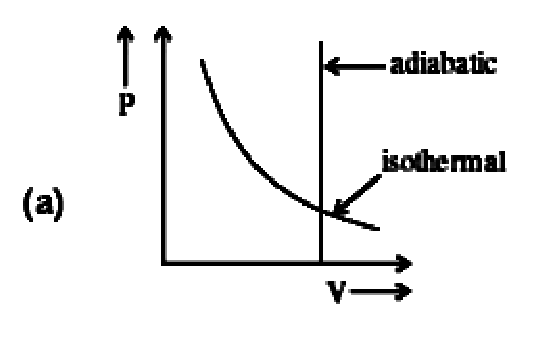
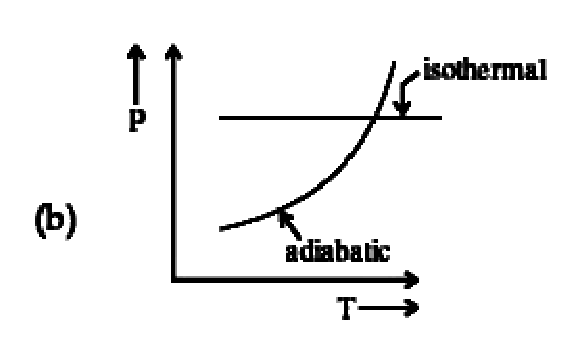
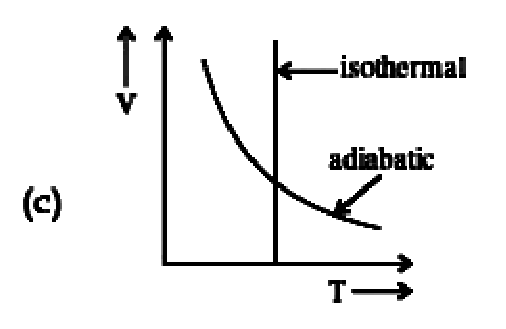
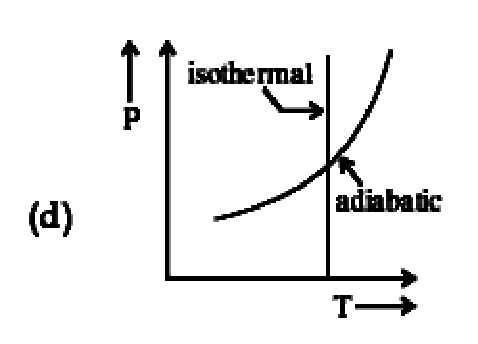
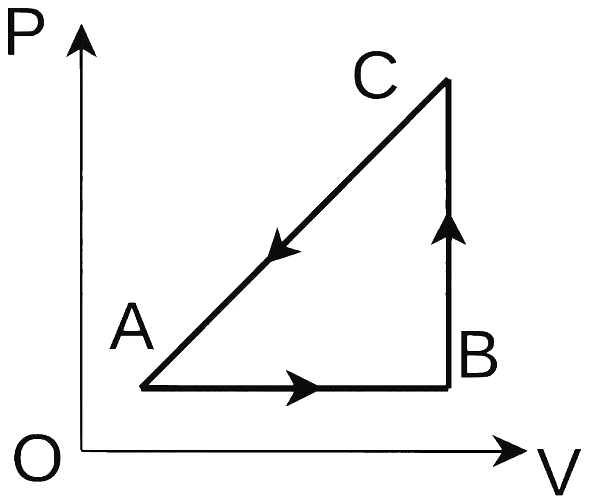
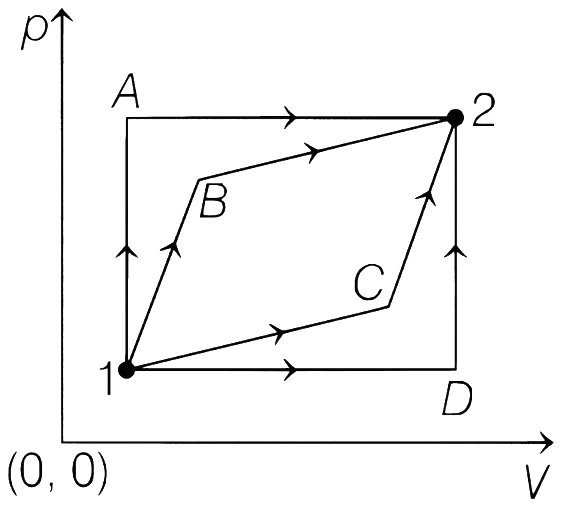
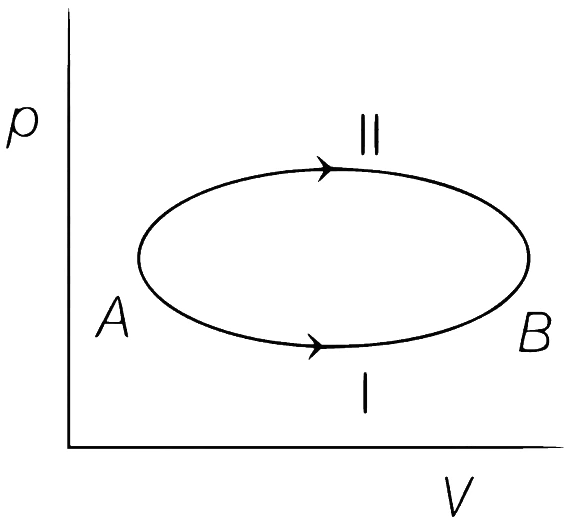
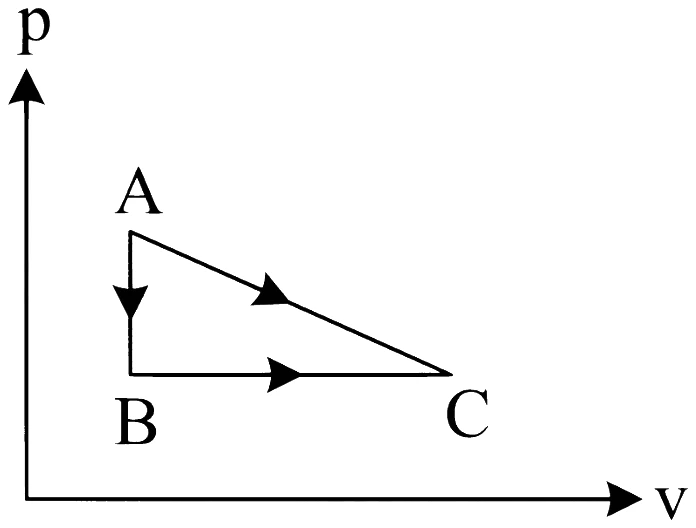
Which one is the correct option for the two different thermodynamic processes?

Figure

Figure

Figure

Figure

Show answer and solution

Answer: (b)

Loading the solution…
Report a mistakeOpen question page
Q16JEE Main 2021 · 1 SEP · SHIFT 2Medium

Heat, Work & First Law of Thermodynamics

The temperature of 3.00 mol of an ideal diatomic gas is increased by 40.0∘^\circC without changing the pressure of the gas. The molecules in the gas rotate but do not oscillate. If the ratio of change in internal energy of the gas to the amount of workdone by the gas is x10\frac{x}{10}. Then the value of x (round off to the nearest integer) is ___________. (Given R = 8.31 J mol−1{}^{-1} K−1{}^{-1})

Numerical answer type. Work it out, then open the answer.

Show answer and solution

Answer: 25

Loading the solution…
Report a mistakeOpen question page
Q17NEET 2019Medium

Heat, Work & First Law of Thermodynamics

1 g of water, of volume 1 cm31\text{ cm}^{3} at 100∘C100^\circ\text{C}, is converted into steam at same temperature under normal atmospheric pressure (≃1×10⁵ Pa\simeq 1 \times 10^{5}\text{ Pa}). The volume of steam formed equals 1671 cm31671\text{ cm}^{3}. If the specific latent heat of vaporisation of water is 2256 J/g2256\text{ J/g}, the change in internal energy is,

Show answer and solution

Answer: (c)

Loading the solution…
Report a mistakeOpen question page
Q18JEE Main 2019 · 12 JAN · SHIFT 2Difficult

Heat, Work & First Law of Thermodynamics

A vertical closed cylinder is separated into two parts by a frictionless piston of mass m and of negligible thickness. The piston is free to move along the length of the cylinder. The length of the cylinder above the piston is ℓ\ell1, and that below the piston is ℓ\ell2, such that ℓ\ell1 > ℓ\ell2. Each part of the cylinder contains n moles of an ideal gas at equal temperature T. If the piston is stationary, its mass, m, will be given by:

(R is universal gas constant and g is the acceleration due to gravity)

Show answer and solution

Answer: (a)

Loading the solution…
Report a mistakeOpen question page
Q19NEET 2018Medium

Heat, Work & First Law of Thermodynamics

A sample of 0.1 g of water at 100°C and normal pressure (1.013 × 10⁵ N m–2) requires 54 cal of heat energy to convert to steam at 100°C. If the volume of the steam produced is 167.1 cc, the change in internal energy of the sample, is

Show answer and solution

Answer: (b)

Loading the solution…
Report a mistakeOpen question page
Q20NEET 2009 · AIPMTEasy

Heat, Work & First Law of Thermodynamics

The internal energy change in a system that has absorbed 2 kcal of heat and done 500 J of work is

Show answer and solution

Answer: (c)

Loading the solution…
Report a mistakeOpen question page
Q21JEE Main 2003 · AIEEEEasy

Heat, Work & First Law of Thermodynamics

Which of the following parameters does not characterize the thermodynamic state of mattter?

Show answer and solution

Answer: (c)

Loading the solution…
Report a mistakeOpen question page
Q22NEET 1993 · AIPMTEasy

Heat, Work & First Law of Thermodynamics

Which of the following is not thermodynamical function?

Show answer and solution

Answer: (b)

Loading the solution…
Report a mistakeOpen question page
Q23NEET 1993 · AIPMTEasy

Heat, Work & First Law of Thermodynamics

110 joule of heat is added to a gaseous system whose internal energy is 40 J, then the amount of external work done is

Show answer and solution

Answer: (b)

Loading the solution…
Report a mistakeOpen question page
Q24NEET 1988 · AIPMTEasy

Heat, Work & First Law of Thermodynamics

First law of thermodynamics is consequence of conservation of

Show answer and solution

Answer: (b)

Loading the solution…
Report a mistakeOpen question page
Q25NDA 2019Easy

Heat, Work & First Law of Thermodynamics

If the work done on the system or by the system is zero, which one of the following statements for a gas kept at a certain temperature is correct?

Show answer

Answer: (a)

Step-by-step solution coming soon.

Report a mistake
Q26JEE Advanced 2025Medium

Heat, Work & First Law of Thermodynamics

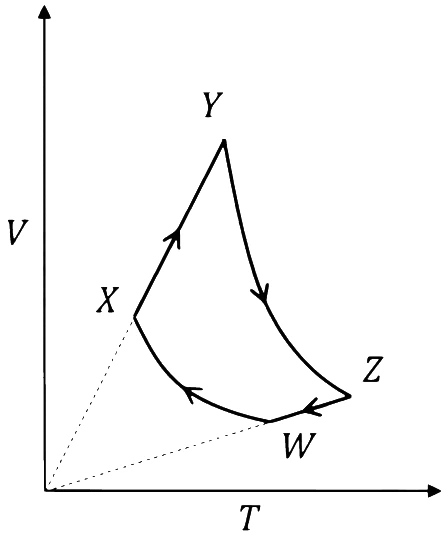
An ideal monatomic gas of nn moles is taken through a cycle WXYZWWXYZW consisting of consecutive adiabatic and isobaric quasi-static processes, as shown in the schematic V−TV-T diagram. The volume of the gas at WW, XX and YY points are, 64 cm364\,\text{cm}^3, 125 cm3125\,\text{cm}^3 and 250 cm3250\,\text{cm}^3, respectively. If the absolute temperature of the gas TWT_W at the point WW is such that nRTW=1 JnRT_W = 1\,\text{J} (RR is the universal gas constant), then the amount of heat absorbed (in J) by the gas along the path XYXY is __________.

V-T diagram of cycle W, X, Y, Z with adiabatic and isobaric segments; dotted lines from origin through X and W

Numerical answer type. Work it out, then open the answer.

Show answer

Answer: 1.6

Step-by-step solution coming soon.

Report a mistake
Q27JEE Advanced 2022Difficult

Heat, Work & First Law of Thermodynamics

List I describes thermodynamic processes in four different systems. List II gives the magnitudes (either exactly or as a close approximation) of possible changes in the internal energy of the system due to the process.

List-IList-II
(I) 10−3 kg10^{-3}\,\text{kg} of water at 100∘C100^\circ\text{C} is converted to steam at the same temperature, at a pressure of 105 Pa10^5\,\text{Pa}. The volume of the system changes from 10−6 m310^{-6}\,\text{m}^3 to 10−3 m310^{-3}\,\text{m}^3 in the process. Latent heat of water =2250 kJ/kg= 2250\,\text{kJ/kg}.(P) 2 kJ2\,\text{kJ}
(II) 0.20.2 moles of a rigid diatomic ideal gas with volume VV at temperature 500 K500\,\text{K} undergoes an isobaric expansion to volume 3V3V. Assume R=8.0 J mol−1K−1R = 8.0\,\text{J mol}^{-1}\text{K}^{-1}.(Q) 7 kJ7\,\text{kJ}
(III) One mole of a monatomic ideal gas is compressed adiabatically from volume V=13 m3V = \dfrac{1}{3}\,\text{m}^3 and pressure 2 kPa2\,\text{kPa} to volume V8\dfrac{V}{8}.(R) 4 kJ4\,\text{kJ}
(IV) Three moles of a diatomic ideal gas whose molecules can vibrate, is given 9 kJ9\,\text{kJ} of heat and undergoes isobaric expansion.(S) 5 kJ5\,\text{kJ}
(T) 3 kJ3\,\text{kJ}

Which one of the following options is correct?

Show answer

Answer: (c)

Step-by-step solution coming soon.

Report a mistake
Q28JEE Advanced 2021Difficult

Heat, Work & First Law of Thermodynamics

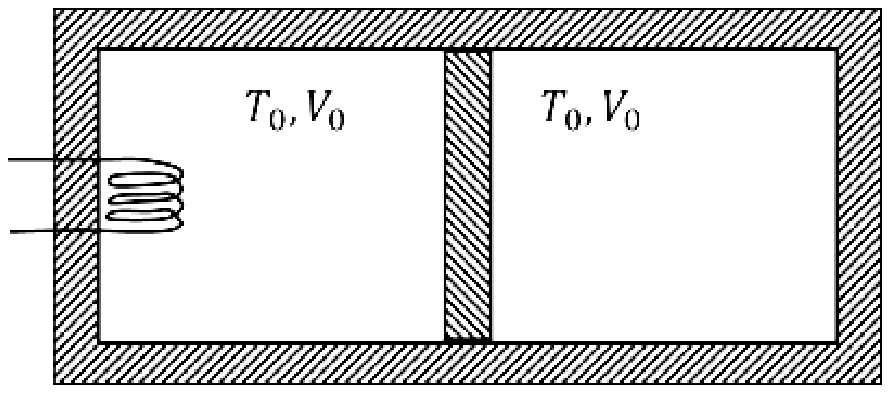
A thermally insulating cylinder has a thermally insulating and frictionless movable partition in the middle, as shown in the figure below. On each side of the partition, there is one mole of an ideal gas, with specific heat at constant volume, CV=2RC_V = 2R. Here, RR is the gas constant. Initially, each side has a volume V0V_0 and temperature T0T_0. The left side has an electric heater, which is turned on at very low power to transfer heat QQ to the gas on the left side. As a result the partition moves slowly towards the right reducing the right side volume to V0/2V_0/2. Consequently, the gas temperatures on the left and the right sides become TLT_L and TRT_R, respectively. Ignore the changes in the temperatures of the cylinder, heater and the partition.

The value of QRT0\dfrac{Q}{RT_0} is

Insulated cylinder with a movable insulating partition in the middle; each side holds gas at T0 and V0; heater coil in the left side
Show answer

Answer: (b)

Step-by-step solution coming soon.

Report a mistake
Q29JEE Advanced 2019Medium

Heat, Work & First Law of Thermodynamics

In a thermodynamic process on an ideal monatomic gas, the infinitesimal heat absorbed by the gas is given by TΔXT\Delta X, where TT is temperature of the system and ΔX\Delta X is the infinitesimal change in a thermodynamic quantity XX of the system. For a mole of monatomic ideal gas, X=32Rln⁡(TTA)+Rln⁡(VVA)X = \dfrac{3}{2}R\ln\left(\dfrac{T}{T_A}\right) + R\ln\left(\dfrac{V}{V_A}\right).
Here, RR is gas constant, VV is volume of gas, TAT_A and VAV_A are constants.
The List-I below gives some quantities involved in a process and List-II gives some possible values of these quantities.

List-IList-II
(I) Work done by the system in process 1→2→31\to2\to3(P) 13RT0ln⁡2\dfrac{1}{3}RT_0\ln 2
(II) Change in internal energy in process 1→2→31\to2\to3(Q) 13RT0\dfrac{1}{3}RT_0
(III) Heat absorbed by the system in process 1→2→31\to2\to3(R) RT0RT_0
(IV) Heat absorbed by the system in process 1→21\to2(S) 43RT0\dfrac{4}{3}RT_0
(T) 13RT0(3+ln⁡2)\dfrac{1}{3}RT_0(3+\ln 2)
(U) 56RT0\dfrac{5}{6}RT_0

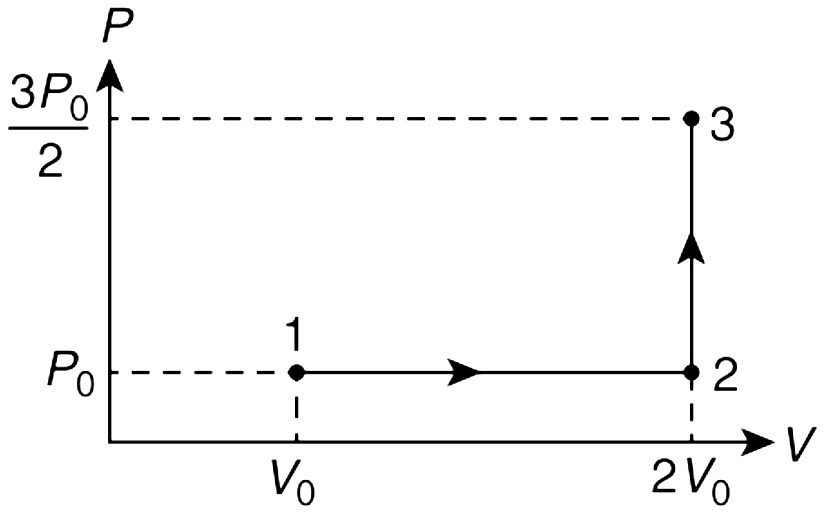
If the process carried out on one mole of monatomic ideal gas is as shown in the PVPV-diagram with p0V0=13RT0p_0V_0 = \dfrac{1}{3}RT_0, the correct match is,

P-V diagram: state 1 (V0, P0) to state 2 (2V0, P0) isobaric, then vertical rise to state 3 (2V0, 3P0/2)
Show answer

Answer: (d)

Step-by-step solution coming soon.

Report a mistake
Q30JEE Advanced 2019Difficult

Heat, Work & First Law of Thermodynamics

In a thermodynamic process on an ideal monatomic gas, the infinitesimal heat absorbed by the gas is given by TΔXT\Delta X where TT is temperature of the system and ΔX\Delta X is the infinitesimal change in a thermodynamic quantity XX of the system. For a mole of monatomic ideal gas, X=32Rln⁡(TTA)+Rln⁡(VVA)X = \dfrac{3}{2}R\ln\left(\dfrac{T}{T_A}\right) + R\ln\left(\dfrac{V}{V_A}\right).

Here, RR is gas constant, VV is volume of gas, TAT_A and VAV_A are constants.

The List-I below gives some quantities involved in a process and List-II gives some possible values of these quantities.

List-IList-II
(I) Work done by the system in process 1→2→31 \to 2 \to 3(P) 13RT0ln⁡2\dfrac{1}{3}RT_0\ln 2
(II) Change in internal energy in process 1→2→31 \to 2 \to 3(Q) 13RT0\dfrac{1}{3}RT_0
(III) Heat absorbed by the system in process 1→2→31 \to 2 \to 3(R) RT0RT_0
(IV) Heat absorbed by the system in process 1→21 \to 2(S) 43RT0\dfrac{4}{3}RT_0
(T) 13RT0(3+ln⁡2)\dfrac{1}{3}RT_0(3+\ln 2)
(U) 56RT0\dfrac{5}{6}RT_0

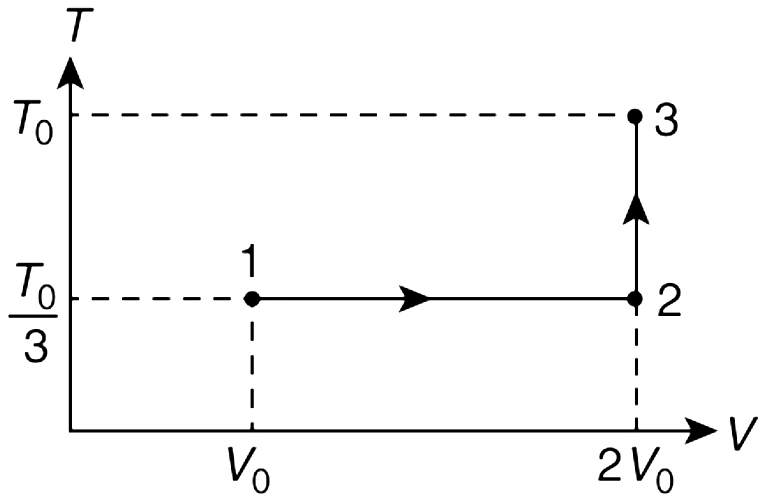
If the process on one mole of monatomic ideal gas is as shown in the TVTV-diagram with P0V0=13RT0P_0V_0 = \dfrac{1}{3}RT_0, the correct match is,

T-V diagram: point 1 at (V0, T0/3), horizontal line to point 2 at (2V0, T0/3), then vertical up to point 3 at (2V0, T0)
Show answer

Answer: (d)

Step-by-step solution coming soon.

Report a mistake
Q31JEE Advanced 2016Difficult

Heat, Work & First Law of Thermodynamics

A gas is enclosed in a cylinder with a movable frictionless piston. Its initial thermodynamic state at pressure Pi=105 PaP_i = 10^{5}\,\text{Pa} and volume Vi=10−3 m3V_i = 10^{-3}\,\text{m}^3 changes to a final state at Pf=(132)×105 PaP_f = \left(\dfrac{1}{32}\right)\times 10^{5}\,\text{Pa} and Vf=8×10⁻³ m3V_f = 8\times 10^{-3}\,\text{m}^3 in an adiabatic quasi-static process, such that P3V5=P^3V^5= constant. Consider another thermodynamic process that brings the system from the same initial state to the same final state in two steps: an isobaric expansion at PiP_i followed by an isochoric (isovolumetric) process at volume VfV_f. The amount of heat supplied to the system in the two-step process is approximately

Show answer

Answer: (c)

Step-by-step solution coming soon.

Report a mistake
Q32JEE Advanced 2015Difficult

Heat, Work & First Law of Thermodynamics

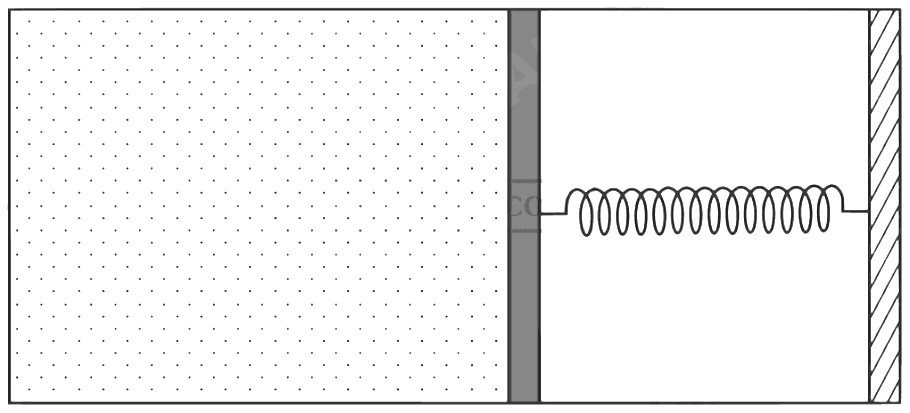
An ideal monoatomic gas is confined in a horizontal cylinder by a spring loaded piston (as shown in the figure). Initially the gas is at temperature T1T_1, pressure P1P_1 and volume V1V_1 and the spring is in its relaxed state. The gas is then heated very slowly to temperature T2T_2, pressure P2P_2 and volume V2V_2. During this process the piston moves out by a distance xx.

Ignoring the friction between the piston and the cylinder, the correct statements is/are

Horizontal cylinder with gas (dotted region) on the left of a movable piston, and a spring connecting the piston to the fixed right wall

More than one option can be correct. Tap every correct option, then tap Check.

Show answer

Answer: (a), (b), (c)

Step-by-step solution coming soon.

Report a mistake
Q33JEE Advanced 2014Medium

Heat, Work & First Law of Thermodynamics

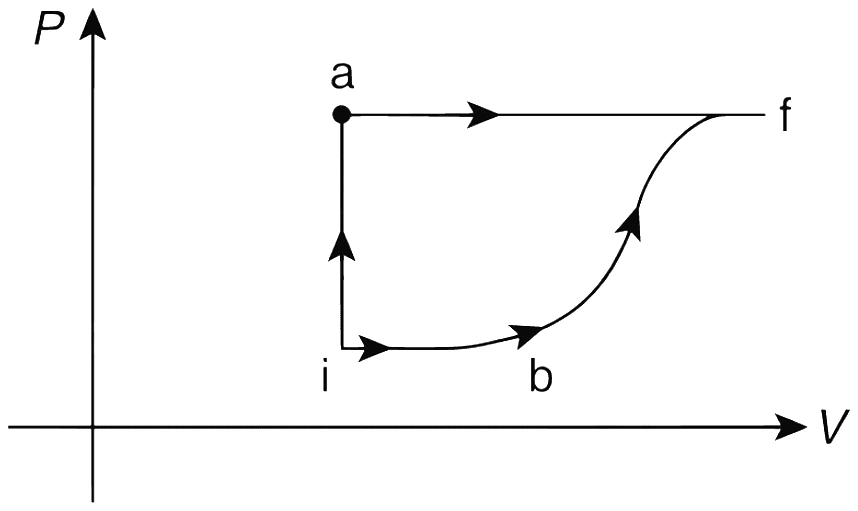
A thermodynamic system is taken from an initial state ii with internal energy Ui=100 JU_i = 100\,\text{J} to the final state ff along two different paths iafiaf and ibfibf, as schematically shown in the figure. The work done by the system along the paths afaf, ibib and bfbf are Waf=200 JW_{af} = 200\,\text{J}, Wib=50 JW_{ib} = 50\,\text{J} and Wbf=100 JW_{bf} = 100\,\text{J} respectively. The heat supplied to the system along the path iafiaf, ibib and bfbf are QiafQ_{iaf}, QibQ_{ib} and QbfQ_{bf} respectively. If the internal energy of the system in the state bb is Ub=200 JU_b = 200\,\text{J} and Qiaf=500 JQ_{iaf} = 500\,\text{J}, the ratio Qbf/QibQ_{bf}/Q_{ib} is

P-V diagram: state i at bottom left, a above i, b to the right of i along a curve, f at top right; paths iaf and ibf

Numerical answer type. Work it out, then open the answer.

Show answer

Answer: 2

Step-by-step solution coming soon.

Report a mistake
Q34JEE Advanced 2014Medium

Heat, Work & First Law of Thermodynamics

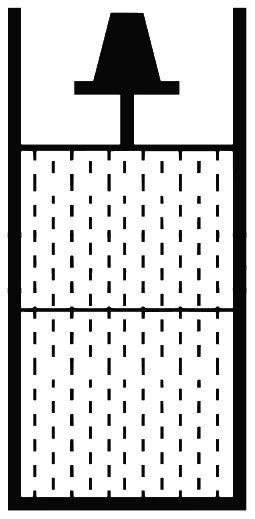
In the figure a container is shown to have a movable (without friction) piston on top. The container and the piston are all made of perfectly insulating material allowing no heat transfer between outside and inside the container. The container is divided into two compartments by a rigid partition made of a thermally conducting material that allows slow transfer of heat. The lower compartment of the container is filled with 22 moles of an ideal monatomic gas at 700 K700\,\text{K} and the upper compartment is filled with 22 moles of an ideal diatomic gas at 400 K400\,\text{K}. The heat capacities per mole of an ideal monatomic gas are Cv=32R, Cp=52RC_v=\dfrac{3}{2}R,\ C_p=\dfrac{5}{2}R, and those for an ideal diatomic gas are Cv=52R, Cp=72RC_v=\dfrac{5}{2}R,\ C_p=\dfrac{7}{2}R.
Consider the partition to be rigidly fixed so that it does not move. When equilibrium is achieved, the final temperature of the gases will be

Insulated cylinder with movable piston on top and a conducting partition dividing it into lower and upper gas compartments
Show answer

Answer: (d)

Step-by-step solution coming soon.

Report a mistake
Q35JEE Advanced 2014Difficult

Heat, Work & First Law of Thermodynamics

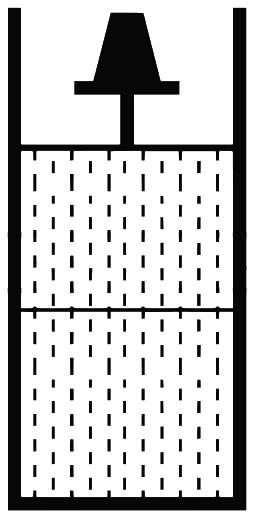
In the figure a container is shown to have a movable (without friction) piston on top. The container and the piston are all made of perfectly insulating material allowing no heat transfer between outside and inside the container. The container is divided into two compartments by a rigid partition made of a thermally conducting material that allows slow transfer of heat. The lower compartment of the container is filled with 22 moles of an ideal monatomic gas at 700 K700\,\text{K} and the upper compartment is filled with 22 moles of an ideal diatomic gas at 400 K400\,\text{K}. The heat capacities per mole of an ideal monatomic gas are Cv=32R, Cp=52RC_v=\dfrac{3}{2}R,\ C_p=\dfrac{5}{2}R, and those for an ideal diatomic gas are Cv=52R, Cp=72RC_v=\dfrac{5}{2}R,\ C_p=\dfrac{7}{2}R.
Now consider the partition to be free to move without friction so that the pressure of gases in both compartments is the same. Then total work done by the gases till the time they achieve equilibrium will be

Insulated cylinder with movable piston on top and a conducting partition dividing it into lower and upper gas compartments
Show answer

Answer: (d)

Step-by-step solution coming soon.

Report a mistake
Q36JEE Advanced 2009Medium

Heat, Work & First Law of Thermodynamics

Column II gives certain systems undergoing a process. Column I suggests changes in some of the parameters related to the system. Match the statements in Column I to the appropriate process(es) from Column II.

Column IColumn II
(A) The energy of the system is increased.(P) System: A capacitor, initially uncharged. Process: It is connected to a battery.
(B) Mechanical energy is provided to the system, which is converted into energy of random motion of its parts.(Q) System: A gas in an adiabatic container filled with an adiabatic piston. Process: The gas is compressed by pushing the piston.
(C) Internal energy of the system is converted into its mechanical energy.(R) System: A gas in a rigid container. Process: The gas gets cooled due to colder atmosphere surrounding it.
(D) Mass of the system is decreased.(S) System: A heavy nucleus, initially at rest. Process: The nucleus fissions into two fragments of nearly equal masses and some neutrons are emitted.
(T) System: A resistive wire loop. Process: The loop is placed in a time varying magnetic field perpendicular to its plane.
Show answer

Answer: (b)

Step-by-step solution coming soon.

Report a mistake
Q37AIIMS 2019Easy

Heat, Work & First Law of Thermodynamics

In an isobaric process, the work done by a di-atomic gas is 10 J10\,\text{J}, the heat given to the gas will be

Show answer

Answer: (a)

Step-by-step solution coming soon.

Report a mistake
Q38AIIMS 2018Easy

Heat, Work & First Law of Thermodynamics

Assertion: In isothermal process, whole of the heat energy supplied to the body is converted into internal energy.
Reason: According to the first law of thermodynamics, ΔQ=ΔU+ΔW\Delta Q = \Delta U + \Delta W

Show answer

Answer: (d)

Step-by-step solution coming soon.

Report a mistake
Q39AIIMS 2013Easy

Heat, Work & First Law of Thermodynamics

When 20 J20\,\text{J} of work was done on a gas, 40 J40\,\text{J} of heat energy was released. If the initial internal energy of the gas was 70 J70\,\text{J}, what is the final internal energy?

Show answer

Answer: (a)

Step-by-step solution coming soon.

Report a mistake
Q40AIIMS 2012Easy

Heat, Work & First Law of Thermodynamics

The heat required to increase the temperature of 4 moles of a monoatomic ideal gas from 273 K273\,\text{K} to 473 K473\,\text{K} at constant volume is

Show answer

Answer: (d)

Step-by-step solution coming soon.

Report a mistake
Q41AIIMS 2012Easy

Heat, Work & First Law of Thermodynamics

Assertion : Soft steel can be made red hot by continued hammering on it, but hard steel cannot.
Reason : Energy transfer in case of soft is large as in hard steel.

Show answer

Answer: (a)

Step-by-step solution coming soon.

Report a mistake
Q42AIIMS 2010Easy

Heat, Work & First Law of Thermodynamics

Assertion : If a gas container in motion is suddenly stopped, the temperature of the gas rises.
Reason : The kinetic energy of ordered mechanical motion is converted into the kinetic energy of random motion of gas molecules.

Show answer

Answer: (a)

Step-by-step solution coming soon.

Report a mistake
Q43AIIMS 2009Easy

Heat, Work & First Law of Thermodynamics

A perfect gas goes from state AA to state BB by absorbing 8×10⁵ J8 \times 10^{5}\,\text{J} of heat and doing 6.5×10⁵ J6.5 \times 10^{5}\,\text{J} of external work. It is now transferred between the same two states in another process in which it absorbs 105 J10^{5}\,\text{J} of heat. In the second process

Show answer

Answer: (b)

Step-by-step solution coming soon.

Report a mistake
Q44JIPMER 2015Medium

Heat, Work & First Law of Thermodynamics

1 kg1\,\text{kg} of water is converted into steam at the same temperature and at 1 atm1\,\text{atm} (100 kPa100\,\text{kPa}). The density of water and steam are 1000 kg m−31000\,\text{kg m}^{-3} and 0.6 kg m−30.6\,\text{kg m}^{-3} respectively. The latent heat of vaporisation of water is 2.25×10⁶ J kg−12.25 \times 10^{6}\,\text{J kg}^{-1}. What will be increase in energy?

Show answer

Answer: (c)

Step-by-step solution coming soon.

Report a mistake
Q45JIPMER 2015Medium

Heat, Work & First Law of Thermodynamics

A diatomic gas (γ=1.4\gamma = 1.4) does 200 J200\,\text{J} of work when it is expanded isobarically. Find the heat given to the gas in the process.

Show answer

Answer: (b)

Step-by-step solution coming soon.

Report a mistake
Q46JIPMER 2013Easy

Heat, Work & First Law of Thermodynamics

A gas expands 0.25 m30.25\,\text{m}^3 at constant pressure 103 N/m210^{3}\,\text{N/m}^2, the work done is

Show answer

Answer: (c)

Step-by-step solution coming soon.

Report a mistake
Q47JIPMER 2009Easy

Heat, Work & First Law of Thermodynamics

Which of the following parameters does not characterise the thermodynamic state of matter?

Show answer

Answer: (c)

Step-by-step solution coming soon.

Report a mistake
Q48JIPMER 2008Easy

Heat, Work & First Law of Thermodynamics

We consider a thermodynamic system. If ΔU\Delta U represents the increase in its internal energy and WW the work done by the system, which of the following statements is true?

Show answer

Answer: (a)

Step-by-step solution coming soon.

Report a mistake
Q49JIPMER 2004Easy

Heat, Work & First Law of Thermodynamics

If heat of 110 J110\,\text{J} is added to a gaseous system, whose internal energy is 40 J40\,\text{J}, then the amount of external work done is

Show answer

Answer: (b)

Step-by-step solution coming soon.

Report a mistake
Q50BITSAT 2025Easy

Heat, Work & First Law of Thermodynamics

In a certain process, 400 cal400\,\text{cal} of heat is supplied to a system and at the same time 105 J105\,\text{J} of mechanical work was done on the system. The increase in its internal energy is

Show answer

Answer: (d)

Step-by-step solution coming soon.

Report a mistake
Q51BITSAT 2022Medium

Heat, Work & First Law of Thermodynamics

A monoatomic gas of molar mass mm is kept in an insulated container. The container is moving with velocity vv. If the container is suddenly stopped, then the change in the temperature of the gas is

Show answer

Answer: (d)

Step-by-step solution coming soon.

Report a mistake
Q52VITEEE 2025Easy

Heat, Work & First Law of Thermodynamics

When an ideal monoatomic gas is heated at constant pressure, the fraction of heat energy supplied which increases the internal energy of the gas is

Show answer

Answer: (b)

Step-by-step solution coming soon.

Report a mistake
Q53VITEEE 2023Difficult

Heat, Work & First Law of Thermodynamics

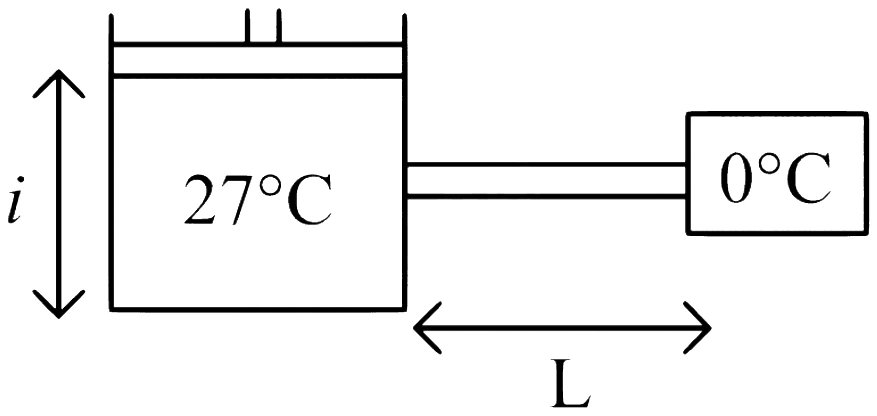
0.50.5 mole of an ideal gas at constant temperature 27∘C27^\circ\text{C} kept inside a cylinder of length LL and cross-section AA closed by a massless piston. The cylinder is attached with a conducting rod of length L1L_1 cross-section area (1/9) m2(1/9)\,\text{m}^2 and thermal conductivity k1k_1 whose other end is maintained at 0∘C0^\circ\text{C}. If piston is moved such that rate of heat flow through the conduction rod is constant then velocity of piston when it is at height L/2L/2 from the bottom of cylinder is (neglect any kind of heat loss from system)

Cylinder with movable piston containing gas at 27 degrees C, connected by a horizontal rod of length L to a block at 0 degrees C; height of piston marked
Show answer

Answer: (c)

Step-by-step solution coming soon.

Report a mistake
Q54VITEEE 2022Medium

Heat, Work & First Law of Thermodynamics

If 22 moles of an ideal monoatomic gas at temperature T0T_0 is mixed with 44 moles of another ideal monoatomic gas at temperature 2T02T_0, then the temperature of the mixture is

Show answer

Answer: (a)

Step-by-step solution coming soon.

Report a mistake
Q55VITEEE 2022Medium

Heat, Work & First Law of Thermodynamics

If the ratio of specific heat of a gas at constant pressure to that at constant volume is γ\gamma, the change in internal energy of the given mass of gas, when the volume changes from VV to 2V2V at constant pressure pp is

Show answer

Answer: (c)

Step-by-step solution coming soon.

Report a mistake
Q56VITEEE 2019Medium

Heat, Work & First Law of Thermodynamics

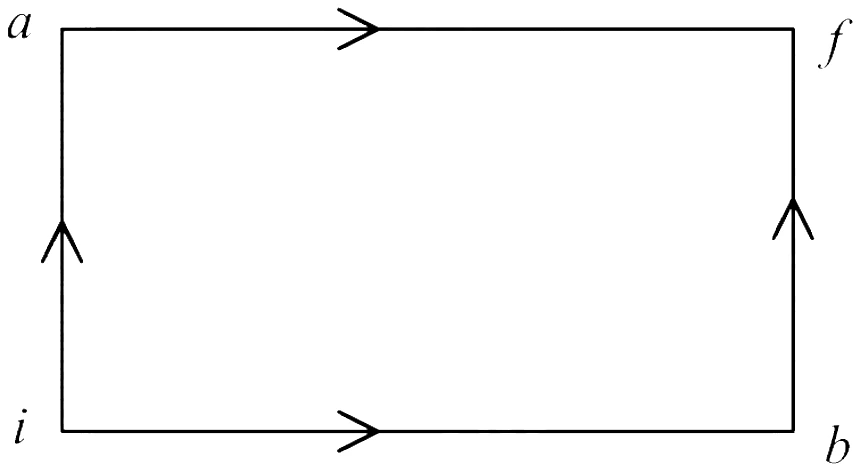
When a system is taken from state ii to state ff along the path iafiaf, it is found that Q=50 calQ = 50\,\text{cal} and W=20 calW = 20\,\text{cal}. Along the path ibfibf, Q=36 calQ = 36\,\text{cal}. WW along the path ibfibf is

Rectangle with corners i (bottom left), a (top left), f (top right), b (bottom right); paths iaf and ibf shown with arrows
Show answer

Answer: (b)

Step-by-step solution coming soon.

Report a mistake
Q57COMEDK 2026Medium

Heat, Work & First Law of Thermodynamics

1 kg1\,\text{kg} of water at 100∘C100^\circ\text{C} is converted to steam at the same temperature. Volume of 1 kg1\,\text{kg} of water changes to 1671×103 cc1671\times10^{3}\,\text{cc} on boiling. The change in internal energy of the system is (Latent heat of vaporisation of water is 22.68×10⁵ J kg−122.68\times10^{5}\,\text{J kg}^{-1}; 1 atm=1.0×10⁵ Pa1\,\text{atm} = 1.0\times10^{5}\,\text{Pa})

Show answer

Answer: (d)

Step-by-step solution coming soon.

Report a mistake
Q58COMEDK 2024Easy

Heat, Work & First Law of Thermodynamics

The latent heat of vaporisation of water is 2240 J2240\,\text{J}. If the work done in the process of vaporisation of 1 g1\,\text{g} is 168 J168\,\text{J}, the increase in internal energy is

Show answer

Answer: (b)

Step-by-step solution coming soon.

Report a mistake
Q59COMEDK 2024Medium

Heat, Work & First Law of Thermodynamics

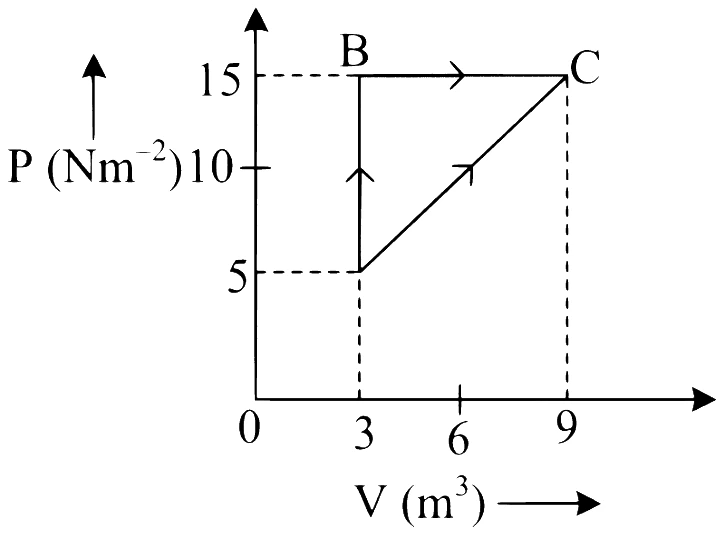
An ideal gas changes its state from AA to CC in two different paths ABCABC and ACAC. The internal energy of the gas at state CC is 20 J20\,\text{J} and at state BB is 10 J10\,\text{J}. Heat supplied to the gas to go from B→CB \to C is

P-V graph: A(3,5) to B(3,15) vertical, B to C(9,15) horizontal, and A to C straight line; P in N/m2, V in m3
Show answer

Answer: (c)

Step-by-step solution coming soon.

Report a mistake
Q60COMEDK 2023Easy

Heat, Work & First Law of Thermodynamics

If 150 J150\,\text{J} of heat is added to a system and the work done by the system is 110 J110\,\text{J}, then change in internal energy will be

Show answer

Answer: (a)

Step-by-step solution coming soon.

Report a mistake
Q61COMEDK 2023Medium

Heat, Work & First Law of Thermodynamics

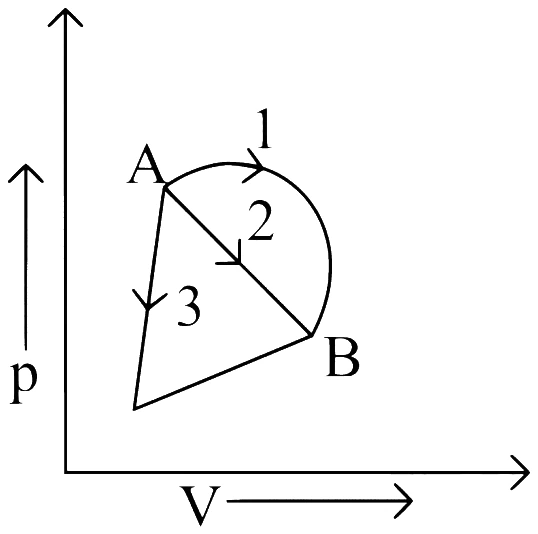
An ideal gas goes from state AA to state BB via three different processes as indicated in the pp-VV diagram. If Q1Q_1, Q2Q_2 and Q3Q_3 indicate the heat absorbed by the three processes and ΔU1\Delta U_1, ΔU2\Delta U_2 and ΔU3\Delta U_3 indicate the change in internal energy along the three processes respectively, then

p-V diagram with three paths from A to B: curved arc 1 above, straight line 2, and path 3 below
Show answer

Answer: (a)

Step-by-step solution coming soon.

Report a mistake
Q62KCET 2025Easy

Heat, Work & First Law of Thermodynamics

A gas is taken from state AA to state BB along two different paths 11 and 22. The heat absorbed and work done by the system along these two paths are Q1Q_1 and Q2Q_2 and W1W_1 and W2W_2 respectively. Then

Show answer

Answer: (b)

Step-by-step solution coming soon.

Report a mistake
Q63AP EAPCET 2026Easy

Heat, Work & First Law of Thermodynamics

A thermodynamic system goes from states
i) P,VP, V to P,2VP, 2V
ii) P1,VP_1, V to 2P1,V2P_1, V
Then works done in these two cases are

Show answer

Answer: (d)

Step-by-step solution coming soon.

Report a mistake
Q64AP EAPCET 2026Easy

Heat, Work & First Law of Thermodynamics

An electric heater supplies heat to a system at a rate of 100 W100\,\text{W}. If the system performs work at a rate of 7575 joules per second, the rate of increase of internal energy is

Show answer

Answer: (b)

Step-by-step solution coming soon.

Report a mistake
Q65AP EAPCET 2026Medium

Heat, Work & First Law of Thermodynamics

The PP-VV diagram of a system undergoing thermodynamic transformation is shown in the figure. The work done on the system in going from A→B→C→AA\to B\to C\to A is 50 J50\,\text{J} and 20 cal20\,\text{cal} heat is given to the system. The change in internal energy between AA and CC is

P-V diagram: A at low P and low V, B to its right at same P, C above B at same V; cycle A to B to C back to A
Show answer

Answer: (d)

Step-by-step solution coming soon.

Report a mistake
Q66AP EAPCET 2026Medium

Heat, Work & First Law of Thermodynamics

Assertion (A): When 1 g1\,\text{g} of ice melts at constant temperature at a pressure of 1 atm1\,\text{atm}, the increase in internal energy is greater than 80 cal80\,\text{cal} (latent heat of fusion of ice =80 cal g−1= 80\,\text{cal g}^{-1}).
Reason (R): During melting of ice, work is done on the ice.
Choose the correct option from the following.

Show answer

Answer: (a)

Step-by-step solution coming soon.

Report a mistake
Q67AP EAPCET 2025Easy

Heat, Work & First Law of Thermodynamics

The heat supplied to a gas at a constant pressure of 5×10⁵ Pa5\times10^{5}\,\text{Pa} is 1000 kJ1000\,\text{kJ}. If the volume of gas changes from 1 m31\,\text{m}^3 to 2.5 m32.5\,\text{m}^3, then the change in internal energy of the gas is

Show answer

Answer: (a)

Step-by-step solution coming soon.

Report a mistake
Q68AP EAPCET 2025Easy

Heat, Work & First Law of Thermodynamics

The work done by 66 moles of helium gas when its temperature increases by 20∘C20^\circ\text{C} at constant pressure is (universal gas constant =8.31 J mol−1K−1= 8.31\,\text{J mol}^{-1}\text{K}^{-1})

Show answer

Answer: (c)

Step-by-step solution coming soon.

Report a mistake
Q69AP EAPCET 2025Medium

Heat, Work & First Law of Thermodynamics

The change in internal energy of a given mass of a gas, when its volume changes from VV to 3V3V at constant pressure pp, is (γ\gamma = ratio of the specific heat capacities of the gas)

Show answer

Answer: (b)

Step-by-step solution coming soon.

Report a mistake
Q70AP EAPCET 2024Easy

Heat, Work & First Law of Thermodynamics

A gas absorbs 18 J18\,\text{J} of heat and work done on the gas is 12 J12\,\text{J}. Then, the change in internal energy of the gas is

Show answer

Answer: (d)

Step-by-step solution coming soon.

Report a mistake
Q71AP EAPCET 2024Easy

Heat, Work & First Law of Thermodynamics

When 40 J40\,\text{J} of heat is absorbed by a monoatomic gas the increase in the internal energy of the gas is

Show answer

Answer: (c)

Step-by-step solution coming soon.

Report a mistake
Q72AP EAPCET 2024Medium

Heat, Work & First Law of Thermodynamics

When 80 J80\,\text{J} of heat is absorbed by a monoatomic gas, its volume increases by 16×10−5 m316 \times 10^{-5}\,\text{m}^3. The pressure of the gas is

Show answer

Answer: (a)

Step-by-step solution coming soon.

Report a mistake
Q73AP EAPCET 2024Medium

Heat, Work & First Law of Thermodynamics

Initially the pressure of 11 mole of an ideal gas is 105 N m−210^{5}\,\text{N m}^{-2} and its volume is 16 L16\,\text{L}. When it is adiabatically compressed, its final volume is 2 L2\,\text{L}. Work-done on the gas is

[ molar specific heat at constant volume =32R= \dfrac{3}{2}R ]

Show answer

Answer: (b)

Step-by-step solution coming soon.

Report a mistake
Q74AP EAPCET 2024Medium

Heat, Work & First Law of Thermodynamics

The work done by an ideal gas of 22 moles in increasing its volume from VV to 2V2V at constant temperature TT is WW. The work done by an ideal gas of 44 moles in increasing its volume from VV to 8V8V at constant temperature T2\dfrac{T}{2} is

Show answer

Answer: (c)

Step-by-step solution coming soon.

Report a mistake
Q75AP EAPCET 2022Medium

Heat, Work & First Law of Thermodynamics

A gas is expanded from an initial state to a final state along a path on a pp-VV diagram. The path consists of (i) an isothermal expansion of work 50 J50\,\text{J}, (ii) an adiabatic expansion and (iii) an isothermal expansion of work 20 J20\,\text{J}. If the internal energy of gas is changed by −30 J-30\,\text{J}, then the work done by gas during adiabatic expansion is

Show answer

Answer: (c)

Step-by-step solution coming soon.

Report a mistake
Q76AP EAPCET 2021Easy

Heat, Work & First Law of Thermodynamics

A system is taken from state-A to state-B along two different paths. The heat absorbed and work done by the system along these two paths are Q1,Q2Q_1, Q_2 and W1,W2W_1, W_2 respectively, then

Show answer

Answer: (c)

Step-by-step solution coming soon.

Report a mistake
Q77AP EAPCET 2021Medium

Heat, Work & First Law of Thermodynamics

An ideal gas is taken from state-1 to state-2 through optional path A,B,CA, B, C and DD as shown in the pp-VV diagram. Let QQ, WW and UU represent the heat supplied, work done and change in internal energy respectively, then

p-V diagram with four paths A, B, C, D from state 1 (low p, low V) to state 2 (high p, high V)
Show answer

Answer: (a)

Step-by-step solution coming soon.

Report a mistake
Q78TS EAMCET 2026Easy

Heat, Work & First Law of Thermodynamics

At a constant pressure of 2×10⁵ N m−22\times10^{5}\,\text{N m}^{-2}, if the volume of 44 moles of a monoatomic gas changes from 1000 cc1000\,\text{cc} to 1500 cc1500\,\text{cc}, then the change in internal energy of the gas is

Show answer

Answer: (a)

Step-by-step solution coming soon.

Report a mistake
Q79TS EAMCET 2026Medium

Heat, Work & First Law of Thermodynamics

At constant pressure, if equal amounts of heat are supplied to a monoatomic gas and a rigid diatomic gas, then the ratio of the changes in the internal energies of the monoatomic and diatomic gases is

Show answer

Answer: (c)

Step-by-step solution coming soon.

Report a mistake
Q80TS EAMCET 2025Easy

Heat, Work & First Law of Thermodynamics

The ratio of the work done, change in internal energy and heat absorbed when a diatomic gas expands at constant pressure is

Show answer

Answer: (d)

Step-by-step solution coming soon.

Report a mistake
Q81TS EAMCET 2025Medium

Heat, Work & First Law of Thermodynamics

At constant pressure, equal amounts of heat are supplied to a monoatomic gas and a diatomic gas separately. The ratio of the increases in internal energies of the two gases is

Show answer

Answer: (d)

Step-by-step solution coming soon.

Report a mistake
Q82TS EAMCET 2024Easy

Heat, Work & First Law of Thermodynamics

If dQdQ, dUdU and dWdW are heat energy absorbed, change in internal energy and external work done respectively by a diatomic gas at constant pressure, then dW:dU:dQdW : dU : dQ is

Show answer

Answer: (d)

Step-by-step solution coming soon.

Report a mistake
Q83TS EAMCET 2024Medium

Heat, Work & First Law of Thermodynamics

When Q1Q_1 amount of heat is supplied to a monoatomic gas, the work done by the gas is WW. When Q2Q_2 amount of heat is supplied to a diatomic gas, the work done by the gas is 2W2W. Then, Q1:Q2Q_1:Q_2.

Show answer

Answer: (d)

Step-by-step solution coming soon.

Report a mistake
Q84TS EAMCET 2023Easy

Heat, Work & First Law of Thermodynamics

When some amount of heat energy is supplied to a monoatomic gas, the percentage of heat energy used for increasing the internal energy of the gas (γ=5/3)(\gamma = 5/3) is

Show answer

Answer: (a)

Step-by-step solution coming soon.

Report a mistake
Q85TS EAMCET 2023Easy

Heat, Work & First Law of Thermodynamics

The percentage of heat supplied to a diatomic ideal gas that is converted into work in an isobaric process is

Show answer

Answer: (c)

Step-by-step solution coming soon.

Report a mistake
Q86TS EAMCET 2023Medium

Heat, Work & First Law of Thermodynamics

An insulating cylinder contains 44 moles of an ideal diatomic gas. When a heat QQ is supplied to it, 22 moles of the gas molecules dissociate. If the temperature of the gas remains constant, then the value of QQ is (RR = universal gas constant)

Show answer

Answer: (b)

Step-by-step solution coming soon.

Report a mistake
Q87TS EAMCET 2022Easy

Heat, Work & First Law of Thermodynamics

An amount of 700 J700\,\text{J} of heat is transferred to a diatomic gas allowing it to expand with the pressure held constant. The work done on the gas is

Show answer

Answer: (a)

Step-by-step solution coming soon.

Report a mistake
Q88TS EAMCET 2022Easy

Heat, Work & First Law of Thermodynamics

Assertion (A): Heat and work are modes of energy transfer to a system resulting in change in its internal energy.
Reason (R): Heat and work in thermodynamics are state variables.
The correct option among the following is

Show answer

Answer: (c)

Step-by-step solution coming soon.

Report a mistake
Q89TS EAMCET 2022Easy

Heat, Work & First Law of Thermodynamics

A diatomic gas (Cp=72R)\left(C_p = \dfrac{7}{2}R\right) does 200 J200\,\text{J} of work when it is expanded isobarically. The heat given to the gas in the process is

Show answer

Answer: (d)

Step-by-step solution coming soon.

Report a mistake
Q90TS EAMCET 2022Easy

Heat, Work & First Law of Thermodynamics

A monoatomic gas does 100 J100\,\text{J} of work when it is expanded isobarically. How much heat is given to the gas in the process?

Show answer

Answer: (c)

Step-by-step solution coming soon.

Report a mistake
Q91TS EAMCET 2022Medium

Heat, Work & First Law of Thermodynamics

A quantity of monoatomic gas undergoes a process in which pressure is changed linearly with volume. The pressure and volume are changed from the initial value (p0,V0)(p_0, V_0) to the final value (3p0,3V0)(3p_0, 3V_0). The heat absorbed by the gas during the process is

Show answer

Answer: (c)

Step-by-step solution coming soon.

Report a mistake
Q92TS EAMCET 2022Medium

Heat, Work & First Law of Thermodynamics

1.00 kg1.00\,\text{kg} of liquid water at 100∘C100^\circ\text{C} undergoes a phase change into steam at 100∘C100^\circ\text{C} at 1.0 atm1.0\,\text{atm} (take it to be 1.00×10⁵ Pa1.00\times10^{5}\,\text{Pa}). The initial volume of the liquid water was 1.00×10⁻³ m31.00\times10^{-3}\,\text{m}^3, which is changed to 2.001 m32.001\,\text{m}^3 of steam. Find the change in the internal energy of the system. (Use heat of vaporisation ≃2000 kJ kg−1\simeq 2000\,\text{kJ kg}^{-1})

Show answer

Answer: (a)

Step-by-step solution coming soon.

Report a mistake
Q93TS EAMCET 2020Easy

Heat, Work & First Law of Thermodynamics

A gas is at a constant pressure of 4×10⁵ N m−24\times10^{5}\,\text{N m}^{-2}. When a heat energy of 2000 J2000\,\text{J} is supplied to the gas, its volume changes by 3×10⁻³ m33\times10^{-3}\,\text{m}^3. What is the increase in its internal energy?

Show answer

Answer: (c)

Step-by-step solution coming soon.

Report a mistake
Q94TS EAMCET 2020Easy

Heat, Work & First Law of Thermodynamics

A system goes from AA to BB via two processes I and II as shown in the figure. If ΔU1\Delta U_1 and ΔU2\Delta U_2 are the changes in internal energies in the processes I and II respectively, then the relation between ΔU1\Delta U_1 and ΔU2\Delta U_2 is

P-V diagram with two paths from A to B: process I along the lower curve and process II along the upper curve
Show answer

Answer: (a)

Step-by-step solution coming soon.

Report a mistake
Q95TS EAMCET 2020Medium

Heat, Work & First Law of Thermodynamics

Work done on heating one mole of monoatomic gas adiabatically through 20∘C20^\circ\text{C} is WW. Then, the work done on heating 66 moles of rigid diatomic gas through the same change in temperature

Show answer

Answer: (b)

Step-by-step solution coming soon.

Report a mistake
Q96WB JEE 2024Difficult

Heat, Work & First Law of Thermodynamics

The internal energy of a thermodynamic system is given by U=as4/3VαU = a s^{4/3}V^{\alpha} where ss is entropy, VV is volume and aa and α\alpha are constants. The value of α\alpha is

Show answer

Answer: (d)

Step-by-step solution coming soon.

Report a mistake
Q97WB JEE 2023Medium

Heat, Work & First Law of Thermodynamics

A given quantity of gas is taken from AA to CC in two ways; a) directly from A→CA \to C along a straight line and b) in two steps, from A→BA \to B and then from B→CB \to C. Work done and heat absorbed along the direct path A→CA \to C is 200 J200\,\text{J} and 280 J280\,\text{J} respectively.

If the work done along A→B→CA \to B \to C is 80 J80\,\text{J}, then heat absorbed along this path is,

p-V diagram: A at top-left, B directly below A, C to the right of B; A to C straight line, A to B down, B to C horizontal
Show answer

Answer: (c)

Step-by-step solution coming soon.

Report a mistake
Q98WB JEE 2022Medium

Heat, Work & First Law of Thermodynamics

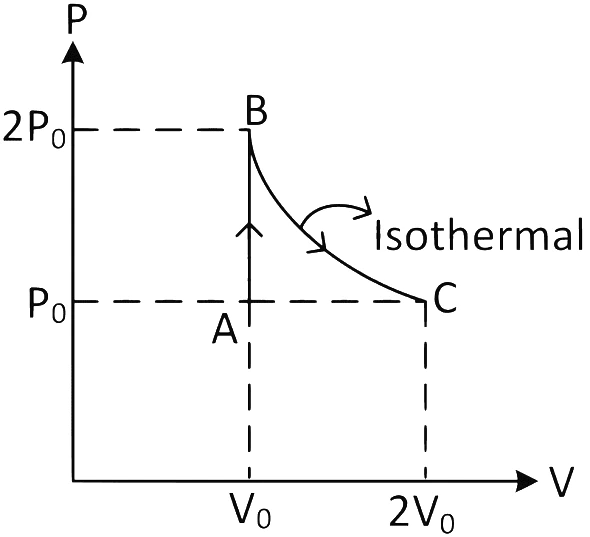
One mole of a diatomic ideal gas undergoes a process shown in PP-VV diagram. The total heat given to the gas (ln⁡2=0.7\ln 2 = 0.7) is

P-V diagram: A at (V0, P0), B at (V0, 2P0), C at (2V0, P0); A to B vertical, B to C isothermal curve
Show answer

Answer: (b)

Step-by-step solution coming soon.

Report a mistake
Q99WB JEE 2021Medium

Heat, Work & First Law of Thermodynamics

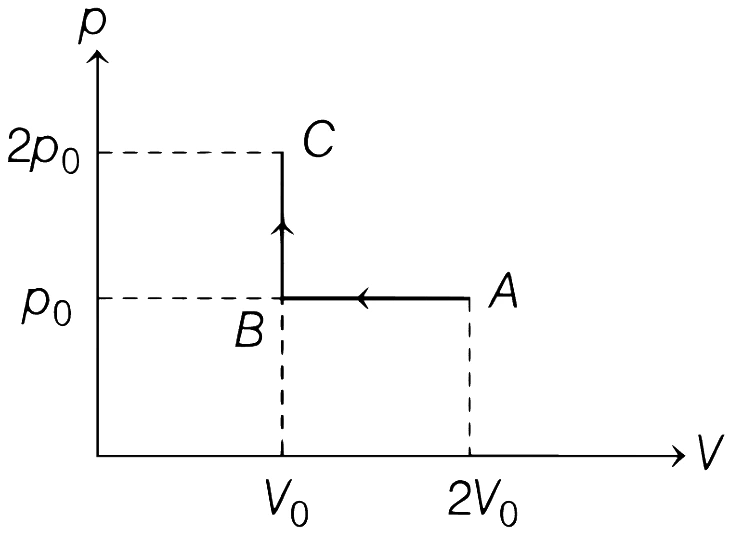
Consider the pp-VV diagram for 11 mole of an ideal monatomic gas shown in the figure. Which of the following statements is/are true?

p-V diagram: A (2V0, p0) to B (V0, p0) horizontally, then B to C (V0, 2p0) vertically

More than one option can be correct. Tap every correct option, then tap Check.

Show answer

Answer: (a), (b), (c)

Step-by-step solution coming soon.

Report a mistake
Q100WB JEE 2020Medium

Heat, Work & First Law of Thermodynamics

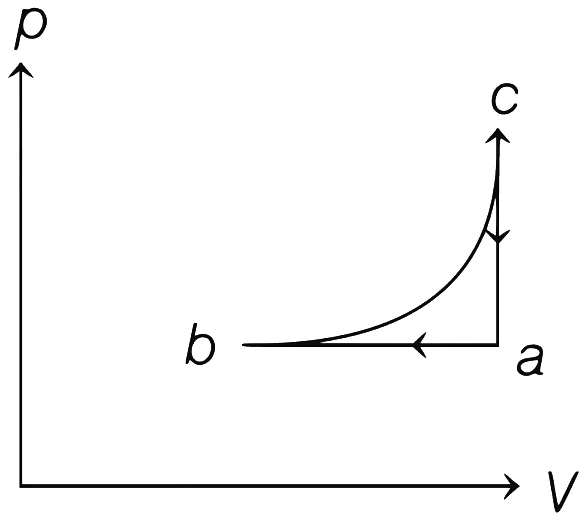
An ideal gas undergoes the cyclic process abcaabca as shown in the given pp-VV diagram

It rejects 50 J50\,\text{J} of heat during abab and absorbs 80 J80\,\text{J} of heat during caca. During bcbc, there is no transfer of heat and 40 J40\,\text{J} of work is done by the gas. What should be the area of the closed curve abcaabca?

p-V diagram of cycle abca: a at bottom right, b at left of a on same level, c directly above a; b to c curve, c to a vertical, a to b horizontal
Show answer

Answer: (a)

Step-by-step solution coming soon.

Report a mistake
Q101WB JEE 2019Easy

Heat, Work & First Law of Thermodynamics

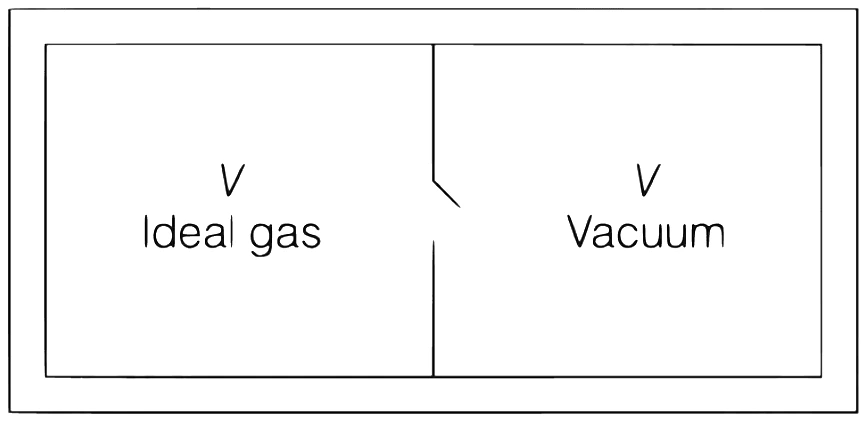
Consider the given diagram. An ideal gas is contained in a chamber (left) of volume VV and is at an absolute temperature TT. It is allowed to rush freely into the right chamber of volume VV which is initially vacuum. The whole system is thermally isolated. What will be the final temperature of the equilibrium has been attained?

Thermally isolated box with left chamber of ideal gas (volume V) and right vacuum chamber (volume V), separated by a partition with a valve
Show answer

Answer: (a)

Step-by-step solution coming soon.

Report a mistake
Q102WB JEE 2019Medium

Heat, Work & First Law of Thermodynamics

The initial pressure and volume of a given mass of an ideal gas with (CpCV=γ)\left(\dfrac{C_p}{C_V}=\gamma\right), taken in a cylinder fitted with a piston, are p0p_0 and V0V_0 respectively. At this stage the gas has the same temperature as that of the surrounding medium which is T0T_0. It is adiabatically compressed to a volume equal to V02\dfrac{V_0}{2}. Subsequently the gas is allowed to come to thermal equilibrium with the surroundings. What is the heat released to the surrounding?

Show answer

Answer: (b)

Step-by-step solution coming soon.

Report a mistake
Q103NEST 2019Difficult

Heat, Work & First Law of Thermodynamics

An ideal diatomic gas of nn moles and with initial pressure PP and volume VV undergoes a thermodynamic process. In this process the pressure is directly proportional to volume and the rms speed of the molecules is doubled. Then, the amount of heat required in this process is

Show answer

Answer: (a)

Step-by-step solution coming soon.

Report a mistake