Electric Current, Drift Velocity & Current Density · Mobility & current density
A cylindrical conductor of length 2 m and area of cross-section 0.2 mm2 carries an electric current of 1.6 A when its ends are connected to a 2 V battery. Mobility of electrons in the conductor is α×10−3 m2/V s. The value of α is:
(electron concentration =5×1028 /m3 and electron charge =1.6×10⁻¹⁹ C)
Numerical answer type. Work it out, then open the answer.
Electric Current, Drift Velocity & Current Density · Current & charge flow
The electric current through a wire varies with time as I=I0+βt, where I0=20 A and β=3 A/s. The amount of electric charge crossed through a section of the wire in 20 s is:
Electric Current, Drift Velocity & Current Density · Current & charge flow
The current in a conductor is expressed as I=3t2+4t3, where I is in Ampere and t is in second. The amount of electric charge that flows through a section of the conductor during t=1 s to t=2 s is __________ C.
Numerical answer type. Work it out, then open the answer.
Electric Current, Drift Velocity & Current Density · Drift velocity & relaxation time
A uniform wire of diameter d carries a current of 100 mA when the mean drift velocity of electrons in the wire is v. For a wire of diameter 2d of the same material to carry a current of 200 mA, the mean drift velocity of electrons in the wire is
Electric Current, Drift Velocity & Current Density · Drift velocity & relaxation time
A copper wire of radius 1 mm contains 1022 free electrons per cubic metre. The drift velocity for free electrons when 10 A current flows through the wire will be (Given, charge on electron =1.6×10⁻¹⁹ C):
Electric Current, Drift Velocity & Current Density · Drift velocity & relaxation time
The number density of free electrons in copper is nearly 8×1028 m−3. A copper wire has its area of cross section =2×10⁻⁶ m2 and is carrying a current of 3.2 A. The drift speed of the electrons is ___________ ×10−6 m s−1
Numerical answer type. Work it out, then open the answer.
Electric Current, Drift Velocity & Current Density · Drift velocity & relaxation time
A current of 2 A flows through a wire of cross-sectional area 25.0 mm2. The number of free electrons in a cubic meter are 2.0×1028. The drift velocity of the electrons is __________ ×10−6 m s−1 (given, charge on electron =1.6×10⁻¹⁹ C ).
Numerical answer type. Work it out, then open the answer.
Electric Current, Drift Velocity & Current Density · Drift velocity & relaxation time
The drift velocity of electrons for a conductor connected in an electrical circuit is Vd. The conductor is now replaced by another conductor with same material and same length but double the area of cross section. The applied voltage remains same. The new drift velocity of electrons will be
Electric Current, Drift Velocity & Current Density · Drift velocity & relaxation time
(A) The drift velocity of electrons decreases with the increase in the temperature of conductor. (B) The drift velocity is inversely proportional to the area of cross-section of given conductor. (C) The drift velocity does not depend on the applied potential difference to the conductor. (D) The drift velocity of electron is inversely proportional to the length of the conductor. (E) The drift velocity increases with the increase in the temperature of conductor. Choose the correct answer from the options given below:
Electric Current, Drift Velocity & Current Density · Mobility & current density
A copper wire of length 10 m and radius (π10−2) m has electrical resistance of 10 Ω. The current density in the wire for an electric field strength of 10 (V/m) is
Electric Current, Drift Velocity & Current Density · Drift velocity & relaxation time
A 1 m long copper wire carries a current of 1 A. If the cross section of the wire is 2.0 mm2 and the resistivity of copper is 1.7×10⁻⁸Ω m, the force experienced by moving electron in the wire is ____________ ×10−23 N.
(charge on electron =1.6×10⁻¹⁹ C)
Numerical answer type. Work it out, then open the answer.
Electric Current, Drift Velocity & Current Density · Mobility & current density
The current density in a cylindrical wire of radius r = 4.0 mm is 1.0 × 10⁶ A/m2. The current through the outer portion of the wire between radial distances 2r and r is xπ A; where x is __________.
Numerical answer type. Work it out, then open the answer.
Electric Current, Drift Velocity & Current Density · Mobility & current density
The current density in a cylindrical wire of radius 4 mm is 4 × 10⁶ Am−2. The current through the outer portion of the wire between radial distances 2R and R is ____________ π A.
Numerical answer type. Work it out, then open the answer.
Electric Current, Drift Velocity & Current Density · Drift velocity & relaxation time
A current of 10A exists in a wire of cross-sectional area of 5 mm2 with a drift velocity of 2 × 10⁻³ ms−1. The number of free electrons in each cubic meter of the wire is ___________.
Electric Current, Drift Velocity & Current Density · Drift velocity & relaxation time
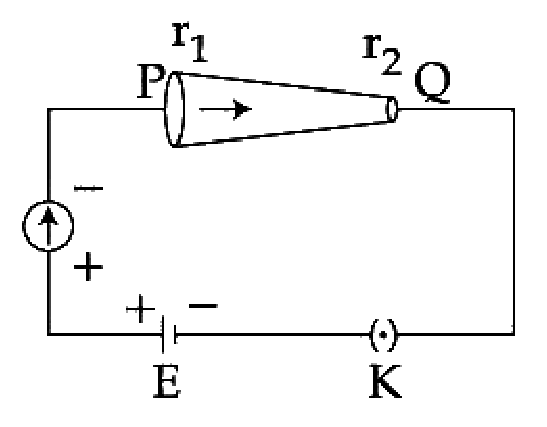
In the given figure, a battery of emf E is connected across a conductor PQ of length 'l' and different area of cross-sections having radii r1 and r2 (r2 < r1).
Choose the correct option as one moves from P to Q:
Electric Current, Drift Velocity & Current Density · Drift velocity & relaxation time
A conducting wire of length 'l', area of cross-section A and electric resistivity ρ is connected between the terminals of a battery. A potential difference V is developed between its ends, causing an electric current.
If the length of the wire of the same material is doubled and the area of cross-section is halved, the resultant current would be:
Electric Current, Drift Velocity & Current Density · Mobility & current density
A current of 5 A is passing through a non-linear magnesium wire of cross-section 0.04 m2. At every point the direction of current density is at an angle of 60∘ with the unit vector of area of cross- section. The magnitude of electric field at every point of the conductor is:
Electric Current, Drift Velocity & Current Density · Mobility & current density
A cylindrical wire of radius 0.5 mm and conductivity 5 × 10⁷ S/m is subjected to an electric field of 10 mV/m. The expected value of current in the wire will be x3π mA. The value of x is _________.
Numerical answer type. Work it out, then open the answer.
Electric Current, Drift Velocity & Current Density · Drift velocity & relaxation time
Drift speed of electrons, when 1.5 A of current flows in a copper wire of cross section 5 mm2, is v. If the electron density in copper is 9 × 1028/m3 the value of v. in mm/s is close to (Take charge of electron to be = 1.6 × 10⁻¹⁹C)
Electric Current, Drift Velocity & Current Density · Drift velocity & relaxation time
In a conductor, if the number of conduction electrons per unit volume is 8.5 × 1028 m–3 and mean free time is 25ƒs (femto second), it's approximate resistivity is :-
Electric Current, Drift Velocity & Current Density · Mobility & current density
A current of 5 A passes through a copper conductor (resistivity = 1.7 × 10⁻⁸ Ωm) of radius of cross- section 5 mm. Find the mobility of the charges if their drift velocity is 1.1 × 10⁻³ m/s.
Electric Current, Drift Velocity & Current Density · Drift velocity & relaxation time
A copper rod of cross-sectional area A carries a uniform current I through it. At temperature T, if the volume charge density of the rod is ρ, how long will the charges take to travel a distance d?
Electric Current, Drift Velocity & Current Density · Drift velocity & relaxation time
Across a metallic conductor of non-uniform cross section a constant potential difference is applied. The quantity which remains constant along the conductor is
Electric Current, Drift Velocity & Current Density · Drift velocity & relaxation time
When 5 V potential difference is applied across a wire of length 0.1 m, the drift speed of electrons is 2.5×10⁻⁴ m s−1. If the electron density in the wire is 8×1028 m−3, the resistivity of the material is close to:
Electric Current, Drift Velocity & Current Density · Drift velocity & relaxation time
−8
The mean free path of electrons in a metal is 4 × 10 m. The electric field which can give on an average 2 eV energy to an electron in the metal will be in units V/m