
Electrical Power & Heating Effect · Bulbs & heaters in combination
A room heater is rated . If the supply voltage drops to 200 V, what will be the power consumed (approximately)?
Show answer and solution
Answer: (c)
Loading the solution…
Home›Practice Hub›Chapters›Current Electricity›Electrical Power & Heating Effect
Current Electricity PYQs · MHT CET · JEE Main · NEET
Electrical Power & Heating Effect · Bulbs & heaters in combination
A room heater is rated . If the supply voltage drops to 200 V, what will be the power consumed (approximately)?
Answer: (c)
Electrical Power & Heating Effect · Power: P = VI = I²R = V²/R
An electric power line having total resistance of , delivers 1 kW of power at 250 V. The percentage efficiency of transmission line is ______.
Answer: (a)
Electrical Power & Heating Effect · Heat & electrical energy
Refer to the circuit diagram given below. The heat generated across the resistance in 100 second is . The value of is ______. (Nearest integer)
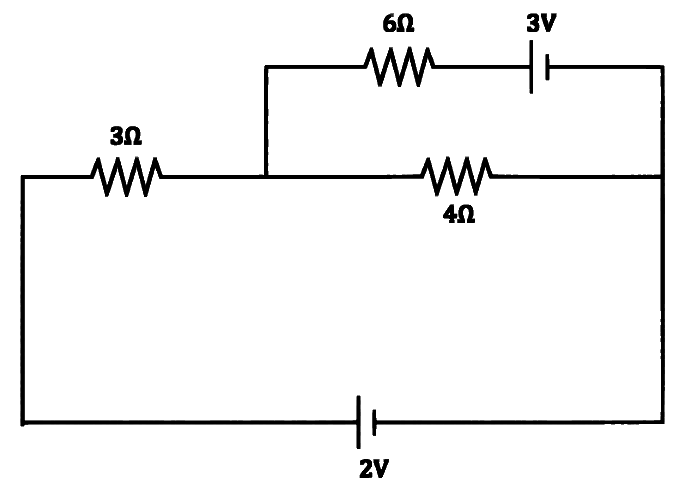
Numerical answer type. Work it out, then open the answer.
Answer: 3477
Electrical Power & Heating Effect · Heat & electrical energy
The heat generated in 1 minute between points and in the given circuit, when a battery of 9 V with internal resistance of is connected across these points is ______ J.
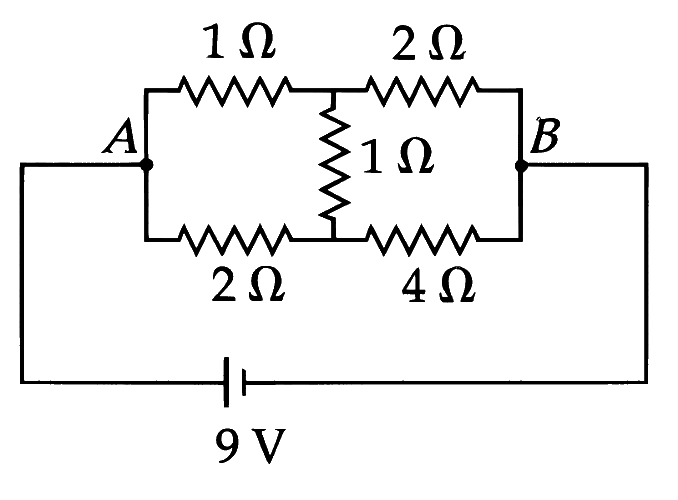
Numerical answer type. Work it out, then open the answer.
Answer: 1080
Electrical Power & Heating Effect · Bulbs & heaters in combination
Two resistors of 200 and 400 are connected in series with a battery of 100 V. A bulb rated at 200 V, 100 W is connected across the 400 resistance. The potential drop across the bulb is ________ V.
Answer: (b)
Electrical Power & Heating Effect · Power: P = VI = I²R = V²/R
A motor operating on 100 V draws a current of 1 A. If the efficiency of the motor is , then the loss of power in units of is
Answer: (b)
Electrical Power & Heating Effect · Heat & electrical energy
The battery of a mobile phone is rated as . How much energy is stored in it when fully charged?
Answer: (a)
Electrical Power & Heating Effect · Bulbs & heaters in combination
There are ' ' number of identical electric bulbs, each is designed to draw a power independently from the mains supply. They are now joined in series across the mains supply. The total power drawn by the combination is:
Answer: (d)
Electrical Power & Heating Effect · Bulbs & heaters in combination
The current flowing in a coil is 3 A and the power consumed is 108 W. If the a.c. source is of , the resistance in the circuit is
Answer: (c)
Electrical Power & Heating Effect · Bulbs & heaters in combination
An electric bulb rated is connected across a supply. The power dissipation of the bulb is:
Answer: (c)
Electrical Power & Heating Effect · Power: P = VI = I²R = V²/R
In the following circuit, a power of 50 watt is absorbed in the section AB of the circuit. The value of resistance ' ' is
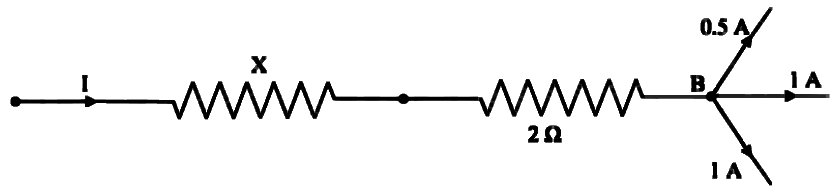
Answer: (c)
Electrical Power & Heating Effect · Power: P = VI = I²R = V²/R
In the following circuit, the battery has an emf of and an internal resistance of . The power consumption in the entire circuit is _________ W.
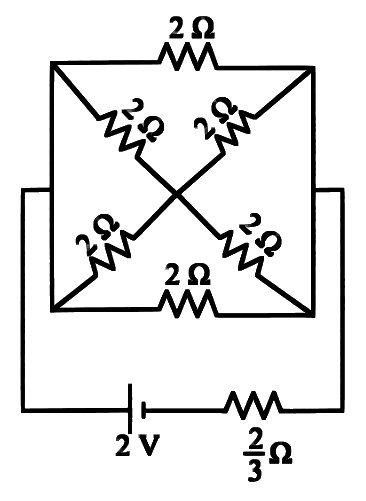
Numerical answer type. Work it out, then open the answer.
Answer: 3
Electrical Power & Heating Effect · Heat & electrical energy
The ratio of heat dissipated per second through the resistance and in the circuit given below is:
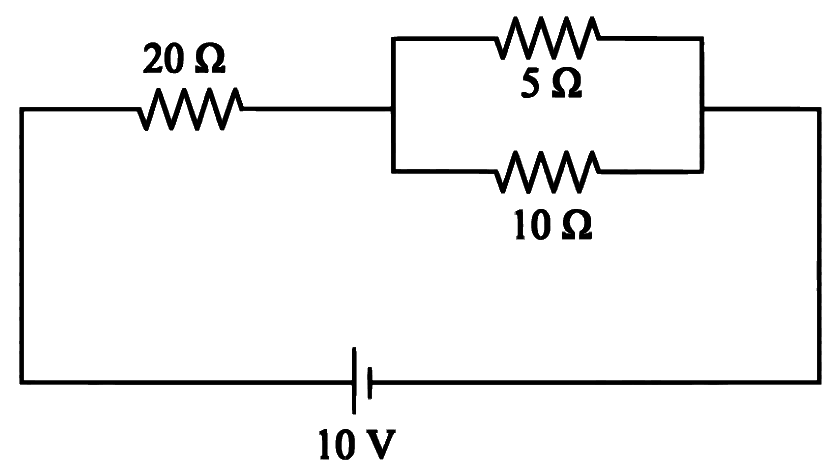
Answer: (b)
Electrical Power & Heating Effect · Heat & electrical energy
When a potential difference is applied across a wire of resistance , it dissipates energy at a rate . If the wire is cut into two halves and these halves are connected mutually parallel across the same supply, the energy dissipation rate will become:
Answer: (b)
Electrical Power & Heating Effect · Bulbs & heaters in combination
Two heaters and have power rating of and , respectively. Those two are first connected in series and then in parallel to a fixed power source. The ratio of power outputs for these two cases is:
Answer: (b)
Electrical Power & Heating Effect · Bulbs & heaters in combination
Water boils in an electric kettle in 20 minutes after being switched on. Using the same main supply, the length of the heating element should be _________ to __________ times of its initial length if the water is to be boiled in 15 minutes.
Answer: (c)
Electrical Power & Heating Effect · Bulbs & heaters in combination
By what percentage will the illumination of the lamp decrease if the current drops by 20%?
Answer: (b)
Electrical Power & Heating Effect · Bulbs & heaters in combination
A heater is designed to operate with a power of in a line. It is connected in combination with a resistance of and a resistance , to a mains as shown in figure. For the heater to operate at , the value of should be _______ .
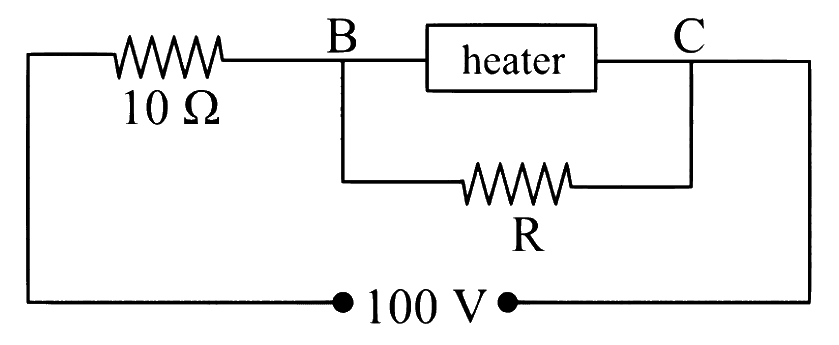
Numerical answer type. Work it out, then open the answer.
Answer: 5
Electrical Power & Heating Effect · Heat & electrical energy
The amount of thermal energy is developed by a resistor in when a current of is passed through it. If the current is increased to , the thermal energy developed by the resistor in will be:
Answer: (b)
Electrical Power & Heating Effect · Heat & electrical energy
Ratio of thermal energy released in two resistors R and 3R connected in parallel in an electric circuit is:
Answer: (d)
Electrical Power & Heating Effect · Bulbs & heaters in combination
Two identical heater filaments are connected first in parallel and then in series. At the same applied voltage, the ratio of heat produced in same time for parallel to series will be:
Answer: (a)
Electrical Power & Heating Effect · Power: P = VI = I²R = V²/R
Different combination of 3 resistors of equal resistance are shown in the figures. The increasing order for power dissipation is:
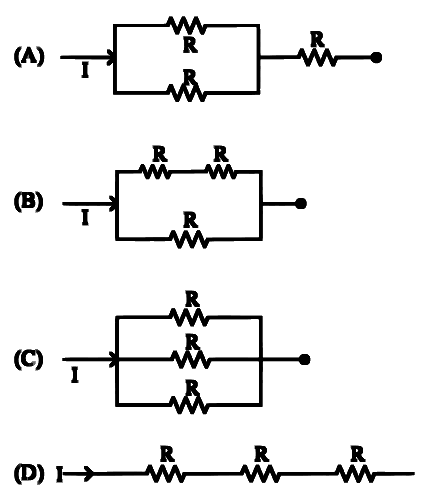
Answer: (b)
Electrical Power & Heating Effect · Power: P = VI = I²R = V²/R
A potential is applied across a uniform wire of resistance . The power dissipation is . The wire is then cut into two equal halves and a potential of is applied across the length of each half. The total power dissipation across two wires is . The ratio is . The value of is ___________.
Numerical answer type. Work it out, then open the answer.
Answer: 16
Electrical Power & Heating Effect · Heat & electrical energy
Two resistors of resistance, 100 and 200 are connected in parallel in an electrical circuit. The ratio of the thermal energy developed in 100 to that in 200 in a given time is
Answer: (b)
Electrical Power & Heating Effect · Heat & electrical energy
A resistor develops 300 J of thermal energy in 15 s, when a current of 2 A is passed through it. If the current increases to 3 A, the energy developed in 10 s is ____________ J.
Numerical answer type. Work it out, then open the answer.
Answer: 450
Electrical Power & Heating Effect · Bulbs & heaters in combination
An electrical bulb rated 220 V, 100 W, is connected in series with another bulb rated 220 V, 60 W. If the voltage across combination is 220 V, the power consumed by the 100 W bulb will be about _______ W.
Numerical answer type. Work it out, then open the answer.
Answer: 14
Electrical Power & Heating Effect · Bulbs & heaters in combination
Two coils require 20 minutes and 60 minutes respectively to produce same amount of heat energy when connected separately to the same source. If they are connected in parallel arrangement to the same source; the time required to produce same amount of heat by the combination of coils, will be ___________ min.
Numerical answer type. Work it out, then open the answer.
Answer: 15
Electrical Power & Heating Effect · Heat & electrical energy
A resistor develops 500 J of thermal energy in 20 s when a current of 1.5A is passed through it. If the current is increased from 1.5A to 3A, what will be the energy developed in 20 s.
Answer: (b)
Electrical Power & Heating Effect · Heat & electrical energy
A uniform heating wire of resistance 36 is connected across a potential difference of 240 V. The wire is then cut into half and potential difference of 240V is applied across each half separately. The ratio of power dissipation in first case to the total power dissipation in the second case would be 1: x, where x is ____________
Numerical answer type. Work it out, then open the answer.
Answer: 4
Electrical Power & Heating Effect · Heat & electrical energy
A resistor dissipates 192 J of energy in 1s when a current of 4A is passed through it. Now, when the current is doubled, the amount of thermal energy dissipated in 5s in _________ J.
Numerical answer type. Work it out, then open the answer.
Answer: 3840
Electrical Power & Heating Effect · Heat & electrical energy
The energy dissipated by a resistor is 10 mJ in 1 s when an electric current of 2 mA flows through it. The resistance is ___________. (Round off to the Nearest Integer)
Numerical answer type. Work it out, then open the answer.
Answer: 2500
Electrical Power & Heating Effect · Heat & electrical energy
In an electrical circuit, a battery is connected to pass 20C of charge through it in a certain given time. The potential difference between two plates of the battery is maintained at 15V. The workdone by the battery is __________J.
Numerical answer type. Work it out, then open the answer.
Answer: 300
Electrical Power & Heating Effect · Power: P = VI = I²R = V²/R
In the given figure, the emf of the cell is 2.2 V and if internal resistance is 0.6. Calculate the power dissipated in the whole circuit:
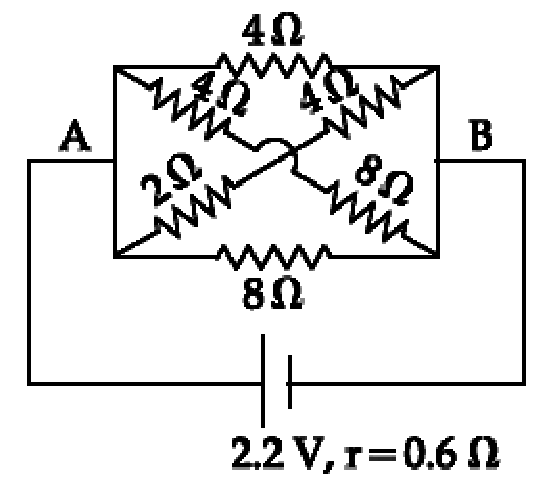
Answer: (c)
Electrical Power & Heating Effect · Bulbs & heaters in combination
An electric bulb of 500 watt at 100 volt is used in a circuit having a 200 V supply. Calculate the resistance R to be connected in series with the bulb so that the power delivered by the bulb is 500 W.
Answer: (a)
Electrical Power & Heating Effect · Bulbs & heaters in combination
An electric bulb rated as 200 W at 100 V is used in a circuit having 200 V supply. The resistance 'R' that must be put in series with the bulb so that the bulb delivers the same power is _____________ .
Numerical answer type. Work it out, then open the answer.
Answer: 50
Electrical Power & Heating Effect · Chemical & thermoelectric effects
If a current flowing in a coil is reduced to half of its initial value, the relation between the new energy and the original energy stored in the coil will be
Answer: (a)
Electrical Power & Heating Effect · Heat & electrical energy
Due to cold weather a 1 m water pipe of cross-sectional area 1 cm2 is filled with ice at C. Resistive heating is used to melt the ice. Current of 0.5A is passed through 4 k resistance. Assuming that all the heat produced is used for melting, what is the minimum time required? (Given latent heat of fusion for water/ice = 3.33 105 J kg, specific heat of ice = 2 103 J kg and density of ice = 103 kg/m3)
Answer: (b)
Electrical Power & Heating Effect · Power: P = VI = I²R = V²/R
An electrical power line, having a total resistance of 2 , delivers 1 kW at 220 V. The efficiency of the transmission line is approximately:
Answer: (b)
Electrical Power & Heating Effect · Bulbs & heaters in combination
In a building there are 15 bulbs of 45 W, 15 bulbs of 100 W, 15 small fans of 10 W and 2 heaters of 1 kW. The voltage of electric main is 220 V. The minimum fuse capacity (rated value) of the building will be:
Answer: (b)
Electrical Power & Heating Effect · Power: P = VI = I²R = V²/R
Two equal resistances when connected in series to a battery, consume electric power of 60 W. If these resistances are now connected in parallel combination to the same battery, the electric power consumed will be:
Answer: (a)
Electrical Power & Heating Effect · Bulbs & heaters in combination
Which of the following acts as a circuit protection device?
Answer: (d)
Electrical Power & Heating Effect · Power: P = VI = I²R = V²/R
A current of 2 mA was passed through an unknown resistor which dissipated a power of 4.4 W. Dissipated power when an ideal power supply of 11 V is connected across it is -
Answer: (a)
Electrical Power & Heating Effect · Bulbs & heaters in combination
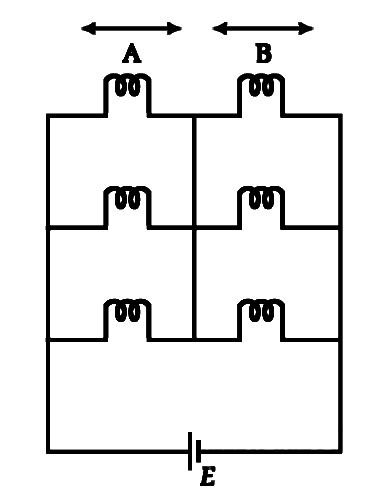
Six similar bulbs are connected as shown in the figure with a DC source of emf E, and zero internal resistance.
The ratio of power consumption by the bulbs when (i) all are glowing and (ii) in the situation when two from section A and one from section B are glowing, will be:
Answer: (b)
Electrical Power & Heating Effect · Bulbs & heaters in combination
Two electric bulbs, rated at (25 W, 220 V) and (100 W, 220 V), are connected in series across a 220 V voltage source. If the 25 W and 100 W bulbs draw powers P1 and P2 respectively, then:
Answer: (b)
Electrical Power & Heating Effect · Heat & electrical energy
A constant voltages is applied between two ends of a metallic wire. If the length is halved and the radius of the wire is doubled, the rate of heat developed in the wire will be:
Answer: (d)
Electrical Power & Heating Effect · Power: P = VI = I²R = V²/R
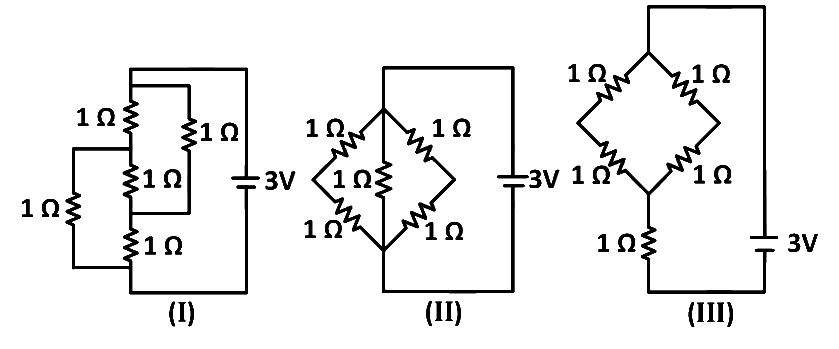
The figure shows three circuits I, II and III which are connected to a 3V battery. If the powers dissipated by the configurations I, II and III are P1, P2 and P3 respectively, then:
Answer: (c)
Electrical Power & Heating Effect · Bulbs & heaters in combination
A filament bulb (500 W, 100 V) is to be used in a 230 V main supply. When a resistance R is connected in series, it works perfectly and the bulb consumes 500 W. The value of R is
Answer: (c)
Electrical Power & Heating Effect · Heat & electrical energy
The charge flowing through a resistance R varies with time t as Q = at bt2, where and are positive constants. The total heat produced in R is
Answer: (c)
Electrical Power & Heating Effect · Power: P = VI = I²R = V²/R
Two cities are 150 km apart. Electric power is sent from one city to another city through copper wires. The fall of potential per km is 8 volt and the average resistance per km is 0.5 . The power loss in the wire is
Answer: (b)
Electrical Power & Heating Effect · Bulbs & heaters in combination
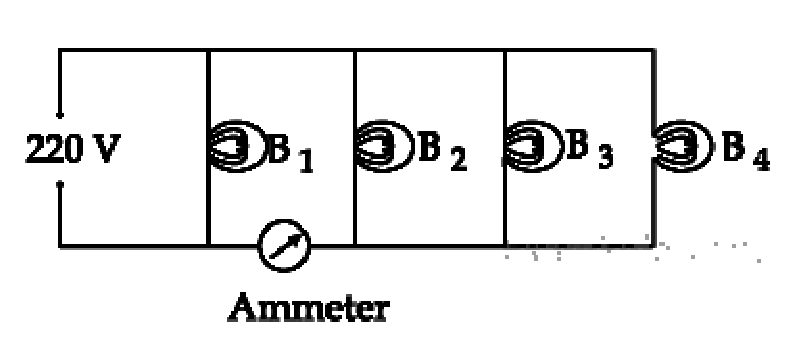
Four bulbs B1, B2, B3 and B4 of 100 W each are connected to 220 V main as shown in the figure. The reading in an ideal ammeter will be:
Answer: (c)
Electrical Power & Heating Effect · Bulbs & heaters in combination
In a large building, there are bulbs of bulbs of fans of and heater of The voltage of electric mains is The minimum capacity of the main fuse of the building will be:
Answer: (c)
Electrical Power & Heating Effect · Heat & electrical energy
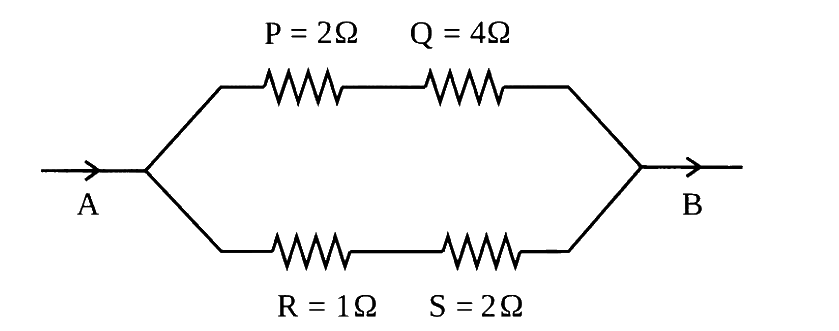
Which of the four resistances P, Q, R and S generate the greatest amount of heat when a current flows from A to B?
Answer: (b)
Electrical Power & Heating Effect · Heat & electrical energy
Ten identical cells connected in series are needed to heat a wire of length one meter and radius 'r' by 10oC in time 't'. How many cells will be required to heat the wire of length two meter of the same radius by the same temperature in time 't'?
Answer: (a)
Electrical Power & Heating Effect · Bulbs & heaters in combination
The supply voltage to room is The resistance of the lead wires is . A bulb is already switched on. What is the decrease of voltage across the bulb, when a heater is switched on in parallel to the bulb?
Answer: (d)
Electrical Power & Heating Effect · Bulbs & heaters in combination
If voltage across a bulb rated 220 volt-100 watt drops by 2.5% of its rated value, the percentage of the rated value by which the power would decrease is
Answer: (c)
Electrical Power & Heating Effect · Power: P = VI = I²R = V²/R
The power dissipated in the circuit shown in the figure is 30 watts. The value of R is
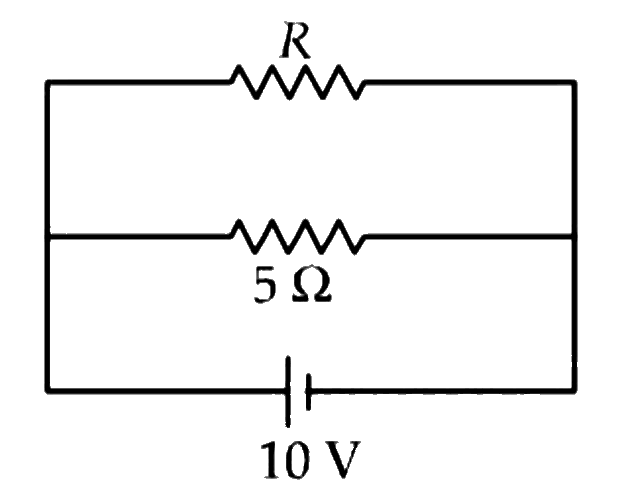
Answer: (c)
Electrical Power & Heating Effect · Bulbs & heaters in combination
Two electric bulbs marked and are connected in series to a supply. Which of the bulbs will fuse?
Answer: (c)
Electrical Power & Heating Effect · Power: P = VI = I²R = V²/R
If power dissipated in the 9 resistor in the circuit shown is 36 watt, the potential difference across the 2 resistor is
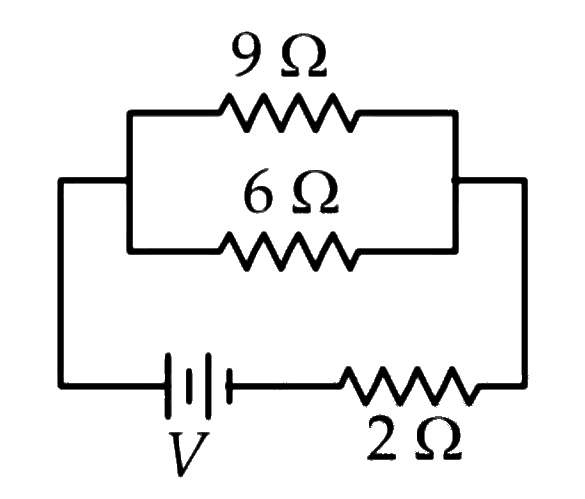
Answer: (c)
Electrical Power & Heating Effect · Chemical & thermoelectric effects
A thermocouple of negligible resistance produces an e.m.f. of 40 µV/ºC in the linear range of temperature. A galvanometer of resistance 10 ohm whose sensitivity is 1 µA/division, is employed with the thermocouple. The smallest value of temperature difference that can be detected by the system will be
Answer: (d)
Electrical Power & Heating Effect · Chemical & thermoelectric effects
The thermo e.m.f. in volts of a certain thermo-couple is found to vary with temperature difference in °C between the two junctions according to the relation
The neutral temperature for the thermo-couple will be
Answer: (c)
Electrical Power & Heating Effect · Chemical & thermoelectric effects
In producing chlorine by electrolysis power at is being consumed. How much chlorine per minute is liberated (E.C.E. of chlorine is )
Answer: (d)
Electrical Power & Heating Effect · Power: P = VI = I²R = V²/R
A current of 3 amp. flows through the 2 resistor shown in the circuit. The power dissipated in the 5 resistor is
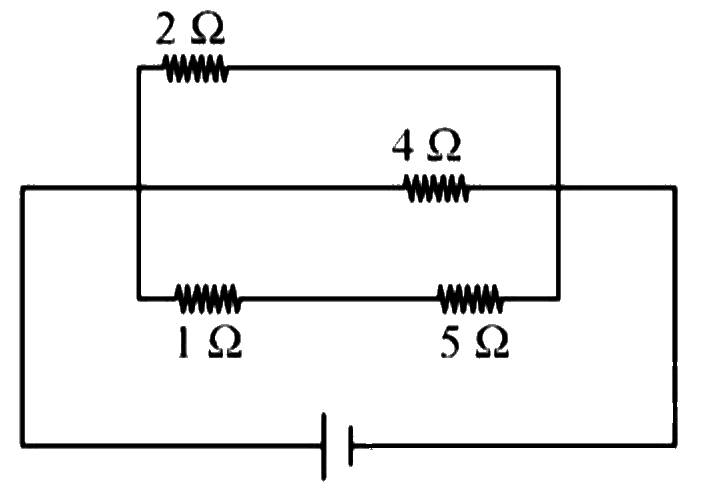
Answer: (b)
Electrical Power & Heating Effect · Bulbs & heaters in combination
An electric kettle takes 4 A current at 220 V. How much time will it take to boil 1 kg of water from temperature 20oC? The temperature of boiling water is 100oC
Answer: (c)
Electrical Power & Heating Effect · Chemical & thermoelectric effects
A steady current of 1.5 amp flows through a copper voltameter for 10 minutes. If the electrochemical equivalent of copper is , the mass of copper deposited on the electrode will be
Answer: (c)
Electrical Power & Heating Effect · Chemical & thermoelectric effects
If the cold junction of a thermocouple is kept at and the hot junction is kept at , then the relation between neutral temperature and temperature of inversion is
Answer: (d)
Electrical Power & Heating Effect · Power: P = VI = I²R = V²/R
The total power dissipated in watt in the circuit shown here is
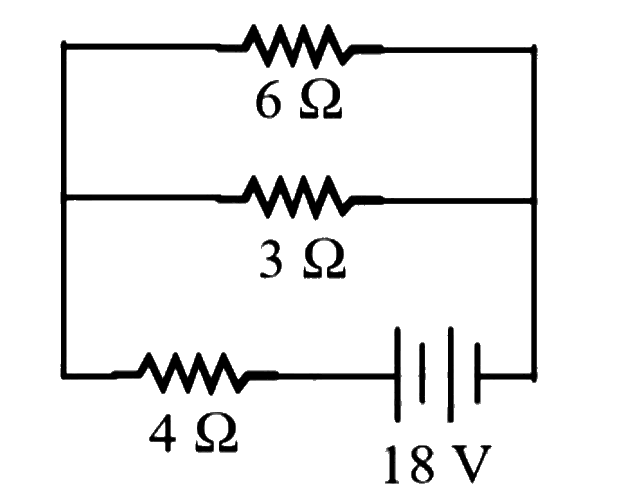
Answer: (b)
Electrical Power & Heating Effect · Bulbs & heaters in combination
An electric bulb is rated volt - watt. The power consumed by it when operated on volt will be
Answer: (c)
Electrical Power & Heating Effect · Chemical & thermoelectric effects
A thermocouple is made from two metals, Antimony and Bismuth. If one junction of the couple is kept hot and the other is kept cold, then, an electric current will
Answer: (d)
Electrical Power & Heating Effect · Power: P = VI = I²R = V²/R
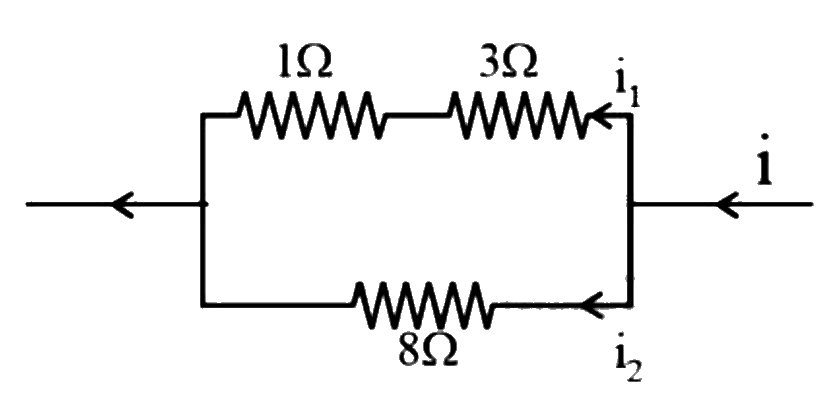
Power dissipated across the 8 resistor in the circuit shown here is 2 watt. The power dissipated in watt units across the 3 resistor is
Answer: (a)
Electrical Power & Heating Effect · Chemical & thermoelectric effects
In producing chlorine through electrolysis power at is being consumed. How much chlorine per min is liberated? ECE of chlorine is
Answer: (a)
Electrical Power & Heating Effect · Bulbs & heaters in combination
A 5-ampere fuse wire can withstand a maximum power of 1 watt in the circuit. The resistance of the fuse wire is
Answer: (a)
Electrical Power & Heating Effect · Bulbs & heaters in combination
A heater coil is cut into two equal parts and only one part is now used in the heater. The heat generated will now be
Answer: (b)
Electrical Power & Heating Effect · Chemical & thermoelectric effects
The temperature of inversion of a thermocouple is and the neutral temperature is . What is the temperature of cold junction?
Answer: (c)
Electrical Power & Heating Effect · Bulbs & heaters in combination
The resistance of hot tungsten filament is about times the cold resistance. What will be resistance of and lamp when not in use?
Answer: (b)
Electrical Power & Heating Effect · Chemical & thermoelectric effects
Two voltmeters, one of copper and another of silver, are joined in parallel. When a total charge flows through the voltmeters, equal amount of metals are deposited. If the electrochemical equivalents of copper and silver are and respectively the charge which flows through the silver voltmeter is
Answer: (a)
Electrical Power & Heating Effect · Bulbs & heaters in combination
when three identical bulbs of 60 watt, 200 volt rating are connected in series to a 200 volt supply, the power drawn by them will be
Answer: (d)
Electrical Power & Heating Effect · Bulbs & heaters in combination
In India electricity is supplied for domestic use at 220 V. It is supplied at 110 V in USA. If the resistance of a 60 W bulb for use in India is R, the resistance of a 60 W bulb for use in USA will be
Answer: (c)
Electrical Power & Heating Effect · Chemical & thermoelectric effects
The electrochemical equivalent of a metal is per Coulomb. The mass of the metal liberated at the cathode when a current is passed for seconds will be
Answer: (c)
Electrical Power & Heating Effect · Heat & electrical energy
A battery is charged at a potential of 15 V for 8 h when the current flowing is 10 A. The battery on discharge supplies a current of 5 A for 15 h. The mean terminal voltage during discharge is 14 V. The "watt-hour" efficiency of the battery is
Answer: (d)
Electrical Power & Heating Effect · Chemical & thermoelectric effects
The thermo of a thermocouple varies with temperature of the hot junction as in volts where the ratio is If the cold junction is kept at then the neutral temperature is
Answer: (d)
Electrical Power & Heating Effect · Bulbs & heaters in combination
Two 220 volt, 100 watt bulbs are connected first in series and then in parallel. Each time the combination is connected to a 220 volt a.c. supply line. The power drawn by the combination in each case respectively will be
Answer: (d)
Electrical Power & Heating Effect · Bulbs & heaters in combination
Fuse wire is a wire of
Answer: (b)
Electrical Power & Heating Effect · Bulbs & heaters in combination
A volt, watt bulb is connected across a mains supply. The power consumed will be
Answer: (c)
Electrical Power & Heating Effect · Bulbs & heaters in combination
An electric kettle has two heating coils. When one of the coils is connected to an a.c. source, the water in the kettle boils in 10 minutes. When the other coil is used the water boils in 40 minutes. If both the coils are connected in parallel, the time taken by the same quantity of water to boil will be
Answer: (a)
Electrical Power & Heating Effect · Chemical & thermoelectric effects
The thermo of a thermo -couple is at room temperature. A galvanometer of resistance, capable of detecting current as low as is connected with the thermo couple. The smallest temperature difference that can be detected by this system is
Answer: (a)
Electrical Power & Heating Effect · Chemical & thermoelectric effects
The negative pole of a Daniell cell, sending a constant current through a circuit, decreases in mass by in minutes. If the electrochemical equivalents of and are and respectively, the increase in the mass of the positive pole in this time is
Answer: (c)
Electrical Power & Heating Effect · Power: P = VI = I²R = V²/R
A wire when connected to mains supply has power dissipation Now the wire is cut into two equal pieces which are connected in parallel to the same supply. Power dissipation in this case is Then is
Answer: (b)
Electrical Power & Heating Effect · Chemical & thermoelectric effects
The mass of product liberated on anode in an electrochemical cell depends on (where is the time period for which the current is passed).
Answer: (b)
Electrical Power & Heating Effect · Chemical & thermoelectric effects
If is the inversion temperature, is the neutral temperature, is the temperature of the cold junction, then
Answer: (c)
Electrical Power & Heating Effect · Power: P = VI = I²R = V²/R
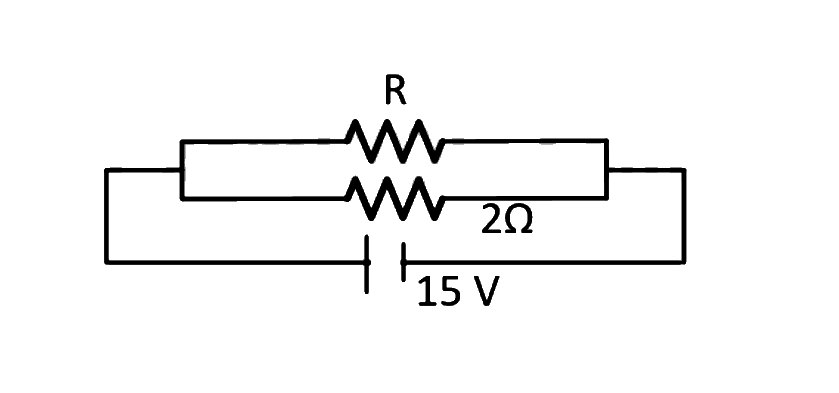
If in the circuit, power dissipation is then is
Answer: (b)
Electrical Power & Heating Effect · Bulbs & heaters in combination
Two bulbs of (40 W, 200 V), and (100 W, 200 V). Then correct relation for their resistances
Answer: (b)
Electrical Power & Heating Effect · Chemical & thermoelectric effects
In electrolysis the mass deposited on an electrode is directly proportional to
Answer: (a)
Electrical Power & Heating Effect · Power: P = VI = I²R = V²/R
Three equal resistors connected in series across a source of emf together dissipate watt of power. What will be the power dissipated in watt if the same resistors are connected in parallel across the same source of emf?
Answer: (d)
Electrical Power & Heating Effect · Heat & electrical energy
A rise in temperature is observed in a conductor by passing a current. When the current is doubled the rise in temperature will be approximately
Answer: (c)
Electrical Power & Heating Effect · Chemical & thermoelectric effects
If nearly liberate equivalent of aluminium, then the amount of aluminium (equivalent weight 9) deposited through electrolysis in by a current of amp will be
Answer: (c)
Electrical Power & Heating Effect · Heat & electrical energy
One kilowatt hour is equal to
Answer: (c)
Electrical Power & Heating Effect · Bulbs & heaters in combination
A (100 W, 200 V) bulb is connected to a 160 volts supply. The power consumption would be
Answer: (c)
Electrical Power & Heating Effect · Bulbs & heaters in combination
If two bulbs, whose resistances are in the ratio of are connected in series, the power dissipated in them has the ratio of
Answer: (d)
Electrical Power & Heating Effect · Chemical & thermoelectric effects
A heating coil is labelled 100 W, 220 V. The coil is cut in half and the two pieces are joined in parallel to the same source. The energy now liberated per second is
Answer: (b)
Electrical Power & Heating Effect · Bulbs & heaters in combination
An electric bulb is rated 60 W, 220 V. The resistance of its filament is
Answer: (d)
Electrical Power & Heating Effect · Heat & electrical energy
A current of , passing through a conductor produces of heat in 10 seconds. The resistance of the conductor in ohm is
Answer: (b)
Electrical Power & Heating Effect · Bulbs & heaters in combination
40 electric bulbs are connected in series across a supply. After one bulb is fused the remaining 39 are connected again in series across the same supply. The illumination will be
Answer: (b)
No questions match these filters.