
Kirchhoff's Laws & Measuring Instruments · Potential difference between points
The currents in different parts of the electric circuit are shown in following figure. The value of current is
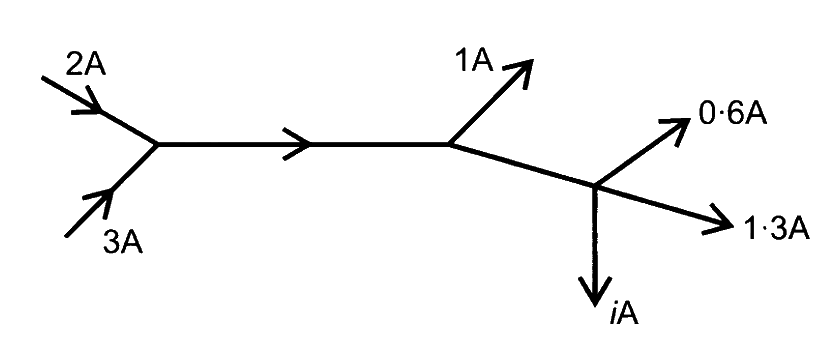
Show answer and solution
Answer: (c)
Loading the solution…
Home›Practice Hub›Chapters›Current Electricity›Kirchhoff's Laws & Measuring Instruments
Current Electricity PYQs · MHT CET · JEE Main · NEET
Kirchhoff's Laws & Measuring Instruments · Potential difference between points
The currents in different parts of the electric circuit are shown in following figure. The value of current is
Answer: (c)
Kirchhoff's Laws & Measuring Instruments · Voltmeter & ammeter in circuits
Which one of the following is not a measurable quantity?
Answer: (d)
Kirchhoff's Laws & Measuring Instruments · Galvanometer to ammeter / voltmeter
A galvanometer of resistance gives full scale deflection for a current of 1 mA. It is converted into an ammeter of range . The shunt required is:
Answer: (a)
Kirchhoff's Laws & Measuring Instruments · Galvanometer to ammeter / voltmeter
A voltmeter with internal resistance of can be used to measure upto 20 V. In order to increase its measuring range to 30 V, the required modification is to ______.
Answer: (a)
Kirchhoff's Laws & Measuring Instruments · Galvanometer to ammeter / voltmeter
A moving coil galvanometer of resistance shows a full scale deflection for a current of 1 mA. The value of resistance required to convert this galvanometer into an ammeter, showing full scale deflection for a current of 5 mA, is
Answer: (a)
Kirchhoff's Laws & Measuring Instruments · Multi-loop circuits
In the circuit shown in the figure, the current through
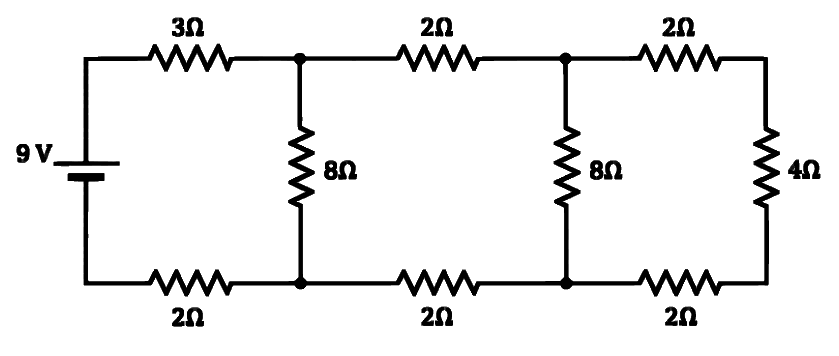
Answer: (d)
Kirchhoff's Laws & Measuring Instruments · Multi-loop circuits
In the following figure, the current I is equal to
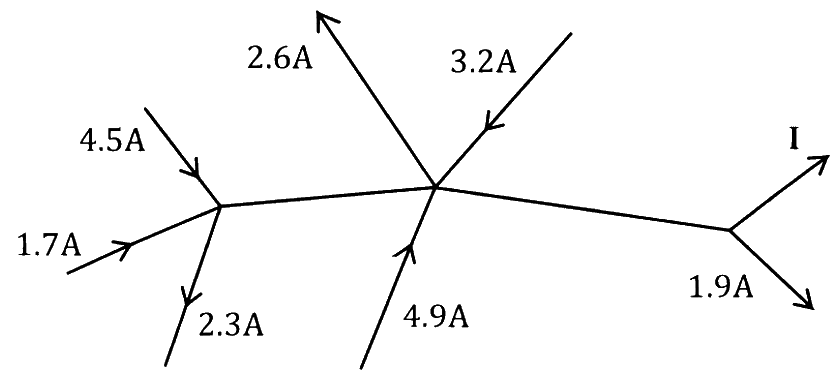
Answer: (d)
Kirchhoff's Laws & Measuring Instruments · Multi-loop circuits
In the following network, the current flowing through resistance is
Answer: (c)
Kirchhoff's Laws & Measuring Instruments · Multi-loop circuits
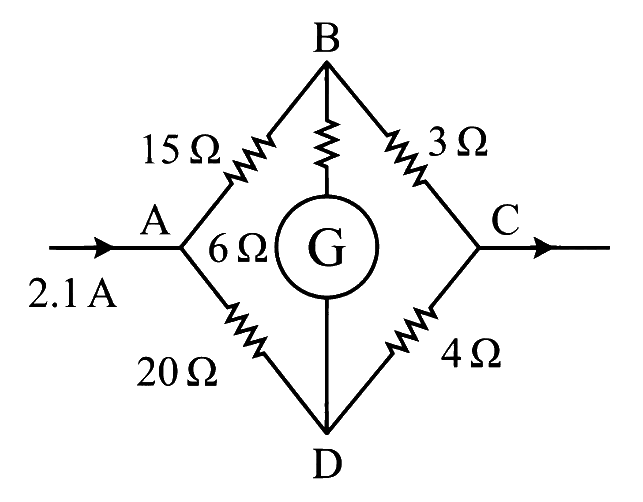
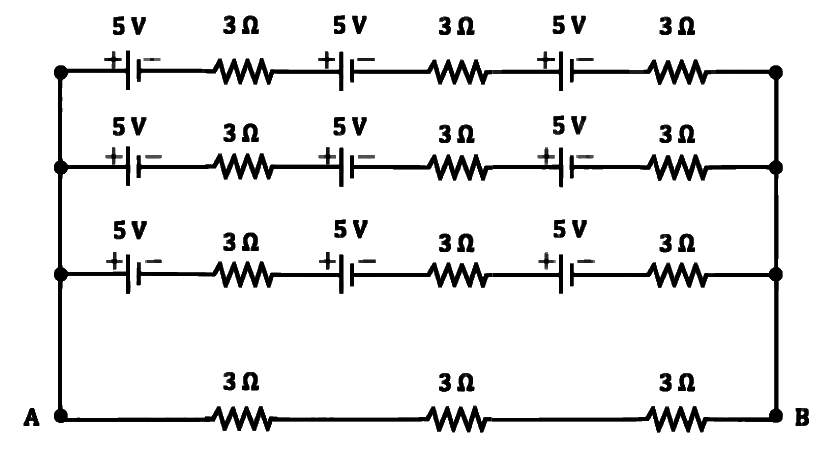
Refer to the figure given below, current between terminals and is
______ A.
Answer: (b)
Kirchhoff's Laws & Measuring Instruments · Potential difference between points
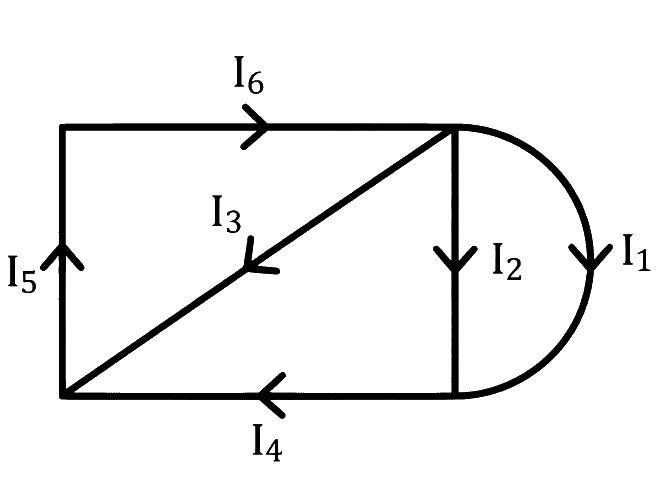
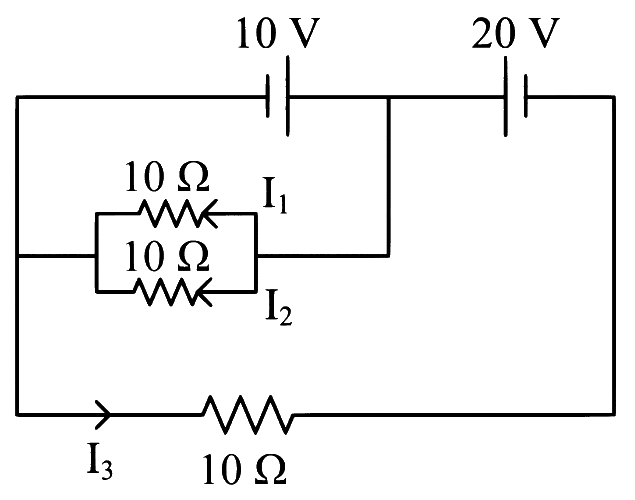
In the following network,
A, A, A
The values of and are respectively
Answer: (c)
Kirchhoff's Laws & Measuring Instruments · Potential difference between points
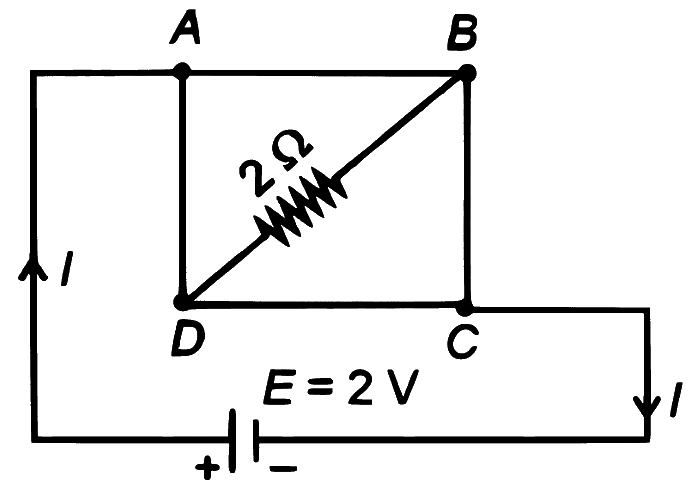
A uniform metallic wire having resistance is bent to form a square loop (ABCD) (see figure). A resistance of is connected between points and and a battery of 2 V is connected across points and as shown in the figure. Now the value of current is:
Answer: (a)
Kirchhoff's Laws & Measuring Instruments · Potential difference between points
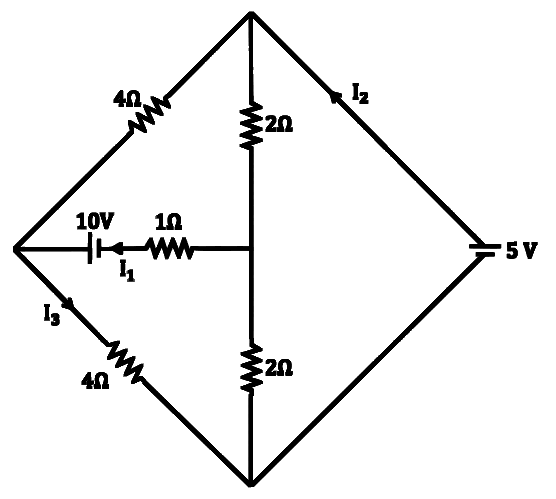
Refer to the figure given below. The values of and are ______.
Answer: (a)
Kirchhoff's Laws & Measuring Instruments · Potential difference between points
The voltage and the current between and points shown in the circuit are ______.
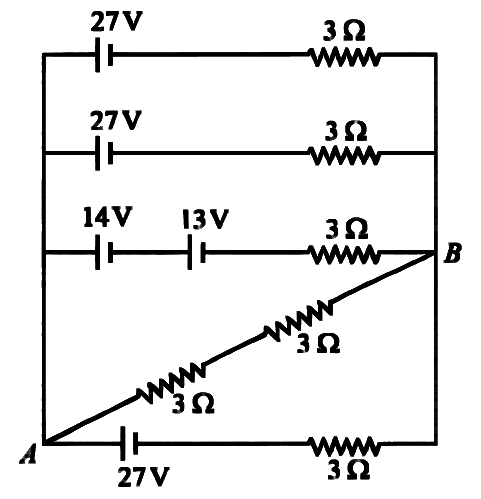
Answer: (b)
Kirchhoff's Laws & Measuring Instruments · Voltmeter & ammeter in circuits
The reading of the ammeter in steady state in the following circuit (assuming negligible internal resistance of the ammeter) is ______ A.
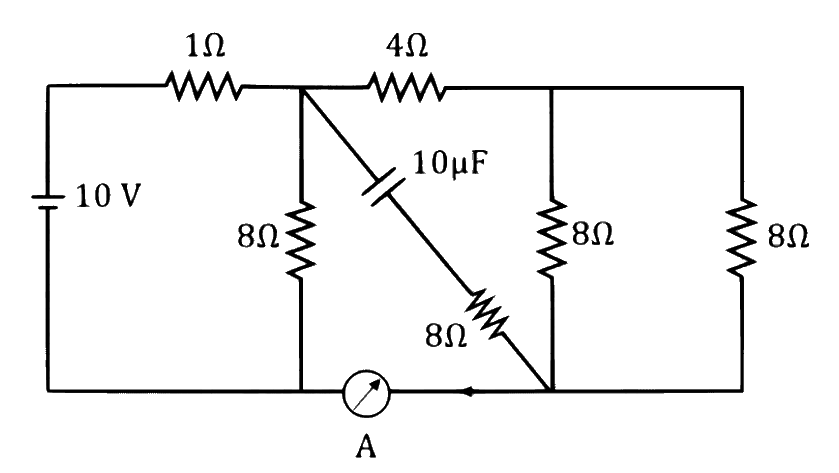
Answer: (b)
Kirchhoff's Laws & Measuring Instruments · Voltmeter & ammeter in circuits
Two resistors of each are connected in series with a 9 V battery. A voltmeter of resistance is connected to measure the voltage drop across one of the resistors. The voltmeter reading is ______ V.
Answer: (c)
Kirchhoff's Laws & Measuring Instruments · Galvanometer to ammeter / voltmeter
By connecting a resistance of in series with a galvanometer, it is converted into a voltmeter of a certain range. When the resistance of is connected in series, the range is halved. The resistance of the galvanometer is
Answer: (b)
Kirchhoff's Laws & Measuring Instruments · Galvanometer to ammeter / voltmeter
With a resistance '' connected in series with a galvanometer of resistance , it acts as a voltmeter of range 0 - 15 V. To double the range, a resistance of is to be connected in series with ''. The value of '' in is
Answer: (c)
Kirchhoff's Laws & Measuring Instruments · Kirchhoff's laws: basics
Kirchhoff's voltage law and current law are based (respectively) on the conservation of
Answer: (b)
Kirchhoff's Laws & Measuring Instruments · Galvanometer to ammeter / voltmeter
The value of the shunt resistance that allows of the main current through the galvanometer of is
Answer: (b)
Kirchhoff's Laws & Measuring Instruments · Galvanometer to ammeter / voltmeter
The voltmeter has range 10 V and its internal resistance is . To increase the range of voltmeter to 15 V, the resistance which is to be connected is
Answer: (d)
Kirchhoff's Laws & Measuring Instruments · Galvanometer to ammeter / voltmeter
If an ammeter is to be used in place of a galvanometer then we must connect
Answer: (a)
Kirchhoff's Laws & Measuring Instruments · Galvanometer to ammeter / voltmeter
Only of the total current in the circuit passes through a galvanometer. If the resistance of the galvanometer is G, then the shunt resistance connected to the galvanometer is
Answer: (b)
Kirchhoff's Laws & Measuring Instruments · Galvanometer to ammeter / voltmeter
If only of the total current is to be passed through galvanometer of resistance G, then the resistance of the shunt will be
Answer: (c)
Kirchhoff's Laws & Measuring Instruments · Galvanometer to ammeter / voltmeter
A galvanometer having a coil of resistance need 20 mA of current for full-scale deflection. If a maximum current of 3 A is to be measured using this galvanometer, the resistance of the shunt to be added to the galvanometer should be , where is
Answer: (c)
Kirchhoff's Laws & Measuring Instruments · Multi-loop circuits
In the following circuit, the current through resistor is
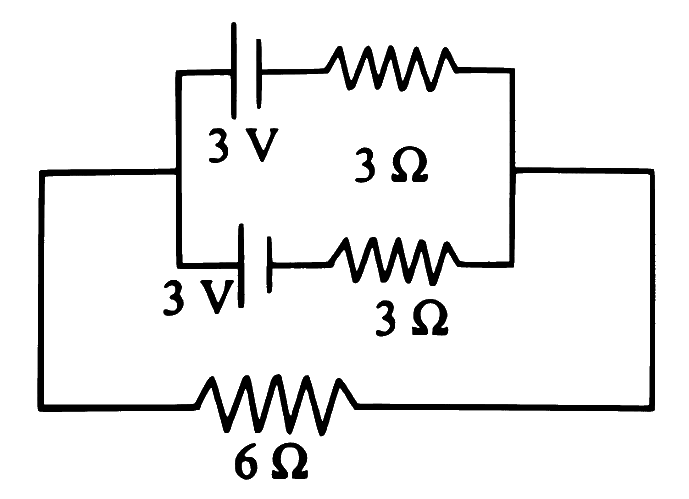
Answer: (b)
Kirchhoff's Laws & Measuring Instruments · Multi-loop circuits
The current passing through the battery in the given circuit, is:
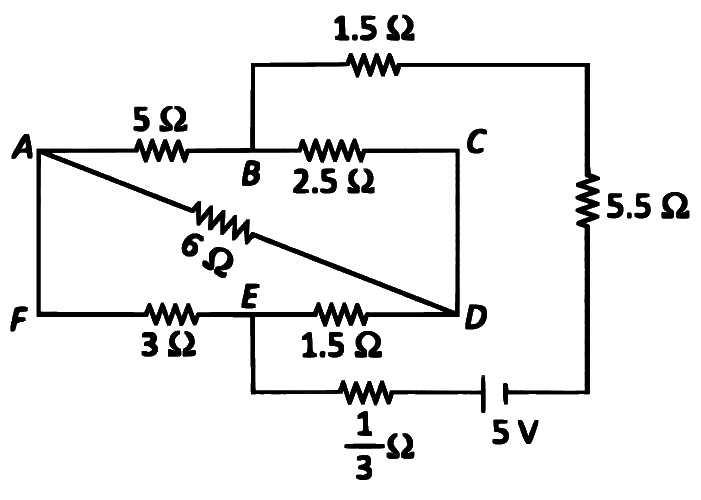
Answer: (d)
Kirchhoff's Laws & Measuring Instruments · Multi-loop circuits
The net current flowing in the given circuit is __________ A.
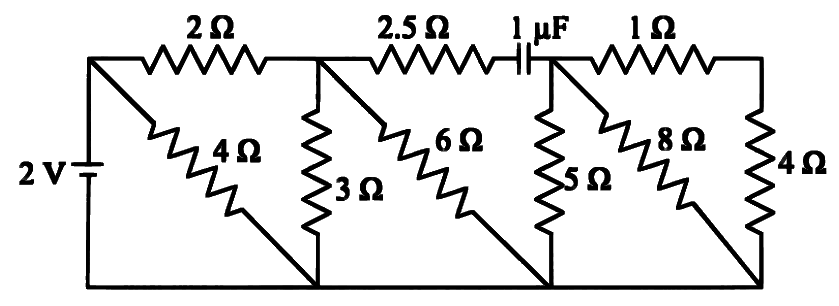
Numerical answer type. Work it out, then open the answer.
Answer: 1
Kirchhoff's Laws & Measuring Instruments · Potential difference between points
Two batteries of e.m.f 4 V and 8 V with internal resistance and respectively are connected in a circuit with a resistance of as shown in the figure. The current and potential difference between the points ' P ' and ' Q ' is
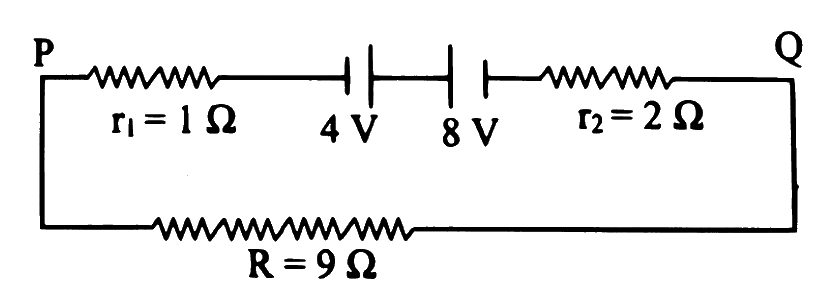
Answer: (b)
Kirchhoff's Laws & Measuring Instruments · Potential difference between points
The value of current I in the given circuit is
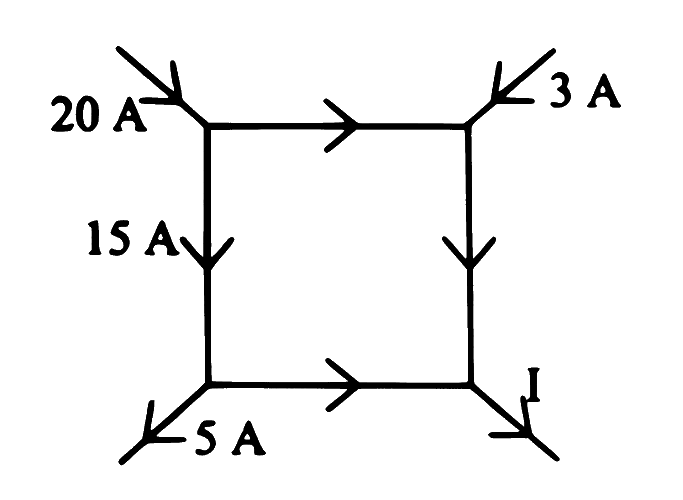
Answer: (c)
Kirchhoff's Laws & Measuring Instruments · Potential difference between points
The potential difference between the points A and B in the given figure is
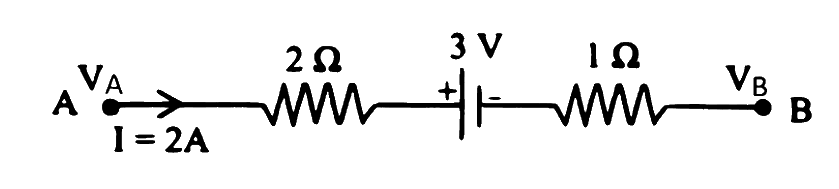
Answer: (c)
Kirchhoff's Laws & Measuring Instruments · Potential difference between points
A constant voltage of 50 V is maintained between the points and of the circuit shown in the figure. The current through the branch of the circuit is:
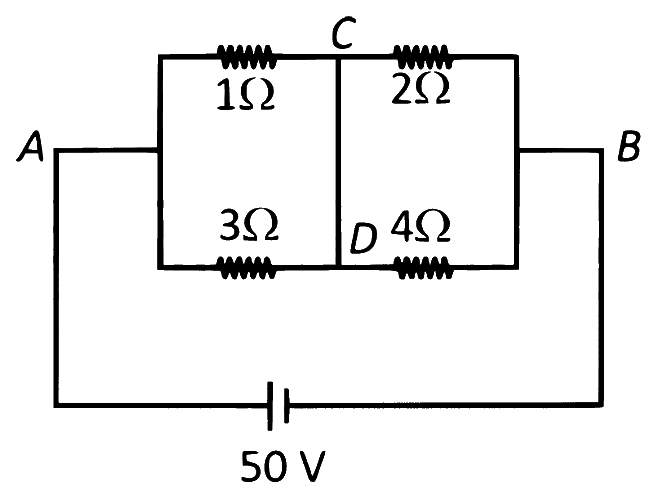
Answer: (d)
Kirchhoff's Laws & Measuring Instruments · Potential difference between points
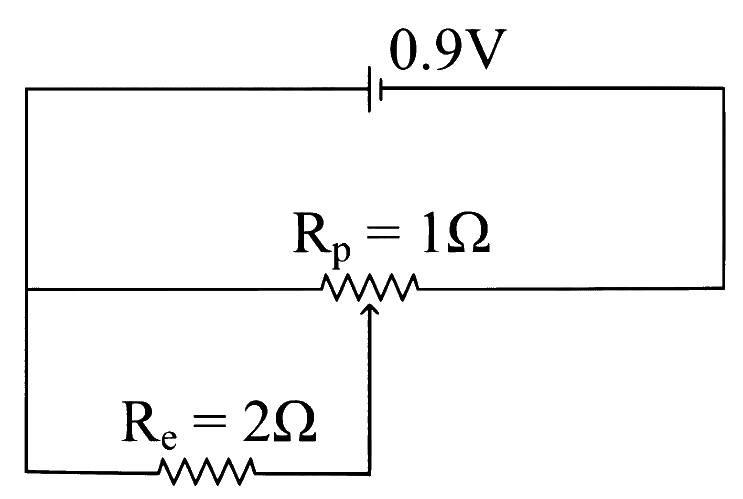
Sliding contact of a potentiometer is in the middle of the potentiometer wire having resistance as shown in the figure. An external resistance of is connected via the sliding contact. The electric current in the circuit is:
Answer: (c)
Kirchhoff's Laws & Measuring Instruments · Galvanometer to ammeter / voltmeter
When a resistance of is connected in series with a galvanometer of resistance ' G ', its range is ' '. To double its range, a resistance of is connected in series. The value of ' ' is
Answer: (b)
Kirchhoff's Laws & Measuring Instruments · Galvanometer to ammeter / voltmeter
With a resistance ' X ' connected in series with a galvanometer of resistance , it acts as a voltmeter of range . To double the range, a resistance of is to be connected in series with ' X '. The value of ' X ' in ohm is
Answer: (c)
Kirchhoff's Laws & Measuring Instruments · Galvanometer to ammeter / voltmeter
The scale of a galvanometer is divided into 160 equal divisions. The galvanometer shows full scale deflection of 16 mA and maximum voltage is 80 mV. Now the range is changed so that galvanometer reads 160 V. The required resistance to be connected is
Answer: (a)
Kirchhoff's Laws & Measuring Instruments · Galvanometer to ammeter / voltmeter
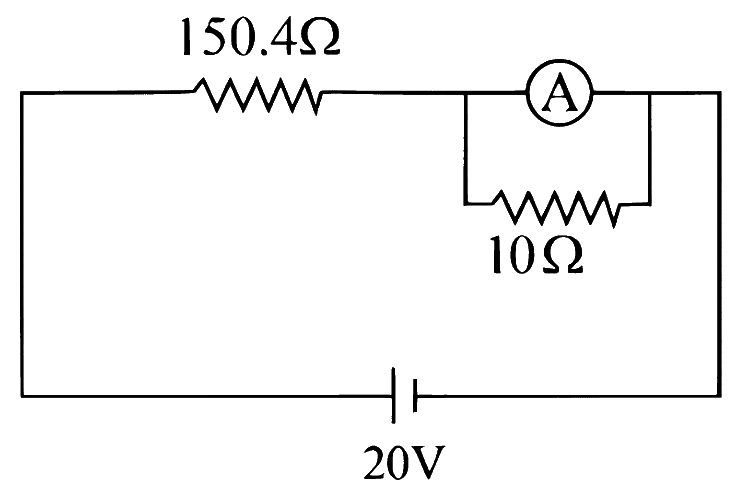
In the figure shown below, a resistance of is connected in series to an ammeter A of resistance . A shunt resistance of is connected in parallel with the ammeter. The reading of the ammeter is___________mA.
Numerical answer type. Work it out, then open the answer.
Answer: 5
Kirchhoff's Laws & Measuring Instruments · Galvanometer sensitivity & figure of merit
Consider a moving coil galvanometer (MCG):
A. The torsional constant in moving coil galvanometer has dimensions B. Increasing the current sensitivity may not necessarily increase the voltage sensitivity. C. If we increase number of turns to its double , then the voltage sensitivity doubles. D. MCG can be converted into an ammeter by introducing a shunt resistance of large value in parallel with galvanometer.
E. Current sensitivity of MCG depends inversely on number of turns of coil.
Choose the correct answer from the options given below:
Answer: (b)
Kirchhoff's Laws & Measuring Instruments · Kirchhoff's laws: basics
Kirchhoff's second law is based on the law of conservation of
Answer: (b)
Kirchhoff's Laws & Measuring Instruments · Multi-loop circuits
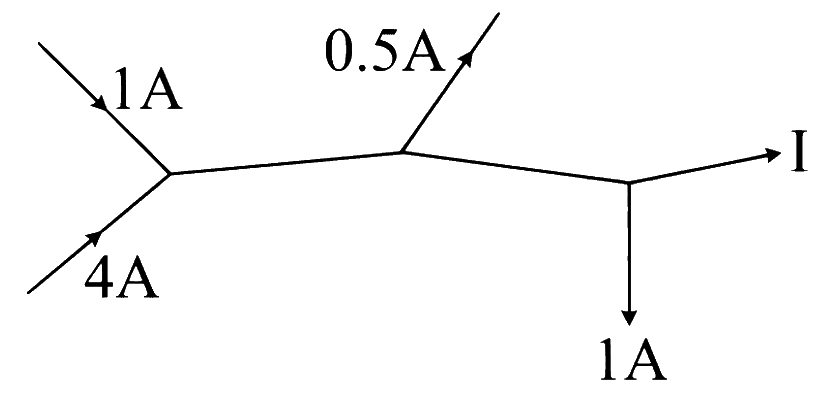
The figure shows currents in a part of electric circuit. Then current I is
Answer: (a)
Kirchhoff's Laws & Measuring Instruments · Galvanometer to ammeter / voltmeter
Two identical galvanometers are converted into an ammeter and into milliammeter. For the same current, the value of shunt of the ammeter as compared to that of milliammeter is
Answer: (a)
Kirchhoff's Laws & Measuring Instruments · Galvanometer to ammeter / voltmeter
In an ammeter, of main current passes through the galvanometer. If the resistance of the galvanometer is ' G ', the resistance of ammeter will be
Answer: (b)
Kirchhoff's Laws & Measuring Instruments · Galvanometer to ammeter / voltmeter
Two identical galvanometers are converted into voltmeter and millivoltmeter. As compared to the series resistance of voltmeter, the series resistance of millivoltmeter will be
Answer: (c)
Kirchhoff's Laws & Measuring Instruments · Galvanometer to ammeter / voltmeter
In an ammeter, of the main current is passing through the galvanometer, If shunt resistance is , then resistance of galvanometer will be
Answer: (b)
Kirchhoff's Laws & Measuring Instruments · Galvanometer to ammeter / voltmeter
The range of voltmeter of resistance ' ' is ' ' volt. The resistance required to be connected in series with it in order to convert it into a voltmeter of range ' ' volt, will be
Answer: (a)
Kirchhoff's Laws & Measuring Instruments · Galvanometer to ammeter / voltmeter
A galvanometer has a coil of resistance with a full scale deflection at . The value of resistance to be added to use it as an ammeter of range is:
Answer: (c)
Kirchhoff's Laws & Measuring Instruments · Galvanometer to ammeter / voltmeter
In an ammeter, of the main current passes through the galvanometer. If resistance of the galvanometer is , the resistance of ammeter will be:
Answer: (c)
Kirchhoff's Laws & Measuring Instruments · Galvanometer to ammeter / voltmeter
A galvanometer has a resistance of and it allows maximum current of . It can be converted into voltmeter to measure up to by connecting in series a resistor of resistance:
Answer: (d)
Kirchhoff's Laws & Measuring Instruments · Galvanometer to ammeter / voltmeter
A galvanometer having coil resistance shows a full scale deflection for a current of . For it to measure a current of , the value of the shunt should be:
Answer: (a)
Kirchhoff's Laws & Measuring Instruments · Galvanometer to ammeter / voltmeter
A current of deflects the coil of a moving coil galvanometer through . The current to cause deflection through radian is:
Answer: (d)
Kirchhoff's Laws & Measuring Instruments · Multi-loop circuits
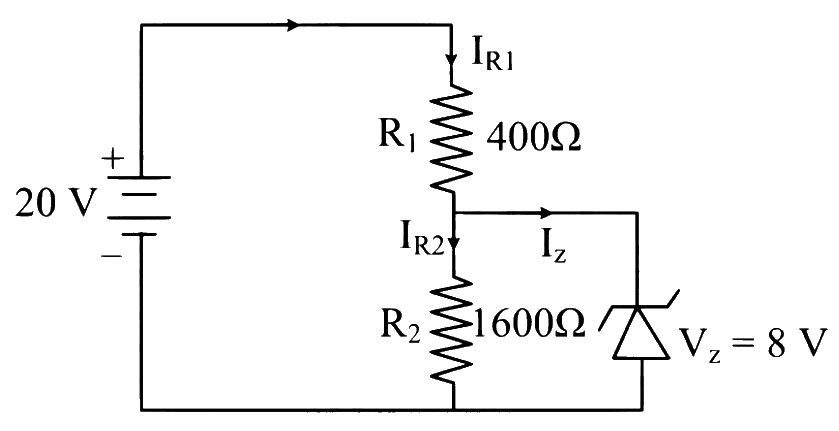
In the following circuit, the current flowing through zener diode is
Answer: (b)
Kirchhoff's Laws & Measuring Instruments · Multi-loop circuits
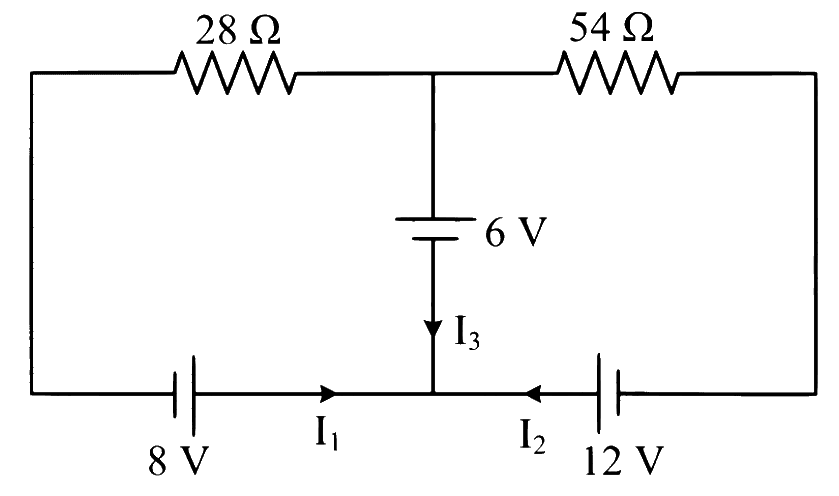
In the following circuit, the current is
Answer: (d)
Kirchhoff's Laws & Measuring Instruments · Multi-loop circuits
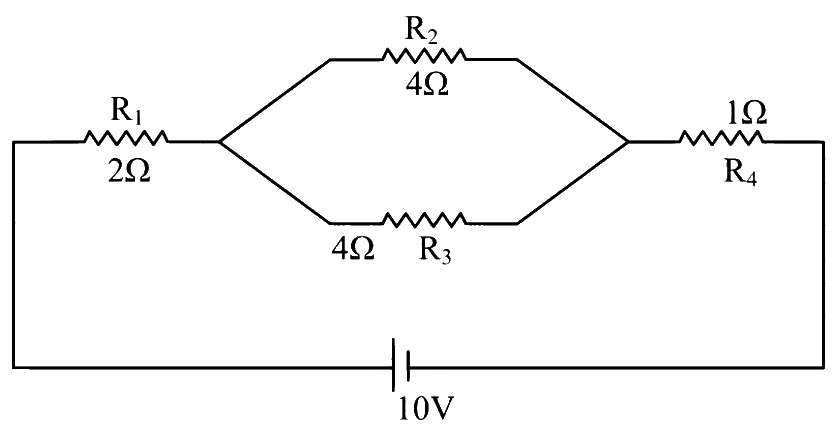
In the given circuit, the current in resistance R is:
Answer: (c)
Kirchhoff's Laws & Measuring Instruments · Potential difference between points
The potential difference between the points A and B in the given part of the circuit

Answer: (d)
Kirchhoff's Laws & Measuring Instruments · Potential difference between points
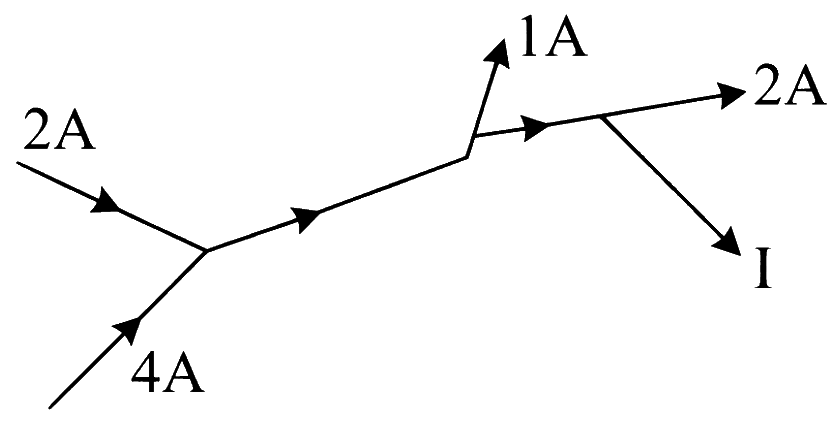
In the following electrical network, the value of I is
Answer: (c)
Kirchhoff's Laws & Measuring Instruments · Potential difference between points
The potential difference between the points ' ' and ' ' in the given part of the circuit is

Answer: (d)
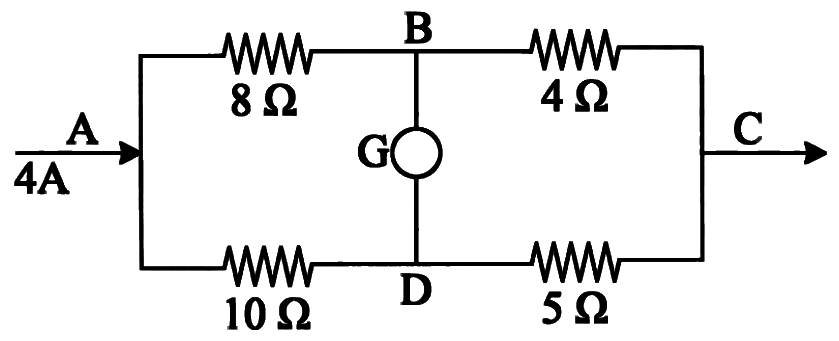
Kirchhoff's Laws & Measuring Instruments · Potential difference between points
Potential difference between the points A and B is nearly
Answer: (c)
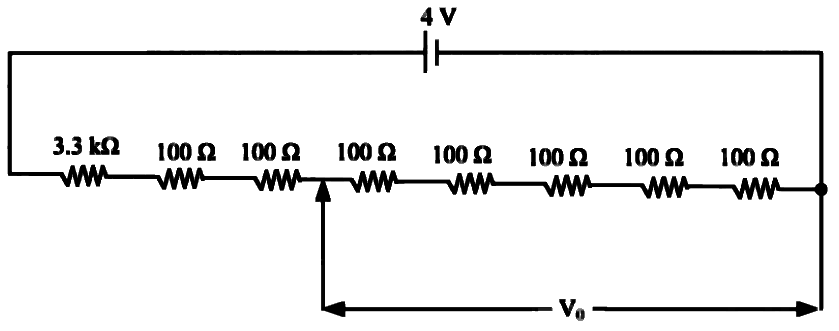
Kirchhoff's Laws & Measuring Instruments · Potential difference between points
A potential divider circuit is shown in figure. The output voltage V is:
Answer: (c)
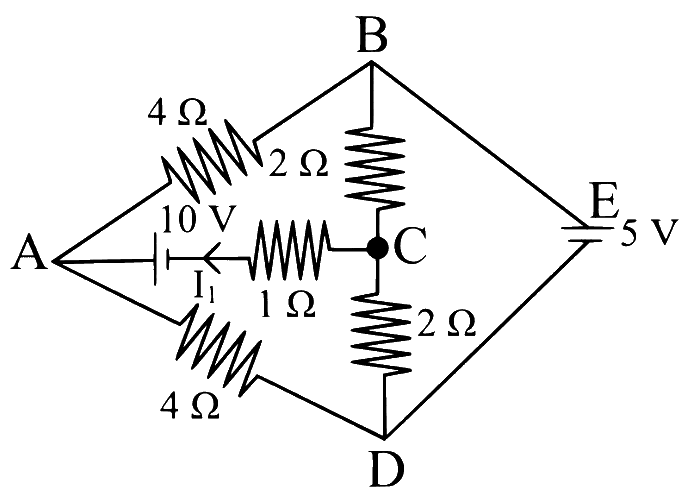
Kirchhoff's Laws & Measuring Instruments · Potential difference between points
The current flowing through the resistor is A. The value of is _______.
Numerical answer type. Work it out, then open the answer.
Answer: 25
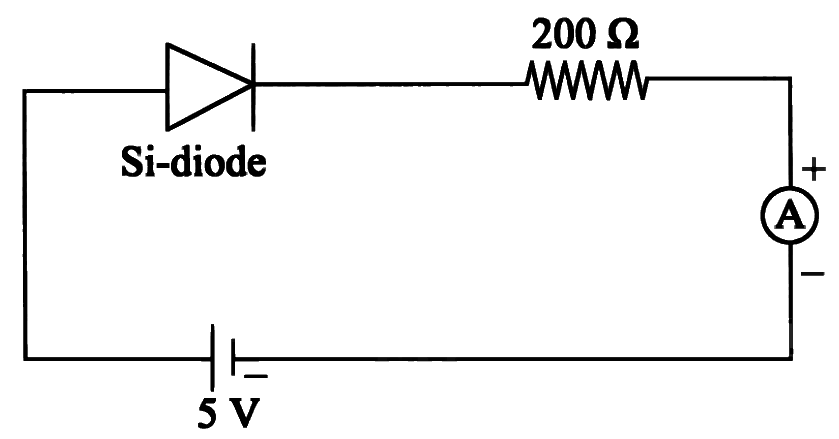
Kirchhoff's Laws & Measuring Instruments · Voltmeter & ammeter in circuits
In the following circuit, the reading in the ammeter is
Answer: (c)
Kirchhoff's Laws & Measuring Instruments · Voltmeter & ammeter in circuits
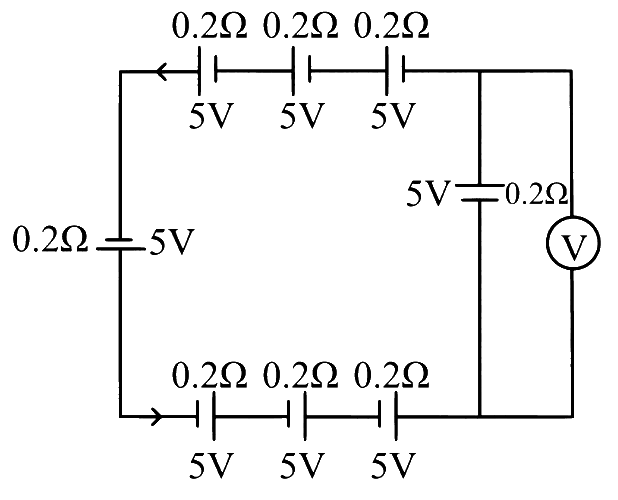
The reading in the ideal voltmeter shown in the given circuit diagram is:
Answer: (d)
Kirchhoff's Laws & Measuring Instruments · Voltmeter & ammeter in circuits
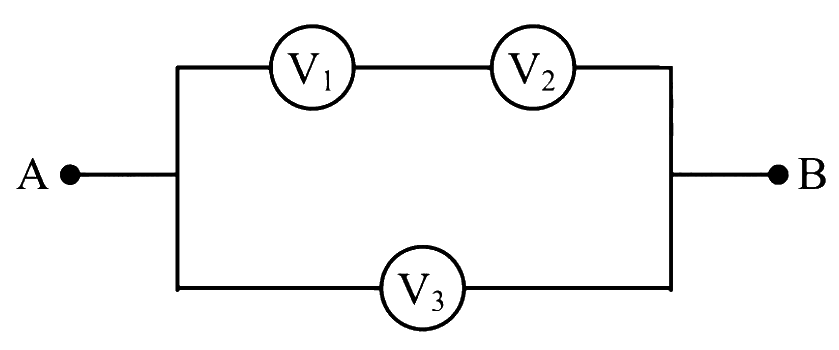
Three voltmeters, all having different internal resistances are joined as shown in figure. When some potential difference is applied across and , their readings are and . Choose the correct option.
Answer: (c)
Kirchhoff's Laws & Measuring Instruments · Voltmeter & ammeter in circuits
Two resistances of and are connected in series with a battery of and negligible internal resistance. A voltmeter is used to measure voltage across resistance, which gives reading as . The resistance of voltmeter must be _______ .
Numerical answer type. Work it out, then open the answer.
Answer: 200
Kirchhoff's Laws & Measuring Instruments · Voltmeter & ammeter in circuits
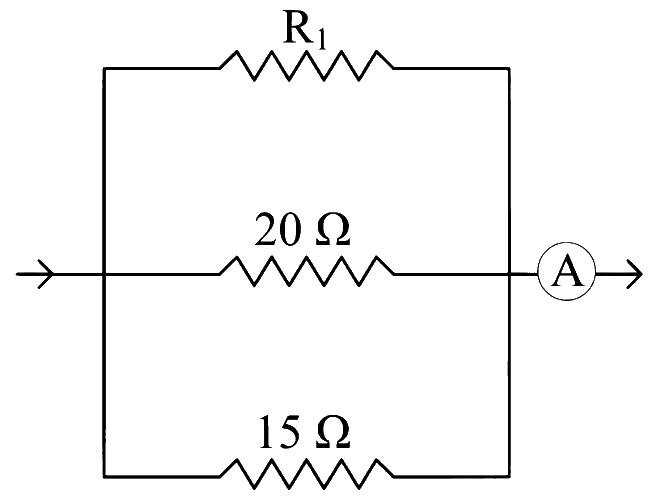
In the given circuit, the current flowing through the resistance is , while the ammeter reads . The value of is _________ .
Numerical answer type. Work it out, then open the answer.
Answer: 30
Kirchhoff's Laws & Measuring Instruments · Galvanometer to ammeter / voltmeter
When a resistance of is connected in series with a galvanometer of resistance ' ', its range is ' '. To triple its range, a resistance of is connected in series. The value of ' ' is
Answer: (d)
Kirchhoff's Laws & Measuring Instruments · Galvanometer to ammeter / voltmeter
When a resistance of is connected in series with a galvanometer of resistance G, its range is V. To double its range a resistance of is connected in series. The value of G is
Answer: (a)
Kirchhoff's Laws & Measuring Instruments · Galvanometer to ammeter / voltmeter
A galvanometer may be converted into ammeter or a voltmeter. In which of the following cases the resistance of the device so obtained will be the largest?
Answer: (d)
Kirchhoff's Laws & Measuring Instruments · Galvanometer to ammeter / voltmeter
A galvanometer has resistance and it is shunted with resistance . If of the main current flows through galvanometer, then what is the value of main current?
Answer: (c)
Kirchhoff's Laws & Measuring Instruments · Galvanometer to ammeter / voltmeter
When a galvanometer is shunted by a resistance ' ', its current capacity increases ' ' times. If the same galvanometer is shunted by another resistance ' ', its capacity will increase to ' ' times original current. The value of ' ' is
Answer: (d)
Kirchhoff's Laws & Measuring Instruments · Galvanometer to ammeter / voltmeter
When a galvanometer is shunted by a resistance ' ', its current capacity increases ' ' times. If the same galvanometer is shunted by another resistance , its current capacity increases to . The value of in terms of and is
Answer: (d)
Kirchhoff's Laws & Measuring Instruments · Galvanometer to ammeter / voltmeter
A galvanometer of resistance when connected in series with measures a voltage of upto . The value of resistance required to convert the galvanometer into ammeter to read upto is . The value of is:
Answer: (b)
Kirchhoff's Laws & Measuring Instruments · Galvanometer to ammeter / voltmeter
The deflection in moving coil galvanometer falls from 25 divisions to 5 divisions when a shunt of is applied. The resistance of galvanometer coil will be:
Answer: (c)
Kirchhoff's Laws & Measuring Instruments · Galvanometer to ammeter / voltmeter
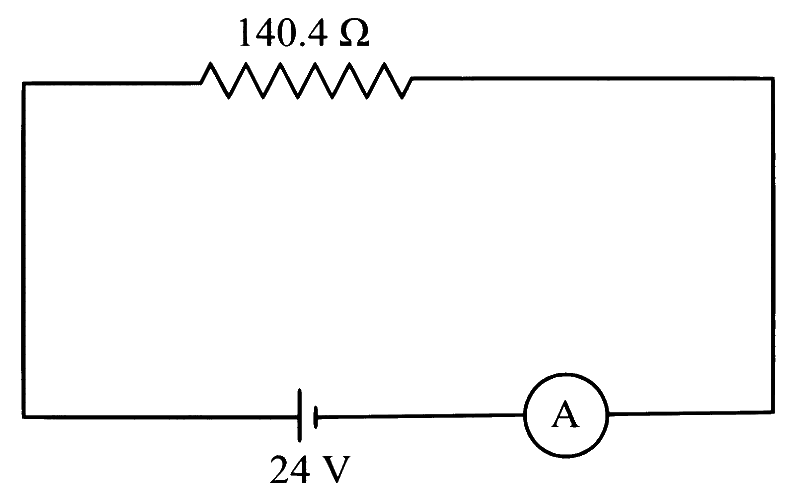
In the given figure an ammeter A consists of a coil connected in parallel to a shunt. The reading of the ammeter is ________ .
Numerical answer type. Work it out, then open the answer.
Answer: 160
Kirchhoff's Laws & Measuring Instruments · Galvanometer to ammeter / voltmeter
A galvanometer of resistance ' ' is shunted by resistance of 'S' ohm. To keep the main current in the circuit unchanged the resistance to be put in series with Galvanometer is
Answer: (a)
Kirchhoff's Laws & Measuring Instruments · Galvanometer sensitivity & figure of merit
In the experiment to determine the galvanometer resistance by half-deflection method, the plot of vs the resistance (R) of the resistance box is shown in the figure. The figure of merit of the galvanometer is _________ division. [The source has emf ]
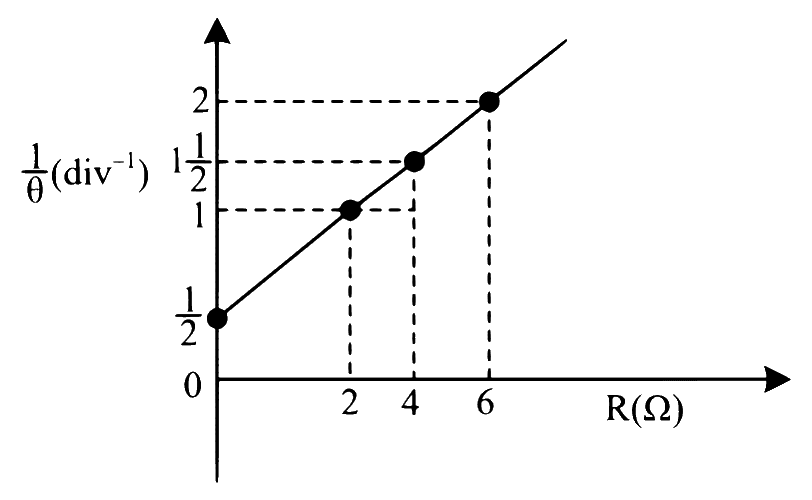
Numerical answer type. Work it out, then open the answer.
Answer: 5
Kirchhoff's Laws & Measuring Instruments · Kirchhoff's laws: basics
Five current carrying conductors meet at point . What is the magnitude and direction of the current in conductor ?
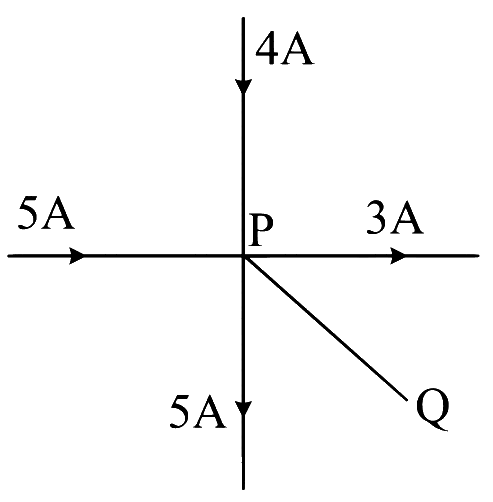
Answer: (b)
Kirchhoff's Laws & Measuring Instruments · Kirchhoff's laws: basics
Five current carrying conductors meet at a point '' as shown in figure. The magnitude and direction of the current in conductor '' is
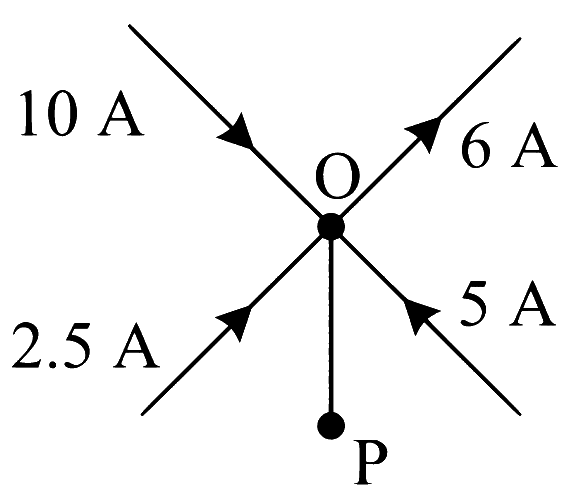
Answer: (d)
Kirchhoff's Laws & Measuring Instruments · Galvanometer to ammeter / voltmeter
Only of the total current in the circuit passes through a galvanometer. If the resistance of the galvanometer is , then the shunt resistance connected to the galvanometer is
Answer: (b)
Kirchhoff's Laws & Measuring Instruments · Galvanometer to ammeter / voltmeter
A galvanometer has resistance '' and range ''. How much resistance is required to read voltage upto '' volt?
Answer: (a)
Kirchhoff's Laws & Measuring Instruments · Galvanometer to ammeter / voltmeter
If only of total current is passed through a galvanometer of resistance '' then the resistance of the shunt is
Answer: (d)
Kirchhoff's Laws & Measuring Instruments · Galvanometer to ammeter / voltmeter
A galvanometer of resistance is shunted with a resistance of of . The part of the total current that flows through the galvanometer is
Answer: (a)
Kirchhoff's Laws & Measuring Instruments · Multi-loop circuits
The magnitude and direction of the current in the following circuit is :-
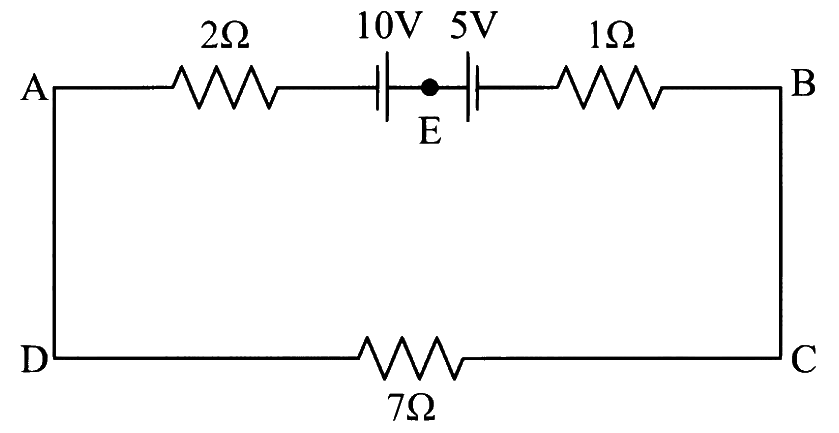
Answer: (a)
Kirchhoff's Laws & Measuring Instruments · Multi-loop circuits
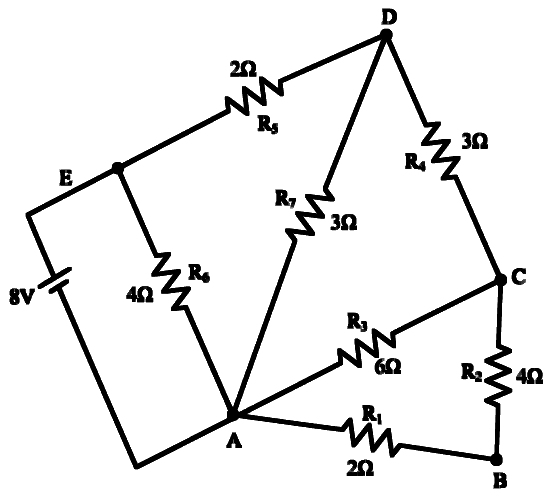
The current flowing through R is:
Answer: (b)
Kirchhoff's Laws & Measuring Instruments · Multi-loop circuits
In the following circuit, the magnitude of current I1, is ___________ A.
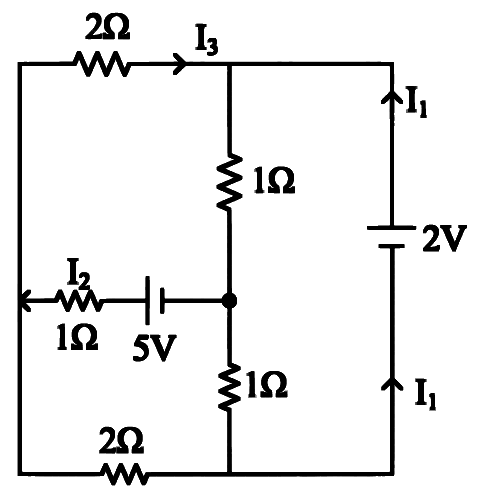
Numerical answer type. Work it out, then open the answer.
Answer: 1.5
Kirchhoff's Laws & Measuring Instruments · Potential difference between points
Potential difference between the points P and Q is nearly
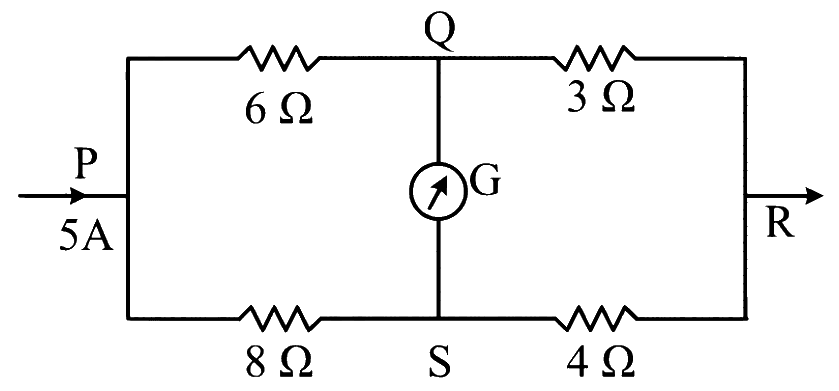
Answer: (a)
Kirchhoff's Laws & Measuring Instruments · Potential difference between points
Potential difference between the points P and Q is nearly
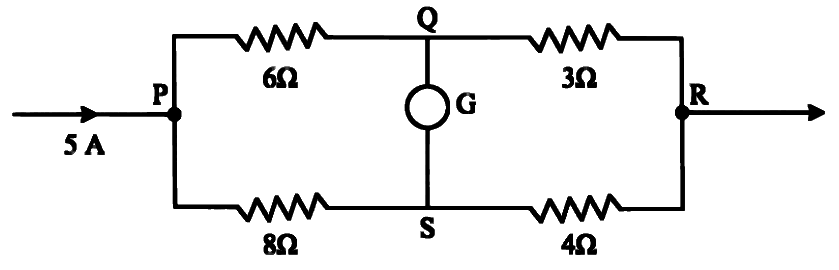
Answer: (c)
Kirchhoff's Laws & Measuring Instruments · Potential difference between points
Figure shows a part of an electric circuit. The potentials at points and are and respectively. The current through the resistor will be,
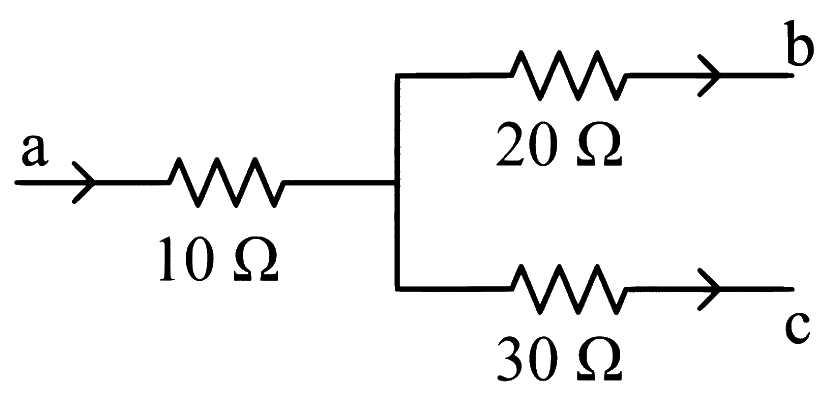
Answer: (c)
Kirchhoff's Laws & Measuring Instruments · Potential difference between points
As shown in the figure, a network of resistors is connected to a battery of 24V with an internal resistance of 3 . The currents through the resistors R and R are I and I respectively. The values of I and I are:
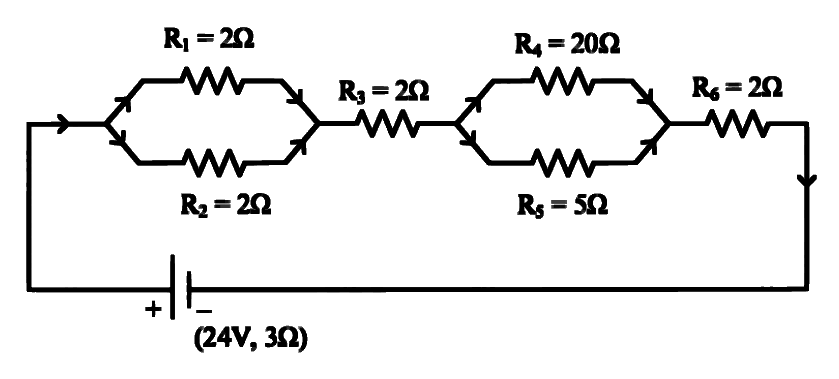
Answer: (c)
Kirchhoff's Laws & Measuring Instruments · Potential difference between points
A network of four resistances is connected to battery, as shown in figure. The magnitude of voltage difference between the points and is __________ .
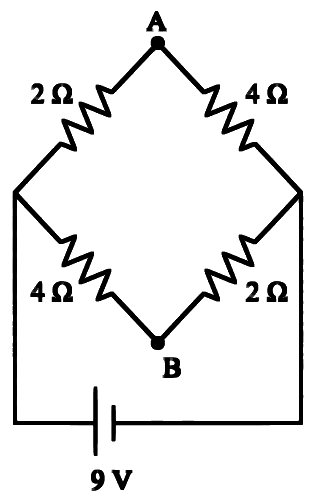
Numerical answer type. Work it out, then open the answer.
Answer: 3
Kirchhoff's Laws & Measuring Instruments · Potential difference between points
In the circuit diagram shown in figure given below, the current flowing through resistance is . The value of is ___________
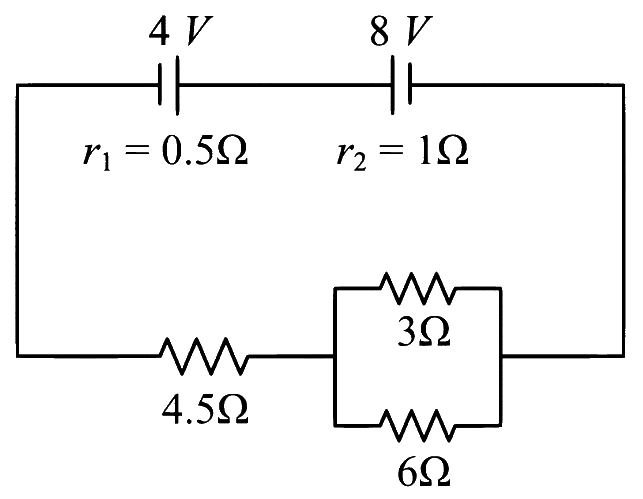
Numerical answer type. Work it out, then open the answer.
Answer: 1
Kirchhoff's Laws & Measuring Instruments · Potential difference between points
In the given circuit, the value of is _____________
Numerical answer type. Work it out, then open the answer.
Answer: 2
Kirchhoff's Laws & Measuring Instruments · Voltmeter & ammeter in circuits
Given below are two statements: One is labelled as Assertion and the other is labelled as Reason .
Assertion A: For measuring the potential difference across a resistance of , the voltmeter with resistance will be preferred over voltmeter with resistance .
Reason R: Voltmeter with higher resistance will draw smaller current than voltmeter with lower resistance.
In the light of the above statements, choose the most appropriate answer from the options given below.
Answer: (a)
Kirchhoff's Laws & Measuring Instruments · Voltmeter & ammeter in circuits
A cell of emf 90 V is connected across series combination of two resistors each of 100 resistance. A voltmeter of resistance 400 is used to measure the potential difference across each resistor. The reading of the voltmeter will be:
Answer: (a)
Kirchhoff's Laws & Measuring Instruments · Voltmeter & ammeter in circuits
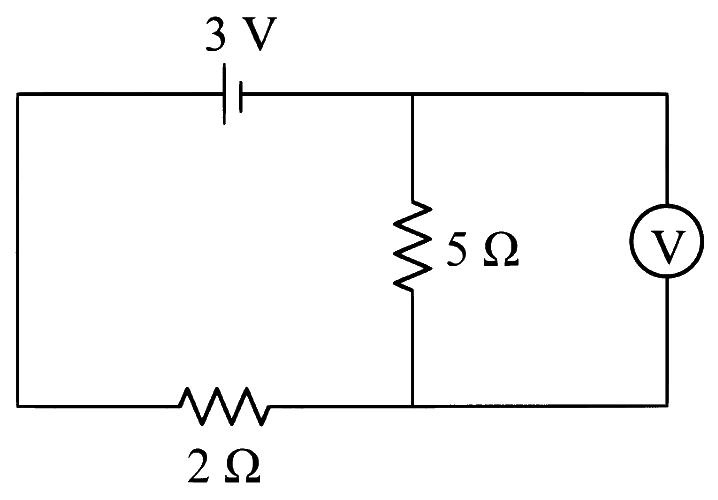
As shown in the figure, the voltmeter reads across resistor. The resistance of the voltmeter is _________ .
Numerical answer type. Work it out, then open the answer.
Answer: 20
Kirchhoff's Laws & Measuring Instruments · Galvanometer to ammeter / voltmeter
When moving coil galvanometer (MCG) is converted into a voltmeter, the series resistance is '' times the resistance of galvanometer. How many times that of MCG the voltmeter is now capable of measuring voltage?
Answer: (c)
Kirchhoff's Laws & Measuring Instruments · Galvanometer to ammeter / voltmeter
A galvanometer of resistance gives a deflection of 5 divisions when current flows through it. The galvanometer scale has 50 divisions. To convert the galvanometer into a voltmeter of range 25 volt, we should connect a resistance of
Answer: (b)
Kirchhoff's Laws & Measuring Instruments · Galvanometer to ammeter / voltmeter
For designing a voltmeter of range and an ammeter of range using a galvanometer which has a coil of resistance showing a full scale deflection for as in figure.
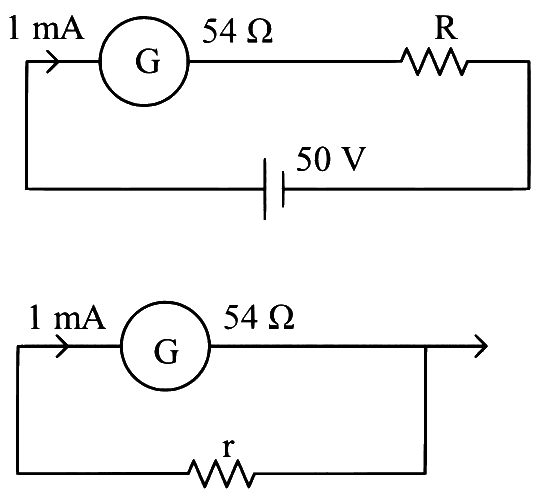
(A) for voltmeter
(B) for ammeter
(C) for ammeter
(D) for voltmeter
(E) for voltmeter
Choose the correct answer from the options given below:
Answer: (a)
Kirchhoff's Laws & Measuring Instruments · Galvanometer to ammeter / voltmeter
When a resistance of is shunted with a moving coil galvanometer, it shows a full scale deflection for a current of , however when resistance is connected with it in series, it gives full scale deflection for 25 volt. The resistance of galvanometer is ____________ .
Numerical answer type. Work it out, then open the answer.
Answer: 50
Kirchhoff's Laws & Measuring Instruments · Galvanometer sensitivity & figure of merit
The current sensitivity of moving coil galvanometer is increased by . This increase is achieved only by changing in the number of turns of coils and area of cross section of the wire while keeping the resistance of galvanometer coil constant. The percentage change in the voltage sensitivity will be:
Answer: (a)
Kirchhoff's Laws & Measuring Instruments · Galvanometer sensitivity & figure of merit
The number of turns of the coil of a moving coil galvanometer is increased in order to increase current sensitivity by . The percentage change in voltage sensitivity of the galvanometer will be:
Answer: (a)
Kirchhoff's Laws & Measuring Instruments · Galvanometer to ammeter / voltmeter
A student is provided with a variable voltage source , a test resistor , two identical galvanometers and and two additional resistors, and . For conducting an experiment to verify Ohm's law, the most suitable circuit is:
Answer: (c)
Kirchhoff's Laws & Measuring Instruments · Galvanometer to ammeter / voltmeter
A galvanometer of resistance is to be converted into an ammeter. The value of shunt resistance which allows of the mains current through the galvanometer is equal to (nearly)
Answer: (a)
Kirchhoff's Laws & Measuring Instruments · Galvanometer to ammeter / voltmeter
A 72 galvanometer is shunted by a resistance of 8 . The percentage of the total current which passes through the galvanometer is:
Answer: (b)
Kirchhoff's Laws & Measuring Instruments · Multi-loop circuits
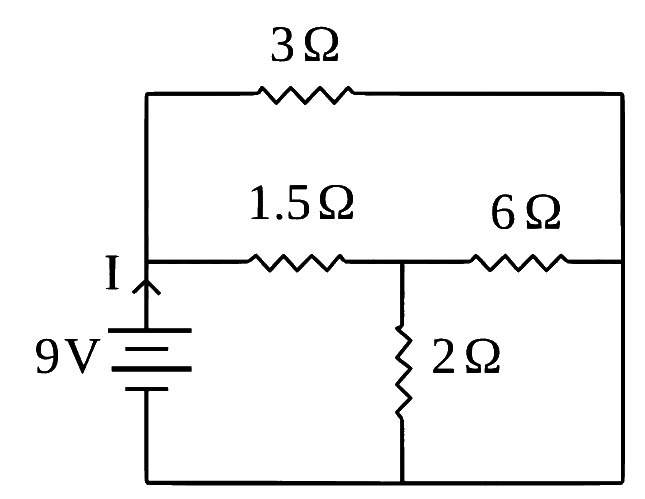
The current I drawn out of the battery connected in the given circuit is:
Answer: (b)
Kirchhoff's Laws & Measuring Instruments · Multi-loop circuits
A battery of is connected to the circuit as shown below. The current I drawn from the battery is:
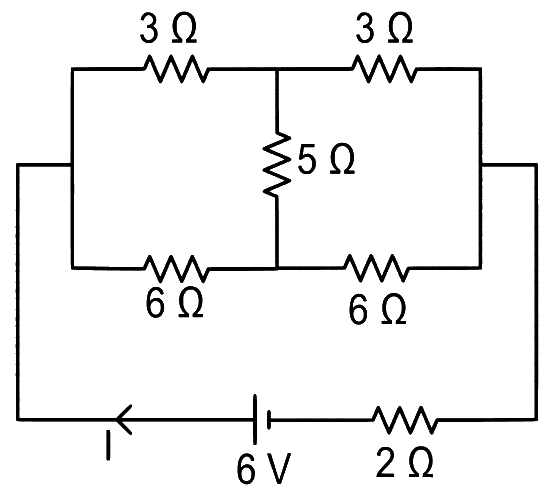
Answer: (a)
Kirchhoff's Laws & Measuring Instruments · Multi-loop circuits
The current I in the given circuit will be:
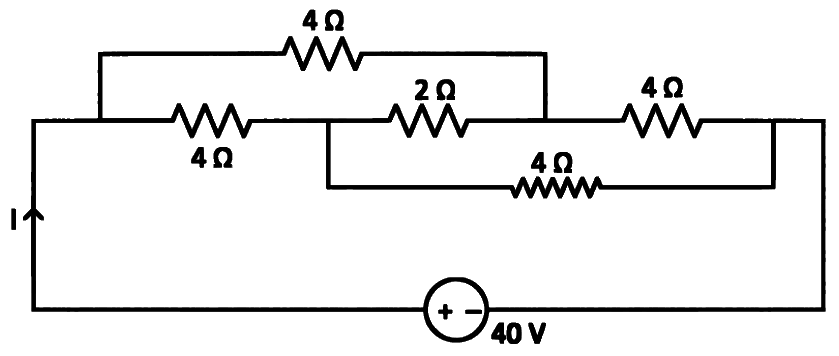
Answer: (a)
Kirchhoff's Laws & Measuring Instruments · Multi-loop circuits
The current I flowing through the given circuit will be __________A.
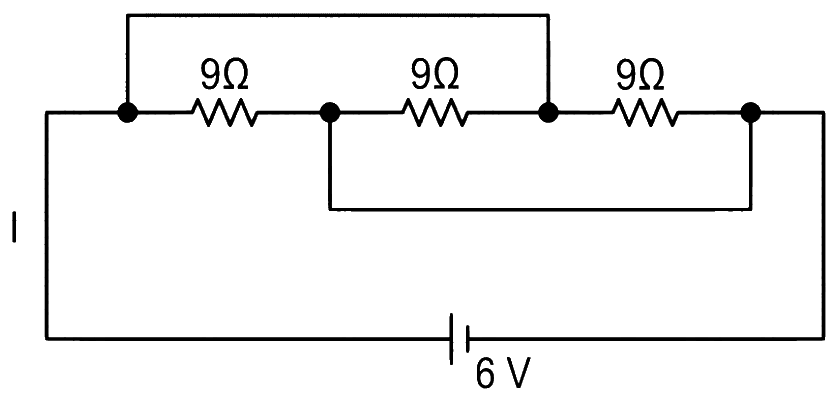
Numerical answer type. Work it out, then open the answer.
Answer: 2
Kirchhoff's Laws & Measuring Instruments · Multi-loop circuits
The total current supplied to the circuit as shown in figure by the 5 V battery is ____________ A.
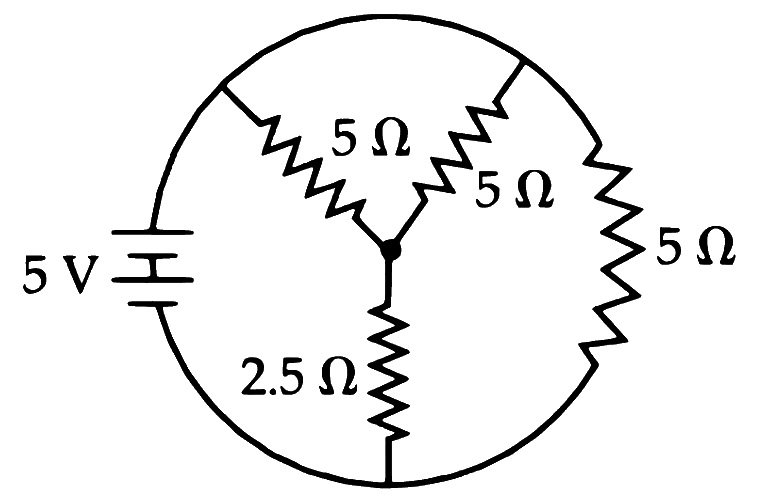
Numerical answer type. Work it out, then open the answer.
Answer: 2
Kirchhoff's Laws & Measuring Instruments · Potential difference between points
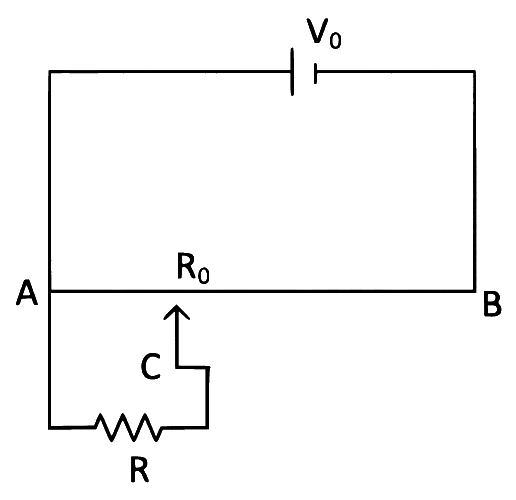
The sliding contact C is at one fourth of the length of the potentiometer wire (AB) from A as shown in the circuit diagram. If the resistance of the wire AB is R0, then the potential drop (V) across the resistor R is
Answer: (b)
Kirchhoff's Laws & Measuring Instruments · Potential difference between points
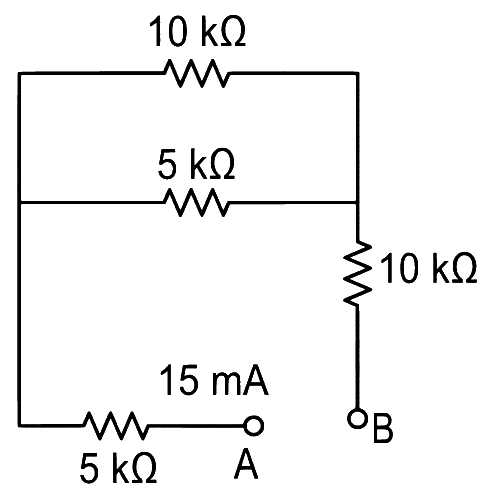
A current of 15 mA flows in the circuit as shown in figure. The value of potential difference between the points A and B will be:
Answer: (d)
Kirchhoff's Laws & Measuring Instruments · Potential difference between points
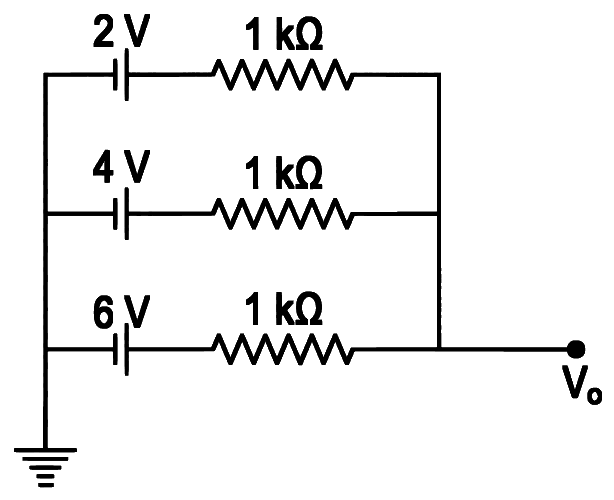
In the given figure, the value of Vo will be _____________ V.
Numerical answer type. Work it out, then open the answer.
Answer: 4
Kirchhoff's Laws & Measuring Instruments · Potential difference between points
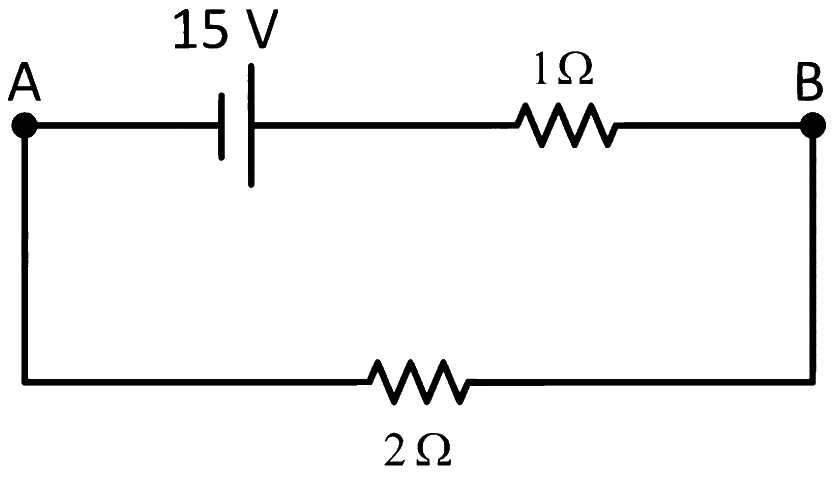
For the network shown below, the value of VB VA is ____________ V.
Numerical answer type. Work it out, then open the answer.
Answer: 10
Kirchhoff's Laws & Measuring Instruments · Voltmeter & ammeter in circuits
Two resistors are connected in series across a battery as shown in figure. If a voltmeter of resistance 2000 is used to measure the potential difference across 500 resistor, the reading of the voltmeter will be ___________ V.
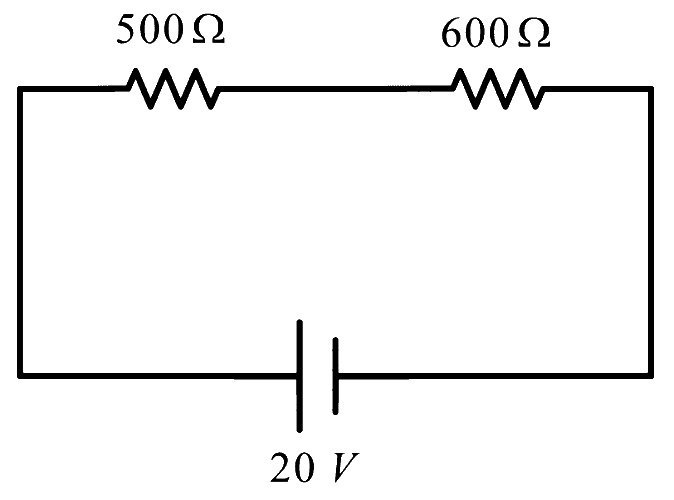
Numerical answer type. Work it out, then open the answer.
Answer: 8
Kirchhoff's Laws & Measuring Instruments · Galvanometer to ammeter / voltmeter
A teacher in his physics laboratory allotted an experiment to determine the resistance (G) of a galvanometer. Students took the observations for deflection in the galvanometer. Which of the below is true for measuring value of G?
Answer: (b)
Kirchhoff's Laws & Measuring Instruments · Galvanometer sensitivity & figure of merit
If n represents the actual number of deflections in a converted galvanometer of resistance G and shunt resistance S. Then the total current I when its figure of merit is K will be:
Answer: (d)
Kirchhoff's Laws & Measuring Instruments · Potential difference between points
All resistances in figure are 1 each. The value of current 'I' is A. The value of a is _________.
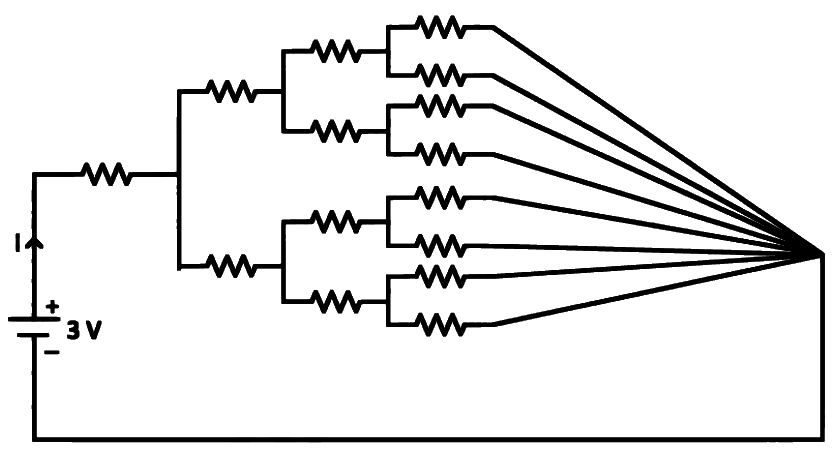
Numerical answer type. Work it out, then open the answer.
Answer: 8
Kirchhoff's Laws & Measuring Instruments · Kirchhoff's laws: basics
Kirchhoff's current and voltage law are respectively based on the conservation of
Answer: (c)
Kirchhoff's Laws & Measuring Instruments · Kirchhoff's laws: basics
The Kirchhoff's current law and voltage law are respectively based upon the conservation of
Answer: (a)
Kirchhoff's Laws & Measuring Instruments · Galvanometer to ammeter / voltmeter
A galvanometer of resistance is converted to an ammeter. After shunting, the effective resistance of ammeter is . The value of shunt is
Answer: (b)
Kirchhoff's Laws & Measuring Instruments · Multi-loop circuits
A current through 1 resistance in the following circuit is
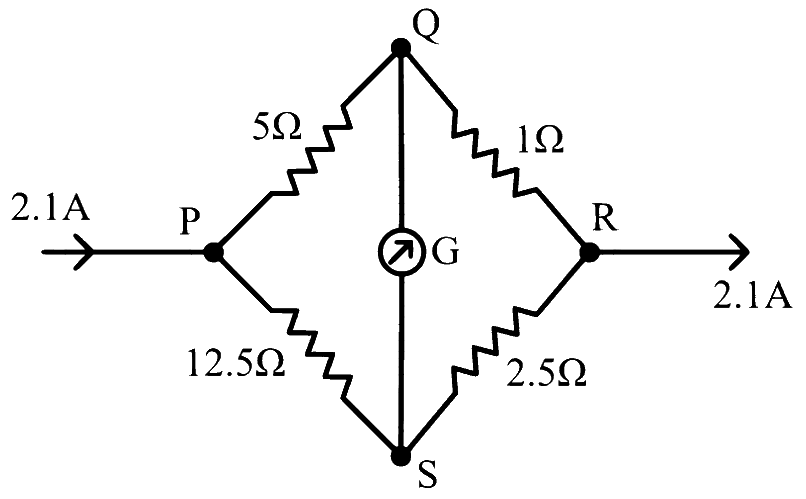
Answer: (c)
Kirchhoff's Laws & Measuring Instruments · Multi-loop circuits
A 16 wire is bent to form a square loop. A 9V supply having internal resistance of 1 is connected across one of its sides. The potential drop across the diagonals of the square loop is _______________ 101 V
Numerical answer type. Work it out, then open the answer.
Answer: 45
Kirchhoff's Laws & Measuring Instruments · Potential difference between points
In the following electrical network, the value of I is
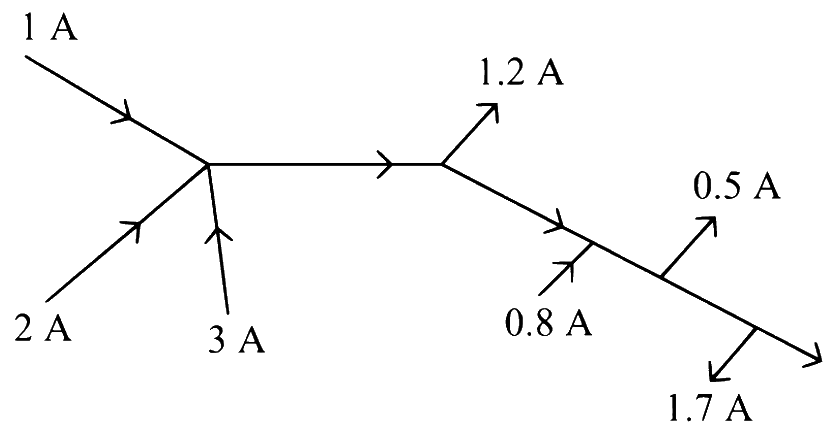
Answer: (c)
Kirchhoff's Laws & Measuring Instruments · Potential difference between points
Consider the circuit shown in the figure. The value of current 'I' is
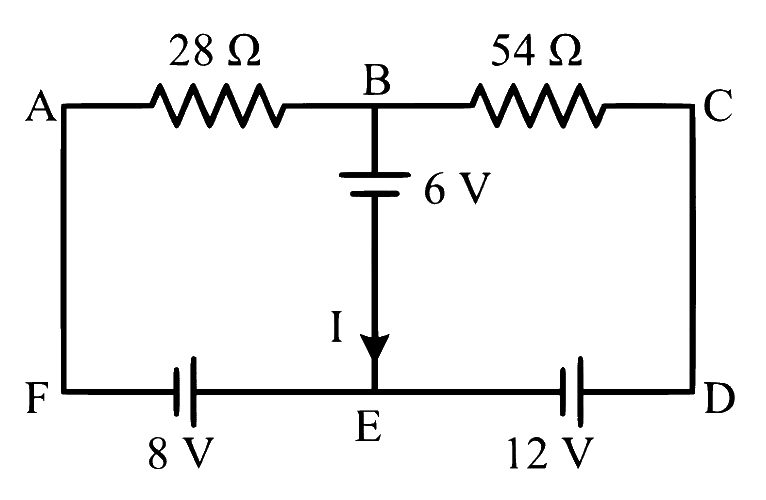
Answer: (a)
Kirchhoff's Laws & Measuring Instruments · Potential difference between points
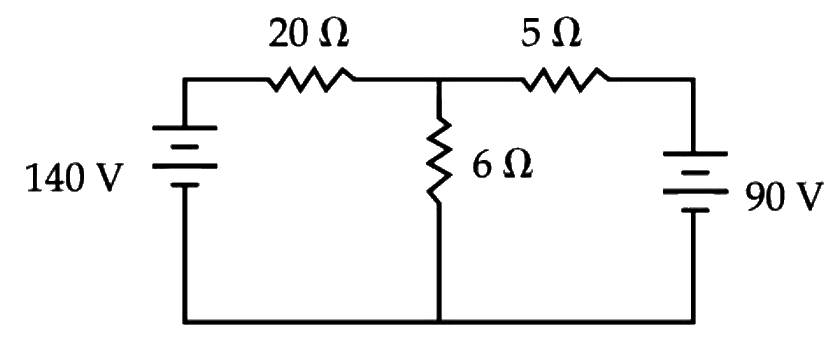
The value of current in the 6 resistance is:
Answer: (c)
Kirchhoff's Laws & Measuring Instruments · Potential difference between points
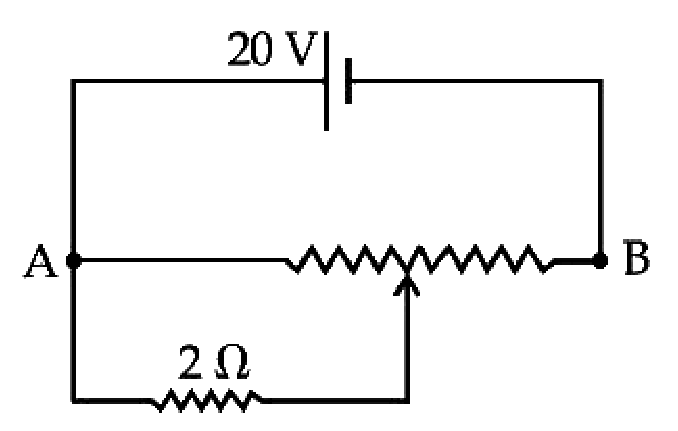
The given potentiometer has its wire of resistance 10. When the sliding contact is in the middle of the potentiometer wire, the potential drop across 2 resistor is:
Answer: (c)
Kirchhoff's Laws & Measuring Instruments · Potential difference between points
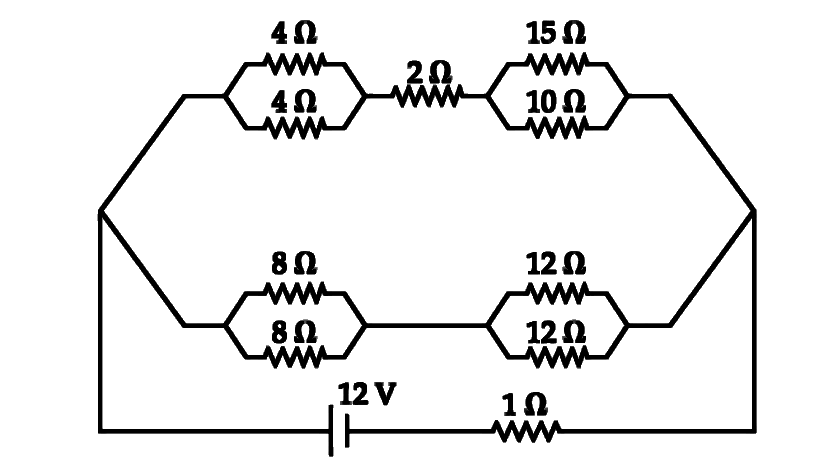
The voltage drop across 15 resistance in the given figure will be ______________ V.
Numerical answer type. Work it out, then open the answer.
Answer: 6
Kirchhoff's Laws & Measuring Instruments · Potential difference between points
The voltage across the 10 resistor in the given circuit is x volt.
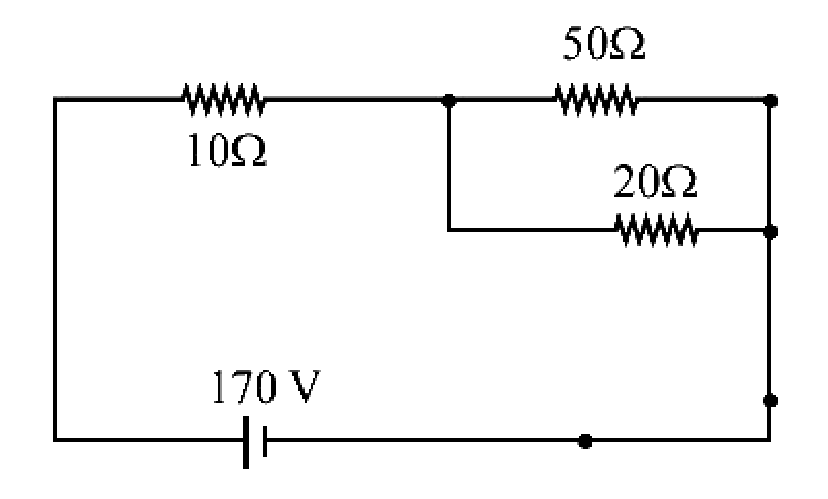
The value of 'x' to the nearest integer is _________.
Numerical answer type. Work it out, then open the answer.
Answer: 70
Kirchhoff's Laws & Measuring Instruments · Potential difference between points
In the figure given, the electric current flowing through the 5 k resistor is 'x' mA.
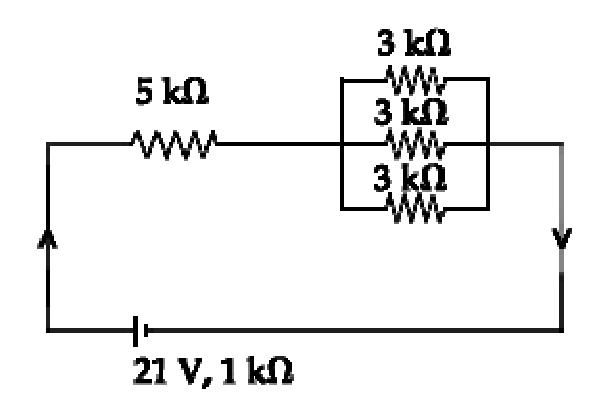
The value of x to the nearest integer is ____________.
Numerical answer type. Work it out, then open the answer.
Answer: 3
Kirchhoff's Laws & Measuring Instruments · Galvanometer to ammeter / voltmeter
A moving coil galvanometer is converted into an ammeter, reading upto by connecting a shunt of resistance '' across it and then into an ammeter reading upto , when a shunt of resistance '' is connected across it. What is the maximum current which can be sent through this galvanometer if no shunt is used?
Answer: (a)
Kirchhoff's Laws & Measuring Instruments · Galvanometer to ammeter / voltmeter
A galvanometer has resistance '' and '' is current flowing through it which produces full scale deflection. '' is the value of shunt which converts it into an ammeter of range 0 to '' and '' is the shunt value which converts it into an ammeter of range 0 to '', the ratio is
Answer: (b)
Kirchhoff's Laws & Measuring Instruments · Galvanometer to ammeter / voltmeter
Consider a galvanometer shunted with 5 resistance and 2% of current passes through it. What is the resistance of the given galvanometer?
Answer: (c)
Kirchhoff's Laws & Measuring Instruments · Galvanometer sensitivity & figure of merit
For full scale deflection of total 50 divisions, 50 mV voltage is required in galvanometer. The resistance of galvanometer if its current sensitivity is 2 div/mA will be:
Answer: (d)
Kirchhoff's Laws & Measuring Instruments · Kirchhoff's laws: basics
For the circuit given below, the Kirchoff's loop rule for the loop is given by the equation
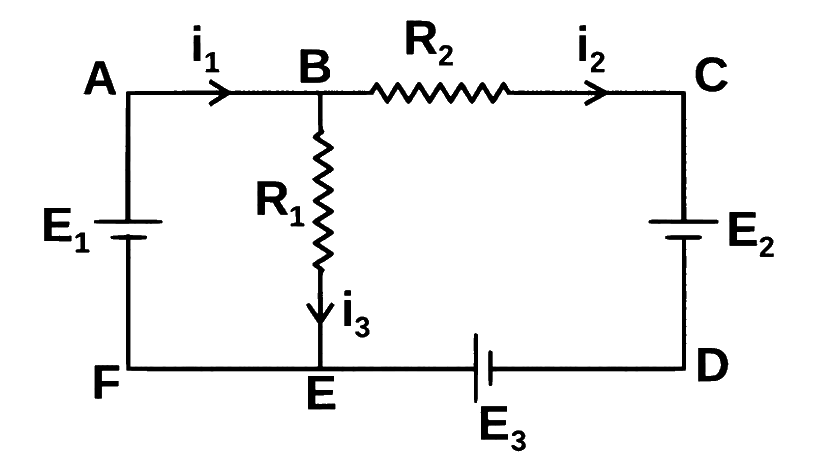
Answer: (c)
Kirchhoff's Laws & Measuring Instruments · Voltmeter & ammeter in circuits
A circuit to verify Ohm's law uses ammeter and voltmeter in series or parallel connected correctly to the resistor. In the circuit:
Answer: (a)
Kirchhoff's Laws & Measuring Instruments · Galvanometer to ammeter / voltmeter
A milliammeter of resistance has a range . What will be the resistance used in series to convert it into voltmeter of range ?
Answer: (a)
Kirchhoff's Laws & Measuring Instruments · Galvanometer to ammeter / voltmeter
In conversion of moving coil galvanometer into an ammeter of required range, the resistance of ammeter, so formed is
[ shunt and resistance of galvanometer]
Answer: (b)
Kirchhoff's Laws & Measuring Instruments · Galvanometer to ammeter / voltmeter
A galvanometer of resistance G is converted into a voltmeter of range 0 – 1 V by connecting a resistance R1 in series with it. The additional resistance that should be connected in series with R1 to increase the range of the voltmeter to 0 – 2 V will be:
Answer: (c)
Kirchhoff's Laws & Measuring Instruments · Galvanometer to ammeter / voltmeter
A galvanometer having a coil resistance 100 gives a full scale deflection when a current of 1 mA is passed through it. What is the value of the resistance which can convert this galvanometer into a voltmeter giving full scale deflection for a potential difference of 10 V?
Answer: (c)
Kirchhoff's Laws & Measuring Instruments · Galvanometer sensitivity & figure of merit
Two galvanometers and require currents of 4 mA and 7 mA, respectively to produce the same deflection of 20 divisions. If and are their sensitivities respectively, then
Answer: (b)
Kirchhoff's Laws & Measuring Instruments · Galvanometer sensitivity & figure of merit
A galvanometer is used in laboratory for detecting the null point in electrical experiments. If, on passing a current of 6 mA it produces a deflection of 2°, its figure of merit is close to:
Answer: (c)
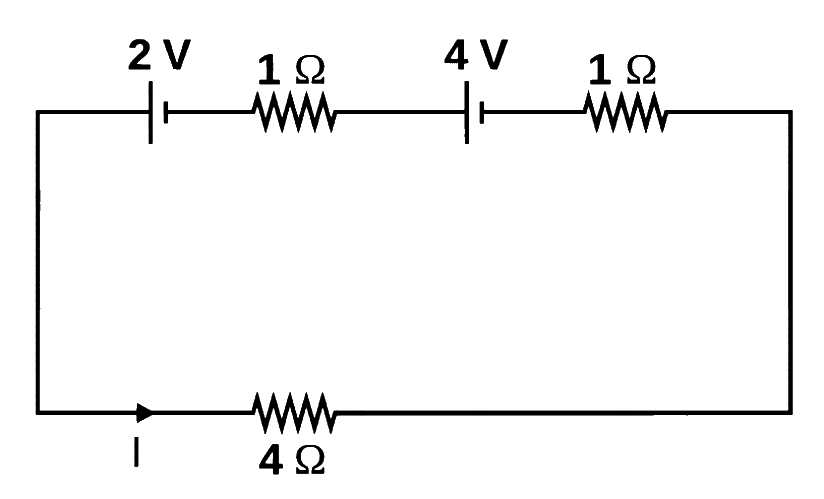
Kirchhoff's Laws & Measuring Instruments · Multi-loop circuits
For the circuit shown in the figure, the current will be
Answer: (c)
Kirchhoff's Laws & Measuring Instruments · Multi-loop circuits
In the figure shown, the current in the 10 V battery is close to:
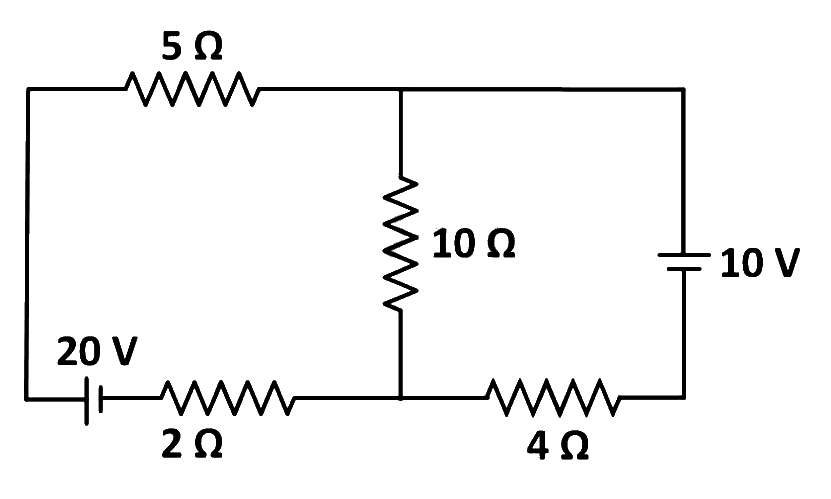
Answer: (d)
Kirchhoff's Laws & Measuring Instruments · Multi-loop circuits
The current I1 (in A) flowing through 1 resistor in the following circuit is:
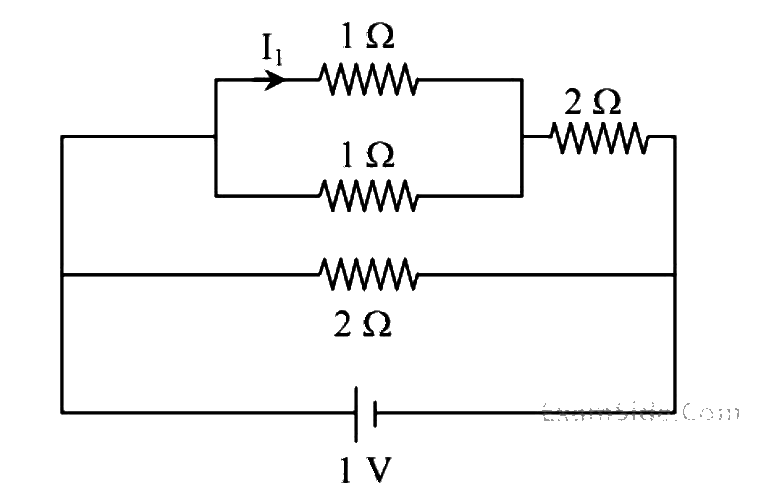
Answer: (c)
Kirchhoff's Laws & Measuring Instruments · Multi-loop circuits
Four resistances 40 , 60 , 90 and 110 make the arms of a quadrilateral ABCD. Across AC is a battery of emf 40 V and internal resistance negligible. The potential difference across BD in V is _______.
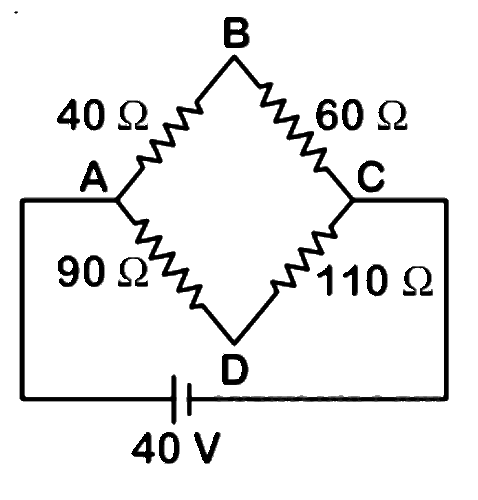
Numerical answer type. Work it out, then open the answer.
Answer: 2
Kirchhoff's Laws & Measuring Instruments · Potential difference between points
In the circuit, given in the figure currents in different branches and value of one resistor are shown. Then potential at point B with respect to the point A is:
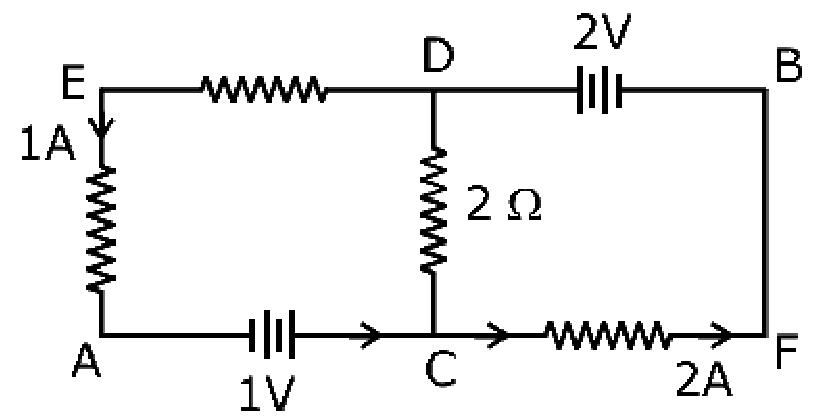
Answer: (c)
Kirchhoff's Laws & Measuring Instruments · Potential difference between points
The value of current i1 flowing from A to C in the circuit diagram is:
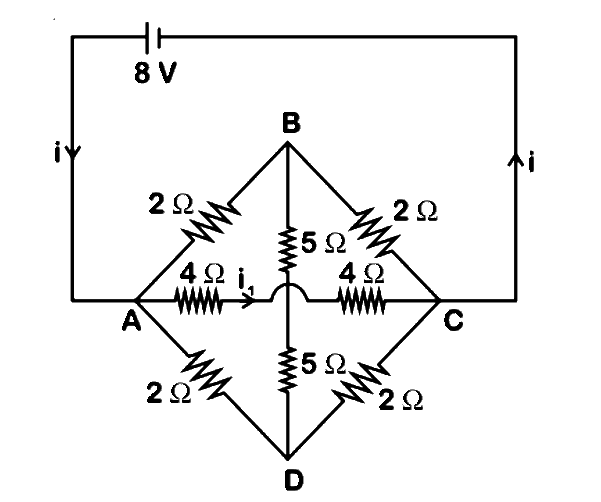
Answer: (a)
Kirchhoff's Laws & Measuring Instruments · Potential difference between points
In the given circuit diagram, a wire is joining points B and D. The current in this wire is:
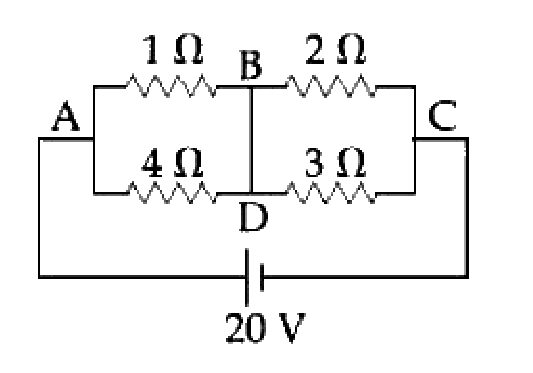
Answer: (b)
Kirchhoff's Laws & Measuring Instruments · Voltmeter & ammeter in circuits
Two resistors 400 and 800 are connected in series across a 6 V battery. The potential difference measured by a voltmeter of 10 k across 400 resistor is close to:
Answer: (b)
Kirchhoff's Laws & Measuring Instruments · Galvanometer to ammeter / voltmeter
An ammeter of resistance gives full scale deflection, when current flows through it. What is the maximum current that can be measured by connecting 4 resistors each of in parallel with the ammeter?
Answer: (a)
Kirchhoff's Laws & Measuring Instruments · Galvanometer to ammeter / voltmeter
The range of an ammeter of resistance ' can be increased from ' ' to ' ' by connecting
Answer: (b)
Kirchhoff's Laws & Measuring Instruments · Galvanometer to ammeter / voltmeter
A galvanometer has resistance of and a current of 10 mA produces full scale deflection in it. The resistance to be connected in series, to get a voltmeter of range 50 volt is
Answer: (d)
Kirchhoff's Laws & Measuring Instruments · Galvanometer to ammeter / voltmeter
A moving coil galvanometer allows a full scale current of 10–4 A. A series resistance of 2 M is required to convert the above galvanometer into a voltmeter of range 0-5 V. Therefore the value of shunt resistance required to convert the above galvanometer into an ammeter of range 0-10 mA is:
Answer: (d)
Kirchhoff's Laws & Measuring Instruments · Galvanometer to ammeter / voltmeter
The resistance of a galvanometer is 50 ohm and the maximum current which can be passed through it is 0.002 A. What resistance must be connected to it in order to convert it into an ammeter of range 0 – 0.5 A?
Answer: (b)
Kirchhoff's Laws & Measuring Instruments · Galvanometer to ammeter / voltmeter
A moving coil galvanometer has resistance 50 and it indicates full deflection at 4mA current. A voltmeter is made using this galvanometer and a 5 k resistance. The maximum voltage, that can be measured using this voltmeter, will be close to:
Answer: (d)
Kirchhoff's Laws & Measuring Instruments · Galvanometer sensitivity & figure of merit
In moving coil galvanometer, strong horse shoe magnet of concave shaped pole pieces is used to
Answer: (c)
Kirchhoff's Laws & Measuring Instruments · Kirchhoff's laws: basics
In the given electrical circuit, which one of the following equations is a correct equation?
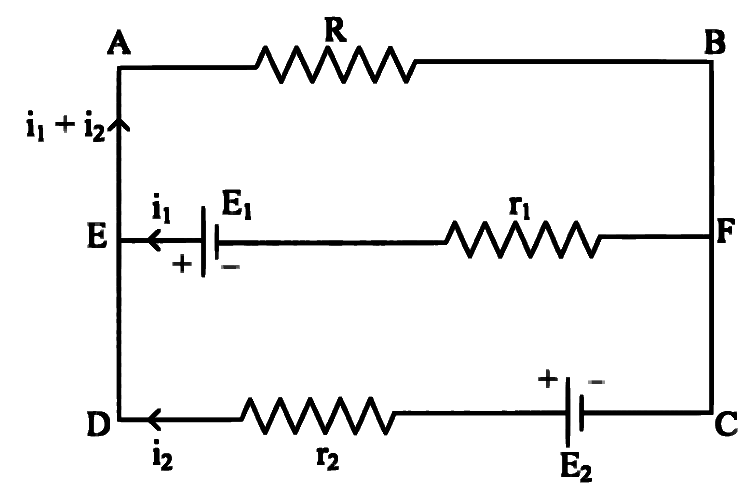
Answer: (c)
Kirchhoff's Laws & Measuring Instruments · Multi-loop circuits
The current in 1 resistor in the following circuit is
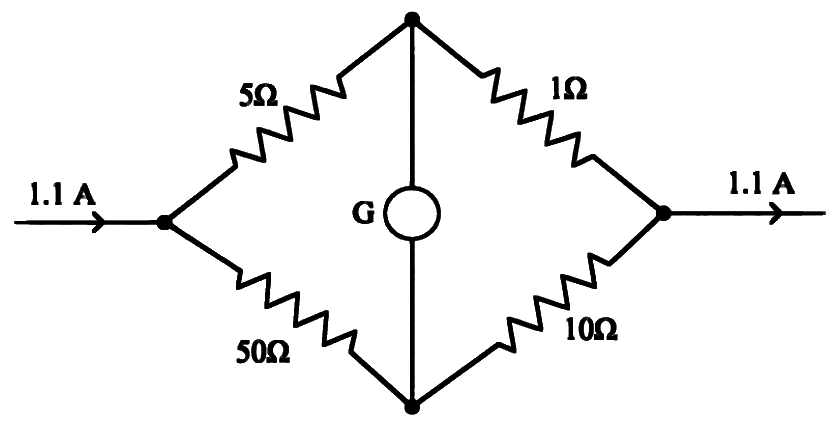
Answer: (a)
Kirchhoff's Laws & Measuring Instruments · Multi-loop circuits
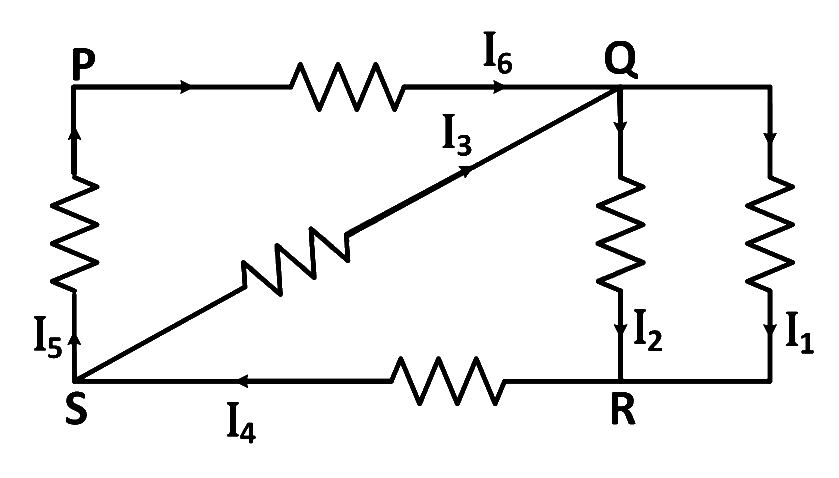
In the given circuit diagram, the currents, I1 = – 0.3 A, I4 = 0.8 A and I5 = 0.4 A, are flowing as shown. The currents I2, I3 and I6, respectively, are:
Answer: (d)
Kirchhoff's Laws & Measuring Instruments · Multi-loop circuits
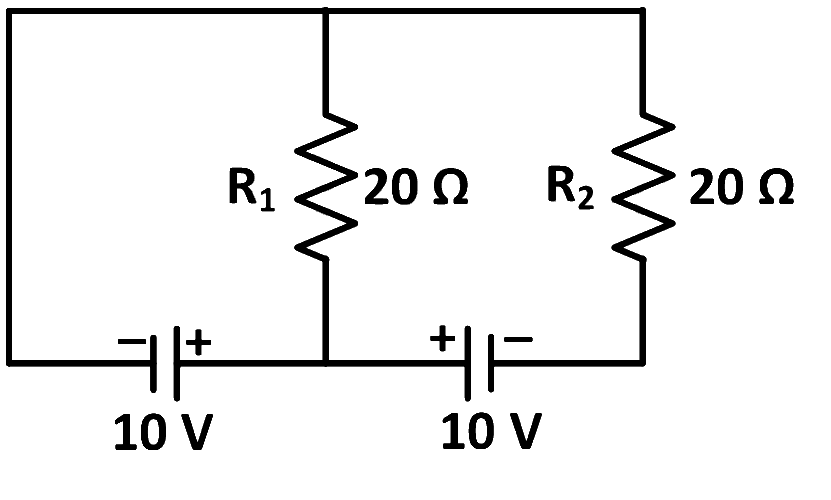
In the given circuit the cells have zero internal resistance. The currents (in Amperes) passing through resistance R1 and R2 respectively, are -
Answer: (a)
Kirchhoff's Laws & Measuring Instruments · Potential difference between points
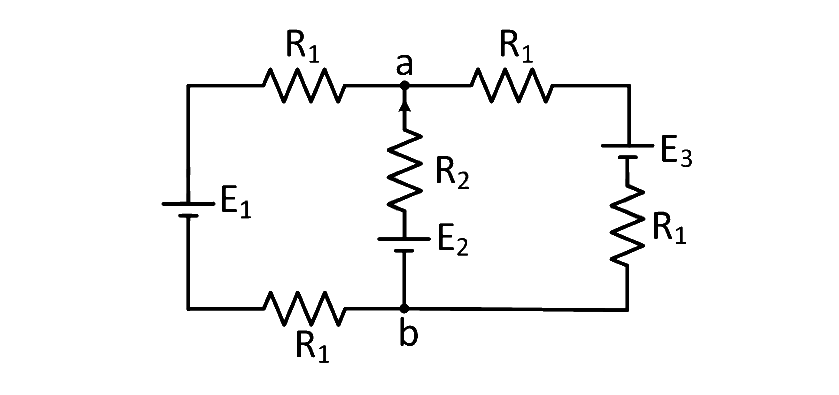
For the circuit shown, with R1 = 1.0 , R2 = 2.0 , E1 = 2 V and E2 = E3 = 4 V, the potential difference between the points 'a' and 'b' is approximately (in V):
Answer: (a)
Kirchhoff's Laws & Measuring Instruments · Potential difference between points
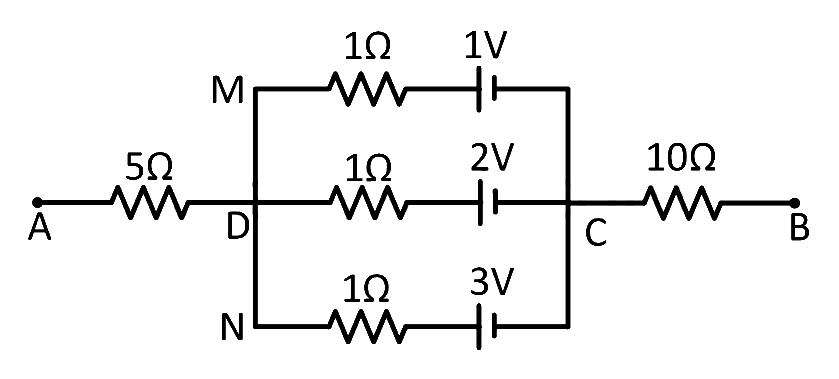
In the circuit shown, the potential difference between A and B is:
Answer: (c)
Kirchhoff's Laws & Measuring Instruments · Potential difference between points
When the switch S, in the circuit shown, is closed, then the value of current i will be:
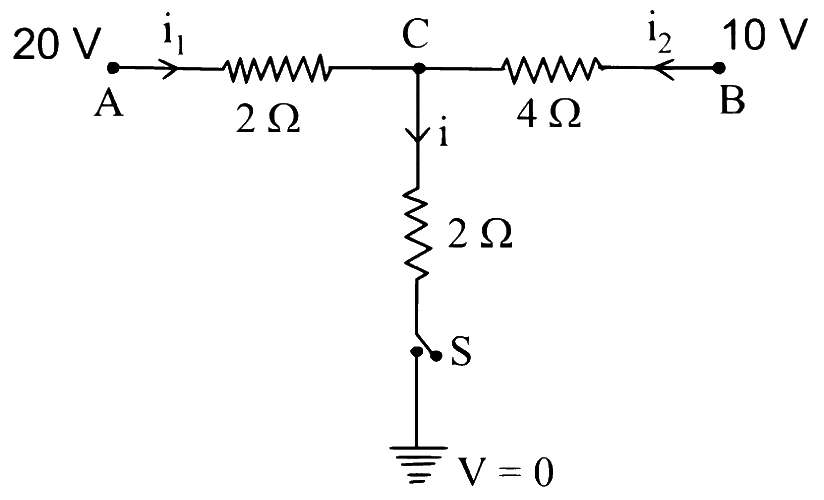
Answer: (b)
Kirchhoff's Laws & Measuring Instruments · Voltmeter & ammeter in circuits
The reading of an ideal voltmeter in the circuit shown is,
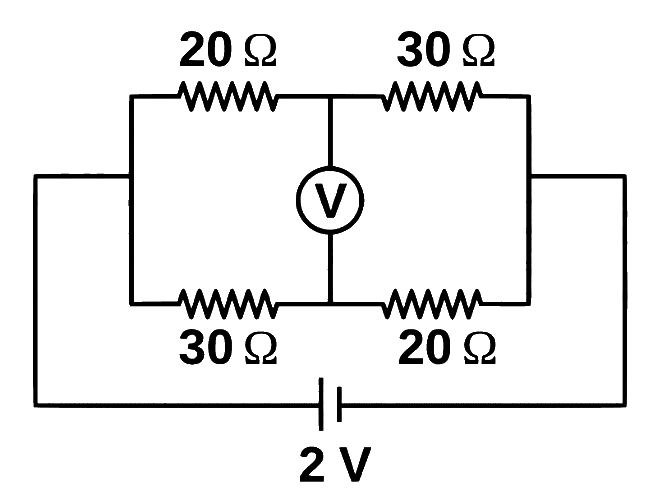
Answer: (a)
Kirchhoff's Laws & Measuring Instruments · Voltmeter & ammeter in circuits
In the circuits shown below, the readings of voltmeters and the ammeters will be:
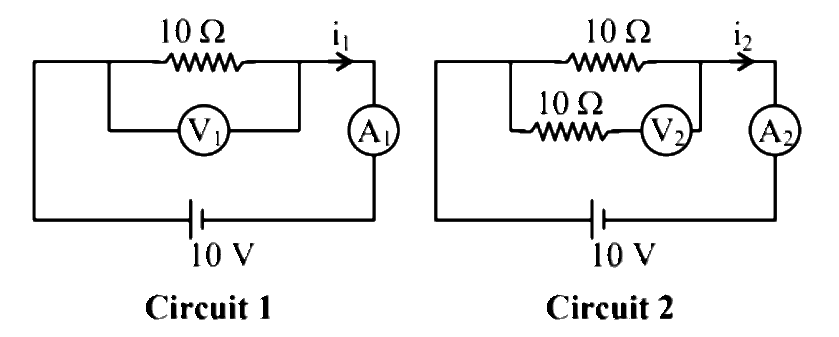
Answer: (a)
Kirchhoff's Laws & Measuring Instruments · Voltmeter & ammeter in circuits
The actual value of resistance R, shown in the figure is 30. This is measuered in an experiment as shown using the standard formula R = , where V and I are the readings of the voltmeter and ammeter, respectively. If the measured value of R is 5% less, then the internal resistance of the voltmeter is -
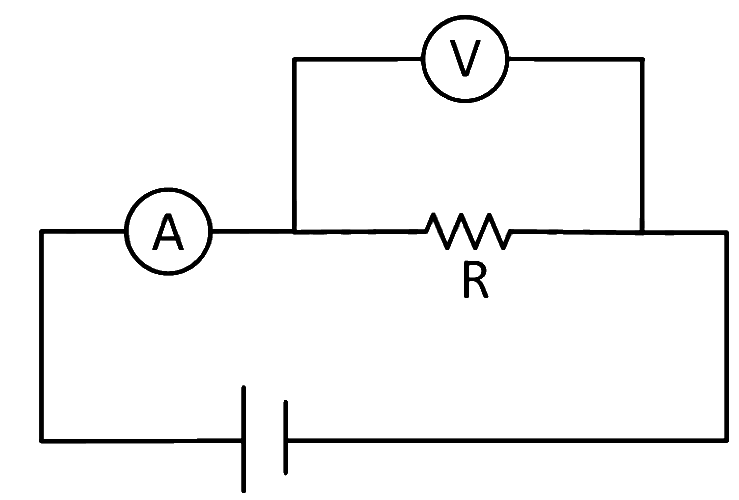
Answer: (a)
Kirchhoff's Laws & Measuring Instruments · Voltmeter & ammeter in circuits
In the given circuit the internal resistance of the 18 V cell is negligible. If R1 = 400 , R3 = 100 and R4 = 500 and the reading of an ideal voltmeter across R4 is 5V, then the value of R2 will be:
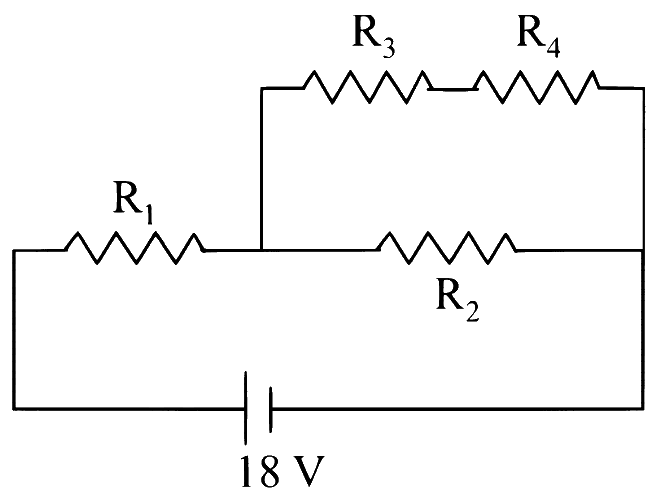
Answer: (a)
Kirchhoff's Laws & Measuring Instruments · Galvanometer to ammeter / voltmeter
A moving coil galvanometer, having a resistance G, produces full scale deflection when a current Ig flows through it. This galvanometer can be converted into (i) an ammeter of range 0 to I0(I0 > Ig) by connecting a shunt resistance RA to it and (ii) into a voltmeter of range 0 to V (V = GI0) by connecting a series resistance RV to it. Then,
Answer: (d)
Kirchhoff's Laws & Measuring Instruments · Galvanometer to ammeter / voltmeter
A galvanometer, whose resistance is 50 ohm, has 25 divisions in it. When a current of 4 10–4 A passes through it, its needle ( pointer) deflects by one division. To use this galvanometer as a voltmeter of range 2.5 V, it should be connected to a resistance of:
Answer: (a)
Kirchhoff's Laws & Measuring Instruments · Galvanometer sensitivity & figure of merit
A galvanometer of resistance 100 has 50 divisions on its scale and has sensitivitv of 20 A/division. It is to be converted to a voltmeter with three ranges of 0-2V, 0-10 V and 0-20 V. The appropriate circuit to do so is
Answer: (c)
Kirchhoff's Laws & Measuring Instruments · Galvanometer sensitivity & figure of merit
A galvanometer having a resistance of 20 and 30 divisions on both sides has figure of merit 0.005 ampere/division. The resistance that should be connected in series such that it can be used as a voltmeter upto 15 volt, is:
Answer: (c)
Kirchhoff's Laws & Measuring Instruments · Galvanometer to ammeter / voltmeter
The galvanometer deflection, when key K1 is closed but K2 is open, equals 0 (see figure). On closing K2 also and adjusting R2 to 5, the deflection in galvanometer becomes . The resistance of the galvanometer is, then, given by [Neglect the internal resistance of battery]:
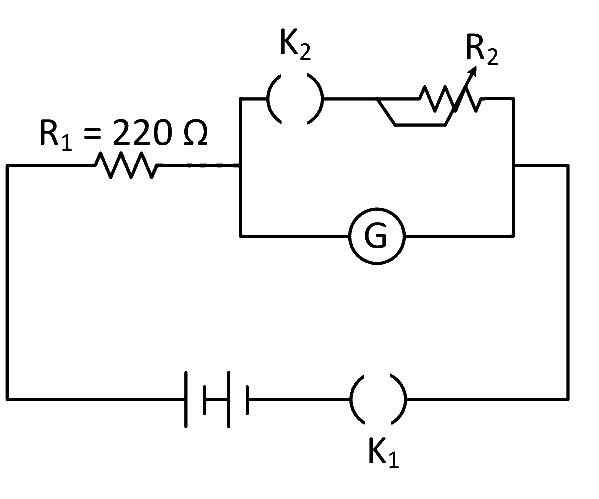
Answer: (d)
Kirchhoff's Laws & Measuring Instruments · Galvanometer to ammeter / voltmeter
A galvanometer with its coil resistance 25 requires a current of 1 mA for its full deflection. In order to construct an ammeter to read upto a current of 2 A, the approximate value of the shunt resistance should be:
Answer: (b)
Kirchhoff's Laws & Measuring Instruments · Galvanometer sensitivity & figure of merit
In a circuit for finding the resistance of a galvanometer by half deflection method, a 6 V battery and a high resistance of 11 k are used. The figure of merit of the galvanometer is 60 division. In the absence of shunt resistance, the galvanometer produces a deflection of = 9 divisions when current flows in the circuit. The value of the shunt resistance that can cause the deflection of is closest to:
Answer: (d)
Kirchhoff's Laws & Measuring Instruments · Galvanometer to ammeter / voltmeter
When a current of 5 mA is passed through a galvanometer having a coil of resistance 15, it shows full scale deflection. The value of the resistance to be put in series with the galvanometer to convert it into a voltmeter of range 0 – 10V is:
Answer: (b)
Kirchhoff's Laws & Measuring Instruments · Multi-loop circuits
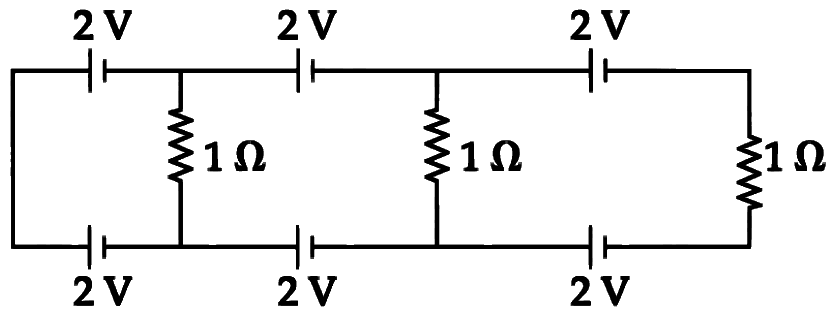
In the given circuit, the current in each resistance is:
Answer: (a)
Kirchhoff's Laws & Measuring Instruments · Galvanometer to ammeter / voltmeter
A galvanometer having a coil resistance of gives a full scale deflection, when a currect of is passed through it. The value of the resistance, which can convert this galvanometer into ammeter giving a full scale deflection for a current of is:
Answer: (c)
Kirchhoff's Laws & Measuring Instruments · Potential difference between points
The potential difference (VA VB) between the points A and B in the given figure is
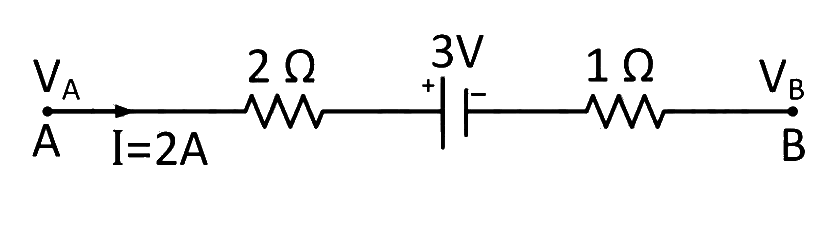
Answer: (d)
Kirchhoff's Laws & Measuring Instruments · Galvanometer to ammeter / voltmeter
A galvanometer has a 50 division scale. Battery has no internal resistance. It is found that there is deflection of 40 divisions when R = 2400 . Deflection becomes 20 divisions when resistance taken from resistance box is 4900 . Then we can conclude:
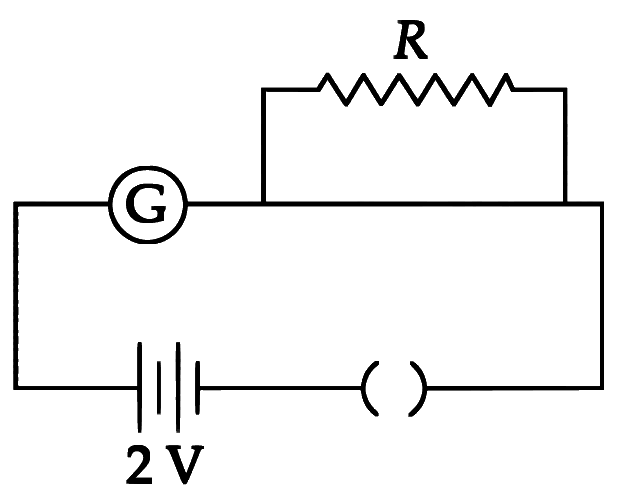
Answer: (c)
Kirchhoff's Laws & Measuring Instruments · Galvanometer to ammeter / voltmeter
A 50 resistance is connected to a battery of 5 V. A galvanometer of resistance 100 is to be used as an ammeter to measure current through the resistance, for this a resistance rs is connected to the galvanometer. Which of the following connections should be employed if the measured current is within 1% of the current without the ammeter in the circuit?
Answer: (a)
Kirchhoff's Laws & Measuring Instruments · Multi-loop circuits
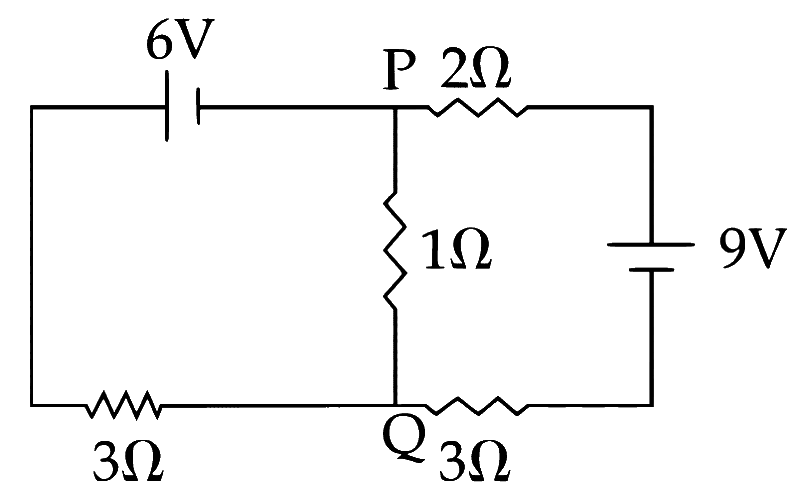
In the circuit shown, the current in the resistor is:
Answer: (a)
Kirchhoff's Laws & Measuring Instruments · Potential difference between points
In the electric network shown, when no current flows through the 4 resistor in the arm EB, the potential difference between the points A and D will be:
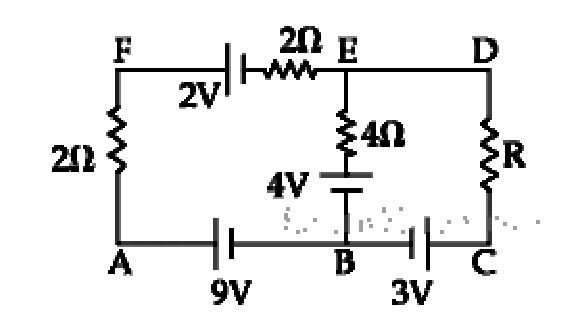
Answer: (c)
Kirchhoff's Laws & Measuring Instruments · Voltmeter & ammeter in circuits
A, B and C are voltmeters of resistance R, 1.5 R and 3R respectively as shown in the figure. When some potential difference is applied between X and Y, the voltmeter readings are VA, VB and VC respectively, Then
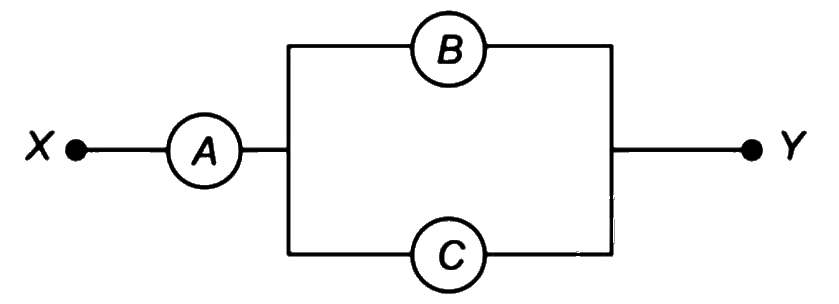
Answer: (c)
Kirchhoff's Laws & Measuring Instruments · Galvanometer to ammeter / voltmeter
A circuit contains an ammeter, a battery of 30 V and a resistance 40.8 ohm all connected in series. If the ammeter has a coil of resistance 480 ohm and a shunt of 20 ohm, the reading in the ammeter will be
Answer: (c)
Kirchhoff's Laws & Measuring Instruments · Multi-loop circuits
In the circuit shown, current (in A) through the 50 V and 30 V batteries are, respectively:
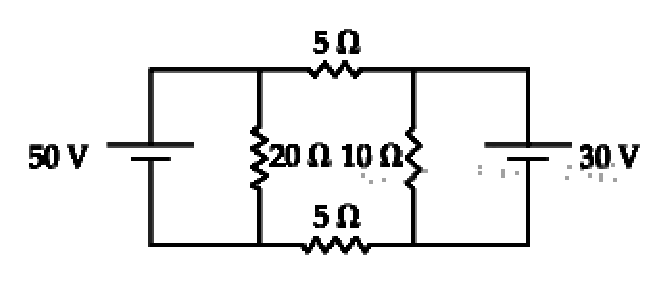
Answer: (c)
Kirchhoff's Laws & Measuring Instruments · Galvanometer sensitivity & figure of merit
In the circuit diagrams (A, B, C and D) shown below, R is a high resistance and S is a resistance of the order of galvanometer resistance G. The correct circuit, corresponding to the half deflection method for finding the resistance and figure of merit of galvanometer, is the circuit labelled as:
Answer: (d)
Kirchhoff's Laws & Measuring Instruments · Voltmeter & ammeter in circuits
Correct set up to verify Ohm's law is:
Answer: (a)
Kirchhoff's Laws & Measuring Instruments · Galvanometer to ammeter / voltmeter
A shunt of resistance 1 is connected across a galvanometer of 120 resistance. A current of 5.5 ampere gives full scale deflection in the galvanometer. The current that will give full scale deflection in the absence of the shunt is nearly:
Answer: (d)
Kirchhoff's Laws & Measuring Instruments · Galvanometer to ammeter / voltmeter
This questions has Statement - and Statement - . Of the four choices given after the Statements, choose the one that best describes into two Statements.
Statement - : Higher the range, greater is the resistance of ammeter.
Statement - : To increase the range of ammeter, additional shunt needs to be used across it.
Answer: (d)
Kirchhoff's Laws & Measuring Instruments · Galvanometer sensitivity & figure of merit
To find the resistance of a galvanometer by the half deflection method, the following circuit is used with resistances and . The deflection in the galvanometer is d. With , the deflection changed to . The galvanometer resistance is approximately:
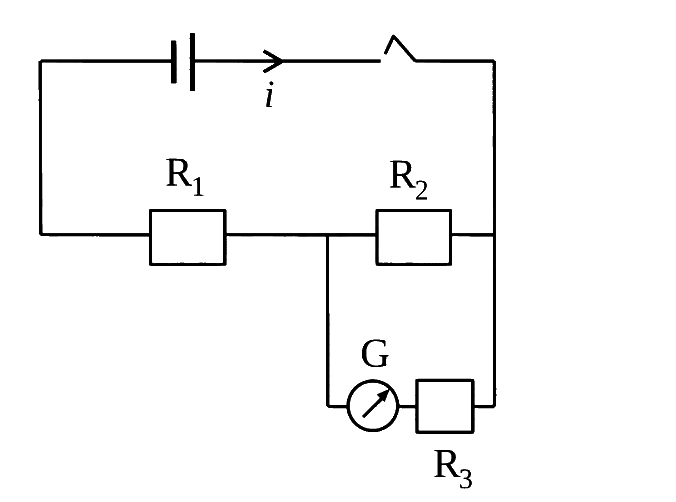
Answer: (d)
Kirchhoff's Laws & Measuring Instruments · Potential difference between points
In the circuit shown in the figure, if the potential at point A is taken to be zero, the potential at point B is
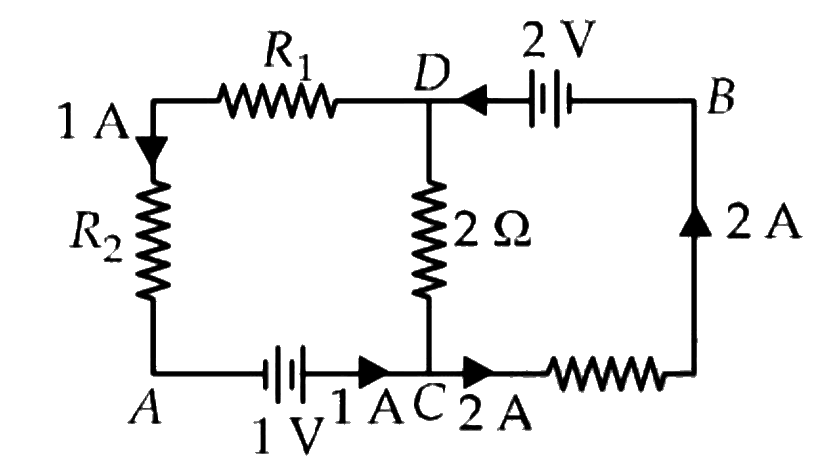
Answer: (a)
Kirchhoff's Laws & Measuring Instruments · Multi-loop circuits
Consider the following two statements.
(A) Kirchoff's junction law follows from the conservation of charge.
(B) Kirchhoff's loop law follows from the conservation of energy.
Which of the following is correct?
Answer: (d)
Kirchhoff's Laws & Measuring Instruments · Kirchhoff's laws: basics
See the electrical circuit shown in this figure. Which of the following equations is a correct equation for it?
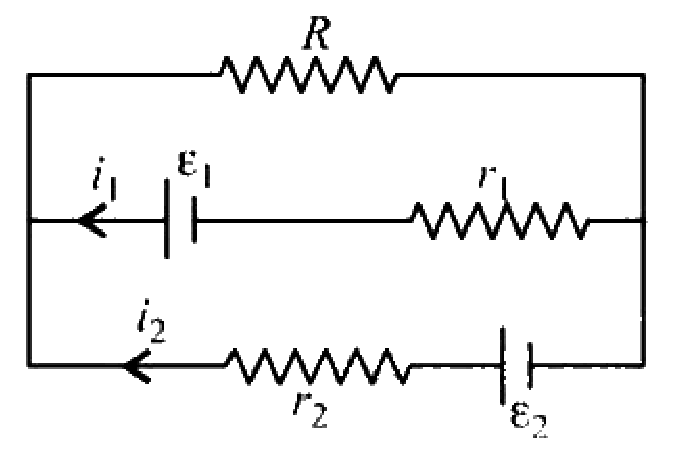
Answer: (d)
Kirchhoff's Laws & Measuring Instruments · Potential difference between points
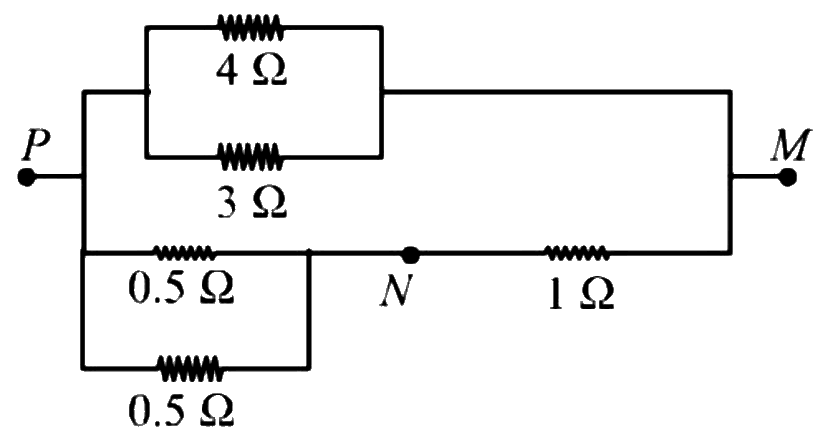
In the circuit shown, the current through the 4 resistor is 1 amp when the points P and M are connected to a d.c. voltage source. The potential difference between the points M and N is
Answer: (b)
Kirchhoff's Laws & Measuring Instruments · Kirchhoff's laws: basics
Kirchhoff's first and second laws of electrical circuits are consequences of
Answer: (c)
Kirchhoff's Laws & Measuring Instruments · Kirchhoff's laws: basics
The Kirchhoff's first law and second law , where the symbols have their usual meanings, are respectively based on
Answer: (a)
Kirchhoff's Laws & Measuring Instruments · Potential difference between points
In the circuit shown, if a conducting wire is connected between points A and B, the current in this wire will
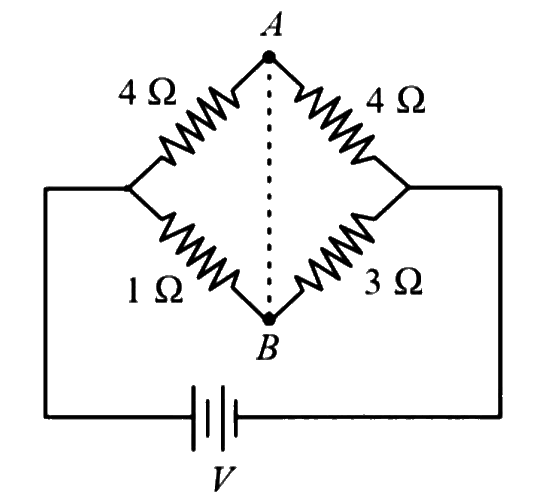
Answer: (a)
Kirchhoff's Laws & Measuring Instruments · Potential difference between points
The current drawn from the volt source will be
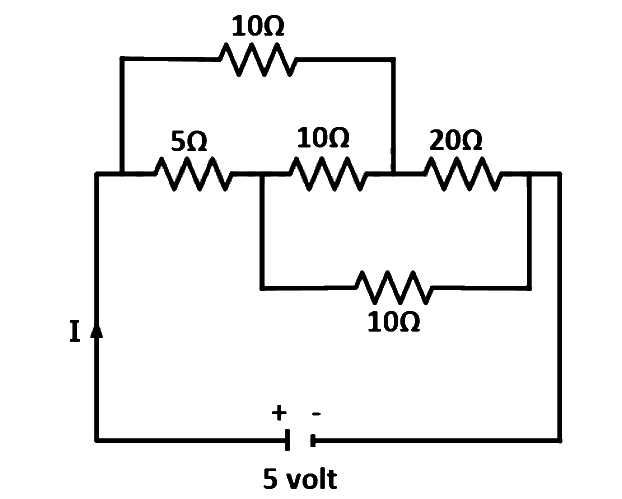
Answer: (b)
Kirchhoff's Laws & Measuring Instruments · Potential difference between points
For the network shown in the figure the value of the current is
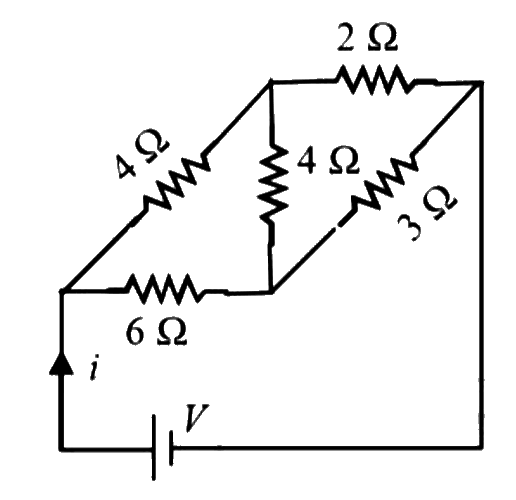
Answer: (d)
Kirchhoff's Laws & Measuring Instruments · Galvanometer to ammeter / voltmeter
In the circuit, the galvanometer shows zero deflection. If the batteries and have negligible internal resistance, the value of the resistor will be -
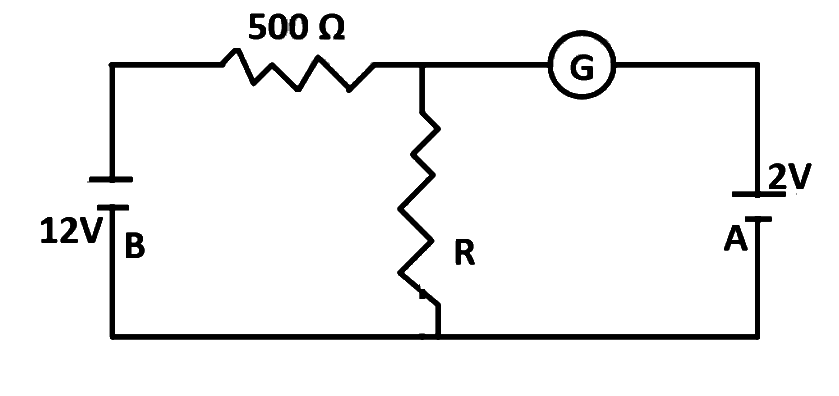
Answer: (a)
Kirchhoff's Laws & Measuring Instruments · Galvanometer sensitivity & figure of merit
A moving coil galvanometer has equal divisions. Its current sensitivity is - divisions per milliampere and voltage sensitivity is divisions per millivolt. In order that each division reads volt, the resistance in needed to be connected in series with the coil will be -
Answer: (c)
Kirchhoff's Laws & Measuring Instruments · Kirchhoff's laws: basics
The Kirchhoff's first law and second law where the symbols have their usual meanings, are respectively based on
Answer: (d)
Kirchhoff's Laws & Measuring Instruments · Galvanometer to ammeter / voltmeter
An ammeter reads upto ampere. Its internal resistance is . To increase the range to the value of the required shunt is
Answer: (d)
Kirchhoff's Laws & Measuring Instruments · Potential difference between points
A volt battery with negligible internal resistance is connected in a circuit as shown in the figure. The current , in the circuit will be
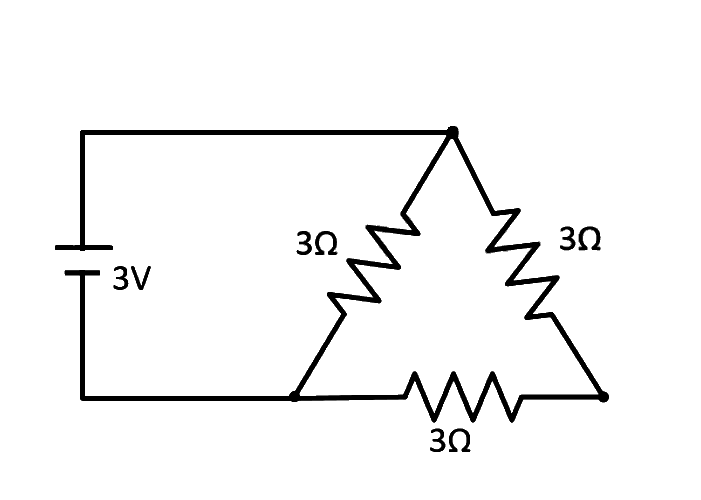
Answer: (b)
Kirchhoff's Laws & Measuring Instruments · Voltmeter & ammeter in circuits
If an ammeter is to be used in place of a voltmeter, then we must connect with the ammeter a
Answer: (c)
Kirchhoff's Laws & Measuring Instruments · Multi-loop circuits
The current in the given circuit is
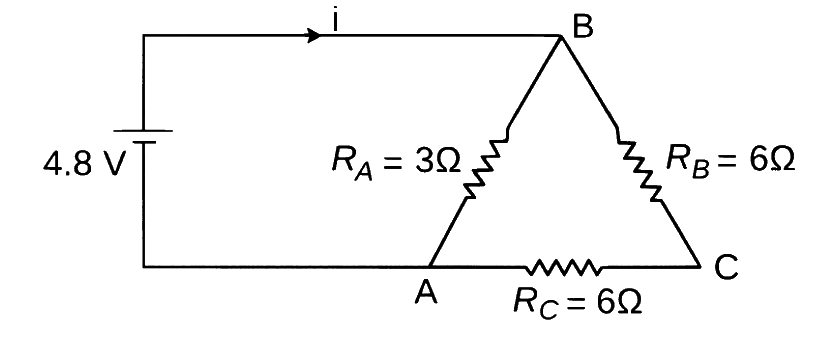
Answer: (b)
Kirchhoff's Laws & Measuring Instruments · Galvanometer to ammeter / voltmeter
A galvanometer having a resistance of ohm is shunted by a wire of resistance ohm. If the total current is , the part of it passing through the shunt will be
Answer: (b)
Kirchhoff's Laws & Measuring Instruments · Kirchhoff's laws: basics
Kirchhoff's first law, i.e. at a junction, deals with the conservation of
Answer: (c)
Kirchhoff's Laws & Measuring Instruments · Multi-loop circuits
The current in the following circuit is
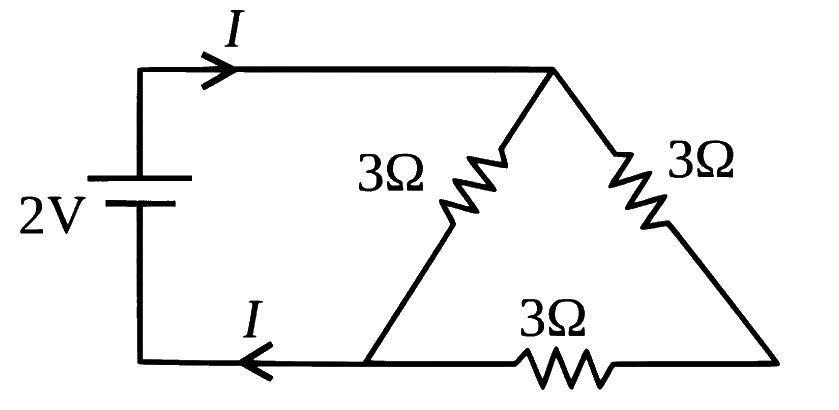
Answer: (b)
Kirchhoff's Laws & Measuring Instruments · Multi-loop circuits
Current through resistor is ampere, then potential drop through resistor is
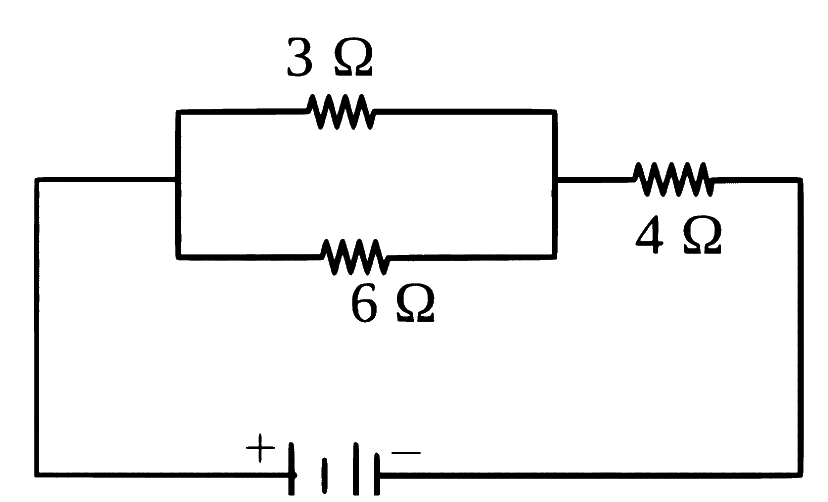
Answer: (c)
Kirchhoff's Laws & Measuring Instruments · Kirchhoff's laws: basics
Kirchhoff's first law, i.e. at a junction, deals with the conservation of
Answer: (c)
Kirchhoff's Laws & Measuring Instruments · Potential difference between points
Two batteries of emf and with internal resistance and are connected in a circuit with resistance of as shown in figure. The current and potential difference between the points and are
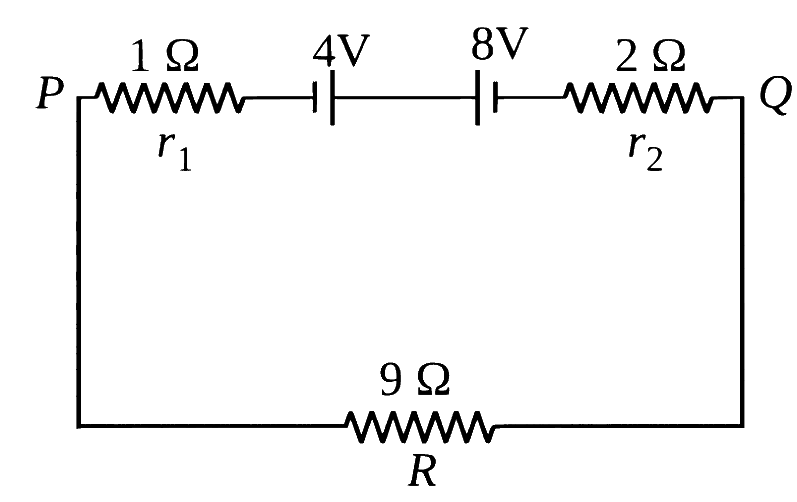
Answer: (a)
No questions match these filters.