Electric Current, Drift Velocity & Current Density
A cylindrical conductor of length 2 m and area of cross-section 0.2 mm2 carries an electric current of 1.6 A when its ends are connected to a 2 V battery. Mobility of electrons in the conductor is α×10−3 m2/V s. The value of α is:
(electron concentration =5×1028 /m3 and electron charge =1.6×10⁻¹⁹ C)
Numerical answer type. Work it out, then open the answer.
Electric Current, Drift Velocity & Current Density
The electric current through a wire varies with time as I=I0+βt, where I0=20 A and β=3 A/s. The amount of electric charge crossed through a section of the wire in 20 s is:
Electric Current, Drift Velocity & Current Density
The current in a conductor is expressed as I=3t2+4t3, where I is in Ampere and t is in second. The amount of electric charge that flows through a section of the conductor during t=1 s to t=2 s is __________ C.
Numerical answer type. Work it out, then open the answer.
Electric Current, Drift Velocity & Current Density
A uniform wire of diameter d carries a current of 100 mA when the mean drift velocity of electrons in the wire is v. For a wire of diameter 2d of the same material to carry a current of 200 mA, the mean drift velocity of electrons in the wire is
Electric Current, Drift Velocity & Current Density
A copper wire of radius 1 mm contains 1022 free electrons per cubic metre. The drift velocity for free electrons when 10 A current flows through the wire will be (Given, charge on electron =1.6×10⁻¹⁹ C):
Electric Current, Drift Velocity & Current Density
The number density of free electrons in copper is nearly 8×1028 m−3. A copper wire has its area of cross section =2×10⁻⁶ m2 and is carrying a current of 3.2 A. The drift speed of the electrons is ___________ ×10−6 m s−1
Numerical answer type. Work it out, then open the answer.
Electric Current, Drift Velocity & Current Density
A current of 2 A flows through a wire of cross-sectional area 25.0 mm2. The number of free electrons in a cubic meter are 2.0×1028. The drift velocity of the electrons is __________ ×10−6 m s−1 (given, charge on electron =1.6×10⁻¹⁹ C ).
Numerical answer type. Work it out, then open the answer.
Electric Current, Drift Velocity & Current Density
The drift velocity of electrons for a conductor connected in an electrical circuit is Vd. The conductor is now replaced by another conductor with same material and same length but double the area of cross section. The applied voltage remains same. The new drift velocity of electrons will be
Electric Current, Drift Velocity & Current Density
(A) The drift velocity of electrons decreases with the increase in the temperature of conductor. (B) The drift velocity is inversely proportional to the area of cross-section of given conductor. (C) The drift velocity does not depend on the applied potential difference to the conductor. (D) The drift velocity of electron is inversely proportional to the length of the conductor. (E) The drift velocity increases with the increase in the temperature of conductor. Choose the correct answer from the options given below:
Electric Current, Drift Velocity & Current Density
A copper wire of length 10 m and radius (π10−2) m has electrical resistance of 10 Ω. The current density in the wire for an electric field strength of 10 (V/m) is
Electric Current, Drift Velocity & Current Density
A 1 m long copper wire carries a current of 1 A. If the cross section of the wire is 2.0 mm2 and the resistivity of copper is 1.7×10⁻⁸Ω m, the force experienced by moving electron in the wire is ____________ ×10−23 N.
(charge on electron =1.6×10⁻¹⁹ C)
Numerical answer type. Work it out, then open the answer.
Electric Current, Drift Velocity & Current Density
The current density in a cylindrical wire of radius r = 4.0 mm is 1.0 × 10⁶ A/m2. The current through the outer portion of the wire between radial distances 2r and r is xπ A; where x is __________.
Numerical answer type. Work it out, then open the answer.
Electric Current, Drift Velocity & Current Density
The current density in a cylindrical wire of radius 4 mm is 4 × 10⁶ Am−2. The current through the outer portion of the wire between radial distances 2R and R is ____________ π A.
Numerical answer type. Work it out, then open the answer.
Electric Current, Drift Velocity & Current Density
A current of 10A exists in a wire of cross-sectional area of 5 mm2 with a drift velocity of 2 × 10⁻³ ms−1. The number of free electrons in each cubic meter of the wire is ___________.
Electric Current, Drift Velocity & Current Density
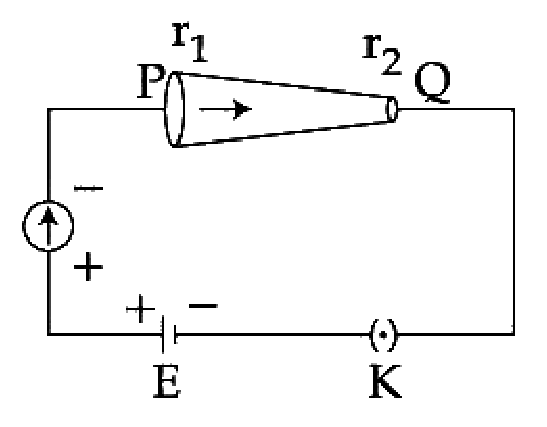
In the given figure, a battery of emf E is connected across a conductor PQ of length 'l' and different area of cross-sections having radii r1 and r2 (r2 < r1).
Choose the correct option as one moves from P to Q:
Electric Current, Drift Velocity & Current Density
A conducting wire of length 'l', area of cross-section A and electric resistivity ρ is connected between the terminals of a battery. A potential difference V is developed between its ends, causing an electric current.
If the length of the wire of the same material is doubled and the area of cross-section is halved, the resultant current would be:
Electric Current, Drift Velocity & Current Density
A current of 5 A is passing through a non-linear magnesium wire of cross-section 0.04 m2. At every point the direction of current density is at an angle of 60∘ with the unit vector of area of cross- section. The magnitude of electric field at every point of the conductor is:
Electric Current, Drift Velocity & Current Density
A cylindrical wire of radius 0.5 mm and conductivity 5 × 10⁷ S/m is subjected to an electric field of 10 mV/m. The expected value of current in the wire will be x3π mA. The value of x is _________.
Numerical answer type. Work it out, then open the answer.
Electric Current, Drift Velocity & Current Density
Drift speed of electrons, when 1.5 A of current flows in a copper wire of cross section 5 mm2, is v. If the electron density in copper is 9 × 1028/m3 the value of v. in mm/s is close to (Take charge of electron to be = 1.6 × 10⁻¹⁹C)
Electric Current, Drift Velocity & Current Density
In a conductor, if the number of conduction electrons per unit volume is 8.5 × 1028 m–3 and mean free time is 25ƒs (femto second), it's approximate resistivity is :-
Electric Current, Drift Velocity & Current Density
A current of 5 A passes through a copper conductor (resistivity = 1.7 × 10⁻⁸ Ωm) of radius of cross- section 5 mm. Find the mobility of the charges if their drift velocity is 1.1 × 10⁻³ m/s.
Electric Current, Drift Velocity & Current Density
A copper rod of cross-sectional area A carries a uniform current I through it. At temperature T, if the volume charge density of the rod is ρ, how long will the charges take to travel a distance d?
Electric Current, Drift Velocity & Current Density
Across a metallic conductor of non-uniform cross section a constant potential difference is applied. The quantity which remains constant along the conductor is
Electric Current, Drift Velocity & Current Density
When 5 V potential difference is applied across a wire of length 0.1 m, the drift speed of electrons is 2.5×10⁻⁴ m s−1. If the electron density in the wire is 8×1028 m−3, the resistivity of the material is close to:
Electric Current, Drift Velocity & Current Density
−8
The mean free path of electrons in a metal is 4 × 10 m. The electric field which can give on an average 2 eV energy to an electron in the metal will be in units V/m
Electric Current, Drift Velocity & Current Density
If the current through an electrical machine running on direct current is 15A and the machine runs for 10 minutes, the charge that passes through the machine during this time is:
Electric Current, Drift Velocity & Current Density
A current of 0.6A is drawn by an electric bulb for 10 minutes. Which one of the following is the amount of electric charge that flows through the circuit?
Electric Current, Drift Velocity & Current Density
A metal wire of cross-sectional area 0.5mm2 and length 100m is connected across a battery of e.m.f. 2V and internal resistance 1Ω. The density, atomic mass and electrical conductivity of the metal are 6.35×10³kg m−3, 63.5gm/mole and 2×10⁸mho m−1, respectively. Assuming one conduction electron per atom of the metal, the drift velocity (in mm s−1) of the electrons in the wire is:
[Take Avogadro's number as 6×10²³ and charge of the electron as 1.6×10⁻¹⁹C.]
Electric Current, Drift Velocity & Current Density
An infinite line charge of uniform electric charge density λ lies along the axis of an electrically conducting infinite cylindrical shell of radius R. At time t=0, the space inside the cylinder is filled with a material of permittivity ε and electrical conductivity σ. The electrical conduction in the material follows Ohm's law. Which one of the following graphs best describes the subsequent variation of the magnitude of current density j(t) at any point in the material?
Electric Current, Drift Velocity & Current Density
A current of 10A is passing through a metallic wire of cross-sectional area 4×10⁻⁶m2. If the density of the aluminium conductor is 2.7gm/cc considering aluminium gives 1 electron per atom for conduction, then find the drift velocity of the electrons if molecular weight of aluminium is 27gm.
Electric Current, Drift Velocity & Current Density
A cylindrical conductor AB of non-uniform area of cross-section carries a current of 5A. The radius of the conductor at one end A is 0.5cm. The current density at the other end of the conductor is half of the value at A. The radius of the conductor at the end B is nearly
Electric Current, Drift Velocity & Current Density
A straight conductor of uniform cross-section carries a current I. Let S be the specific charge of an electron. The momentum of all the free electrons per unit length of the conductor due to their drift velocity only, is
Electric Current, Drift Velocity & Current Density
Assertion : A wire carrying an electric current has no electric field around it. Reason : Rate of flow of electrons in one direction is equal to the rate of flow of protons in opposite direction.
Electric Current, Drift Velocity & Current Density
Charge passing through a conductor of cross-section area A=0.3m2 is given by q=3t2+5t+2 coulomb, where t is in second. What is the value of drift velocity at t=2s? (Given, n=2×1025/m3)
Electric Current, Drift Velocity & Current Density
Assertion : Though large number of free electrons are present in the metal. Yet there is no current in the absence of electric field. Reason : In the absence of electric field electrons move randomly in all directions.
Electric Current, Drift Velocity & Current Density
A steady current is set up in a metallic wire of non-uniform cross-section. How is the rate of flow K of electrons related to the area of cross-section A ?
Electric Current, Drift Velocity & Current Density
A current i is flowing through the wire of diameter (d) having drift velocity of electrons vd in it. What will be new drift velocity when diameter of wire is made d/4 ?
Electric Current, Drift Velocity & Current Density
At room temperature, copper has free electron density of 8.4×1028m−3. The electron drift velocity in a copper conductor of cross-sectional area of 10−6m2 and carrying a current of 5.4A, will be
Electric Current, Drift Velocity & Current Density
A current of 5A is passing through a metallic wire of cross-sectional area 4×10⁻⁶m2. If the density of charge carriers of the wire is 5×1026m−3, then the drift velocity of the electrons will be
Electric Current, Drift Velocity & Current Density
At room temperature, copper has free electron density of 8.4×1028m−3. The electron drift velocity in a copper conductor of cross-sectional area of 10−6m2 and carrying a current of 5.4A, will be
Electric Current, Drift Velocity & Current Density
The current density varies with radial distance r as J=ar2, in a cylindrical wire of radius R. The current passing through the wire between radial distance R/3 and R/2 is
Electric Current, Drift Velocity & Current Density
In hydrogen discharge tube, it is observed that through a given cross-section 3.13×10¹⁵ electrons are moving from right to left and 3.12×10¹⁵ protons are moving from left to right. The current in the discharge tube and its direction will be
Electric Current, Drift Velocity & Current Density
In a hydrogen discharged tube it is observed that through a given cross-section 3.13×10¹⁵ electrons are moving from right to left and 3.12×10¹⁵ protons are moving from left to right. What is the electric current in the discharge tube and what is its direction?
Electric Current, Drift Velocity & Current Density
Charge passing through a conductor of cross-section area A=0.3m2 is given by q=3t2+5t+2 in coulomb, where t is in second. What is the value of drift velocity at t=2s? (Given, n=2×1025m−3)
Electric Current, Drift Velocity & Current Density
A uniform copper wire of length 1m and cross-sectional area 5×10⁻⁷m2 carries a current of 1A. Assuming that there are 8×1028 free electrons per m3 in copper, how long will an electron take to drift from one end of the wire to the other
Electric Current, Drift Velocity & Current Density
A current of 5A is passing through a metallic wire of cross-sectional area 4×10⁻⁶m2. If the density of the charge carriers in the wire is 5×1026m−3, the drift speed of the electrons will be [e=1.602×10⁻¹⁹C]
Electric Current, Drift Velocity & Current Density
Current in a conductor is expressed as I=8t3+3t2+2, where current I is measured in amperes and time t is measured in seconds. What is the charge that flows through a cross-section of the conductor between time t=1s to t=2s?
Electric Current, Drift Velocity & Current Density
Two wires A and B made of the same material having lengths 10cm and 40cm respectively are connected in parallel to the same source of emf 10V. What will be the ratio of the drift velocity of the electrons in the wire A to the drift velocity in the wire B?
Electric Current, Drift Velocity & Current Density
Two identical conductors of lengths l and 3l respectively are maintained at the same temperature. They are given potential differences in the ratio 1:3. The ratio of their drift velocities is
Electric Current, Drift Velocity & Current Density
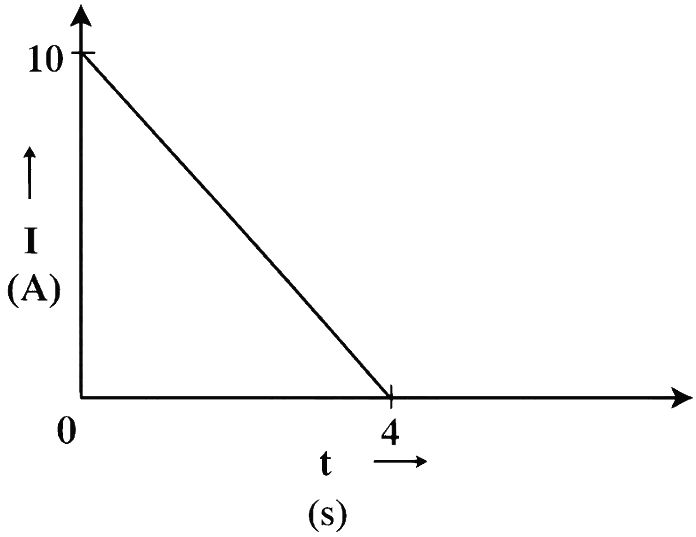
Current flowing through a wire decreases linearly from 10A to zero in 4s as shown in the graph. Find the total charge flowing through the wire in the given time interval.
Electric Current, Drift Velocity & Current Density
In a conducting region, 1019 electrons and 1019 protons move to the left, while 1019α-particles move to the right per second. The resulting electric current is (e=1.6×10⁻¹⁹C) ________.
Electric Current, Drift Velocity & Current Density
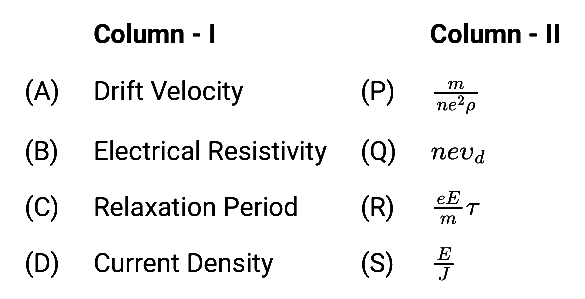
E is the electric field inside a conductor whose material has conductivity σ and resistivity ρ. The current density inside the conductor is J. The correct form of Ohm's law is
Electric Current, Drift Velocity & Current Density
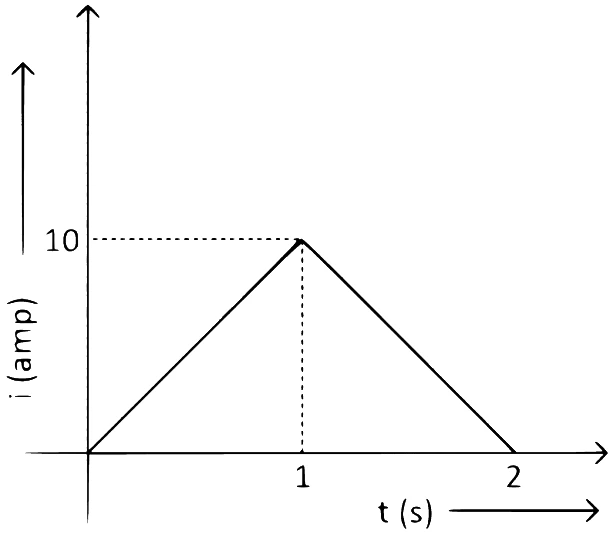
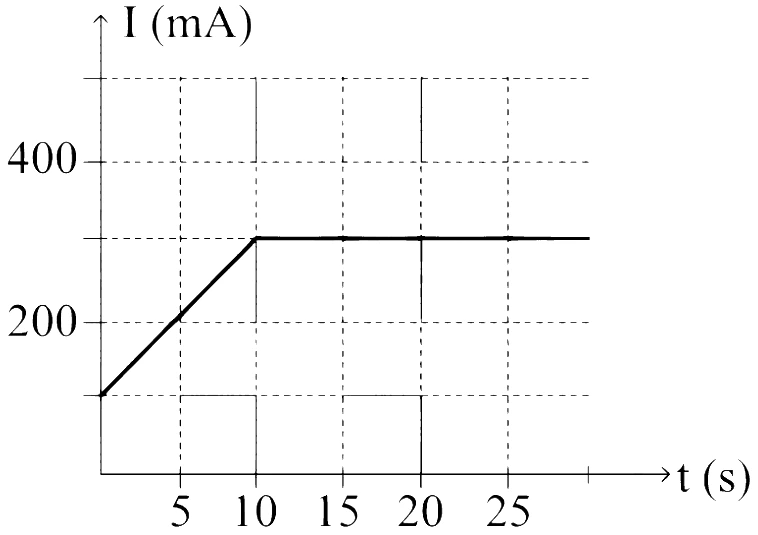
The electric current flowing through a given conductor varies with time as shown in the graph below. The number of free electrons which flow through a given cross-section of the conductor in the time interval 0≤t≤20s is
Electric Current, Drift Velocity & Current Density
For a given electric current the drift velocity of conduction electrons in a copper wire is vd and their mobility is μ. When the current is increased at constant temperature
Electric Current, Drift Velocity & Current Density
In an atom electrons revolve around the nucleus along a path of radius 0.72A˚ making 9.4×10¹⁸ revolutions per second. The equivalent current is [given, e=1.6×10⁻¹⁹C]
Electric Current, Drift Velocity & Current Density
A copper wire of length 1m and uniform cross-sectional area 5×10⁻⁷m2 carries a current of 1A. Assuming that there are 8×1028 free electrons per m3 in copper, how long will an electron take to drift from one end of the wire to the other?
Electric Current, Drift Velocity & Current Density
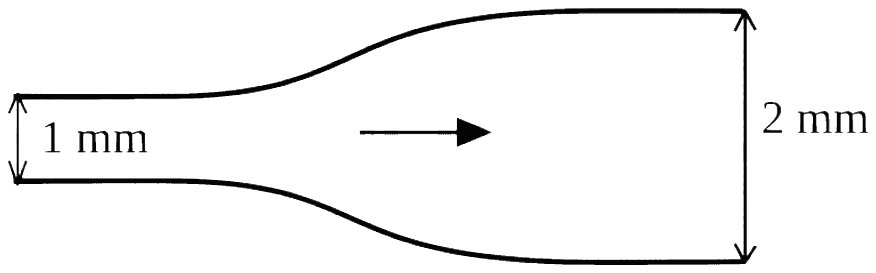
In the diagram, the current through the part of the wire with 1mm diameter is 1.6A and the drift speed is 2×10⁻⁴m s−1. The drift speed in the part of wire with 2mm diameter is
Electric Current, Drift Velocity & Current Density
The area of cross-section of a copper wire is 4×10⁻⁷m2 and the electrons per cubic metre in copper is 8×1028. If the wire carries a current of 6.4A, then the drift velocity of the electrons ( in 10−3m s−1 ) is
Electric Current, Drift Velocity & Current Density
The potential difference across a conducting wire of length 20cm is 30V. If the electron mobility is 2×10⁻⁶m2V−1s−1, then the drift velocity of the electrons is
Electric Current, Drift Velocity & Current Density
Charge ′Q′ (in coulomb) flowing through a conductor in terms of time ′t′ (in second) is given by the equation Q=3t2+t. The current in the conductor at time t=3s is
Electric Current, Drift Velocity & Current Density
If a current of 80A is passing through a straight conductor of length 10m, then the total momentum of electrons in the conductor is (mass of electron =9.1×10⁻³¹kg and charge of electron =1.6×10⁻¹⁹C)
Electric Current, Drift Velocity & Current Density
In a metal, the charge carrier density is 9.1×1028m−3 and its electrical conductivity is 6.4×10⁷S m−1. When an electric field of 10N C−1 is applied to the metal, then the average time between two successive collisions of electrons in the metal is (Mass of electron =9.1×10⁻³¹kg, charge of electron =1.6×10⁻¹⁹C)
Electric Current, Drift Velocity & Current Density
The charge q (in coulomb) passing through a 10Ω resistor as a function of time t (in second) is given by q=3t2−2t+6. The potential difference across the ends of the resistor at time t=5s is
Electric Current, Drift Velocity & Current Density
The drift velocity of electrons in a conducting wire connected to a cell is vd. If the length of the wire is doubled and area of cross-section is halved, then the drift velocity of electrons becomes
Electric Current, Drift Velocity & Current Density
Charge passing through a conductor of cross-section 0.3m2 is given by q=(3t2+5t+2)C where t is in seconds. The drift velocity at t=2s is (Concentration of electrons in the conductor =2×1025m−3)
Electric Current, Drift Velocity & Current Density
The electrons take 40×103s to drift from one end of a metal wire of length 2m to its other end. The area of cross-section of the wire is 4mm2 and it is carrying a current of 1.6A. The number density of free electrons in the metal wire is
Electric Current, Drift Velocity & Current Density
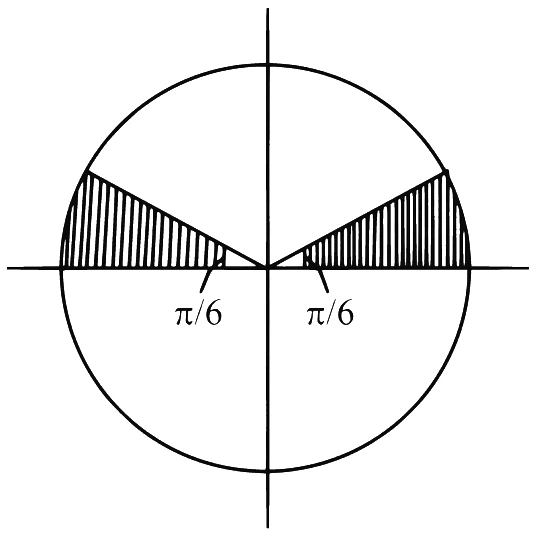
Current density in a cylindrical wire of radius R varies with radial distance as β(r+r0)2. The current through the section of the wire shown in the figure is
Electric Current, Drift Velocity & Current Density
If the potential difference across the ends of a copper wire of 100cm length is 2V and the conductivity of copper is 5.95×10⁷S m−1, then the current per unit area (in A m−2) of the conductor is
Electric Current, Drift Velocity & Current Density
If e, m and τ are charge, mass and average collision time for an electron respectively, then the magnitude of drift velocity per unit electric field is
Electric Current, Drift Velocity & Current Density
If the number density of free electrons in a copper wire is 8.5×1022cm−3 and the relaxation time of free electrons in the wire is 2.25×10⁻¹⁴s, then the electrical conductivity of copper is
(Mass of the electron =9×10⁻³¹kg and charge of the electron =1.6×10⁻¹⁹C)
Electric Current, Drift Velocity & Current Density
The lengths of two wires made of the same material are in the ratio 2:3 and their radii are in the ratio 1:2. If the two wires are connected in parallel to a battery, then the ratio of the drift velocities of free electrons in the two wires is
Electric Current, Drift Velocity & Current Density
The drift speed of electrons in a material is found to be 0.3m s−1 when an electric field of 2V m−1 is applied across it. The electron mobility (in m2V−1s−1) in the material is
Electric Current, Drift Velocity & Current Density
The relation between the current i (in ampere) in a conductor and the time t (in second) is i=12t+9t2. The charge passing through the conductor between the times t=2s and t=10s is
Electric Current, Drift Velocity & Current Density
The potential difference between the ends of a straight conductor of length 20cm is 16V. If the drift speed of the electrons is 2.4×10⁻⁴m s−1, the electron mobility in m2V−1s−1 is
Electric Current, Drift Velocity & Current Density
Find the mobility of electron in a wire, if its average collision time is 9.1×10⁻¹⁵s. (Charge of electron =1.6×10⁻¹⁹C and mass of electron =9.1×10⁻³¹kg)
Electric Current, Drift Velocity & Current Density
The resistivity of a metal is 1×10⁻⁸Ω-m. If it contains 9×1028 electrons per m3, then the relaxation time of electrons inside the metal is nearly (electron mass =9×10⁻³¹kg)
Electric Current, Drift Velocity & Current Density
A metal has 9×1028 conduction electrons per m3 and its resistivity is 1×10⁻⁸Ωm. If the drift speed of an electron in the metal is 1.6×10⁶m/s, then its mean free path is (mass of electron =9×10⁻³¹kg and charge of electron =1.6×10⁻¹⁹C)
Electric Current, Drift Velocity & Current Density
A conducting wire of cross-sectional area 1cm2 has 3×10²³ charge carriers per m3. If the wire carries a current of 24mA, then the drift velocity of carriers is
Electric Current, Drift Velocity & Current Density
A metal, whose temperature coefficient of resistivity is 5×10⁻⁴∘C−1, is heated from 100∘C to 1100∘C. By what factor does the mobility of electrons in the metal change due to this change in temperature?