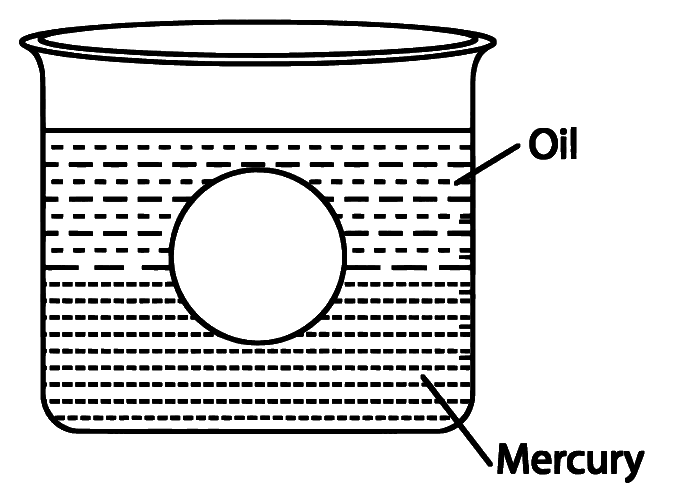
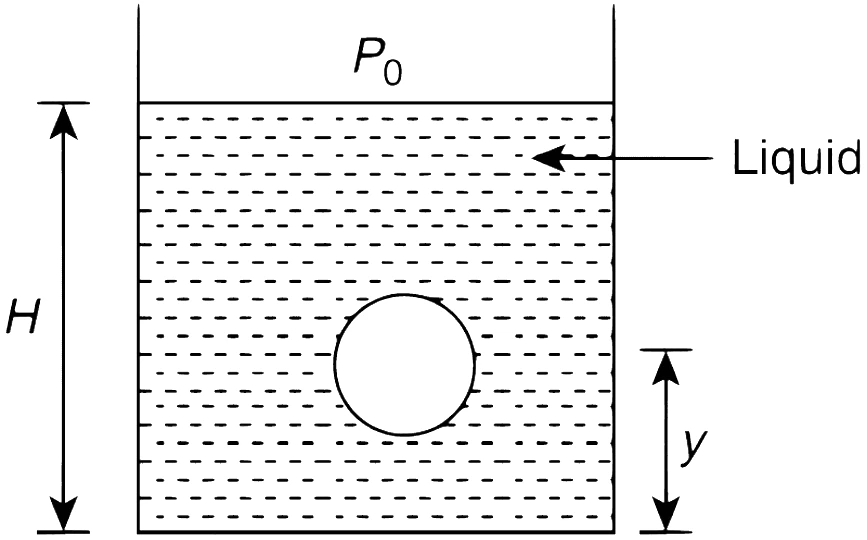
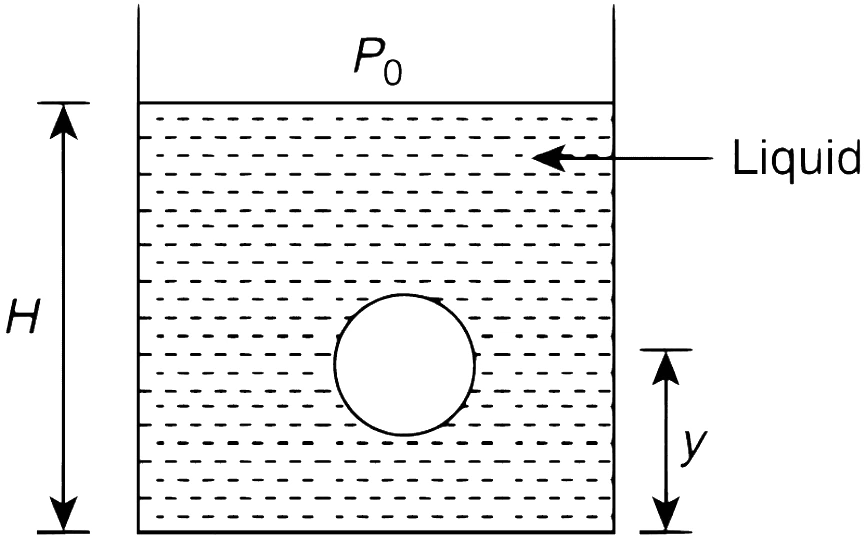
A vessel contains oil (density=0.6 g/cm3) over mercury (density=13.6 g/cm3). A homogeneous sphere floats with half its volume immersed in mercury and the remaining half in oil. The density of the material of the sphere in g/cm3 is
A vessel contains oil (density =0.8 gm/cm3) over mercury (density =13.6 gm/cm3). A homogeneous sphere floats with half of its volume immersed in mercury and the other half in oil. The density of the material of the sphere in gm/cm3 is
A cubical block of density ρb=600 kg/m3 floats in a liquid of density ρe=900 kg/m3. If the height of block is H=8.0 cm then height of the submerged part is
A tub is filled with water and a wooden cube 10 cm ×10 cm ×10 cm is placed in the water. The wooden cube is found to float on the water with a part of it submerged in water. When a metal coin is placed on the wooden cube, the submerged part is increased by 3.87 cm. The mass of the metal coin is ________ gram.
(Take water density as 1 g/cm3 and density of wood as 0.4 g/cm3)
Numerical answer type. Work it out, then open the answer.
A solid cylinder of length l and cross-sectional area 5a is immersed such that it floats with its axis vertical at the liquid-liquid interface with length l/4 in the denser liquid as shown in figure. The lower density liquid ( ρ) is open to atmosphere having pressure P0. The density d of solid cylinder is
A small metal sphere of density ρ is dropped from height h into a jar containing liquid of density σ(σ>ρ). The maximum depth up to which the sphere sinks is (Neglect damping forces)
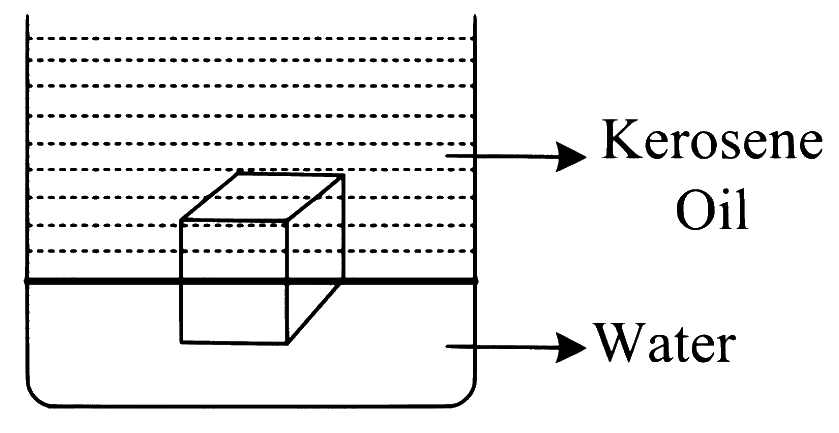
A cube of ice floats partly in water and partly in kerosene oil. The ratio of volume of ice immersed in water to that in kerosene oil (specific gravity of Kerosene oil = 0.8, specific gravity of ice = 0.9):
A hemispherical portion of radius ' R ' is removed from the bottom of a cylinder of radius ' R '. The volume of the remaining cylinder is ' V ' and its mass is ' M '. It is suspended by a string in a liquid of density ' ρ ', where it stays vertical. The upper surface of the cylinder is at a depth ' h ' below the liquid surface. The force on the bottom of the cylinder by the liquid is
The fundamental frequency of a sonometer wire carrying a block of mass 'M' and density 'ρ' is 'n' Hz. When the block is completely immersed in a liquid of density 'σ' then the new frequency will be
A body of density 'ρ' is dropped from rest at a height 'h' into a lake of density 'σ(σ>ρ). The maximum depth to which the body sinks before returning to float on the surface is (neglect air dissipative forces)
A body of density V is dropped from (at rest) height 'h' into a lake of density 'δ' (δ>ρ). The maximum depth to which the body sinks before returning to float on the surface is [Neglect all dissipative forces]
A hollow spherical shell of outer radius R floats just submerged under the water surface. The inner radius of the shell is r. If the specific gravity of the shell material is 827 w.r.t water, the value of r is:
A leak proof cylinder of length 1m, made of a metal which has very low coefficient of expansion is floating vertically in water at 0°C such that its height above the water surface is 20 cm. When the temperature of water is increased to 4°C, the height of the cylinder above the water surface becomes 21 cm. The density of water at T = 4°C, relative to the density at T = 0°C is close to:
A air bubble of radius 1 cm in water has an upward acceleration 9.8 cm s–2. The density of water is 1 gm cm–3 and water offers negligible drag force on the bubble. The mass of the bubble is (g = 980 cm/s2).
A cubical block of side 0.5 m floats on water with 30% of its volume under water. What is the maximum weight that can be put on the block without fully submerging it under water? [Take, density of water = 103 kg/m3]
A wooden block floating in a bucket of water has 4/5 of its volume submerged. When certain amount of an oil is poured into the bucket, it is found that the block is just under the oil surface with half of its volume under water and half in oil. The density of oil relative to that of water is :-
A thin uniform tube is bent into a circle of radius r in the vertical plane. Equal volumes of two immiscible liquids, whose densities are ρ1 and ρ2(ρ1>ρ2), fill half the circle. The angle θ between the radius vector passing through the common interface and the vertical is:
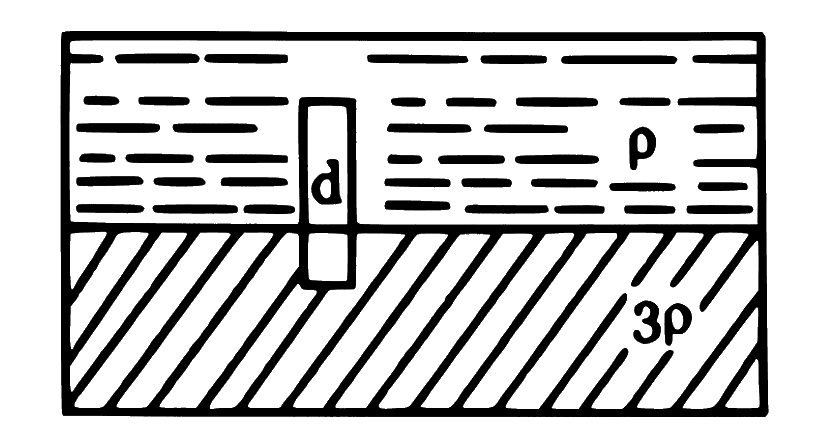
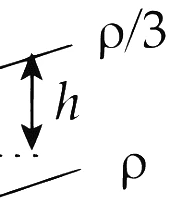
Two non-mixing liquids of densities ρ and nρ (n > 1) are put in a container. The height of each liquid is h. A solid cylinder of length L and density d is put in this container. The cylinder floats with its axis vertical and length pL (p < 1) in the denser liquid. The density d is equal to
An open glass tube is immersed in mercury in such a way that a length of 8 cm extends above the mercury level. The open end of the tube is then closed and sealed and the tube is raised vertically up by additional 46 cm. What will be length of the air column above mercury in the tube now? (Atmospheric pressure =76 cm of Hg)
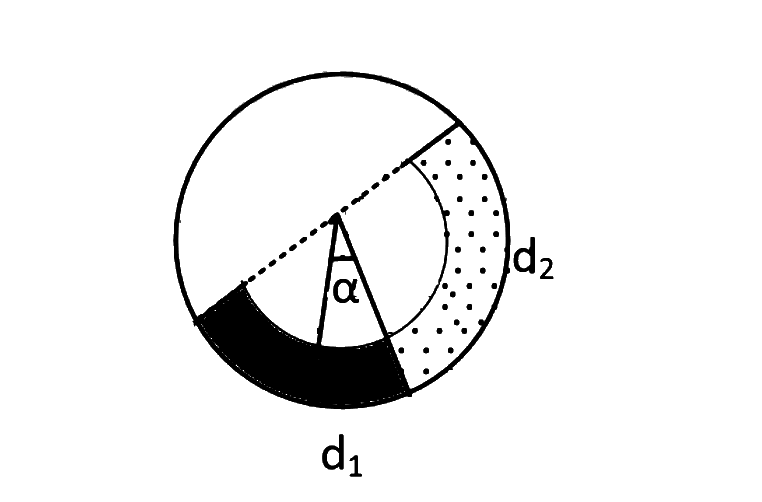
There is a circular tube in a vertical plane. Two liquids which do not mix and of densities d1 and d2 are filled in the tube. Each liquid subtends 90∘ angle at center. Radius joining their interface makes an angle α with vertical. Ratio d2d1 is:
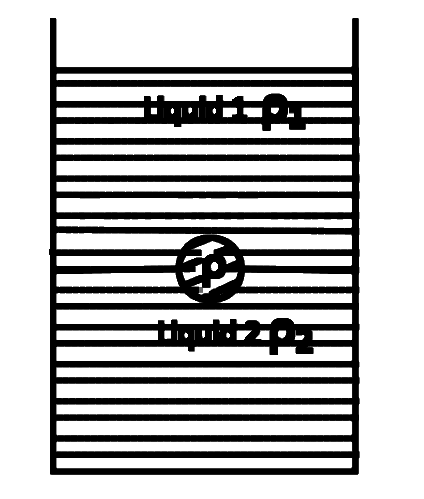
A jar is filled with two non-mixing liquids 1 and 2 having densities ρ1 and ρ2 respectively. A solid ball, made of a material of density ρ3, is dropped in the jar. It comes to equilibrium in the position shown in the figure. Which of the following is true for ρ1,ρ1 and ρ3?
When a solid body is partially or completely immersed in a fluid, the fluid exerts an upward force on the body. The magnitude of the force is equal to 1. the mass of the body 2. the weight of the displaced fluid by the body Which of the above is/are correct?
A pumpkin weighs 7.5N. On submerging it completely in water, 43L of water gets displaced. The acceleration due to gravity at the place where the pumpkin was weighed is 10m s−2. Which one of the following is the correct value of the density of the pumpkin?
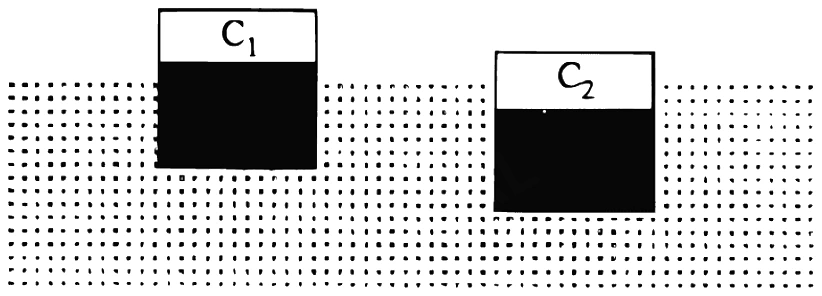
Shown in the figure are two hollow cubes C1 and C2 of negligible mass partially filled (depicted by darkened area) with liquids of densities ρ1 and ρ2, respectively, floating in water (density ρw). The relationship between ρ1, ρ2 and ρw is
An iron nail sinks in water whereas an iron ship floats. Which of the following statements is correct in this regard? 1. Average density of ship is greater than that of the water 2. Average density of iron nail is greater than that of the water 3. Average density of the ship is less than that of the water 4. Average density of the ship is equal to that of the water Select the correct answer using the code given below:
A sphere of volume V is made of a material with lower density than water. While on Earth, it floats on water with its volume f1V (f1<1) submerged. On the other hand, on a spaceship accelerating with acceleration a<g (g is the acceleration due to gravity on Earth) in outer space, its submerged volume in water is f2V. Then:
The volume of a sealed packet is 1 litre and its mass is 800g. The packet is first put inside the water with a density of 1g cm−3 and then in another liquid B with a density of 1.5g cm−3. Then which one of the following statements holds true?
Suppose we have an iron nail and an iron ball of same mass. When submerged in water, the iron ball may float but the nail always sinks. This is because
A vessel contains oil (density ρ1) over a liquid of density ρ2; a homogeneous sphere of volume V floats with half of its volume immersed in the liquid and the other half in oil. The weight of the sphere is
A vessel contains oil of density 0.8g cm−3 over mercury of density 13.6g cm−3. A homogeneous sphere floats with half of its volume immersed in mercury and the other half in oil. The density of the material of the sphere in CGS unit is
A table tennis ball has radius (3/2)×10−2m and mass (22/7)×10−3kg. It is slowly pushed down into a swimming pool to a depth of d=0.7m below the water surface and then released from rest. It emerges from the water surface at speed v, without getting wet, and rises up to a height H. Which of the following option(s) is(are) correct? [Given: π=22/7, g=10m s−2, density of water =1×10³kg m−3, viscosity of water =1×10⁻³Pa-s.]
More than one option can be correct. Tap every correct option, then tap Check.
A hot air balloon is carrying some passengers, and a few sandbags of mass 1kg each so that its total mass is 480kg. Its effective volume giving the balloon its buoyancy is V. The balloon is floating at an equilibrium height of 100m. When N number of sandbags are thrown out, the balloon rises to a new equilibrium height close to 150m with its volume V remaining unchanged. If the variation of the density of air with height h from the ground is ρ(h)=ρ0e−h/h0, where ρ0=1.25kg m−3 and h0=6000m, the value of N is ______.
Numerical answer type. Work it out, then open the answer.
A solid sphere of radius R and density ρ is attached to one end of a mass-less spring of force constant k. The other end of the spring is connected to another solid sphere of radius R and density 3ρ. The complete arrangement is placed in a liquid of density 2ρ and is allowed to reach equilibrium. The correct statement(s) is (are)
More than one option can be correct. Tap every correct option, then tap Check.
A thin uniform cylindrical shell, closed at both ends, is partially filled with water. It is floating vertically in water in half-submerged state. If ρc is the relative density of the material of the shell with respect to water, then the correct statement is that the shell is
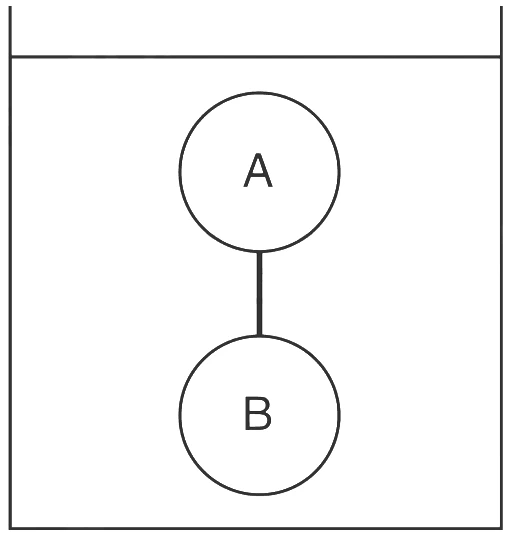
Two solid spheres A and B of equal volumes but of different densities dA and dB are connected by a string. They are fully immersed in a fluid of density dF. They get arranged into an equilibrium state as shown in the figure with a tension in the string. The arrangement is possible only if
More than one option can be correct. Tap every correct option, then tap Check.
A small spherical monoatomic ideal gas bubble (γ=35) is trapped inside a liquid of density ρl (see figure). Assume that the bubble does not exchange any heat with the liquid. The bubble contains n moles of gas. The temperature of the gas when the bubble is at the bottom is T0, the height of the liquid is H and the atmospheric pressure is P0 (Neglect surface tension) As the bubble moves upwards, besides the buoyancy force the following forces are acting on it
A small spherical monoatomic ideal gas bubble (γ=35) is trapped inside a liquid of density ρl (see figure). Assume that the bubble does not exchange any heat with the liquid. The bubble contains n moles of gas. The temperature of the gas when the bubble is at the bottom is T0, the height of the liquid is H and the atmospheric pressure is P0 (Neglect surface tension) The buoyancy force acting on the gas bubble is (Assume R is the universal gas constant)
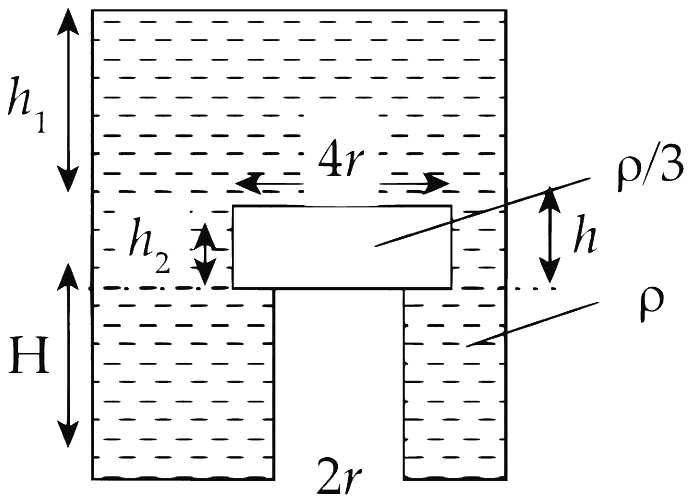
A wooden cylinder of diameter 4r, height h and density 3ρ is kept on a hole of diameter 2r of a tank, filled with water of density ρ as shown in the figure. The height of the base of cylinder from the base of tank is H. If the level of liquid starts decreasing slowly when the level of liquid is at a height h1 above the cylinder, the block just starts moving up. Then, the value of h1 is:
A wooden cylinder of diameter 4r, height h and density 3ρ is kept on a hole of diameter 2r of a tank, filled with water of density ρ as shown in the figure. The height of the base of cylinder from the base of tank is H. Let the cylinder be prevented from moving up, by applying a force and water level is further decreased. Then, the height of water level (h2 in the figure) for which the cylinder remains in original position without application of force is
A wooden cylinder of diameter 4r, height h and density 3ρ is kept on a hole of diameter 2r of a tank, filled with water of density ρ as shown in the figure. The height of the base of cylinder from the base of tank is H. If the height h2 of water level is further decreased, then
A sphere of solid material of relative density 9 has a concentric spherical cavity and just sinks in water. If the radius of sphere be R, then the radius of cavity (r) will be related to R as
Assertion: To float, a body must displace liquid whose weight is greater than actual weight of the body. Reason: During floating the body will experience no net downward force in that case.
Assertion: A ship floats higher in the water on a high pressure day than on a low pressure day. Reason: Floating of ship in the water is not possible because of buoyancy force which is present due to pressure difference.
Assertion: In taking into account the fact that any object which floats must have an average density less than that of water, during world war I, a number of cargo vessels are made of concrete. Reason: Concrete cargo vessels were filled with air.
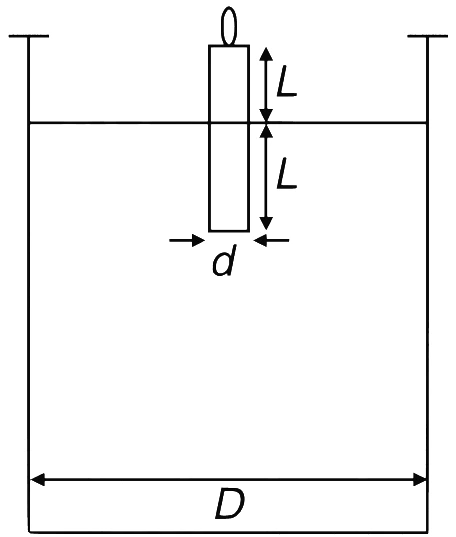
A candle of diameter d is floating on a liquid in a cylindrical container of diameter D (D≫d) as shown in figure. If it is burning at the rate of 2cm/h then the top of the candle will :
A hollow sphere of volume V is floating on water surface with half immersed in it. What should be the minimum volume of water poured inside the sphere so that the sphere now sinks into the water ?
A large block of ice 10m thick with a vertical hole drilled through it is floating in a lake. The minimum length of the rope required to scoop out a bucket full of water through the hole is (density of ice =0.9g/cm3)
A wooden block floats with 53 of its volume submerged in a tank of water. If a denser liquid is poured into the tank, the wooden block floats with half its volume in the liquid and the remaining half in water. The relative density of the liquid is:
A block of wood floats in water with (4/5)th of its volume submerged. If the same block just floats in a liquid, the density of the liquid is (in kg m−3)
A balloon with mass m is descending down with an acceleration a (where, a<g). How much mass should be removed from it so that it starts moving up with an acceleration a ?
A vessel contains oil of density 0.8g cm−3 over mercury of density 13.6g cm−3. A homogeneous sphere floats with half of its volume immersed in mercury and the other half in oil. Then the density of the material of the sphere is
When a body floats in water and another liquid separately, it floats with one third of its volume outside water and 43 of its volume outside another liquid. The density of the liquid is
If the apparent weight of a cube of mass 400g immersed in water is 3.36N, then the density of the material of the cube (in kg m−3) is (Acceleration due to gravity =10m s−2)
A cube of side 40cm is floating with 41th of its volume immersed in water. When a circular disc is placed on the cube, it floats with 52th of its volume immersed in water. The mass of the disc is
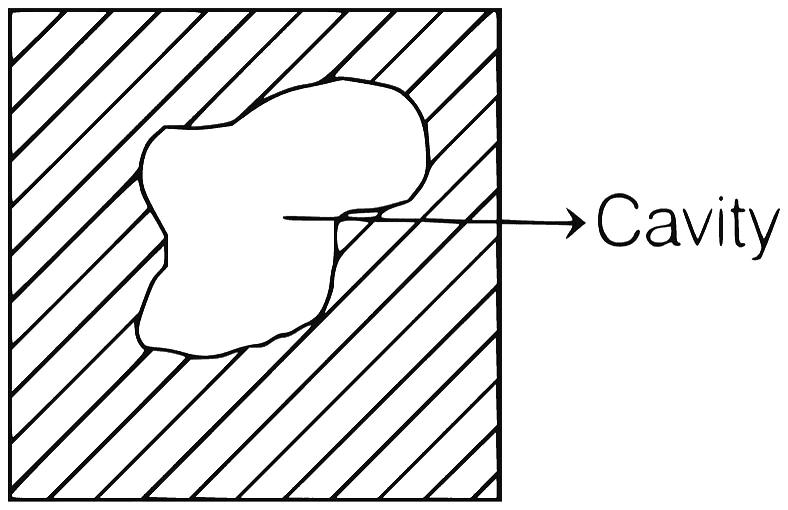
A wooden block of outer volume 1 litre and specific gravity 43 having a cavity floats with half of its volume immersed in water. Then, the volume of the cavity is
A wooden cube of side 10cm floats at the interface between water and oil with its lower surface 3cm below the interface. If the density of oil is 0.9g cm−3, the mass of the wooden cube is
A cylinder of mass m and material density ρ hanging from a string is lowered into a vessel of cross-sectional area A containing a liquid of density σ(<ρ) until it is fully immersed. The increase in pressure at the bottom of the vessel is
A hollow spherical body of outer and inner radii of 4cm and 2cm respectively, floats half submerged in a liquid of density 2.0g/cm3. The density of the material of the sphere is
A block of iron contains a hollow cavity as shown below. The block weighs 6000N in air and 4000N in water. If the density of iron and water are 6g/cm3 and 1g/cm3, then the volume of the cavity is (assume, g=10m/s2)
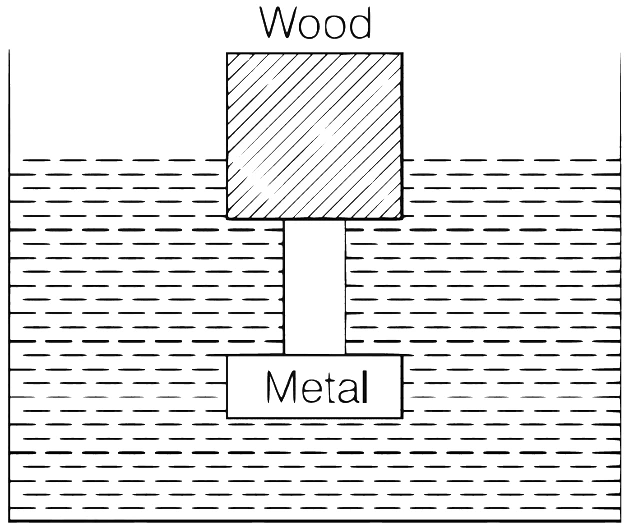
A cubical block of wood having mass of 160g has a metal piece fastened underneath as shown in the figure. Find the maximum mass of the metal piece which will allow the block to float in water. Specific gravity of wood is 0.8 and that metal is 10 and density of water =1g/cc.
A body of density ρ is dropped slowly on the surface of a lake of depth d. If the density of the lake water be ρ′ (ρ′<ρ) then the time taken by the body to reach the bottom of the lake is
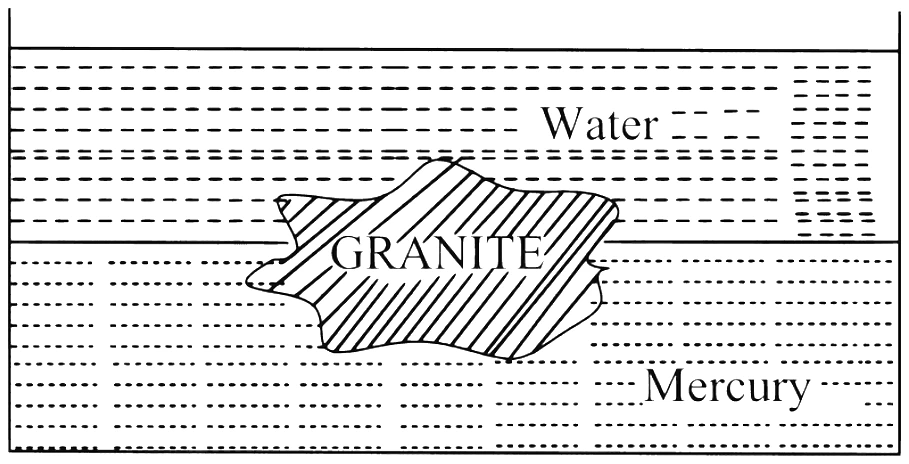
A piece of granite floats at the interface of mercury and water contained in a beaker as in figure. If the densities of granite, water and mercury are ρ, ρ1 and ρ2 respectively, the ratio of the volume of granite in water to the volume of granite in mercury is
A body floats with n1 of its volume keeping outside of water. If the body has been taken to height h inside water and released, it will come to the surface after time t. Then
A body of density 1.2×10³kg m−3 is dropped from rest from a height 1m into a liquid of density 2.4×10³kg m−3. Neglecting all dissipative effects, the maximum depth to which the body sinks before returning to float on the surface is
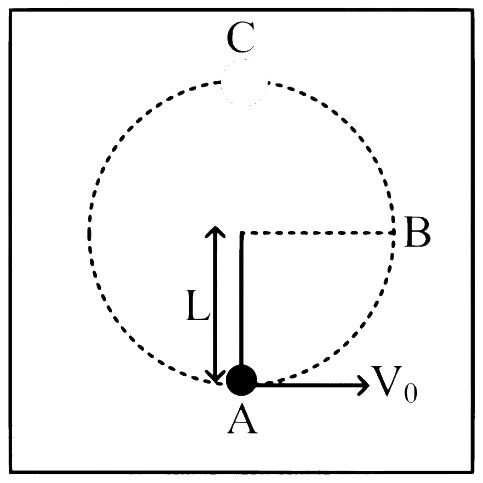
A solid bob of a material having density twice that of water is suspended with a massless and inextensible string of length L. The whole set-up is placed inside a water-filled tank. The bob is imparted a horizontal velocity V0 at the lowest point A, while the other end of the string is fixed, such that the bob completes a semi-circular trajectory in the vertical plane. The string becomes slack only when the bob reaches the topmost point C. Assume that the effects of viscosity and water currents are negligible. The acceleration due to gravity is g. What is the expression for V0?
Two cubes A and B of same dimensions are made of different materials with densities ρA and ρB, respectively. Cube A floats in water with a fraction η of its volume immersed. When cube B is placed on top of cube A, it is found that cube A is just entirely immersed, while cube B is entirely above the surface of the water. What is the ratio ρB/ρA?
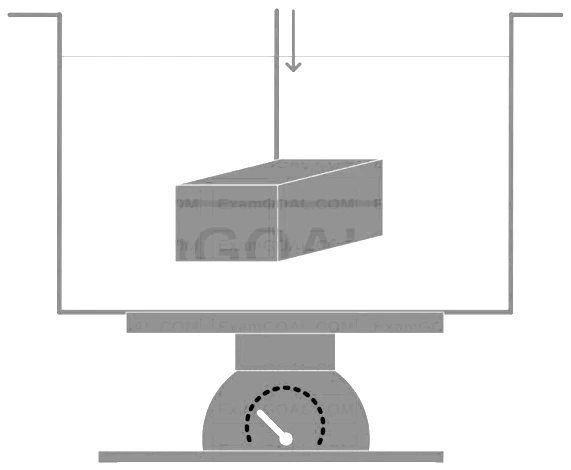
A liquid of density ρ in a container weighs W. A cubic block of side L and density ρb<ρ is pushed by a stick to completely submerge the block in the liquid without touching the bottom. If g is the acceleration due to the gravity and liquid displaced by the stick is negligible, what is the new weight of the container as registered by the weighing machine below?
A sphere made of a material with density 12kg m−3 and weighing 100N in vacuum is immersed in a container of gas. Its weight in gas is 85N. The density of the gas in kg m−3 is closest to
Consider a steel ball of mass 20kg inside an ice cube which is floating on water in a container. The density of the steel is 8000kg m−3. If the cross-sectional area of the container is 1m2 then the change in the water level when the ice melts is closest to
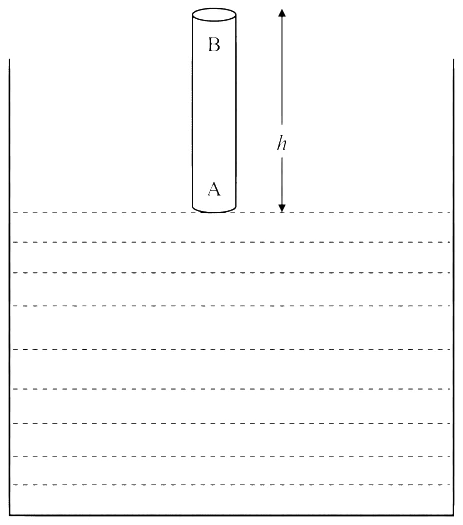
A cylinder (density =5.0×10³kg m−3) of height h=2.0m is vertically released from rest in a water-filled tank (density of water =1.0×10³kg m−3) when the top surface A just touches the water as shown in the figure. Assume that the cylinder remains exactly vertical while it is sinking. The velocity of the cylinder at the instance when its top surface (B) just touches the water is