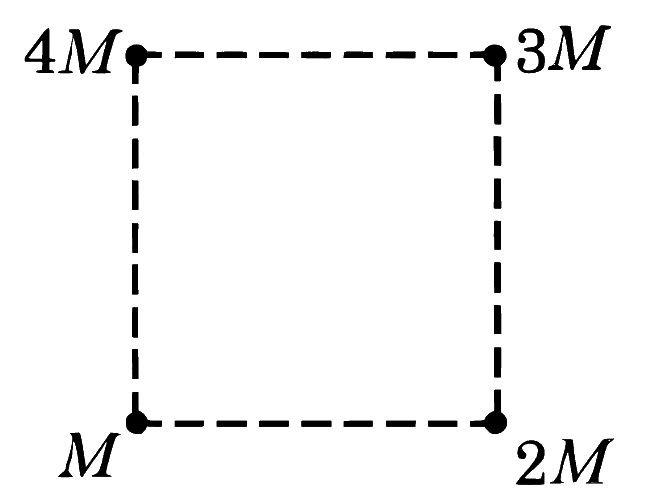
Net gravitational force at the center of a square is found to be F1 when four particles having mass M,2M,3M and 4M are placed at the four corners of the square as shown in figure and it is F2 when the positions of 3M and 4M are interchanged. The ratio F2F1 is 5α. The value of α is ______.
Three identical spheres of mass m, are placed at the vertices of an equilateral triangle of length a. When released, they interact only through gravitational force and collide after a time T=4 seconds. If the sides of the triangle are increased to length 2a and also the masses of the spheres are made 2 m, then they will collide after__________seconds.
Numerical answer type. Work it out, then open the answer.
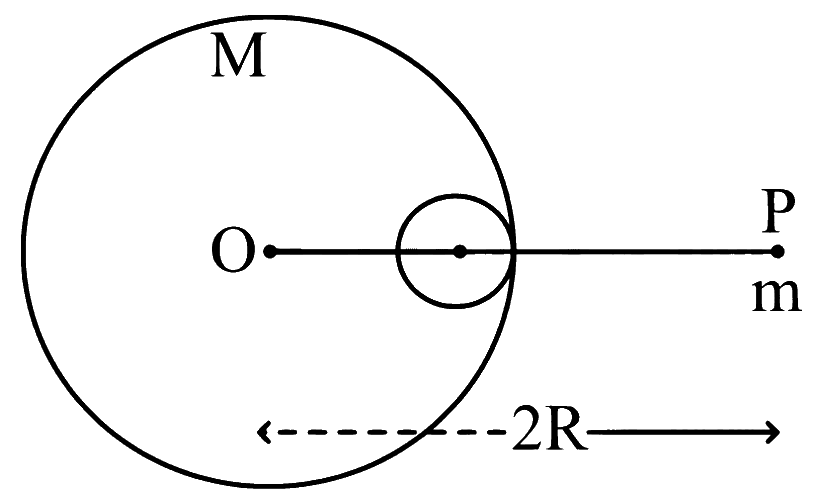
A small point of mass m is placed at a distance 2R from the centre ' O ' of a big uniform solid sphere of mass M and radius R. The gravitational force on ' m ' due to M is F1. A spherical part of radius R/3 is removed from the big sphere as shown in the figure and the gravitational force on m due to remaining part of M is found to be F2. The value of ratio F1:F2 is
Four identical particles of mass m are kept at the four corners of a square. If the gravitational force exerted on one of the masses by the other masses is (3222+1)L2Gm2, the length of the sides of the square is
Two identical metal spheres are kept in contact with each other, each having radius ' R ' cm and ' ρ ' is the density of material of metal spheres. The gravitational force ' F ' of attraction between them is proportional to
A metal wire of uniform mass density having length L and mass M is bent to form a semicircular arc and a particle of mass m is placed at the centre of the arc. The gravitational force on the particle by the wire is:
A system consists of three particles each of mass 'm1 ' placed at the corners of an equilateral triangle of side ' 3L ', A particle of mass 'm2 ' is placed at the mid point of any one side of the triangle. Due to the system of particles, the force acting on m2 is
If two identical spherical bodies of same material and dimensions are kept in contact, the gravitational force between them is proportional to Rx, where x is non zero integer [Given: R is radius of each spherical body]
Two objects of equal masses placed at certain distance from each other attracts each other with a force of F. If one-third mass of one object is transferred to the other object, then the new force will be:
Statement I: The law of gravitation holds good for any pair of bodies in the universe. Statement II: The weight of any person becomes zero when the person is at the centre of the earth. In the light of the above statements, choose the correct answer from the options given below.
Three identical particles A,B and C of mass 100 kg each are placed in a straight line with AB=BC=13 m. The gravitational force on a fourth particle P of the same mass is F, when placed at a distance 13 m from the particle B on the perpendicular bisector of the line AC. The value of F will be approximately:
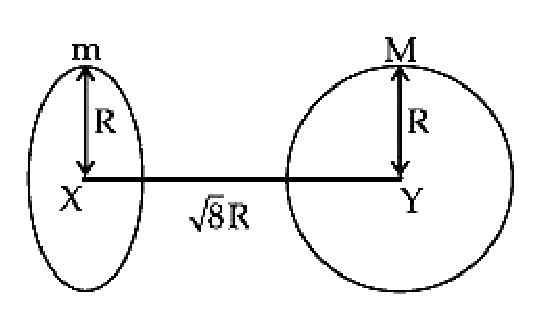
Find the gravitational force of attraction between the ring and sphere as shown in the diagram, where the plane of the ring is perpendicular to the line joining the centres. If 8R is the distance between the centres of a ring (of mass 'm') and a sphere (mass 'M') where both have equal radius 'R'.
A solid sphere of radius R gravitationally attracts a particle placed at 3R from its centre with a force F1. Now a spherical cavity of radius (2R) is made in the sphere (as shown in figure) and the force becomes F2. The value of F1: F2 is
A straight rod of length L extends from x = a to x = L + a. The gravitational force it exerts on a point mass 'm' at x = 0, if the mass per unit length of the rod is A + Bx2, is given by:
Take the mean distance of the moon and the sun from the earth to be 0.4×10⁶ km and 150×106 km respectively. Their masses are 8×10²² kg and 2×1030 kg respectively. The radius of the earth is 6400 km. Let ΔF1 be the difference in the forces exerted by the moon at the nearest and farthest points on the earth and ΔF2 be the difference in the force exerted by the sun at the nearest and farthest points on the earth. Then, the number closest to ΔF2ΔF1 is:
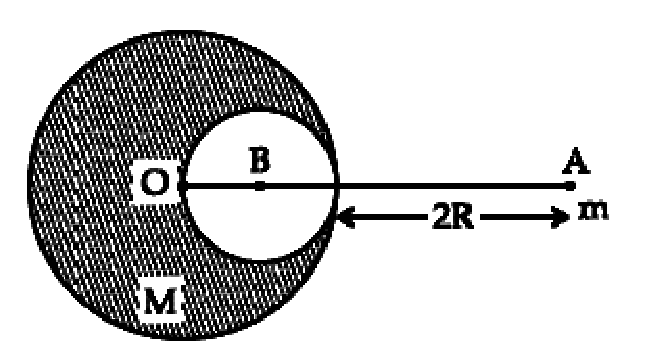
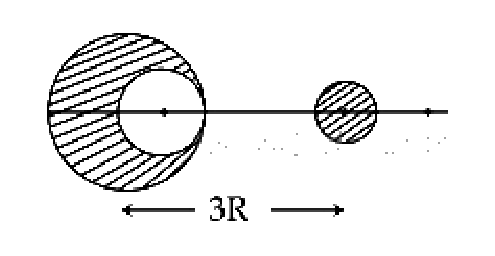
From a sphere of mass M and radius R, a smaller sphere of radius 2R is carved out such that the cavity made in the original sphere is between its centre and the periphery. (See figure). For the configuration in the figure where the distance between the center of the original sphere and the removed sphere is 3R, the gravitational force between the two spheres is:
The change in the value of acceleration of earth towards sun, when the moon comes from the position of solar eclipse to the position on the other side of earth in line with sun is: (mass of the moon = 7.36×10²² kg, radius of the moon's orbit = 3.8×10⁸ m).
(1) Centre of gravity (C.G) of a body is the point at which the weight of the body acts (2) Centre of mass coincides with the centre of gravity if the earth is assumed to have infinitely large radius.
(3) To evaluate the gravitational field intensity due to any body at an external point, the entire mass of the body can be considered to be concentrated at its C.G.
(4) The radius of gyration of any body rotating about an axis is the length of the perpendicular dropped from the C.G. of the body to the axis.
Which one of the following pairs of statements is correct?
A man of 50 kg mass is standing in a gravity free space at a height of 10 m above the floor. He throws a stone of 0.5 kg mass downwards with a speed 2 m/s. When the stone reaches the floor, the distance of the man above the floor will be
Two spheres of masses m and M are situated in air and the gravitational force between them is F. The space around the masses is now filled with a liquid of specific gravity 3. The gravitational force will now be
Two spherical bodies of mass M and 5M & radii R & 2R respectively are released in free space with initial separation between their centers equal to 12R. If they attract each other due to gravitational force only, then the distance covered by the smaller body just before collision is
Consider the following: I. Gravitational field due to a spherical body II. Electrostatic field due to a point charge III. Strong nuclear force field due to a proton IV. Magnetic field due to a bar magnet How many of the above follow the inverse square law?
Which of the following forces is/are fundamental in nature? 1. Gravitational force 2. Electromagnetic forces 3. Strong and weak nuclear forces Select the correct answer using the code given below:
Two bodies of mass M each are placed R distance apart. In another system, two bodies of mass 2M each are placed 2R distance apart. If F be the gravitational force between the bodies in the first system, then the gravitational force between the bodies in the second system will be
Suppose the force of gravitation between two bodies of equal masses is F. If each mass is doubled keeping the distance of separation between them unchanged, the force would become
A large spherical mass M is fixed at one position and two identical masses m are kept on a line passing through the centre of M (see figure). The point masses are connected by a rigid massless rod of length l and this assembly is free to move along the line connecting them.
All three masses interact only through their mutual gravitational interaction. When the point mass nearer to M is at a distance r=3l from M the tension in the rod is zero for m=k(288M). The value of k is ________.
Numerical answer type. Work it out, then open the answer.
Some physical quantities are given in Column I and some possible SI units in which these quantities may be expressed are given in Column II. Match the physical quantities in Column I with the units in Column II.
Column I
Column II
(A) GMeMs (G - universal gravitational constant, Me - mass of the earth, Ms - mass of the Sun)
(P) (volt)(coulomb)(metre)
(B) M3RT (R - universal gas constant, T - absolute temperature, M - molar mass)
(Q) (kilogram)(metre)3(second)−2
(C) q2B2F2 (F - force, q - charge, B - magnetic field)
(R) (metre)2(second)−2
(D) ReGMe (G - universal gravitational constant, Me - mass of the earth, Re - radius of the earth)
Assertion : The ratio of inertial mass to gravitational mass is equal to one. Reason : The inertial mass and gravitational mass of a body are equivalent.
A uniform ring of mass m and radius a is placed directly above a uniform sphere of mass M and of equal radius. The centre of the ring is at a distance 3a from the centre of the sphere. The gravitational force F exerted by the sphere on the ring is
A mass M is broken into two parts of masses m1 and m2. How are m1 and m2 related, so that the force of gravitational attraction between the two parts is maximum?
Two neutral bodies of masses m1 and m2 are kept at a distance of rcm from one another in a vacuum medium. A gravitational force Fv acts between the two bodies. The entire set-up is then transferred, as it is, to a water medium. The force between the bodies is then Fw. The ratio of Fv to Fw is:
Two particles, one heavy and the other light, placed at 50cm from each other, are under the influence of gravitational force of one another. If the mass of the heavier particle is 4kg and its acceleration under the influence of gravitational force is 5×10⁻¹⁰m s−2, find the mass of the lighter particle.
Two spheres of masses M1 and M2 are in air separated by a distance of dm. The gravitational force of attraction between them is F. If the space around the masses is filled with a liquid of density ρ, the force between the masses will be
Two spherical bodies of masses M and 5M and radii R and 2R are released in free space with initial separation between their centres equal to 12R. If they attract each other due to gravitational force only, then the distance covered by the smaller body before collision is
Electrical as well as gravitational effects can be thought to be caused by fields. Which of the following is true for an electrical or gravitational field?
Two bodies of masses 8kg are placed at the vertices A and B of an equilateral triangle ABC. A third body of mass 2kg is placed at the centroid G of the triangle. If AG=BG=CG=1m, where should a fourth body of mass 4kg be placed so that the resultant force on the 2kg body is zero?
Two solid spheres each of radius R made of the same material are placed in contact with each other. If the gravitational force acting between them is F, then
Three particles, each of mass M, are situated at the vertices of an equilateral triangle of side length l. The only forces acting on the particles are their mutual gravitational forces. It is desired that each particle moves in a circle while maintaining the original separation l. The initial speed that should be given to each particle is
A mass M is split into two parts m0 and M−m0. These two masses are then separated by a distance D. If the gravitational force between the parts is maximum, then the ratio Mm0 is
A point object P of mass m and charge q is placed at a distance r from a stationary object Q of mass M and charge −q. Let Tg be the time for P to reach Q if it is moving only under gravitational attraction. Similarly, let Te be the time for P to reach Q if it is moving only under electrostatic attraction. Then,
More than one option can be correct. Tap every correct option, then tap Check.