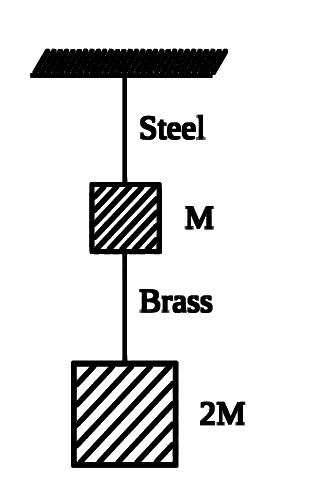
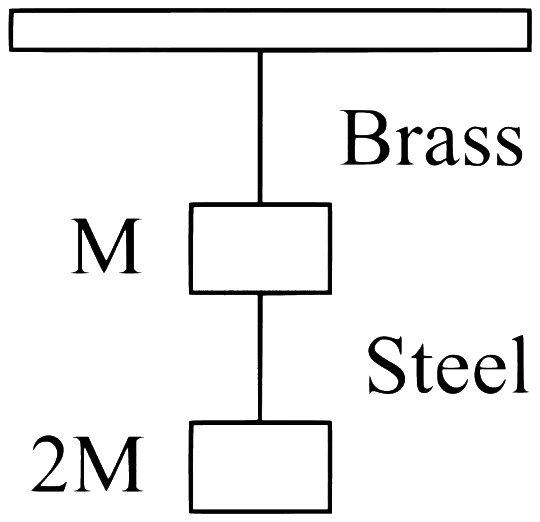
A metal string A is suspended from a rigid support and its free end is attached to a block of mass M. Second block having mass 2 M is suspended at the bottom of the first block using a string B. The area of cross sections of strings A and B are same. The ratio of lengths of strings of A to B is 2 and the ratio of their Young's moduli (YA/YB) is 0.5. The ratio of elongations in A to B is ______.
A string A of length 0.314 m and Young's modulus 2×10¹⁰ N/m2 is connected to another string B of length and Young's modulus both twice of those of A. This series combination of strings is then suspended from a rigid support and its free end is fixed to a load of mass 0.8 kg. The net change in length of the combination is ______ mm.
(radius of both the strings is 0.2 mm and acceleration due to gravity =10 m/s2) (Mass of both strings is to be neglected as compared to the mass of load)
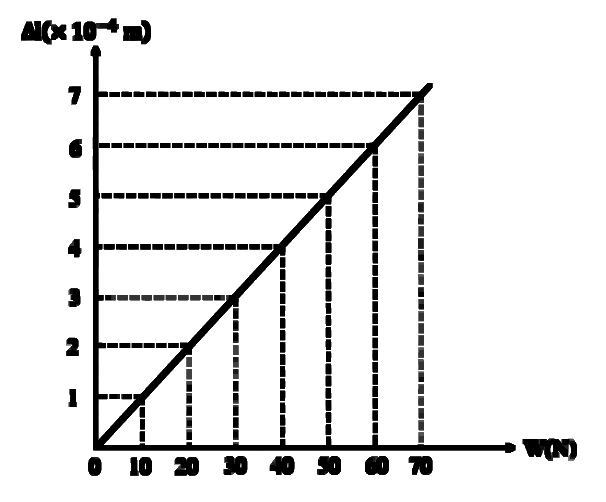
Figure represents the extension (Δl) of a wire of length 1 meter, suspended from the ceiling of the room at one end with a load W connected to the other end. If the cross-sectional area of the wire is 10−5 m2 then the Young's modulus of the wire is N/m2.
The length of a light string is 1.4 m when the tension on it is 5 N. If the tension increases to 7 N, the length of the string is 1.56 m. The original length of the string is__________m.
Numerical answer type. Work it out, then open the answer.
Two persons pull a wire towards themselves. Each person exerts a force of 200 N on the wire. Young's modulus of the material of wire is 1×10¹¹ N m−2. Original length of the wire is 2 m and the area of cross section is 2 cm2. The wire will extend in length by _________ μm.
Numerical answer type. Work it out, then open the answer.
An elastic spring under tension of 3 N has a length a. Its length is b under tension 2 N. For its length (3a−2b), the value of tension will be _______ N.
Numerical answer type. Work it out, then open the answer.
A spring has length L and force constant K. It is cut into two springs of length L1 and L2 such that L1=NL2 ( N is an integer). The force constant of spring of length L1 is
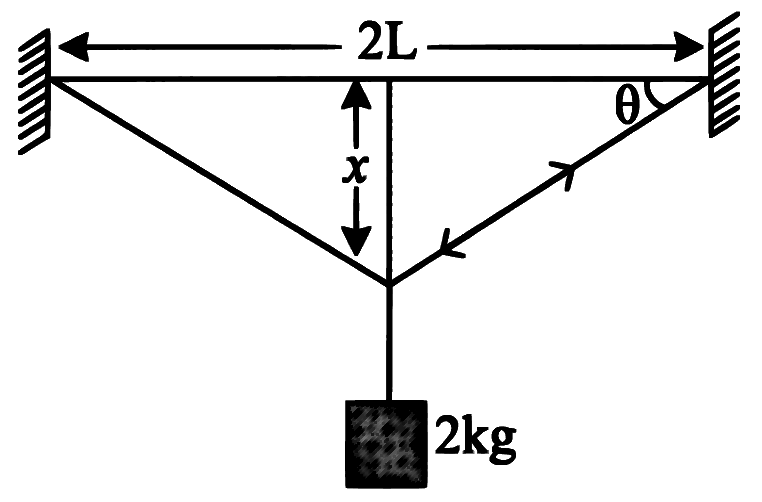
A wire of cross sectional area A, modulus of elasticity 2×10¹¹ Nm−2 and length 2 m is stretched between two vertical rigid supports. When a mass of 2 kg is suspended at the middle it sags lower from its original position making angle θ=1001 radian on the points of support. The value of A is ________ ×10−4 m2 (consider x<<L ).
(given: g=10 m/s2)
Numerical answer type. Work it out, then open the answer.
Young's modulus is determined by the equation given by Y=49000lmcm2dyne where M is the mass and l is the extension of wire used in the experiment. Now error in Young modules (Y) is estimated by taking data from M−l plot in graph paper. The smallest scale divisions are 5 g and 0.02 cm along load axis and extension axis respectively. If the value of M and l are 500 g and 2 cm respectively then percentage error of Y is:
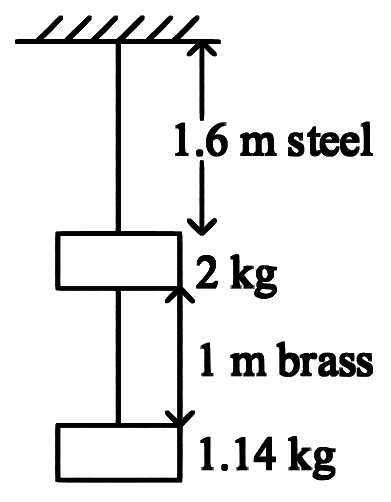
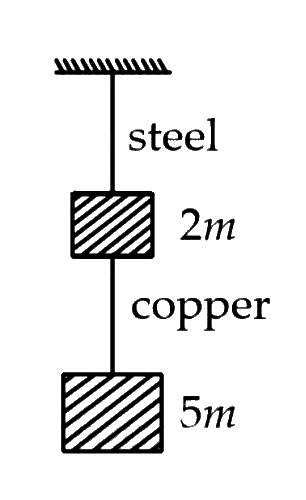
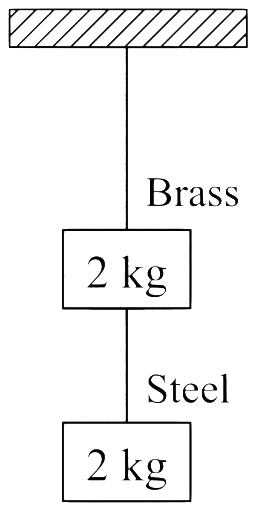
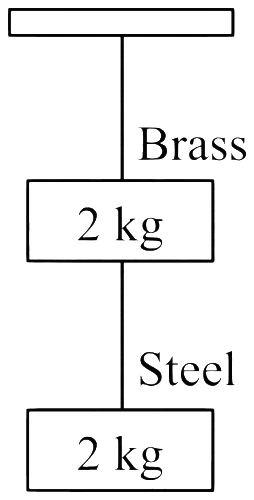
Two wires each of radius 0.2 cm and negligible mass, one made of steel and the other made of brass are loaded as shown in the figure. The elongation of the steel wire is __________ × 10 −6 m. [Young's modulus for steel = 2 × 10¹¹ Nm−2 and g = 10 ms−2 ]
Numerical answer type. Work it out, then open the answer.
The length of a wire becomes l1 and l2 when 100 N and 120 N tensions are applied respectively. If 10l2=11l1, the natural length of wire will be x1l1. Here the value of x is _____________.
Numerical answer type. Work it out, then open the answer.
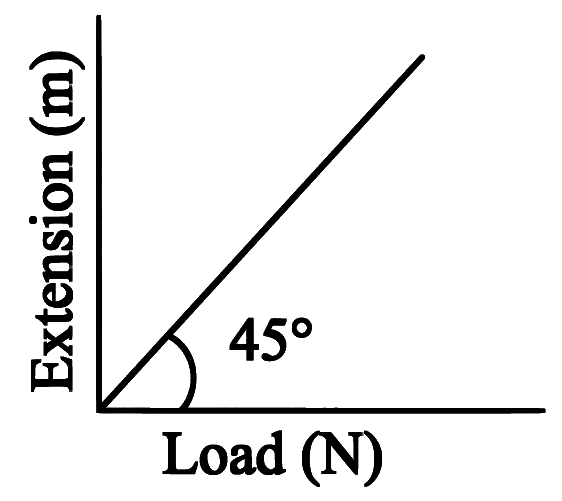
As shown in the figure, in an experiment to determine Young's modulus of a wire, the extension-load curve is plotted. The curve is a straight line passing through the origin and makes an angle of 45 ∘ with the load axis. The length of wire is 62.8 cm and its diameter is 4 mm. The Young's modulus is found to be x×104 Nm−2. The value of x is ___________.
Numerical answer type. Work it out, then open the answer.
A steel wire of length 3.2 m(Ys=2.0×10¹¹ N m−2) and a copper wire of length 4.4 m(Yc=1.1×10¹¹ N m−2), both of radius 1.4 mm are connected end to end. When stretched by a load, the net elongation is found to be 1.4 mm. The load applied, in Newton, will be: ( Given π=722)
A uniform heavy rod of mass 20 kg, cross sectional area 0.4 m2 and length 20 m is hanging from a fixed support. Neglecting the lateral contraction, the elongation in the rod due to its own weight is x×10−9 m. The value of x is _______________.
(Given, young modulus Y = 2 × 10¹¹ Nm−2 and g = 10 ms−2)
Numerical answer type. Work it out, then open the answer.
A wire of length L is hanging from a fixed support. The length changes to L1 and L2 when masses 1 kg and 2 kg are suspended respectively from its free end. Then the value of L is equal to:
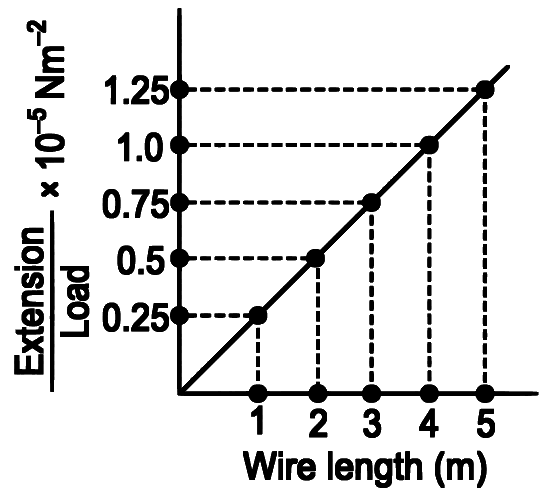
In an experiment to determine the Young's modulus, steel wires of five different lengths (1,2,3,4, and 5 m) but of same cross section (2 mm2) were taken and curves between extension and load were obtained. The slope (extension/load) of the curves were plotted with the wire length and the following graph is obtained. If the Young's modulus of given steel wires is x×1011 Nm−2, then the value of x is __________.
Numerical answer type. Work it out, then open the answer.
In an experiment to determine the Young's modulus of wire of a length exactly 1 m, the extension in the length of the wire is measured as 0.4 mm with an uncertainty of ±0.02 mm when a load of 1 kg is applied. The diameter of the wire is measured as 0.4 mm with an uncertainty of ±0.01 mm. The error in the measurement of Young's modulus (ΔY) is found to be x×1010 Nm−2. The value of x is _________________. (take g=10 ms−2)
Numerical answer type. Work it out, then open the answer.
Two wires of same length and radius are joined end to end and loaded. The Young's moduli of the materials of the two wires are Y1 and Y2. The combination behaves as a single wire then its Young's modulus is:
A uniform heavy rod of weight 10 kg ms−2, cross-sectional area 100 cm2 and length 20 cm is hanging from a fixed support. Young modulus of the material of the rod is 2 × 10¹¹ Nm−2. Neglecting the lateral contraction, find the elongation of rod due to its own weight.
The value of tension in a long thin metal wire has been changed from T1 to T2. The lengths of the metal wire at two different values of tension T1 and T2 are l1 and l2 respectively. The actual length of the metal wire is:
An object of mass m is suspended at the end of a massless wire of length L and area of crosssection A. Young modulus of the material of the wire is Y. If the mass is pulled down slightly its frequency of oscillation along the vertical direction is:
In an experiment, brass and steel wires of length 1 m each with areas of cross section 1mm2 are used. The wires are connected in series and one end of the combined wire is connected to a rigid support and other end is subjected to elongation. The stress required to produce a net elongation of 0.2 mm is, [Given, the Young's Modulus for steel and brass are, respectively, 120 × 109 N/m2 and 60 × 109 N/m2]
A load of mass M kg is suspended from a steel wire of length 2m and radius 1.0 mm in Searle's apparatus experiment. The increase in length produced in the wire is 4.0 mm. Now the load is fully immersed in a liquid of relative density 2. The relative density of the material of load is 8. The new value of increase in length of the steel wire is:
A uniformly tapering conical wire is made from a material of Young’s modulus Y and has a normal, unextended length L. The radii, at the upper and lower ends of this conical wire, have values R and 3 R, respectively. The upper end of the wire is fixed to a rigid support and a mass M is suspended from its lower end. The equilibrium extended length, of this wire, would equal:
A thin 1 m long rod has a radius of 5 mm. A force of 50 πkN is applied at one end to determine its Young’s modulus. Assume that the force is exactly known. If the least count in the measurement of all lengths is 0.01 mm, which of the following statements is false?
If the ratio of diameters, lengths and Young's modulus of steel and copper wires shown in the figure are p, q and s respectively, then the corresponding ratio of increase in their lengths would be
A copper wire of length 1.0 m and a steel wire of length 0.5 m having equal cross-sectional areas are joined end to end. The composite wire is stretched by a certain load which stretches the copper wire by 1 mm. If the Young's moduli of copper and steel are respectively 1.0×10¹¹ Nm −2 and 2.0×10¹¹ Nm−2, the total extension of the composite wire is:
If the ratio of lengths, radii and Young's moduli of steel and brass wires in the figure are a, b and c respectively, then the corresponding ratio of increase in their lengths is:
A wire elongates by l mm when a LOAD W is hanged from it. If the wire goes over a pulley and two weights W each are hung at the two ends, the elongation of the wire will be (in mm)
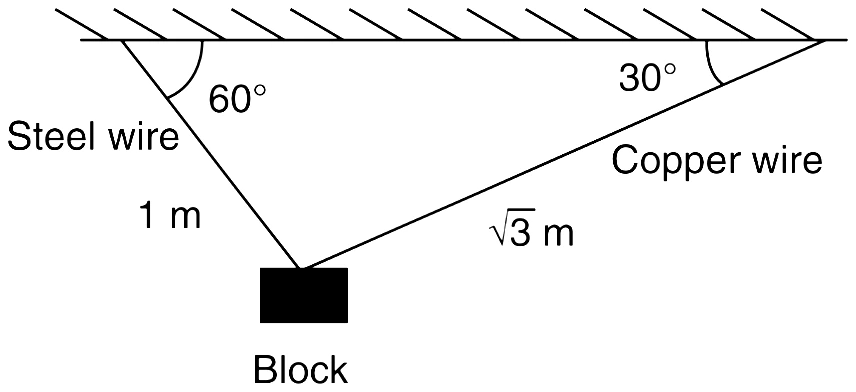
A block of weight 100N is suspended by copper and steel wires of same cross-sectional area 0.5cm2 and length 3m and 1m, respectively. Their other ends are fixed on a ceiling as shown in figure. The angles subtended by copper and steel wires with ceiling are 30∘ and 60∘, respectively. If elongation in copper wire is (Δlc) and elongation in steel wire is (Δls), then the ratio ΔlsΔlc is ............ [Young's modulus for copper and steel are 1×10¹¹N/m2 and 2×10¹¹N/m2 respectively.]
Numerical answer type. Work it out, then open the answer.
One end of a horizontal thick copper wire of length 2L and radius 2R is welded to an end of another horizontal thin copper wire of length L and radius R. When the arrangement is stretched by applying forces at two ends, the ratio of the elongation in the thin wire to that in the thick wire is
If the ratio of lengths, radii and Young's modulus of steel and brass wires shown in the figure are a, b and c respectively, the ratio between the increase in lengths of steel and brass wires would be
A wire of cross-section A is stretched horizontally between two clamps located 2l metre apart. A weight wkg is suspended from the mid-point of the wire. If the mid-point sags vertically through a distance x<1, the strain produced is
A copper wire of length 2.2m and a steel wire of length 1.6m, both of diameter 3.0mm are connected end to end. When stretched by a force, the elongation in length 0.50mm is produced in the copper wire. The stretching force is (YCu=1.1×10¹¹N/m2, Ysteel=2.0×10¹¹N/m2)
If the ratio of lengths, radii and Young's modulus of steel and brass wires shown in the figure are a, b and c respectively, the ratio between the increase in lengths of steel and brass wires would be
A light rod of length 1m is suspended from the ceiling horizontally by means of two vertical wires of equal length tied to its ends. One of the wires is made of material X and is of cross-section 0.1cm2 and the other of material Y of cross-section 0.3cm2. A weight is hung from the rod at a point to produce equal strain in the wires. The ratio of Young's moduli of wires A to B is 3:1. The location of the point from one end of the wire is
If the ratio of lengths, radii and Young's moduli of steel and brass wires in the figure are a, b and c respectively, then the corresponding ratio of increase in their lengths would be
As shown in the figure, a light uniform rod PQ of length 150cm is suspended from the ceiling horizontally using two metal wires A and B tied to the ends of the rod. The ratios of the radii and the Young's moduli of the materials of the two wires A and B are respectively 2:3 and 3:2. The position at which a weight should be suspended from the rod such that the elongations of the two wires become equal is
Two wires A and B of same cross-section are connected end to end. When same tension is created in both wires, the elongation in B wire is twice the elongation in A wire. If LA and LB are the initial lengths of the wires A and B respectively, then (Young's modulus of material of wire A=2×10¹¹N m−2 and Young's modulus of material of wire B=1.1×10¹¹N m−2).
A steel wire of length 3m and a copper wire of length 2.2m are connected end to end. When the combination is stretched by a force, the net elongation is 1.05mm. If the area of cross-section of each wire is 6mm2, then the load applied is (Young's moduli of steel and copper are respectively 2×10¹¹N m−2 and 1.1×10¹¹N m−2)
Two metal wires A and B have length L and 3L respectively. The radius of cross-sectional circular area of wire A and B are R and 2R, respectively. These wires are joined end to end along their axis. When one end of the combined system is fixed and other end is pulled with a constant force F, the elongation in both the wires is equal. If YA and YB are Young's modulus of wire A and B, then the YB/YA is
A steel and a brass wire, each of length 50cm and cross-sectional area 0.005cm2 hang from a ceiling and are 15cm apart. Lower ends of the wires are attached to a light horizontal bar. A suitable downward load is applied to the bar, so that each of the wires extends in length by 0.1cm. At what distance from the steel wire, the load must be applied? [Young's modulus of steel =2×10¹²dyne cm−2 and that of brass =1×10¹²dyne cm−2]
A copper wire of length LCu, Young's modulus YCu, and diameter d is hung from the ceiling. An aluminium wire of length LAl, Young's modulus YAl, and of the same diameter d is joined end-to-end at the free end of the copper wire. If under the action of a load applied at the free end of the aluminium wire the net elongation is ΔL, the applied load is
Both the ends of a massless wire of length 2L and radius r are fixed to rigid supports such that the wire stays straight horizontally without any tension. A mass m is attached to the center of the wire and the center point is found to be lowered by distance l under the weight. Choose the correct statement(s).
More than one option can be correct. Tap every correct option, then tap Check.
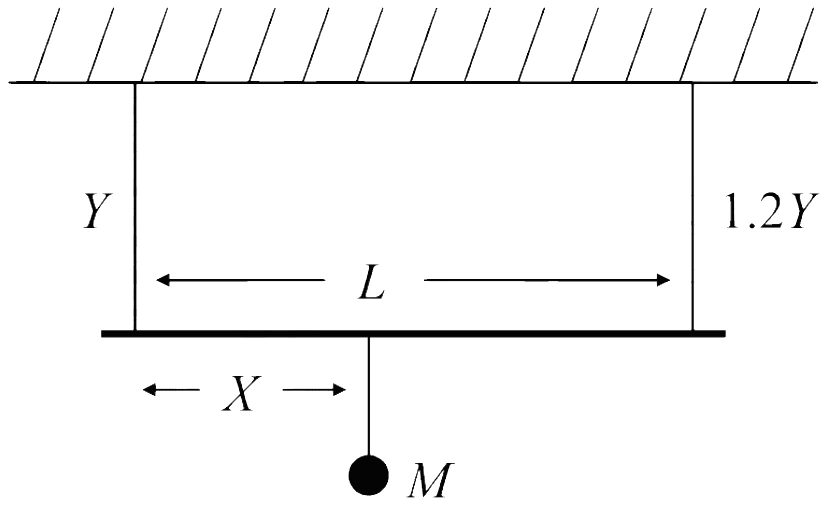
A massless rod of length L is hanging from a horizontal ceiling with help of two wires, of equal length and diameter, attached to the ends of the rod. The Young's modulus of the first wire is Y and the second wire is 1.2Y. A mass M is attached to the rod at a distance X from the first wire. If the stretching of the two wires is equal then X/L is