A cylindrical block of mass M and area of cross section A is floating in a liquid of density ρ and with its axis vertical. When depressed a little and released the block starts oscillating. The period of oscillation is ______
A small sphere oscillates simple harmonically in a watch glass whose radius of curvature is 1.6 m. The period of Oscillation of the sphere is (Acceleration due to gravity g=10 m/s2)
A wooden cube (density d) of side L floats on a liquid of density ρ with its upper and lower surfaces horizontal. If the cube is pushed slightly down and released, it performs S.H.M. of period T. The value of T is (g = acceleration due to gravity)
A rectangular block of mass 'm' and cross-sectional area 'A' floats on a liquid of density 'ϱ'. It is given a small vertical displacement from equilibrium, it starts oscillating with frequency (g=acceleration due to gravity)
A cylindrical cork of uniform density floats in a liquid of density ρ1. If the cork is depressed slightly and released, it oscillates harmonically with time period T. If the same cork floats in another liquid of density ρ2, then the similar oscillation has time period 2T. The value of ρ2/ρ1 is:
A small sphere oscillates simple harmonically in a watch glass whose radius of curvature is 1.6 m. The period of oscillation of the sphere is (acceleration due to gravity g=10 m/s2)
A light hollow cube of side length 10 cm and mass 10 g, is floating in water. It is pushed down and released to execute simple harmonic oscillations. The time period of oscillations is yπ×10−2 s, where the value of y is (Acceleration due to gravity, g=10 m/s2, density of water =103 kg/m3)
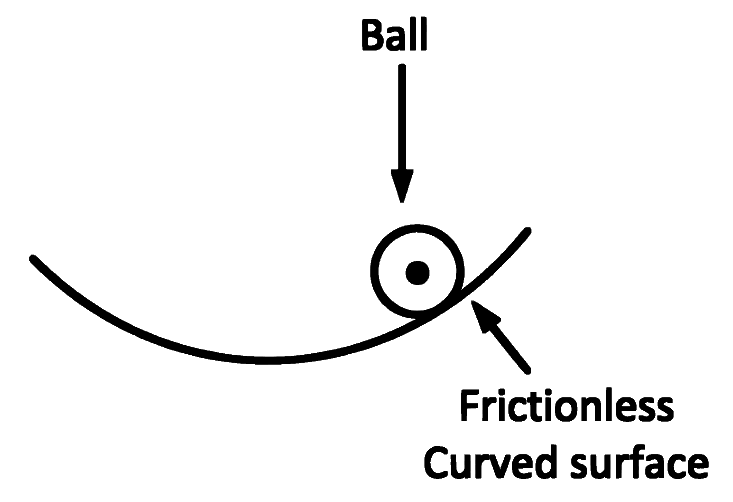
A small spherical ball of radius ' r ' is rolling on a curved surface which is frictionless and has a radius of curvature ' R '. Its motion is simple harmonic. Then its time period of oscillation is proportional to ( g= acceleration due to gravity)
A small sphere oscillates simple harmonically in a watch glass whose radius of curvature is 1.6 m. The period of oscillation of the sphere in second is (acceleration due to gravity, g=10 m/s2)
A piece of wood has length, breadth and height, ' a ', ' b ' and ' c ' respectively. Its relative density, is ' d '. It is floating in water such that the side ' a ' is vertical. It is pushed down a little and released. The time period of S.H.M. executed by it is (g= acceleration due to gravity)
A tube of uniform bore of cross-sectional area ' A ' has been set up vertically with open end facing up. Now ' M ' gram of a liquid of density ' d ' is poured into it. The column of liquid in this tube will oscillate with a period ' T ', which is equal to [ g= acceleration due to gravity]
Assume that a tunnel is dug along a chord of the earth, at a perpendicular distance (R/2) from the earth's centre, where 'R' is the radius of the Earth. The wall of the tunnel is frictionless. If a particle is released in this tunnel, it will execute a simple harmonic motion with a time period:
A cylindrical plastic bottle of negligible mass is filled with 310 ml of water and left floating in a pond with still water. If pressed downward slightly and released, it starts performing simple harmonic motion at angular frequency ω. If the radius of the bottle is 2.5 cm then ω is close to – (density of water = 103 kg/m3).
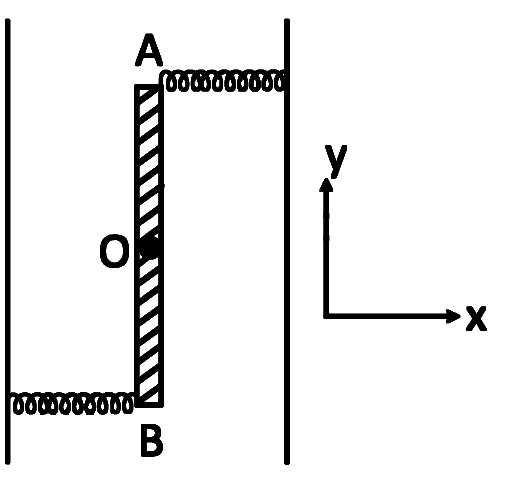
Two light identical springs of spring constant k are attached horizontally at the two ends of a uniform horizontal rod AB of length ℓ and mass m. The rod is pivoted at its centre 'O' and can rotate freely in horizontal plane. The other ends of the two springs are fixed to rigid supports as shown in figure. The rod is gently pushed through a small angle and released. The frequency of resulting oscillation is:
A rod of mass 'M' and length '2L' is suspended at its middle by a wire. It exhibits torsional oscillations; If two masses each of 'm' are attached at distance 'L/2' from its centre on both sides, it reduces the oscillation frequency by 20%. The value of ratio m/M is close to:
A cylindrical block of wood (density = 650 kg m−3), of base area 30 cm2 and height 54 cm, floats in a liquid of density 900 kg m−3. The block is depressed slightly and then released. The time period of the resulting oscillations of the block would be equal to that of a simple pendulum of length (nearly):
A pendulum made of a uniform wire of cross sectional area A has time period T. When an additional mass M is added to its bob, the time period changes to TM. If the Young's modulus of the material of the wire is Y then Y1 is equal to:
A uniform cylinder of length L and mass M having cross-sectional area A is suspended, with its length vertical, from a fixed point by a massless spring, such that it is half submerged in a liquid of density σ at equilibrium position. When the cylinder is given a downward push and released, it starts oscillating vertically with a small amplitude. The time period T of the oscillations of the cylinder will be:
An ideal gas enclosed in a vertical cylindrical container supports a freely moving piston of mass M. The piston and the cylinder have equal cross sectional area A. When the piston is in equilibrium, the volume of the gas is V0 and its pressure is P0. The piston is slightly displaced from the equilibrium position and released. Assuming that the system is completely isolated from its surrounding, the piston executes a simple harmonic motion with frequency
A rectangular block of mass m and area of cross-section A floats in a liquid of density ρ. If it is given a small vertical displacement from equilibrium it undergoes with a time period T, then
A tank contains two immiscible liquids of densities 6ρ and 2ρ. The higher density liquid is filled up to a height L/2 from the bottom. A thin rod of density ρ and length L is fully immersed and hinged at the bottom so that it can oscillate freely, as shown in the figure. If the rod is slightly disturbed from its equilibrium, the time period of small oscillations is n2πgL, where g is the acceleration due to gravity. The value of n is:
Numerical answer type. Work it out, then open the answer.
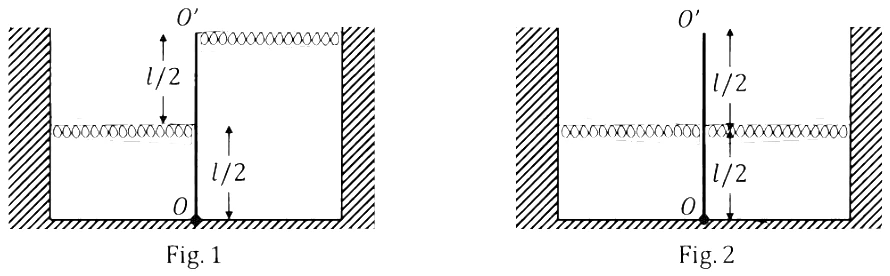
As shown in the figures, a uniform rod OO′ of length l is hinged at the point O and held in place vertically between two walls using two massless springs of same spring constant. The springs are connected at the midpoint and at the top-end (O′) of the rod, as shown in Fig. 1 and the rod is made to oscillate by a small angular displacement. The frequency of oscillation of the rod is f1. On the other hand, if both the springs are connected at the midpoint of the rod, as shown in Fig. 2 and the rod is made to oscillate by a small angular displacement, then the frequency of oscillation is f2. Ignoring gravity and assuming motion only in the plane of the diagram, the value of f2f1 is:
A particle of mass 1kg is subjected to a force which depends on the position as F=−k(xi^+yj^)kg m s−2 with k=1kg s−2. At time t=0, the particle's position r=(21i^+2j^)m and its velocity v=(−2i^+2j^+π2k^)m s−1. Let vx and vy denote the x and the y components of the velocity of the particle, respectively. Ignore gravity. When z=0.5m, the value of (xvy−yvx) is ______ m2s−1.
Numerical answer type. Work it out, then open the answer.
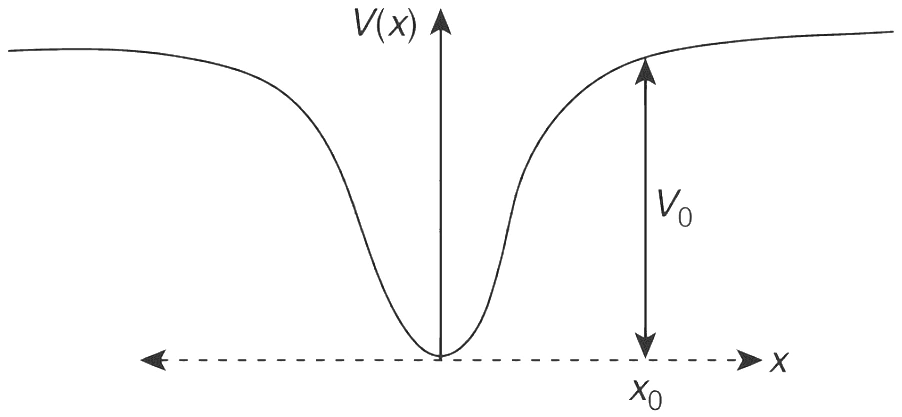
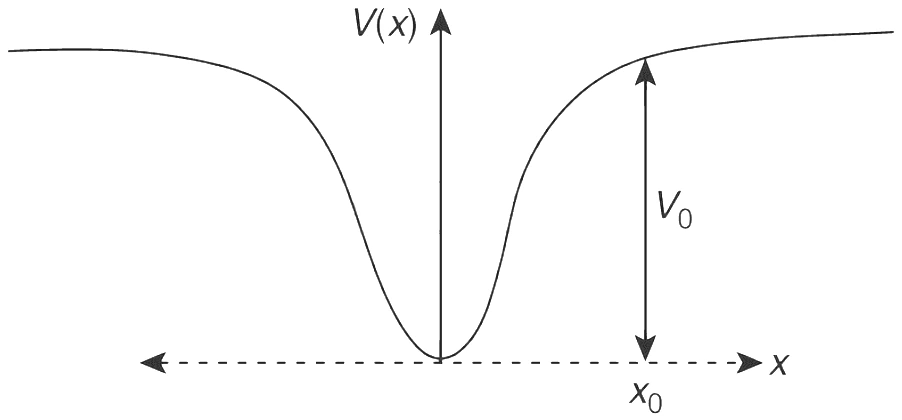
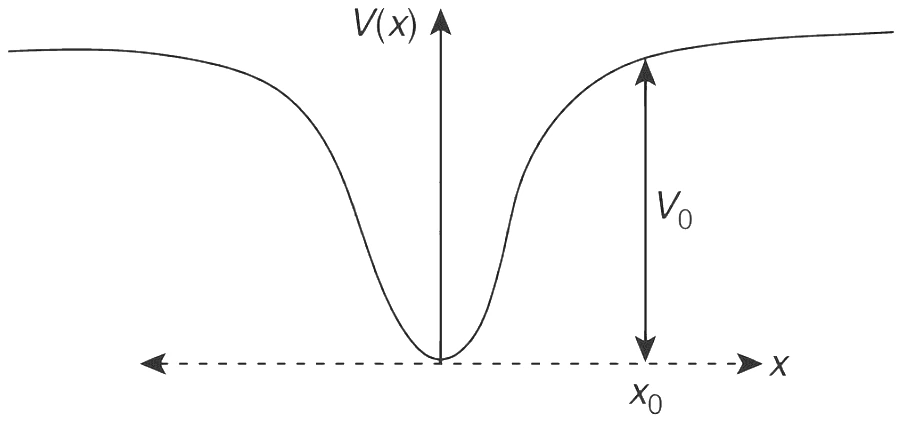
When a particle of mass m moves on the x-axis in a potential of the form V(x)=kx2, it performs simple harmonic motion. The corresponding time period is proportional to km, as can be seen easily using dimensional analysis. However, the motion of a particle can be periodic even when its potential energy increases on both sides of x=0 in a way different from kx2 and its total energy is such that the particle does not escape to infinity. Consider a particle of mass m moving on the x-axis. Its potential energy is V(x)=αx4 (α>0) for ∣x∣ near the origin and becomes a constant equal to V0 for ∣x∣≥X0 (see figure).
When a particle of mass m moves on the x-axis in a potential of the form V(x)=kx2, it performs simple harmonic motion. The corresponding time period is proportional to km, as can be seen easily using dimensional analysis. However, the motion of a particle can be periodic even when its potential energy increases on both sides of x=0 in a way different from kx2 and its total energy is such that the particle does not escape to infinity. Consider a particle of mass m moving on the x-axis. Its potential energy is V(x)=αx4 (α>0) for ∣x∣ near the origin and becomes a constant equal to V0 for ∣x∣≥X0 (see figure).
If the total energy of the particle is E, it will perform periodic motion only if
When a particle of mass m moves on the x-axis in a potential of the form V(x)=kx2, it performs simple harmonic motion. The corresponding time period is proportional to km, as can be seen easily using dimensional analysis. However, the motion of a particle can be periodic even when its potential energy increases on both sides of x=0 in a way different from kx2 and its total energy is such that the particle does not escape to infinity. Consider a particle of mass m moving on the x-axis. Its potential energy is V(x)=αx4 (α>0) for ∣x∣ near the origin and becomes a constant equal to V0 for ∣x∣≥X0 (see figure).
For periodic motion of small amplitude A, the time period T of this particle is proportional to
A uniform rod of length L and mass M is pivoted at the centre. Its two ends are attached to two springs of equal spring constants k. The springs are fixed to rigid supports as shown in the figure, and the rod is free to oscillate in the horizontal plane. The rod is gently pushed through a small angle θ in one direction and released. The frequency of oscillation is
A particle free to move along the x-axis has potential energy given by U(x)=k[1−exp(−x2)] for −∞≤x≤∞, where k is a positive constant of appropriate dimensions. Then
A block of rectangular size of mass m and area of cross-section A, floats in a liquid of density ρ. If we give a small vertical displacement from equilibrium, it undergoes SHM with time period T, then
A coin is placed on a horizontal platform which undergoes vertical simple harmonic motion of angular frequency ω. The amplitude of oscillation is gradually increased. The coin will leave contact with the platform for the first time
Assertion : Water in a U-tube executes SHM, the time period for mercury filled up to the same height in the U-tube be greater than that in case of water. Reason : The amplitude of an oscillating pendulum goes on increasing.
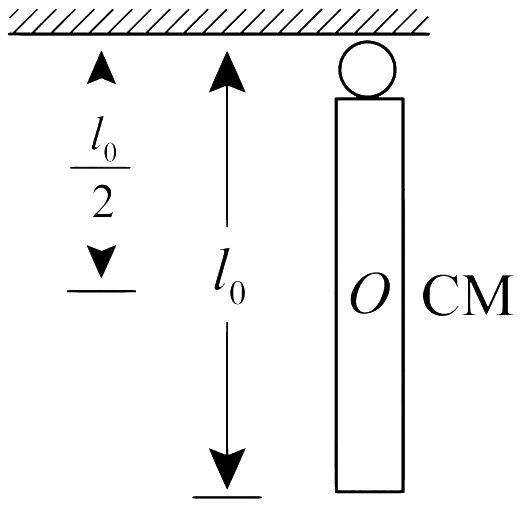
A uniform rod of mass m and length l0 is pivoted at one end and is hanging in the vertical direction. The period of small angular oscillations of the rod is
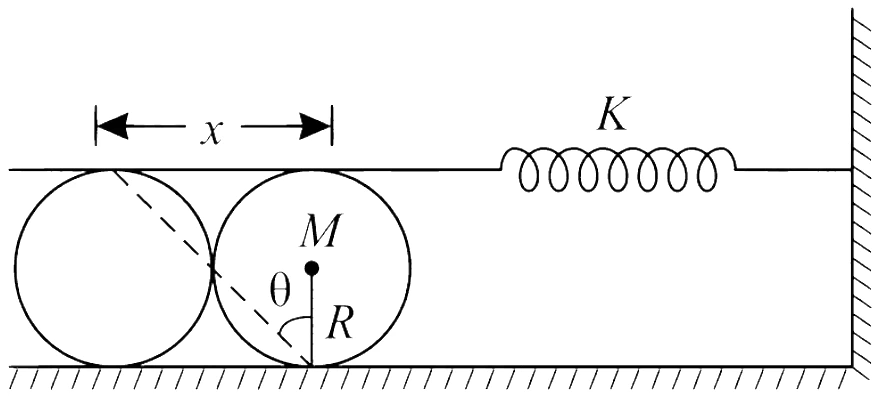
A solid cylinder is attached to a horizontal massless spring as shown in figure. If the cylinder rolls without slipping, the time period of oscillation of the cylinder is
A circular disc of mass 20kg, having radius 10cm is suspended by a wire attached to its centre. The wire is twisted by rotating the disc and released. The time period of torsional oscillations is found to be 1s. The torsional spring constant of the wire is
One bar magnet is in simple harmonic motion with time period T in the earth's magnetic field. If its mass is increased by 9 times, the time period becomes
A horizontal board is performing simple harmonic oscillations horizontally with an amplitude 0.3m and a period of 4s. The minimum coefficient of friction between a heavy body placed on the board and the board, if the body does not slip, will be
A test tube of mass 6g and uniform area of cross-section 10cm2 is floating in water vertically when 10g of mercury is in the bottom. The tube is depressed by a small amount and then released. The time period of oscillation is (acceleration due to gravity =10m s−2)
A hydrometer executes simple harmonic motion when it is pushed down vertically in a liquid of density ρ. If the mass of the hydrometer is m and the radius of the hydrometer tube is r, then the time period of oscillation is
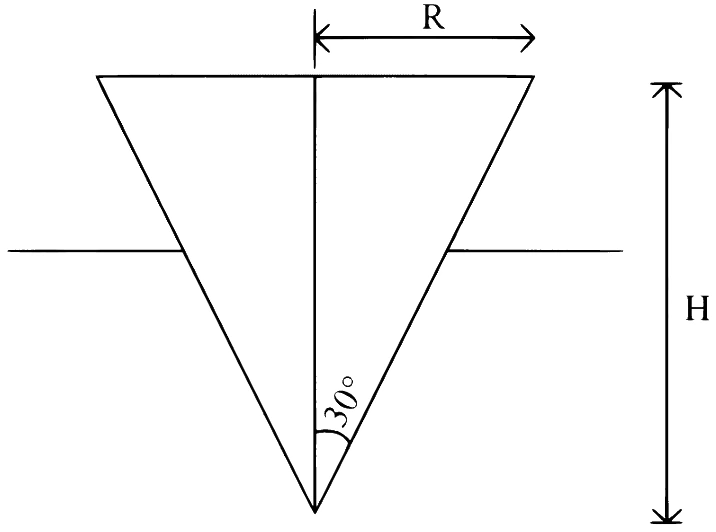
A cone with half the density of water is floating in water as shown in the figure. It is depressed down by a small distance δ(≪H) and released. The frequency of simple harmonic oscillations of the cone is
A circular disc of radius 15cm and mass 10kg is suspended by a wire attached to its centre. When the wire is twisted by rotating the disc and released, the period of torsional oscillations of the disc is 1.5s. The torsional spring constant of the wire is nearly
A uniform string of length L and mass M is fixed at both ends while it is subject to a tension T. It can vibrate at frequencies (ν) given by the formula (where n=1,2,3,…)
Consider a solid sphere of radius R floating in a pond with half of the sphere submerged. The sphere is pushed vertically downwards at the topmost point and released, such that it executes a simple harmonic motion. Acceleration due to gravity is g. What is the time period of oscillation?
A bead is constrained to move on a frictionless wire, placed in the x-y plane and under the influence of gravity. The shape of this wire is described by the equation y=axn, where x and y represent the horizontal and vertical coordinates respectively. The bead is released at a small distance away from the origin. The bead will oscillate around origin provided
A body of mass m is subjected to a position dependent force F=−k1x−k3x3, where k1 and k3 are positive constants. The motion is bounded with a maximum amplitude A. The motion is analysed by neglecting the cubic term. Then, the most appropriate condition to do this is
A point particle of mass M is oscillating inside a one-dimensional potential energy well of the form ϕ(x)=k∣x∣ where k is a positive constant. The particle was initially released from x=x0 with zero initial speed. Then, the time period of oscillation of the particle is
A particle of mass m moves under the influence of the potential V(x)=P/x2−Q/x. Here P, Q are real positive constants. The angular frequency of small oscillations of the particle around the equilibrium point is
A horizontal cylinder closed at one end contains an ideal gas which is compressed by a tight-fitting and frictionless piston. The piston is connected to the other closed end of the cylinder via a spring with spring constant k. The piston is of cross-sectional area A and mass M. In equilibrium, the chamber containing the gas has pressure P and length L while the spring is compressed by l. Let the piston be displaced by d(≪L) towards the vacuum region, and released. Choose the correct statement(s) regarding the oscillations of the piston by assuming all processes are isothermal.
More than one option can be correct. Tap every correct option, then tap Check.
A thin rod of mass 0.3kg and length 0.2m is suspended horizontally by a metal wire which passes through its centre of mass and is perpendicular to its length. The rod is set to torsional oscillation with a period of 2s. The thin rod is replaced by an equilateral triangular lamina which is suspended horizontally from its centre of mass. If its period of oscillations is found to be 10s, the moment of inertia of the triangular lamina about the axis of suspension is approximately