
Combination of Lenses
A thin convex lens and a thin concave lens are kept in contact and are co-axial. Which of the following statements is correct for this combination of two lenses?
Show answer and solution
Answer: (a)
Loading the solution…
Home›Practice Hub›Chapters›Ray Optics›Combination of Lenses
Ray Optics PYQs · MHT CET · JEE Main · NEET
Combination of Lenses
A thin convex lens and a thin concave lens are kept in contact and are co-axial. Which of the following statements is correct for this combination of two lenses?
Answer: (a)
Combination of Lenses
An equiconvex lens of focal length F is cut in to two equal parts along the vertical axis. The focal length of each part will be
Answer: (c)
Combination of Lenses
The combined focal length is when a convex lens of focal length and concave lens of focal length is combined. The combination of these lenses will behave like a concave lens, if
Answer: (a)
Combination of Lenses
A thin convex lens of focal length 5 cm and a thin concave lens of focal length 4 cm are combined together (without any gap) and this combination has magnification when an object is placed 10 cm before the convex lens. Keeping the positions of convex lens and object undisturbed a gap of 1 cm is introduced between the lenses by moving the concave lens away, which lead to a change in magnification of total lens system to . The value of is ______.
Answer: (b)
Combination of Lenses
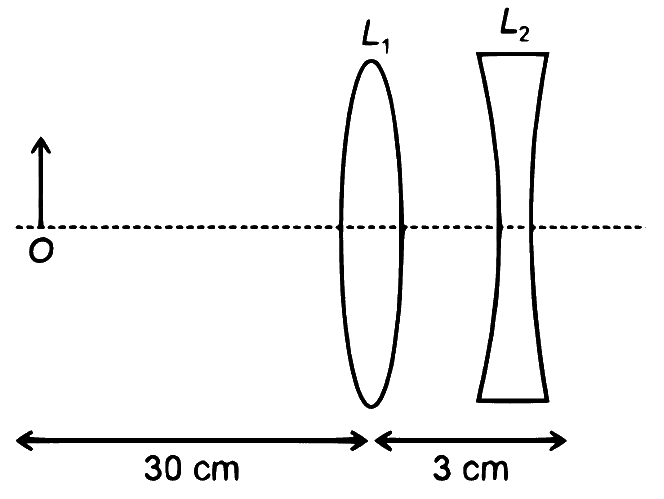
The lens combination as shown in the figure, consists of two lenses, and , of the focal lengths +10 cm and -10 cm, respectively. The position of the image formed is:
Answer: (c)
Combination of Lenses
An object is placed 15 cm on the left of a convex lens of focal length 10 cm. Another convex lens is now placed 15 cm right of lens . If the focal length of lens is 15 cm, the final image is ______.
Answer: (b)
Combination of Lenses
A collimated beam of light of diameter 2 mm is propagating along -axis. The beam is required to be expanded in a collimated beam of diameter 14 mm using a system of two convex lenses. If first lens has focal length 40 mm, then the focal length of second lens is ______ mm.
Numerical answer type. Work it out, then open the answer.
Answer: 280
Combination of Lenses
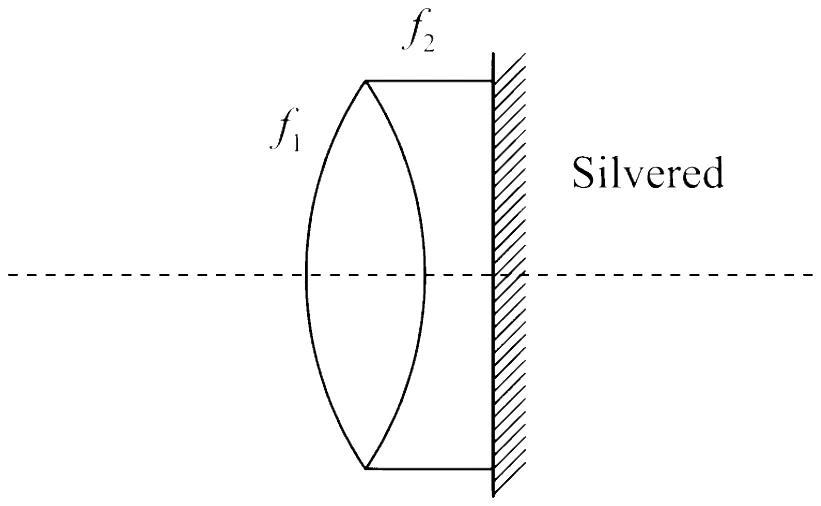
A thin biconvex lens is prepared from the glass both curved surfaces of which have equal radii of 20 cm each. Left side surface of the lens is silvered from outside to make it reflecting. To have the position of image and object at the same place, the object should be placed, from the lens at a distance of ______ cm.
Answer: (a)
Combination of Lenses
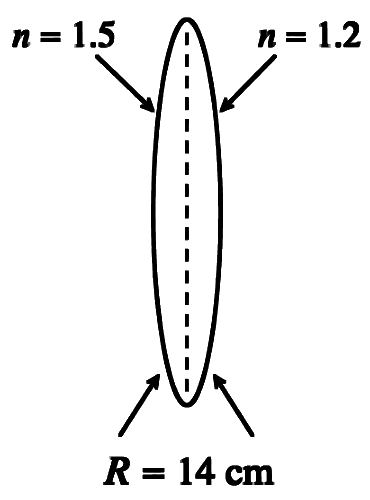
A bi-convex lens is formed with two thin plano-convex lenses as shown in the figure. Refractive index of the first lens is and that of second is . Both the curved surfaces are of the same radius of curvature cm. For an object distance of cm, the image distance will be
Answer: (d)
Combination of Lenses
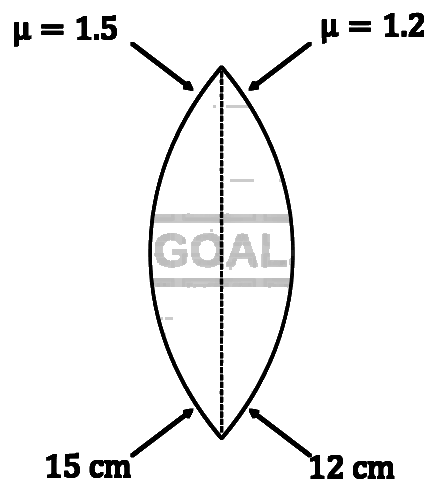
A biconvex lens is formed by using two thin planoconvex lenses, as shown in the figure. The refractive index and radius of curved surfaces are also mentioned in figure. When an object is placed on the left side of lens at a distance of 30 cm from the biconvex lens, the magnification of the image will be:
Answer: (a)
Combination of Lenses
In a certain camera, a combination of four similar thin convex lenses are arranged axially in contact. Then the power of the combination and the total magnification in comparison to the power ( ) and magnification ( ) for each lens will be, respectively
Answer: (a)
Combination of Lenses
Two thin convex lenses of focal lengths 30 cm and 10 cm are placed coaxially, 10 cm apart. The power of this combination is:
Answer: (d)
Combination of Lenses
Two thin lenses having as the radii of curved surfaces are kept coaxially together. Their power is proportional to
Answer: (d)
Combination of Lenses
A convex lens of focal length 30 cm is placed in contact with a concave lens of focal length 20 cm. An object is placed at 20 cm to the left of this lens system. The distance of the image from the lens in cm is ________.
Answer: (b)
Combination of Lenses
A thin plano convex lens made of glass of refractive index 1.5 is immersed in a liquid of refractive index 1.2. When the plane side of the lens is silver coated for complete reflection, the lens immersed in the liquid behaves like a concave mirror of focal length 0.2 m. The radius of curvature of the curved surface of the lens is
Answer: (b)
Combination of Lenses
Given is a thin convex lens of glass (refractive index ) and each side having radius of curvature . One side is polished for complete reflection. At what distance from the lens, an object be placed on the optic axis so that the image gets formed on the object itself?
Answer: (b)
Combination of Lenses
A plano convex lens fits exactly in to a plano concave lens. Their plane surfaces are parallel to each other. Lenses are made up of different materials of refractive indices ' ' ' ' and ' R ' is the radius of curvature of the curved surface of lenses. Focal length of the combination is
Answer: (d)
Combination of Lenses
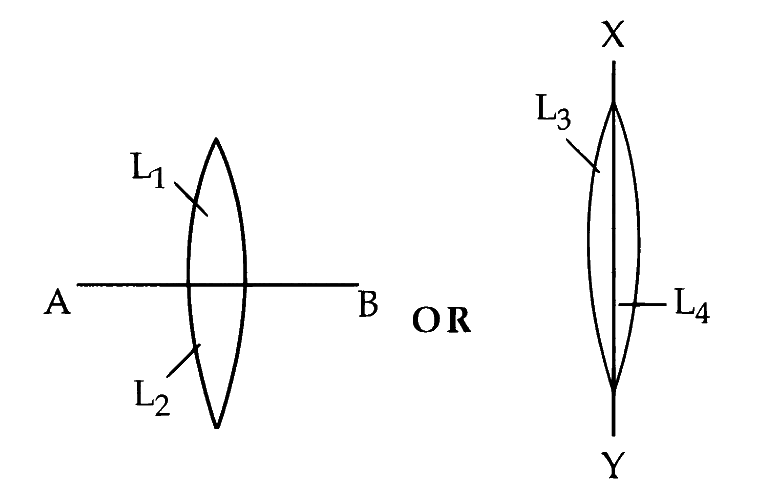
Two identical symmetric double convex lenses of focal length f are cut into two equal parts L1, L2 by AB plane and L3, L4 by XY plane as shown in figure respectively. The ratio of focal lengths of lenses L1 and L3 is
Answer: (a)
Combination of Lenses
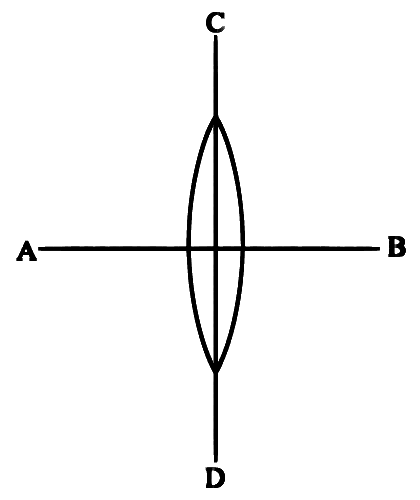
A symmetric thin biconvex lens is cut into four equal parts by two planes and as shown in figure. If the power of original lens is 4D then the power of a part of the divided lens is
Answer: (a)
Combination of Lenses
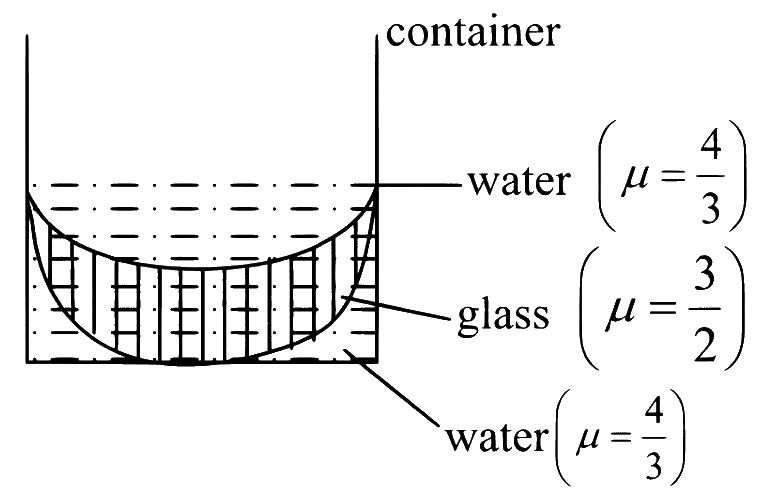
In the diagram given below, there are three lenses formed. Considering negligible thickness of each of them as compared to and , i.e., the radii of curvature for upper and lower surfaces of the glass lens, the power of the combination is
Answer: (a)
Combination of Lenses
A concave-convex lens of refractive index 1.5 and the radii of curvature of its surfaces are 30 cm and 20 cm, respectively. The concave surface is upwards and is filled with a liquid of refractive index 1.3. The focal length of the liquid-glass combination will be
Answer: (b)
Combination of Lenses
Given a thin convex lens (refractive index ), kept in a liquid (refractive index ) having radii of curvatures and . Its second surface is silver polished. Where should an object be placed on the optic axis so that a real and inverted image is formed at the same place?
Answer: (d)
Combination of Lenses
An optician makes spectacles having a combination of a convex lens of focal length 40 cm in contact with a concave lens of focal length 25 cm. The power of this combination of lenses in dioptre is
Answer: (b)
Combination of Lenses
A convex lens of focal length 40 cm is in contact with a concave lens of focal length 25 cm. The power of combination is
Answer: (a)
Combination of Lenses
The focal length of combination of lenses formed with lenses having power of +2.50 D and D will be
Answer: (d)
Combination of Lenses
An effective power of a combination of 5 identical convex lenses which are kept in contact along the principal axis is . Focal length of each of the convex lens is:
Answer: (b)
Combination of Lenses
Concave and convex lenses are placed touching each other. The ratio of magnitudes of their power is . The focal length of the system is 30 cm. The focal lengths of individual lens are
Answer: (b)
Combination of Lenses
Two thin lenses have a combined power of +9D. When they are separated by a distance of 20 cm, their equivalent power becomes . The power of both the lenses in dioptre are respectively
Answer: (b)
Combination of Lenses
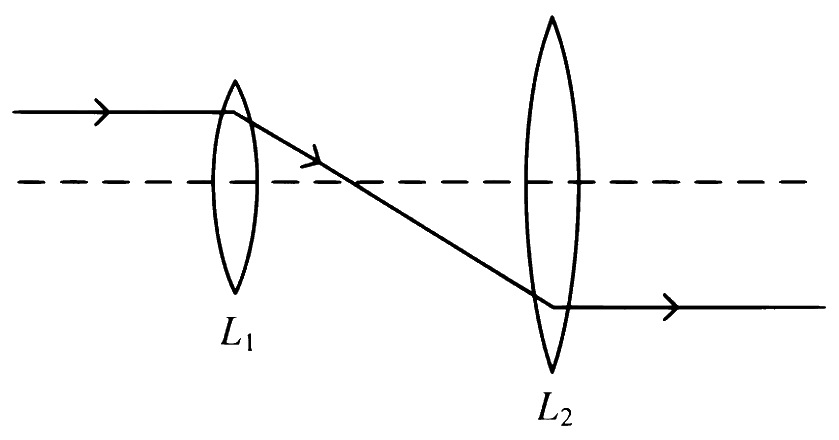
The following figure represents two biconvex lenses and having focal length and respectively. The distance between & is:
Answer: (a)
Combination of Lenses
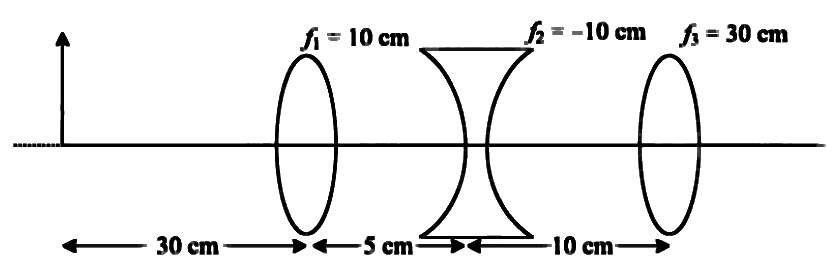
The position of the image formed by the combination of lenses is:
Answer: (b)
Combination of Lenses
Two lenses of power and are in contact with each other. The focal length of the combination is
Answer: (b)
Combination of Lenses
Two thin lenses are of same focal lengths , but one is convex and the other one is concave. When they are placed in contact with each other, the equivalent focal length of the combination will be:
Answer: (c)
Combination of Lenses
A double convex lens of focal length '' is cut into two equal parts along the vertical axis. The focal length of each part will be
Answer: (a)
Combination of Lenses
A bi convex lens of focal length is cut in two identical parts along a plane perpendicular to the principal axis. The power of each lens after cut is ____________ D.
Numerical answer type. Work it out, then open the answer.
Answer: 5
Combination of Lenses
A combination of two thin lenses in contact have power . The power reduces to when the lenses are apart. The power of individual lens is
Answer: (d)
Combination of Lenses
Two convex lenses of focal length each are placed coaxially with a separation of between them. The image of the distant object formed by the combination is at _____________ from the first lens.
Numerical answer type. Work it out, then open the answer.
Answer: 100
Combination of Lenses
A point object, 'O' is placed in front of two thin symmetrical coaxial convex lenses and with focal length and respectively. The distance between two lenses is and the object is placed away from lens as shown in the figure. The distance between the object and the image formed by the system of two lenses is __________ .
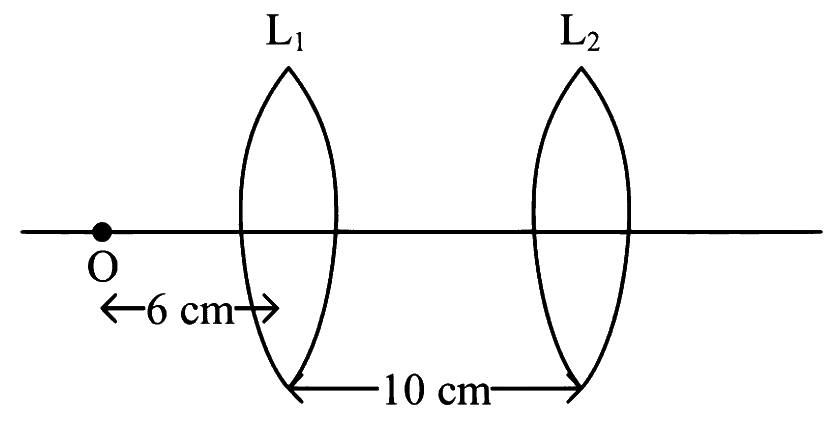
Numerical answer type. Work it out, then open the answer.
Answer: 34
Combination of Lenses
As shown in the figure, a combination of a thin plano concave lens and a thin plano convex lens is used to image an object placed at infinity. The radius of curvature of both the lenses is 30 cm and refraction index of the material for both the lenses is 1.75. Both the lenses are placed at distance of 40 cm from each other. Due to the combination, the image of the object is formed at distance _________ cm, from concave lens.
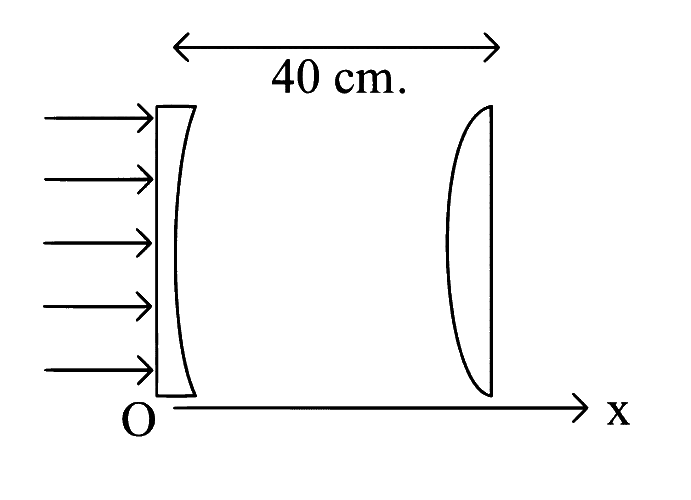
Numerical answer type. Work it out, then open the answer.
Answer: 120
Combination of Lenses
An object is placed on the principal axis of convex lens of focal length 10cm as shown. A plane mirror is placed on the other side of lens at a distance of 20 cm. The image produced by the plane mirror is 5cm inside the mirror. The distance of the object from the lens is ___________ cm.
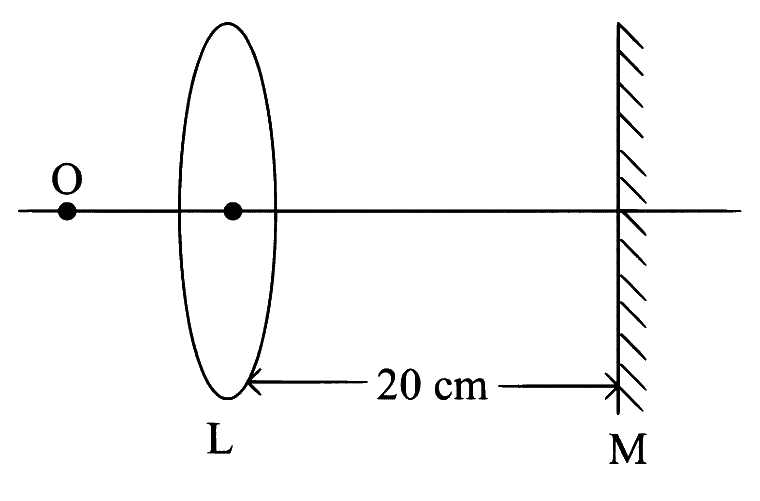
Numerical answer type. Work it out, then open the answer.
Answer: 30
Combination of Lenses
In the figure shown here, what is the equivalent focal length of the combination of lenses (Assume that all layers are thin)?
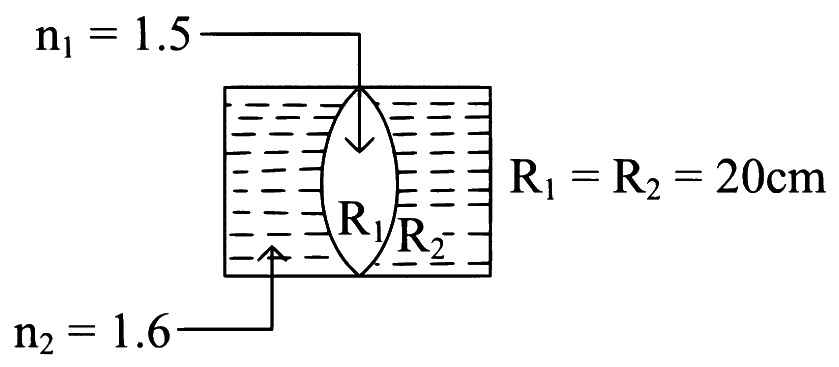
Answer: (b)
Combination of Lenses
A convex lens of focal length 20 cm is placed in front of a convex mirror with principal axis coinciding each other. The distance between the lens and mirror is 10 cm. A point object is placed on principal axis at a distance of 60 cm from the convex lens. The image formed by combination coincides the object itself. The focal length of the convex mirror is ____________ cm.
Numerical answer type. Work it out, then open the answer.
Answer: 10
Combination of Lenses
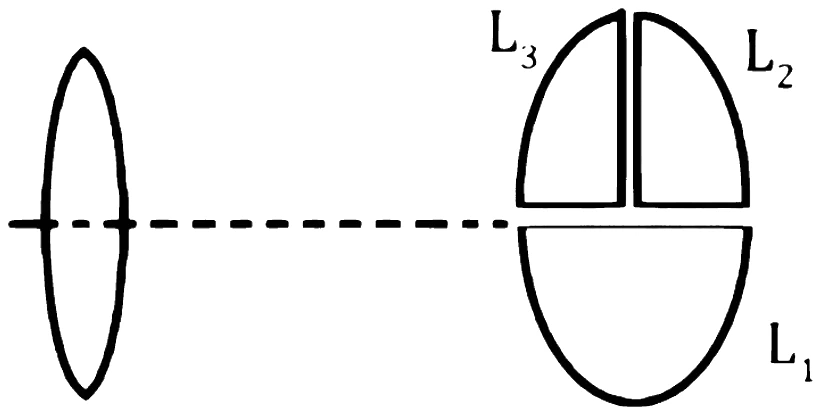
A convex lens has power P. It is cut into two halves along its principal axis. Further one piece (out of the two halves) is cut into two halves perpendicular to the principal axis (as shown in figures). Choose the incorrect option for the reported pieces.
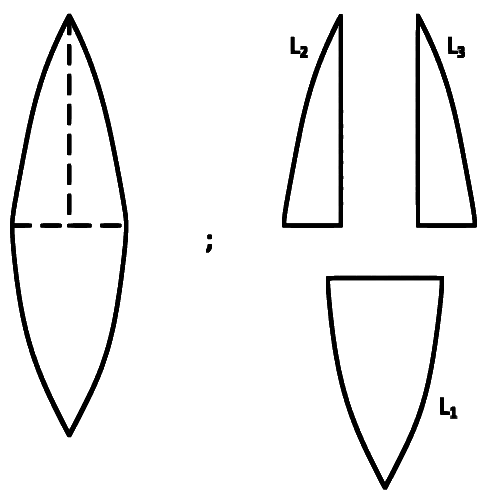
Answer: (a)
Combination of Lenses
Two identical thin biconvex lens of focal length 15 cm and refractive index 1.5 are in contact with each other. The space between the lenses is filled with a liquid of refractive index 1.25. The focal length of the combination is __________ cm.
Numerical answer type. Work it out, then open the answer.
Answer: 10
Combination of Lenses
A convex lens 'A' of focal length 20 cm and a concave lens 'B' of focal length 5 cm are kept along the same axis with a distance 'd' between them. If a parallel beam of light falling on 'A' leaves 'B' as a parallel beam, then the distance 'd' in cm will be:
Answer: (c)
Combination of Lenses
A point object is placed at a distance of 60 cm from a convex lens of focal length 30 cm. If a plane mirror were put perpendicular to the principal axis of the lens and at a distance of 40 cm from it, the final image would be formed at a distance of -
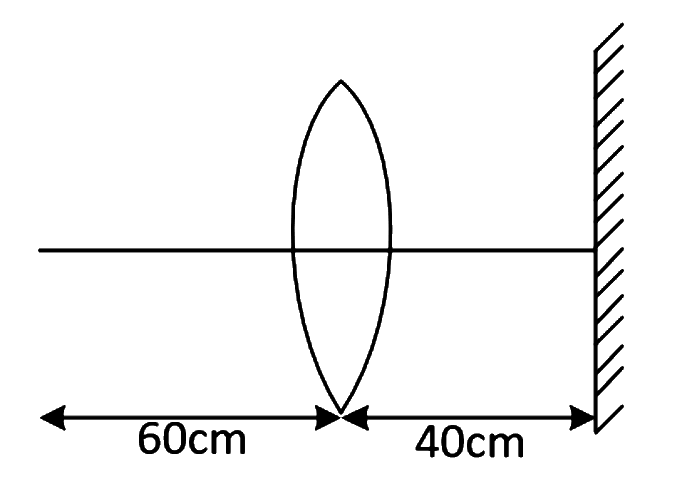
Answer: (a)
Combination of Lenses
A plano-convex lens of refractive index ( fits exactly into a plano-concave lens of refractive index . Their plane surface are parallel to each other. 'R' is the radius of curvature of the curved surface of the lenses. The focal length of the combination is
Answer: (a)
Combination of Lenses
Curved surfaces of a plano-convex lens of refractive index 1 and a plano-concave lens of refractive index 2 have equal radius of curvature as shown in figure. Find the ratio of radius of curvature to the focal length of the combined lenses.
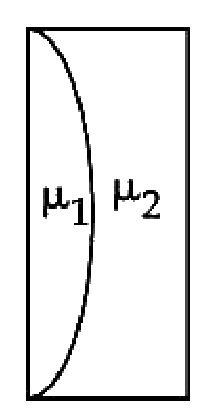
Answer: (b)
Combination of Lenses
Find the distance of the image from object O, formed by the combination of lenses in the figure:
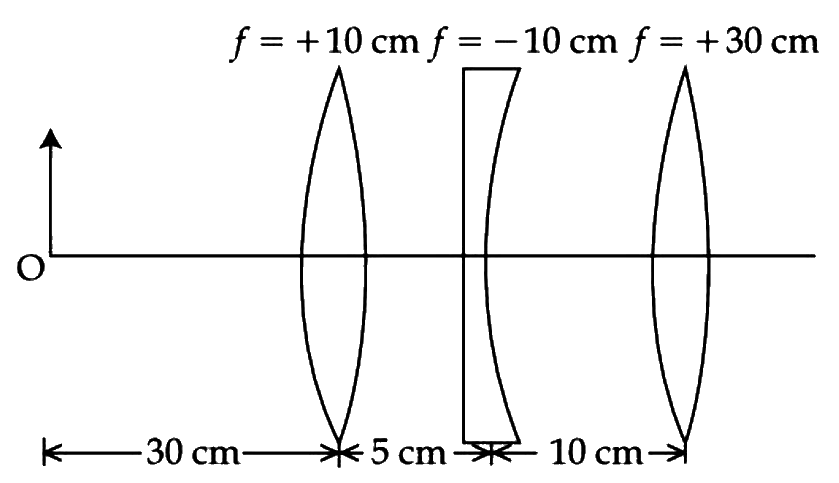
Answer: (a)
Combination of Lenses
An object is placed at a distance of 12 cm from a convex lens. A convex mirror of focal length 15 cm is placed on other side of lens at 8 cm as shown in the figure. Image of object coincides with the object.
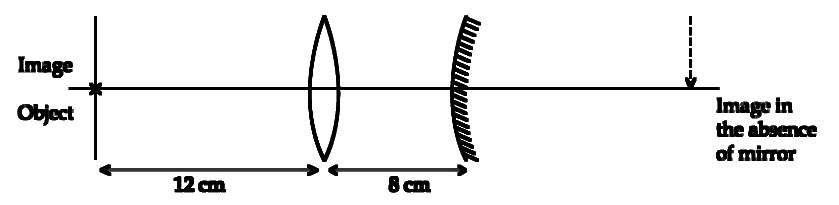
When the convex mirror is removed, a real and inverted image is formed at a position. The distance of the image from the object will be .............. (cm)
Numerical answer type. Work it out, then open the answer.
Answer: 50
Combination of Lenses
A point like object is placed at a distance of 1 m in front of a convex lens of focal length 0.5 m. A plane mirror is placed at a distance of 2 m behind the lens. The position and nature of the final image formed by the system is:
Answer: (a)
Combination of Lenses
A convex lens of focal length ' ' is placed in contact with a concave lens of the same focal length. The equivalent focal length of the combination is
Answer: (b)
Combination of Lenses
The equi-convex lens has a focal length ' '. If the lens is cut along the line perpendicular to the principal axis and passing through the pole, what will be the focal length of any half part?
Answer: (b)
Combination of Lenses
An equiconvex lens has power . It is cut into two symmetrical halves by a plane containing the principal axis. The power of one part will be,
Answer: (a)
Combination of Lenses
A plano convex lens of refractive index 1 and focal length ƒ1 is kept in contact with another plano concave lens of refractive index 2 and focal length ƒ2. If the radius of curvature of their spherical faces is R each and ƒ1 = 2ƒ2, then 1 and 2 are related as -
Answer: (c)
Combination of Lenses
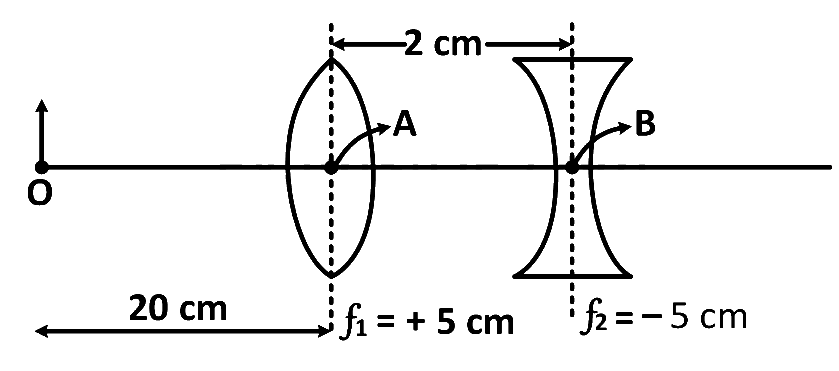
What is the position and nature of image formed by lens combination shown in figure? (f1, f2 are focal lengths)
Answer: (b)
Combination of Lenses
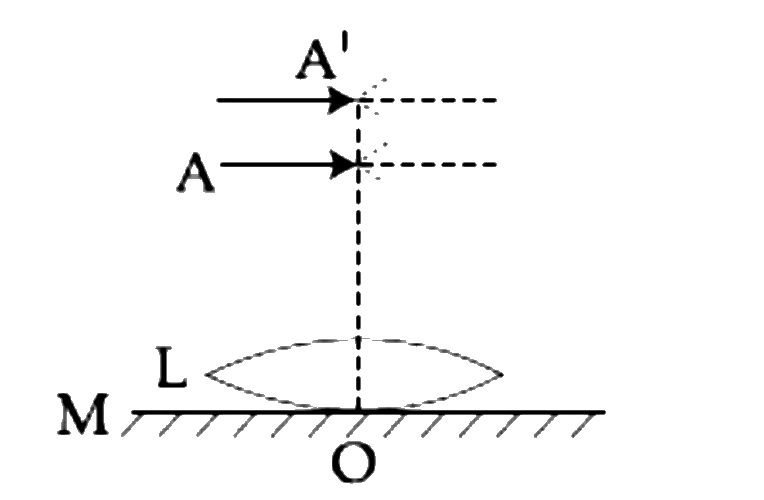
A thin convex lens L (refractive index = 1.5) is placed on a plane mirror M. When a pin is placed at A, such that OA = 18 cm, its real inverted image is formed at A itself, as shown in figure. When a liquid of refractive index μ1 is put between the lens and the mirror, The pin has to be moved to A', such that OA' = 27 cm, to get its inverted real image at A' itself. The value of μ1 will be :-
Answer: (d)
Combination of Lenses
Two similar thin equi-convex lenses, of focal length f each, are kept coaxially in contact with each other such that the focal length of the combination is F1. When the space between the two lenses is filled with glycerin (which has the same refractive index ( = 1.5) as that of glass) then the equivalent focal length is F2. The ratio F1: F2 will be:
Answer: (a)
Combination of Lenses
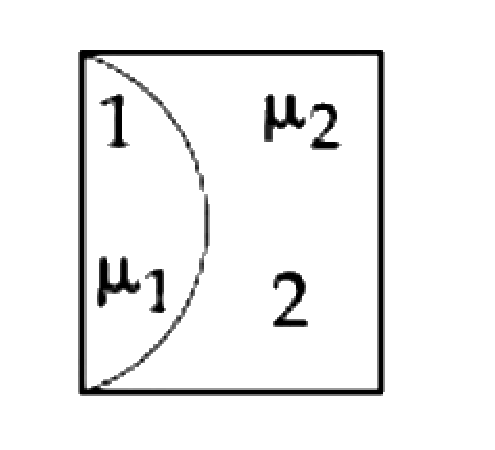
One plano-convex and one plano-concave lens of same radius of curvature 'R' but of different materials are joined side by side as shown in the figure. If the refractive index of the material of 1 is 1 and that of 2 is 2, then the focal length of the combination is:
Answer: (c)
Combination of Lenses
A plano-convex lens (focal length f2, refractive index 2, radius of curvature R) fits exactly into a plano-concave lens (focal length f1, refractive index 1, radius of curvature R). Their plane surfaces are parallel to each other. Then, the focal length of the combination will be:
Answer: (c)
Combination of Lenses
A concave mirror has radius of curvature of 40 cm. It is at the bottom of a glass that has water filled up to 5 cm (see figure). If a small particle is floating on the surface of water, its image as seen, from directly above the glass, is at a distance d from the surface of water. The value of d is close to: (Refractive index of water = 1.33)
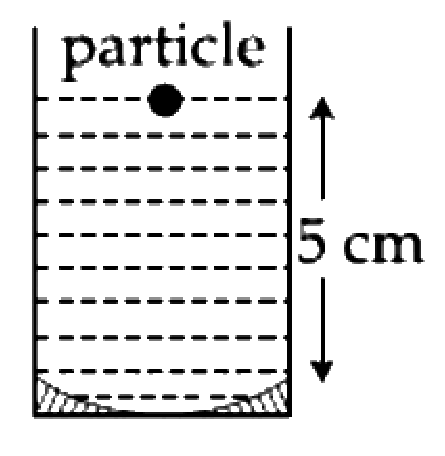
Answer: (d)
Combination of Lenses
A convex lens (of focal length 20 cm) and a concave mirror, having their principal axes along the same lines, are kept 80 cm apart from each other. The concave mirror is to the right of the convex lens. When an object is kept at a distance of 30 cm to the left of the convex lens, its image remains at the same position even if the concave mirror is removed. The maximum distance of the object for which this concave mirror, by itself would produce a virtual image would be :-
Answer: (b)
Combination of Lenses
An upright object is placed at a distance of 40 cm in front of a convergent lens of focal length 20 cm. A convergent mirror of focal length 10 cm is placed at a distance of 60 cm on the other side of the lens. The position and size of the final image will be:
Answer: (c)
Combination of Lenses
A convergent doublet of separated lenses, corrected for spherical aberration, has resultant focal length of 10 cm. The separation between the two lenses is cm. The focal lengths of the component lenses are:
Answer: (d)
Combination of Lenses
A planoconvex lens becomes an optical system of focal length when its plane surface is silvered and illuminated from left to right as shown in Fig-A.
If the same lens is instead silvered on the curved surface and illuminated from other side as in Fig- B, it acts like an optical system of focal length The refractive index of the material of lens is:
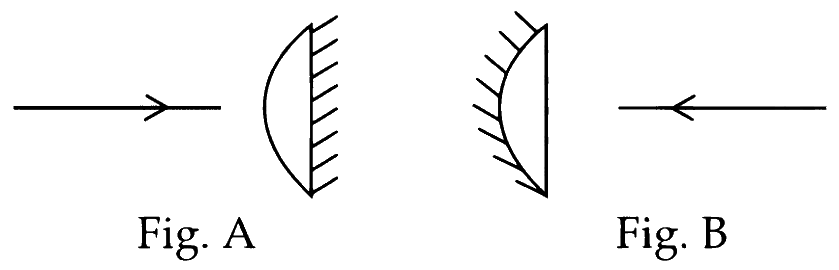
Answer: (b)
Combination of Lenses
A diverging lens with magnitude of focal length 25 cm is placed at a distance of 15cm from a converging lens of magnitude of focal length 20cm. A beam of parallel light falls on the diverging lens. The final image formed is:
Answer: (b)
Combination of Lenses
In an experiment a convex lens of focal length 15 cm is placed coaxially on an optical bench in front of a convex mirror at a distance of 5 cm from it. It is found that an object and its image coincide, if the object is placed at a distance of 20 cm from the lens. The focal length of the convex mirror is:
Answer: (a)
Combination of Lenses
To find the focal length of a convex mirror, a student records the following data:
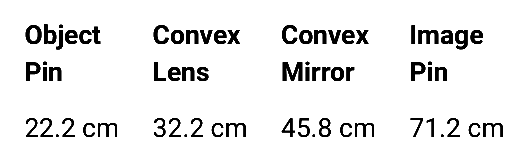
The focal length of the convex lens is f1 and that of mirror is f2. Then taking index correction to be negligibly small, f1 and f2 are close to:
Answer: (b)
Combination of Lenses
Two identical glass (g = 3/2) equiconvex lenses of focal length each are kept in contact. The space between the two lenses is filled with water . The focal length of the combination is
Answer: (d)
Combination of Lenses
A hemispherical glass body of radius 10 cm and refractive index 1.5 is silvered on its curved surface. A small air bubble is 6 cm below the flat surface inside it along the axis. The position of the image of the air bubble made by the mirror is seen:
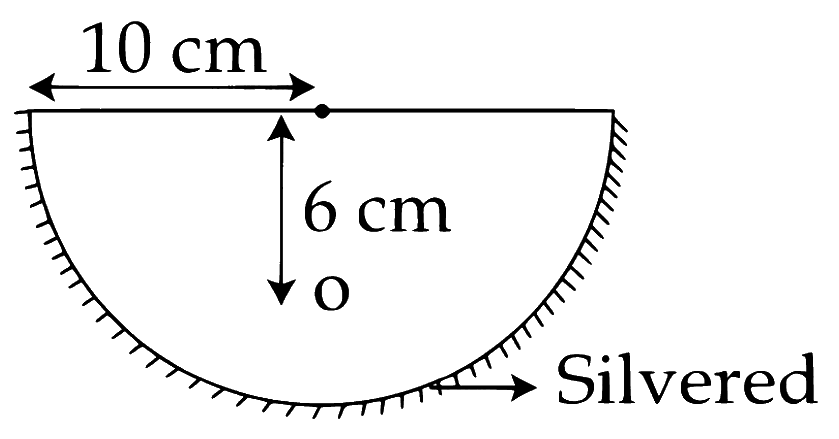
Answer: (c)
Combination of Lenses
A convex lens, of focal length 30 cm, a concave lens of focal length 120 cm, and aplane mirror are arranged as shown. For an object kept at a distance of 60 cm from the convex lens, the final image, formed by the combination, is a real image, at a distance of:
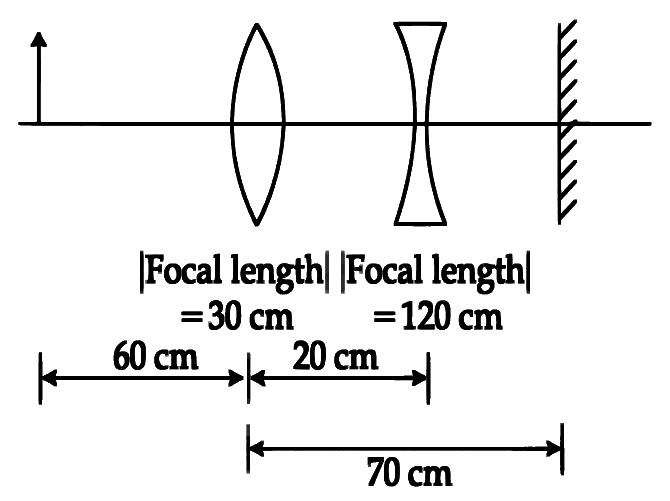
Answer: (a)
Combination of Lenses
Two identical thin plano-convex glass lenses (refractive index 1.5) each having radius of curvature of 20 cm are placed with their convex surfaces in contact at the centre. The intervening space is filled with oil of refractive index 1.7. The focal length of the combination is
Answer: (a)
Combination of Lenses
A thin convex lens of focal length 'f' is put on a plane mirror as shown in the figure. When an object is kept at a distance 'a' from the lens mirror combination, its image is formed at a distance in front of the combination. The value of 'a' is:
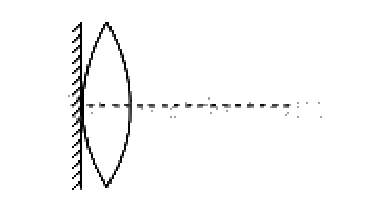
Answer: (b)
Combination of Lenses
A plano convex lens fits exactly into a plano concave lens. Their plane surfaces are parallel to each other. If lenses are made of different materials of refractive indices 1 and 2 and R is the radius of curvature of the curved surface of the lenses, then the focal length of the combination is
Answer: (a)
Combination of Lenses
A concave mirror of focal length 1 is placed at a distance of d from a convex lens of focal length 2. A beam of light coming from infinity and falling on this convex lens concave mirror combination returns to infinity. The distance d must equal
Answer: (c)
Combination of Lenses
Two thin lenses of focal lengths f1 and f2 are in contact and coaxial. The power of the combination is
Answer: (b)
Combination of Lenses
Two lenses of power and are in contact with each other. The focal length of the combination is
Answer: (c)
Combination of Lenses
A convex lens and a concave lens, each having same focal length of 25 cm, are put in contact to form a combination of lenses. The power in diopters of the combination is
Answer: (a)
Combination of Lenses
A plano convex lens of refractive index and radius of curvature is silvered at the curved surface. Now this lens has been used to form the image of an object. At what distance from this lens an object be placed in order to have a real image of size of the object
Answer: (c)
Combination of Lenses
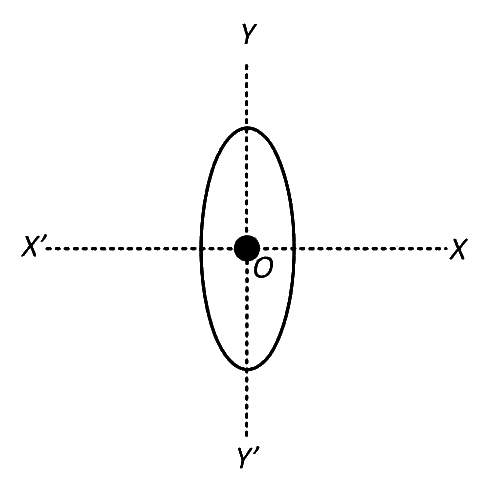
An equiconvex lens is cut into two halves along (i) XOX' and (ii) YOY' as shown in the figure. Let be the focal lengths of the complete lens, of each half in case (i), and of each half in case (ii), respectively.
Choose the correct statement from the following
Answer: (a)
Combination of Lenses
For a plano convex lens ( = 1.5) has radius of curvature 10 cm. It is silvered on its plane surface. Find focal length after silvering
Answer: (a)
Combination of Lenses
A luminous object is placed at a distance of from the convex lens of focal length . On the other side of the lens, at what distance from the lens, a convex mirror of radius of curvature , be placed in order to have an upright image of the object coincident with it?
Answer: (c)
Combination of Lenses
If a convex lens of focal length 80 cm and a concave lens of focal length 50 cm are combined together, what will be their resulting power?
Answer: (b)
Combination of Lenses
Which one among the following is the correct focal length of a combination of lenses of power and ?
Answer: (c)
Step-by-step solution coming soon.
Combination of Lenses
Two convex lenses have focal lengths of and , respectively. If these two lenses are placed in contact, then the net power of this combination will be equal to
Answer: (b)
Step-by-step solution coming soon.
Combination of Lenses
Two convex lenses with power dioptre are kept in contact with each other. The focal length of the combined lens system is
Answer: (d)
Step-by-step solution coming soon.
Combination of Lenses
Two thin convex lenses of focal lengths and are separated by a distance of in air. The combination will have the focal length
Answer: (a)
Step-by-step solution coming soon.
Combination of Lenses
An optical arrangement consists of two concave mirrors and , and a convex lens with a common principal axis, as shown in the figure. The focal length of is . The radii of curvature of and are and , respectively. The distance between and is . A point object is placed at the mid-point between and on the axis. When the distance between and is , one of the images coincides with . The value of is ______.
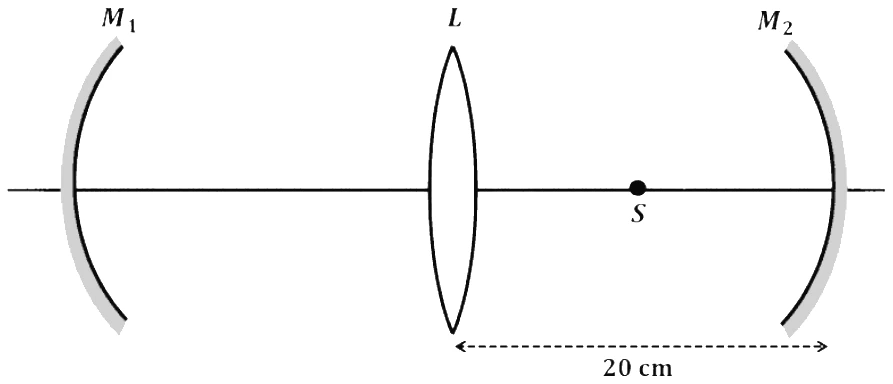
Numerical answer type. Work it out, then open the answer.
Answer: 80
Step-by-step solution coming soon.
Combination of Lenses
List I contains four combinations of two lenses (1 and 2) whose focal lengths (in ) are indicated in the figures. In all cases, the object is placed from the first lens on the left, and the distance between the two lenses is . List II contains the positions of the final images.
| List-I | List-II |
| (I) , | (P) Final image is formed at on the right side of lens 2. |
| (II) , | (Q) Final image is formed at on the right side of lens 2. |
| (III) , | (R) Final image is formed at on the left side of lens 2. |
| (IV) , | (S) Final image is formed at on the right side of lens 2. |
| (T) Final image is formed at on the right side of lens 2. |
Which one of the following options is correct?
Answer: (a)
Step-by-step solution coming soon.
Combination of Lenses
An extended object is placed at point O, in front of a convex lens and a concave lens is placed behind it, as shown in the figure. The radii of curvature of all the curved surfaces in both the lenses are . The refractive index of both the lenses is . The total magnification of this lens system is
Answer: (b)
Step-by-step solution coming soon.
Combination of Lenses
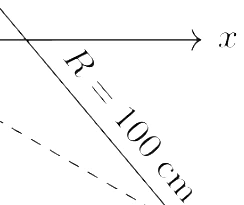
A small object is placed to the left of a thin convex lens of focal length . A convex spherical mirror of radius of curvature is placed to the right of the lens at a distance of . The mirror is tilted such that the axis of the mirror is at an angle to the axis of the lens, as shown in the figure.
If the origin of the coordinate system is taken to be at the centre of the lens, the coordinates (in ) of the point at which the image is formed are
Answer: (d)
Step-by-step solution coming soon.
Combination of Lenses
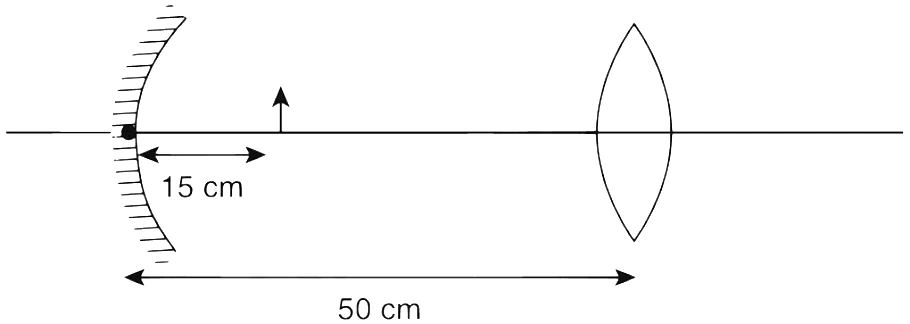
Consider a concave mirror and a convex lens (refractive index ) of focal length each, separated by a distance of in air (refractive index ) as shown in the figure. An object is placed at a distance of from the mirror. Its erect image formed by this combination has magnification . When the set-up is kept in a medium of refractive index , the magnification becomes . The magnitude is
Numerical answer type. Work it out, then open the answer.
Answer: 7
Step-by-step solution coming soon.
Combination of Lenses
Four combinations of two thin lenses are given in List I. The radius of curvature of all curved surfaces is and the refractive index of all the lenses is . Match lens combinations in List I with their focal length in List II and select the correct answer using the code given below the lists.
| List I | List II |
| P. two biconvex lenses in contact | 1. |
| Q. biconvex lens in contact with a plano-concave lens | 2. |
| R. plano-convex lens in contact with a biconcave lens | 3. |
| S. biconvex lens placed against a plano-concave lens | 4. |
Answer: (b)
Step-by-step solution coming soon.
Combination of Lenses
A biconvex lens of focal length is in front of a plane mirror. The distance between the lens and the mirror is . A small object is kept at a distance of from the lens. The final image is
Answer: (b)
Step-by-step solution coming soon.
Combination of Lenses
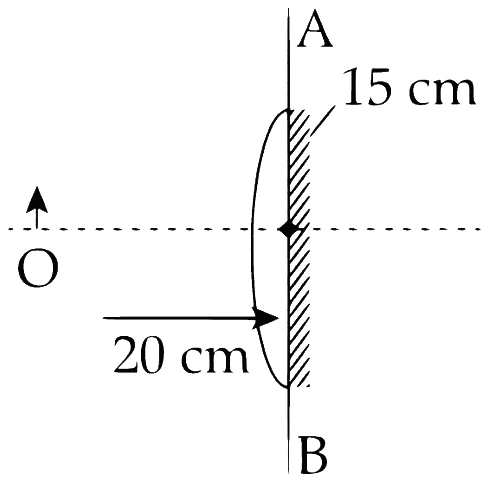
A point object is placed at a distance of from a thin plano-convex lens of focal length , if the plane surface is silvered. The image will form at
Answer: (c)
Step-by-step solution coming soon.
Combination of Lenses
A beam of parallel rays is brought to focus by a plano-convex lens. A thin concave lens of the same focal length is joined to the first lens. The effect of this is
Answer: (a)
Step-by-step solution coming soon.
Combination of Lenses
Assertion : A biconvex lens of focal length is split into two equal parts by a plane parallel to its principal axis. The focal length of the each part will be .
Reason : Focal length does not depend on the radii of curvature of two surfaces.
Answer: (d)
Step-by-step solution coming soon.
Combination of Lenses
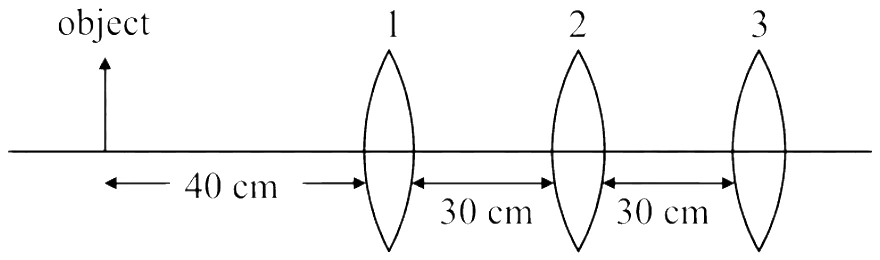
Find the position of final image from first lens. Given focal length of each lens is .
Answer: (b)
Step-by-step solution coming soon.
Combination of Lenses
The plane face of a plano convex lens is silvered. If be the refractive index and , the radius of curvature of curved surface, then system will behave like a concave mirror of curvature
Answer: (c)
Step-by-step solution coming soon.
Combination of Lenses
A luminous object is placed at a distance of from the convex lens of focal length . On the other side of the lens, at what distance from the lens a convex mirror of radius of curvature be placed in order to have an upright image of the object coincident with it
Answer: (c)
Step-by-step solution coming soon.
Combination of Lenses
A symmetric double convex lens is cut in two equal parts by a plane perpendicular to the principal axis. If the power of the original lens is , the power of a cut lens will be
Answer: (a)
Step-by-step solution coming soon.
Combination of Lenses
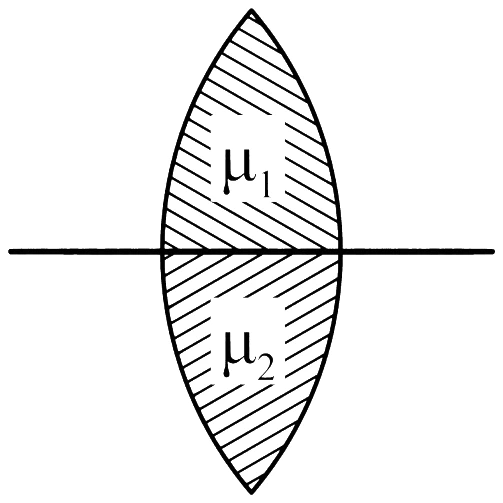
Which of the following is true for rays coming from infinity? The upper half of a biconvex lens has refractive index and the lower half has refractive index .
Answer: (a)
Step-by-step solution coming soon.
Combination of Lenses
If a convex lens of focal length and a concave lens of focal length are combined together, what will be their resultant power ?
Answer: (d)
Step-by-step solution coming soon.
Combination of Lenses
Two thin lenses of powers and respectively are placed in contact, the power, focal length and nature respectively will be
Answer: (d)
Step-by-step solution coming soon.
Combination of Lenses
A plano-convex lens of refractive index and radius of curvature of its curved surface as is silvered at its plane surface. The focal length of the equivalent mirror formed is
Answer: (b)
Step-by-step solution coming soon.
Combination of Lenses
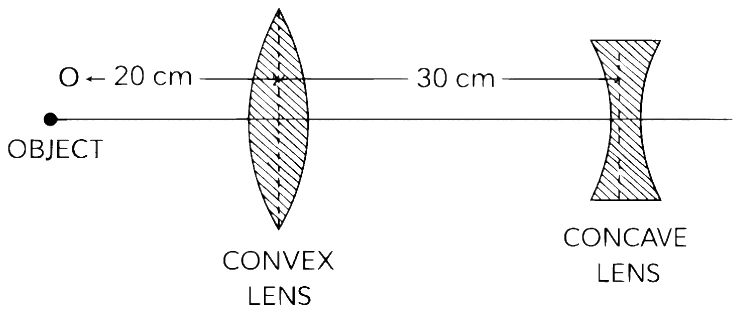
In given lens combination, each lens is of focal length .
Correct ray diagram for this combination is
Answer: (c)
Step-by-step solution coming soon.
Combination of Lenses
Power of biconvex lens is diopter. When it is cut into two symmetrical halves by a plane containing the principal axis. The ratio of power of two halves is
Answer: (d)
Step-by-step solution coming soon.
Combination of Lenses
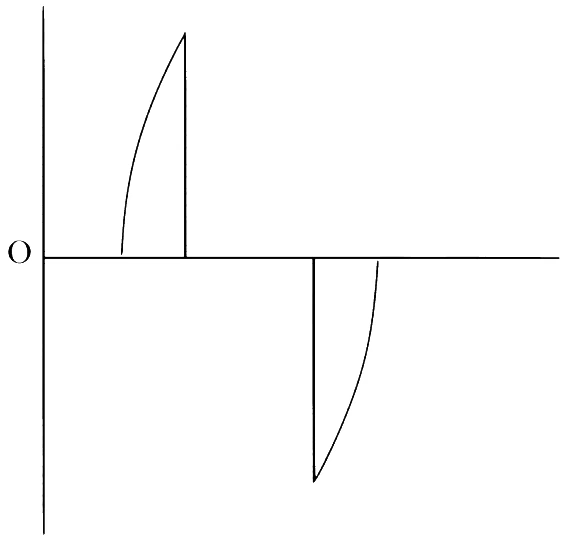
A thin plano-convex lens of focal length is split into two halves; one of the halves is shifted along the optical axis. The separation between object and image formed by one of the half-lenses is and the magnification of same lens is . If and be the focal length of the lens and separation between the two halves respectively then
Answer: (a)
Step-by-step solution coming soon.
Combination of Lenses
A spherical lens of power is placed at a distance of from another spherical lens of power . A beam of parallel light falls on the first spherical lens. The final image formed is
Answer: (a)
Step-by-step solution coming soon.
Combination of Lenses
Ratio of powers of a convex and concave lens is and their equivalent focal length (when lenses are kept in contact) is . Focal lengths of lenses are
Answer: (b)
Step-by-step solution coming soon.
Combination of Lenses
Two thin lenses are in contact and the focal length of the combination is . If the focal length of one lens is , then the power of the other lens will be
Answer: (d)
Step-by-step solution coming soon.
Combination of Lenses
Two lenses of focal length and are kept as shown. The resultant power of combination will be
Answer: (d)
Step-by-step solution coming soon.
Combination of Lenses
Two convex lenses of power and are separated by a distance . The power of optical system formed is
Answer: (d)
Step-by-step solution coming soon.
Combination of Lenses
A symmetric double convex lens is cut into two equal parts by a plane perpendicular to the principal axis. If the power of the original lens is , the difference between the powers of the original lens and the cut lens is
Answer: (d)
Step-by-step solution coming soon.
Combination of Lenses
A beam of incident parallel light falls on a diverging lens of focal length in magnitude. If a converging lens of focal length in magnitude is placed at a distance of to the right of the diverging lens on the other side, then, the final image formed is:
Answer: (c)
Step-by-step solution coming soon.
Combination of Lenses
A plano-convex lens made of refractive index and having radius of curvature fits exactly into a planoconcave lens made of refractive index and having the same radius of curvature such that their plane surfaces are parallel to each other. The focal length of the combination is :
Answer: (d)
Step-by-step solution coming soon.
Combination of Lenses
A beam of light parallel to the principal axis of a concave and convex lens, first passes through the concave lens of focal length and then through the convex lens of focal length . If the lenses are placed apart, which of the given statement is true?
Answer: (c)
Step-by-step solution coming soon.
Combination of Lenses
A lens of power is made in contact with another lens of power the combination will then act as a:
Answer: (a)
Step-by-step solution coming soon.
Combination of Lenses
Two converging lenses of focal length and are placed in contact. The effective power of the combination is
Answer: (d)
Step-by-step solution coming soon.
Combination of Lenses
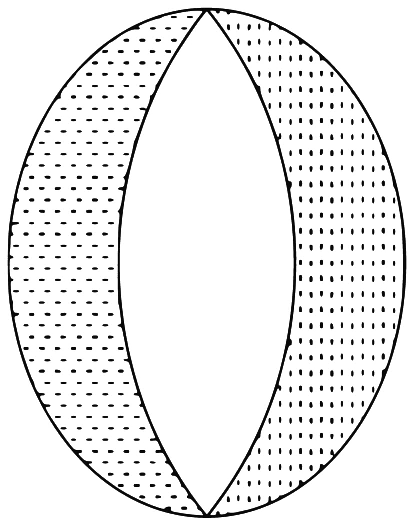
A convex lens is made of layers of glass of different materials as in the figure. A point object is placed on its axis. The number of images of the object are
Answer: (c)
Step-by-step solution coming soon.
Combination of Lenses
A convex lens has power . It is cut into two halves along its principal axis. Further one piece (out of two halves) is cut into two halves perpendicular to the principal axis as shown in figure. Choose the incorrect option for the reported lens pieces
Answer: (d)
Step-by-step solution coming soon.
Combination of Lenses
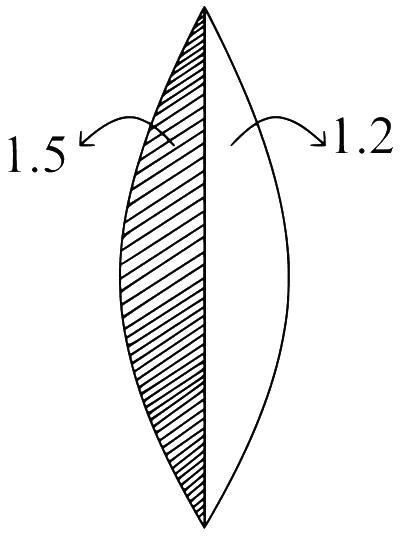
An equiconvex lens of radius of curvature is made up of two different materials. Left half and right half of vertical portion is made up of material of refractive index and respectively as shown in the figure. If a point object is placed at a distance of , calculate the image distance.
Answer: (d)
Step-by-step solution coming soon.
Combination of Lenses
Two thin biconvex lenses have focal lengths and . A third thin biconcave lens has focal length of . If the two biconvex lenses are in contact, then the total power of the lenses is . If the first convex lens is in contact with the third lens, then the total power is . If the second lens is in contact with the third lens, the total power is , then
Answer: (d)
Step-by-step solution coming soon.
Combination of Lenses
The size of the image of an object, which is at infinity, as formed by a convex lens of focal length is . If a concave lens of focal length is placed between the convex lens and the image at a distance of from the lens, the new size of the image is
Answer: (b)
Step-by-step solution coming soon.
Combination of Lenses
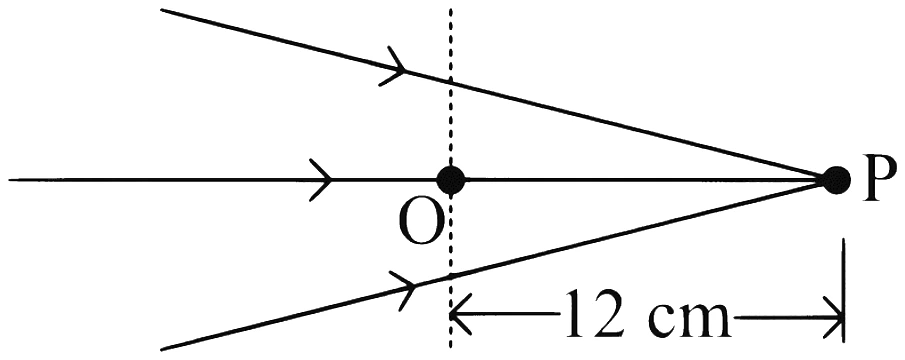
The following figure shows a beam of light converging at point . When a concave lens of focal length is introduced in the path of the beam at a place shown by dotted line such that becomes the axis of the lens, the beam converges at a distance from the lens. The value of will be equal to
Answer: (d)
Step-by-step solution coming soon.
Combination of Lenses
Convex lens of focal length and a concave lens of focal length of are separated by a distance of . Equivalent power of this arrangement is
Answer: (c)
Step-by-step solution coming soon.
Combination of Lenses
An object is placed at a distance of from a convex lens of focal length . On the other side of the lens, at its focus a convex mirror is placed such that final image formed coincides with the object. The focal length of convex mirror is
Answer: (b)
Step-by-step solution coming soon.
Combination of Lenses
Two thin convex lenses are kept in contact coaxially. If the focal length of the combination of the lenses is and sum of the focal lengths of the two lenses is , then the focal length of the lens of low power is
Answer: (d)
Step-by-step solution coming soon.
Combination of Lenses
For a combination of two convex lenses of focal lengths and to act as a glass slab, the distance of separation between them is
Answer: (a)
Step-by-step solution coming soon.
Combination of Lenses
Two convex lenses of focal lengths and are placed in contact with each other co-axially. The focal length of the combination is
Answer: (c)
Step-by-step solution coming soon.
Combination of Lenses
A convex lens and a concave lens, each with focal length of are separated by a distance of along their axis. An object is placed before the convex lens. The distance between the object and its image is
Answer: (c)
Step-by-step solution coming soon.
Combination of Lenses
A plano-convex lens fits exactly into a plano-concave lens. Their plane surfaces are parallel to each other. If lenses are made of different materials of refractive indices and and is the radius of curvature of the curved surface of the lenses, then the focal length of the combination is
Answer: (a)
Step-by-step solution coming soon.
Combination of Lenses
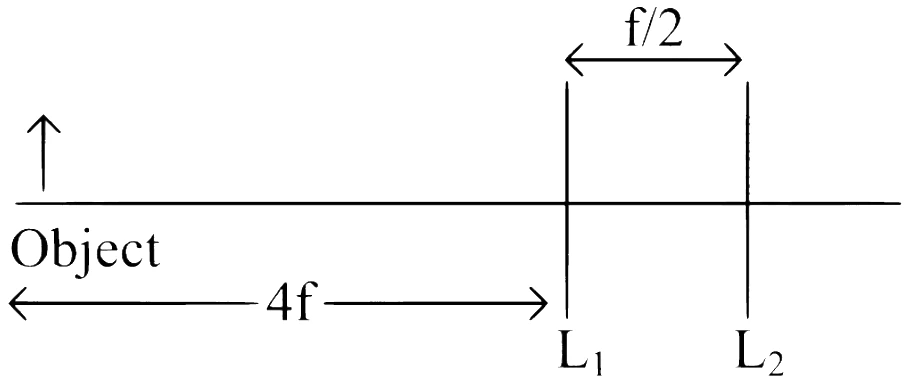
Two convex lenses ( and ) of equal focal length are placed at a distance apart. An object is placed at a distance to the left of as shown in figure. The final image is at
Answer: (a)
Step-by-step solution coming soon.
Combination of Lenses
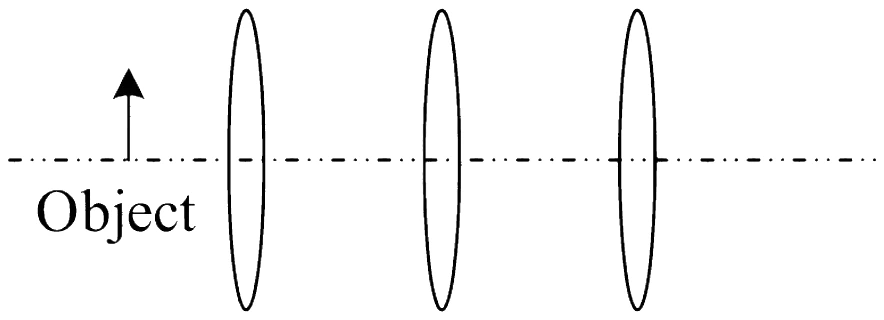
Three identical convex lenses each of focal length are placed in a straight line separated by a distance from each other. An object is located at in front of the leftmost lens. Then,
Answer: (a)
Step-by-step solution coming soon.
Combination of Lenses
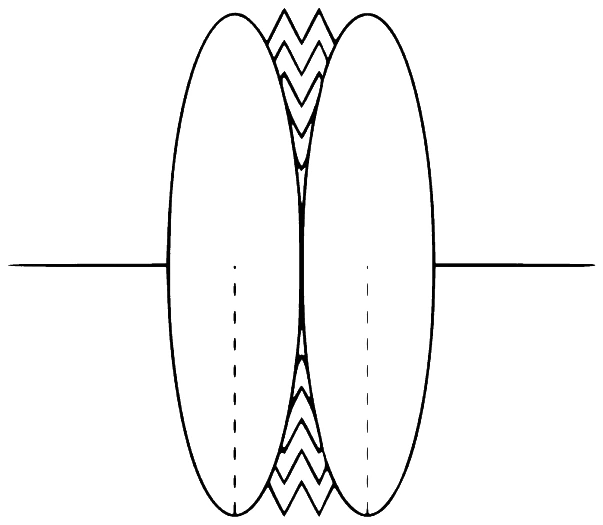
Two identical equiconvex lenses, each of focal length are placed side by side in contact with each other with a layer of water in between them as shown in the figure. If refractive index of the material of the lenses is greater than that of water, how the combined focal length is related to ?
Answer: (b)
Step-by-step solution coming soon.
Combination of Lenses
A point object is held above a thin equiconvex lens at its focus. The focal length is and the lens rests on a horizontal thin plane mirror. The final image will be formed at
Answer: (b)
Step-by-step solution coming soon.
Combination of Lenses
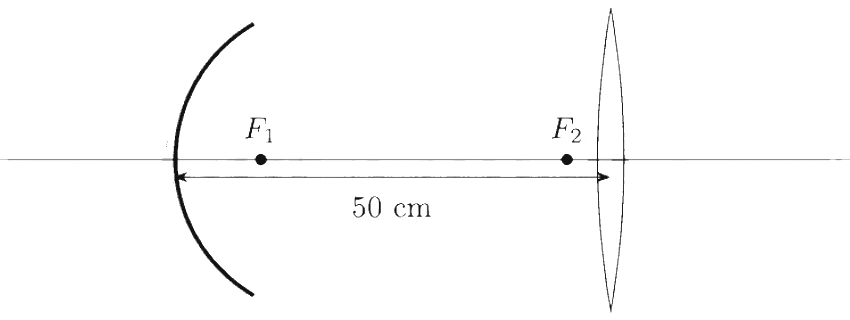
A spherical concave mirror of focal length and a double convex lens of focal length are arranged on the common principal axis as shown in the figure. A small object is placed on the principal axis between the focal points and of the mirror and the lens, respectively. If two real and mutually inverted images are formed by the lens at the same location on the principal axis, what is the distance of the object from the mirror on the principal axis?
Answer: (c)
Step-by-step solution coming soon.
Combination of Lenses
The power of a system of two thin lenses which share a common axis and are separated by a distance is given by . Consider two thin lenses with focal lengths and . There is an object in front of the first lens at a distance . A real image is created on the screen behind the second lens. If the image on the screen is of the same size regardless of the position of the object, the distance (in ) between the lenses is
Answer: (c)
Step-by-step solution coming soon.
Combination of Lenses
An object is placed at a distance of from a thin convex lens of focal length . A plane mirror is kept behind the convex lens. An observer viewing the object from front of the lens will see
Answer: (a)
Step-by-step solution coming soon.
No questions match these filters.