A simple microscope is used to see the object first in blue light and then in red light. Due to the change from blue to red light, what is the effect on its magnifying power?
A simple microscope is a combination of two lenses in contact. Their powers are +20D and −4D. The distance of distinct vision is 25 cm. When seen through the microscope, the size of the image of an object 3 mm high is
In a microscope of tube length 10 cm two convex lenses are arranged with focal length of 2 cm and 5 cm. Total magnification obtained with this system for normal adjustment is (5)k. The value of k is ______.
In a microscope the objective is having focal length fo=2 cm and eye-piece is having focal length fe=4 cm. The tube length is 32 cm. The magnification produced by this microscope for normal adjustment is ______.
Numerical answer type. Work it out, then open the answer.
A compound microscope is designed with two symmetric biconvex lenses. The objective lens is cut vertically, creating two identical plano-convex lenses. One of them is used in place of original objective lens. To retain same magnification keeping the object distance unchanged, the tube length has to be
The length of the compound microscope is 15 cm. The magnifying power for relaxed eye is 25. If the focal length of eye lens is 6 cm then the object distance for objective lens will be
A microscope has an objective of focal length 2 cm, eyepiece of focal length 4 cm and the tube length of 40 cm. If the distance of distinct vision of eye is 25 cm, the magnification in the microscope is
Focal length of objective of an astronomical telescope is 1.5 m. Under normal adjustment, length of telescope is 1.56 m. Focal length of the eyepiece is
A small telescope has an objective of focal length 140 cm and an eye piece of focal length 5.0 cm. The magnifying power of telescope for viewing a distant object is:
A person has been using spectacles of power −1.0 dioptre for distant vision and a separate reading glass of power 2.0 dioptres. What is the least distance of distinct vision for this person:
An astronomical refracting telescope is being used by an observer to observe planets in normal adjustment. The focal lengths of the objective and eye piece used in the construction of the telescope are 20 m and 2 cm respectively. Consider the following statements about the telescope: (a) The distance between the objective and eye piece is 20.02 m
(a) The magnification of the telescope is (−) 1000
(b) The image of the planet is erect and diminished
(c) The aperture of eye piece is smaller than that of objective The correct statements are:
In normal adjustment, for a refracting telescope, the distance between objective and eye piece is 30 cm. The focal length of the objective, when the angular magnification of the telescope is 2, will be:
A microscope was initially placed in air (refractive index 1). It is then immersed in oil (refractive index 2). For a light whose wavelength in air is λ, calculate the change of microscope's resolving power due to oil and choose the correct option.
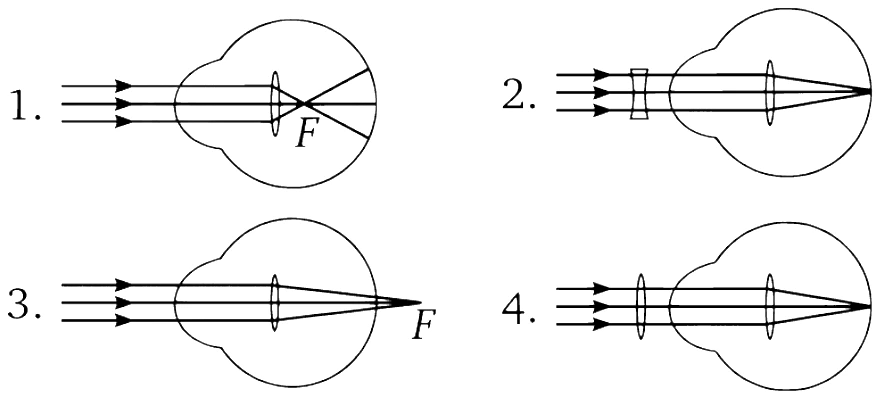
Your friend is having eye sight problem. She is not able to see clearly a distant uniform window mesh and it appears to her as non-uniform and distorted. The doctor diagnosed the problem as:
The magnifying power of a refracting type of astronomical telescope is 'm'. If focal length of eyepiece is doubled then the magnifying power will become
An object viewed from a near point distance of 25 cm, using a microscopic lens with magnification '6', gives an unresolved image. A resolved image is observed at infinite distance with a total magnification double the earlier using an eyepiece along with the given lens and a tube of length 0.6 m, if the focal length of the eyepiece is equal to __________ cm.
Numerical answer type. Work it out, then open the answer.
By increasing the aperture of the objective lens, wavelength of light, focal length of the objective lens and the resolving power of an astronomical telescope respectively
If we need a magnification of 375 from a compound microscope of tube length 150 mm and an objective of focal length 5 mm, the focal length of the eye-piece, should be close to:
In a compound microscope, the magnified virtual image is formed at a distance of 25 cm from the eye-piece. The focal length of its objective lens is 1 cm. If the magnification is 100 and the tube length of the microscope is 20 cm, then the focal length of the eye-piece lens (in cm) is __________.
Numerical answer type. Work it out, then open the answer.
There are four convex lenses L1,L2,L3 and L4 of focal length 2,4,6 and 8 cm, respectively. Two of these lenses from a telescope of length 10 cm and magnifying power 4. The objective and eye lenses are respectively
The magnifying power of a telescope is nine. When it is adjusted for parallel rays, the distance between the objective and eyepiece is 20 cm. The focal length of objective and eyepiece are respectively
A person can see clearly objects only when they lie between 50 cm and 400 cm from his eyes. In order to increase the maximum distance of distinct vision to infinity, the type and power of the correcting lens, the person has to use, will be
A astronomical telescope has objective and eyepiece of focal lengths 40 cm and 4 cm respectively. To view an object 200 cm away from the objective, the lenses must be separated by a distance
A telescope has an objective lens of focal length 150 cm and an eyepiece of focal length 5 cm. If a 50 m tall tower at a distance of 1 km is observed through this telescope in normal setting, the angle formed by the image of the tower is θ, then θ is close to:
In an astronomical telescope in normal adjustment a straight black line of length L is drawn on inside part of objective lens. The eye-piece forms a real image of this line. The length of this image is I. The magnification of the telescope is
In a compound microscope the focal length of objective lens is 1.2 cm and focal length of eye piece is 3.0 cm. When object is kept at 1.25 cm in front of objective, final image is formed at infinity. Magnifying power of the compound microscope should be:
The focal lengths of objective lens and eye lens of a Galilean Telescope are respectively 30 cm and 3.0 cm. Telescope produces virtual, erect image of an object situated far away from it at least distance of distinct vision from the eye lens. In this condition, the Magnifying Power of the Galilean Telescope should be:
This question has Statement-1 and Statement-2. Of the four choices given after the Statements, choose the one that best describes the two Statements.
Statement 1: Very large size telescopes are reflecting telescopes instead of refracting telescopes. Statement 2: It is easier to provide mechanical support to large size mirrors than large size lenses.
For a normal eye, the cornea of eye provides a converging power of 40 D and the least converging power of the eye lens behind the cornea is 20 D. Using this information, the distance between the retina and the cornea-eye lens can be estimated to be
The focal length of the objective and the eyepiece of a telescope are 50 cm and 5 cm respectively. If the telescope is focussed for distinct vision on a scale distant 2 m from its objective, then its magnifying power will be:
The magnifying power of a telescope is 9. When it is adjusted for parallel rays the distance between the objective and eyepiece is 20 cm. The focal length of lenses are
Diameter of human eye lens is 2 mm. What will be the minimum distance between two points to resolve them, which are situated at a distance of 50 meter from eye. The wavelength of light is 5000 A˚
Four lenses of focal length ±15 cm and ±150 cm are available for making a telescope. To produce the largest magnification, the focal length of the eyepiece should be
For a human eye, where u is the distance of an object from the eye, f is the focal length of the lens and v is the distance of image from the eye, which is the correct schematic graph?
Consider the following statements about a microscope and a telescope: 1. Both the eyepiece and the objective of a microscope are convex lenses. 2. The focal length of the objective of a telescope is larger than the focal length of its eyepiece. 3. The magnification of a telescope increases with the increase in focal length of its objective. 4. The magnification of a microscope increases with the increase in focal length of its objective. Which of the statements given above are correct?
In case of a compound microscope which of the following statements is / are correct? 1. The focal length of the eye piece is larger than the focal length of the objective 2. The focal length of the eye piece is smaller than the focal length of the objective 3. The image produced in a normal optical microscope is real 4. The image produced in a normal optical microscope is virtual Select the correct answer using the code given below:
Which one among the following is the major cause of blurring and unsharp images of objects observed through very large telescope at the extreme limit of magnification?
Statement I: A myopic person is advised to use concave lens. Statement II: The eye lens of a myopic person focuses the parallel rays coming from distant objects in front of the retina.
A simple telescope used to view distant objects has eyepiece and objective lens of focal lengths fe and fo, respectively. Match Column I with Column II:
A simple telescope, consisting of an objective of focal length 60cm and a single eye lens of focal length 5cm is focused on a distant object in such a way that parallel rays emerge from the eye lens. If the object subtends an angle of 2∘ at the objective, the angular width of the image is
A simple telescope, consisting of an objective of focal length 60cm and a single eye lens of focal length 5cm is focused on a distant object in such a way that parallel rays emerge from the eye lens. If the object makes an angle of 2∘ at the objective, then the angular width of the image is
The near point and far point of a person are 40cm and 250cm respectively. Determine the power of the lens he/she should use while reading a book kept at distance 25cm from the eye.
Assertion : A normal human eye can clearly see all the objects beyond a certain minimum distance. Reason : The human eye has the capacity to suitably adjust the focal length of its lens to a certain extent.
A telescope has an objective lens of focal length 200cm and an eye piece with focal length 2cm. If this telescope is used to see a 50m tall building at a distance of 2km, what is the height of the image of the building formed by the objective lens?
The magnification produced by an astronomical telescope for normal adjustment is 10 and the length of the telescope is 1.1m. The magnification, when the image is formed at least distance of distinct vision is
In a laboratory four convex lenses L1, L2, L3 and L4 of focal lengths 2,4,6 and 8cm, respectively are available. Two of these lenses form a telescope of length 10cm and magnifying power 4. The objective and eye lenses are respectively
If the focal length of a lens of a camera is 5f and that of another is 2.5f, what is the time of exposure for the second, if for the first one is 2001s ? (where f is focal length/unit aperture)
A person who can see things most clearly at a distance of 10cm, requires spectacles to enable to see clearly things at a distance of 30cm. What should be the focal length of the spectacles?
A student can distinctly see the object up to a distance 15cm. He wants to see the black board at a distance of 3m. Focal length and power of lens used respectively will be :
The magnifying power of a telescope is 9. When it is adjusted for parallel rays, the distance between the objective and eyepiece is 20cm. The ratio of focal length of objective lens to focal length of eyepiece is found to be m, then the value of m is
A compound microscope having magnifying power 35 with its eye-piece of focal length 10cm. Assume that the final image is at least distance of distinct vision then the magnification produced by the objective is
The distance between the objective and eye piece of astronomical telescope in normal adjustment is 27cm and its magnifying power is 8. What is the focal length of the eye piece?
An object is placed at an unknown distance from a convex objective lens of focal length 5cm. The objective lens forms a real image which acts as an object for a convex eyepiece of focal length 6.25cm. The distance between the objective and eyepiece is 20cm. The microscope is adjusted so that the final image is formed at the least distance of distinct vision (25cm). Which of the following is correct? A. Object distance =7.5cm; Total magnification =10 B. Object distance =10cm; Total magnification =20 C. Object distance =5cm; Total magnification =20 D. Object distance =2.5cm; Total magnification =10
In the normal adjustment of an astronomical telescope, the objective and eyepiece are 36cm apart. If the magnifying power of the telescope is 8, find the focal lengths of the objective and eyepiece.
The focal lengths of the objective and eyepiece of a compound microscope are 1cm and 10cm respectively. Length of the tube is 25cm. If the final image is formed at infinity, the magnifying power of the microscope is :
In the normal adjustment of an astronomical telescope, the objective and eyepiece are 32cm apart. If the magnifying power of the telescope is 7, find the focal lengths of the objective and eyepiece.
A person has a normal near point 25cm. What is the magnifying power of the simple microscope he used, if the focal length of the convex lens used is 10cm and the final image is formed at the least distance of distinct vision?
The magnifying power of a telescope is 9. When it is adjusted for parallel rays, the distance between the objective and eyepiece is 20cm. The focal length of lenses are
A compound microscope consists of an objective lens of focal length fo=1cm and an eyepiece of focal length fe=5cm. An object is placed 1.2cm in front of the objective. The final image is formed at the least distance of distinct vision. The nature of the intermediate image and the total magnification of the microscope are:
In a compound microscope, the focal lengths of two lenses are 1.5cm and 6.25cm. An object is placed at 2cm from objective and final image is formed at 25cm from eye lens. The distance between two lenses is
A person can see objects clearly when they lie between 40cm and 400cm from his eye. In order to increase the maximum distance of distant vision to infinity the type of lens and power of correction lens required respectively, are
The focal length of the objective lens of a telescope is 30cm and that of its eye lens is 3cm. It is focussed on a scale at a distance 2m from it. The distance of objective lens from eye lens to see the clear image is
A card divided into squares each of size 1mm2 is viewed through a magnifying glass of focal length 10cm which is held close to the eye. The distance at which the lens is to be placed from the card to view the squares with maximum possible magnification is
If the focal lengths of the objective and eyepiece of a giant refracting telescope are 20m and 1cm respectively, then the angular magnification of the telescope is
In an astronomical telescope of 135cm length kept in normal adjustment, if the difference between the focal lengths of the objective and eyepiece is 125cm, then the magnification of the telescope is
Keeping the length of an astronomical telescope constant in normal adjustment, to increase its magnification from 4 to 9, the focal length of the eyepiece is to be decreased by 10cm. The length of the telescope is
If the length of a compound microscope is 100cm and the focal length of its objective is 5cm, then the difference between the magnifications of the microscope when the final image forms at infinity and at near point is (Least distance of distinct vision =25cm)
The total magnification produced by a compound microscope is 24 when the final image is formed at the least distance of distinct vision. If the focal length of the eyepiece is 5cm, the magnification produced by the objective is
A cassegrain telescope uses two mirrors of radii of curvature 25cm and 16cm separated by a distance of 2.5cm. The position of the final image of an object at infinity is
A compound microscope has an objective of focal length 1.25cm and an eyepiece of focal length 5cm separated by a distance of 7.5cm. The total magnification produced by the microscope when the final image forms at infinity is
The focal lengths of the objective and the eyepiece of a compound microscope are 2cm and 3cm respectively and the distance between them is 15cm. The final image formed by the eyepiece is at infinity. The distances of the object and the image produced by the object from the objective lens are respectively.
The human eye has an approximate angular resolution of θ=5.8×10⁻⁴rad and typical photo printer prints a minimum of 300 dpi (dots per inch, 1inch=2.54cm). At what minimal distance d should a printed page be held so that one does not see the individual dots?
A jeweller examines a 1.0cm diamond through a small magnifying glass (called a loupe) having an angular magnification of 3.5. The near point of her eye is 25.0cm and she wants the image to be located at the near point. The focal length of the loupe should be
A square object of size 1cm×1cm consists of two dark spots which are 4μm apart. The object is viewed using a compound microscope of numerical aperture 0.25 with light of wavelength 500nm. The objective lens has a focal length of 1.8cm and the eyepiece lens has a focal length of 6cm. The distance between the objective and eyepiece lens is 24cm. Then,
More than one option can be correct. Tap every correct option, then tap Check.
The distance between the objective and eyepiece of a compound microscope is 0.12m and their focal lengths are the same. When an object is placed 0.025m in front of the objective, the image formed by the eyepiece is at infinity. The focal length of the lenses is
An astronomical telescope has an objective of focal length 100cm and a diameter D. The eyepiece has a focal length of 2.5cm and the eye is held close to the eyepiece for viewing. Let M1 be the magnifying power when the telescope is in normal adjustment (i.e., final image is at infinity), and M2 be the magnifying power when the final image is at the least distance of distinct vision (25cm). Then
The focal lengths of the objective and the eyepiece of a compound microscope are 1cm and 2cm respectively. If the tube length of the microscope is 10cm, the magnification obtained by the microscope for most suitable viewing by relaxed eye is