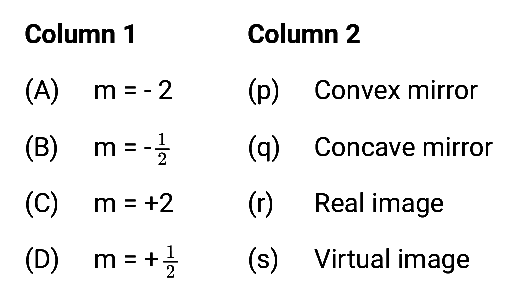
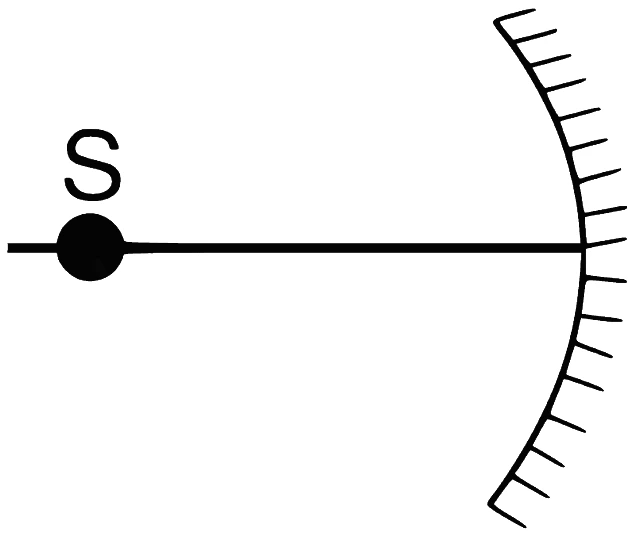
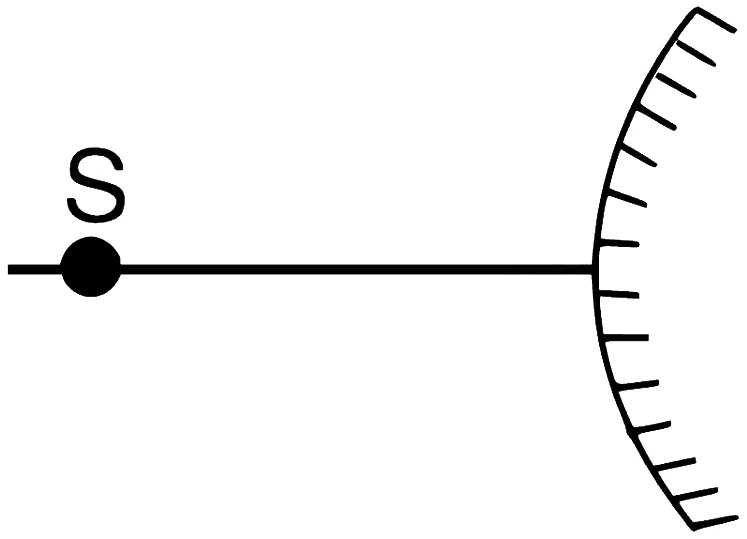
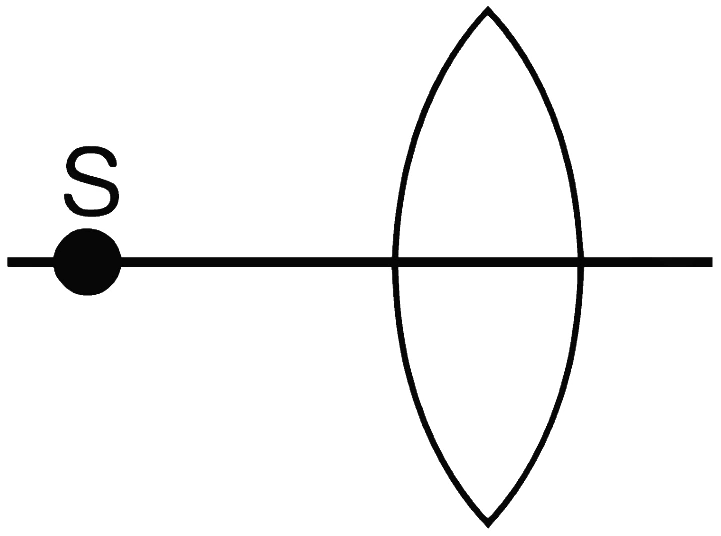
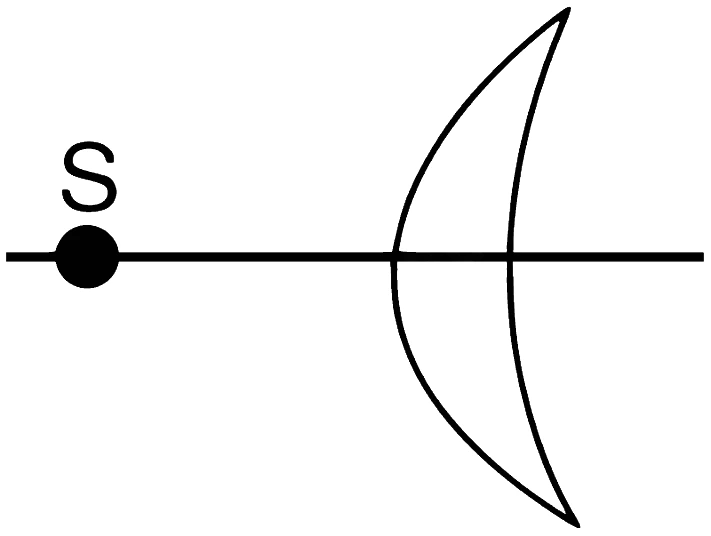
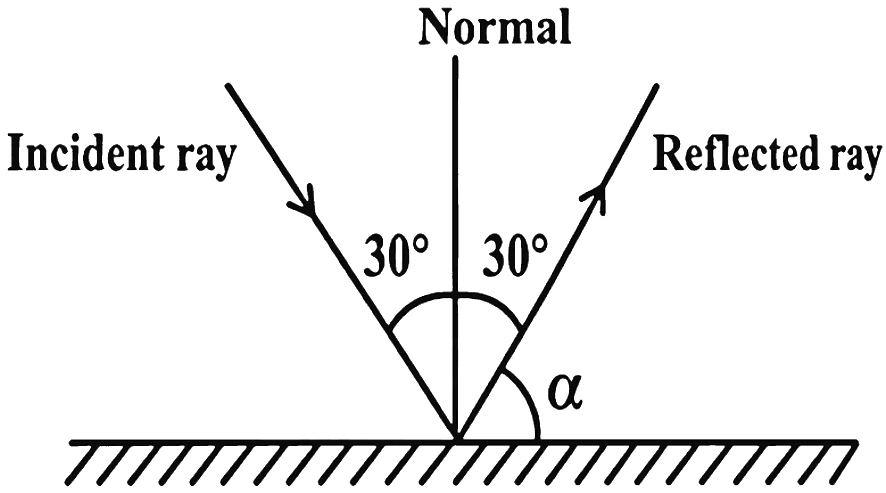
If a parallel beam of light is incident on spherical mirrors then after reflection they pass through focal point. If F is the focal length and R is the radius of curvature of mirror then
A concave mirror of focal length 10 cm forms an image which is double the size of object when the object is placed at two different positions. The distance between the two positions of the object is ______ cm.
Numerical answer type. Work it out, then open the answer.
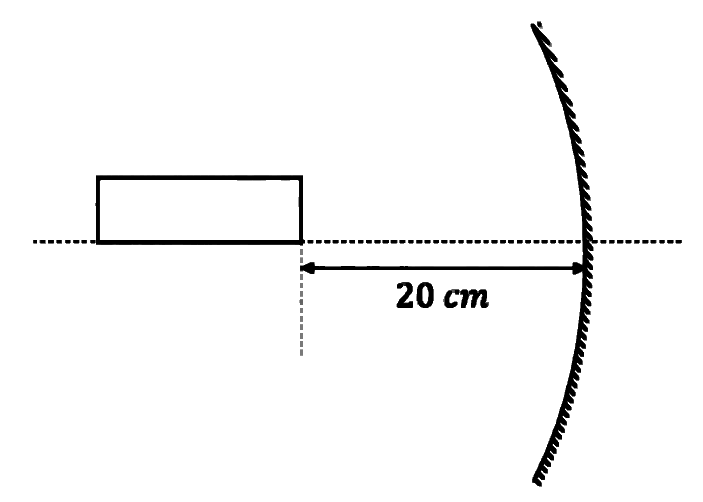
A rod of length 10 cm lies along the principle axis of a concave mirror of focal length 10 cm as shown in figure. The length of the image is ______ cm.
Two identical objects are placed in front of convex mirror and concave mirror having same radii of curvature of 12 cm, at same distance of 18 cm from the respective mirrors. The ratio of sizes of the images formed by convex mirror and by concave mirror is:
Distance between object and its image (magnified by −31) is 30 cm. The focal length of the mirror used is (4x)cm, where magnitude of value of x is _________.
Numerical answer type. Work it out, then open the answer.
The driver sitting inside a parked car is watching vehicles approaching from behind with the help of his side view mirror, which is a convex mirror with radius of curvature R=2 m. Another car approaches him from behind with a uniform speed of 90 km/hr. When the car is at a distance of 24 m from him, the magnitude of the acceleration of the image of the car in the side view mirror is ' a '. The value of 100a is __________ m/s2.
Numerical answer type. Work it out, then open the answer.
A mirror is used to produce an image with magnification of 41. If the distance between object and its image is 40 cm, then the focal length of the mirror is ________.
When an object is placed 40 cm away from a spherical mirror an image of magnification 21 is produced. To obtain an image with magnification of 31, the object is to be moved:
A concave mirror produces an image of an object such that the distance between the object and image is 20 cm. If the magnification of the image is –3, then the magnitude of the radius of curvature of the mirror is:
The image of an object approaching a convex mirror of radius of curvature 20 m along its optical axis is observed to move from 325 m to 750 m in 30 second. The speed of the object in km/hr is
A finite size object is placed normal to the principal axis at a distance of 30 cm from a convex mirror of focal length 30 cm. A plane mirror is now placed in such a way that the image produced by both the mirrors coincide with each other. The distance between the two mirrors is:
A concave mirror of focal length ' f ' produces an image ' n ' time the size of the object. If the image is real, then the distance of the object from the mirror is
An object is placed at a distance of 12 cm in front of a plane mirror. The virtual and erect image is formed by the mirror. Now the mirror is moved by 4 cm towards the stationary object. The distance by which the position of image would be shifted, will be
Two objects A and B are placed at 15 cm and 25 cm from the pole in front of a concave mirror having radius of curvature 40 cm. The distance between images formed by the mirror is _______________.
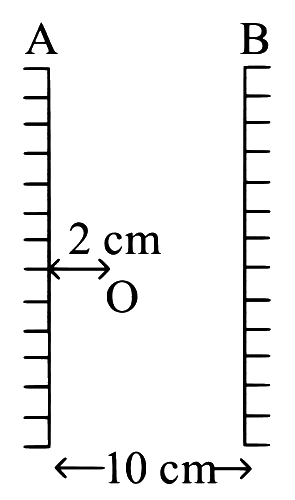
Two vertical parallel mirrors A and B are separated by 10 cm. A point object O is placed at a distance of 2 cm from mirror A. The distance of the second nearest image behind mirror A from the mirror A is _________ cm.
Numerical answer type. Work it out, then open the answer.
A thin cylindrical rod of length 10 cm is placed horizontally on the principal axis of a concave mirror of focal length 20 cm. The rod is placed in such a way that mid point of the rod is at 40 cm from the pole of mirror. The length of the image formed by the mirror will be 3x cm. The value of x is _____________.
Numerical answer type. Work it out, then open the answer.
In an experiment for estimating the value of focal length of converging mirror, image of an object placed at 40 cm from the pole of the mirror is formed at distance 120 cm from the pole of the mirror. These distances are measured with a modified scale in which there are 20 small divisions in 1 cm. The value of error in measurement of focal length of the mirror is K1 cm. The value of K is __________.
Numerical answer type. Work it out, then open the answer.
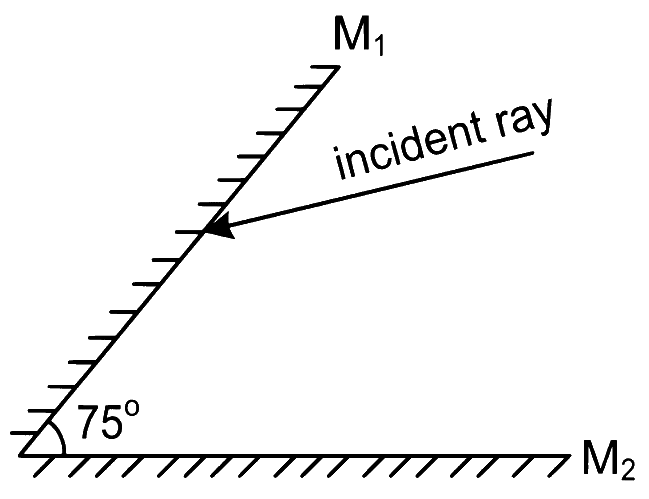
A light ray is incident, at an incident angle θ1, on the system of two plane mirrors M1 and M2 having an inclination angle 75∘ between them (as shown in figure). After reflecting from mirror M1 it gets reflected back by the mirror M2 with an angle of reflection 30∘. The total deviation of the ray will be _____________ degree.
Numerical answer type. Work it out, then open the answer.
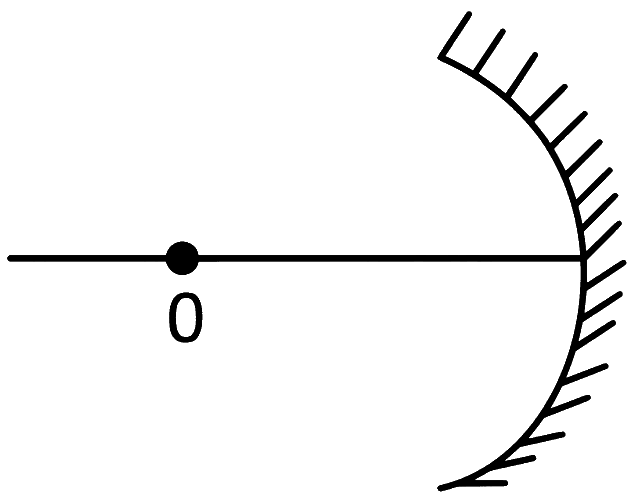
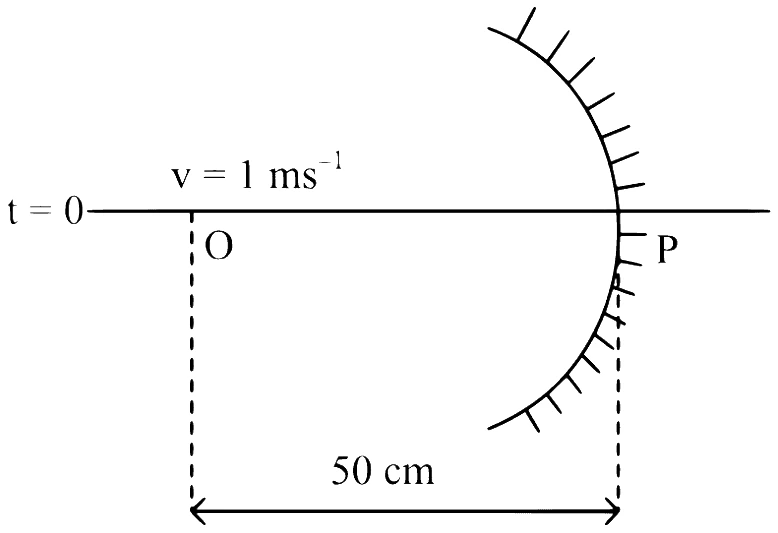
An object 'O' is placed at a distance of 100 cm in front of a concave mirror of radius of curvature 200 cm as shown in the figure. The object starts moving towards the mirror at a speed 2 cm/s. The position of the image from the mirror after 10 s will be at _________ cm.
Numerical answer type. Work it out, then open the answer.
An object is placed beyond the centre of curvature C of the given concave mirror. If the distance of the object is d1 from C and the distance of the image formed is d2 from C, the radius of curvature of this mirror is:
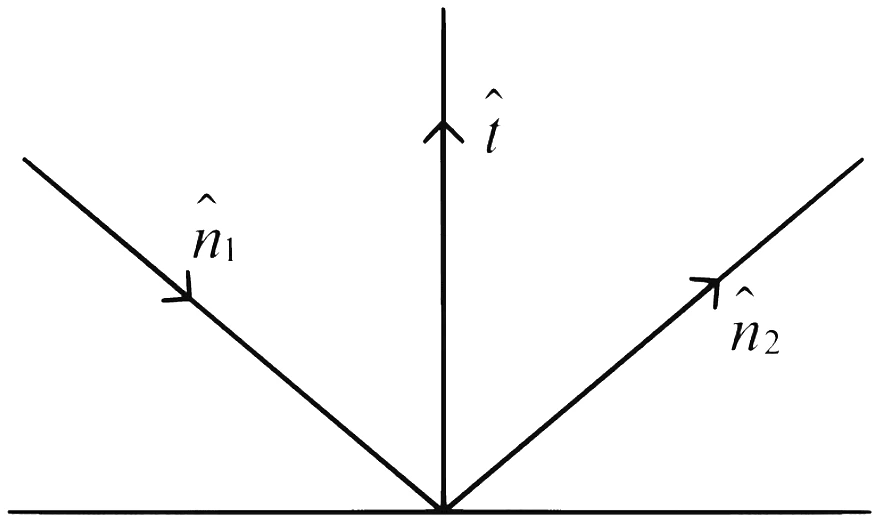
The incident ray, reflected ray and the outward drawn normal are denoted by the unit vectorsa,b, and crespectively. Then choose the correct relation for these vectors.
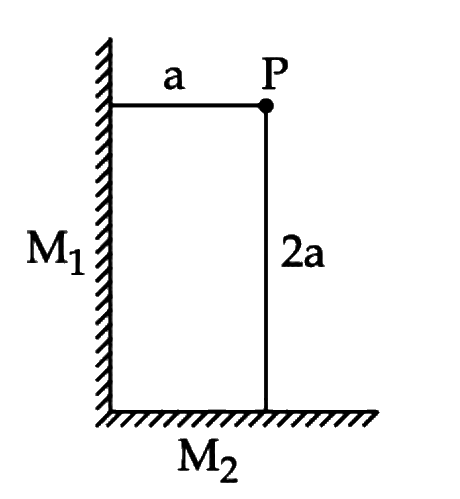
Two plane mirrors M1 and M2 are at right angle to each other shown. A point source 'P' is placed at 'a' and '2a' meter away from M1 and M2 respectively. The shortest distance between the images thus formed is: (Take 5 = 2.3)
Car B overtakes another car A at a relative speed of 40 ms−1. How fast will the image of car B appear to move in the mirror of focal length 10 cm fitted in car A, when the car B is 1.9 m away from the car A?
A short straight object of height 100 cm lies before the central axis of a spherical mirror whose focal length has absolute value | f | = 40 cm. The image of object produced by the mirror is of height 25 cm and has the same orientation of the object. One may conclude from the information:
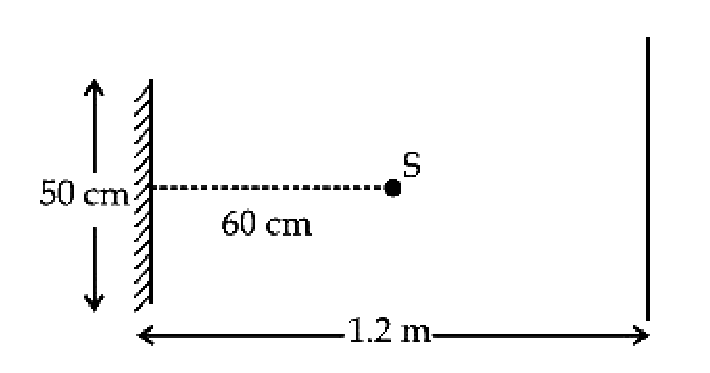
A point source of light S, placed at a distance 60cm in front of the centre of a plane mirror of width 50 cm, hangs vertically on a wall. A man walks in front of the mirror along a line parallel to the mirror at a distance 1.2 m from it (see in the figure). The distance between the extreme points where he can see the image of the light source in the mirror is __________ cm.
Numerical answer type. Work it out, then open the answer.
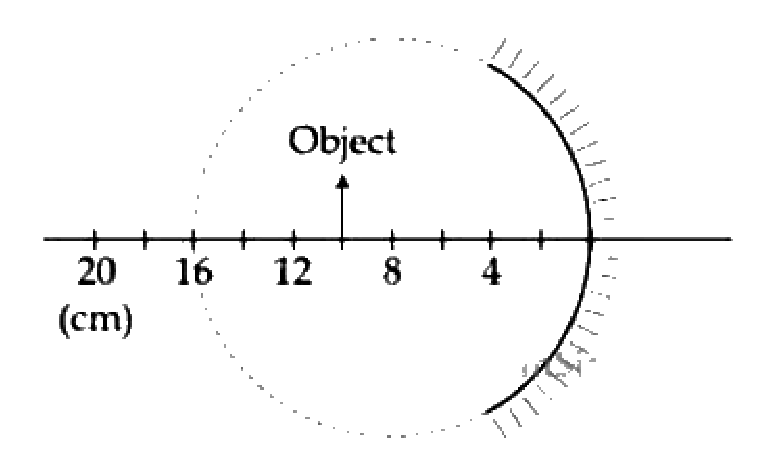
A spherical mirror is obtained as shown in the figure from a hollow glass sphere. If an object is positioned in front of the mirror, what will be the nature and magnification of the image of the object?
An object is gradually moving away from the focal point of a concave mirror along the axis of the mirror. The graphical representation of the magnitude of linear magnification (m) versus distance of the object from the mirror (x) is correctly given by:
(Graphs are drawn schematically and are not to scale)
When an object is kept at a distance of 30 cm from a concave mirror, the image is formed at a distance of 10 cm from the mirror. If the object is moved with a speed of 9 cms–1, the speed (in cms–1) with which image moves at that instant is ____.
Numerical answer type. Work it out, then open the answer.
A concave mirror for face viewing has focal length of 0.4 m. The distance at which you hold the mirror from your face in order to see your image upright with a magnification of 5 is:
Two plane mirrors are inclined to each other such that a ray of light incident on the first mirror (M1) and parallel to the second mirror (M2) is finally reflected from the second mirror (M2) parallel to the first mirror (M1). The angle between the two mirrors will be:
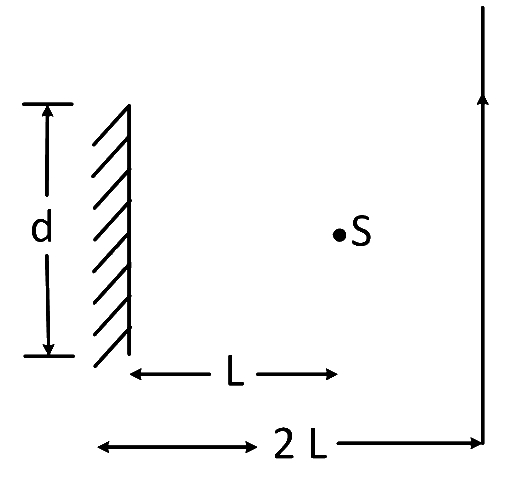
A point source of light, S is placed at distance L in front of the centre of plane mirror of width d which is hanging vertically on a wall. A man walks in front of the mirror along a line parallel to the mirror, at a distance 2L as shown below. The distance over which the man can see the image of the light source in the mirror is
An object is placed at a distance of 40 cm from a concave mirror of focal length 15 cm. If the object is displaced through a distance of 20 cm towards the mirror, the displacement of the image will be
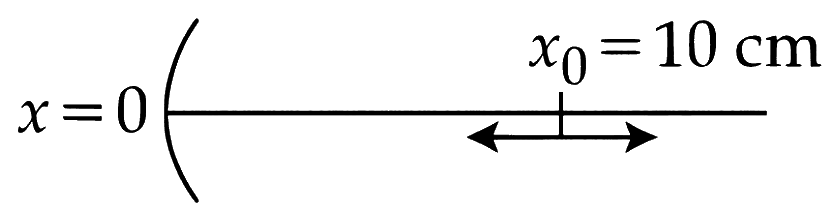
A particle is oscillating on the X-axis with an amplitude 2 cm about the point x0=10 cm, with a frequency ω. A concave mirror of focal length 5 cm is placed at the origin (see figure).
Identify the correct statements.
(A) The image executes periodic motion.
(B) The image executes non-periodic motion.
(C) The turning points of the image are asymmetric w.r.t. the image of the point at x=10 cm. (D) The distance between the turning points of the oscillation of the image is 21100 cm.
A beam of light from a source L is incident normally on a plane mirror fixed at a certain distance x from the source. The beam is reflected back as a spot on a scale placed just above the source L. When the mirror is rotated through a small angle θ, the spot of the light is found to move through a distance y on the scale. The angle θ is given by
You are asked to design a shaving mirror assuming that a person keeps it 10 cm from his face and views the magnified image of the face at the closest comfortable distance of 25 cm. The radius of curvature of the mirror would then be:
Two plane mirrors are inclined at 70°. A ray incident on one mirror at angle, θ after reflection falls on second mirror and is reflected from there parallel to first mirror. The value of θ is
A rod of length 10 cm lies along the principal axis of a concave mirror of focal length 10 cm in such a way that its end closer to the pole is 20 cm away from the mirror. The length of the image is
A car is fitted with a convex side-view mirror of focal length 20 cm. A second car 2.8 m behind the first car is overtaking the first car at a relative speed of 15 m/s. The speed of the image of the second car as seen in the mirror of the first one is:
It has been observed that a mirror always forms the image between the pole and the focus, irrespective of the location of the object. Which one of the following is correct in respect of the nature of the mirror?
A periscope uses two plane mirrors inclined at 45∘. If the tube of the periscope is filled with a completely transparent liquid of refractive index 1.5, then which one of the following is correct in respect of the image seen?
An object is placed far beyond the centre of curvature of a concave mirror. The object then starts accelerating towards the mirror. Which one of the following is correct?
A point object is placed at the centre of curvature of a spherical concave mirror. Which one among the following would be the correct location of image formed?
Sita, 1.5m high, stands before a plane mirror fixed on a wall to view her full image. What should be the minimum height of the plane mirror so that Sita can view her image fully?
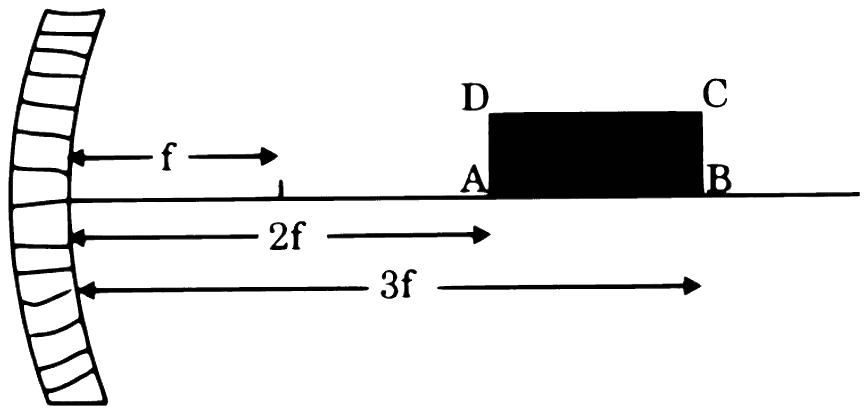
A rectangle ABCD is kept in front of a concave mirror of focal length f with its corners A and B being, respectively, at distances 2f and 3f from the mirror with AB along the principal axis as shown in the figure. It forms an image A'B'C'D' in front of the mirror. What is the ratio of B'C' to A'D'?
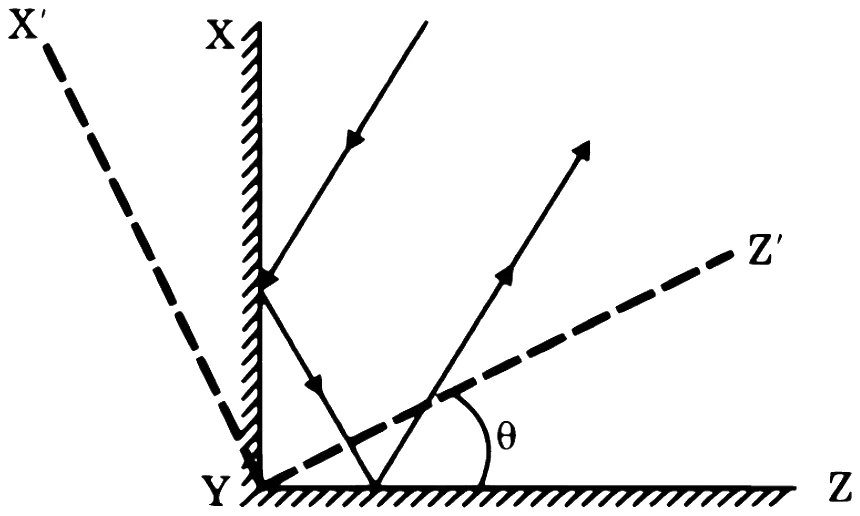
Shown in the figure are two plane mirrors XY and YZ (XY⊥YZ) joined at their edge. Also shown is a light ray falling on one of the mirrors and reflected back parallel to its original path as a result of this arrangement. The two mirrors are now rotated by an angle θ to their new position X'YZ', as shown. As a result the new reflected ray is at an angle α from the original reflected ray. Then:
According to the New Cartesian Sign Convention, which one of the following is correct in respect of the formula f1=v1+u1, where symbols have their usual meanings?
In case of a concave mirror, if an object is kept between principal focus F and pole P of the mirror, then which one of the following statements about the image is NOT correct ?
A lady is standing in front of a plane mirror at a distance of 1m from it. She walks 60cm towards the mirror. The distance of her image now from herself (ignoring the thickness of the mirror) is
An object is placed at the centre of curvature of a concave mirror of focal length 16cm. If the object is shifted by 8cm towards the focus, the nature of the image would be
Statement I : Due to diffused or irregular reflection of light, a closed room gets light even if no direct sunlight falls inside the room. Statement II : Irregular reflection, where the reflected rays are not parallel, does not follow the laws of reflection. Which one of the following is correct? (Choose the code that matches both statements.)
Consider the following statements: A real image 1. can be formed on a screen 2. is always magnified and inverted Which of the statements given above is/are correct?
Directions: Examine the two statements carefully and select the correct answer using the code given below. Statement I: Convex mirror is used as a driver mirror. Statement II: Images formed by convex mirror are diminished in size.
Suppose you are standing 1m in front of a plane mirror. What should be the minimum vertical size of the mirror so that you can see your full image in it?
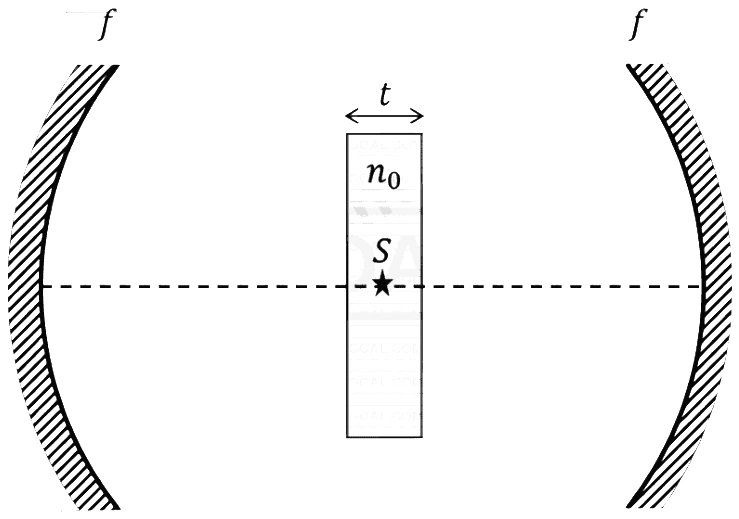
Two identical concave mirrors each of focal length f are facing each other as shown in the schematic diagram. The focal length f is much larger than the size of the mirrors. A glass slab of thickness t and refractive index n0 is kept equidistant from the mirrors and perpendicular to their common principal axis. A monochromatic point light source S is embedded at the center of the slab on the principal axis, as shown in the schematic diagram. For the image to be formed on S itself, which of the following distances between the two mirrors is/are correct:
More than one option can be correct. Tap every correct option, then tap Check.
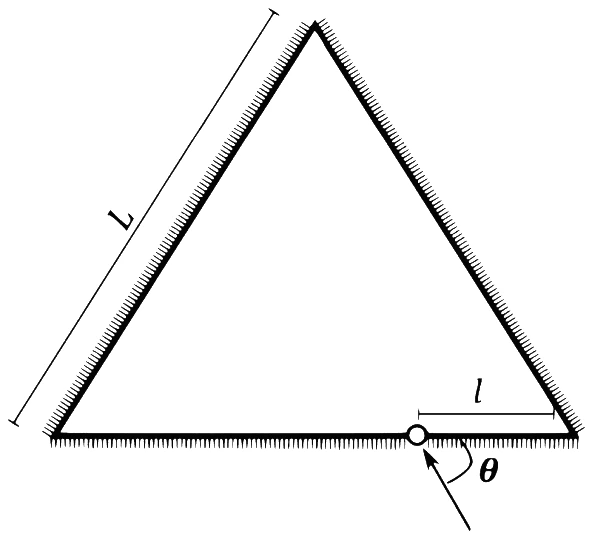
Three plane mirrors form an equilateral triangle with each side of length L. There is a small hole at a distance l>0 from one of the corners as shown in the figure. A ray of light is passed through the hole at an angle θ and can only come out through the same hole. The cross section of the mirror configuration and the ray of light lie on the same plane.
Which of the following statement(s) is(are) correct?
More than one option can be correct. Tap every correct option, then tap Check.
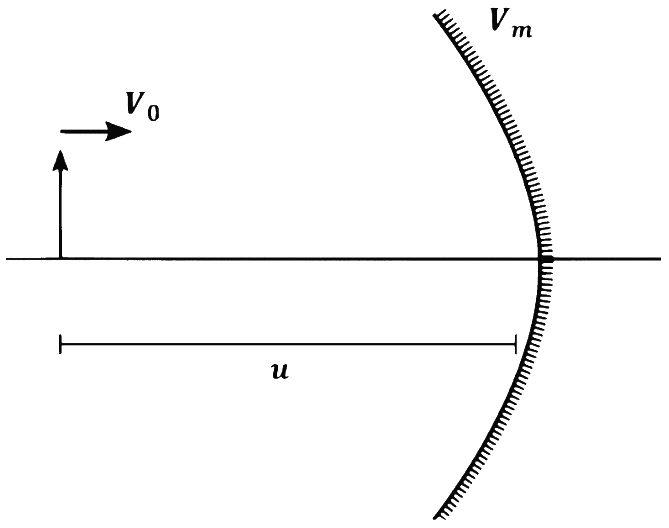
An object and a concave mirror of focal length f=10cm both move along the principal axis of the mirror with constant speeds. The object moves with speed V0=15cm s−1 towards the mirror with respect to a laboratory frame. The distance between the object and the mirror at a given moment is denoted by u. When u=30cm, the speed of the mirror Vm is such that the image is instantaneously at rest with respect to the laboratory frame, and the object forms a real image. The magnitude of Vm is ______ cm s−1.
Numerical answer type. Work it out, then open the answer.
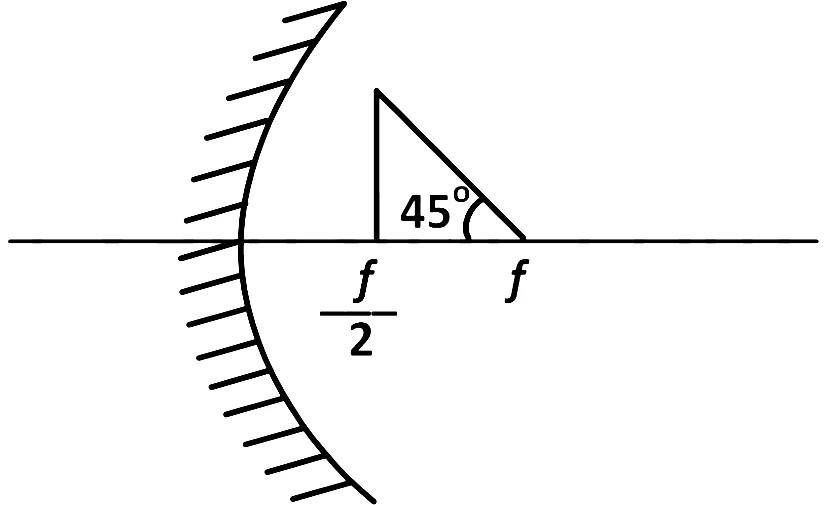
A wire is bent in the shape of a right angled triangle and is placed in front of a concave mirror of focal length f, as shown in the figure. Which of the figures shown in the four options qualitatively represent(s) the shape of the image of the bent wire? (These figures are not to scale.)
More than one option can be correct. Tap every correct option, then tap Check.
A ray of light travelling in the direction 21(i^+3j^) is incident on a plane mirror. After reflection, it travels along the direction 21(i^−3j^). The angle of incidence is
Image of an object approaching a convex mirror of radius of curvature 20m along its optical axis is observed to move from 325m to 750m in 30s. What is the speed of the object in km per hour?
Numerical answer type. Work it out, then open the answer.
A student performed the experiment of determination of focal length of a concave mirror by u-v method using an optical bench of length 1.5m. The focal length of the mirror used is 24cm. The maximum error in the location of the image can be 0.2cm. The 5 sets of (u,v) values recorded by the student (in cm) are : (42,56), (48,48), (60,40), (66,33), (78,39). The data set(s) that cannot come from experiment and is (are) incorrectly recorded, is (are)
More than one option can be correct. Tap every correct option, then tap Check.
An optical component and an object S placed along its optic axis are given in Column I. The distance between the object and the component can be varied. The properties of images are given in Column II. Match all the properties of images from Column II with the appropriate components given in Column I.
Column I
Column II
(A) concave mirror with object S on axis
(P) Real Image
(B) convex mirror with object S on axis
(Q) Virtual Image
(C) biconvex lens with object S on axis
(R) Magnified Image
(D) concavo-convex (meniscus) lens with object S on axis
Statement 1: The formula connecting u, v and f for a spherical mirror is valid only for mirrors whose sizes are very small compared to their radii of curvature. Statement 2: Laws of reflection are strictly valid for plane surfaces, but not for large spherical surfaces.
In an experiment to determine the focal length (f) of a concave mirror by the u-v method, a student places the object pin A on the principal axis at a distance x from the pole P. The student looks at the pin and its inverted image from a distance keeping his/her eye in line with PA. When the student shifts his/her eye towards left, the image appears to the right of the object pin. Then,
Assertion : The mirror used in search lights are parabolic and not concave spherical. Reason : In concave spherical mirror, the image formed is always virtual.
A rod of length 10cm lies along the principal axis of a concave mirror of focal length 10cm in such a way that the end closer to the pole is 20cm away from it. Find the length of the image.
Assertion : The relation among u, v and f for the spherical mirror is valid only for mirrors whose sizes are very small compared to their radii of curvature. Reason : The laws of reflection are strictly valid for plane surfaces but not for large spherical surfaces.
A source of light lies on the angle bisector of two plane mirrors inclined at angle θ. The values of θ, so that the light reflected from one mirror does not reach the other mirror will be
Assertion : The formula connecting u, v and f for a spherical mirror is valid only for mirrors whose sizes are very small compared to their radii of curvature. Reason : Laws of reflection are strictly valid for plane surfaces, but not for large spherical surface.
An isotropic point source of light is suspended h metre vertically above the centre of circular table of radius r metre. Then, the ratio of illumenances at the centre to that at the edge of the table is
A square wire of side 2.0cm is placed 20cm in front of a concave mirror of focal length 10cm with its centre on the axis of the mirror and its plane normal to the axis. The area enclosed by the image of wire is
A short linear object of length b lies along the axis of a concave mirror of focal length f at a distance u from the pole of the mirror, what is the size of image?
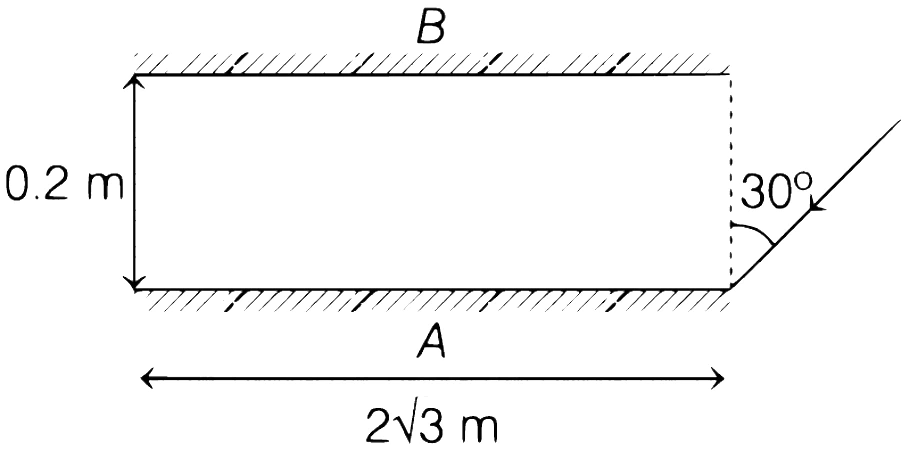
Two plane mirrors A and B are aligned parallel to each other as shown in the figure. A ray of light is incident at an angle 30∘ at a point just inside one end of A. The plane of incidence coincides with the plane of the figure. The maximum number of times, the ray undergoes reflection (excluding the first one) before it emerges out is
An object is placed 25cm in front of a fully silvered concave mirror of focal length 15cm. A plane mirror is placed 35cm behind the concave mirror on the side opposite to the object. The final image after reflection first from the concave mirror and then from the plane mirror is formed at:
When a particular wavelength of light is used, the focal length of a convex mirror is found to be 10cm. If the wavelength of the incident light is doubled keeping the area of the mirror constant, the focal length of the mirror will be:
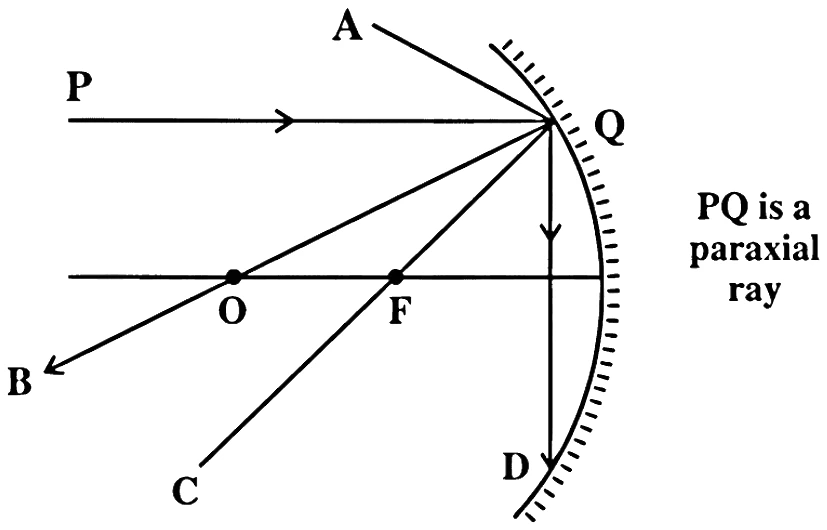
The direction of a ray of light incident on a concave mirror is shown by PQ, while direction in which the ray would travel after reflection is shown by four rays marked as A, B, C and D as shown in the figure. Which of the four rays correctly shows the direction of the reflected ray? (PQ is a paraxial ray)
A point object is moving uniformly towards the pole of a concave mirror of focal length 25cm along its axis as shown below. The speed of the object is 1m s−1. At t=0, the distance of the object from the mirror is 50cm. The average velocity of the image formed by the mirror between time t=0 and t=0.25s is
A dentist uses a mirror of 24mm focal length. He views a cavity in the tooth of a patient by holding the mirror at a distance of 16mm from the cavity. The magnification is
An object is 20cm away from a concave mirror with focal length 15cm. If the object moves with a speed of 5m s−1 along the axis, then the speed of the image will be
When an object is placed infront of a convex mirror at a distance 'u' from the pole of the mirror such that the size of the image is 'n' times that of the object. Then, the object distance 'u' =
An object is placed at a distance of 18cm in front of a mirror. If the image is formed at a distance of 4cm on the other side, then focal length, nature of the mirror and nature of image are respectively
A point object is moving towards a concave mirror of focal length 20cm along the principal axis with a uniform speed of 4cm s−1. The speed of the image when the object is at a distance of 60cm from the mirror is
Two plane mirrors A and B are placed parallel to each other with a separation of 2m between them. If an object is placed in between the two mirrors at a distance of 60cm from the mirror B, then the distance of the second nearest image seen in mirror B from mirror A is (The reflecting surfaces of the two mirrors face each other)
A point object is at rest on the principal axis at a distance of 20cm from a concave mirror of radius of curvature 30cm. Under the action of a horizontal force, the object moves away from the mirror along the axis and reaches a distance of 40cm from the mirror in a time of 3s. The acceleration of the image is
If the distances of the object and its real image from the principal focus of a concave mirror are 16cm and 9cm respectively, then the focal length of the mirror is
A straight metal rod of length 6cm is placed along the principal axis of a concave mirror of focal length 9cm such that the end of the rod closer to the mirror is at a distance of 15cm from the pole of the mirror. The length of the image of the rod is
An object of height 3.6cm is placed normally on the principal axis of a concave mirror of radius of curvature 30cm. If the object is at a distance of 10cm from the principal focus of the mirror, then the height of the real image formed due to the mirror is
An object placed at a distance of 24cm from a concave mirror forms an image at a distance of 12cm from the mirror. If the object is moved with a speed of 12m s−1, then the speed of the image is
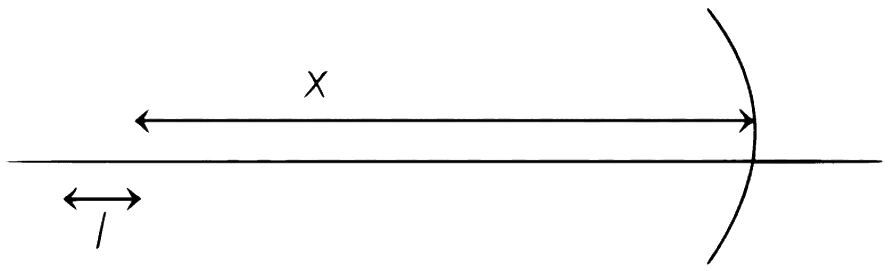
A short straight object of length l lies along the central axis of a spherical concave mirror, at a distance X from the mirror. The focal length of the mirror is F. If the length of the image in the mirror is l′, then ratio (ll′) is (assume, l≪X and l≪F)
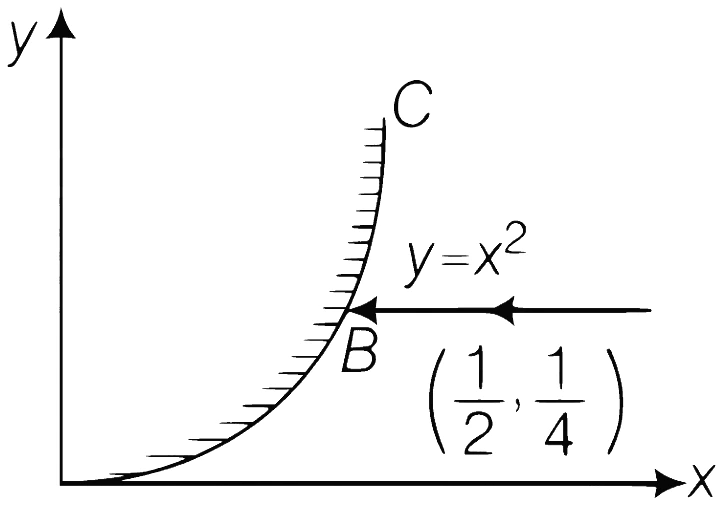
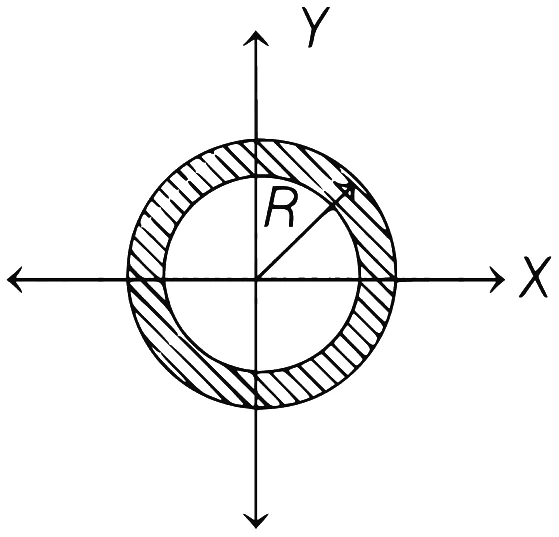
The cross-section of a reflecting surface is represented by the equation x2+y2=R2 as shown in the figure. A ray travelling in the positive x-direction is directed toward positive y-direction after reflection from the surface at point M. The coordinate of the point M on the reflecting surface is
A tennis ball hits the floor with a speed v at an angle θ with the normal to the floor. If the collision is inelastic and the coefficient of restitution is ε, what will be the angle of reflection?
An object is placed 60cm in front of a convex mirror of focal length 30cm. A plane mirror is now placed facing the object in between the object and the convex mirror such that it covers lower half of the convex mirror. What should be the distance of the plane mirror from the object, so that there will be no parallax between the images formed by the two mirrors?
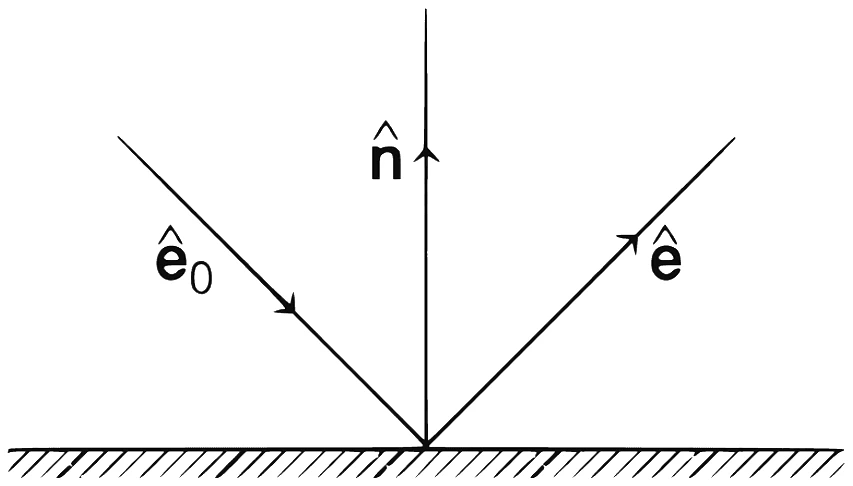
A ray of light is reflected by a plane mirror. e^0, e^ and n^ be the unit vectors along the incident ray, reflected ray and the normal to the reflecting surface respectively.
Which of the following gives an expression for e^?
A point source is placed at coordinates (0,1) in xy-plane. A ray of light from the source is reflected on a plane mirror placed along the X-axis and perpendicular to the xy-plane. The reflected ray passes through the point (3,3). What is the path length of the ray from (0,1) to (3,3)?
The ratio of the diameter of the sun to the distance between the earth and the sun is approximately 0.009. The approximate diameter of the image of the sun formed by concave spherical mirror of radius of curvature 0.4m is
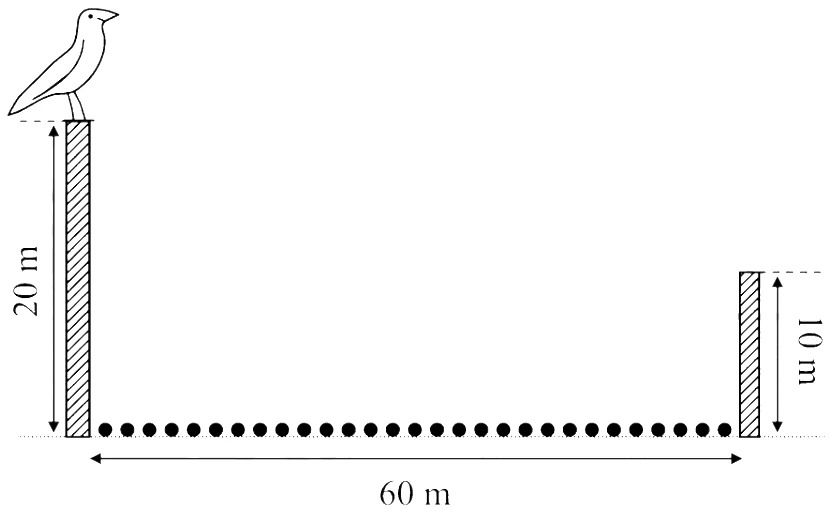
Two posts of heights 20m and 10m are 60m apart, as shown in the figure. Food grains are continuously distributed between the two posts. A crow sitting on top of the taller post wants to pick up a grain and sit on the other post. What should be the distance of the grain it picks from the bottom of the taller post to minimize the total flight length?