
Speed of Waves
The speed of a wave on a string is m/s when the tension is N. The percentage increase in the tension to raise the wave speed by is
Show answer and solution
Answer: (a)
Loading the solution…
Home›Practice Hub›Chapters›Wave Motion›Speed of Waves
Wave Motion PYQs · MHT CET · JEE Main · NEET
 Wave Motion · Lecture 3 · Wave Equation & Speed of Sound1:28:05
 Wave Motion Part 2 · String + Sound + Progressive Wave + PYQs1:12:20All 9 Wave Motion videos →
Speed of Waves
The speed of a wave on a string is m/s when the tension is N. The percentage increase in the tension to raise the wave speed by is
Answer: (a)
Speed of Waves
A wire is under tension of kg wt and a wave is travelling through it with some speed. Tension in the wire is so increased that the wave travels through it with thrice the original speed. The increase in tension is (in kg wt)
Answer: (c)
Speed of Waves
What is the effect of humidity on sound waves when humidity increases?
Answer: (a)
Speed of Waves
The velocity of sound in air is doubled when the temperature is raised from to . The value of is ______.
Numerical answer type. Work it out, then open the answer.
Answer: 819
Speed of Waves
A string of length m and mass kg is tightly clamped at its ends. The tension in the string is N. Identical wave pulses are produced at one end at equal intervals of time . What is the minimum value of which allows constructive interference between successive pulses?
Answer: (d)
Speed of Waves
Two monoatomic ideal gases '1' and '2' of molecular masses and respectively are enclosed in separate containers kept at the same temperature. The ratio of the speed of sound in gas '1' to that in gas '2' is
Answer: (b)
Speed of Waves
The ratio of the speed of sound in helium gas to that in nitrogen gas at K is ( Ratio of specific heats for helium is and that for nitrogen is . Molecular weight for helium and nitrogen are and respectively.)
Answer: (d)
Speed of Waves
The enclosed air inside a closed box of rigid walls has pressure . The density of air inside this box is constant. On heating the gas, the pressure of the enclosed air is increased from to . Now it is observed that the sound travels times faster than at pressure . The ratio by is
Answer: (b)
Speed of Waves
Two strings having linear densities and, and lengths and respectively are joined. Free ends of and are tied to two rigid supports and , respectively creating a tension of 500 N in the wire. Two identical pulses, sent from and ends, take time and , respectively, to reach the joint. The ratio is:
Answer: (b)
Speed of Waves
A uniform rope of mass kg and length m hangs from ceiling. The speed of transverse wave in the rope at upper end and at a point m distance from lower end will be ( m/s)
Answer: (a)
Speed of Waves
Two strings with circular cross section and made of same material, are stretched to have same amount of tension. A transverse wave is then made to pass through both the strings. The velocity of the wave in the first string having the radius of cross section R is , and that in the other string having radius of cross section R/2 is . Then =
Answer: (c)
Speed of Waves
Given below are two statements: one is labelled as Assertion A and the other is labelled as Reason
Assertion A: A sound wave has higher speed in solids than gases.
Reason R: Gases have higher value of Bulk modulus than solids.
In the light of the above statements, choose the correct answer from the options given below
Answer: (c)
Speed of Waves
A string of mass 0.2 Kg is under a tension of 2.5 N. The length of the string is 2 m. A transverse wave starts from one end of the string. The time taken by the wave to reach the other end is
Answer: (b)
Speed of Waves
The speed of sound in oxygen at S.T.P. will be approximately: (given, )
Answer: (d)
Speed of Waves
A steel wire with mass per unit length is under tension of . The speed of transverse waves in the wire will be:
Answer: (c)
Speed of Waves
The ratio of speed of sound in hydrogen gas to the speed of sound in oxygen gas at the same temperature is:
Answer: (d)
Speed of Waves
A uniform wire long and weighing hangs vertically. The speed of the wave at mid point of the wire is (acceleration due to gravity )
Answer: (c)
Speed of Waves
A tuning fork of frequency produces sound waves of wavelength in air at N.T.P. The increase in wavelength when the temperature of air is is nearly
Answer: (d)
Speed of Waves
A wire has length and mass . Another wire QR has length and mass . Both wires have same radii and are joined as a single wire. This wire is under tension of . A wave pulse of amplitude is sent along the wire from end . the time taken by the wave pulse to travel along the wire from point P to R is?
Answer: (c)
Speed of Waves
A uniform rope of length '' and mass ' ' hangs vertically from a rigid support. A block of mass '' is attached to the free end of the rope. A transverse wave of wavelength '' is produced at the lower end of the rope. The wavelength of the wave when it reaches the top of the rope is ''. The ratio is
Answer: (a)
Speed of Waves
If the initial tension on a stretched string is doubled, then the ratio of the initial and final speeds of a transverse wave along the string is
Answer: (c)
Speed of Waves
An organ pipe filled with a gas at 27C resonates at 400 Hz in its fundamental mode. If it is filled with the same gas at 90C, the resonance frequency at the same mode will be
Answer: (c)
Speed of Waves
The percentage increase in the speed of transverse waves produced in a stretched string if the tension is increased by 4%, will be __________%.
Numerical answer type. Work it out, then open the answer.
Answer: 2
Speed of Waves
The wavelength of sound in any gas depends upon
Answer: (c)
Speed of Waves
What is the effect of pressure on the speed of sound in a medium, if pressure is doubled at constant temperature?
Answer: (a)
Speed of Waves
A uniform rope of length and mass hangs vertically from the rigid support. A block of mass is attached to the free end of the rope. A transverse pulse of wavelength is produced at the lower end of the rope. The wavelength of the pulse when it reaches the top of the rope is
Answer: (c)
Speed of Waves
A uniform metal wire has length , mass and density . It is under tension and is the speed of transverse wave along the wire. The area of cross-section of the wire is
Answer: (a)
Speed of Waves
A transverse wave travels on a taut steel wire with a velocity of v when tension in it is 2.06 × 10⁴ N. When the tension is changed to T, the velocity changed to v/2. The value of T is close to:
Answer: (d)
Speed of Waves
The extension in a wire obeying Hooke's law is . The speed of sound in the stretched wire is . If the extension in the wire is increased to , then the speed of sound in a wire is
Answer: (b)
Speed of Waves
A uniform thin rope of length 12 m and mass 6 kg hangs vertically from a rigid support and a block of mass 2 kg is attached to its free end. A transverse short wavetrain of wavelength 6 cm is produced at the lower end of the rope. What is the wavelength of the wavetrain (in cm) when it reaches the top of the rope?
Answer: (a)
Speed of Waves
Speed of a transverse wave on a straight wire (mass 6.0 g, length 60 cm and area of cross-section 1.0 mm2) is 90 ms-1. If the Young's modulus of wire is 16 1011 Nm-2, the extension of wire over its natural length is:
Answer: (a)
Speed of Waves
A heavy ball of mass M is suspendeed from the ceiling of a car by a light string of mass m (m < < M). When the car is at rest, the speed of transverse waves in the string is 60 ms. When the car has acceleration a, the wave-speed increases to 60.5 ms. The value of a, in terms of gravitational acceleration g, is closest to:
Answer: (b)
Speed of Waves
The pressure wave, P = 0.01 sin [1000t – 3x] Nm–2, corresponds to the sound produced by a vibrating blade on a day when atmospheric temperature is 0°C. On some other day, when temperature is T, the speed of sound produced by the same blade and at the same frequency is found to be 336 ms–1. Approximate value of T is
Answer: (c)
Speed of Waves
A granite rod of 60 cm length is clamped at its middle point and is set into longitudinal vibrations. The density of granite is 2.7 103 kg/m3 and its Young’s modulus is 9.27 1010 Pa. What will be the fundamental frequency of the longitudinal vibrations?
Answer: (b)
Speed of Waves
A uniform rope of length L and mass m1 hangs vertically from a rigid support. A block of mass m2 is attached to the free end of the rope. A transverse pulse of wavelength 1 is produced at the lower end of the rope. The wavelength of the pulse when it reaches the top of the rope is 2. The ratio 2/1 is
Answer: (d)
Speed of Waves
A uniform string of length is suspended from a rigid support. A short wave pulse is introduced at its lowest end. It starts moving up the string. The time taken to reach the supports is: (take )
Answer: (a)
Speed of Waves
4.0 g of a gas occupies 22.4 litres at NTP. The specific heat capacity of the gas at constant volume is 5.0 J K mol. If the speed of sound in this gas at NTP is 952 m s, then the heat capacity at constant pressure is
(Take gas constant R 8.3 J K mol)
Answer: (c)
Speed of Waves
The temperature at which the speed of sound becomes double as was at is
Answer: (c)
Speed of Waves
A metre length of string has a mass of . If the tension in the string in , the speed of a wave on the string is
Answer: (a)
Speed of Waves
The velocity of sound in any gas depends upon
Answer: (b)
Speed of Waves
A very large container consists of an ideal gas. The speed of sound in the gas is . When the pressure of the gas is doubled while keeping the temperature constant, the speed of sound now becomes . What is the ratio of to ?
Answer: (a)
Step-by-step solution coming soon.
Speed of Waves
Consider the following statements in respect of sound waves:
I. The speed of sound waves decreases with an increase in temperature if the atmospheric pressure remains the same.
II. The speed of sound waves increases with increasing humidity if the atmospheric pressure remains the same.
III. The speed of sound waves is not affected by a change in atmospheric pressure, provided the temperature is kept constant.
Which of the statements given above are correct?
Answer: (b)
Step-by-step solution coming soon.
Speed of Waves
Which one among the following is true for the speed of sound in a given medium?
Answer: (a)
Step-by-step solution coming soon.
Speed of Waves
Which one of the following statements about the speed of sound waves is not correct?
Answer: (b)
Step-by-step solution coming soon.
Speed of Waves
At , the speed of sound in water is approximately
Answer: (c)
Step-by-step solution coming soon.
Speed of Waves
Which one of the following statements is correct?
Answer: (d)
Step-by-step solution coming soon.
Speed of Waves
Ultrasonic waves of frequency are passed through a medium where speed of sound is times that in air (speed of sound in air is ). The wavelength of this wave in that medium will be of the order of
Answer: (a)
Step-by-step solution coming soon.
Speed of Waves
Sound moves with higher velocity if:
Answer: (d)
Step-by-step solution coming soon.
Speed of Waves
A block hangs vertically at the bottom end of a uniform rope of constant mass per unit length. The top end of the rope is attached to a fixed rigid support at . A transverse wave pulse (Pulse 1) of wavelength is produced at point on the rope. The pulse takes time to reach point . If the wave pulse of wavelength is produced at point (Pulse 2) without disturbing the position of , it takes time to reach point . Which of the following options is/are correct?
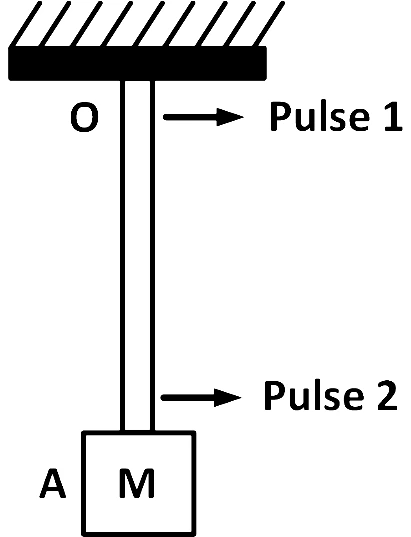
More than one option can be correct. Tap every correct option, then tap Check.
Answer: (a), (d)
Step-by-step solution coming soon.
Speed of Waves
A steel rod long is clamped at its middle. The fundamental frequency of longitudinal vibrations of the rod is . What is the speed of sound in steel?
Answer: (b)
Step-by-step solution coming soon.
Speed of Waves
Assertion: Sound would travel faster on a hot summer day than on a cold winter day.
Reason: The velocity of sound is directly proportional to the square of its absolute temperature.
Answer: (c)
Step-by-step solution coming soon.
Speed of Waves
The velocity of sound in air at NTP is . What will be its value when the temperature is doubled and the pressure is halved?
Answer: (c)
Step-by-step solution coming soon.
Speed of Waves
Assertion: The change in air pressure affects the speed of sound.
Reason: The speed of sound in gases is proportional to the square of pressure.
Answer: (d)
Step-by-step solution coming soon.
Speed of Waves
A block is suspended from the ceiling of an elevator through a spring having a linear mass density of . Find the speed with respect to spring with which a wave pulse can proceed on the spring if the elevator accelerates up at the rate of . Take
Answer: (d)
Step-by-step solution coming soon.
Speed of Waves
Linear density of a string is and wave equation is . Find the tension in the string, where in metre and in second.
Answer: (a)
Step-by-step solution coming soon.
Speed of Waves
Transverse waves of the same frequency are generated in two steel wires A and B. The diameter of A is twice that of B and the tension in A is half that in B. The ratio of the velocities of the waves in A and B is
Answer: (c)
Step-by-step solution coming soon.
Speed of Waves
If the speed of a wave doubles as it passes from shallow water into deeper water, its wavelength will be
Answer: (c)
Step-by-step solution coming soon.
Speed of Waves
The speed of transverse wave in aluminium wire is times the speed of longitudinal wave in the wire. The stress in the wire is (Young's modulus of Al )
Answer: (c)
Step-by-step solution coming soon.
Speed of Waves
A steel wire of length has a mass of . If the wire is under a tension of , then the speed of transverse waves on the wire is
Answer: (c)
Step-by-step solution coming soon.
Speed of Waves
The equation of a transverse wave propagating along a stretched string of length is , where and are in and is in second. If the mass of the string is , then the tension in the string is
Answer: (c)
Step-by-step solution coming soon.
Speed of Waves
The speed of a wave on a string is when the tension is . The percentage increase in the tension in order to raise the wave speed by is
Answer: (a)
Step-by-step solution coming soon.
Speed of Waves
A string of length is stretched by and the speed of transverse waves along it is . The speed of the wave when it is stretched by will be (assume that Hooke's law is applicable)
Answer: (c)
Step-by-step solution coming soon.
Speed of Waves
The speed of sound in air near room temperature is approximately
Answer: (a)
Step-by-step solution coming soon.
Speed of Waves
Match the following.
| Column I | Column II |
| (A) Transverse wave through a steel rod | 1. |
| (B) Longitudinal waves in Earth's crust | 2. |
| (C) Longitudinal waves through a steel rod | 3. |
| (D) Ripples | 4. |
Answer: (a)
Step-by-step solution coming soon.
Speed of Waves
If a long steel rod clamped at its middle is vibrated in its fundamental mode with a frequency of , then the speed of longitudinal waves in the rod is
Answer: (c)
Step-by-step solution coming soon.
Speed of Waves
A metal rod of length is clamped at its midpoint. If the speed of the sound in the metal is , then the fundamental frequency of the longitudinal vibrations of the rod is
Answer: (a)
Step-by-step solution coming soon.
Speed of Waves
The speed of a transverse wave in a stretched string is . Another string of the same length and same radius is subjected to the same tension. If the density of the material of string is more than that of , then the speed of the transverse wave in string is
Answer: (d)
Step-by-step solution coming soon.
Speed of Waves
The tension applied to a metal wire of one metre length produces an elastic strain of . The density of the metal is and Young's modulus of the metal is . The fundamental frequency of the transverse waves in the metal wire is
Answer: (c)
Step-by-step solution coming soon.
Speed of Waves
One end of a string is tied to the ceiling of a lift and a load is attached at the bottom end of the string. When the lift is moving upwards with an acceleration of , the speed of the transverse wave at the lower end of the string is . If the lift moves downwards with an acceleration of , the speed of the transverse wave at the lower end of the string is ()
Answer: (d)
Step-by-step solution coming soon.
Speed of Waves
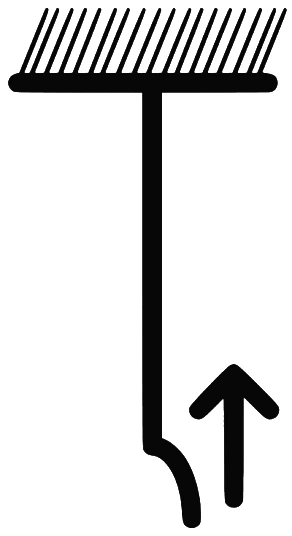
A heavy uniform rope is suspended vertically from a ceiling and is in equilibrium. A pulse is generated at the bottom end of the rope as shown. As the pulse travels up the rope, its acceleration at any instant is ( is acceleration due to gravity)
Answer: (a)
Step-by-step solution coming soon.
Speed of Waves
The velocity of sound in air at and pressure is . At and pressure, the velocity of sound in air is approximately
Answer: (b)
Step-by-step solution coming soon.
Speed of Waves
An elastic wave generates a stress of magnitude while propagating in a wire. The relation between its frequency and the wavevector is given by , where and are constants. In the long wavelength approximation (), the linear density of the wire is
Answer: (c)
Step-by-step solution coming soon.
Speed of Waves
A mass of hangs vertically from the end of a string of mass and length . The time a transverse pulse will take to travel from bottom to top is close to,
Answer: (d)
Step-by-step solution coming soon.
Speed of Waves
Standing waves of frequency are set up in a monoatomic gas kept in a cylindrical chamber closed at both ends and at temperature . The distance between the adjacent anti-nodes of the wave is . The atomic weight of the gas in is closest to
Answer: (d)
Step-by-step solution coming soon.
Speed of Waves
A rope of length and uniform linear density is hanging from the ceiling. A transverse wave pulse, generated close to the free end of the rope, travels upwards through the rope. Then,
More than one option can be correct. Tap every correct option, then tap Check.
Answer: (a), (b), (d)
Step-by-step solution coming soon.
Speed of Waves
Universal gas constant . Diatomic bromine vapour is kept in a long tube at a temperature of . Stationary waves are created in the vapour with a frequency of . The atomic mass of bromine is . The distance between two adjacent nodes is
Answer: (d)
Step-by-step solution coming soon.
No questions match these filters.