
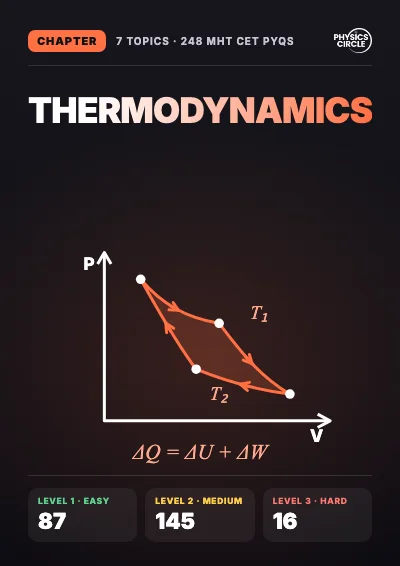
Thermodynamics Formula Book
55 formulas in 7 topics, in the same order as the PYQ topics.
Only formulas used in the solutions of 248 MHT CET PYQs (Level 1, 2, 3)Gas Laws & Ideal Gas Equation
9 formulas · from 30 MHT CET PYQs
- Ideal gas equation
- Combined gas law
- Boyle's law (T constant)
- Charles' law (P constant)
- Gay-Lussac's law (V constant)
- Number of molecules
- Density of a gas
- Moles that escape when pressure falls (V, T same)
- Pressure with changing moles and temperature
Degrees of Freedom & Internal Energy
5 formulas · from 9 MHT CET PYQs
- Internal energy of n moles (f degrees of freedom)
- Molar heat capacity at constant volume
- Monatomic and diatomic gases
- Internal energy of a diatomic gas
- Moving container stops suddenly (M = molar mass)
🔒 For Vajra 2.0 Pro studentsTopic 1 is free. Log in with your Vajra 2.0 Pro number to see every formula.
Specific Heats of Gases - Cp, Cv, γ & Mayer's Relation
8 formulas · from 27 MHT CET PYQs
- Mayer's relation
- Ratio of specific heats
- Cv and Cp in terms of gamma
- R in terms of Cv or Cp
- Specific heats from degrees of freedom
- Polyatomic gas with f vibrational modes
- Mayer's relation for specific heats per unit mass
- Gas density from specific heats
🔒 For Vajra 2.0 Pro studentsTopic 1 is free. Log in with your Vajra 2.0 Pro number to see every formula.
Heat, Work & First Law of Thermodynamics
5 formulas · from 4 MHT CET PYQs
- First law of thermodynamics
- Heat at constant pressure
- Change in internal energy
- Work at constant pressure
- Constant volume: no work
🔒 For Vajra 2.0 Pro studentsTopic 1 is free. Log in with your Vajra 2.0 Pro number to see every formula.
Thermodynamic Processes
16 formulas · from 131 MHT CET PYQs
- First law
- Work done by a gas
- Isobaric process
- Isobaric process: ratios
- Isobaric: fraction of heat used as work and as U
- Isochoric process
- Same heat at constant P (gas A) and constant V (gas B)
- Isothermal process
- Adiabatic process: first law
- Adiabatic relations
- Adiabatic: P and T
- Adiabatic: final pressure and temperature
- Work done in adiabatic process
- Internal energy in terms of gamma
- Molar heat capacity of any process
- RMS speed and temperature
🔒 For Vajra 2.0 Pro studentsTopic 1 is free. Log in with your Vajra 2.0 Pro number to see every formula.
P-V Diagrams & Cyclic Processes
6 formulas · from 25 MHT CET PYQs
- Cyclic process: no change in internal energy
- Net work in a cycle = area of the loop
- Change in U between two states (diatomic gas)
- Temperature from the P-V graph
- Isochoric part of a cycle
- First law for each step
🔒 For Vajra 2.0 Pro studentsTopic 1 is free. Log in with your Vajra 2.0 Pro number to see every formula.
Heat Engines, Refrigerators & Second Law
6 formulas · from 22 MHT CET PYQs
- Efficiency of a heat engine
- Efficiency of a Carnot engine
- Coefficient of performance of a refrigerator
- COP of a Carnot refrigerator
- Relation between COP and efficiency
- Heat removed from COP
🔒 For Vajra 2.0 Pro studentsTopic 1 is free. Log in with your Vajra 2.0 Pro number to see every formula.