
Degrees of Freedom & Internal Energy
The internal energy of a diatomic molecule (air) in sized room at N/m atmospheric pressure will be J. The value of is
Show answer and solution
Answer: (b)
Loading the solution…
Home›Practice Hub›Chapters›Thermodynamics›Degrees of Freedom & Internal Energy
Thermodynamics PYQs · MHT CET · JEE Main · NEET
 Thermodynamics One Shot for MHT-CET2:48:33All 7 Thermodynamics videos →
Degrees of Freedom & Internal Energy
The internal energy of a diatomic molecule (air) in sized room at N/m atmospheric pressure will be J. The value of is
Answer: (b)
Degrees of Freedom & Internal Energy
If 2 mole of an ideal monoatomic gas at temperature , is mixed with 6 mole of another ideal monoatomic gas at temperature then the temperature of mixture is:
Answer: (d)
Degrees of Freedom & Internal Energy
One gas of mole of molecules at temperature , volume , and pressure , and another gas of mole of molecules at temperature , volume , and pressure , are mixed resulting in pressure and volume of the mixture. The temperature of the mixture is ______.
Answer: (b)
Degrees of Freedom & Internal Energy
A rigid diatomic gas having molar mass m is contained in an insulated container. The container is moving with velocity V. If it is stopped suddenly, the change in temperature is (R - gas constant)
Answer: (c)
Degrees of Freedom & Internal Energy
An insulated container contains a monoatomic gas of molar mass 'm'. The container is moving with velocity 'V'. If it is stopped suddenly, the change in temperature of the gas is (R-gas constant)
Answer: (c)
Degrees of Freedom & Internal Energy
Match the List I with List II
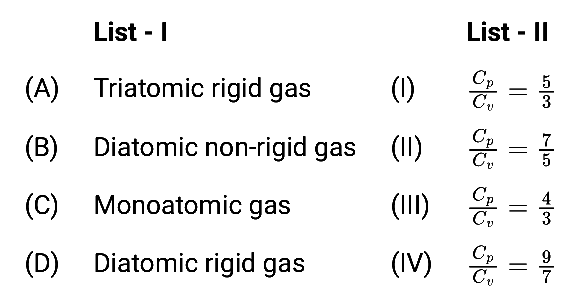
Choose the correct answer from the options given below:
Answer: (a)
Degrees of Freedom & Internal Energy
500 gram of a diatomic gas is enclosed at a pressure of . The density of the gas is . The energy of one mole of the gas due to its thermal motion is [consider the gas molecule as a rigid rotator]
Answer: (b)
Degrees of Freedom & Internal Energy
The internal energy of air in sized room at 1 atmospheric pressure will be___________________
(Consider air as diatomic molecule)
Numerical answer type. Work it out, then open the answer.
Answer: 12
Degrees of Freedom & Internal Energy
The translational degrees of freedom and rotational degrees of freedom of molecule are:
Answer: (b)
Degrees of Freedom & Internal Energy
Energy of 10 non rigid diatomic molecules at temperature is:
Answer: (d)
Degrees of Freedom & Internal Energy
A gas mixture consists of 8 moles of argon and 6 moles of oxygen at temperature T. Neglecting all vibrational modes, the total internal energy of the system is:
Answer: (b)
Degrees of Freedom & Internal Energy
moles of a polyatomic gas must be mixed with two moles of a monoatomic gas so that the mixture behaves as a diatomic gas. The value of is:
Answer: (c)
Degrees of Freedom & Internal Energy
An insulated container contains a diatomic gas of molar mass ' m '. The container is moving with velocity ' ', if it is stopped suddenly, the change in temperature is ( gas constant)
Answer: (b)
Degrees of Freedom & Internal Energy
An insulated container contains a monoatomic gas of molar mass ' '. The container is moving with velocity ' '. If it is stopped suddenly, the change in temperature is ( gas constant)
Answer: (b)
Degrees of Freedom & Internal Energy
Three vessels of equal volume contain gases at the same temperature and pressure. The first vessel contains neon (monoatomic), the second contains chlorine (diatomic) and third contains uranium hexafluoride (polyatomic). Arrange these on the basis of their root mean square speed and choose the correct answer from the options given below:
Answer: (b)
Degrees of Freedom & Internal Energy
Match List I with List II:
Choose the correct answer from the options given below:
| List I | List II | ||
| (A) | 3 Translational degrees of freedom | (I) | Monoatomic gases |
| (B) | 3 Translational, 2 rotational degrees of freedom | (II) | Polyatomic gases |
| (C) | 3 Translational, 2 rotational and 1 vibrational degrees of freedom | (III) | Rigid diatomic gases |
| (D) | 3 Translational, 3 rotational and more than one vibrational degrees of freedom | (IV) | Nonrigid diatomic gases |
Answer: (a)
Degrees of Freedom & Internal Energy
The internal energy of a monoatomic ideal gas molecule is
Answer: (b)
Degrees of Freedom & Internal Energy
A gas mixture consists of 2 moles of oxygen and 4 moles of neon at temperature T. Neglecting all vibrational modes, the total internal energy of the system will be,
Answer: (d)
Degrees of Freedom & Internal Energy
An insulated container contains a monoatomic gas of molar mass ''. The container is moving with velocity ''. If it is stopped suddenly, the change in temperature of a gas is [R is gas constant]
Answer: (c)
Degrees of Freedom & Internal Energy
Three vessels of equal capacity have gases at the same temperature and pressure. The first vessel contains helium (monoatomic), the second contains fluorine (diatomic) and the third contains sulfur hexafluoride (polyatomic). The correct statement, among the following is:
Answer: (d)
Degrees of Freedom & Internal Energy
The total internal energy of two mole monoatomic ideal gas at temperature T = 300 K will be _____________ J. (Given R = 8.31 J/mol.K)
Numerical answer type. Work it out, then open the answer.
Answer: 7479
Degrees of Freedom & Internal Energy
A thermally insulated vessel contains an ideal gas of molecular mass M and ratio of specific heats 1.4. Vessel is moving with speed v and is suddenly brought to rest. Assuming no heat is lost to the surrounding and vessel, temperature of the gas increases by:
(R = universal gas constant)
Answer: (b)
Degrees of Freedom & Internal Energy
Internal energy of moles of hydrogen at temperature '' is equal to internal energy of '' moles of helium at temperature , then the ratio is
[Degree of freedom of , Degree of freedom of ]
Answer: (b)
Degrees of Freedom & Internal Energy
Two ideal polyatomic gases at temperatures T1 and T2 are mixed so that there is no loss of energy. If F1 and F2, m1 and m2, n1 and n2 be the degrees of freedom, masses, number of molecules of the first and second gas respectively, the temperature of mixture of these two gases is:
Answer: (b)
Degrees of Freedom & Internal Energy
The volume V of an enclosure contains a mixture of three gases, 16 g of oxygen, 28 g of nitrogen and 44 g of carbon dioxide at absolute temperature T. Consider R as universal gas constant. The pressure of the mixture of gases is:
Answer: (d)
Degrees of Freedom & Internal Energy
The internal energy (U), pressure (P) and volume (V) of an ideal gas are related as U 3PV + 4. The gas is:
Answer: (c)
Degrees of Freedom & Internal Energy
A monoatomic gas of mass 4.0 u is kept in an insulated container. Container is moving with velocity 30 m/s. If container is suddenly stopped then change in temperature of the gas (R = gas constant) is . Value of x is ___________.
Numerical answer type. Work it out, then open the answer.
Answer: 3600
Degrees of Freedom & Internal Energy
Molecules of an ideal gas are known to have three translational degrees of freedom and two rotational degrees of freedom.The gas is maintained at a temperature of T. The total internal energy, U of a mole of this gas, and the value of
are given, respectively by:
Answer: (a)
Degrees of Freedom & Internal Energy
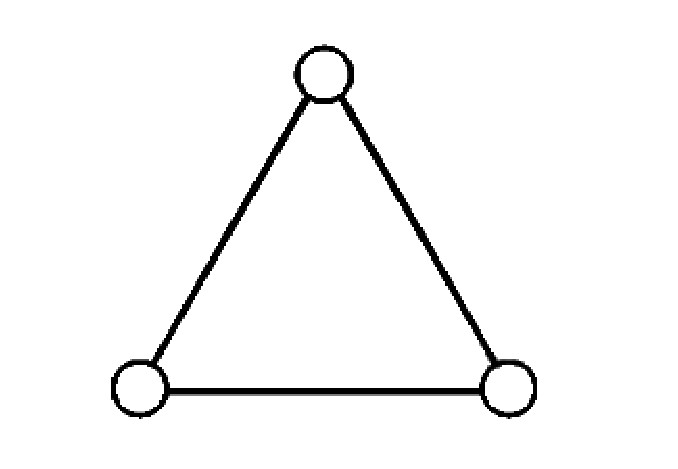
Consider a gas of triatomic molecules. The molecules are assumed to be triangular and made of massless rigid rods whose vertices are occupied by atoms. The internal energy of a mole of the gas at temperature T is:
Answer: (d)
Degrees of Freedom & Internal Energy
A gas mixture consists of 3 moles of oxygen and 5 moles of argon at temperature T. Assuming the gases to be ideal and the oxygen bond to be rigid, the total internal energy (in units of RT) of the mixture is:
Answer: (c)
Degrees of Freedom & Internal Energy
A closed vessel contains 0.1 mole of a monoatomic ideal gas at 200 K. If 0.05 mole of the same gas at 400 K is added to it, the final equilibrium temperature (in K) of the gas in the vessel will be close to _______.
Numerical answer type. Work it out, then open the answer.
Answer: 266
Degrees of Freedom & Internal Energy
Initially a gas of diatomic molecules is contained in a cylinder of volume V1 at a pressure P1 and temperature 250 K. Assuming that 25% of the molecules get dissociated causing a change in number of moles. The pressure of the resulting gas at temperature 2000 K, when contained in a volume 2V1 is given by P2. The ratio is ________.
Numerical answer type. Work it out, then open the answer.
Answer: 5
Degrees of Freedom & Internal Energy
A gas mixture consists of 3 moles of oxygen and 5 moles of argon at temperature T. considering only translational and rotational modes, the total internal energy of the system is:
Answer: (d)
Degrees of Freedom & Internal Energy
Two kg of a monoatomic gas is at a pressure of 4 104 N/m2. The density of the gas is 8 kg/m3. What is the order of energy of the gas due to its thermal motion?
Answer: (a)
Degrees of Freedom & Internal Energy
A gas mixture consists of 2 moles of O2 and 4 moles of Ar at temperature T. Neglecting all vibrational modes, the total internal energy of the system is
Answer: (c)
Degrees of Freedom & Internal Energy
N moles of a diatomic gas in a cylinder are at a temperature T. Heat is supplied to the cylinder such that the temperature remains constant but n moles of the diatomic gas get converted into monoatomic gas. What is the change in the total kinetic energy of the gas?
Answer: (a)
Degrees of Freedom & Internal Energy
This question has Statement-1 and Statement-2. Of the four choices given after the Statements, choose the one that best describes the two Statements.
Statement 1: The internal energy of a perfect gas is entirely kinetic and depends only on absolute temperature of the gas and not on its pressure or volume.
Statement 2: A perfect gas is heated keeping pressure constant and later at constant volume. For the same amount of heat the temperature of the gas at constant pressure is lower than that at constant volume.
Answer: (c)
Degrees of Freedom & Internal Energy
Three perfect gases at absolute temperatures and are mixed. The masses of molecules are and and the number of molecules are and respectively. Assuming no loss of energy, the final temperature of the mixture is:
Answer: (a)
Degrees of Freedom & Internal Energy
A thermally insulated vessel contains an ideal gas of molecular mass and ratio of specific heats It is moving with speed and it's suddenly brought to rest. Assuming no heat is lost to the surroundings, Its temperature increases by:
Answer: (c)
Degrees of Freedom & Internal Energy
One of a diatomic gas is at a pressure of The density of the gas is . What is the energy of the gas due to its thermal motion?
Answer: (a)
Degrees of Freedom & Internal Energy
Two rigid boxes containing different ideal gases are placed on a table. Box A contains one mole of nitrogen at temperature while Box contains one mole of helium at temperature The boxes are then put into thermal contact with each other, and heat flows between them until the gases reach a common final temperature (ignore the heat capacity of boxes). Then, the final temperature of the gases, in terms of is
Answer: (c)
Degrees of Freedom & Internal Energy
To find out degree of freedom, the expansion is
Answer: (a)
Degrees of Freedom & Internal Energy
The degrees of freedom of a molecule of a triatomic gas are
Answer: (c)
Degrees of Freedom & Internal Energy
The number of translational degrees of freedom for a diatomic gas is
Answer: (b)
Degrees of Freedom & Internal Energy
Three containers of the same volume contain three different gases. The masses of the molecules are and and the number of molecules in their respective containers are and . The gas pressure in the containers are and respectively. All the gases are now mixed and put in one of these containers. The pressure of the mixture will be
Answer: (c)
Degrees of Freedom & Internal Energy
An ideal gas is in thermodynamic equilibrium. The number of degrees of freedom of a molecule of the gas is . The internal energy of one mole of the gas is and the speed of sound in the gas is . At a fixed temperature and pressure, which of the following is the correct option?
Answer: (c)
Step-by-step solution coming soon.
Degrees of Freedom & Internal Energy
Assertion: Vibrational degree of freedom of a di-atomic gas molecule appears at very high temperature.
Reason: Di-atomic gas has two vibrational degrees of freedom in one direction.
Answer: (b)
Step-by-step solution coming soon.
Degrees of Freedom & Internal Energy
Assertion: Internal energy of an ideal gas does not depend on volume of gas.
Reason: Internal energy depends only on temperature of gas.
Answer: (a)
Step-by-step solution coming soon.
Degrees of Freedom & Internal Energy
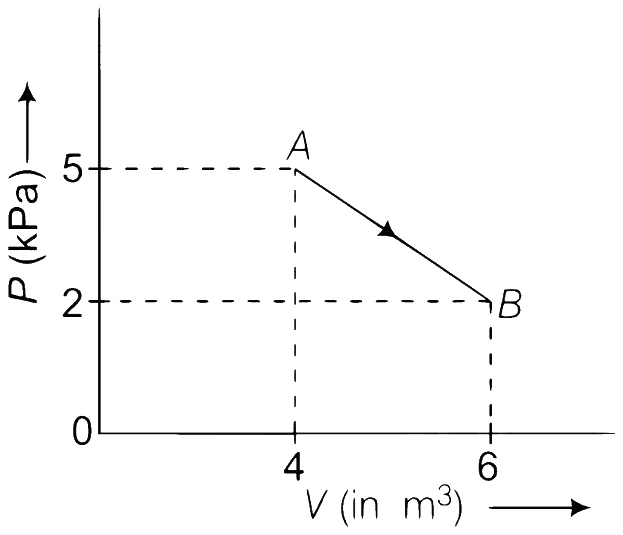
One mole of an ideal diatomic gas undergoes transition from A to B along a path AB as shown below.
The change in internal energy of the gas during the transition is
Answer: (c)
Step-by-step solution coming soon.
Degrees of Freedom & Internal Energy
Assertion: The molecules of a monoatomic gas has three degrees of freedom.
Reason: The molecules of diatomic gas has five degrees of freedom.
Answer: (b)
Step-by-step solution coming soon.
Degrees of Freedom & Internal Energy
Assertion : The molecules of a monoatomic gas has three degrees of freedom.
Reason : The molecules of a diatomic gas has five degrees of freedom.
Answer: (b)
Step-by-step solution coming soon.
Degrees of Freedom & Internal Energy
Assertion : The molecules of a monatomic gas has three degree of freedom.
Reason : The molecules of a diatomic gas has five degree of freedom.
Answer: (b)
Step-by-step solution coming soon.
Degrees of Freedom & Internal Energy
Two rigid boxes containing different ideal gases are placed on table. Box contains one mole of nitrogen at temperature , while box contains one mole of helium at temperature . The boxes are then put into thermal contact with each other, and heat flows between them until the gases reach a common final temperature (Ignore the heat capacity of boxes). Then, the final temperature of the gases, , in terms of is
Answer: (c)
Step-by-step solution coming soon.
Degrees of Freedom & Internal Energy
Graph of specific heat at constant volume for a monatomic gas is
Answer: (c)
Step-by-step solution coming soon.
Degrees of Freedom & Internal Energy
If a gas mixture contains moles of and moles of Ar at temperature , then what will be the total energy of the system (neglecting all vibrational modes)
Answer: (a)
Step-by-step solution coming soon.
Degrees of Freedom & Internal Energy
Find the mass of oxygen gas with which degrees of freedom are associated at N.T.P. Given: molar mass of diatomic gas, oxygen is and oxygen molecule possesses three translational and two rotational degrees of freedom.
Answer: (d)
Step-by-step solution coming soon.
Degrees of Freedom & Internal Energy
The total number of degrees of freedom associated with of Nitrogen gas at normal temperature and pressure is:
[Given Avogadro number as '']
Answer: (c)
Step-by-step solution coming soon.
Degrees of Freedom & Internal Energy
Internal energy of moles of hydrogen at temperature is equal to internal energy of moles of helium at temperature . The ratio is
Answer: (a)
Step-by-step solution coming soon.
Degrees of Freedom & Internal Energy
A gas mixture contains monoatomic and diatomic molecules of moles each. The mixture has a total internal energy of (symbols have usual meanings)
Answer: (c)
Step-by-step solution coming soon.
Degrees of Freedom & Internal Energy
Internal energy of an ideal gas depends only on
Answer: (c)
Step-by-step solution coming soon.
Degrees of Freedom & Internal Energy
If the temperature of moles of helium gas is increased by , then the change in the internal energy of helium gas is
Answer: (c)
Step-by-step solution coming soon.
Degrees of Freedom & Internal Energy
If a gaseous mixture consists of moles of oxygen and moles of argon at an absolute temperature , then the total internal energy of the mixture is (neglect vibrational modes and = universal gas constant)
Answer: (c)
Step-by-step solution coming soon.
Degrees of Freedom & Internal Energy
The internal energy of moles of a monoatomic gas at a temperature of is ( = universal gas constant)
Answer: (c)
Step-by-step solution coming soon.
Degrees of Freedom & Internal Energy
If the internal energy of moles of a gas at a temperature of is , then the number of degrees of freedom of the gas is ( = universal gas constant)
Answer: (b)
Step-by-step solution coming soon.
Degrees of Freedom & Internal Energy
The internal energy of one mole of a rigid diatomic gas at absolute temperature is
Answer: (c)
Step-by-step solution coming soon.
Degrees of Freedom & Internal Energy
If the ratio of specific heats of a gas at constant pressure and at constant volume is , then the number of degrees of freedom of the rigid molecules of the gas is
Answer: (b)
Step-by-step solution coming soon.
Degrees of Freedom & Internal Energy
A gaseous mixture consists of moles of oxygen and moles of argon at an absolute temperature . Neglecting all vibrational modes, the total internal energy of the mixture of the gases is
Answer: (d)
Step-by-step solution coming soon.
Degrees of Freedom & Internal Energy
If moles of an ideal monoatomic gas at a temperature of is mixed with moles of another ideal monoatomic gas at a temperature of , then the temperature of the mixture of the two gases is
Answer: (b)
Step-by-step solution coming soon.
Degrees of Freedom & Internal Energy
A monoatomic gas of moles is heated from temperature to under two different conditions, (i) at constant volume and (ii) at constant pressure. The change in internal energy of the gas is
Answer: (c)
Step-by-step solution coming soon.
Degrees of Freedom & Internal Energy
An ideal gas is kept in a cylinder of volume at a pressure of . The energy of the gas is
Answer: (c)
Step-by-step solution coming soon.
Degrees of Freedom & Internal Energy
The total internal energy of moles of a monoatomic gas at a temperature is . The total internal energy of moles of a diatomic gas at a temperature is
Answer: (b)
Step-by-step solution coming soon.
Degrees of Freedom & Internal Energy
The number of rotational degrees of freedom of a monatomic molecule is
Answer: (c)
Step-by-step solution coming soon.
Degrees of Freedom & Internal Energy
moles of a monatomic gas requires heat energy to be heated from to at constant volume. The heat energy required to raise the temperature of moles of a diatomic gas from to at constant volume is
Answer: (d)
Step-by-step solution coming soon.
Degrees of Freedom & Internal Energy
The number of rotational degrees of freedom of a diatomic molecule
Answer: (c)
Step-by-step solution coming soon.
Degrees of Freedom & Internal Energy
The number of vibrational degree of freedom of a diatomic molecule is
Answer: (b)
Step-by-step solution coming soon.
Degrees of Freedom & Internal Energy
In non-rigid diatomic molecule with an additional vibrational mode
Answer: (a)
Step-by-step solution coming soon.
Degrees of Freedom & Internal Energy
Which one of the graphs below best illustrates the relationship between internal energy of an ideal gas and temperature of the gas in K?
Answer: (a)
Step-by-step solution coming soon.
Degrees of Freedom & Internal Energy
moles of monoatomic gas and one mole of rigid diatomic gas are mixed. The internal energy (in kJ) of the gaseous mixture at a temperature of is
(Universal gas constant )
Answer: (d)
Step-by-step solution coming soon.
Degrees of Freedom & Internal Energy
The total internal energy of moles of a diatomic gas at a temperature of is (gas constant )
Answer: (c)
Step-by-step solution coming soon.
Degrees of Freedom & Internal Energy
Ratio of translational degrees of freedom to rotational degrees of freedom of a polyatomic linear gas molecule is
Answer: (d)
Step-by-step solution coming soon.
Degrees of Freedom & Internal Energy
How many rotational degrees of freedom does a rigid diatomic molecule have?
Answer: (c)
Step-by-step solution coming soon.
Degrees of Freedom & Internal Energy
If a gas has degrees of freedom, then the ratio of is
Answer: (a)
Step-by-step solution coming soon.
Degrees of Freedom & Internal Energy
What will be the molar specific heat at constant volume of an ideal gas consisting of rigid diatomic molecules?
Answer: (b)
Step-by-step solution coming soon.
Degrees of Freedom & Internal Energy
An ideal gas inside a container is heated such that its internal energy changes at a slow constant rate . Due to a leak in the container, the density of gas inside the container decreases at a slow constant rate . Then, the rate of change of pressure inside the container must
Answer: (b)
Step-by-step solution coming soon.
No questions match these filters.