
Thermodynamic Processes
We consider a thermodynamic system. If is the increase in internal energy and is the work done by the system, which one of the following statement is true?
Show answer and solution
Answer: (a)
Loading the solution…
Home›Practice Hub›Chapters›Thermodynamics›Thermodynamic Processes
Thermodynamics PYQs · MHT CET · JEE Main · NEET
 Thermodynamics · Lecture 2 · Isothermal & Adiabatic Process51:57
 Thermodynamics · Lecture 3 · Adiabatic Process PYQs1:18:13
 Thermodynamics Part 1 · Thermodynamic Process & System1:10:24All 7 Thermodynamics videos →
Thermodynamic Processes
We consider a thermodynamic system. If is the increase in internal energy and is the work done by the system, which one of the following statement is true?
Answer: (a)
Thermodynamic Processes
Out of the following relations which one is true in the case of an adiabatic process, where ?
Answer: (a)
Thermodynamic Processes
The thermodynamic process in which no work is done by the gas or on the gas is
Answer: (d)
Thermodynamic Processes
When the temperature of 4 moles of a gas was increased from C to C, at constant volume, the change in internal energy was J. The total heat capacity of the gas at constant volume is
Answer: (c)
Thermodynamic Processes
In thermodynamic isobaric process
Answer: (c)
Thermodynamic Processes
Heat is supplied to a diatomic gas at constant pressure. Then the ratio of is ______.
Answer: (d)
Thermodynamic Processes
If a gas is compressed isothermally then the r.m.s. velocity of the molecules
Answer: (b)
Thermodynamic Processes
A thermodynamic system is compressed adiabatically, then its temperature
Answer: (c)
Thermodynamic Processes
In an adiabatic expansion, the temperature of one mole of an ideal monatomic gas ( ) decreases from 60 K to 50 K. The work done by the gas in the process is:
(Take the universal gas constant as )
Answer: (d)
Thermodynamic Processes
In an adiabatic process, which one of the following statement is true?
Answer: (c)
Thermodynamic Processes
Consider the following statements:
A. Zeroth law of thermodynamics gives concept of temperature
B. First law of thermodynamics gives concept of internal energy
C. In isothermal expansion of ideal gas,
D. Product of intensive and extensive variables is extensive
E. The ratio of any extensive variable to mass will be an extensive variable
Choose the correct combination of statements from the options given below:
Answer: (c)
Thermodynamic Processes
A vessel contains 0.15 m3 of a gas at pressure 8 bar and temperature 140 °C with and . It is expanded adiabatically till pressure falls to 1 bar. The work done during this process is _________ kJ. (R is gas constant)
Numerical answer type. Work it out, then open the answer.
Answer: 120
Thermodynamic Processes
A diatomic gas does 100 J of work when it is expanded isobarically. Then the heat given to the gas ______ J.
Numerical answer type. Work it out, then open the answer.
Answer: 350
Thermodynamic Processes
Heat is supplied to a rigid diatomic gas at constant pressure. The ratio of is heat supplied change in internal energy work done during expansion
Answer: (c)
Thermodynamic Processes
Two moles of a rigid diatomic gas does a work when the amount of heat supplied is . In this process the total heat capacity of the gas is ( = gas constant)
Answer: (d)
Thermodynamic Processes
How much heat energy in joule must be supplied to g of nitrogen at room temperature to raise its temperature by C at constant pressure?
(molecular wt. of nitrogen = g, = gas constant) (gas is diatomic)
Answer: (c)
Thermodynamic Processes
If the ratio of molar heat capacities then the ratio of and in an isobaric process is
Answer: (b)
Thermodynamic Processes
Heat required to raise the temperature of 2 mol of an ideal gas at constant pressure from C to C is 310 J. The amount of heat required to raise the temperature of the gas through the same range at constant volume is
( J/mol K)
Answer: (b)
Thermodynamic Processes
Six moles of oxygen gas is heated from C to C at constant volume. If specific heat capacity at constant pressure is cal molk and gas constant is cal molk . The change in internal energy of the gas is
Answer: (d)
Thermodynamic Processes
The r.m.s. speed of hydrogen at S.T.P. is '' m/s. If the gas is heated at constant pressure till its volume becomes three times, the final temperature of the gas and the r.m.s. speed are respectively
Answer: (c)
Thermodynamic Processes
Two cylinders A and B fitted with pistons contain equal amount of an ideal diatomic gas at 303 K. The piston of cylinder A is free to move and that of cylinder B is held fixed. The same amount of heat is given to the gas in each cylinder. If the rise in temperature of the gas in cylinder B is 63 K then the rise in temperature of the gas in A is
Answer: (c)
Thermodynamic Processes
The heat energy that must be supplied to 14 g of nitrogen at room temperature to raise its temperature by C at constant pressure is ( = gas constant, Molecular weight of nitrogen = 28)
Answer: (b)
Thermodynamic Processes
The change in internal energy of the mass of gas, when the volume changes from V to 2V at constant pressure P is ( is the ratio of specific heat at constant pressure to that of volume) ()
Answer: (a)
Thermodynamic Processes
If is the amount of heat supplied to 'n' moles of a rigid diatomic gas at constant pressure, is the change in internal energy and is the work done then is
Answer: (a)
Thermodynamic Processes
5 moles of unknown gas is heated at constant volume from 10°C to 20°C. The molar specific heat of this gas at constant pressure cal/mol.°C and J/mol.°C. The change in the internal energy of the gas is __________ calorie.
Numerical answer type. Work it out, then open the answer.
Answer: 300
Thermodynamic Processes
10 mole of oxygen is heated at constant volume from to . The change in the internal energy of the gas is ______ cal. (The molecular specific heat of oxygen at constant pressure, and
Numerical answer type. Work it out, then open the answer.
Answer: 500
Thermodynamic Processes
Two identical containers A and B with friction-less pistons contain the same ideal gas at the same temperature and the same volume, . The mass of gas in A is and that in B is . The gas in each cylinder is now allowed to expand isothermally to the same final volume . The changes in pressure in A and B are found to be and respectively. Then
Answer: (c)
Thermodynamic Processes
The temperature of an ideal gas increases times when compressed adiabatically to half the volume. Its equation of state is
Answer: (d)
Thermodynamic Processes
During an adiabatic process, the pressure of a gas is found to be proportional to the cube of its temperature. The ratio for the gas is
Answer: (d)
Thermodynamic Processes
A rigid diatomic gas is compressed adiabatically to volume , where is the initial volume. The initial temperature of the gas is ' ' K and the final temperature is ' ' K. The value of is
Answer: (c)
Thermodynamic Processes
An ideal gas () is expanded adiabatically. To reduce the root mean square velocity of molecules two times, the gas should be expanded
Answer: (b)
Thermodynamic Processes
A gas at normal temperature is suddenly compressed to one-fourth of its original volume. If , then the increase in the temperature of the gas in Kelvin is ( is the ratio of specific heats)
Answer: (a)
Thermodynamic Processes
An ideal gas at C is compressed adiabatically to of its original volume. If , then the rise in temperature of a gas is
Answer: (c)
Thermodynamic Processes
An ideal gas is expanded adiabatically. How many times has the gas to be expanded to reduce the r.m.s. speed of molecules 3 times? ()
Answer: (d)
Thermodynamic Processes
A monoatomic gas is stored in a thermally insulated container and the gas is suddenly compressed to of its initial volume. The ratio of final pressure to initial pressure is
Answer: (c)
Thermodynamic Processes
A sample of gas at temperature is adiabatically expanded to double its volume. The work done by the gas in the process is (given, ):
Answer: (d)
Thermodynamic Processes
An ideal gas expands adiabatically (). To reduce the r.m.s. velocity of the molecules 3 times the gas has to be expanded
Answer: (b)
Thermodynamic Processes
Initial pressure and volume of a monoatomic ideal gas are and . The change in internal energy of this gas in adiabatic expansion to volume final is ______ J.
Answer: (c)
Thermodynamic Processes
The volume of an ideal gas increases 8 times and temperature becomes th of initial temperature during a reversible change. If there is no exchange of heat in this process then identify the gas from the following options (Assuming the gases given in the options are ideal gases):
Answer: (d)
Thermodynamic Processes
An ideal gas having pressure , volume and temperature is expanded isothermally, to a volume and final pressure . The same gas is expanded adiabatically to a volume , the final pressure being . The ratio is
Answer: (c)
Thermodynamic Processes
An ideal gas with pressure P, volume V and temperature T is expanded isothermally to volume 2V and a final pressure . The same gas is expanded adiabatically to a volume 2V then the final pressure is . In terms of , the ratio of the two specific heats for the gas, the ratio is
Answer: (c)
Thermodynamic Processes
Two samples A and B of gas initially at the same pressure and temperature. They are compressed from volume to (A isothermally and B adiabatically). The relation between pressure of the gas A () and pressure of gas B () is
Answer: (a)
Thermodynamic Processes
One mole of an ideal diatomic gas expands from volume to isothermally at a temperature and does joule of work. If the gas undergoes same magnitude of expansion adiabatically from doing the same amount of work , then its final temperature will be (close to)
Answer: (a)
Thermodynamic Processes
A monoatomic gas undergoes adiabatic change. Its pressure and temperature are related as where is
Answer: (b)
Thermodynamic Processes
An ideal rigid diatomic gas undergoes an adiabatic change. If the relation between temperature and volume is constant then the value of x is
Answer: (c)
Thermodynamic Processes
A rigid diatomic gas undergoes adiabatic change. Its pressure P and temperature T are related as where x is
Answer: (c)
Thermodynamic Processes
One mole of diatomic gas having rotational modes only is kept in a cylinder with a piston system. The cross-section area of the cylinder is . The gas is heated slowly to raise the temperature by during which the piston moves by 25 mm. The amount of heat supplied to the gas is ______ J. (Atmospheric pressure ) (Neglect mass of the piston)
Answer: (b)
Thermodynamic Processes
The internal energy of a monoatomic gas is 3nRT. One mole of helium is kept in a cylinder having internal cross section area of and fitted with a light movable frictionless piston. The gas is heated slowly by suppling 126 J heat. If the temperature rises by , then the piston will move ______ cm.
(atmospheric pressure )
Answer: (c)
Thermodynamic Processes
A monoatomic ideal gas, initially at temperature is enclosed in a cylinder fitted with a frictionless piston. The gas is allowed to expand adiabatically to a temperature by releasing the piston suddenly. If and be the lengths of the gas column before and after expansion respectively, then is
Answer: (d)
Thermodynamic Processes
A cylinder with adiabatic walls is closed at both ends and is divided into two compartments by a frictionless adiabatic piston. Ideal gas is filled in both (left and right) the compartments at same . Heating is started from left side until pressure changes to . If initial volume of each compartment was 9 litres then the final volume in right-hand side compartment is ______ litres. (for this ideal gas )
Answer: (b)
Thermodynamic Processes
A monoatomic gas at pressure P having volume V expands isothermally to a volume 3V and then adiabatically to a volume 81 V. The final pressure of the gas is ().
Answer: (d)
Thermodynamic Processes
An ideal gas undergoes a process maintaining relation between pressure and as
, where and are constants. If two samples and (two moles each) with initial volumes and respectively undergo above mentioned process and attain same pressure, then the difference at the temperatures of these samples, is ______. ( gas constant)
Answer: (b)
Thermodynamic Processes
In the thermodynamic processes, which of the following statements is NOT true?
Answer: (c)
Thermodynamic Processes
Heat supplied increase in internal energy dU is true for
Answer: (d)
Thermodynamic Processes
During thermodynamic process, the increase in internal energy of a system is equal to the done on the system. Which process does the system undergo?
Answer: (b)
Thermodynamic Processes
Match List - I with List - II.
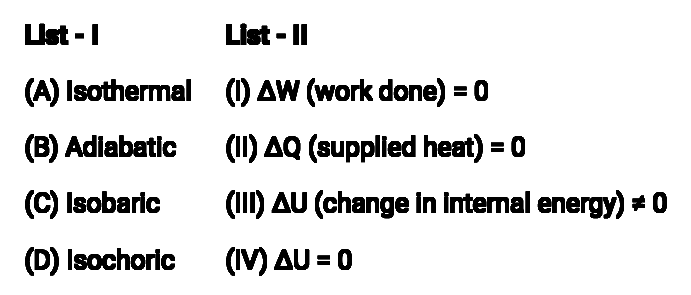
Choose the correct answer from the options given below:
Answer: (c)
Thermodynamic Processes
Identify the characteristics of an adiabatic process in a monoatomic gas.
(A) Internal energy is constant.
(B) Work done in the process is equal to the change in internal energy.
(C) The product of temperature and volume is a constant.
(D) The product of pressure and volume is a constant.
(E) The work done to change the temperature from to is proportional to . Choose the correct answer from the options given below:
Answer: (b)
Thermodynamic Processes
Match the List - I with List - II
Choose the correct answer from the options given below:
| List - I | List - II | ||
| (A) | Pressure varies inversely with volume of an ideal gas. | (I) | Adiabatic process |
| (B) | Heat absorbed goes partly to increase internal energy and partly to do work. | (II) | Isochoric process |
| (C) | Heat is neither absorbed nor released by a system. | (III) | Isothermal process |
| (D) | No work is done on or by a gas. | (IV) | Isobaric process |
Answer: (d)
Thermodynamic Processes
Heat is given to an ideal gas in an isothermal process. Then
A. internal energy of the gas will decrease.
B. internal energy of the gas will increase.
C. internal energy of the gas will not change.
D. the gas will do negative work.
Answer: (b)
Thermodynamic Processes
If a gas is compressed isothermally then the r.m.s. velocity of its molecules
Answer: (c)
Thermodynamic Processes
When the heat is given to a gas in an Isothermal process, then there will be
Answer: (a)
Thermodynamic Processes
During the isothermal expansion, a confined ideal gas does of work against its surroundings. This means that
Answer: (b)
Thermodynamic Processes
The work done in an adiabatic change in an ideal gas depends upon only:
Answer: (b)
Thermodynamic Processes
In an adiabatic process, which of the following statements is true?
Answer: (b)
Thermodynamic Processes
Match List - I with List - II.
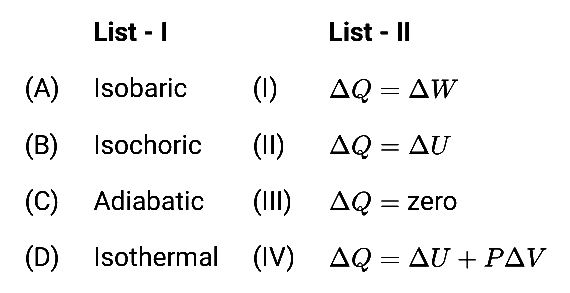
Heat supplied
Work done by the system
Change in internal energy
Pressure of the system
Change in volume of the system
Choose the correct answer from the options given below:
Answer: (b)
Thermodynamic Processes
An ideal gas exists in a state with pressure , volume . It is isothermally expanded to 4 times of its initial volume , then isobarically compressed to its original volume. Finally the system is heated isochorically to bring it to its initial state. The amount of heat exchanged in this process is
Answer: (b)
Thermodynamic Processes
Given below are two statements. One is labelled as Assertion (A) and the other is labelled as Reason (R).
Assertion (A): With the increase in the pressure of an ideal gas, the volume falls off more rapidly in an isothermal process in comparison to the adiabatic process.
Reason (R): In isothermal process, PV = constant, while in adiabatic process = constant. Here is the ratio of specific heats, P is the pressure and V is the volume of the ideal gas. In the light of the above statements, choose the correct answer from the options given below:
Answer: (d)
Thermodynamic Processes
Given below are two statements. One is labelled as Assertion (A) and the other is labelled as Reason (R).
Assertion (A): In an insulated container, a gas is adiabatically shrunk to half of its initial volume. The temperature of the gas decreases.
Reason (R): Free expansion of an ideal gas is an irreversible and an adiabatic process. In the light of the above statements, choose the correct answer from the options given below:
Answer: (c)
Thermodynamic Processes
Two cylinders A and B fitted with piston contain equal amount of an ideal diatomic gas at temperature T K. The piston of cylinder A is free to move while that of cylinder is held fixed. The same amount of heat is given to the gas in each cylinder. If the rise of temperature of the gas in A is , then the rise in temperature of the gas in B is
Answer: (c)
Thermodynamic Processes
The heat energy that must be supplied to 14 gram of nitrogen at room temperature to raise its temperature by at constant pressure is (Molecular weight of nitrogen gas constant, for diatomic gas)
Answer: (b)
Thermodynamic Processes
A sample of an ideal gas is heated at constant pressure. If 100 J of heat is supplied to the gas, the work done by the gas is
Answer: (c)
Thermodynamic Processes
In an isobaric process of an ideal gas, the ratio of heat supplied and work done by the system is .
Answer: (c)
Thermodynamic Processes
When an ideal gas is heated under constant pressure, then what percentage of given heat energy will be utilised in doing external work?
Answer: (d)
Thermodynamic Processes
Two cylinders A and B fitted with pistons contain equal amount of an ideal rigid diatomic gas at 303 K. The piston of cylinder is free to move and that of cylinder B is held fixed. The same amount heat is given to the gas in each cylinder. If the rise in temperature of the gas in cylinder B is 49 K, then the rise in temperature of the gas in is
Answer: (b)
Thermodynamic Processes
The change in the internal energy of the mass of gas, when the volume changes from V to 2 V at constant pressure P is
Answer: (d)
Thermodynamic Processes
A monoatomic ideal gas is heated at constant pressure. The percentage of total heat used in increasing the internal energy and that used for doing external work is and respectively. Then the ratio, is
Answer: (c)
Thermodynamic Processes
An ideal gas goes from an initial state to final state. During the process, the pressure of gas increases linearly with temperature.
A. The work done by gas during the process is zero.
B. The heat added to gas is different from change in its internal energy.
C. The volume of the gas is increased.
D. The internal energy of the gas is increased.
E. The process is isochoric (constant volume process)
Choose the correct answer from the options given below:
Answer: (b)
Thermodynamic Processes
The temperature of 1 mole of an ideal monoatomic gas is increased by at constant pressure. The total heat added and change in internal energy are and , respectively. If then the value of is _________.
Numerical answer type. Work it out, then open the answer.
Answer: 15
Thermodynamic Processes
A gas having and volume 360 c.c. is suddenly compressed to 90 c.c. If the initial pressure of the gas is P, then the final pressure will be
Answer: (d)
Thermodynamic Processes
An ideal gas expands adiabatically, . To reduce the r.m.s. velocity of the molecules 4 times, the gas has to be expanded
Answer: (a)
Thermodynamic Processes
A monoatomic ideal gas is compressed adiabatically to of its initial volume. If initial temperature of the gas is ' T ' K and final temperature is ' xT ' K, the value of ' x ' is
Answer: (b)
Thermodynamic Processes
A polyatomic gas is compressed to th of its volume adiabatically. If its initial pressure is , its new pressure will be [Given, ]
Answer: (d)
Thermodynamic Processes
A diatomic gas is compressed adiabatically to volume , where is its initial volume. The initial temperature of the gas is in kelvin and the final temperature is in kelvin. The value of is
Answer: (b)
Thermodynamic Processes
A monoatomic gas having is stored in a thermally insulated container and the gas is suddenly compressed to th of its initial volume. The ratio of final pressure and initial pressure is: ( is the ratio of specific heats of the gas at constant pressure and at constant volume)
Answer: (b)
Thermodynamic Processes
An ideal gas initially at temperature, is compressed suddenly to one fourth of its volume. If the ratio of specific heat at constant pressure to that at constant volume is , the change in temperature due to the thermodynamic process is _________ K.
Numerical answer type. Work it out, then open the answer.
Answer: 273
Thermodynamic Processes
When a diatomic gas (rigid) undergoes adiabatic change, its pressure and temperature are related as . The value of is
Answer: (b)
Thermodynamic Processes
A gas is kept in a container having walls which are thermally non-conducting. Initially the gas has a volume of and temperature . The change in temperature when the gas is adiabatically compressed to is:
(Take is the ratio of specific heats at constant pressure and at constant volume)
Answer: (a)
Thermodynamic Processes
Three samples , and of same gas have equal volumes and temperatures. The volume of each sample is doubled, the process being isothermal for X, adiabatic for Y and isobaric for Z. If the final pressures are equal for the three samples, the ratio of the initial pressures is ( )
Answer: (b)
Thermodynamic Processes
Two gases and are filled at the same pressure in separate cylinders with movable pistons of radius and , respectively. On supplying an equal amount of heat to both the systems reversibly under constant pressure, the pistons of gas and are displaced by 16 cm and 9 cm, respectively. If the change in their internal energy is the same, then the ratio is equal to
Answer: (d)
Thermodynamic Processes
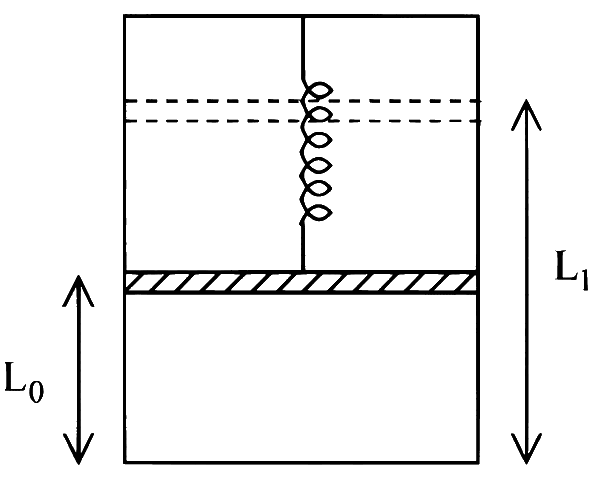
A piston of mass is hung from a massless spring whose restoring force law goes as , where k is the spring constant of appropriate dimension. The piston separates the vertical chamber into two parts, where the bottom part is filled with ' ' moles of an ideal gas. An external work is done on the gas isothermally (at a constant temperature T) with the help of a heating filament (with negligible volume) mounted in lower part of the chamber, so that the piston goes up from a height to , the total energy delivered by the filament is:(Assume spring to be in its natural length before heating)
Answer: (b)
Thermodynamic Processes
A monoatomic ideal gas, initially at temperature is enclosed in a cylinder fitted with massless, frictionless piston. By releasing the piston suddenly, the gas is allowed to expand adiabatically to a temperature . If and are the lengths of the gas columns before and after expansion respectively, then is given by
Answer: (c)
Thermodynamic Processes
A polyatomic gas at pressure P, having volume ' ' expands isothermally to a volume ' 3 V ' and then adiabatically to a volume ' 24 V '. The final pressure of gas is (for moderate temperature changes)
Answer: (d)
Thermodynamic Processes
A gas undergoes a change in which its pressure ' P ' and volume ' V ' are related as constant, where n is a constant. If the specific heat of the gas in this change is zero, then the value of is ( adiabatic ratio)
Answer: (d)
Thermodynamic Processes
In a thermodynamic system ' ' represents the increase in internal energy and ' ' the work done by the system. Which of the following statement is true?
Answer: (a)
Thermodynamic Processes
The internal energy of a gas will increase when it
Answer: (b)
Thermodynamic Processes
In an isobaric process
Answer: (a)
Thermodynamic Processes
A perfect gas of volume 5 litre is compressed isothermally to volume of 1 litre. The r.m.s. speed of the molecules will
Answer: (d)
Thermodynamic Processes
The equilibrium state of a thermodynamic system is described by
A. Pressure
B. Total heat
C. Temperature
D. Volume
E. Work done
Choose the most appropriate answer from the options given below.
Answer: (d)
Thermodynamic Processes
A diatomic gas does of work when it is expanded isobarically. The heat given to the gas in the process is:
Answer: (c)
Thermodynamic Processes
A monoatomic ideal gas is heated at constant pressure. The percentage of total heat used in changing the internal energy is
Answer: (d)
Thermodynamic Processes
An ideal diatomic gas is heated at constant pressure. What is the fraction of total energy applied, which increases the internal energy for the gas?
Answer: (b)
Thermodynamic Processes
The ratio of work done by an ideal rigid diatomic gas to the heat supplied by the gas in an isobaric process is
Answer: (b)
Thermodynamic Processes
The internal energy of an ideal diatomic gas corresponding to volume ' ' and pressure ' P ' is 2.5 PV. The gas expands from 1 litre to 2 litre at a constant pressure of . The heat supplied to a gas is
Answer: (a)
Thermodynamic Processes
A quantity of heat ' ' is supplied to monoatomic ideal gas which expands at constant pressure. The fraction of heat converted into work is
Answer: (c)
Thermodynamic Processes
Two cylinders A and B fitted with piston contain equal amount of an ideal diatomic as at temperature ' T ' K. The piston of cylinder A is free to move while that of B is held fixed. The same amount of heat is given to the gas in each cylinder. If the rise temperature of the gas in A is ' ', then the rise in temperature of the gas in cylinder B is
Answer: (c)
Thermodynamic Processes
In an isobaric process of an ideal gas, the ratio of work done by the system (W) during the expansion and the heat exchanged is
Answer: (d)
Thermodynamic Processes
For an ideal gas, in an isobaric process, the ratio of heat supplied ' ' to the work done ' ' by the system is ( ratio of specific heat at constant pressure to that at constant volume)
Answer: (c)
Thermodynamic Processes
The change in the internal energy of the mass of gas, when the volume changes from ' ' to ' 2 V ' at constant pressure ' ' is ( is the ratio of specific heat of gas at constant pressure to specific heat at constant volume)
Answer: (a)
Thermodynamic Processes
In an isobaric process of an ideal gas, the ratio of work done by the system to the heat supplied is
Answer: (d)
Thermodynamic Processes
A monoatomic gas is heated at constant pressure. The percentage of total heat used for doing external work is
Answer: (b)
Thermodynamic Processes
The r.m.s. velocity of hydrogen at S.T.P. is ' ' . If the gas is heated at constant pressure till its volume becomes three times, then the final temperature of the gas and the r.m.s. speed are respectively
Answer: (a)
Thermodynamic Processes
A fixed mass of gas at constant pressure occupies a volume ' V '. The gas undergoes a rise in temperature so that the r.m.s. velocity of the molecules is doubled. The new volume will be
Answer: (d)
Thermodynamic Processes
A diatomic gas does of work in an isobaric expansion. The heat given to the gas is:
Answer: (c)
Thermodynamic Processes
air is heated at constant volume through . The specific heat of air at constant volume is and joule/ . The change in its internal energy is approximately.
Answer: (c)
Thermodynamic Processes
In ideal gas of is compressed adiabatically to of its original volume. If , the rise in temperature of a gas is
Answer: (b)
Thermodynamic Processes
An ideal gas is expanded adiabatically. To reduce root mean square velocity of molecules two times, the gas should be expanded
Answer: (b)
Thermodynamic Processes
One mole of an ideal gas at an initial temperature of ' ' does ' ' of work adiabatically. If the ratio of specific heats of this gas at constant pressure and at constant volume is , the final temperature of gas will be
Answer: (d)
Thermodynamic Processes
The volume of an ideal gas is changed adiabatically from 5 litres to 4 litres. The ratio of initial pressure to final pressure is:
Answer: (b)
Thermodynamic Processes
A sample of 1 mole gas at temperature is adiabatically expanded to double its volume. If adiabatic constant for the gas is , then the work done by the gas in the process is:
Answer: (b)
Thermodynamic Processes
During an adiabatic process, if the pressure of a gas is found to be proportional to the cube of its absolute temperature, then the ratio of for the gas is:
Answer: (b)
Thermodynamic Processes
A sample of gas at temperature is adiabatically expanded to double its volume. Adiabatic constant for the gas is . The work done by the gas in the process is:
mole
Answer: (b)
Thermodynamic Processes
During an adiabatic process, the pressure of a gas is found to be proportional to the cube of its absolute temperature. The ratio of for the gas is:
Answer: (b)
Thermodynamic Processes
Two gases A and B having same initial state ( ). Now gas A is compressed to by isothermal process and other gas B is compressed to by adiabatic process. The ratio of final pressure of gas and is (Both gases are monoatomic, )
Answer: (b)
Thermodynamic Processes
Initial pressure and volume of a gas are ' P ' and ' ' respectively. First its volume is expanded to ' 4 V ' by isothermal process and then again its volume is reduced to ' V ' by adiabatic process then its final pressure if
Answer: (b)
Thermodynamic Processes
There are two samples A and B of a certain gas, which are initially at the same temperature and pressure. Both are compressed from volume v to . Sample A is compressed isothermally while sample B is compressed adiabatically. The final pressure of is
Answer: (d)
Thermodynamic Processes
In an adiabatic process for an ideal gas, the relation between the universal gas constant ' ' and specific heat at constant volume ' ' is . The pressure ' ' of the gas is proportional to the temperature ' ', of the gas as . The value of constant ' K ' is
Answer: (a)
Thermodynamic Processes
A gas expands in such a way that its pressure and volume satisfy the condition constant. Then the temperature of the gas
Answer: (a)
Thermodynamic Processes
A diatomic gas undergoes adiabatic change. Its pressure P and temperature T are related as where the value of x is
Answer: (a)
Thermodynamic Processes
A total of heat is given to one mole of helium kept in a cylinder. The temperature of helium increases by . The work done by the gas is: Given, .
Answer: (a)
Thermodynamic Processes
The pressure and volume of an ideal gas are related as (Constant). The work done when the gas is taken from state to state is:
Answer: (d)
Thermodynamic Processes
A monoatomic ideal gas, initially at temperature is enclosed in a cylinder fitted with frictionless piston. The gas is allowed to expand adiabatically to a temperature by releasing the piston suddenly. and are the lengths of the gas columns before and after the expansion respectively. The ratio is
Answer: (a)
Thermodynamic Processes
During an experiment, an ideal gas is found to obey an additional law constant. The gas is initially at temperature ' T ' and volume ' V '. What will be the temperature of the gas when it expands to a volume 2 V?
Answer: (c)
Thermodynamic Processes
In a thermodynamic system, represents the increases in its internal energy and dW is the work done by the system then correct statement out of the following is
Answer: (b)
Thermodynamic Processes
Select the WRONG statement from the following. For an isothermal process
Answer: (c)
Thermodynamic Processes
In a thermodynamic process, there is no exchange of heat between the system and surroundings. Then the thermodynamic process is
Answer: (d)
Thermodynamic Processes
The Thermodynamic process, in which internal energy of the system remains constant is
Answer: (d)
Thermodynamic Processes
Match List I with List II
Choose the correct answer from the options given below:
| List I | List II | ||
| A. | Isothermal Process | I. | Work done by the gas decreases internal energy |
| B. | Adiabatic Process | II. | No change in internal energy |
| C. | Isochoric Process | III. | The heat absorbed goes partly to increase internal energy and partly to do work |
| D. | Isobaric Process | IV. | No work is done on or by the gas |
Answer: (c)
Thermodynamic Processes
is the heat energy supplied to an ideal gas under isochoric conditions. If and denote the change in internal energy and the work done respectively then
Answer: (d)
Thermodynamic Processes
If a gas is compressed isothermally then the r.m.s. velocity of the molecules
Answer: (c)
Thermodynamic Processes
In an Isothermal change, the change in pressure and volume of a gas can be represented for three different temperatures; as:
Answer: (b)
Thermodynamic Processes
For an adiabatic process, which one of the following is wrong statement?
Answer: (b)
Thermodynamic Processes
The initial pressure and volume of an ideal gas are P and V. The final pressure of the gas when the gas is suddenly compressed to volume will be:
(Given = ratio of specific heats at constant pressure and at constant volume)
Answer: (d)
Thermodynamic Processes
A gas is compressed adiabatically, which one of the following statements is NOT true?
Answer: (c)
Thermodynamic Processes
A gas is compressed at a constant pressure of from a volume of to a volume of . Energy of is then added to the gas by heating. Its internal energy is
Answer: (a)
Thermodynamic Processes
Heat energy of is given to a diatomic gas allowing the gas to expand at constant pressure. Each gas molecule rotates around an internal axis but do not oscillate. The increase in the internal energy of the gas will be:
Answer: (c)
Thermodynamic Processes
Heat is given to an ideal gas in an isothermal process.
A. Internal energy of the gas will decrease.
B. Internal energy of the gas will increase.
C. Internal energy of the gas will not change.
D. The gas will do positive work.
E. The gas will do negative work.
Choose the correct answer from the options given below:
Answer: (d)
Thermodynamic Processes
The pressure and density of a diatomic gas changes adiabatically from to . If then should be
Answer: (b)
Thermodynamic Processes
A gas at normal temperature is suddenly compressed to one-fourth of its original volume. If , then the increase in its temperature is
Answer: (a)
Thermodynamic Processes
An ideal gas expands adiabatically. To reduce the r.m.s. velocity of the molecules 3 times, the gas has to be expanded
Answer: (a)
Thermodynamic Processes
A diatomic gas is compressed adiabatically to volume where is its initial volume. The initial temperature of the gas is in Kelvin and the final temperature is ' '. The value of '' is
Answer: (b)
Thermodynamic Processes
A sample of gas at temperature is adiabatically expanded to double its volume. The work done by the gas in the process is gas constant
Answer: (d)
Thermodynamic Processes
A gas at N.T.P. is suddenly compressed to onefourth of its original volume. If , then the final pressure is
Answer: (c)
Thermodynamic Processes
A gas at N.T.P. is suddenly compressed to th of its original volume. The final pressure in (Given ratio of sp. heats ) atmosphere is ( original pressure)
Answer: (c)
Thermodynamic Processes
A sample of gas at temperature is adiabatically expanded to double its volume. The work done by the gas in the process is :
Answer: (d)
Thermodynamic Processes
A hypothetical gas expands adiabatically such that its volume changes from 8 litres to 27 litres. If the ratio of final pressure of the gas to initial pressure of the gas is . Then the ratio of will be.
Answer: (b)
Thermodynamic Processes
A monoatomic gas at pressure '', having volume '' expands isothermally to a volume '' and then adiabatically to a volume ' '. The final pressure of the gas is (Take )
Answer: (a)
Thermodynamic Processes
Consider two containers A and B containing monoatomic gases at the same Pressure (P), Volume (V) and Temperature (T). The gas in A is compressed isothermally to of its original volume while the gas in B is compressed adiabatically to of its original volume. The ratio of final pressure of gas in B to that of gas in A is
Answer: (c)
Thermodynamic Processes
A monoatomic ideal gas initially at temperature ' ' is enclosed in a cylinder fitted with massless, frictionless piston. By releasing the piston suddenly the gas is allowed to expand to adiabatically to a temperature ' '. If ' ' and '' are the lengths of the gas columns before and after expansion respectively, then is
Answer: (c)
Thermodynamic Processes
The thermodynamic process in which no work is done on or by the gas is
Answer: (a)
Thermodynamic Processes
A diatomic gas ( = 1.4) does 400J of work when it is expanded isobarically. The heat given to the gas in the process is __________ J.
Numerical answer type. Work it out, then open the answer.
Answer: 1400
Thermodynamic Processes
Starting with the same initial conditions, an ideal gas expands from volume V1 to V2 in three different ways. The work done by the gas is W1 if the process is purely isothermal, W2, if the process is purely adiabatic and W3 if the process is purely isobaric. Then, choose the correct option
Answer: (d)
Thermodynamic Processes
Given below are two statements:
Statement I: When amount of an ideal gas undergoes adiabatic change from state (P1, V1, T1) to state (P2, V2, T2), then work done is , where and R = universal gas constant. Statement II: In the above case, when work is done on the gas, the temperature of the gas would rise.
Choose the correct answer from the options given below:
Answer: (a)
Thermodynamic Processes
7 mol of a certain monoatomic ideal gas undergoes a temperature increase of at constant pressure. The increase in the internal energy of the gas in this process is:
(Given )
Answer: (b)
Thermodynamic Processes
At a certain temperature, the degrees of freedom per molecule for gas is 8. The gas performs 150 J of work when it expands under constant pressure. The amount of heat absorbed by the gas will be _________ J.
Numerical answer type. Work it out, then open the answer.
Answer: 750
Thermodynamic Processes
A monoatomic gas initially at having volume '' is suddenly compressed to one- eighth of its original volume . After the compression its temperature becomes
Answer: (b)
Thermodynamic Processes
A monoatomic gas at pressure and volume is suddenly compressed to one eighth of its original volume. The final pressure at constant entropy will be:
Answer: (c)
Thermodynamic Processes
A sample of monoatomic gas is taken at initial pressure of 75 kPa. The volume of the gas is then compressed from 1200 cm3 to 150 cm3 adiabatically. In this process, the value of workdone on the gas will be:
Answer: (b)
Thermodynamic Processes
The pressure and density of diatomic gas changes suddenly to and respectively during an adiabatic process. The temperature of the gas increases and becomes ________ times of its initial temperature. (given )
Numerical answer type. Work it out, then open the answer.
Answer: 4
Thermodynamic Processes
A certain amount of gas of volume at temperature and pressure expands isothermally until its volume gets doubled. Later it expands adiabatically until its volume gets redoubled. The final pressure of the gas will be (Use :
Answer: (b)
Thermodynamic Processes
An ideal gas follows a process described by the equation from the initial to final thermodynamic states, where C is a constant. Then
Answer: (d)
Thermodynamic Processes
A monoatomic gas performs a work of where Q is the heat supplied to it. The molar heat capacity of the gas will be ______________ R during this transformation. Where R is the gas constant.
Numerical answer type. Work it out, then open the answer.
Answer: 2
Thermodynamic Processes
Which one of the following statements is wrong for an isobaric process?
Answer: (c)
Thermodynamic Processes
Which of the following statements is true?
( increase in internal energy, work done by the system)
Answer: (b)
Thermodynamic Processes
Which one of the following equations specifies an isobaric process? heat supplied and are change in pressure, volume and temperature respectively]
Answer: (d)
Thermodynamic Processes
Match List I with List II.
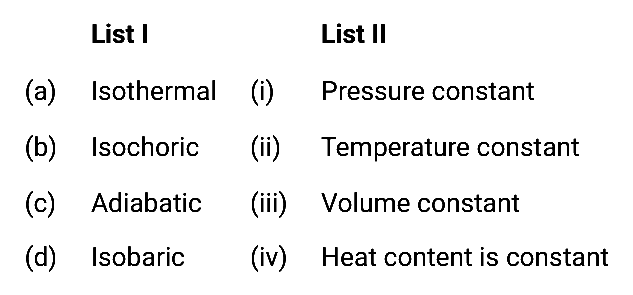
Choose the correct answer from the options given below:
(1) (a) - (ii), (b) - (iii), (c) - (iv), (d) - (i)
(2) (a) - (ii), (b) - (iv), (c) - (iii), (d) - (i)
(3) (a) - (iii), (b) - (ii), (c) - (i), (d) - (iv)
(4) (a) - (i), (b) - (iii), (c) - (ii), (d) - (iv)
Numerical answer type. Work it out, then open the answer.
Answer: 1
Thermodynamic Processes
In thermodynamics, for an isochoric process, which one of the following statement is INCORRECT?
Answer: (a)
Thermodynamic Processes
A diatomic gas, having and , is heated at constant pressure. The ratio dU: dQ: dW:
Answer: (c)
Thermodynamic Processes
If the pressure of an ideal gas is decreased by isothermally, then its volume will
Answer: (d)
Thermodynamic Processes
A perfect gas of volume 10 litre n compressed isothermally to a volume of 1 litre. The rms speed of the molecules will
Answer: (b)
Thermodynamic Processes
For a monoatomic gas, the work done at constant pressure is ''. The heat supplied at constant volume for the same rise in temperature of the gas is
for monoatomic gas]
Answer: (d)
Thermodynamic Processes
The change in internal energy of the mass of a gas, when the volume changes from '' to '' at constant pressure 'P' is ( Ratio of Cp to Cv)
Answer: (a)
Thermodynamic Processes
For a monoatomic gas, work done at constant pressure is W. The heat supplied at constant volume for the same rise in temperature of the gas is
Answer: (d)
Thermodynamic Processes
A monoatomic gas is suddenly compressed to th of its initial volume adiabatically. The ratio of the final pressure to initial pressure of the gas is
Answer: (a)
Thermodynamic Processes
An ideal gas at pressure '' is adiabatically compressed so that its density becomes twice that of the initial. If , then final pressure of the gas is
Answer: (d)
Thermodynamic Processes
An ideal gas at is compressed adiabatically to of its original volume. If ratio of specific heats, then the rise in temperature of the gas is
Answer: (d)
Thermodynamic Processes
A polyatomic gas is compressed to th of its volume adiabatically. If its initial pressure is , its new pressure will be
Answer: (d)
Thermodynamic Processes
The relation obeyed by a perfect gas during an adiabatic process is . The initial temperature of the gas is ''. When the gas is compressed to half of its Initial volume, the final temperature of the gas is
Answer: (c)
Thermodynamic Processes
A monoatomic gas is suddenly compressed to (1/8)th of its initial volume adiabatically. The ratio of the final pressure to initial pressure of the gas is ()
Answer: (a)
Thermodynamic Processes
One mole of an ideal gas expands adiabatically at constant pressure such that its temperature . The value of for the gas is ( Volume of the gas)
Answer: (b)
Thermodynamic Processes
One mole of an ideal gas is taken through an adiabatic process where the temperature rises from 27 C to 37 C. If the ideal gas is composed of polyatomic molecule that has 4 vibrational modes, which of the following is true? [R = 8.314 J mol K]
Answer: (b)
Thermodynamic Processes
For an adiabatic expansion of an ideal gas, the fractional change in its pressure is equal to (where is the ratio of specific heats):
Answer: (c)
Thermodynamic Processes
A sample of gas with = 1.5 is taken through an adiabatic process in which the volume is compressed from 1200 cm3 to 300 cm3. If the initial pressure is 200 kPa. The absolute value of the workdone by the gas in the process = _____________ J.
Numerical answer type. Work it out, then open the answer.
Answer: 480
Thermodynamic Processes
An ideal gas with pressure , volume and temperature is expanded isothermally to a volume and a final pressure . The same gas is expanded adiabatically to a volume , the final pressure is . In terms of the ratio of the two specific heats for the gas '', the ratio is
Answer: (b)
Thermodynamic Processes
The initial pressure and volume of a gas is '' and '' respectively. First by isothermal process gas is expanded to volume '' and then by adiabatic process its volume is compressed to '' then its final pressure is (Ratio of specific heat at constant pressure to constant volume )
Answer: (c)
Thermodynamic Processes
A monoatomic gas at pressure '' having volume '' expands isothermally to a volume and then adiabatically to a volume . The final pressure of the gas is
Answer: (a)
Thermodynamic Processes
1 mole of rigid diatomic gas performs a work of when heat Q is supplied to it. The molar heat capacity of the gas during this transformation is . The value of x is _________. [R = universal gas constant]
Numerical answer type. Work it out, then open the answer.
Answer: 25
Thermodynamic Processes
The volume V of a given mass of monoatomic gas changes with temperature T according to the relation . The workdone when temperature changes by 90K will be xR. The value of x is _________. [R = universal gas constant]
Numerical answer type. Work it out, then open the answer.
Answer: 60
Thermodynamic Processes
In a certain thermodynamical process, the pressure of a gas depends on its volume as kV3. The work done when the temperature changes from 100 C to 300C will be ___________ nR, where n denotes number of moles of a gas.
Numerical answer type. Work it out, then open the answer.
Answer: 50
Thermodynamic Processes
A monoatomic ideal gas initially at temperature is enclosed in a cylinder fitted with 8 frictionless piston. The gas is allowed to expand adiabatically to a temperature by releasing the piston suddenly. and are the lengths of the gas columns before and after the expansion respectively. Then is
Answer: (b)
Thermodynamic Processes
A monoatomic ideal gas, initially at temperature T1 is enclosed in a cylinder fitted with a frictionless piston. The gas is allowed to expand adiabatically to a temperature T2 by releasing the piston suddenly. If l1 and l2 are the lengths of the gas column, before and after the expansion respectively, then the value of will be:
Answer: (b)
Thermodynamic Processes
Two cylinders A and B of equal capacity are connected to each other via a stop cock. A contains an ideal gas at standard temperature and pressure. B is completely evacuated. The entire systems is thermally insulated. The stop cock is suddenly opened. The Process is:
Answer: (a)
Thermodynamic Processes
Match the thermodynamic processes taking place in a system with the correct conditions. In the
table: Q is the heat supplied, W is the work done and U is change in internal energy of the
system.
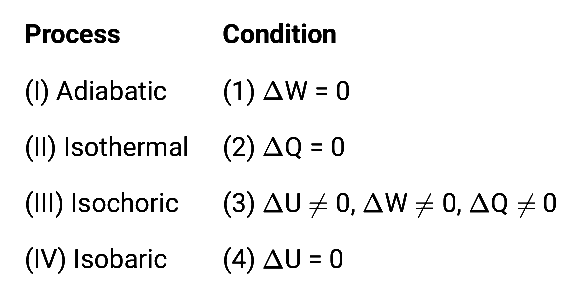
Answer: (b)
Thermodynamic Processes
A balloon filled with helium (32oC and 1.7 atm.) bursts. Immediately afterwards the expansion of helium can be considered as
Answer: (a)
Thermodynamic Processes
To raise the temperature of a certain mass of gas by 50oC at a constant pressure, 160 calories of heat is required. When the same mass of gas is cooled by 100oC at constant volume, 240 calories of heat is released. How many degrees of freedom does each molecule of this gas have (assume gas to be ideal)?
Answer: (a)
Thermodynamic Processes
In an adiabatic process, the density of a diatomic gas becomes 32 times its initial value. The final pressure of the gas is found to be n times the initial pressure. The value of n is:
Answer: (a)
Thermodynamic Processes
A litre of dry air at STP expands adiabatically to a volume of 3 litres. If = 1.40, the work done by air is: (31.4 = 4.6555) [Take air to be an ideal gas]
Answer: (c)
Thermodynamic Processes
An engine takes in 5 moles of air at 20oC and 1 atm, and compresses it adiabatically to 1/10th of the original volume. Assuming air to be a diatomic ideal gas made up of rigid molecules, the change in its internal energy during this process comes out to be X kJ. The value of X to the nearest integer is________.
Numerical answer type. Work it out, then open the answer.
Answer: 46
Thermodynamic Processes
A monoatomic gas of pressure having volume expands isothermally to a volume and then adiabatically to a volume . The final pressure of the gas is (ratio of specific heats
Answer: (c)
Thermodynamic Processes
A diatomic gas undergoes adiabatic change. Its pressure and temperature are related as , where is
Answer: (d)
Thermodynamic Processes
Starting at temperature 300 K, one mole of an
ideal diatomic gas ( = 1.4) is first compressed
adiabatically from volume V1 to V2 = . It is
then allowed to expand isobarically to volume 2V2. If all the processes are the quasi-static then the final temperature of the gas (in oK) is (to the nearest integer) _____.
Numerical answer type. Work it out, then open the answer.
Answer: 1818
Thermodynamic Processes
Under an adiabatic process, the volume of an ideal gas gets doubled. Consequently the mean collision time between the gas molecule changes from to . If for this gas then a good estimate for is given by:
Answer: (a)
Thermodynamic Processes
In which of the following processes, heat is neither absorbed nor released by a system?
Answer: (a)
Thermodynamic Processes
A rigid diatomic ideal gas undergoes an adiabatic process at room temperature. The relation between temperature and volume for this process is TVx = constant, then x is:
Answer: (b)
Thermodynamic Processes
A diatomic gas with rigid molecules does 10 J of work when expanded at constant pressure. What would be the heat energy absorbed by the gas, in this process?
Answer: (a)
Thermodynamic Processes
When heat Q is supplied to a diatomic gas of rigid molecules, at constant volume its temperature increases by T. the heat required to produce the same change in temperature, at a constant pressure is:
Answer: (a)
Thermodynamic Processes
n moles of an ideal gas with constant volume heat capcity CV undergo an isobaric expansion by certain volume. The ratio of the work done in the process, to the heat supplied is:
Answer: (d)
Thermodynamic Processes
Half mole of an ideal monoatomic gas is heated at constant pressure of 1 atm from 20oC to 90oC. Work done by gas is close to – (Gas constant R = 8.31 J/mol.K)
Answer: (d)
Thermodynamic Processes
One mole of ideal gas passes through a process where pressure and volume obey the relation
. Here P0 and V0 are constants. Calculate the change in the temperature of the gas if its volume changes form V0 to 2V0
Answer: (c)
Thermodynamic Processes
In a process, temperature and volume of one mole of an ideal monoatomic gas are varied according to the relation VT = K, where K is a constant. In this process the temperature of the gas is increased by T. The amount of heat absorbed by gas is (R is gas constant):
Answer: (b)
Thermodynamic Processes
One mole of an ideal monoatomic gas is compressed isothermally in a rigid vessel to double its pressure at room temperature, The work done on the gas will be:
Answer: (c)
Thermodynamic Processes
Two moles of an ideal monatomic gas occupies a volume V at 27oC. The gas expands adiabatically to a volume 2 V. Calculate (a) the final temperature of the gas and (b) change in its internal energy.
Answer: (d)
Thermodynamic Processes
The ratio of work done by an ideal monoatomic gas to the heat supplied to it in an isobaric process is:
Answer: (d)
Thermodynamic Processes
A gas is compressed isothermally to half its initial volume. The same gas is compressed separately through an adiabatic process until its volume is again reduced to half. Then
Answer: (d)
Thermodynamic Processes
One mole of an ideal monatomic gas undergoes a process described by the equation PV3 = constant. The heat capacity of the gas during this process is
Answer: (d)
Thermodynamic Processes
An ideal gas undergoes a quasi static, reversible process in which its molar heat capacity remains constant. If during this process the relation of pressure and volume is given by constant, then is given by (Here and are molar specific heat at constant pressure and constant volume, respectively:
Answer: (d)
Thermodynamic Processes
An ideal gas is compressed to half its initial volume by means of several processes. Which of the process results in the maximum work done on the gas?
Answer: (c)
Thermodynamic Processes
Consider a spherical shell of radius at temperature . The black body radiation inside it can be considered as an ideal gas of photons with internal energy per unit volume and pressure . If the shell now undergoes an adiabatic expansion the relation between and is:
Answer: (a)
Thermodynamic Processes
Consider an ideal gas confined in an isolated closed chamber. As the gas undergoes an adiabatic expansion, the average time of collision between molecules increases as where is the volume of the gas. The value of is:
Answer: (a)
Thermodynamic Processes
A gas is compressed from a volume of 2 m3 to a volume of 1 m3 at a constant pressure of 100 N/m2. Then it is heated at constant volume by supplying 150 J of energy. As a result, the internal energy of the gas:
Answer: (a)
Thermodynamic Processes
During an adiabatic compression, 830 J of work is done on 2 moles of a diatomic ideal gas to reduce its volume by 50%. The change in its temperature is nearly: (R = 8.3 JK mol)
Answer: (c)
Thermodynamic Processes
A monatomic gas at a pressure P, having a volume V expands isothermally to a volume 2V and then adiabatically to a volume 16V. The final pressure of the gas is (Take = 5/3)
Answer: (c)
Thermodynamic Processes
The equation of state for a gas is given by PV = nRT + V, where n is the number of moles and is a positive constant. The initial temperature and pressure of one mole of the gas contained in a cylinder are To and Po respectively. The work done by the gas when its temperature doubles isobarically will be:
Answer: (a)
Thermodynamic Processes
Which of the following relations does not give the equation of an adiabatic process, where terms have their usual meaning?
Answer: (d)
Thermodynamic Processes
A sample of gas expands from to . In which of the following, the work done will be greatest?
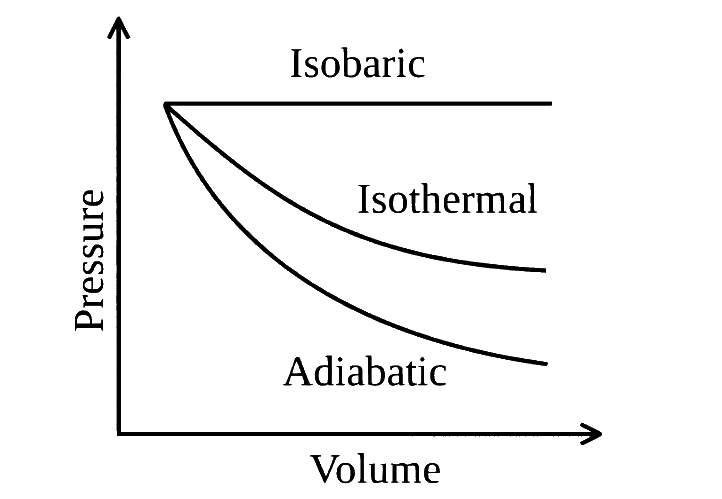
Answer: (b)
Thermodynamic Processes
In the isothermal expansion of 10 g of gas from volume V to 2V the work done by the gas is 575 J. What is the root mean square speed of the molecules of the gas at that temperature?
Answer: (c)
Thermodynamic Processes
During an adiabatic process, the pressure of a gas is found to be proportional to the cube of its temperature. The ratio of for the gas is
Answer: (b)
Thermodynamic Processes
An ideal gas at atmospheric pressure is adiabatically compressed so that its density becomes 32 times of its initial value. If the final pressure of gas is 128 atmospheres, the value of '' of the gas is:
Answer: (b)
Thermodynamic Processes
There are two identical chambers, completely thermally insulated from surroundings. Both chambers have a partition wall dividing the chambers in two compartments. Compartment 1 is filled with an ideal gas and Compartment 3 is filled with a real gas. Compartments 2 and 4 are vacuum. A small hole (orifice) is made in the partition walls and the gases are allowed to expand in vacuum. Statement - 1: No change in the temperature of the gas takes place when ideal gas expands in vacuum. However, the temperature of real gas goes down (cooling) when it expands in vacuum. Statement - 2: The internal energy of an ideal gas is only kinetic. The internal energy of a real gas is kinetic as well as potential.
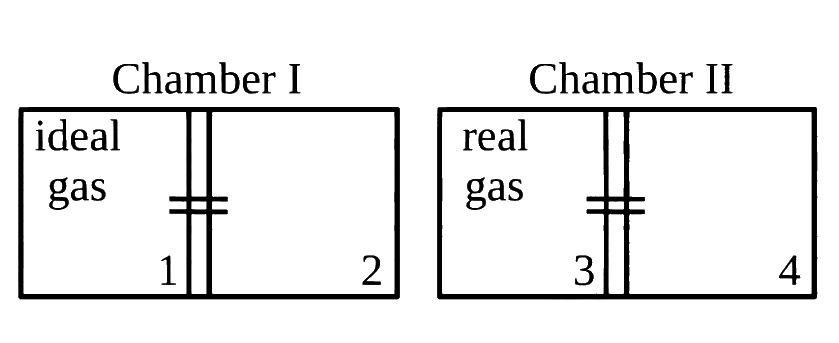
Answer: (b)
Thermodynamic Processes
During an isothermal expansion, a confined ideal gas does 150 J of work against its surroundings. This implies that
Answer: (d)
Thermodynamic Processes
A mass of diatomic gas at a pressure of 2 atmospheres is compressed adiabatically so that its temperature rises from 27oC to 927oC. The pressure of the gas in the final state is
Answer: (d)
Thermodynamic Processes
If U and W represent the increase in internal energy and work done by the system respectively in a thermodynamical process, which of the following is true?
Answer: (a)
Thermodynamic Processes
A monatomic gas at pressure P1 and volume V1 is compressed adiabatically to of its original volume. What is the final pressure of the gas?
Answer: (d)
Thermodynamic Processes
In thermodynamic processes which of the following statements is not true?
Answer: (a)
Thermodynamic Processes
The work of is performed in order to compress one kilo mole of gas adiabatically and in this process the temperature of the gas increases by The gas is
Answer: (a)
Thermodynamic Processes
One mole of an ideal gas at an initial temperature of T K does 6R joule of work adiabatically. If the ratio of specific heats of this gas at constant pressure and at constant volume is 5/3, the final temperature of gas will be
Answer: (d)
Thermodynamic Processes
During an adiabatic process, the pressure of a gas is found to be proportional to the cube of its absolute temperature. The ratio for the gas is
Answer: (d)
Thermodynamic Processes
An ideal gas at is compressed adiabatically to of its original volume. The rise in temperature is
Answer: (d)
Thermodynamic Processes
We consider a thermodynamic system. If represents the increase in its internal energy and the work done by the system, which of the following statements is true?
Answer: (a)
Thermodynamic Processes
If the ratio of specific heat of a gas at constant pressure to that at constant volume is , the change in internal energy of a mass of gas, when the volume changes from to at constant pressure is
Answer: (c)
Thermodynamic Processes
A sample of gas expands from volume to . The amount of work done by the gas is greatest, when the expansion is
Answer: (d)
Thermodynamic Processes
An ideal gas, undergoing adiabatic change, has which of the following pressure temperature relationship?
Answer: (b)
Thermodynamic Processes
A diatomic gas initially at is compressed adiabatically to one eighth of its original volume. The temperature after compression will be
Answer: (a)
Thermodynamic Processes
In an adiabatic change, the pressure and temperature of a monatomic gas are related as , where equals
Answer: (d)
Thermodynamic Processes
An ideal gas and a real gas have their volumes increased from to under isothermal conditions. The increase in internal energy
Answer: (c)
Thermodynamic Processes
One mole of an ideal gas requires 207 J heat to rise the temperature by 10 K when heated at constant pressure. If the same gas is heated at constant volume to raise the temperature by the same 10 K, the heat required is
(Given the gas constant )
Answer: (d)
Thermodynamic Processes
For an ideal gas, a process is described by , where is a constant. If the molar heat capacity for this process is , then which one of the following is correct (where the symbols have their usual meanings)?
Answer: (b)
Step-by-step solution coming soon.
Thermodynamic Processes
In a certain process, the relation between pressure () and volume (), for an ideal gas, is given by . If the initial temperature is and the final temperature is ; and the initial volume is and the final volume is , then which one of the following is correct?
Answer: (c)
Step-by-step solution coming soon.
Thermodynamic Processes
A system that does NOT allow exchange of heat with its surrounding is called
Answer: (a)
Step-by-step solution coming soon.
Thermodynamic Processes
A thermodynamic process where no heat is exchanged with the surroundings is
Answer: (b)
Step-by-step solution coming soon.
Thermodynamic Processes
Ten moles of an ideal monoatomic gas, initially in state at atmospheric pressure and temperature , is enclosed in a metal cylinder of volume fitted with a frictionless piston. The gas is suddenly compressed to state with volume . Now, keeping the piston stationary, the cylinder is submerged in a water bath of temperature until the gas reaches the temperature of the water bath, which is denoted as state . Finally, while still in the water bath, the piston is brought slowly to its initial position, which is denoted as state . If is universal gas constant, then the correct option(s) is/are :
[Given: ]
More than one option can be correct. Tap every correct option, then tap Check.
Answer: (a), (b), (c)
Step-by-step solution coming soon.
Thermodynamic Processes
One mole of an ideal gas expands adiabatically from an initial state to final state . Another mole of the same gas expands isothermally from a different initial state to the same final state . The ratio of the specific heats at constant pressure and constant volume of this ideal gas is . What is the ratio ?
Answer: (a)
Step-by-step solution coming soon.
Thermodynamic Processes
A thermally insulating cylinder has a thermally insulating and frictionless movable partition in the middle, as shown in the figure below. On each side of the partition, there is one mole of an ideal gas, with specific heat at constant volume, . Here, is the gas constant. Initially, each side has a volume and temperature . The left side has an electric heater, which is turned on at very low power to transfer heat to the gas on the left side. As a result the partition moves slowly towards the right reducing the right side volume to . Consequently, the gas temperatures on the left and the right sides become and , respectively. Ignore the changes in the temperatures of the cylinder, heater and the partition.
The value of is
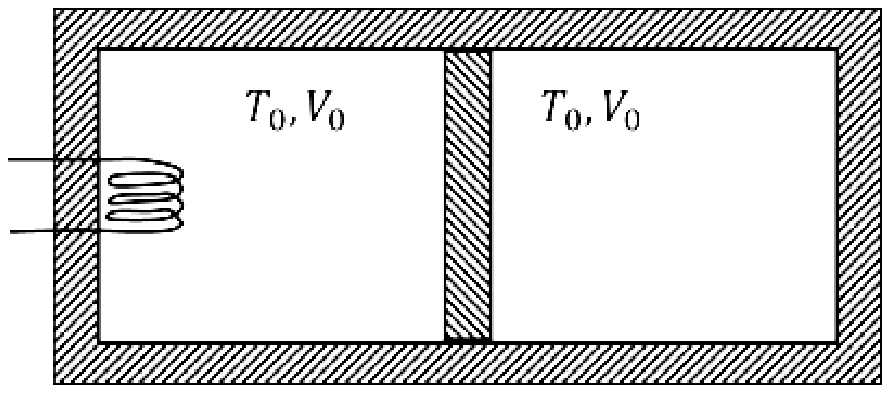
Answer: (a)
Step-by-step solution coming soon.
Thermodynamic Processes
Consider one mole of helium gas enclosed in a container at initial pressure and volume . It expands isothermally to volume . After this, the gas expands adiabatically and its volume becomes . The work done by the gas during isothermal and adiabatic expansion processes are and , respectively. If the ratio , then is ______.
Numerical answer type. Work it out, then open the answer.
Answer: 1.77
Step-by-step solution coming soon.
Thermodynamic Processes
One mole of a monatomic ideal gas undergoes a cyclic process as shown in the figure (where is the volume and is the temperature). Which of the statements below is (are) true?
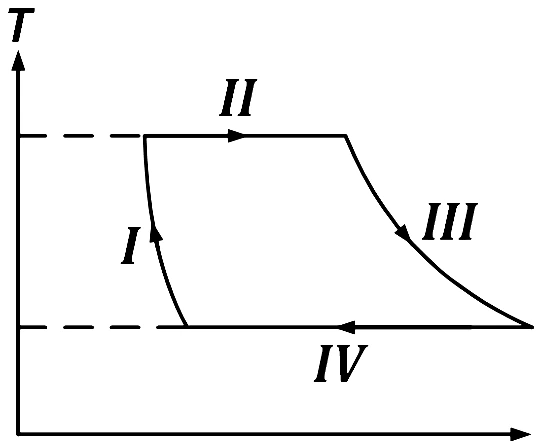
More than one option can be correct. Tap every correct option, then tap Check.
Answer: (b), (c), (d)
Step-by-step solution coming soon.
Thermodynamic Processes
One mole of a monatomic ideal gas undergoes an adiabatic expansion in which its volume becomes eight times its initial value. If the initial temperature of the gas is and the universal gas constant , the decrease in its internal energy, in Joule, is ______.
Numerical answer type. Work it out, then open the answer.
Answer: 900
Step-by-step solution coming soon.
Thermodynamic Processes
One mole of a monatomic ideal gas undergoes four thermodynamic processes as shown schematically in the -diagram below. Among these four processes, one is isobaric, one is isochoric, one is isothermal and one is adiabatic. Match the processes mentioned in List-I with the corresponding statements in List-II.
| List-I | List-II |
| P. In process I | 1. Work done by the gas is zero |
| Q. In process II | 2. Temperature of the gas remains unchanged |
| R. In process III | 3. No heat is exchanged between the gas and its surroundings |
| S. In process IV | 4. Work done by the gas is |
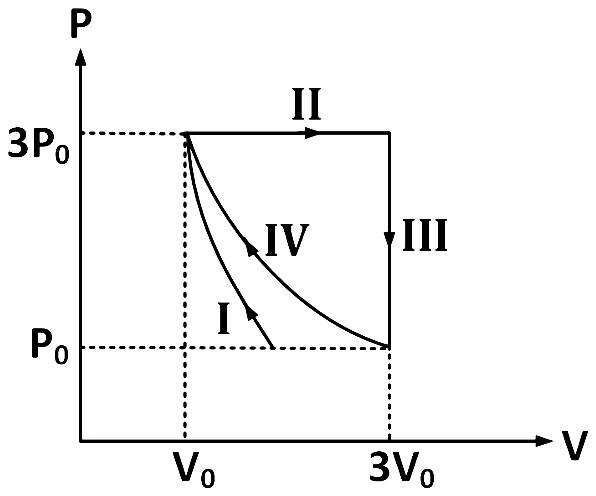
Answer: (c)
Step-by-step solution coming soon.
Thermodynamic Processes
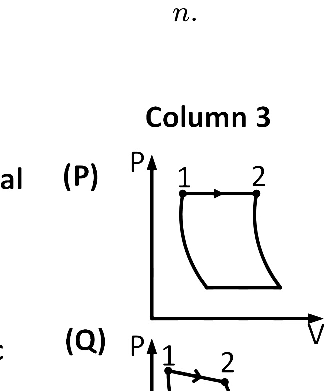
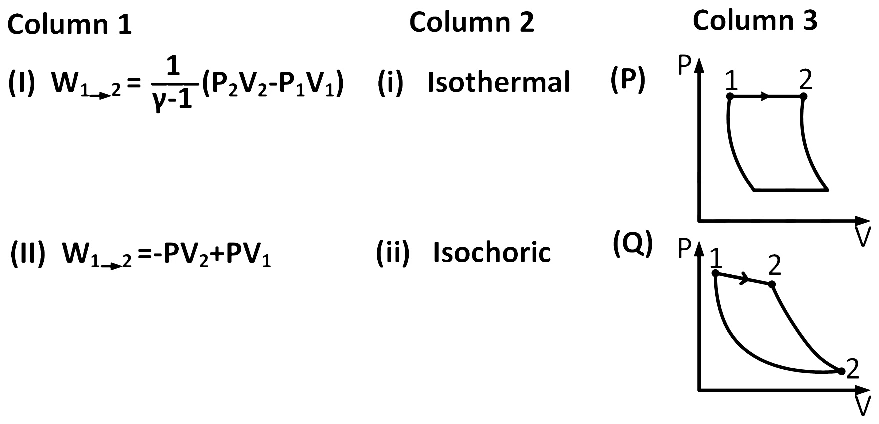
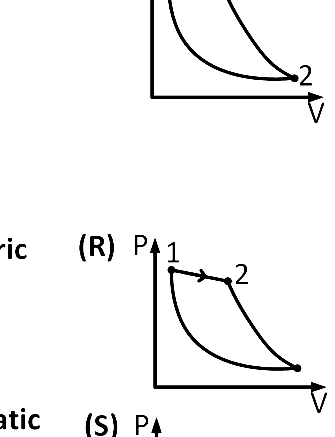
An ideal gas is undergoing a cyclic thermodynamic process in different ways as shown in the corresponding diagram in column 3 of the table. Consider only the path from state to state . denotes the corresponding work done on the system. The equations and plots in the table have standard notations as used in thermodynamic processes. Here is the ratio of heat capacities at constant pressure and constant volume. The number of moles in the gas is .
| Column 1 | Column 2 | Column 3 |
| (I) | (i) Isothermal | (P) P-V plot |
| (II) | (ii) Isochoric | (Q) P-V plot |
| (III) | (iii) Isobaric | (R) P-V plot |
| (IV) | (iv) Adiabatic | (S) P-V plot |
Which one of the following options is the correct combination?
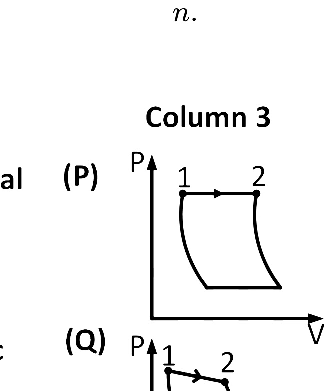
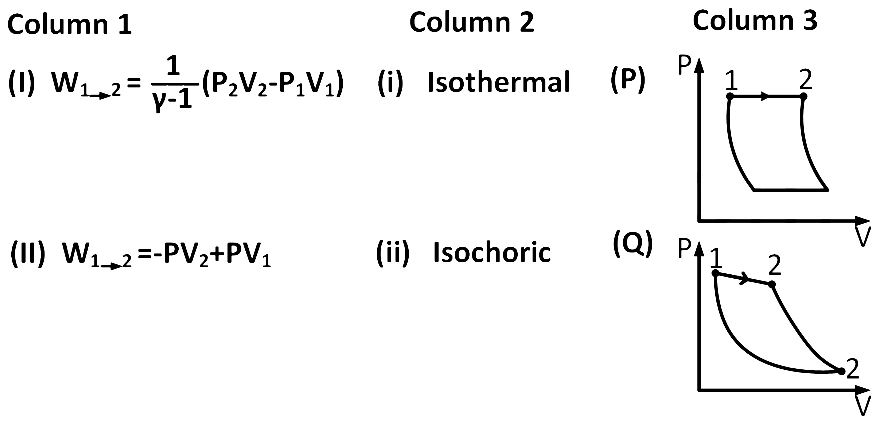
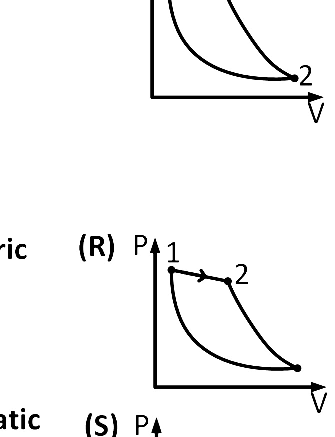
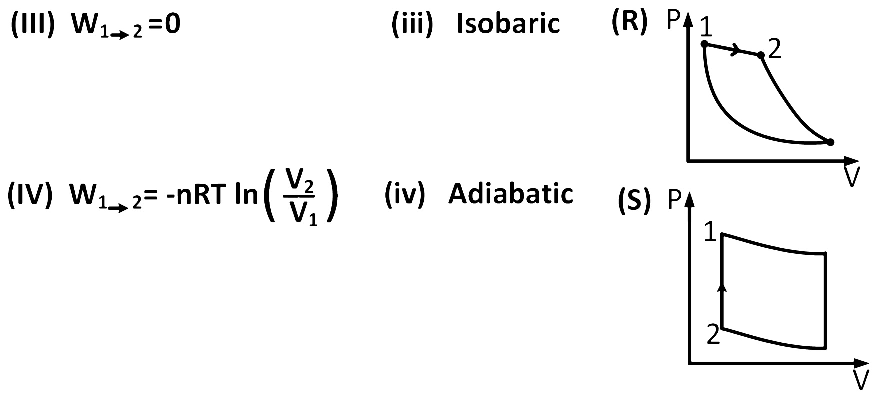
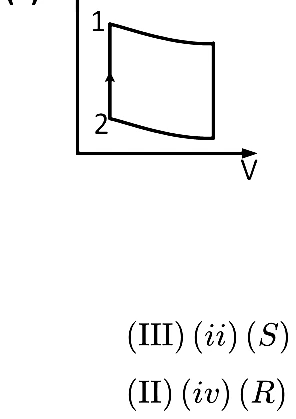
Answer: (b)
Step-by-step solution coming soon.
Thermodynamic Processes
An ideal gas is undergoing a cyclic thermodynamic process in different ways as shown in the corresponding diagram in column 3 of the table. Consider only the path from state to state . denotes the corresponding work done on the system. The equations and plots in the table have standard notations as used in thermodynamic processes. Here is the ratio of heat capacities at constant pressure and constant volume. The number of moles in the gas is .
| Column 1 | Column 2 | Column 3 |
| (I) | (i) Isothermal | (P) P-V plot |
| (II) | (ii) Isochoric | (Q) P-V plot |
| (III) | (iii) Isobaric | (R) P-V plot |
| (IV) | (iv) Adiabatic | (S) P-V plot |
Which of the following options is the only correct representation of a process in which ?
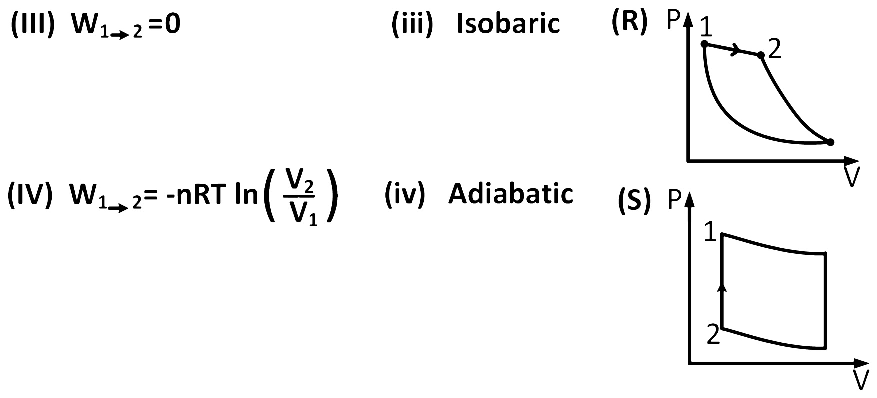
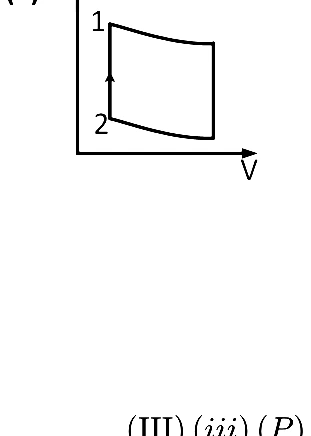
Answer: (d)
Step-by-step solution coming soon.
Thermodynamic Processes
An ideal gas is undergoing a cyclic thermodynamic process in different ways as shown in the corresponding diagram in column 3 of the table. Consider only the path from state to state . denotes the corresponding work done on the system. The equations and plots in the table have standard notations as used in thermodynamic processes. Here is the ratio of heat capacities at constant pressure and constant volume. The number of moles in the gas is .
| Column 1 | Column 2 | Column 3 |
| (I) | (i) Isothermal | (P) P-V plot |
| (II) | (ii) Isochoric | (Q) P-V plot |
| (III) | (iii) Isobaric | (R) P-V plot |
| (IV) | (iv) Adiabatic | (S) P-V plot |
Which one of the following options correctly represents a thermodynamic process that is used as a correction in the determination of the speed of sound in an ideal gas?
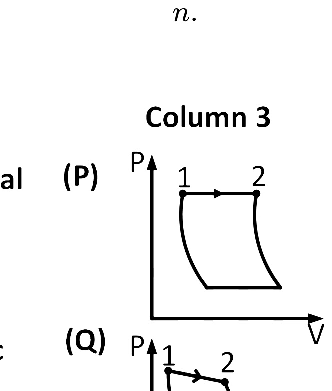
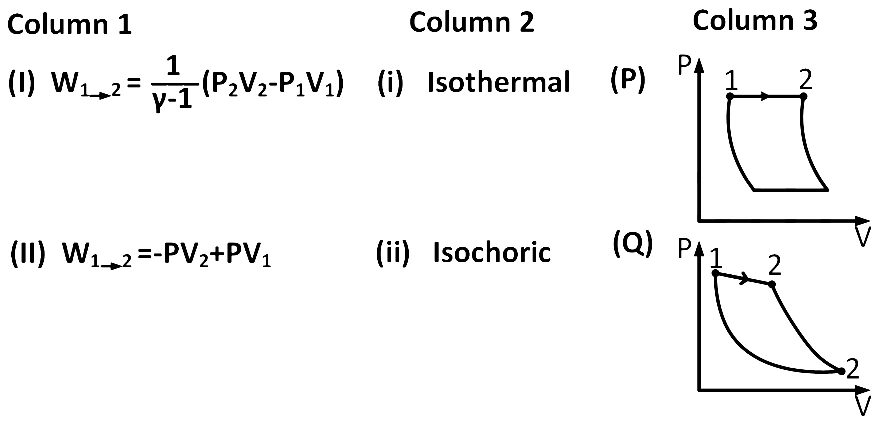
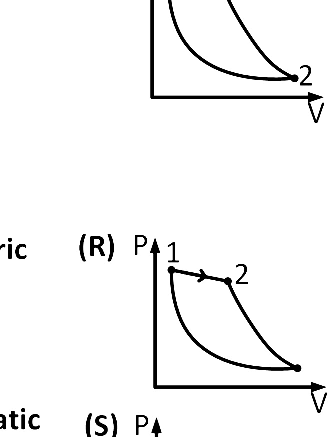
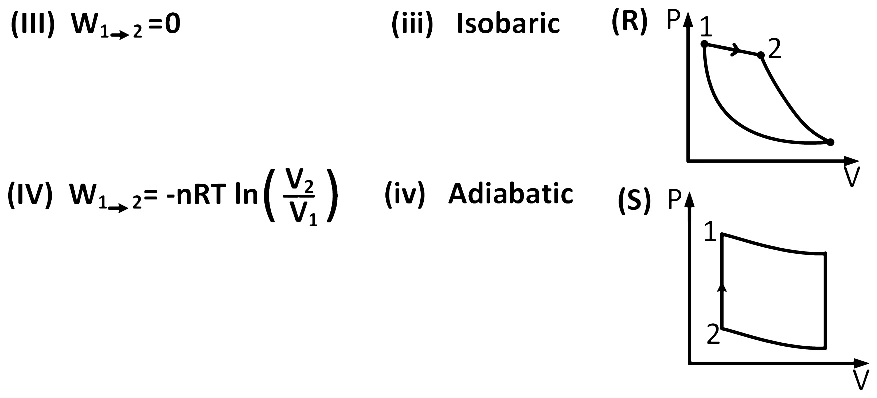
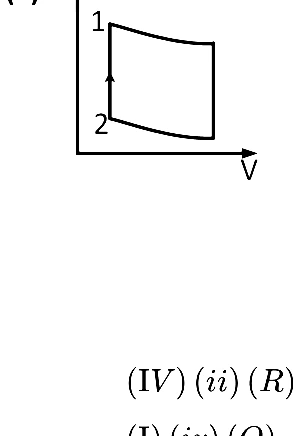
Answer: (d)
Step-by-step solution coming soon.
Thermodynamic Processes
litre of helium gas at STP is adiabatically compressed to litre. Taking the initial temperature to be , the work done in the process is
Answer: (a)
Step-by-step solution coming soon.
Thermodynamic Processes
A diatomic ideal gas is compressed adiabatically to of its initial volume. If the initial temperature of the gas is (in Kelvin) and the final temperature is , the value of is
Numerical answer type. Work it out, then open the answer.
Answer: 4
Step-by-step solution coming soon.
Thermodynamic Processes
Column I contains a list of processes involving expansion of an ideal gas. Match this with Column II describing the thermodynamic change during this process. Indicate your answer by darkening the appropriate bubbles of the matrix given in the ORS.
| Column I | Column II |
| (A) An insulated container has two chambers separated by a valve. Chamber I contains an ideal gas and the Chamber II has vacuum. The valve is opened. | (P) The temperature of the gas decreases |
| (B) An ideal monatomic gas expands to twice its original volume such that its pressure , where is the volume of the gas | (Q) The temperature of the gas increases or remains constant. |
| (C) An ideal monatomic gas expands to twice its original volume such that its pressure , where is its volume | (R) The gas loses heat |
| (D) An ideal monatomic gas expands such that its pressure and volume follows the behaviour shown in the graph | (S) The gas gains heat |
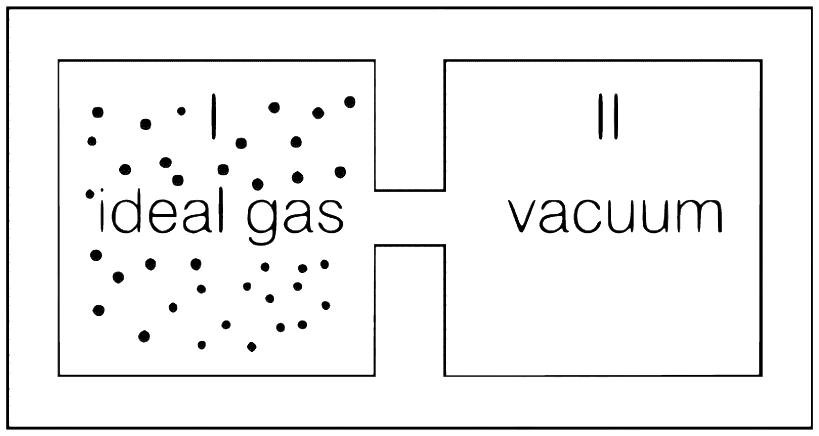
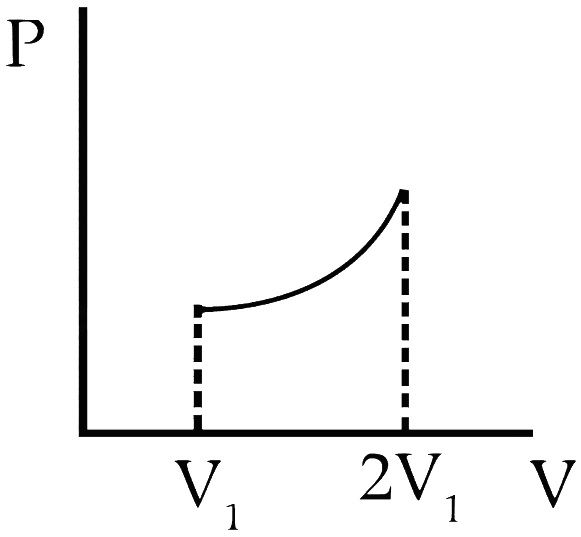
Answer: (d)
Step-by-step solution coming soon.
Thermodynamic Processes
Assertion: In adiabatic process work is independent of the path.
Reason: In adiabatic process work done is equal to negative of change in internal energy.
Answer: (a)
Step-by-step solution coming soon.
Thermodynamic Processes
Assertion: In adiabatic expansion the product of and always decreases.
Reason: In adiabatic expansion process, work is done by the gas at the cost of internal energy of gas.
Answer: (a)
Step-by-step solution coming soon.
Thermodynamic Processes
Assertion: Molar heat capacity cannot be defined for isothermal process.
Reason: In isothermal process - versus graph is a dot.
Answer: (b)
Step-by-step solution coming soon.
Thermodynamic Processes
Assertion: In an adiabatic process change in internal energy of a gas is equal to work done on or by the gas in the process.
Reason: Temperature of gas remains constant in an adiabatic process.
Answer: (c)
Step-by-step solution coming soon.
Thermodynamic Processes
In an isobaric process of an ideal gas. The ratio of heat supplied and work done by the system is
Answer: (c)
Step-by-step solution coming soon.
Thermodynamic Processes
Assertion : The isothermal curves intersect each other at a certain point.
Reason : The isothermal changes takes place rapidly, so the isothermal curves have very little slope.
Answer: (d)
Step-by-step solution coming soon.
Thermodynamic Processes
Assertion : In adiabatic compression the internal energy and temperature of the system get decreased.
Reason : The adiabatic compression is a slow process.
Answer: (d)
Step-by-step solution coming soon.
Thermodynamic Processes
Assertion : Air quickly leaking out of a balloon becomes cooler.
Reason : The leaking air undergoes adiabatic expansion.
Answer: (a)
Step-by-step solution coming soon.
Thermodynamic Processes
plots for two gases during adiabatic process as shown in figure plots and should correspond respectively to
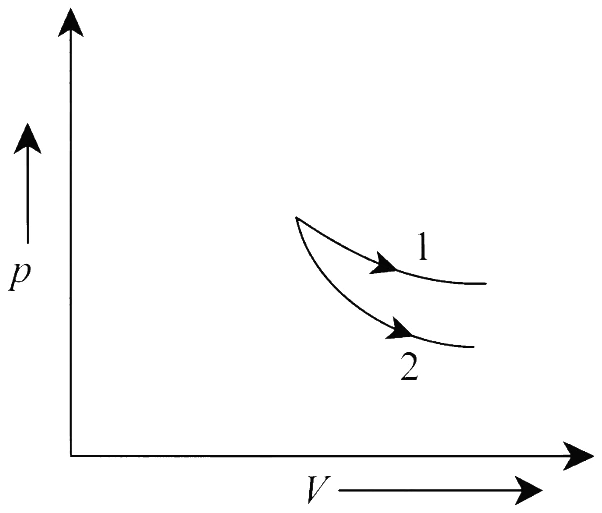
Answer: (b)
Step-by-step solution coming soon.
Thermodynamic Processes
The volume of an ideal gas is doubled in an isothermal process. Then, which of the following is true?
Answer: (a)
Step-by-step solution coming soon.
Thermodynamic Processes
The slope of isothermal and adiabatic curves are related as
Answer: (c)
Step-by-step solution coming soon.
Thermodynamic Processes
One mole of a monoatomic ideal gas undergoes the process in the given diagram. The molar heat capacity for this process is
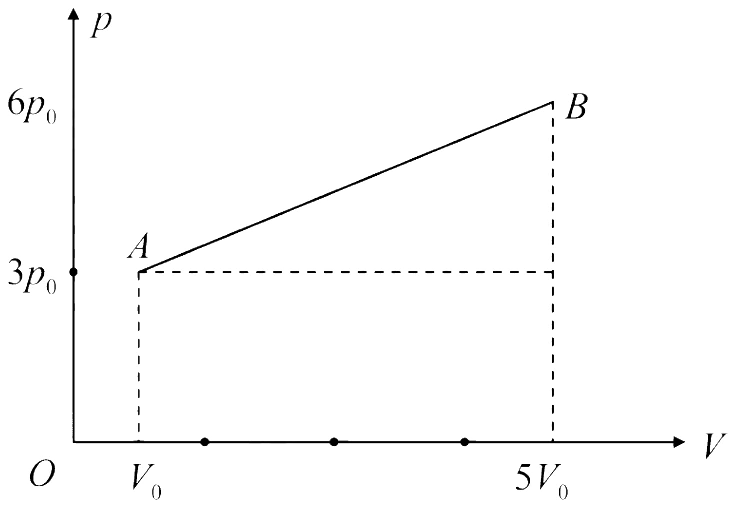
Answer: (b)
Step-by-step solution coming soon.
Thermodynamic Processes
The given diagram shows gases during adiabatic process. Plots 1 and 2 should correspond respectively to
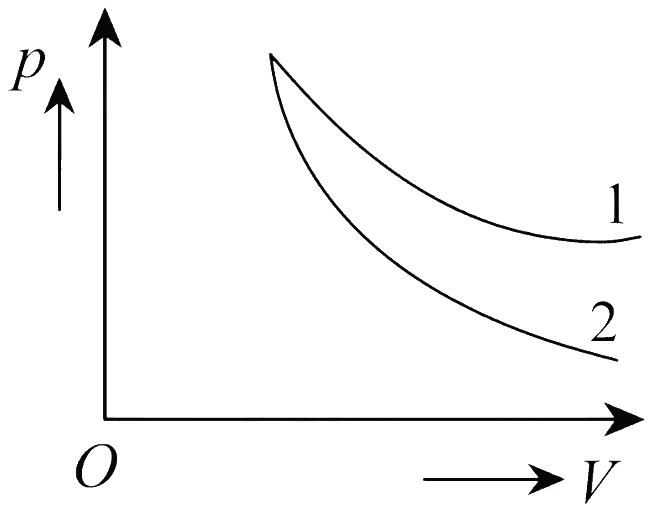
Answer: (b)
Step-by-step solution coming soon.
Thermodynamic Processes
For an adiabatic expansion of a mono atomic perfect gas, the volume increases by . What is the percentage decrease in pressure?
Answer: (b)
Step-by-step solution coming soon.
Thermodynamic Processes
During an adiabatic process, the pressure of a gas is found to be proportional to the cube of absolute temperature. The ratio for the gas is
Answer: (d)
Step-by-step solution coming soon.
Thermodynamic Processes
mole of an ideal gas at an initial temperature of does joule of work adiabatically. If the ratio of specific heats of this gas at constant pressure and at constant volume is , then final temperature of the gas will be
Answer: (a)
Step-by-step solution coming soon.
Thermodynamic Processes
The work of is performed in order to compress one kilo mole of a gas adiabatically and in this process the temperature of the gas increases by . The gas is ()
Answer: (a)
Step-by-step solution coming soon.
Thermodynamic Processes
In an isothermal process, which of the following is not true?
Answer: (c)
Step-by-step solution coming soon.
Thermodynamic Processes
A perfect gas is found to obey the relation during an adiabatic process. If such a gas initially at a temperature is compressed to half of its initial volume, then its final temperature will be
Answer: (c)
Step-by-step solution coming soon.
Thermodynamic Processes
A monoatomic gas is supplied the heat very slowly keeping the pressure constant. The work done by the gas will be
Answer: (c)
Step-by-step solution coming soon.
Thermodynamic Processes
An ideal gas undergoes an adiabatic process such that its pressure is proportional to the cube of its absolute temperature (). The ratio of specific heats for the gas is
Answer: (d)
Step-by-step solution coming soon.
Thermodynamic Processes
One mole of an ideal diatomic gas undergoes a process as shown in the figure. The molar specific heat of the gas in the process is
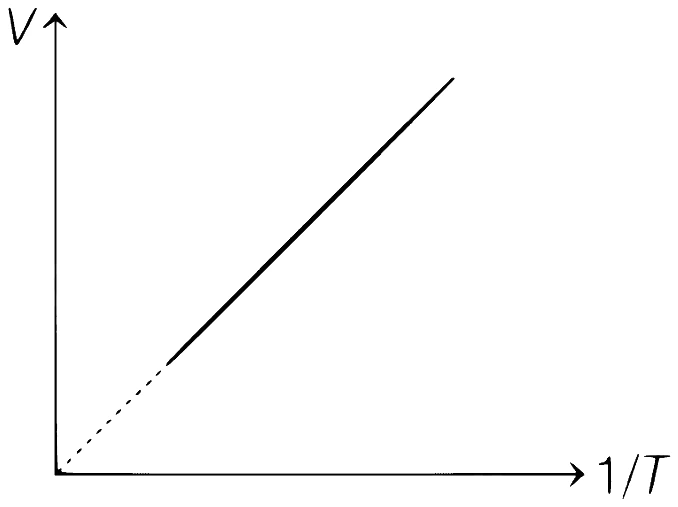
Answer: (a)
Step-by-step solution coming soon.
Thermodynamic Processes
In an adiabatic process, where pressure is decreased by , if , then the volume increases by
Answer: (b)
Step-by-step solution coming soon.
Thermodynamic Processes
Two different ideal diatomic gases and are initially in the same state. and are then expanded to same final volume through adiabatic and isothermal process, respectively. If and represent the final pressures and temperatures at and respectively, then
Answer: (a)
Step-by-step solution coming soon.
Thermodynamic Processes
The following graph shows four different processes, adiabatic, isothermal, isobaric and isochoric for an ideal gas, from the same initial state. Study the graph carefully and state which of the following statements is correct?
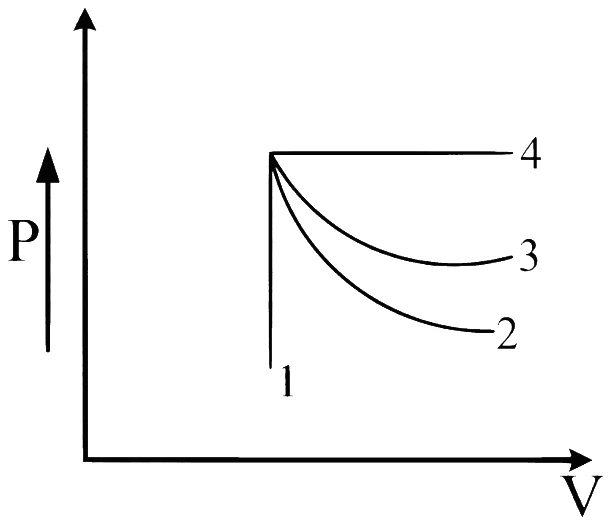
Answer: (c)
Step-by-step solution coming soon.
Thermodynamic Processes
A monoatomic ideal gas, initially at temperature , is enclosed in a cylinder fitted with a frictionless piston. The gas is allowed to expand adiabatically to a temperature by releasing the piston suddenly. If and are the lengths of the gas column before and after expansion respectively, then is
Answer: (b)
Step-by-step solution coming soon.
Thermodynamic Processes
The ratio of specific heat capacities at constant pressure to that at constant volume for a given mass of a gas is . If the percentage increase in volume of the gas while undergoing an adiabatic change is , then the percentage decrease in pressure will be:
Answer: (a)
Step-by-step solution coming soon.
Thermodynamic Processes
A given volume of gas at NTP is allowed to expand 6 times of its original volume, first under isothermal condition and then under adiabatic condition. Which of the given statement is correct?
[Given ]
Answer: (d)
Step-by-step solution coming soon.
Thermodynamic Processes
In an adiabatic expansion of air, the volume is increased by . The percentage change in pressure is ()
Answer: (a)
Step-by-step solution coming soon.
Thermodynamic Processes
From the following p-V diagram, an ideal gas undergoing a change of state from to . Four different processes I, II, III and IV as shown in the figure may lead to same change of state.
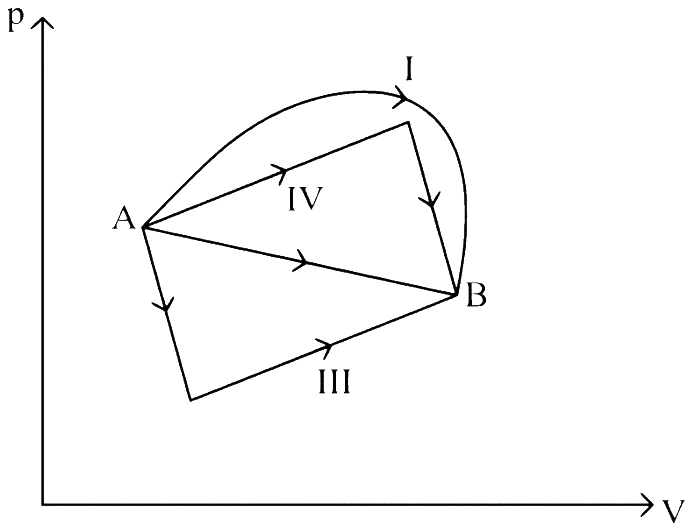
Answer: (b)
Step-by-step solution coming soon.
Thermodynamic Processes
There are two identical containers and containing two identical gases. Gas in is reduced to half of its original volume adiabatically, while the gas in container is also reduced to half of its initial volume isothermally. Find the ratio of final pressure in these containers. ( be the adiabatic constant).
Answer: (d)
Step-by-step solution coming soon.
Thermodynamic Processes
In an adiabatic process with the ratio of two specific heat, , pressure is increased by , then decrease in the volume will be
Answer: (a)
Step-by-step solution coming soon.
Thermodynamic Processes
of a gas is compressed at atmospheric pressure and temperature to . What is the final pressure under adiabatic condition?
( for the gas )
Answer: (a)
Step-by-step solution coming soon.
Thermodynamic Processes
In thermodynamic processes, which of the following statements is not true?
Answer: (b)
Step-by-step solution coming soon.
Thermodynamic Processes
The graph of pressure and volume of mole of an ideal gas at constant temperature is
Answer: (d)
Step-by-step solution coming soon.
Thermodynamic Processes
In an adiabatic expansion of an ideal gas the product of pressure and volume
Answer: (a)
Step-by-step solution coming soon.
Thermodynamic Processes
A certain amount of heat energy is supplied to a monoatomic ideal gas which expands at constant pressure. What fraction of the heat energy is converted into work?
Answer: (c)
Step-by-step solution coming soon.
Thermodynamic Processes
The pressure and density of a diatomic gas change to and during an adiabatic operation. Find the value of , if
Answer: (d)
Step-by-step solution coming soon.
Thermodynamic Processes
The pressure and density of a diatomic gas change adiabatically from to . If , then should be
Answer: (c)
Step-by-step solution coming soon.
Thermodynamic Processes
In which of the following thermodynamic processes does the internal energy of the system remain constant?
Answer: (d)
Step-by-step solution coming soon.
Thermodynamic Processes
Two moles of an ideal gas undergo isothermal expansion from volume to at temperature . The work done during the expansion is
Answer: (b)
Step-by-step solution coming soon.
Thermodynamic Processes
Two gases and are initially at the same pressure, volume and temperature. If is compressed isothermally and adiabatically to half of the initial volume, then the final pressure of is
Answer: (c)
Step-by-step solution coming soon.
Thermodynamic Processes
When an ideal diatomic gas undergoes adiabatic expansion, if the increase in its volume is , then the change in the pressure of the gas is
Answer: (c)
Step-by-step solution coming soon.
Thermodynamic Processes
The work done to increase the volume of moles of an ideal gas from to at a constant temperature is . The work to be done to increase the volume of moles of the same gas from to at the same constant temperature is
Answer: (b)
Step-by-step solution coming soon.
Thermodynamic Processes
During adiabatic expansion, if the temperature of moles of a diatomic gas decreases by , then the work done by the gas is ( = universal gas constant)
Answer: (a)
Step-by-step solution coming soon.
Thermodynamic Processes
A monoatomic gas at a pressure of expands adiabatically such that its final volume becomes times its initial volume. If the work done during the process is , then the initial volume of the gas is
Answer: (a)
Step-by-step solution coming soon.
Thermodynamic Processes
If litres of a monoatomic gas at STP is adiabatically compressed to litres, then the work done on the gas is nearly ( = universal gas constant)
Answer: (a)
Step-by-step solution coming soon.
Thermodynamic Processes
If the given graph shows the logarithmic values of pressure () and volume () of an ideal gas, then the ratio of the specific heat capacities of the gas is
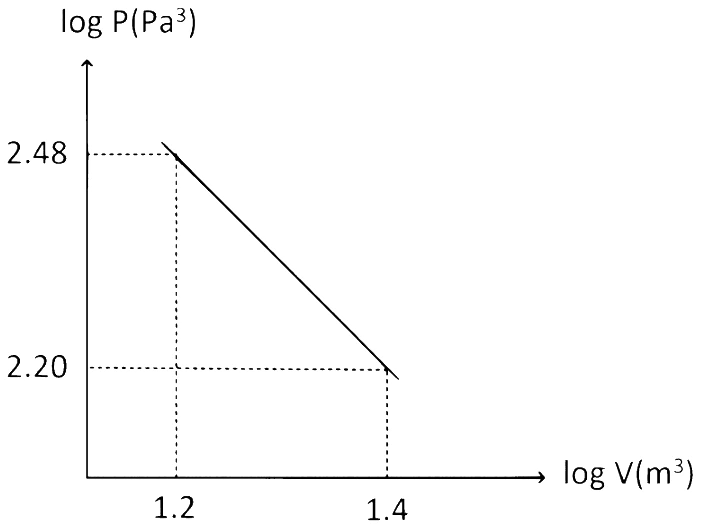
Answer: (b)
Step-by-step solution coming soon.
Thermodynamic Processes
If a gas of volume at an initial pressure is suddenly compressed to , then its final pressure is (the ratio of the specific heat capacities of the gas at constant pressure and constant volume is )
Answer: (b)
Step-by-step solution coming soon.
Thermodynamic Processes
From the figure shown for a thermodynamic system, match the curves with their respective thermodynamic processes. ( = pressure and = volume)
| Curve | Process | ||
| (i) | I | A | Adiabatic |
| (ii) | II | B | Isobaric |
| (iii) | III | C | Isochoric |
| (iv) | IV | D | Isothermal |
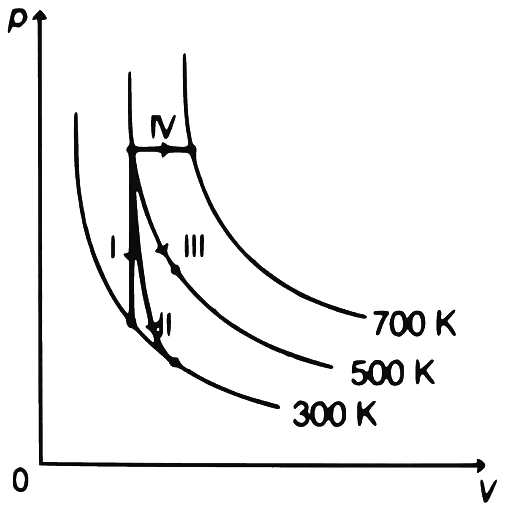
Answer: (a)
Step-by-step solution coming soon.
Thermodynamic Processes
The condition holds good in the following process.
Answer: (b)
Step-by-step solution coming soon.
Thermodynamic Processes
When moles of a monoatomic gas expands adiabatically from a temperature of to , the work done is . The work done when moles of a diatomic gas expands adiabatically from to is
Answer: (c)
Step-by-step solution coming soon.
Thermodynamic Processes
Two ideal gases and of the same number of moles expand at constant temperatures and respectively such that the pressure of gas decreases by and the pressure of gas decreases by . If the work done by both the gases is the same, then is
Answer: (d)
Step-by-step solution coming soon.
Thermodynamic Processes
An ideal gas is found to obey during an adiabatic process. If such a gas initially at temperature is adiabatically compressed to th of its volume, then its final temperature is
Answer: (c)
Step-by-step solution coming soon.
Thermodynamic Processes
A certain volume of a gas at expands adiabatically until its volume is doubled. The resultant fall in temperature of the gas is nearly (The ratio of the specific heats of the gas )
Answer: (a)
Step-by-step solution coming soon.
Thermodynamic Processes
The work done by a gas is maximum when it expands from a volume to , then the expansion is
Answer: (c)
Step-by-step solution coming soon.
Thermodynamic Processes
A monatomic gas at expands adiabatically to times its initial volume. The final temperature of the gas is
Answer: (d)
Step-by-step solution coming soon.
Thermodynamic Processes
Isothermal bulk modulus of a gas at a pressure is ( - ratio of specific heat capacities of the gas)
Answer: (c)
Step-by-step solution coming soon.
Thermodynamic Processes
A monatomic gas of volume and pressure expands isothermally to a volume and then compressed adiabatically to a volume . The final pressure of the gas is
Answer: (c)
Step-by-step solution coming soon.
Thermodynamic Processes
The slopes of the isothermal and adiabatic - graphs of a gas are by and respectively. If the heat capacity ratio of the gas is , then
Answer: (b)
Step-by-step solution coming soon.
Thermodynamic Processes
Isothermal process is the graph between
Answer: (b)
Step-by-step solution coming soon.
Thermodynamic Processes
A gas () is suddenly compressed to its initial volume. Then, find the ratio of its final to initial pressure.
Answer: (d)
Step-by-step solution coming soon.
Thermodynamic Processes
A Carnot's heat engine operates between the temperatures and . The relation between the absolute temperature () and volume () of the working substance during adiabatic expansion is constant. The work done by moles of the working substance during adiabatic expansion process is
( - Universal gas constant)
Answer: (c)
Step-by-step solution coming soon.
Thermodynamic Processes
A gas is suddenly compressed such that its absolute temperature is doubled. If the ratio of the specific heat capacities of the gas is , then the percentage decrease in the volume of the gas is
Answer: (d)
Step-by-step solution coming soon.
Thermodynamic Processes
Two moles of a gas at a temperature of expands adiabatically such that its volume increases by . If the ratio of the specific heat capacities of the gas is , then the work done by the gas is (Universal gas constant )
Answer: (a)
Step-by-step solution coming soon.
Thermodynamic Processes
The ratio of the specific heat capacities of a gas is . When the gas undergoes adiabatic process, its volume is doubled and pressure becomes . When the gas undergoes isothermal process, its volume is doubled and pressure becomes . If , the ratio of the initial pressures of the gas when it undergoes adiabatic and isothermal processes is
Answer: (d)
Step-by-step solution coming soon.
Thermodynamic Processes
In a process, the work done by the system is equal to the decrease in its internal energy. The process that the system undergoes is
Answer: (b)
Step-by-step solution coming soon.
Thermodynamic Processes
An ideal gas at is compressed suddenly to of its initial volume. If for the gas, then the rise in its temperature is
Answer: (b)
Step-by-step solution coming soon.
Thermodynamic Processes
Two moles of triatomic gas at temperature expands adiabatically such that its volume becomes times its initial volume. Later the temperature of the gas is doubled in an isochoric process. The total work done in the two processes is (where is the universal gas constant)
Answer: (b)
Step-by-step solution coming soon.
Thermodynamic Processes
When a gas expands adiabatically, its volume is doubled while its absolute temperature is decreased by a factor of . The value of the adiabatic constant is
Answer: (c)
Step-by-step solution coming soon.
Thermodynamic Processes
An ideal gas having initial pressure , volume and temperature is allowed to expand adiabatically until its volume becomes , while its temperature falls to . If the work done by the gas during the expansion is , the value of is
Answer: (b)
Step-by-step solution coming soon.
Thermodynamic Processes
An ideal gas at pressure undergoes an isothermal expansion until its volume is times its initial volume. The gas is slowly and adiabatically compressed back to its original volume. If the adiabatic constant of the gas is , then the ratio of the average kinetic energy per molecule in this final state to that in the initial state is
Answer: (c)
Step-by-step solution coming soon.
Thermodynamic Processes
What is the name of the ideal-gas process in which no heat is transferred?
Answer: (d)
Step-by-step solution coming soon.
Thermodynamic Processes
A certain amount of heat supplied to an ideal gas under isothermal condition will result in
Answer: (d)
Step-by-step solution coming soon.
Thermodynamic Processes
A cyclic process is shown in the - diagram and the - diagram. Which of the following statements is/are true?
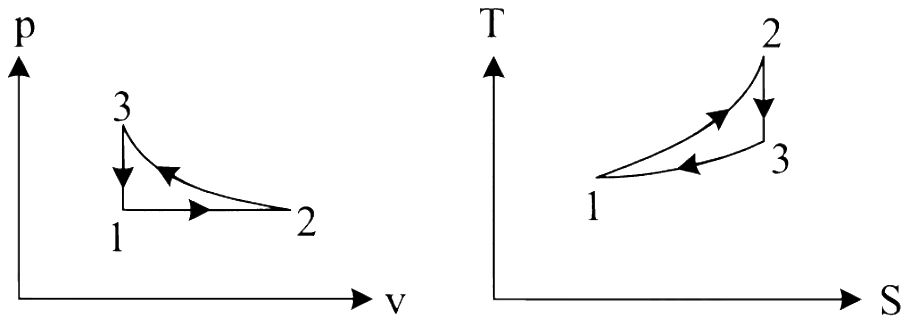
More than one option can be correct. Tap every correct option, then tap Check.
Answer: (b), (c), (d)
Step-by-step solution coming soon.
Thermodynamic Processes
Consider a thermodynamic process where integral energy ( = constant). If the process is performed adiabatically, then
Answer: (b)
Step-by-step solution coming soon.
Thermodynamic Processes
One mole of an ideal monoatomic gas expands along the polytrope from to at a constant pressure . The temperature during the process is such that molar specific heat . The total heat absorbed during the process can be expressed as
Answer: (b)
Step-by-step solution coming soon.
Thermodynamic Processes
In the given figure, represents isobaric, represents isothermal and represents adiabatic processes of an ideal gas. If , and be the changes in internal energy in these processes respectively, then
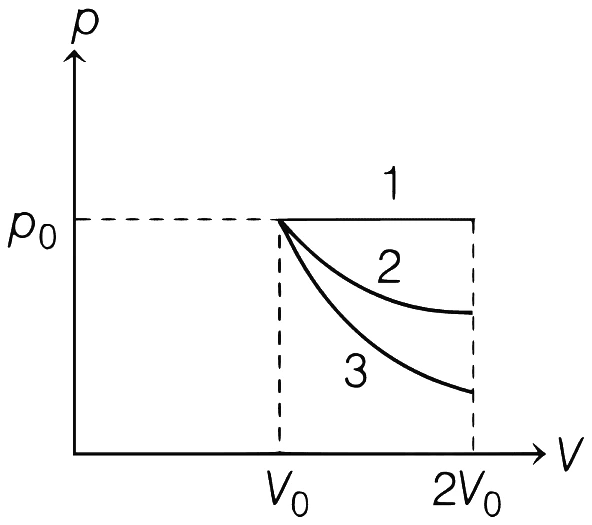
Answer: (d)
Step-by-step solution coming soon.
Thermodynamic Processes
Which of the following statement(s) is/are true?
"Internal energy of an ideal gas .............."
More than one option can be correct. Tap every correct option, then tap Check.
Answer: (b)
Step-by-step solution coming soon.
Thermodynamic Processes
For an ideal gas with initial pressure and volume and respectively, a reversible isothermal expansion happens, when its volume becomes . Then, it is compressed to its original volume by a reversible adiabatic process. If the final pressure is , then which of the following statement(s) is/are true?
Answer: (b)
Step-by-step solution coming soon.
Thermodynamic Processes
One mole of a monoatomic ideal gas undergoes a quasistatic process, which is depicted by a straight line joining points and in a - diagram. What is the value of the heat capacity of the gas at the point ?
Answer: (c)
Step-by-step solution coming soon.
Thermodynamic Processes
One mole of an ideal gas of volume and temperature is allowed to expand adiabatically to volume while doing no external work. The universal gas constant is . What is the pressure of the gas after expansion?
Answer: (b)
Step-by-step solution coming soon.
Thermodynamic Processes
A monoatomic ideal gas at pressure and volume is first adiabatically compressed to volume and then is allowed to expand isothermally back to its original volume. What is the final pressure of the gas?
Answer: (c)
Step-by-step solution coming soon.
Thermodynamic Processes
Which of the following statements about the P-V diagram of an ideal gas of fixed number of particles is incorrect?
Answer: (d)
Step-by-step solution coming soon.
Thermodynamic Processes
An ideal monoatomic gas, initially at pressure , is kept in a spherical container of volume . The container is adiabatically compressed to half of its initial radius. Assuming the process is reversible and neglecting the thickness of the container, the magnitude of compressional work on the system is expressed as , where is
Answer: (a)
Step-by-step solution coming soon.
Thermodynamic Processes
An ideal gas undergoes expansion via various processes. Select the correct option.
Answer: (c)
Step-by-step solution coming soon.
Thermodynamic Processes
In an adiabatic compression of a monoatomic ideal gas, the pressure increases to times the original pressure. Let be a typical inter-particle distance of the gas before the compression and be the corresponding value after compression. If the ratio is expressed as then the value of is
Answer: (b)
Step-by-step solution coming soon.
Thermodynamic Processes
Two air bubbles of equal initial volume rise from the bottom of a lake to the surface. One bubble ascends and expands adiabatically while the other bubble ascends and expands isothermally. Let and be the final volumes of the bubbles with adiabatic and isothermal expansions, respectively. Consider an ideal gas behaviour and note that is the adiabatic constant. Then,
Answer: (b)
Step-by-step solution coming soon.
Thermodynamic Processes
The correct statement(s) about an ideal gas is(are)
More than one option can be correct. Tap every correct option, then tap Check.
Answer: (a), (b)
Step-by-step solution coming soon.
Thermodynamic Processes
In an adiabatic expansion process, the density of an ideal gas changes from to such that . Select the correct statement(s) about this process.
More than one option can be correct. Tap every correct option, then tap Check.
Answer: (b), (c), (d)
Step-by-step solution coming soon.
Thermodynamic Processes
One mole of Helium gas (assumed ideal) is subjected to a process such that remains constant in the process, where and represent its pressure and temperature, respectively. Which of the following statements is/are true?
More than one option can be correct. Tap every correct option, then tap Check.
Answer: (a), (b), (c)
Step-by-step solution coming soon.
Thermodynamic Processes
2 moles of hydrogen gas at standard temperature () and pressure () are contained in a cylinder with a movable piston. The walls of the cylinder and also the piston are insulated. If the gas is compressed to one third of its original volume, the pressure of the gas will be
Answer: (c)
Step-by-step solution coming soon.
No questions match these filters.