
Gas Laws & Ideal Gas Equation
At constant temperature, the volume of a gas is to be decreased by 4%. The pressure must be increased by
Show answer and solution
Answer: (b)
Loading the solution…
Home›Practice Hub›Chapters›Thermodynamics›Gas Laws & Ideal Gas Equation
Thermodynamics PYQs · MHT CET · JEE Main · NEET
 Thermodynamics One Shot for MHT-CET2:48:33All 7 Thermodynamics videos →
Gas Laws & Ideal Gas Equation
At constant temperature, the volume of a gas is to be decreased by 4%. The pressure must be increased by
Answer: (b)
Gas Laws & Ideal Gas Equation
A balloon contains m of He at C and atmospheric pressure. Then, volume of He at C and atmospheric pressure will be
Answer: (b)
Gas Laws & Ideal Gas Equation
The pressure of a given mass of a gas is decreased by at constant temperature, then its volume will
Answer: (d)
Gas Laws & Ideal Gas Equation
An ideal gas is heated from C to C at constant pressure. If initial volume of gas is m, then the new volume of the gas will be
Answer: (a)
Gas Laws & Ideal Gas Equation
A gas of certain mass filled in a closed cylinder at a pressure of 3.23 kPa has temperature . The gas is now heated to double its temperature. The modified pressure is ______ Pa.
Numerical answer type. Work it out, then open the answer.
Answer: 3730
Gas Laws & Ideal Gas Equation
The gas in a vessel is subjected to a pressure of atm. at C. Now half of the gas is released from the vessel and the temperature is raised by C. The pressure of a gas in a vessel is nearly
Answer: (c)
Gas Laws & Ideal Gas Equation
At a pressure P and temperature T, 7 gram of oxygen occupies a volume V. The equation of state will be (Molecular weight of Oxygen )
Answer: (d)
Gas Laws & Ideal Gas Equation
A vessel has gram of hydrogen at pressure and temperature K. A small hole is made in it so that hydrogen leaks out. How much hydrogen leaks out if the final pressure is and the temperature falls to K?
Answer: (d)
Gas Laws & Ideal Gas Equation
When 300 J of heat given to an ideal gas with its temperature raises from to keeping its volume constant. The mass of the gas is (approximately) ______ g.
Numerical answer type. Work it out, then open the answer.
Answer: 481
Gas Laws & Ideal Gas Equation
An insulated cylinder of volume is filled with a gas at and 2 atmospheric pressure. Then the gas is compressed making the final volume as while allowing the temperature to rise to . The final pressure is ______ atmospheric pressure.
Numerical answer type. Work it out, then open the answer.
Answer: 7
Gas Laws & Ideal Gas Equation
At C, the value of density of a fixed mass of a gas (ideal) divided by its pressure is . At C this ratio is
Answer: (d)
Gas Laws & Ideal Gas Equation
Gas at pressure P, temperature T, and volume V is filled in jar A. Another jar B is filled with gas having parameters . The ratio of number of molecules of jar B to those of jar A is
Answer: (b)
Gas Laws & Ideal Gas Equation
An ideal gas at pressure 'P' and temperature 'T' is enclosed in a vessel of volume 'V'. Some gas leaks through a hole from the vessel and the pressure of the enclosed gas falls to . Assuming that the temperature of the gas remains constant during the leakage, the number of moles of the gas that have leaked is
Answer: (b)
Gas Laws & Ideal Gas Equation
An air bubble of volume rises from the bottom of a swimming pool of 5 m deep. At the bottom of the pool water temperature is . The volume of the bubble when it reaches the surface, where the water temperature is , is .
( , density of water , and 1 atm pressure is )
Answer: (d)
Gas Laws & Ideal Gas Equation
A mixture of carbon dioxide and oxygen has volume 8310 cm3, temperature 300 K, pressure 100 kPa and mass 13.2 g. The number of moles of carbon dioxide and oxygen gases in the mixture respectively are ______.
(Assume both carbon dioxide and oxygen gases behave like ideal gases) [R = 8.31 J/mol K]
Answer: (c)
Gas Laws & Ideal Gas Equation
Two closed vessels of same volume are joined through a narrow tube and both vessels are filled with air of pressure 90 kPa and temperature 400 K. Keeping the temperature of one vessel constant at 400 K the second vessel temperature is raised to 500 K. The final pressure in the vessels is ______ kPa.
Answer: (a)
Gas Laws & Ideal Gas Equation
A balloon is filled at and 1 atmospheric pressure by volume helium gas. At and 0.5 atmospheric pressure, the volume of helium gas will be
Answer: (c)
Gas Laws & Ideal Gas Equation
The volume of given mass of a gas is decreased by at constant temperature. The pressure should be increased by
Answer: (c)
Gas Laws & Ideal Gas Equation
How much should the pressure be increased in order to reduce the volume of a given mass of gas by at the constant temperature?
Answer: (c)
Gas Laws & Ideal Gas Equation
A tyre of a vehicle is filled with air having pressure 270 kPa at . The air pressure in the tyre when the temperature increases to is
Answer: (d)
Gas Laws & Ideal Gas Equation
The helium and argon are put in the flask at the same room temperature (300 K). The ratio of average kinetic energies (per molecule) of helium and argon is:
(Give: Molar mass of helium = 4 g/mol, Molar mass of argon = 40 g/mol)
Answer: (d)
Gas Laws & Ideal Gas Equation
Pressure of an ideal gas, contained in a closed vessel, is increased by when heated by . Its initial temperature must be:
Answer: (d)
Gas Laws & Ideal Gas Equation
A container of fixed volume contains a gas at 27°C. To double the pressure of the gas, the temperature of gas should be raised to _____ °C.
Numerical answer type. Work it out, then open the answer.
Answer: 327
Gas Laws & Ideal Gas Equation
When the pressure of the gas contained in a closed vessel is increased by , the temperature of the gas increases by 4 K. The initial temperature of the gas is
Answer: (c)
Gas Laws & Ideal Gas Equation
An oxygen cylinder of volume 30 litre has 18.20 moles of oxygen. After some oxygen is withdrawn from the cylinder, its gauge pressure drops to 11 atmospheric pressures at temperature . The mass of the oxygen withdrawn from the cylinder is nearly equal to:
[Given, , and molecular mass of atm pressure ]
Answer: (a)
Gas Laws & Ideal Gas Equation
The pressure ' P ', volume ' V ' and temperature ' T ' of a gas in a jar ' ' and the gas in other jar ' ' is at pressure ' 2 P ', volume ' ' and temperature ' '. Then the ratio of the number of molecules in jar A and jar B will be
Answer: (b)
Gas Laws & Ideal Gas Equation
For an ideal gas, the density of the gas is when temperature and pressure of the gas are and respectively. when the temperature of the gas is , its pressure becomes . The new density will be
Answer: (d)
Gas Laws & Ideal Gas Equation
An ideal gas at pressure ' P ' and temperature ' T ' is enclosed in a vessel of volume ' '. Some gas leaks through a hole from the vessel and the pressure of the enclosed gas falls to ' '. Assuming that the temperature of the gas remains constant during the leakage, the number of moles of the gas that have leaked is
Answer: (b)
Gas Laws & Ideal Gas Equation
A container has two chambers of volumes litres and litres separated by a partition made of a thermal insulator. The chambers contain and moles of ideal gas at pressures and , respectively. When the partition is removed, the mixture attains an equilibrium pressure of
Answer: (d)
Gas Laws & Ideal Gas Equation
There are two vessels filled with an ideal gas where volume of one is double the volume of other. The large vessel contains the gas at 8 kPa at 1000 K while the smaller vessel contains the gas at 7 kPa at 500 K. If the vessels are connected to each other by a thin tube allowing the gas to flow and the temperature of both vessels is maintained at 600 K, at steady state the pressure in the vessels will be (in kPa ).
Answer: (d)
Gas Laws & Ideal Gas Equation
Temperature remaining constant, the pressure of gas is decreased by . The percentage change in volume is
Answer: (c)
Gas Laws & Ideal Gas Equation
A gas is contained in closed vessel. The initial temperature of the gas is . If the pressure of the gas is increased by , the increase in the temperature of the gas is
Answer: (a)
Gas Laws & Ideal Gas Equation
A sample of oxygen gas and a sample of hydrogen gas both have the same mass, same volume and the same pressure. The ratio of their absolute temperature is (Molecular wt. of is 32 and 2 respectively)
Answer: (c)
Gas Laws & Ideal Gas Equation
The following graph represents the curves of an ideal gas (where is the temperature and the volume) at three pressures and compared with those of Charles's law represented as dotted lines.
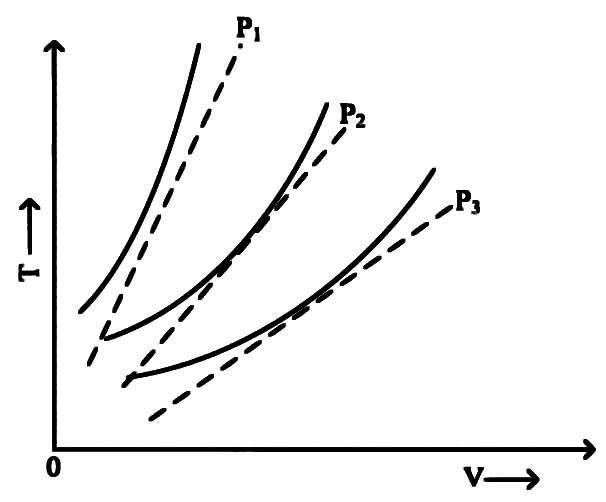
Then the correct relation is:
Answer: (d)
Gas Laws & Ideal Gas Equation
P-T diagram of an ideal gas having three different densities (in three different cases) is shown in the figure. Which of the following is correct:
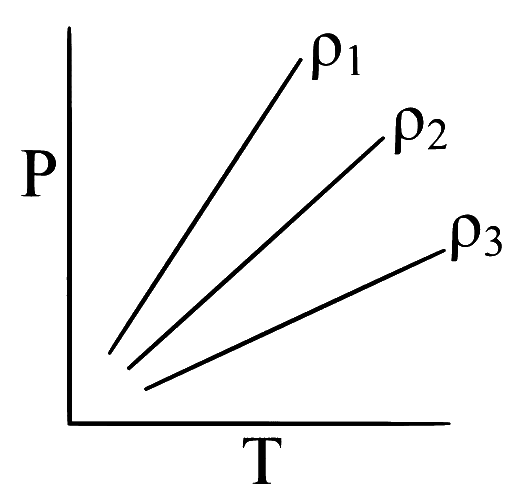
Answer: (a)
Gas Laws & Ideal Gas Equation
The temperature of a gas having molecules per cubic meter at (Given, ) is:
Answer: (a)
Gas Laws & Ideal Gas Equation
Two vessels separately contain two ideal gases A and B at the same temperature, pressure of A being twice that of B. Under such conditions, the density of A is found to be 1.5 times the density of . The ratio of molecular weights of and is
Answer: (c)
Gas Laws & Ideal Gas Equation
Two vessels and are of the same size and are at same temperature. A contains of hydrogen and contains of oxygen. and are the pressures of the gases in and respectively, then is:
Answer: (d)
Gas Laws & Ideal Gas Equation
At constant temperature, increasing the pressure of a gas by its volume will decrease by
Answer: (d)
Gas Laws & Ideal Gas Equation
Which one of the following represents correctly the variation of volume (V) of an ideal gas with temperature under constant pressure conditions?
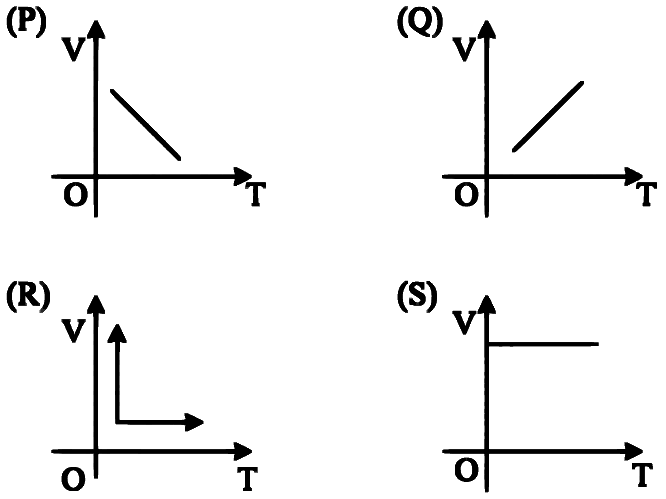
Answer: (b)
Gas Laws & Ideal Gas Equation
According to Boyle's law, the product PV remains constant. The unit of is same as that of
Answer: (a)
Gas Laws & Ideal Gas Equation
A bicycle tyre is filled with air having pressure of at . The approximate pressure of the air in the tyre when the temperature increases to is
Answer: (d)
Gas Laws & Ideal Gas Equation
For three low density gases A, B, C pressure versus temperature graphs are plotted while keeping them at constant volume, as shown in the figure.
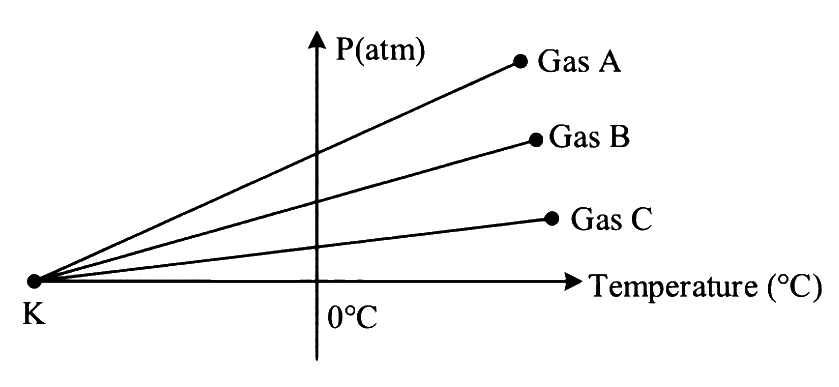
The temperature corresponding to the point '' is:
Answer: (a)
Gas Laws & Ideal Gas Equation
A sample of oxygen gas and a sample of hydrogen gas both have the same mass, same volume and the same pressure. The ratio of their absolute temperature is
Answer: (d)
Gas Laws & Ideal Gas Equation
A container of volume contains 0.2 mole of hydrogen gas and 0.3 mole of argon gas. The pressure of the system at temperature () will be :-
Answer: (d)
Gas Laws & Ideal Gas Equation
The correct relation between and temperature T is:
Answer: (d)
Gas Laws & Ideal Gas Equation
The pressure and temperature ( relationship of an ideal gas obeys the equation constant. The volume expansion coefficient of the gas will be:
Answer: (d)
Gas Laws & Ideal Gas Equation
For an ideal gas the density of the gas is when temperature and pressure of the gas are and respectively. When the temperature of the gas is , its pressure will be . The new density will be
Answer: (a)
Gas Laws & Ideal Gas Equation
We have a jar filled with gas characterized by parameters and another jar B filled with gas having parameters , where symbols have their usual meaning. The ratio of number of molecules in jar A to those in jar B is
Answer: (d)
Gas Laws & Ideal Gas Equation
A jar '' is filled with gas having pressure, volume and temperature respectively. Another gas jar filled with a gas having pressure , volume and temperature . The ratio of the number of molecules in jar to those in jar is
Answer: (d)
Gas Laws & Ideal Gas Equation
When a gas filled in a closed vessel is heated by raising the temperature by 1C, its pressure increases by 0.4%. The initial temperature of the gas is ___________ K.
Numerical answer type. Work it out, then open the answer.
Answer: 250
Gas Laws & Ideal Gas Equation
The volume occupied by the molecules contained in 4.5 kg water at STP, if the intermolecular forces vanish away is
Answer: (d)
Gas Laws & Ideal Gas Equation
A vessel contains 16g of hydrogen and 128g of oxygen at standard temperature and pressure. The volume of the vessel in cm3 is:
Answer: (c)
Gas Laws & Ideal Gas Equation
A cylinder of fixed capacity of 44.8 litres contains helium gas at standard temperature and pressure. The amount of heat needed to raise the temperature of gas in the cylinder by 20.0C will be: (Given gas constant R = 8.3 JK-mol)
Answer: (c)
Gas Laws & Ideal Gas Equation
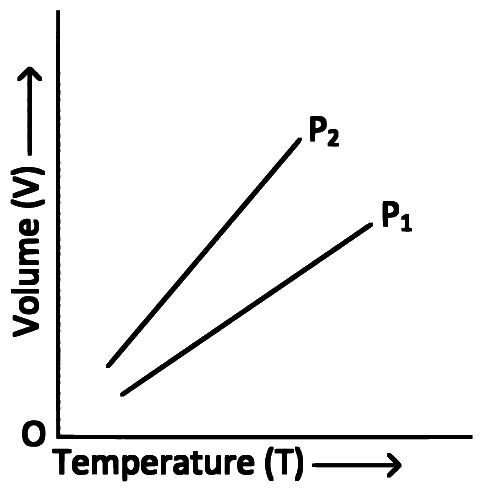
For a perfect gas, two pressures P1 and P2 are shown in figure. The graph shows:
Answer: (a)
Gas Laws & Ideal Gas Equation
A mixture of hydrogen and oxygen has volume 2000 cm3, temperature 300 K, pressure 100 kPa and mass 0.76 g. The ratio of number of moles of hydrogen to number of moles of oxygen in the mixture will be:
[Take gas constant R = 8.3 JKmol]
Answer: (b)
Gas Laws & Ideal Gas Equation
A balloon carries a total load of 185 kg at normal pressure and temperature of 27C. What load will the balloon carry on rising to a height at which the barometric pressure is 45 cm of Hg and the temperature is C. Assuming the volume constant?
Answer: (d)
Gas Laws & Ideal Gas Equation
An ideal gas is expanding such that PT3 = constant. The coefficient of volume expansion of the gas is:
Answer: (c)
Gas Laws & Ideal Gas Equation
Which of the following graphs represent the behavior of an ideal gas? Symbols have their usual meaning.
Answer: (c)
Gas Laws & Ideal Gas Equation
A mixture of hydrogen and oxygen has volume 500 cm3, temperature 300 K, pressure 400 kPa and mass 0.76 g. The ratio of masses of oxygen to hydrogen will be :-
Answer: (c)
Gas Laws & Ideal Gas Equation
A cylindrical container of volume 4.0 103 m3 contains one mole of hydrogen and two moles of carbon dioxide. Assume the temperature of the mixture is 400 K. The pressure of the mixture of gases is:
[Take gas constant as 8.3 J mol K]
Answer: (c)
Gas Laws & Ideal Gas Equation
A container is divided into two chambers by a partition. The volume of first chamber is 4.5 litre and second chamber is 5.5 litre. The first chamber contain 3.0 moles of gas at pressure 2.0 atm and second chamber contain 4.0 moles of gas at pressure 3.0 atm. After the partition is removed and the mixture attains equilibrium, then, the common equilibrium pressure existing in the mixture is x 101 atm. Value of x is ________.
Numerical answer type. Work it out, then open the answer.
Answer: 25
Gas Laws & Ideal Gas Equation
For an ideal gas the instantaneous change in pressure 'p' with volume 'v' is given by the equation . If p = p0 at v =0 is the given boundary condition, then the maximum temperature one mole of gas can attain is: (Here R is the gas constant)
Answer: (a)
Gas Laws & Ideal Gas Equation
The average thermal energy for a mono-atomic gas is: (kB is Boltzmann constant and T absolute temperature)
Answer: (a)
Gas Laws & Ideal Gas Equation
An ideal gas equation can be written as
where and are respectively,
Answer: (d)
Gas Laws & Ideal Gas Equation
A cylinder contains hydrogen gas at pressure 249 kPa and temperature 27C
Its density is: (R = 8.3 J mol-1 K-1)
Answer: (a)
Gas Laws & Ideal Gas Equation
The change in the magnitude of the volume of an ideal gas when a small additional pressure P is applied at a constant temperature, is the same as the change when the temperature is reduced by a small quantity T at constant pressure. The initial temperature and pressure of the gas were 300 K and 2 atm. respectively.
If |T| = C|P| then value of C in (K/atm.) is _________.
Numerical answer type. Work it out, then open the answer.
Answer: 150
Gas Laws & Ideal Gas Equation
The equation of state for 2 g of oxygen at a pressure ' ' and temperature ' , when occupying a volume ' ' will be
Answer: (c)
Gas Laws & Ideal Gas Equation
A cylinder with fixed capacity of 67.2 lit contains helium gas at STP. The amount of heat needed to raise the temperature of the gas by 20°C is: [Given that R = 8.31 J mol–1 K–1]
Answer: (c)
Gas Laws & Ideal Gas Equation
An ideal gas occupies a volume of 2m3 at a pressure of 3 106 Pa. The energy of the gas is:
Answer: (b)
Gas Laws & Ideal Gas Equation
The temperature of an open room of volume 30 m3 increases from 17oC to 27oC due to the sunshine. The atmospheric pressure in the room remains 1 105 Pa. If Ni and Nf are the number of molecules in the room before and after heating, then Nf – Ni will be:
Answer: (d)
Gas Laws & Ideal Gas Equation
A given sample of an ideal gas occupies a volume V at a pressure P and absolute temperature T. The mass of each molecule of the gas is m. Which of the following gives the density of the gas?
Answer: (b)
Gas Laws & Ideal Gas Equation
Which of the following shows the correct relationship between the pressure ‘P’ and density of an ideal gas at constant temperature?
Answer: (d)
Gas Laws & Ideal Gas Equation
Two vessels separately contain two ideal gases A and B at the same temperature, the pressure of A being twice that of B. Under such conditions, the density of A is found to be 1.5 times the density of B. The ratio of molecular weight of A and B is
Answer: (d)
Gas Laws & Ideal Gas Equation
Modern vacuum pumps can evacuate a vessel down to a pressure of 4.0 1015 atm. at room temperature (300 K). Taking R = 8.3 JK mole, 1 atm = 105 Pa and NAvogadro = 6 1023 mole, the mean distance between molecules of gas in an evacuated vessel will be of the order of:
Answer: (b)
Gas Laws & Ideal Gas Equation
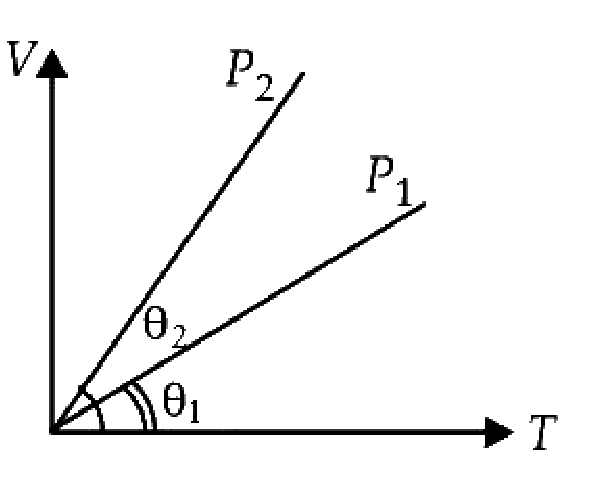
In the given (V T) diagram, what is the relation between pressure P1 and P2?
Answer: (a)
Gas Laws & Ideal Gas Equation
The amount of heat energy required to raise the temperature of 1 g of Helium at NTP, from T1K to T2K is
Answer: (c)
Gas Laws & Ideal Gas Equation
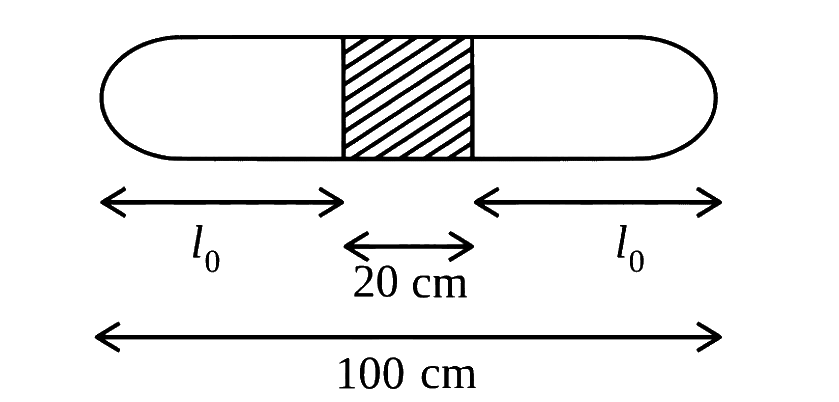
A thin tube sealed at both ends is 100 cm long. It lies horizontally, the middle 20 cm containing mercury and two equal ends containing air at standard atmospheric pressure. If the tube is now turned to a vertical position, by what amount will the mercury be displaced?
(Given: cross-section of the tube can be assumed to be uniform)
Answer: (b)
Gas Laws & Ideal Gas Equation
At 10oC the value of the density of a fixed mass of an ideal gas divided by its pressure is x. At 110oC this ratio is
Answer: (b)
Gas Laws & Ideal Gas Equation
An insulated container of gas has two chambers separated by an insulating partition. One of the chambers has volume and contains ideal gas at pressure and temperature . The other chamber has volume and contains ideal gas at pressure and temperature . If the partition is removed without doing any work on the gas, the final equilibrium temperature of the gas in the container will be
Answer: (a)
Gas Laws & Ideal Gas Equation
The equation of state for 5 g of oxygen at a pressure P and temperature T, when occupying a volume V, will be
(where R is the gas constant)
Answer: (a)
Gas Laws & Ideal Gas Equation
Two thermally insulated vessels and are filled with air at temperatures volume and pressure respectively. If the valve joining the two vessels is opened, the temperature inside the vessel at equilibrium will be
Answer: (a)
Gas Laws & Ideal Gas Equation
The gases carbon-monoxide (CO) and nitrogen at the same temperature have kinetic energies and respectively. Then
Answer: (a)
Gas Laws & Ideal Gas Equation
Relation between pressure () and energy () of a gas is
Answer: (a)
Gas Laws & Ideal Gas Equation
For hydrogen gas and for oxygen gas , so the relation between and is given by
Answer: (d)
Gas Laws & Ideal Gas Equation
Two containers and are partly filled with water and closed. The volume of is twice that of and it contains half the amount of water in . If both are at the same temperature, the water vapour in the containers will have pressure in the ratio of
Answer: (b)
Gas Laws & Ideal Gas Equation
If we plot a graph between volume and inverse of pressure (i.e., ) for an ideal gas at constant temperature , the curve so obtained is
Answer: (a)
Step-by-step solution coming soon.
Gas Laws & Ideal Gas Equation
The pressure of an ideal gas undergoing isothermal change is increased by . The volume of the gas must decrease by about
Answer: (b)
Step-by-step solution coming soon.
Gas Laws & Ideal Gas Equation
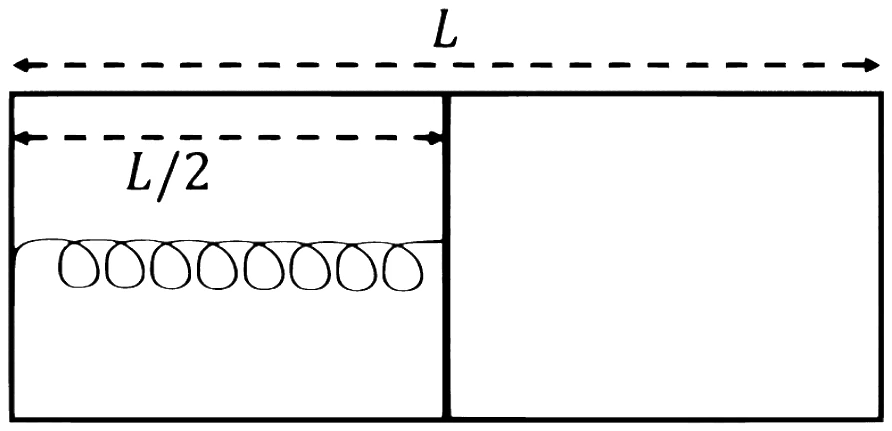
The left and right compartments of a thermally isolated container of length are separated by a thermally conducting, movable piston of area . The left and right compartments are filled with and moles of an ideal gas, respectively. In the left compartment the piston is attached by a spring with spring constant and natural length . In thermodynamic equilibrium, the piston is a distance from the left and right edges of the container as shown in the figure. Under the above conditions, if the pressure in the right compartment is , then the value of is __________.
Numerical answer type. Work it out, then open the answer.
Answer: 0.2
Step-by-step solution coming soon.
Gas Laws & Ideal Gas Equation
A spherical soap bubble inside an air chamber at pressure has a certain radius so that the excess pressure inside the bubble is . Now, the chamber pressure is reduced to so that the bubble radius and its excess pressure change. In this process, all the temperatures remain unchanged. Assume air to be an ideal gas and the excess pressure in both the cases to be much smaller than the chamber pressure. The new excess pressure in is ______.
Numerical answer type. Work it out, then open the answer.
Answer: 96
Step-by-step solution coming soon.
Gas Laws & Ideal Gas Equation
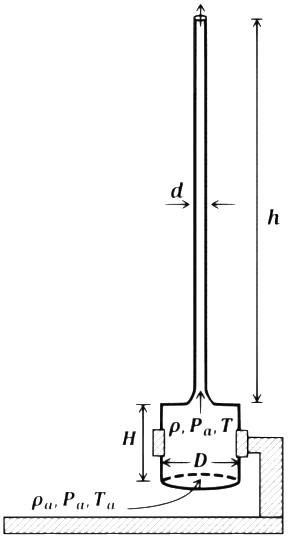
A cylindrical furnace has height () and diameter () both . It is maintained at temperature . The air gets heated inside the furnace at constant pressure and its temperature becomes . The hot air with density rises up a vertical chimney of diameter and height above the furnace and exits the chimney (see the figure). As a result, atmospheric air of density , pressure and temperature enters the furnace. Assume air as an ideal gas, neglect the variations in and inside the chimney and the furnace. Also ignore the viscous effects.
[Given: The acceleration due to gravity and ]
Considering the air flow to be streamline, the steady mass flow rate of air exiting the chimney is ________ .
Numerical answer type. Work it out, then open the answer.
Answer: 47.1
Step-by-step solution coming soon.
Gas Laws & Ideal Gas Equation
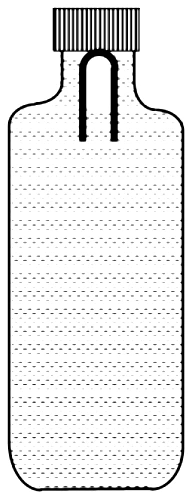
A soft plastic bottle, filled with water of density , carries an inverted glass test-tube with some air (ideal gas) trapped as shown in the figure. The test-tube has a mass of , and it is made of a thick glass of density . Initially the bottle is sealed at atmosphere pressure so that the volume of the trapped air is . When the bottle is squeezed from outside at constant temperature, the pressure inside rises and the volume of the trapped air reduces. It is found that the test tube begins to sink at pressure without changing its orientation. At this pressure, the volume of the trapped air is . Let and .
The value of is ______.
Numerical answer type. Work it out, then open the answer.
Answer: 0.3
Step-by-step solution coming soon.
Gas Laws & Ideal Gas Equation
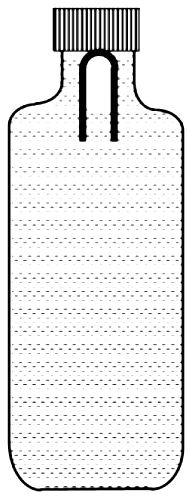
A soft plastic bottle, filled with water of density , carries an inverted glass test-tube with some air (ideal gas) trapped as shown in the figure. The test-tube has a mass of , and it is made of a thick glass of density . Initially the bottle is sealed at atmosphere pressure so that the volume of the trapped air is . When the bottle is squeezed from outside at constant temperature, the pressure inside rises and the volume of the trapped air reduces. It is found that the test tube begins to sink at pressure without changing its orientation. At this pressure, the volume of the trapped air is . Let and .
The value of is ______.
Numerical answer type. Work it out, then open the answer.
Answer: 10
Step-by-step solution coming soon.
Gas Laws & Ideal Gas Equation
A thermally isolated cylindrical closed vessel of height is kept vertically. It is divided into two equal parts by a diathermic (perfect thermal conductor) frictionless partition of mass . Thus the partition is held initially at a distance of from the top, as shown in the schematic figure below. Each of the two parts of the vessel contains mole of an ideal gas at temperature . The partition is now released and moves without any gas leaking from one part of the vessel to the other. When equilibrium is reached, the distance of the partition from the top (in m) will be ______. (take the acceleration due to gravity and the universal gas constant ).
Numerical answer type. Work it out, then open the answer.
Answer: 6
Step-by-step solution coming soon.
Gas Laws & Ideal Gas Equation
Two non-reactive monoatomic ideal gases have their atomic masses in the ratio . The ratio of their partial pressures, when enclosed in a vessel kept at a constant temperature, is . The ratio of their densities is
Answer: (d)
Step-by-step solution coming soon.
Gas Laws & Ideal Gas Equation
An ideal gas is expanding such that constant. The coefficient of volume expansion of the gas is
Answer: (c)
Step-by-step solution coming soon.
Gas Laws & Ideal Gas Equation
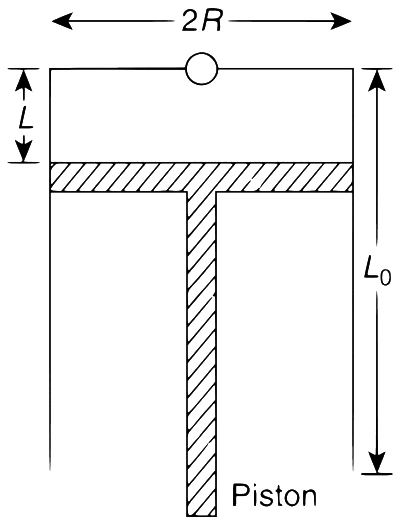
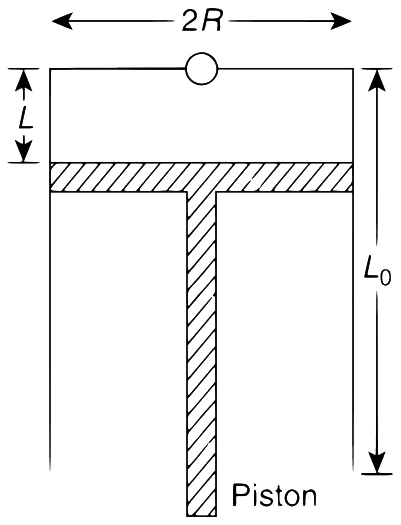
A fixed thermally conducting cylinder has a radius and height . The cylinder is open at its bottom and has a small hole at its top. A piston of mass is held at a distance from the top surface, as shown in the figure. The atmospheric pressure is .
The piston is now pulled out slowly and held at a distance from the top. The pressure in the cylinder between its top and the piston will then be
Answer: (a)
Step-by-step solution coming soon.
Gas Laws & Ideal Gas Equation
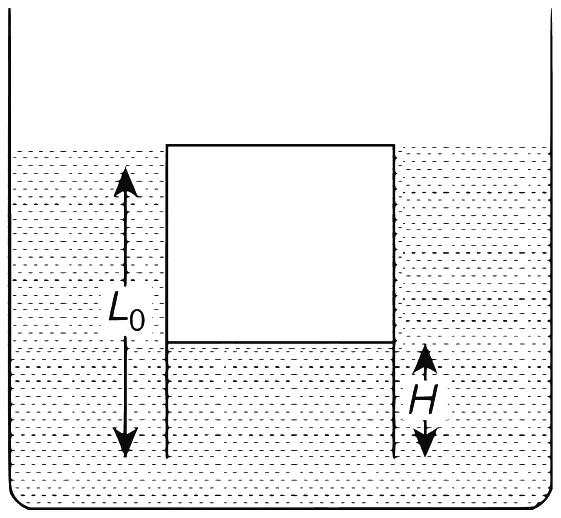
A fixed thermally conducting cylinder has a radius and height . The cylinder is open at its bottom and has a small hole at its top. A piston of mass is held at a distance from the top surface, as shown in the figure. The atmospheric pressure is .
The piston is taken completely out of the cylinder. The hole at the top is sealed. A water tank is brought below the cylinder and put in a position so that the water surface in the tank is at the same level as the top of the cylinder as shown in the figure. The density of the water is . In equilibrium, the height of the water column in the cylinder satisfies
Answer: (c)
Step-by-step solution coming soon.
Gas Laws & Ideal Gas Equation
An ideal gas initially at pressure is being compressed from to volume and its temperature decreases from to , then find the final pressure of the gas.
Answer: (a)
Step-by-step solution coming soon.
Gas Laws & Ideal Gas Equation
A balloon is filled at and pressure by He. At and pressure, the volume of He will be
Answer: (b)
Step-by-step solution coming soon.
Gas Laws & Ideal Gas Equation
1 mole of gas occupies a volume of at pressure. What is the volume occupied by two moles of gas at pressure and at same temperature?
Answer: (b)
Step-by-step solution coming soon.
Gas Laws & Ideal Gas Equation
By what percentage should the pressure of a given mass of a gas be increased, so as to decrease its volume by at a constant temperature?
Answer: (d)
Step-by-step solution coming soon.
Gas Laws & Ideal Gas Equation
Assertion : Air pressure in a car tyre increases during driving.
Reason : Absolute zero temperature is not zero energy temperature.
Answer: (b)
Step-by-step solution coming soon.
Gas Laws & Ideal Gas Equation
Two balloons are filled, one with pure He gas and the other by air, respectively. If the pressure and temperature of these balloons are same then the number of molecules per unit volume is :
Answer: (b)
Step-by-step solution coming soon.
Gas Laws & Ideal Gas Equation
A graph between pressure (along -axis) and absolute temperature (along -axis) for equal moles of two gases has been drawn. Given that volume of second gas is more than volume of first gas. Which of the following statement is correct?
Answer: (b)
Step-by-step solution coming soon.
Gas Laws & Ideal Gas Equation
Two identical glass spheres filled with air are connected by a horizontal glass tube. The glass tube contains a pellet of mercury at its mid-point. Air in one sphere is at and the other is at . If both the vessels are heated through , then neglecting the expansions of the bulbs and the tube
Answer: (b)
Step-by-step solution coming soon.
Gas Laws & Ideal Gas Equation
A cylindrical tube of uniform cross-sectional area is fitted with two air tight frictionless pistons. The pistons are connected to each other by a metallic wire. Initially, the pressure of the gas is and temperature is , atmospheric pressure is also . Now, the temperature of the gas is increased to , the tension of wire will be
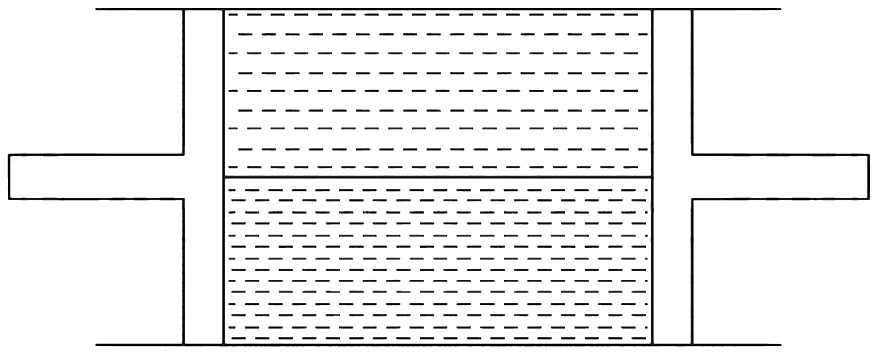
Answer: (b)
Step-by-step solution coming soon.
Gas Laws & Ideal Gas Equation
Two different isotherms representing the relationship between pressure and volume at a given temperature of the same ideal gas are shown for masses and , then
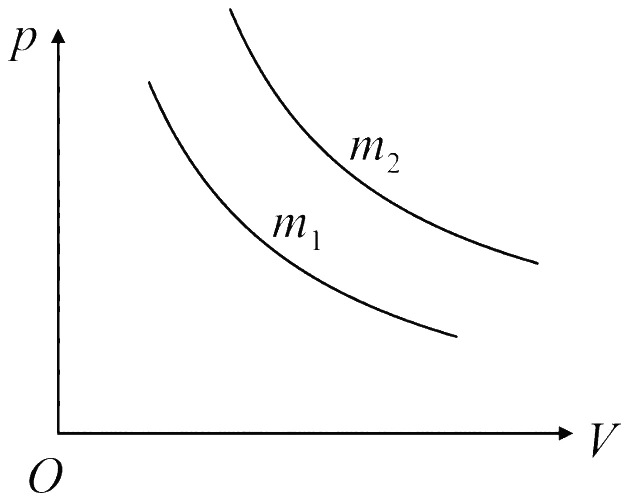
Answer: (b)
Step-by-step solution coming soon.
Gas Laws & Ideal Gas Equation
A balloon contains of helium at and atmosphere pressure. The volume of the helium at temperature and atmosphere pressure will be
Answer: (b)
Step-by-step solution coming soon.
Gas Laws & Ideal Gas Equation
A cylinder contains of gas at a pressure of . The quantity of gas taken out of the cylinder, if the final pressure is , will be (temperature of gas is constant)
Answer: (d)
Step-by-step solution coming soon.
Gas Laws & Ideal Gas Equation
A vessel is filled with a gas at a pressure of of mercury at a certain temperature. The mass of gas is increased by by introducing more gas in the vessel at the same temperature. Now the resultant pressure of the gas is
Answer: (b)
Step-by-step solution coming soon.
Gas Laws & Ideal Gas Equation
A vessel containing mole of gas (molar mass ) at temperature . The pressure of the gas is . An identical vessel containing one mole of He gas (molar mass ) at temperature has a pressure of
Answer: (c)
Step-by-step solution coming soon.
Gas Laws & Ideal Gas Equation
A vessel contains one mole of gas (molar mass ) at a temperature . The pressure of the gas is . An identical vessel containing one mole of He gas (molar mass ) at a temperature has a pressure of
Answer: (c)
Step-by-step solution coming soon.
Gas Laws & Ideal Gas Equation
The figure shows graphs of pressure () versus density () for an ideal gas at two temperatures and , then
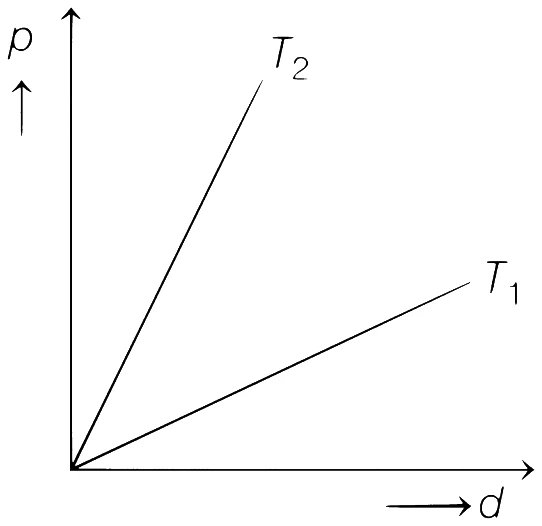
Answer: (b)
Step-by-step solution coming soon.
Gas Laws & Ideal Gas Equation
Two gases occupy two containers and . The gas in of volume , exerts a pressure of and that in , of volume exerts a pressure of . The two containers and united by a tube of negligible volume and the gases are allowed to exchange. Then, if the temperature remains constants. the final pressure in the container will be (in MPa).
Answer: (b)
Step-by-step solution coming soon.
Gas Laws & Ideal Gas Equation
In the diagram shown in adjoining figure, what is the relation between and ?
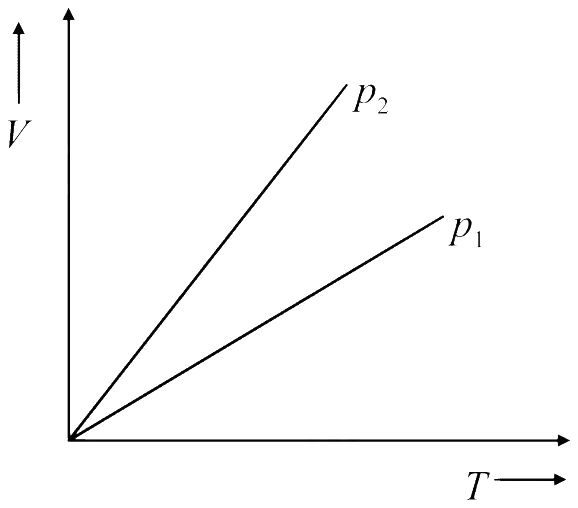
Answer: (b)
Step-by-step solution coming soon.
Gas Laws & Ideal Gas Equation
Two vessels and contain same mass of Oxygen and Hydrogen respectively at the same temperature. The volume of is twice that of . The ratio of gas pressure in to that in is
Answer: (a)
Step-by-step solution coming soon.
Gas Laws & Ideal Gas Equation
A vessel of volume contains a mixture of hydrogen (molar mass ) and oxygen (molar mass ) gas at standard temperature and pressure. If the mass of hydrogen is , find the mass of oxygen gas contained in the vessel.
Answer: (b)
Step-by-step solution coming soon.
Gas Laws & Ideal Gas Equation
An ideal gas is expanding such that . The coefficient of volume expansion of the gas is
Answer: (d)
Step-by-step solution coming soon.
Gas Laws & Ideal Gas Equation
An electric bulb of volume was sealed off during manufacture at a pressure of of mercury at . The number of air molecules contained in the bulb is, ( and )
Answer: (d)
Step-by-step solution coming soon.
Gas Laws & Ideal Gas Equation
For an ideal gas, coefficient of volume expansion is given by
Answer: (d)
Step-by-step solution coming soon.
Gas Laws & Ideal Gas Equation
Which of the following curves represent the variation of coefficient of volume expansion of an ideal gas at constant pressure?
Answer: (b)
Step-by-step solution coming soon.
Gas Laws & Ideal Gas Equation
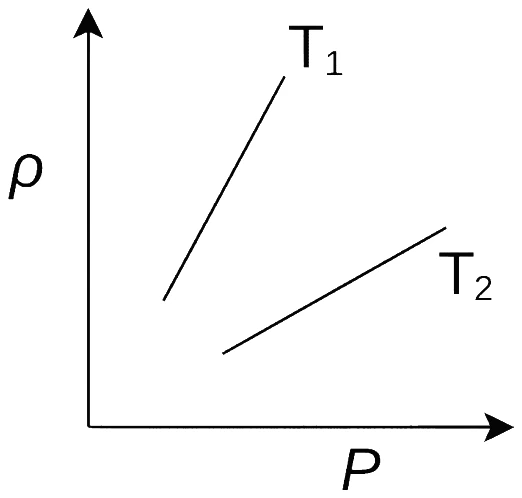
The density versus pressure of a given mass of an ideal gas is shown at two temperatures and . The relation between and is
Answer: (b)
Step-by-step solution coming soon.
Gas Laws & Ideal Gas Equation
An ideal gas is expanding such that constant. The coefficient of volume expansion of the gas is
( - Pressure, - temperature of the gas)
Answer: (d)
Step-by-step solution coming soon.
Gas Laws & Ideal Gas Equation
An ideal gas of density is enclosed in a vessel of volume at temperature and atmospheric pressure. If the pressure inside the vessel decreased by due to a leakage, the mass of the leaked-out gas is
Answer: (d)
Step-by-step solution coming soon.
Gas Laws & Ideal Gas Equation
A vessel contains a mixture of nitrogen of mass and carbon dioxide of mass at a temperature of and pressure of . The density of the mixture is
Answer: (c)
Step-by-step solution coming soon.
Gas Laws & Ideal Gas Equation
In a container of volume at temperature, moles of oxygen, moles of nitrogen and moles of hydrogen are present, then the pressure in the container is (universal gas constant )
Answer: (c)
Step-by-step solution coming soon.
Gas Laws & Ideal Gas Equation
A balloon contains of He at and atmospheric pressure. The volume of He at temperature and atmospheric pressure will be
Answer: (d)
Step-by-step solution coming soon.
Gas Laws & Ideal Gas Equation
A vessel has of oxygen at pressure and temperature . A small hole is made in it, so that oxygen leaks out. How much oxygen leaks out if the final pressure is and temperature is ?
Answer: (c)
Step-by-step solution coming soon.
Gas Laws & Ideal Gas Equation
The intensive variables among thermodynamic state variables internal energy , volume , pressure , absolute temperature and total mass are
Answer: (d)
Step-by-step solution coming soon.
Gas Laws & Ideal Gas Equation
An air bubble rises from the bottom of a lake of depth . The temperature of the lake is constant from the bottom to the top and atmospheric pressure is equal to the pressure of water column. The percentage increase in the volume of the bubble when it rises from a depth of to a depth of is
Answer: (c)
Step-by-step solution coming soon.
Gas Laws & Ideal Gas Equation
When the temperature of a gas in a closed vessel is increased by , its pressure increases by . The initial temperature of the gas is
Answer: (d)
Step-by-step solution coming soon.
Gas Laws & Ideal Gas Equation
The pressure of a mixture of of oxygen, of nitrogen and of carbon dioxide gases in a closed vessel is . Under isothermal conditions if entire oxygen is removed from the vessel, the pressure of the mixture of remaining two gases is
Answer: (d)
Step-by-step solution coming soon.
Gas Laws & Ideal Gas Equation
At a pressure and temperature , a vessel contains of a gas. A small hole is made into the vessel, so that the gas in it leaks out. At a pressure of and a temperature of , the mass of the gas leaked out is . Then,
Answer: (b)
Step-by-step solution coming soon.
Gas Laws & Ideal Gas Equation
For an ideal gas at a temperature of and at constant pressure, the coefficient of volume expansion is nearly
Answer: (d)
Step-by-step solution coming soon.
Gas Laws & Ideal Gas Equation
For a given mass of a gas at constant temperature, the volume and the pressure are and respectively. Then the slope of the graph drawn between on -axis and on -axis is
Answer: (b)
Step-by-step solution coming soon.
Gas Laws & Ideal Gas Equation
Air is filled at in a vessel of open mouth. The vessel is heated to a temperature so that th of the air escaped from the vessel. Assuming air as an ideal gas and the volume of the vessel remaining constant, then the value of is
Answer: (b)
Step-by-step solution coming soon.
Gas Laws & Ideal Gas Equation
Two identical containers and with frictionless pistons contain the same ideal gas at the same temperature and same volume . The mass of the gas in is and that in is . The gas in each cylinder is now allowed to expand isothermally to the same final volume . The changes in the pressure of the gases in and are found to be and respectively. Then the relation between and is
Answer: (b)
Step-by-step solution coming soon.
Gas Laws & Ideal Gas Equation
An ideal gas at pressure is enclosed in a container that is placed in a reservoir at temperature . If the volume of the gas is increased to two times its original value, then the new pressure
Answer: (a)
Step-by-step solution coming soon.
Gas Laws & Ideal Gas Equation
If and are the coefficient of volume expansion and temperature for an ideal gas respectively, then
Answer: (a)
Step-by-step solution coming soon.
Gas Laws & Ideal Gas Equation
All gases deviate from gas laws at
Answer: (b)
Step-by-step solution coming soon.
Gas Laws & Ideal Gas Equation
An ideal gas at temperature and pressure occupies a volume . If its temperature is halved and pressure doubled, what is its new volume?
Answer: (a)
Step-by-step solution coming soon.
Gas Laws & Ideal Gas Equation
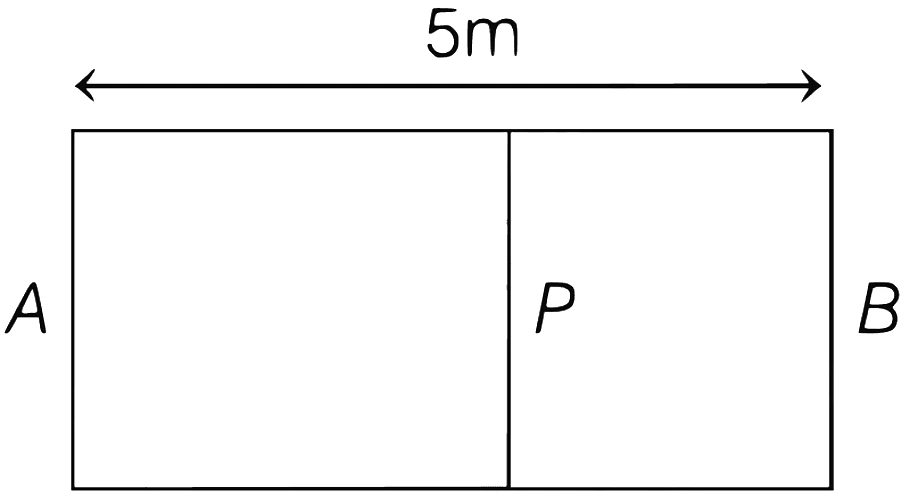
A container in the shape of a rectangular parallelopiped of length is divided internally by a movable partition as shown in the figure.
The left compartment is filled with a given mass of an ideal gas of molar mass while the right compartment is filled with an equal mass of another ideal gas of molar mass at same temperature. What will be the distance of from the left wall when equilibrium is established?
Answer: (b)
Step-by-step solution coming soon.
Gas Laws & Ideal Gas Equation
The perfect gas equation for of hydrogen gas is
Answer: (b)
Step-by-step solution coming soon.
Gas Laws & Ideal Gas Equation
The temperature and pressure at the summit of Mt. Everest is and , respectively. The corresponding values at sea-level are and . Considering air to be an ideal gas, the ratio between the molecular number density at the summit of Mt. Everest to that at sea level is closest to
Answer: (d)
Step-by-step solution coming soon.
Gas Laws & Ideal Gas Equation
A turbo-pump working at constant pumping speed of is used to evacuate a vessel of of an ideal gas at room temperature. The approximate time (in seconds) required to reduce inside pressure of the vessel from to is closest to
Answer: (c)
Step-by-step solution coming soon.
Gas Laws & Ideal Gas Equation
Two containers and of volumes and respectively hold the same ideal gas and are connected by a thin horizontal tube of negligible volume with a valve which is initially closed. The initial temperature and pressure of the gas in are and , respectively and those in are and , respectively. Heaters are employed to maintain the temperatures in both the containers at their initial values even after the valve is opened. Then,
More than one option can be correct. Tap every correct option, then tap Check.
Answer: (b), (c), (d)
Step-by-step solution coming soon.
Gas Laws & Ideal Gas Equation
A certain diatomic gas has the same specific heats as an ideal gas but a slightly different equation of state: , . The temperature of the gas is raised from to at constant pressure. It is found that work done on the gas is higher than what would be on an ideal gas. Choose the correct statement(s).
More than one option can be correct. Tap every correct option, then tap Check.
Answer: (a)
Step-by-step solution coming soon.
Gas Laws & Ideal Gas Equation
30 moles of nitrogen gas is kept in a canister at a temperature of . Due to a leak in the canister the pressure drops to of its original value and the temperature drops to . Assuming nitrogen to be an ideal gas, the amount of nitrogen (in moles) that has leaked out is
Answer: (b)
Step-by-step solution coming soon.
No questions match these filters.