Q1 MHT CET 2026 · 17 APR · SHIFT 2 Easy ☆
Vector Basics, Unit Vectors & Components
There are two vectors A ⃗ = 6 i ^ + 9 j ^ − k ^ \vec{A} = 6\hat{i} + 9\hat{j} - \hat{k} A = 6 i ^ + 9 j ^ − k ^ B ⃗ = 2 i ^ + 3 j ^ − p k ^ \vec{B} = 2\hat{i} + 3\hat{j} - p\hat{k} B = 2 i ^ + 3 j ^ − p k ^
(a) 3 3 3 (b) 1 3 \frac{1}{3} 3 1 (c) 2 3 \frac{2}{3} 3 2 (d) − 1 3 -\frac{1}{3} − 3 1 Show answer and solution
Answer: (b)
Loading the solution…
Report a mistake Open question page Q2 MHT CET 2026 · 15 APR · SHIFT 2 Easy ☆
Vector Basics, Unit Vectors & Components
Let A ⃗ \vec{A} A B ⃗ \vec{B} B
(a) A ⃗ ⋅ B ⃗ = − B ⃗ ⋅ A ⃗ \vec{A} \cdot \vec{B} = -\vec{B} \cdot \vec{A} A ⋅ B = − B ⋅ A (b) A ⃗ × B ⃗ = B ⃗ × A ⃗ \vec{A} \times \vec{B} = \vec{B} \times \vec{A} A × B = B × A (c) A ⃗ + B ⃗ = B ⃗ + A ⃗ \vec{A} + \vec{B} = \vec{B} + \vec{A} A + B = B + A (d) A ⃗ − B ⃗ = B ⃗ − A ⃗ \vec{A} - \vec{B} = \vec{B} - \vec{A} A − B = B − A Show answer and solution
Answer: (c)
Loading the solution…
Report a mistake Open question page Q3 MHT CET 2026 · 18 APR · SHIFT 2 Easy ☆
Vector Basics, Unit Vectors & Components
If a unit vector is represented by U ⃗ = 0.9 i ^ − 0.2 j ^ + m k ^ \vec{U} = 0.9\hat{i} - 0.2\hat{j} + m\hat{k} U = 0.9 i ^ − 0.2 j ^ + m k ^
(a) 0.85 0.85 0.85 (b) 0.15 \sqrt{0.15} 0.15 (c) 1 1 1 (d) 0.77 \sqrt{0.77} 0.77 Show answer and solution
Answer: (b)
Loading the solution…
Report a mistake Open question page Q4 MHT CET 2026 · 15 APR · SHIFT 1 Easy ☆
Vector Basics, Unit Vectors & Components
A vector A ⃗ \vec{A} A ( i ^ − 2 j ^ + 2 k ^ ) (\hat{i} - 2\hat{j} + 2\hat{k}) ( i ^ − 2 j ^ + 2 k ^ ) ( − 2 i ^ + j ^ − k ^ ) (-2\hat{i} + \hat{j} - \hat{k}) ( − 2 i ^ + j ^ − k ^ ) A ⃗ \vec{A} A
(a) 3 \sqrt{3} 3 (b) 6 \sqrt{6} 6 (c) 8 \sqrt{8} 8 (d) 10 \sqrt{10} 10 Show answer and solution
Answer: (b)
Loading the solution…
Report a mistake Open question page Q5 MHT CET 2026 · 15 MAY · SHIFT 2 Easy ☆
Vector Basics, Unit Vectors & Components
The angle made by a vector B ⃗ = 3 i ^ + 2 j ^ + 4 k ^ \vec{B} = 3\hat{i} + 2\hat{j} + 4\hat{k} B = 3 i ^ + 2 j ^ + 4 k ^
(a) cos − 1 ( 4 11 ) \cos^{-1}\left(\frac{4}{\sqrt{11}}\right) cos − 1 ( 11 4 ) (b) cos − 1 ( 3 17 ) \cos^{-1}\left(\frac{3}{\sqrt{17}}\right) cos − 1 ( 17 3 ) (c) cos − 1 ( 2 29 ) \cos^{-1}\left(\frac{2}{\sqrt{29}}\right) cos − 1 ( 29 2 ) (d) cos − 1 ( 5 23 ) \cos^{-1}\left(\frac{5}{\sqrt{23}}\right) cos − 1 ( 23 5 ) Show answer and solution
Answer: (c)
Loading the solution…
Report a mistake Open question page Q6 MHT CET 2026 · 18 APR · SHIFT 1 Easy ☆
Vector Basics, Unit Vectors & Components
The angle made by vector A ⃗ = 2 i ^ + 3 j ^ \vec{A} = 2\hat{i} + 3\hat{j} A = 2 i ^ + 3 j ^
(a) tan − 1 2 13 tan − 1 3 13 \tan^{-1} 2\sqrt{13} \quad \tan^{-1} 3\sqrt{13} tan − 1 2 13 tan − 1 3 13 (b) cos − 1 2 13 cos − 1 3 13 \cos^{-1}\frac{2}{\sqrt{13}} \quad \cos^{-1}\frac{3}{\sqrt{13}} cos − 1 13 2 cos − 1 13 3 (c) cos − 1 1 2 cos − 1 1 3 \cos^{-1}\frac{1}{\sqrt{2}} \quad \cos^{-1}\frac{1}{\sqrt{3}} cos − 1 2 1 cos − 1 3 1 (d) sin − 1 1 6 sin − 1 1 2 3 \sin^{-1}\frac{1}{\sqrt{6}} \quad \sin^{-1}\frac{1}{2\sqrt{3}} sin − 1 6 1 sin − 1 2 3 1 Show answer and solution
Answer: (b)
Loading the solution…
Report a mistake Open question page Q7 JEE Main 2026 · 2 APR · SHIFT 1 Medium ☆
Vector Basics, Unit Vectors & Components
The velocity of a particle is given as v ⃗ = − x i ^ + 2 y j ^ − z k ^ \vec{v} = -x\hat{i} + 2y\hat{j} - z\hat{k} v = − x i ^ + 2 y j ^ − z k ^
(a) 6 \sqrt{6} 6 (b) 9 9 9 (c) 33 \sqrt{33} 33 (d) 0 0 0 Show answer and solution
Answer: (b)
Loading the solution…
Report a mistake Open question page Q8 MHT CET 2025 · 20 APR · SHIFT 2 Easy ☆
Vector Basics, Unit Vectors & Components
Three vectors are expressed as a ⃗ = 4 i ^ − j ^ , b ⃗ = − 3 i ^ + 2 j ^ \vec{a} = 4\hat{i} - \hat{j}, \vec{b} = -3\hat{i} + 2\hat{j} a = 4 i ^ − j ^ , b = − 3 i ^ + 2 j ^ c ⃗ = − k ^ \vec{c} = -\hat{k} c = − k ^
(a) i ^ + j ^ − k ^ 3 \frac{\hat{i} + \hat{j} - \hat{k}}{\sqrt{3}} 3 i ^ + j ^ − k ^ (b) 1 3 ( i ^ − j ^ + k ^ ) \frac{1}{3}(\hat{i} - \hat{j} + \hat{k}) 3 1 ( i ^ − j ^ + k ^ ) (c) 1 2 ( i ^ − j ^ + k ^ ) \frac{1}{\sqrt{2}}(\hat{i} - \hat{j} + \hat{k}) 2 1 ( i ^ − j ^ + k ^ ) (d) 1 2 ( i ^ + j ^ + k ^ ) \frac{1}{\sqrt{2}}(\hat{i} + \hat{j} + \hat{k}) 2 1 ( i ^ + j ^ + k ^ ) Show answer and solution
Answer: (a)
Loading the solution…
Report a mistake Open question page Q9 MHT CET 2025 · 21 APR · SHIFT 2 Medium ☆
Vector Basics, Unit Vectors & Components
A unit vector in the direction of resultant vector of A ⃗ = − 2 i ^ + 3 j ^ + k ^ \vec{A} = -2\hat{i} + 3\hat{j} + \hat{k} A = − 2 i ^ + 3 j ^ + k ^ B ⃗ = i ^ + 2 j ^ − 4 k ^ \vec{B} = \hat{i} + 2\hat{j} - 4\hat{k} B = i ^ + 2 j ^ − 4 k ^
(a) − 3 i ^ + j ^ + 5 k ^ 35 \frac{-3\hat{i} + \hat{j} + 5\hat{k}}{\sqrt{35}} 35 − 3 i ^ + j ^ + 5 k ^ (b) i ^ + 2 j ^ − 4 k ^ 35 \frac{\hat{i} + 2\hat{j} - 4\hat{k}}{\sqrt{35}} 35 i ^ + 2 j ^ − 4 k ^ (c) − 2 i ^ + 3 j ^ + k ^ 35 \frac{-2\hat{i} + 3\hat{j} + \hat{k}}{\sqrt{35}} 35 − 2 i ^ + 3 j ^ + k ^ (d) − i ^ + 5 j ^ − 3 k ^ 35 \frac{-\hat{i} + 5\hat{j} - 3\hat{k}}{\sqrt{35}} 35 − i ^ + 5 j ^ − 3 k ^ Show answer and solution
Answer: (d)
Loading the solution…
Report a mistake Open question page Q10 JEE Main 2024 · 30 JAN · SHIFT 2 Medium ☆
Vector Basics, Unit Vectors & Components
A vector has magnitude same as that of A ⃗ = 3 i ^ + 4 j ^ \vec{A} = 3\hat{i} + 4\hat{j} A = 3 i ^ + 4 j ^ B ⃗ = 4 i ^ + 3 j ^ \vec{B} = 4\hat{i} + 3\hat{j} B = 4 i ^ + 3 j ^ x x x y y y x x x x = x = x =
Numerical answer type. Work it out, then open the answer.
Show answer and solution
Answer: 4
Loading the solution…
Report a mistake Open question page Q11 JEE Main 2024 · 8 APR · SHIFT 1 Medium ☆
Vector Basics, Unit Vectors & Components
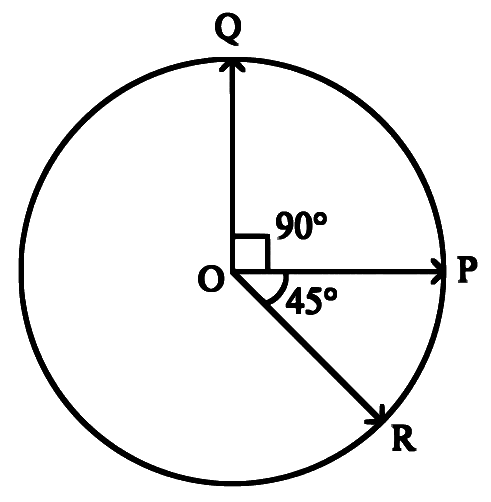
Three vectors O P → , O Q → \overrightarrow{OP}, \overrightarrow{OQ} OP , OQ O R → \overrightarrow{OR} OR A A A A x A\sqrt{x} A x x x x
Numerical answer type. Work it out, then open the answer.
Show answer and solution
Answer: 3
Loading the solution…
Report a mistake Open question page Q12 JEE Main 2023 · 11 APR · SHIFT 2 Easy ☆
Vector Basics, Unit Vectors & Components
When vector A ⃗ = 2 i ^ + 3 j ^ + 2 k ^ \vec{A} = 2\hat{i} + 3\hat{j} + 2\hat{k} A = 2 i ^ + 3 j ^ + 2 k ^ B ⃗ \vec{B} B 2 j ^ 2\hat{j} 2 j ^ B ⃗ \vec{B} B
(a) 3 (b) 33 \sqrt{33} 33 (c) 6 \sqrt{6} 6 (d) 5 \sqrt{5} 5 Show answer and solution
Answer: (b)
Loading the solution…
Report a mistake Open question page Q13 JEE Main 2023 · 15 APR · SHIFT 1 Easy ☆
Vector Basics, Unit Vectors & Components
A vector in x − y x - y x − y 3 0 ∘ 30^\circ 3 0 ∘ y y y y y y 2 3 2\sqrt{3} 2 3 x x x
(a) 3 \sqrt{3} 3 (b) 2 (c) 6 (d) 1 3 \frac{1}{\sqrt{3}} 3 1 Show answer and solution
Answer: (b)
Loading the solution…
Report a mistake Open question page Q14 JEE Main 2021 · 27 AUG · SHIFT 1 Medium ☆
Vector Basics, Unit Vectors & Components
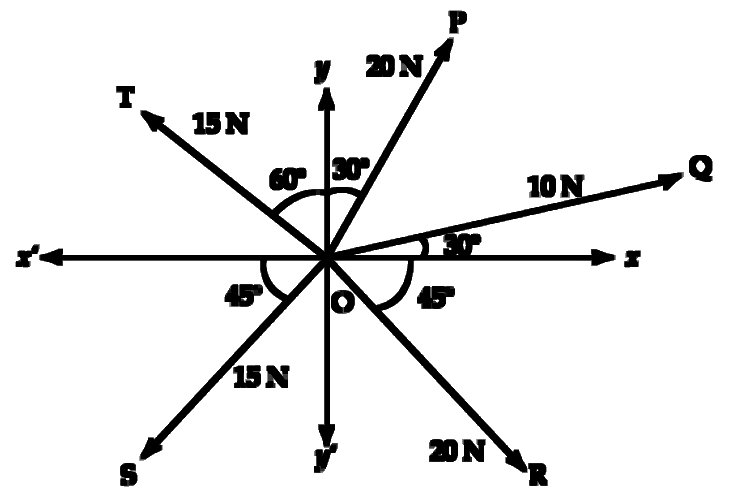
The resultant of these forces O P → , O Q → , O R → , O S → \overrightarrow{OP}, \overrightarrow{OQ}, \overrightarrow{OR}, \overrightarrow{OS} OP , OQ , OR , OS O T → \overrightarrow{OT} OT 3 = 1.7 , 2 = 1.4 \sqrt{3} = 1.7,\ \sqrt{2} = 1.4 3 = 1.7 , 2 = 1.4 i ^ \hat{i} i ^ j ^ \hat{j} j ^
(a) 9.25 i ^ + 5 j ^ 9.25\hat{i} + 5\hat{j} 9.25 i ^ + 5 j ^ (b) 3 i ^ + 15 j ^ 3\hat{i} + 15\hat{j} 3 i ^ + 15 j ^ (c) 2.5 i ^ − 14.5 j ^ 2.5\hat{i} - 14.5\hat{j} 2.5 i ^ − 14.5 j ^ (d) − 1.5 i ^ − 15.5 j ^ -1.5\hat{i} - 15.5\hat{j} − 1.5 i ^ − 15.5 j ^ Show answer and solution
Answer: (a)
Loading the solution…
Report a mistake Open question page Q15 JEE Main 2021 · 26 AUG · SHIFT 1 Medium ☆
Vector Basics, Unit Vectors & Components
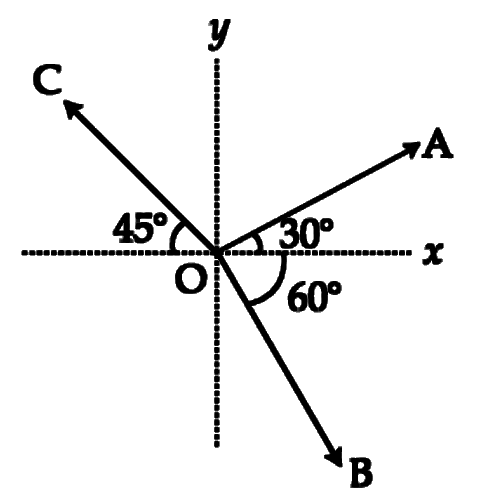
The magnitude of vectors O A → O B → \overrightarrow{OA} \ \overrightarrow{OB} O A OB O C → \overrightarrow{OC} OC O A → + O B → − O C → \overrightarrow{OA} + \overrightarrow{OB} - \overrightarrow{OC} O A + OB − OC
(a) tan − 1 ( 1 − 3 − 2 ) ( 1 + 3 + 2 ) \tan^{-1}\frac{(1-\sqrt{3}-\sqrt{2})}{(1+\sqrt{3}+\sqrt{2})} tan − 1 ( 1 + 3 + 2 ) ( 1 − 3 − 2 ) (b) tan − 1 ( 3 − 1 + 2 ) ( 1 + 3 − 2 ) \tan^{-1}\frac{(\sqrt{3}-1+\sqrt{2})}{(1+\sqrt{3}-\sqrt{2})} tan − 1 ( 1 + 3 − 2 ) ( 3 − 1 + 2 ) (c) tan − 1 ( 3 − 1 + 2 ) ( 1 − 3 + 2 ) \tan^{-1}\frac{(\sqrt{3}-1+\sqrt{2})}{(1-\sqrt{3}+\sqrt{2})} tan − 1 ( 1 − 3 + 2 ) ( 3 − 1 + 2 ) (d) tan − 1 ( 1 + 3 − 2 ) ( 1 − 3 − 2 ) \tan^{-1}\frac{(1+\sqrt{3}-\sqrt{2})}{(1-\sqrt{3}-\sqrt{2})} tan − 1 ( 1 − 3 − 2 ) ( 1 + 3 − 2 ) Show answer and solution
Answer: (a)
Loading the solution…
Report a mistake Open question page Q16 MHT CET 2020 · 19 OCT · SHIFT 2 Easy ☆
Vector Basics, Unit Vectors & Components
The angle subtended by the vector A = 4 i ^ + 3 j ^ + 12 k ^ A = 4\hat{i} + 3\hat{j} + 12\hat{k} A = 4 i ^ + 3 j ^ + 12 k ^ X X X
(a) cos − 1 ( 3 13 ) \cos^{-1}\left(\frac{3}{13}\right) cos − 1 ( 13 3 ) (b) sin − 1 ( 3 13 ) \sin^{-1}\left(\frac{3}{13}\right) sin − 1 ( 13 3 ) (c) sin − 1 ( 4 13 ) \sin^{-1}\left(\frac{4}{13}\right) sin − 1 ( 13 4 ) (d) cos − 1 ( 4 13 ) \cos^{-1}\left(\frac{4}{13}\right) cos − 1 ( 13 4 ) Show answer and solution
Answer: (d)
Loading the solution…
Report a mistake Open question page Q17 MHT CET 2020 · 16 OCT · SHIFT 2 Easy ☆
Vector Basics, Unit Vectors & Components
The x , y x, y x , y P \mathbf{P} P x , y x, y x , y P \mathbf{P} P Q \mathbf{Q} Q Q \mathbf{Q} Q
Show answer and solution
Answer: (a)
Loading the solution…
Report a mistake Open question page Q18 MHT CET 2019 · 3 MAY · SHIFT 1 Easy ☆
Vector Basics, Unit Vectors & Components
A vector P P P X X X Y Y Y Q Q Q X X X ( Q − P ) (\mathbf{Q} - \mathbf{P}) ( Q − P )
(a) 4 ( 2 i ^ − j ^ ) 4(2\hat{i} - \hat{j}) 4 ( 2 i ^ − j ^ ) (b) − 4 ( 2 i ^ − j ^ ) -4(2\hat{i} - \hat{j}) − 4 ( 2 i ^ − j ^ ) (c) 4 ( 2 i ^ + j ^ ) 4(2\hat{i} + \hat{j}) 4 ( 2 i ^ + j ^ ) (d) − 4 ( 2 i ^ + j ^ ) -4(2\hat{i} + \hat{j}) − 4 ( 2 i ^ + j ^ ) Show answer and solution
Answer: (d)
Loading the solution…
Report a mistake Open question page Q19 JEE Main 2019 · 10 JAN · SHIFT 1 Medium ☆
Vector Basics, Unit Vectors & Components
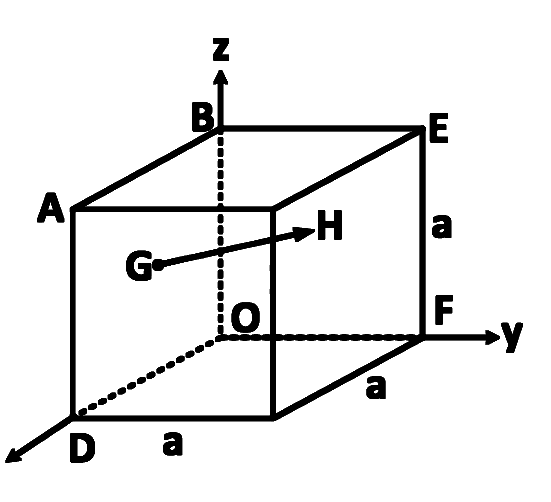
In the cube of side ‘a’ shown in the figure, the vector from the central point of the face ABOD to the central point of the face BEFO will be -
(a) 1 2 a ( k ^ − i ^ ) \frac{1}{2}a\left(\hat{k} - \hat{i}\right) 2 1 a ( k ^ − i ^ ) (b) 1 2 a ( j ^ − i ^ ) \frac{1}{2}a\left(\hat{j} - \hat{i}\right) 2 1 a ( j ^ − i ^ ) (c) 1 2 a ( j ^ − k ^ ) \frac{1}{2}a\left(\hat{j} - \hat{k}\right) 2 1 a ( j ^ − k ^ ) (d) 1 2 a ( i ^ − k ^ ) \frac{1}{2}a\left(\hat{i} - \hat{k}\right) 2 1 a ( i ^ − k ^ ) Show answer and solution
Answer: (b)
Loading the solution…
Report a mistake Open question page Q20 NEET 1999 · AIPMT Easy ☆
Vector Basics, Unit Vectors & Components
If a unit vector is represented by 0.5 i ^ + 0.8 j ^ + c k ^ 0.5\hat{i} + 0.8\hat{j} + c\hat{k} 0.5 i ^ + 0.8 j ^ + c k ^ c c c
(a) 1 1 1 (b) 0.11 \sqrt{0.11} 0.11 (c) 0.01 \sqrt{0.01} 0.01 (d) 0.39 0.39 0.39 Show answer and solution
Answer: (b)
Loading the solution…
Report a mistake Open question page Q21 NDA 2015 Easy ☆
Vector Basics, Unit Vectors & Components
When the sun is 3 0 ∘ 30^\circ 3 0 ∘ 17.3 m 17.3\,\text{m} 17.3 m
(a) 20 m 20\,\text{m} 20 m (b) 17.30 m 17.30\,\text{m} 17.30 m (c) 10 m 10\,\text{m} 10 m (d) 1.73 m 1.73\,\text{m} 1.73 m Show answer
Answer: (c)
Step-by-step solution coming soon.
Report a mistake Q22 JIPMER 2012 Medium ☆
Vector Basics, Unit Vectors & Components
A certain vector in the x y xy x y x x x 4 m 4\,\text{m} 4 m y y y 10 m 10\,\text{m} 10 m x y xy x y x x x y y y
(a) 20 m 20\,\text{m} 20 m (b) 7.2 m 7.2\,\text{m} 7.2 m (c) 5.0 m 5.0\,\text{m} 5.0 m (d) 4.5 m 4.5\,\text{m} 4.5 m Show answer
Answer: (b)
Step-by-step solution coming soon.
Report a mistake Q23 VITEEE 2019 Easy ☆
Vector Basics, Unit Vectors & Components
A particle covers half of the circle of radius r r r
(a) 2 π r , 0 2\pi r, 0 2 π r , 0 (b) 2 r , π r 2r, \pi r 2 r , π r (c) π r 2 , 2 r \dfrac{\pi r}{2}, 2r 2 π r , 2 r (d) π r , r \pi r, r π r , r Show answer
Answer: (b)
Step-by-step solution coming soon.
Report a mistake Q24 COMEDK 2020 Easy ☆
Vector Basics, Unit Vectors & Components
A particle starts moving from point ( 2 , 10 , 1 ) (2, 10, 1) ( 2 , 10 , 1 ) 8 i ^ − 2 j ^ + k ^ 8\hat{i} - 2\hat{j} + \hat{k} 8 i ^ − 2 j ^ + k ^
(a) ( 10 , 8 , 2 ) (10, 8, 2) ( 10 , 8 , 2 ) (b) ( 8 , 10 , 2 ) (8, 10, 2) ( 8 , 10 , 2 ) (c) ( 2 , 10 , 8 ) (2, 10, 8) ( 2 , 10 , 8 ) (d) ( 8 , 2 , 10 ) (8, 2, 10) ( 8 , 2 , 10 ) Show answer
Answer: (a)
Step-by-step solution coming soon.
Report a mistake Q25 AP EAPCET 2025 Easy ☆
Vector Basics, Unit Vectors & Components
If α \alpha α β \beta β γ \gamma γ x x x y y y z z z sin 2 α + sin 2 β = \sin^2\alpha + \sin^2\beta = sin 2 α + sin 2 β =
(a) sin 2 γ \sin^2\gamma sin 2 γ (b) cos 2 γ \cos^2\gamma cos 2 γ (c) 1 + cos 2 γ 1 + \cos^2\gamma 1 + cos 2 γ (d) 1 + sin 2 γ 1 + \sin^2\gamma 1 + sin 2 γ Show answer
Answer: (c)
Step-by-step solution coming soon.
Report a mistake Q26 AP EAPCET 2025 Easy ☆
Vector Basics, Unit Vectors & Components
If the magnitude of a vector P \mathbf{P} P 25 25 25 y y y 7 7 7 x x x
(a) 24 24 24 (b) 18 18 18 (c) 32 32 32 (d) 16 16 16 Show answer
Answer: (a)
Step-by-step solution coming soon.
Report a mistake Q27 AP EAPCET 2024 Easy ☆
Vector Basics, Unit Vectors & Components
The angle made by the resultant vector of two vectors 2 i ^ + 3 j ^ + 4 k ^ 2\hat{i} + 3\hat{j} + 4\hat{k} 2 i ^ + 3 j ^ + 4 k ^ 2 i ^ − 7 j ^ − 4 k ^ 2\hat{i} - 7\hat{j} - 4\hat{k} 2 i ^ − 7 j ^ − 4 k ^ X X X
(a) 6 0 ∘ 60^\circ 6 0 ∘ (b) 4 5 ∘ 45^\circ 4 5 ∘ (c) 9 0 ∘ 90^\circ 9 0 ∘ (d) 12 0 ∘ 120^\circ 12 0 ∘ Show answer
Answer: (b)
Step-by-step solution coming soon.
Report a mistake Q28 AP EAPCET 2023 Medium ☆
Vector Basics, Unit Vectors & Components
A force F = ( 4 i ^ + 3 j ^ − 5 k ^ ) N \mathbf{F} = (4\hat{i} + 3\hat{j} - 5\hat{k})\,\text{N} F = ( 4 i ^ + 3 j ^ − 5 k ^ ) N θ \theta θ θ \theta θ
(a) cos − 1 ( 2 2 5 ) \cos^{-1}\left(\dfrac{2\sqrt{2}}{5}\right) cos − 1 ( 5 2 2 ) (b) cos − 1 ( 2 5 ) \cos^{-1}\left(\dfrac{\sqrt{2}}{5}\right) cos − 1 ( 5 2 ) (c) cos − 1 ( 5 2 9 ) \cos^{-1}\left(\dfrac{5\sqrt{2}}{9}\right) cos − 1 ( 9 5 2 ) (d) cos − 1 ( 3 5 2 ) \cos^{-1}\left(\dfrac{3}{5\sqrt{2}}\right) cos − 1 ( 5 2 3 ) Show answer
Answer: (a)
Step-by-step solution coming soon.
Report a mistake Q29 AP EAPCET 2021 Easy ☆
Vector Basics, Unit Vectors & Components
One of the rectangular components of a force of 40 N 40\,\text{N} 40 N 20 3 N 20\sqrt{3}\,\text{N} 20 3 N
(a) 10 N 10\,\text{N} 10 N (b) 20 N 20\,\text{N} 20 N (c) 30 N 30\,\text{N} 30 N (d) 25 N 25\,\text{N} 25 N Show answer
Answer: (b)
Step-by-step solution coming soon.
Report a mistake Q30 TS EAMCET 2023 Easy ☆
Vector Basics, Unit Vectors & Components
The velocity of a particle having magnitude of 10 m s − 1 10\,\text{m s}^{-1} 10 m s − 1 6 0 ∘ 60^\circ 6 0 ∘ X X X
(a) 5 i ^ − 5 3 j ^ 5\hat{i} - 5\sqrt{3}\hat{j} 5 i ^ − 5 3 j ^ (b) 5 3 i ^ − 5 j ^ 5\sqrt{3}\hat{i} - 5\hat{j} 5 3 i ^ − 5 j ^ (c) 5 3 i ^ + 5 j ^ 5\sqrt{3}\hat{\mathbf{i}} + 5\hat{\mathbf{j}} 5 3 i ^ + 5 j ^ (d) 5 i ^ + 5 3 j ^ 5\hat{\mathbf{i}} + 5\sqrt{3}\hat{\mathbf{j}} 5 i ^ + 5 3 j ^ Show answer
Answer: (d)
Step-by-step solution coming soon.
Report a mistake Q31 TS EAMCET 2020 Easy ☆
Vector Basics, Unit Vectors & Components
If 0.5 i ^ + 0.8 j ^ + c k ^ 0.5\hat{\mathbf{i}} + 0.8\hat{\mathbf{j}} + c\hat{\mathbf{k}} 0.5 i ^ + 0.8 j ^ + c k ^ c c c
(a) 0.89 \sqrt{0.89} 0.89 (b) 0.2 0.2 0.2 (c) 0.3 0.3 0.3 (d) 0.11 \sqrt{0.11} 0.11 Show answer
Answer: (d)
Step-by-step solution coming soon.
Report a mistake Q32 WB JEE 2026 Medium ☆
Vector Basics, Unit Vectors & Components
If a vector v ⃗ = 3 i ^ \vec{v} = 3\hat{i} v = 3 i ^ x − z x - z x − z θ \theta θ x x x + y +y + y
(a) 3 sin θ i ^ 3\sin\theta\,\hat{i} 3 sin θ i ^ (b) 3 cos θ i ^ 3\cos\theta\,\hat{i} 3 cos θ i ^ (c) 3 sin θ i ^ + 3 cos θ k ^ 3\sin\theta\,\hat{i} + 3\cos\theta\,\hat{k} 3 sin θ i ^ + 3 cos θ k ^ (d) 3 cos θ i ^ + 3 sin θ k ^ 3\cos\theta\,\hat{i} + 3\sin\theta\,\hat{k} 3 cos θ i ^ + 3 sin θ k ^ Show answer
Answer: (d)
Step-by-step solution coming soon.
Report a mistake Q33 WB JEE 2008 Easy ☆
Vector Basics, Unit Vectors & Components
The angle subtended by the vector A = 4 i ^ + 3 j ^ + 12 k ^ A = 4\hat{i} + 3\hat{j} + 12\hat{k} A = 4 i ^ + 3 j ^ + 12 k ^
(a) sin − 1 ( 3 13 ) \sin^{-1}\left(\dfrac{3}{13}\right) sin − 1 ( 13 3 ) (b) sin − 1 ( 4 13 ) \sin^{-1}\left(\dfrac{4}{13}\right) sin − 1 ( 13 4 ) (c) cos − 1 ( 4 13 ) \cos^{-1}\left(\dfrac{4}{13}\right) cos − 1 ( 13 4 ) (d) cos − 1 ( 3 13 ) \cos^{-1}\left(\dfrac{3}{13}\right) cos − 1 ( 13 3 ) Show answer
Answer: (c)
Step-by-step solution coming soon.
Report a mistake
No questions match these filters.