The velocity of a small ball of mass M and density d when dropped in a container filled with glycerine becomes constant after some time. If density of glycerine is 2d then the viscous force acting on the ball will be (g=acceleration due to gravity)
A spherical ball of radius 1 mm and density 10.5 g/cc is dropped in glycerine of coefficient of viscosity 9.8 poise and density 1.5 g/cc. Viscous force on the ball when it attains constant velocity is 3696×10−x N. The value of is
Statement I: The hot water flows faster than cold water
Statement II: Soap water has higher surface tension as compared to fresh water. In the light above statements, choose the correct answer from the options given below
A small rigid spherical ball of mass M is dropped in a long vertical tube containing glycerine. The velocity of the ball becomes constant after some time. If the density of glycerine is half of the density of the ball, then the viscous force acting on the ball will be (consider g as acceleration due to gravity)
Water is flowing steadily in a river. A and B are the two layers of water at heights 40 cm and 90 cm from the bottom. The velocity of the layer A is 12 cm/s. The velocity of the layer B is
The velocity of small spherical ball of mass ' m ' and density ' d1 ', when dropped in a container filled with glycerine becomes constant after some time. The viscous force acting on the ball if density of glycerine is ' d2 ' is
Statement (I) :Viscosity of gases is greater than that of liquids.
Statement (II): Surface tension of a liquid decreases due to the presence of insoluble impurities. In the light of the above statements, choose the most appropriate answer from the options given below:
A ball rises to surface at a constant velocity in liquid whose density is 3 times greater than that of the material of the ball. The ratio of force of friction acting on the rising ball to its weight is
A ball rises to surface at a constant velocity in liquid whose density is 4 times greater than that of the material of the ball. The ratio of the force of friction acting on the rising ball and its weight is
A small ball of mass m and density ρ is dropped in a viscous liquid of density ρ0. After sometime, the ball falls with constant velocity. The viscous force on the ball is:
A metal sphere of mass 'm' and density 'σ1' falls with terminal velocity through a container containing liquid. The density of liquid is 'σ2 '. The viscous force acting on the sphere is
A small ball of mass M and density ρ is dropped in a viscous liquid of density ρ0. After some time, the ball falls with a constant velocity. What is the viscous force on the ball?
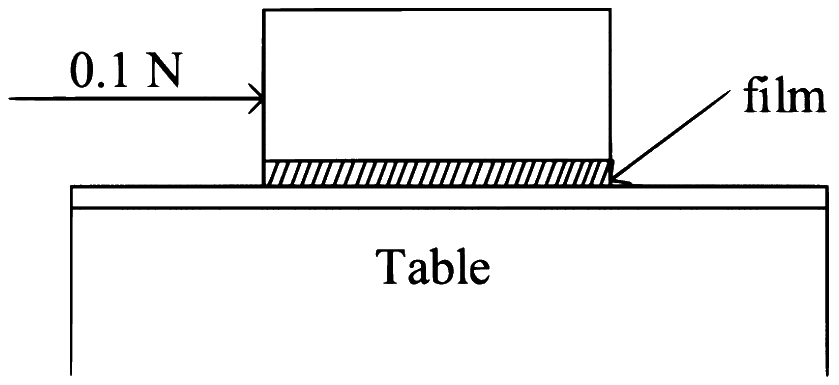
A metal block of base area 0.20 m2 is placed on a table, as shown in figure. A liquid film of thickness 0.25 mm is inserted between the block and the table. The block is pushed by a horizontal force of 0.1 N and moves with a constant speed. If the viscosity of the liquid is 5.0×10⁻³ Pl, the speed of block is ____________ ×10−3 m/s.
Numerical answer type. Work it out, then open the answer.
A Spherical ball of radius 1mm and density 10.5 g/cc is dropped in glycerine of coefficient of viscosity 9.8 poise and density 1.5 g/cc. Viscous force on the ball when it attains constant velocity is 3696×10−x N. The value of x is ________.
(Given, g = 9.8 m/s2 and π=722)
Numerical answer type. Work it out, then open the answer.
The velocity of upper layer of water in a river is 36 kmh−1. Shearing stress between horizontal layers of water is 10−3 Nm−2. Depth of the river is __________ m. (Co-efficient of viscosity of water is 10−2 Pa.s)
Numerical answer type. Work it out, then open the answer.
The terminal velocity of a copper ball of radius 5 mm falling through a tank of oil at room temperature is 10 cm s−1. If the viscosity of oil at room temperature is 0.9 kg m−1 s−1, the viscous drag force is:
The velocity of a small ball of mass 'm' and density d1, when dropped in a container filled with glycerin, becomes constant after some time. If the density of glycerin is d2, then the viscous force acting on the ball, will be:
The velocity of a small ball of mass 0.3 g and density 8 g/cc when dropped in a container filled with glycerine becomes constant after some time. If the density of glycerine is 1.3 g/cc, then the value of viscous force acting on the ball will be x×10−4 N. The value of x is _________. [use g=10 m/s2]
Numerical answer type. Work it out, then open the answer.
A ball rises to the surface of a liquid with constant velocity. The density of the liquid is four times the density of the material of the ball. The viscous force of the liquid on the rising ball is greater than the weight of the ball by a factor of
The velocity of a small ball of mass 'M' and density 'd1' when dropped in a container filled with glycerine becomes constant after some time. If the density of glycerine is 'd2', the viscous force acting on the ball is ( g= acceleration due to gravity)
The velocity of a small ball of mass M and density d, when dropped in a container filled with glycerin becomes constant after some time. If the density of glycerin is 2d, then the viscous force acting on the ball will be:
In Millikan's oil drop experiment, what is viscous force acting on an uncharged drop of radius 2.0 × 10⁻⁵ m and density 1.2 × 10³ kgm− 3? Take viscosity of liquid = 1.8 × 10⁻⁵ Nsm−2. (Neglect buoyancy due to air).
A raindrop with radius R = 0.2 mm falls from a cloud at a height h = 2000 m above the ground. Assume that the drop is spherical throughout its fall and the force of buoyance may be neglected, then the terminal speed attained by the raindrop is:
[Density of water fw = 1000 kg m−3 and Density of air fa = 1.2 kg m−3, g = 10 m/s2, Coefficient of viscosity of air = 1.8 × 10⁻⁵ Nsm−2]
A small metal sphere of mass M and density d1 when dropped in a jar filled with liquid moves with terminal velocity after sometime. The viscous force acting on the sphere is (d2= density of liquid and g= gravitational acceleration)
A small sphere of radius ‘r’ falls from rest in a viscous liquid. As a result, heat is produced due to viscous force. The rate of production of heat when the sphere attains its terminal velocity, is proportional to
Two tubes of radii r1 and r2, and lengths l1 and l2, respectively, are connected in series and a liquid flows through each of them in stream line conditions. P1 and P2 are pressure differences across the two tubes.
If P2 is 4P1 and l2 is 4l1, then the radius r2 will be equal to:
The velocity of water in a river is 18 km/hr near the surface. If the river is 5 m deep, find the shearing stress between the horizontal layers of water. The co-efficient of viscosity of water = 10−2 poise.
A spherical solid ball of volume V is made of a material of density ρ1. It is falling through a liquid of density ρ2(ρ2<ρ1). Assume that the liquid applies a viscous force on the ball that is proportional to the square of its speed v, i.e., Fviscous=−kv2(k>0). The terminal speed of the ball is
Spherical balls of radius R are falling in a viscous fluid of viscosity η with a velocity v. The retarding viscous force acting on the spherical ball is
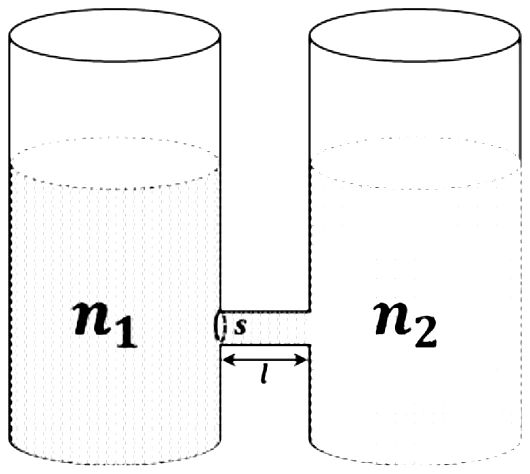
As shown schematically in the figure, two vessels contain water solutions (at temperature T) of potassium permanganate (KMnO4) of different concentrations n1 and n2 (n1>n2) molecules per unit volume with Δn=(n1−n2)≪n1. When they are connected by a tube of small length l and cross-sectional area S, KMnO4 starts to diffuse from the left to the right vessel through the tube. Consider the collection of molecules to behave as dilute ideal gases and the difference in their partial pressure in the two vessels causing the diffusion. The speed v of the molecules is limited by the viscous force −βv on each molecule, where β is a constant. Neglecting all terms of the order (Δn)2, which of the following is/are correct? (kB is the Boltzmann constant)
More than one option can be correct. Tap every correct option, then tap Check.
Consider a thin square plate floating on a viscous liquid in a large tank. The height h of the liquid in the tank is much less than the width of the tank. The floating plate is pulled horizontally with a constant velocity u0. Which of the following statements is (are) true?
More than one option can be correct. Tap every correct option, then tap Check.
Assertion: If a liquid in a vessel is stirred and left to itself, the motion disappears after few minutes. Reason: The moving liquid exerts equal and opposite force.
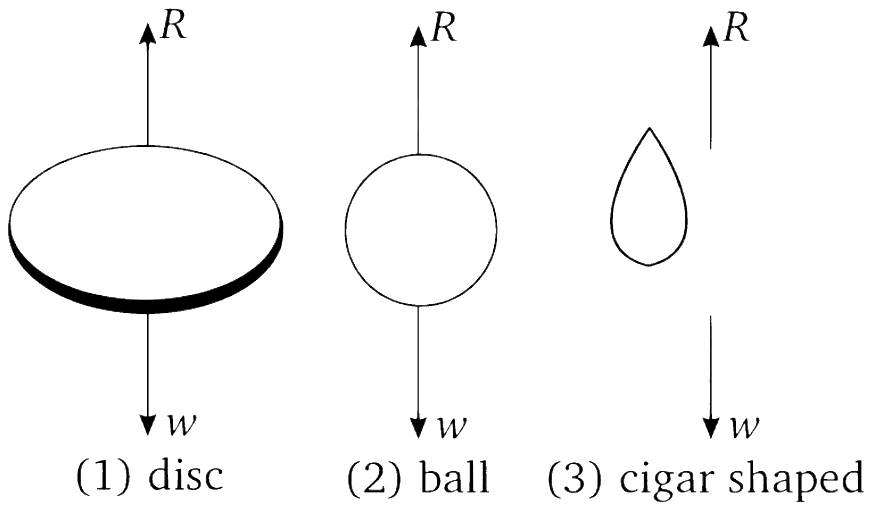
When a body falls in air, the resistance of air depends to a great extent on the shape of the body. Three different shapes are given. Identify the combination of air resistances which truly represents the physical situation? (The cross-sectional areas are the same).
A capillary tube of length L and radius r is connected with another capillary tube of the same length but half the radius in series. The rate of steady volume flow of water through first capillary tube under a pressure difference of p is V. The rate of steady volume flow through the combination will be (the pressure difference across the combination is p)
Water is flowing on a horizontal fixed surface such that its flow velocity varies with y (vertical direction) as v=k(a22y2−a3y3). If coefficient of viscosity for water is 2η. What will be the shear stress between layers of water at y=a?
A capillary tube is attached horizontally to a constant head arrangement. If the radius of the capillary tube is increased by 25%, then the rate of flow of liquid will change nearly by
The velocity of water in a river is 18km h−1 near the surface. If the river is 5m deep, find the shearing stress between the horizontal layers of water. The co-efficient of viscosity of water =10−2 poise.
A rain drop of diameter 1mm falls with a terminal velocity of 0.7m s−1 in air. If the coefficient of viscosity of air is 2×10⁻⁵Pa s, the viscous force on the rain drop is
A metal cube of side 10cm rests on a film of a liquid of thickness 0.2mm. If upon applying a horizontal force F of magnitude 0.1N. The cube slides with a constant speed of 0.08m/s, then the coefficient of viscosity is
A metal plate of area 10−2m2 rests on a layer of castor oil, 2×10⁻³m thick, whose coefficient of viscosity is 1.55N s m−2. The approximate horizontal force required to move the plate with a uniform speed of 3×10⁻²m s−1 is