A man standing between two parallel cliffs fires a gun. He hear two echos one after 3 second and the other after 5 second. The separation between the two cliffs is 1360 m, the speed of sound is
A person standing between two parallel cliffs fires a gun and hears two echoes, first echo after 1 second and second echo after 3 second. The distance between the two cliffs is (The velocity of sound =330 m/s)
Two sound waves each of wavelength λ and same amplitude A interfere at point Q. If the path difference is 4λ, the amplitude of the resultant wave at point Q is [sin2π=1,cos2π=0]
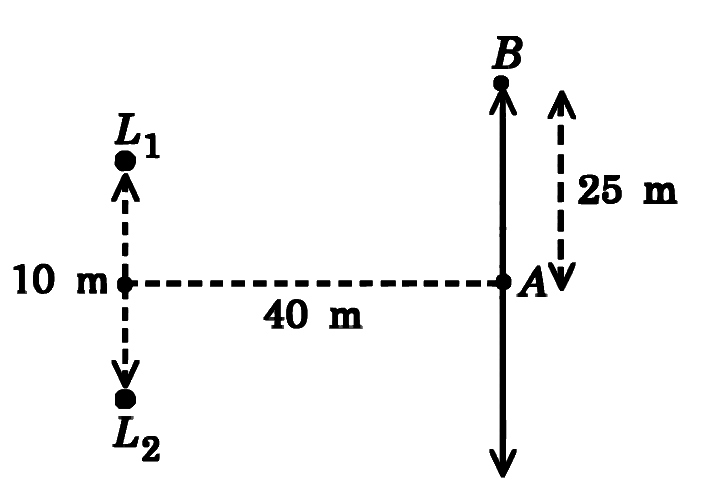
Two loudspeakers (L1 and L2) are placed with a separation of 10 m, as shown in figure. Both speakers are fed with an audio input signal of same frequency with constant volume. A voice recorder, initially at point A, at equidistant to both loudspeakers, is moved by 25 m along the line AB while monitoring the audio signal. The measured signal was found to undergo 10 cycles of minima and maxima during the movement. The frequency of the input signal is ______ Hz (Speed of sound in air is 324 m/s and 5=2.23)
Numerical answer type. Work it out, then open the answer.
A person standing between two parallel cliffs fires a gun and hears two echoes, first echo after 1 second and the second echo after 3 second. The distance between the two cliffs is (Velocity of sound =340 m/s)
The amplitude and phase of a wave that is formed by the superposition of two harmonic travelling waves, y1(x,t)=4sin(kx−ωt) and y2(x,t)=2sin(kx−ωt+32π), are:
(Take the angular frequency of initial waves same as ω)
Two sound waves having same amplitude ' A ' and angular frequency ' ω ' but having a phase difference of (2π)c are superimposed then the maximum amplitude of the resultant wave is
Two simple harmonic waves having equal amplitudes of 8 cm and equal frequency of 10 Hz are moving along the same direction. The resultant amplitude is also 8 cm. The phase difference between the individual waves is _________ degree.
Numerical answer type. Work it out, then open the answer.
Q13JEE Main 2022 · 25 JUL · SHIFT 2EasyOld syllabus
Reflection, Superposition & Interference
Two waves executing simple harmonic motions travelling in the same direction with same amplitude and frequency are superimposed. The resultant amplitude is equal to the 3 times of amplitude of individual motions. The phase difference between the two motions is ___________ (degree).
Numerical answer type. Work it out, then open the answer.
Two waves are simultaneously passing through a string and their equations are: y1 = A1 sin k(x − vt), y2 = A2 sin k(x − vt + x0). Given amplitudes A1 = 12 mm and A2 = 5 mm, x0 = 3.5 cm and wave number k = 6.28 cm−1. The amplitude of resulting wave will be ................ mm.
Numerical answer type. Work it out, then open the answer.
Three harmonic waves having equal frequency ν and same intensity I0, have phase angles 0, 4π and −4π respectively. When they are superimposed the intensity of the resultant wave is close to:
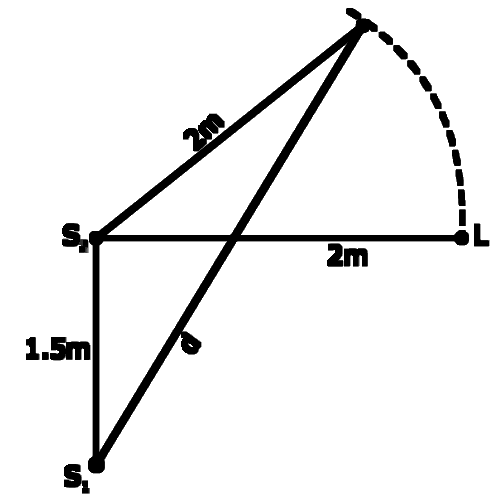
Two coherent sources of sound, S1 and S2, produce sound waves of the same wavelength, λ = 1 m, in phase. S1 and S2 are placed 1.5 m apart (see fig). A listener, located at L, directly in front of S2 finds that the intensity is at a minimum
when he is 2 m away from S2. The listener moves away from S1, keeping his distance from S2 fixed. The adjacent maximum of intensity is observed when the listener is at a distance d from S1. Then, d is:
An engine approaches a hill with a constant speed. When it is at a distance of 0.9 km, it blows a whistle whose echo is heard by the driver after 5 seconds. If the speed of sound in air is 330 m/s, then the speed of the engine is:
Two periodic waves of intensities I1 and I2 pass through a region at the same time in the same direction. The sum of the maximum and minimum intensities is
Two waves having equation x1 = asin(ωt − kx + ϕ1), x2 = asin(ωt −kx + ϕ2). If in the resultant wave the frequency and amplitude remain equal to amplitude of superimposing waves, the phase difference between them is
Wave has simple harmonic motion whose period is 4 seconds while another wave which also possesses simple harmonic motion has its period 3 second. If both are combined, then the resultant wave will have the period equal to
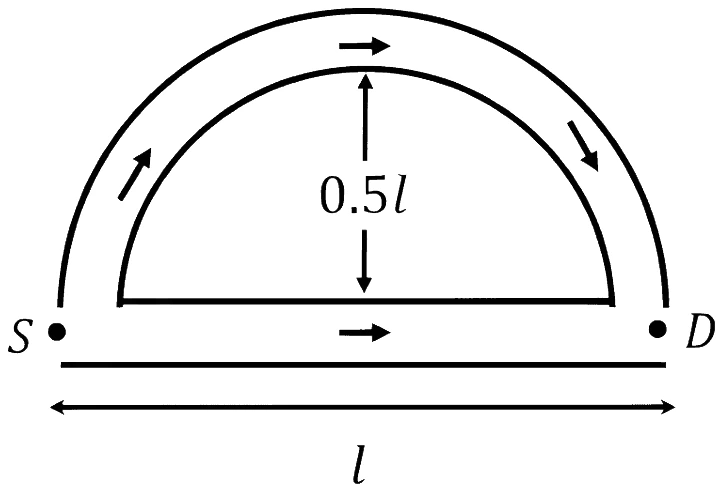
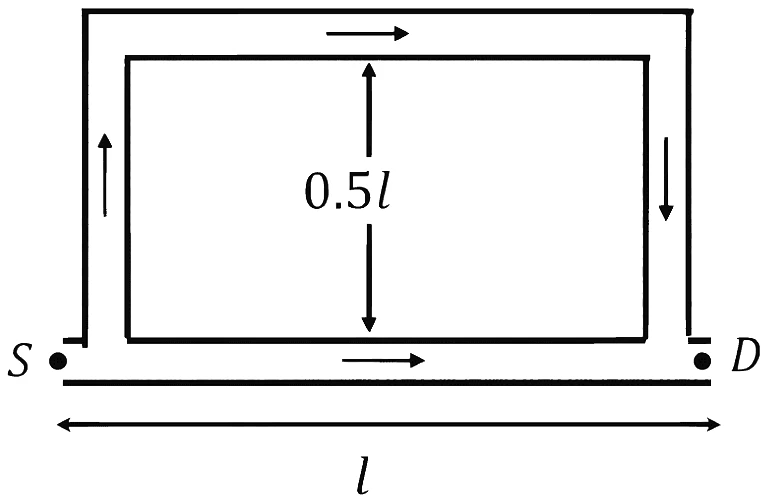
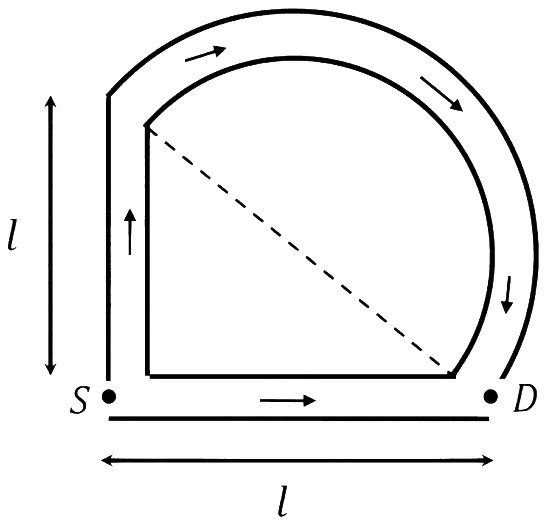
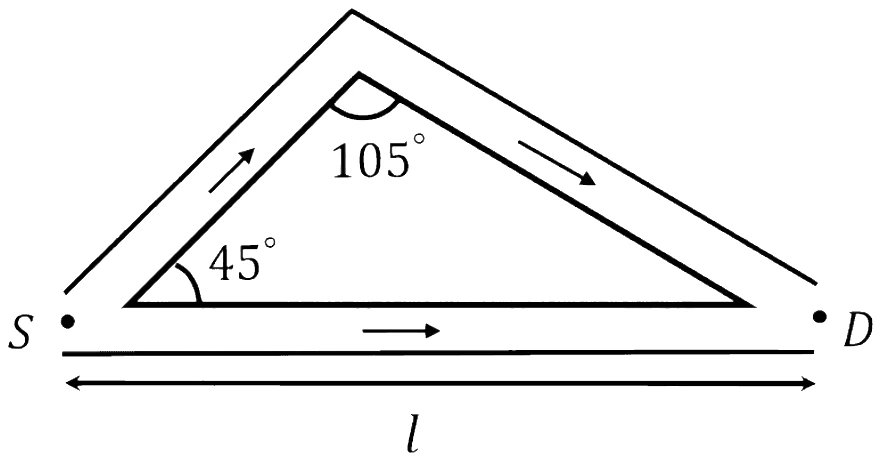
List-I shows four configurations made of straight and semi-circular narrow tubes containing air. A sound wave of wavelength λ=0.29m enters these structures at the point S and a sound detector is placed at D. Between the points S and D, the sound travels only through the tubes. List-II contains the possible smallest values of l (refer to the figures) for which the detector D records maximum amplitude. Ignore effects of sharp corners. [Given cos(15∘)=0.97] Choose the option that best describes the match between the entries in List-I to those in List-II.
List-I
List-II
(P) semicircular tube, see figure
(1) 1.32m
(Q) rectangular tube, see figure
(2) 1.19m
(R) tube with three-quarter circular arc, see figure
(3) 0.51m
(S) triangular tube with 45∘ and 105∘ angles, see figure
Four harmonic waves of equal frequencies and equal intensities I0 have phase angles 0, 3π, 32π and π. When they are superposed, the intensity of the resulting wave is nI0. The value of n is _____.
Numerical answer type. Work it out, then open the answer.
Assertion: It is not possible to have interference between the waves produced by two violins. Reason: For interference of two waves, the phase difference between the waves must remain constant.
The ratio of intensities between two coherent sound sources is 4:1. The difference of loudness in decibels between the maximum and minimum intensities, when they interfere in space, is
A person is standing at some point between two parallel cliffs (not exactly at the centre). He claps, and hears two echoes: the first after 1s and the second after 2s. If the speed of sound in air is 330m s−1, the distance between the two cliffs is
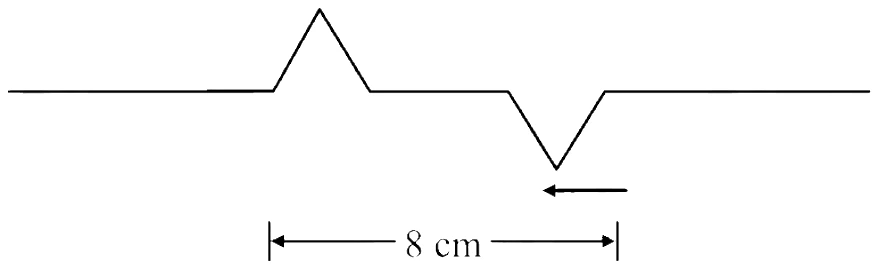
In the adjoining figure, two pulses in a stretched string are shown. If initially their centres are 8cm apart and they are moving towards each other with a speed of 2cm s−1, then the total energy of the pulses after 2s will be
A string of length 25cm and mass 10−3kg is clamped at its ends. The tension in the string is 2.5N. The identical wave pulses are generated at one end and at regular interval of time, Δt. The minimum value of Δt, so that a constructive interference takes place between successive pulses is
A car is approaching a cliff at a constant speed. It sounds a horn when it is at 0.9km from the cliff. The reflected sound of the horn is heard by the car driver after 5s. The speed of the car is [velocity of sound in air is 330m s−1]
The sources of sound A and B produce waves of 350Hz in the same phase. A particle P is vibrating under the influence of these two waves. If the amplitudes at P produced by the two waves are 0.3mm and 0.4mm, the resultant amplitude at the point P will be, when AP−BP=25cm and the velocity of sound is 350m s−1
The speed of a progressive transverse wave on a string is 18m s−1. If the phase difference between two points on the string separated by a distance of 3cm is 90∘, then the frequency of the transverse waves on the string is
Two waves of amplitudes A1 and A2 respectively are superimposed. The ratio between the maximum and minimum intensities of the resultant wave is 9:4. The value of A1A2 is (assume A1>A2)
When sound is produced in an aeroplane moving with a velocity of 200m s−1 horizontally, its echo is heard after 105 seconds. If the velocity of sound in air is 300m s−1, the elevation of the aircraft is
Consider two waves, which are given by y1(x,t)=Asin(kx−ωt) and y2(x,t)=3Acos(kx−ωt), where k is the wave number and ω is the angular frequency. The amplitude of the resultant waveform obtained by the superposition of the two waves is As and its phase difference with y1 is ϕs. What are As and ϕs?
Two speakers are driven by the same oscillator of frequency f. They are located a distance d from each other on a vertical pole. An observer far away walks slowly, straight towards the lower speaker and his ears are at the same level as the lower speaker. Let v represent the speed of sound and assume that there is no reflection from the ground. Let nmax be the number of times the observer hears the minimum in sound intensity and let λ=v/f be wavelength of the sound emitted. Choose the correct alternative(s).
More than one option can be correct. Tap every correct option, then tap Check.
A siren produces a sound whose amplitude goes as x=10cos(3ωt)cos(2ωt)+5cos(5ωt). Tuning forks with natural frequency f will resonate with the siren for the value(s) of f given by
More than one option can be correct. Tap every correct option, then tap Check.
Two sinusoidal waves, whose displacements are given by y1=Asin(2πν1t−k1x) and y2=Asin(2πν2t−k2x), are simultaneously present in a medium. Given that ν1=100Hz, ν2=200Hz, k1=32πm−1 and k2=34πm−1, an observer located at the origin finds
More than one option can be correct. Tap every correct option, then tap Check.