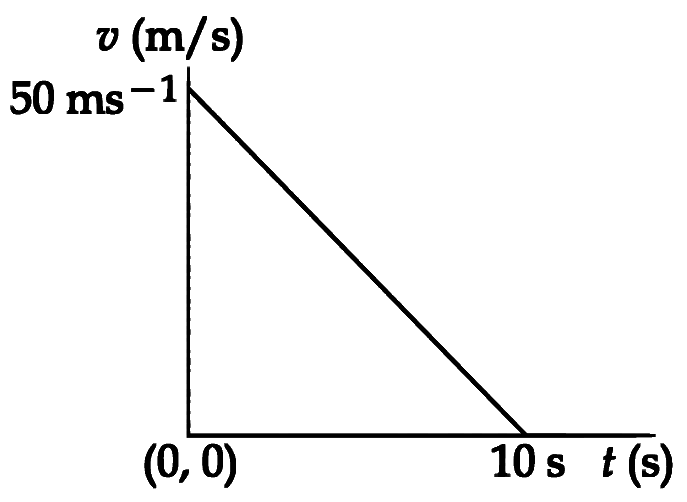
The rain drop of mass 1 g, starts with zero velocity from a height of 1 km. It hits the ground with a speed of 5 m/s. The work done by the unknown resistive force is ______ J.
A body of mass 2 kg is moving along x-direction such that its displacement as function of time is given by x(t)=αt2+βt+γ m, where α=1 m/s2,β=1 m/s and γ=1 m. The work done on the body during the time interval t=2 s to t=3 s, is ________ J.
The kinetic energies of two similar cars A and B are 100 J and 225 J respectively. On applying brakes, car A stops after 1000 m and car B stops after 1500 m. If FA and FB are the forces applied by the brakes on cars A and B respectively, then the ratio of FBFA is
A particle of mass m moves on a straight line with its velocity increasing with distance according to the equation v=αx, where α is a constant. The total work done by all the forces applied on the particle during its displacement from x=0 to x=d, will be:
A bullet is fired into a fixed target loses one third of its velocity after travelling 4 cm. It penetrates further D×10−3 m before coming to rest. The value of D is:
A lift of mass M=500 kg is descending with speed of 2 ms−1. Its supporting cable begins to slip thus allowing it to fall with a constant acceleration of 2 ms−2. The kinetic energy of the lift at the end of fall through to a distance of 6 m will be _____________ kJ.
Numerical answer type. Work it out, then open the answer.
A spherical body of mass 2 kg starting from rest acquires a kinetic energy of 10000 J at the end of 5th second. The force acted on the body is ________ N.
Numerical answer type. Work it out, then open the answer.
Statement I: A truck and a car moving with same kinetic energy are brought to rest by applying brakes which provide equal retarding forces. Both come to rest in equal distance. Statement II: A car moving towards east takes a turn and moves towards north, the speed remains unchanged. The acceleration of the car is zero.
In the light of given statements, choose the most appropriate answer from the options given below
A body of mass 0.5 kg travels on straight line path with velocity v=(3x2+4) m/s. The net workdone by the force during its displacement from x=0 to x=2 m is:
A particle of mass 500 gm is moving in a straight line with velocity v = b x5/2. The work done by the net force during its displacement from x = 0 to x = 4 m is: (Take b = 0.25 m−3/2 s−1).
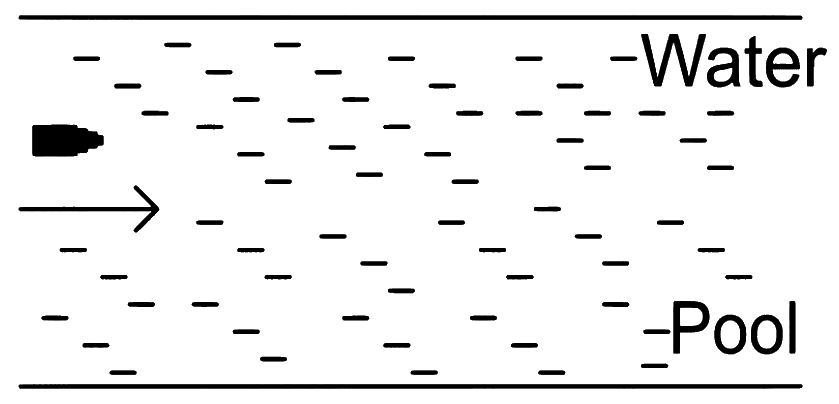
A bullet of mass 200 g having initial kinetic energy 90 J is shot inside a long swimming pool as shown in the figure. If its kinetic energy reduces to 40 J within 1 s, the minimum length of the pool, the bullet has to travel so that it completely comes to rest is
A cricket ball of mass 0.15 kg is thrown vertically up by a bowling machine so that it rises to a maximum height of 20 m after leaving the machine. If the part pushing the ball applies a constant force F on the ball and moves horizontally a distance of 0.2 m while launching the ball, the value of F (in N) is (g = 10 ms–2) ____.
Numerical answer type. Work it out, then open the answer.
A vehicle of mass m is moving with momentum p on a rough horizontal road. The coefficient of friction between the tyres and the horizontal road is μ. The stopping distance is (g= acceleration due to gravity)
A particle which is experiencing a force, given by F=3i^−12j^, undergoes a displacement of d=4i particle had a kinetic energy of 3 J at the beginning of the displacement, what is its kinetic energy at the end of the displacement?
A force acts on a 2 kg object so that its position is given as a function of time as x = 3t2 + 5. What is the work done by this force in first 5 seconds?
A body of mass m starts moving from rest along x-axis so that its velocity varies as v=as where a is a constant and s is the distance covered by the body. The total work done by all the forces acting on the body in the first t seconds after the start of the motion is:
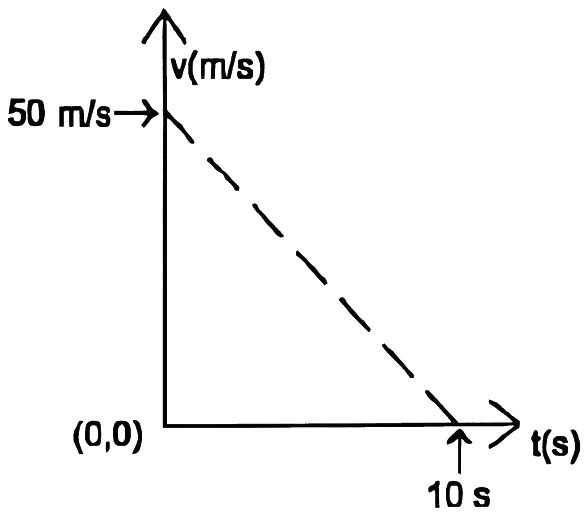
Consider a drop of rain water having mass 1 g falling from a height of 1 km. It hits the ground with a speed of 50 m s−1. Take 'g' constant with a value 10 m s−2. The work done by the (i) gravitational force and the (ii) resistive force of air is
A time dependent force F = 6t acts on a particle of mass 1 kg. If the particle starts from rest, the work done by the force during the first 1 sec. will be:
A body of mass 1 kg is thrown upwards with a velocity 20 m/s. It momentarily comes to rest after attaining a height of 18 m. How much energy is lost due to air friction? (g = 10 m/s2)
A body of mass 3 kg is under a constant force which causes a displacement s in metres in it, given by the relation s = 31 t2, where t is in seconds. Work done by the force in 2 seconds is
A ball of mass 0.2 kg is thrown vertically upwards by applying a force by hand. If the hand moves 0.2 m while applying the force and the ball goes upto 2 m height further, find the magnitude of the force. (consider g=10 m/s2 ).
A bullet fired into a fixed target loses half of its velocity after penetrating 3 cm How much further it will penetrate before coming to rest assuming that it faces constant resistance to motion?
A force acts on a 3.0 g particle in such a way that the position of the particle as a function of time is given by x=3t−4t2+t3, where x is in metre and t in second. The work done during the first 4 s is
A bullet of mass 10 g leaves a rifle at an initial velocity of 1000 m/s and strikes the earth at the same level with a velocity of 500 m/s. The work done in joule overcoming the resistance of air will be
A particle is moved from point A to point B under a force field. The work done depends only on the initial and final speeds. Which one of the following is correct?
A ball is dropped from rest from height h above the ground in frame S (the Earth's frame). Another frame S′ is moving upwards with constant speed u relative to the Earth. In frame S′, the ball has initial downward speed v. Pertaining to the change in kinetic energy (ΔK) of the ball from release to just before hitting the ground as measured in frames S and S′ separately, which one of the following is correct?
A block of mass 20kg slides on a rough horizontal plane surface. Let the speed of the block at a particular instant is 10m s−1. It comes to rest after travelling a distance of 20m. Which one of the following could be the magnitude of the frictional force?
A block of mass 2kg, moving with the initial speed of 3m s−1 comes to rest on a rough horizontal surface after travelling a distance of 3m. The magnitude of the frictional force is:
Two cars A and B have masses mA and mB respectively, with mA>mB. Both the cars are moving in the same direction with equal kinetic energy. If equal braking force is applied on both, then before coming to rest
A particle of mass m is initially at rest at the origin. It is subjected to a force and starts moving along the x-axis. Its kinetic energy K changes with time as dK/dt=γt, where γ is a positive constant of appropriate dimensions. Which of the following statement is (are) true?
More than one option can be correct. Tap every correct option, then tap Check.
A flat plate is moving normal to its plane through a gas under the action of a constant force F. The gas is kept at a very low pressure. The speed of the plate v is much less than the average speed u of the gas molecules. Which of the following options is/are true?
More than one option can be correct. Tap every correct option, then tap Check.
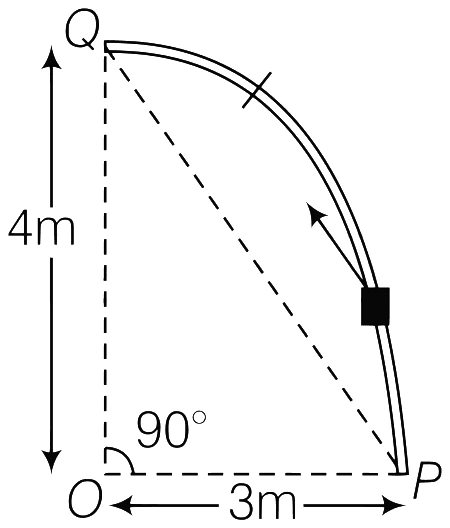
Consider an elliptically shaped rail PQ in the vertical plane with OP=3m and OQ=4m. A block of mass 1kg is pulled along the rail from P to Q with a force of 18N, which is always parallel to line PQ (see the figure given). Assuming no frictional losses, the kinetic energy of the block when it reaches Q is (n×10) joules. The value of n is (take acceleration due to gravity =10m s−2)
Numerical answer type. Work it out, then open the answer.
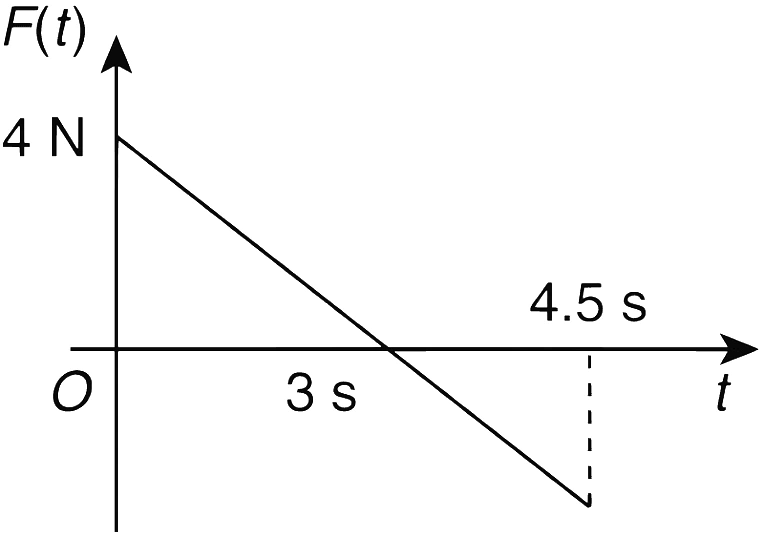
A block of mass 2kg is free to move along the x-axis. It is at rest and from t=0 onwards, it is subjected to a time-dependent force F(t) in the x-direction. The force F(t) varies with t as shown in the figure. The kinetic energy of the block after 4.5s is
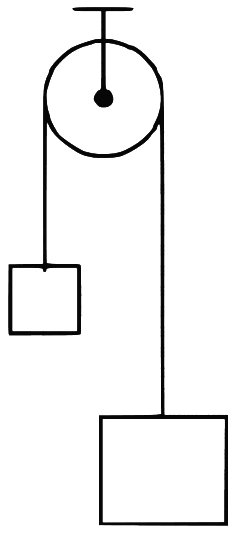
A light inextensible string that goes over a smooth fixed pulley as shown in the figure connects two blocks of masses 0.36kg and 0.72kg. Taking g=10m s−2, find the work done (in joules) by the string on the block of mass 0.36kg during the first second after the system is released from rest.
Numerical answer type. Work it out, then open the answer.
Statement 1: A block of mass m starts moving on a rough horizontal surface with a velocity v. It stops due to friction between the block and the surface after moving through a certain distance. The surface is now tilted to an angle of 30∘ with the horizontal and the same block is made to go up on the surface with the same initial velocity v. The decrease in the mechanical energy in the second situation is smaller than that in the first situation. Statement 2: The coefficient of friction between the block and the surface decreases with the increase in the angle of inclination.
A particle is acted upon by a force of constant magnitude which is always perpendicular to the velocity of the particle. The motion of the particle takes place in a plane. It follows that:
More than one option can be correct. Tap every correct option, then tap Check.
Assertion: The change in kinetic energy of a particle is equal to the work done on it by the net force. Reason: Change in kinetic energy of a particle is equal to the work done only in case of a system of one particle.
A particle of mass 100g is thrown vertically upward with a speed of 5m s−1. The work done by the force of gravity during the time the particle goes up is
A particle of mass 100g is thrown vertically upwards with a speed of 5m s−1. The work done by the force of gravity during the time the particle goes up is
A scooter moves with a speed of 7m s−1, on a straight road and is stopped by applying the brakes. Before stopping, the scooter travels 10m. If the weight of the scooter is W, then the total resistance to the motion of the scooter will be
An object of mass 3kg moves due to an applied constant force such that its position along X axis is given by x=3t3 where x is in meters and t in seconds. The work done in 1 second is
A force of 20N is applied on a body of mass 5kg resting on a horizontal plane. The body gains a kinetic energy of 10J after it moves a distance 2m. The frictional force is
A horizontal force of 5N is applied on a stationary body of mass 5kg, which is initially at rest on a frictionless table. The change in kinetic energy of the body in 10s is
A body of mass 0.25kg travels along a straight line from x=0 to x=2m with a speed v=kx3/2, where k=2 SI units. The work done by the net force during this displacement is
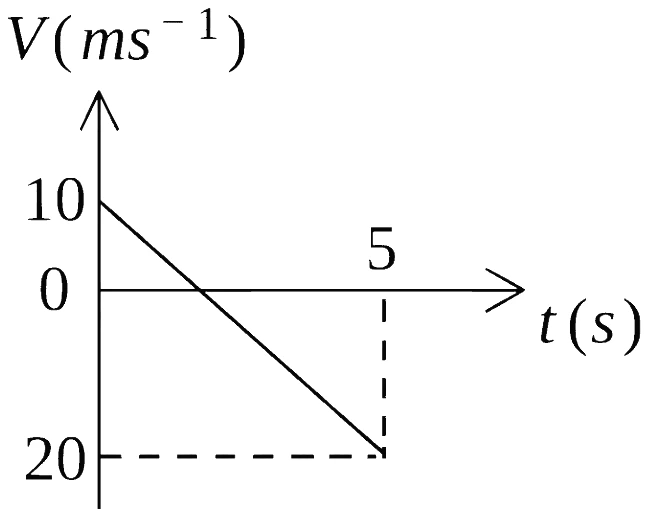
The velocity-time graph of a body of mass 4kg moving along a straight line is shown in the figure. Work done by all the forces acting on the body from t=0 to t=5s is
A 5kg block is pushed by 100N over 10m on a plane. If the coefficient of friction between the block and the plane is 0.2, the final kinetic energy of the block is ______ (g=10m s−2)
A body of mass 5kg is projected vertically upwards from a point X from the ground with an initial speed of 20m s−1. It rises to a point Y where its kinetic energy is reduced to 400J. If the body experiences a constant air resistance of 10N throughout its motion, then the vertical distance between X and Y is (Acceleration due to gravity =10m s−2)
A person holds a ball of mass 0.25kg in his hand and throws it, so that it leaves his hand with a speed of 12m s−1. In this process, if his hand moved through a distance of 0.9m, then the net force acted on the ball is
The upper (n1)th of an inclined plane is smooth and the remaining lower part is rough with coefficient of friction μk. If a body starting from rest at the top of the inclined plane will again come to rest at the bottom of the plane, then the angle of inclination of the inclined plane is
A ball of mass 300g is dropped from a height 10m above a sandy ground. On reaching the ground, it penetrates through a distance 1.5m in sand and finally stops. The average resistance offered by the sand to oppose the motion is (acceleration due to gravity =10m s−2)
A body of mass 8kg, under the action of a force, is displaced according to the equation s=4t2m, where t is the time. Find the work done by the force in the first 4s.
A tank of height 5m is completely filled with water and a cube of side 1cm and density 1.5g cm−3 is placed at the bottom of the tank. The work to be done to lift the cube at the bottom to a height of 15m above the surface of the water is (Neglect the side of the cube when compared with the height and take acceleration due to gravity =10m s−2)
A body of mass 500g is falling from rest from a height of 3.2m from the ground. If the body reaches the ground with a velocity of 6m s−1, then the energy lost by the body due to air resistance is (Acceleration due to gravity =10m s−2)
A block of mass m with an initial kinetic energy E moves up an inclined plane of inclination θ. If μ is the coefficient of friction between the plane and the body, the work done against friction before coming to rest is
A man of mass 80kg goes to the market on a scooter of mass 100kg with certain speed. On application of brakes, the stopping distance is s1. The man returns home on the same scooter, with the same speed with a 60kg bag of rice. If s2 is the new stopping distance when the brakes are applied with the same force, then
A block of mass 0.5kg is at rest on a horizontal table. The coefficient of kinetic friction between the table and the block is 0.2. If a horizontal force of 5N is applied on the block, the kinetic energy of the block in a time of 4s is (Acceleration due to gravity =10m s−2)
A body of mass 3kg is moving under the action of a force which causes a displacement of (3t3)m, where t is time in seconds. The work done by the force in first 2s is
The displacement s of a body of mass 3kg under the action of a force is given by s=3t3, where s is in metres and t is in seconds. The work done by the force in the first two seconds is
Statement I: The slope of kinetic energy-displacement curve of a body in motion will be directly proportional to its acceleration. Statement II: From a height of 15m, a ball is projected vertically upwards with a velocity of 30m s−1. If the ball rises to the same height after hitting the ground, the loss of its energy on hitting the ground is 30%. Statement III: The velocity acquired by a body of mass m after travelling a fixed distance from rest under the action of a constant force is directly proportional to mass m. Which of the following is correct?
A ball of mass 1kg moves in a straight line with velocity v=cxα, where c=1 (SI unit) and α is a constant. If the work done by the net force during its displacement from x=0 to x=4m is 128J, then α is
A force acts on a 30g particle in such a way that the position of the particle as a function of time is given by x=αt2, where x is in metre, t is in seconds and α=1m s−2. The work done during the first 4s is
Under action of force, a 2kg body moves such that its position x as function of time t is given by x=αt2/2, where x is in metre, t is in seconds and α=1m s−2. The work done by the force in the first two seconds is
A force of 4N acts on a 10kg body initially at rest. Let W1 be the work done by the force during 0≤t≤1s. Likewise W2 is the work done by the force during 1s≤t≤2s, where t is time in second. The ratio W1W2 is
A train is moving along the tracks at a constant speed u. A girl on the train throws a ball of mass m straight ahead along the direction of motion of the train with speed v with respect to herself. Then
More than one option can be correct. Tap every correct option, then tap Check.
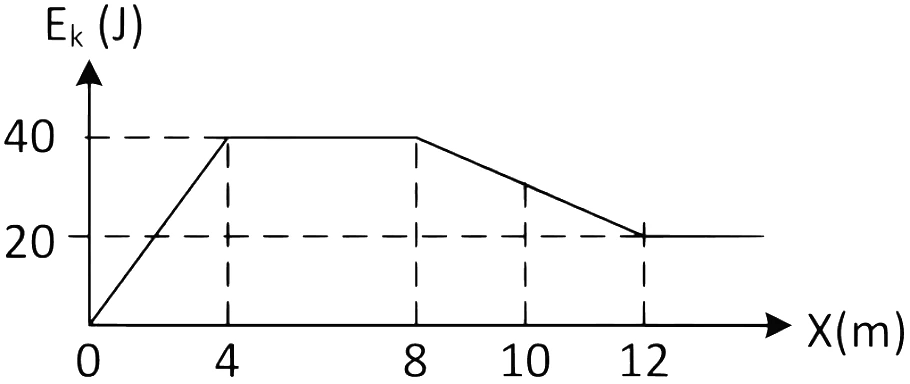
The kinetic energy (Ek) of a particle moving along X-axis varies with its position (X) as shown in the figure. The force acting on the particle at X=10m is
A body of mass 3kg acted upon by a constant force is displaced by S meter, given by relation S=31t2, where t is in second. Work done by the force in 2 seconds
A solid object is dropped from height H under the influence of gravity. The object experiences a drag force whose magnitude is proportional to the square of its instantaneous speed in air. Assume that drag force is negligible compared to gravitational force but contributes exclusively towards the heating of the object. The rise in temperature of the object just before it reaches the ground is proportional to